
Acid Strength and Resonance Stabilisation in Organic Acids
Discover how resonance stabilisation affects organic acid strength by comparing the conjugate bases of alcohols, phenols, and carboxylic acids. Explore inductive effects, substituent positions, pKa comparisons, and challenging worked examples.
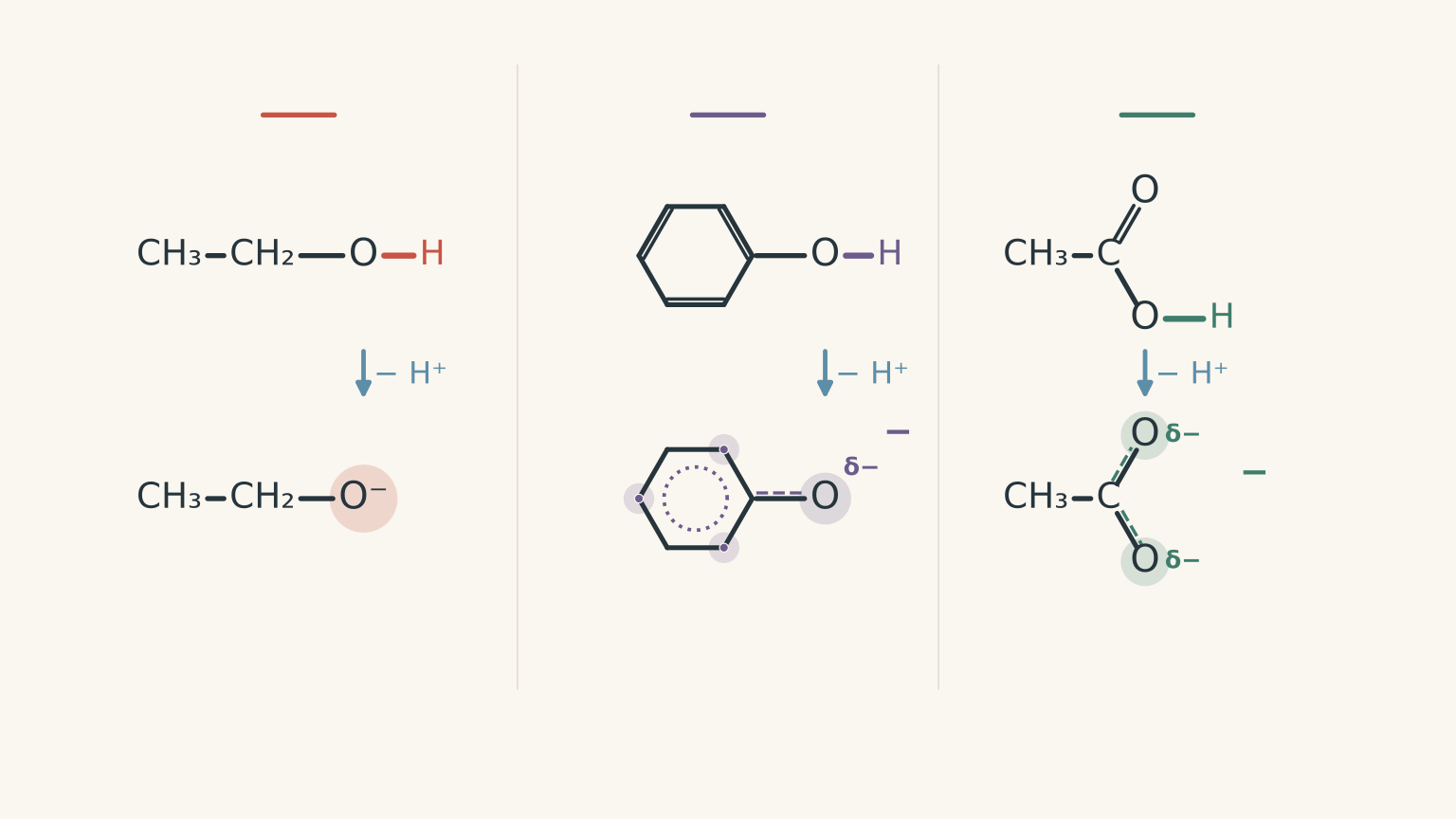
Ethanol, phenol, and ethanoic acid all lose a proton from an O-H bond. Yet their approximate aqueous pKa values are 15.5, 9.99, and 4.76, respectively. Why does ethanoic acid donate its proton so much more readily when the bond being broken looks similar?
The answer lies partly in what happens to the electrons after the proton leaves. Some conjugate bases can spread their negative charge across several atoms, while others must keep most of it in one place. This difference is called resonance stabilisation, and it helps explain some surprisingly large differences in organic acid strength.
This is extension material beyond the required NSW Chemistry 11-12 (2025) syllabus. The prerequisite is the Year 12 acid-base content involving Ka, Kb, pKa, and pKb. The resonance-based comparisons developed here go beyond the required syllabus and are not additional HSC assessment requirements.
Due to technical limitations, this figure may display incorrectly or contain inaccuracies. Please check key details against your course materials.
01Start with the acid-base equilibrium
Before looking at molecular structures, recall what happens when a weak acid dissolves in water.
A general monoprotic acid, represented by HA, donates a proton to water:
\[ \ce{HA + H2O <=> H3O+ + A^-} \]
Here:
- HA is the acid.
- H₂O is water, which accepts the proton.
- H₃O⁺ is the hydronium ion.
- A⁻ is the conjugate base formed when HA loses its proton.
The acid dissociation constant, \(K_a\), measures the extent to which this equilibrium favours ionisation.
\[ K_a=\frac{[\ce{H3O+}][\mathrm{A}^{-}]}{[\ce{HA}]} \]
The square brackets represent equilibrium molar concentrations, measured in mol L⁻¹. Water is omitted from the expression because it is the solvent.
The logarithmic form is:
\[ pK_a=-\log_{10}K_a \]
A lower pKa means a larger Ka and therefore a stronger acid.
For bases, the equivalent quantities are the base dissociation constant, \(K_b\), and pKb:
\[ \ce{B + H2O <=> BH+ + OH^-} \]
\[ K_b=\frac{[\ce{BH+}][\mathrm{OH}^{-}]}{[\ce{B}]} \]
\[ pK_b=-\log_{10}K_b \]
For a conjugate acid-base pair in water at 25°C:
\[ pK_a+pK_b=pK_w=14.00 \]
Here, \(K_w\) is the ion-product constant of water, and pKw is its negative base-10 logarithm.
The important connection is that a stronger acid generally produces a weaker conjugate base. If an acid readily donates its proton, the resulting conjugate base is relatively stable.
If you need to revise the logarithmic comparison first, see tutorgum’s How to Compare Acid Strength Using pKa Values.
A starting comparison
Consider three organic acids and their conjugate bases.
| Acid | Approximate aqueous pKa | Conjugate base |
|---|---|---|
| Ethanol | 15.5 | Ethoxide, \(\mathrm{CH_{3}CH_{2}O}^{-}\) |
| Phenol | 9.99 | Phenoxide, \(\mathrm{C_{6}H_{5}O}^{-}\) |
| Ethanoic acid | 4.76 | Ethanoate (acetate), \(\mathrm{CH_{3}COO}^{-}\) |
These are representative aqueous values near 25°C. Small differences between published values can occur because of experimental conditions and data sources. The values above are consistent with the organic acid tables in the Nova Scotia Chemistry Data Booklet.
The acidity order is:
\[ \text{Ethanoic acid}>\text{Phenol}>\text{Ethanol} \]
Before reading further, predict which conjugate base can stabilise its negative charge most effectively.
To answer, we need to examine the electrons themselves.
02What is resonance stabilisation?
Imagine placing a heavy backpack on a single support. The support carries the entire load.
Now imagine distributing that load across several supports. Each one carries less, and the overall arrangement can become more stable.
Negative charge behaves somewhat similarly. When electron density is spread across several atoms rather than concentrated in one location, the resulting ion can become more stable.
This is the basic idea behind charge delocalisation.
In chemistry, resonance occurs when electrons can be distributed across a connected system of atoms rather than being adequately represented by one Lewis structure.
Chemists draw multiple resonance contributors to represent the different possible electron arrangements. The actual molecule or ion is called a resonance hybrid.
There is an important distinction:
A molecule does not rapidly switch between resonance structures. The structures are alternative representations of one real electron distribution.
The analogy with sharing a load also has a limit. Electrons are not physical objects being passed between atoms. The negative charge is distributed across the connected electron system.
With that model in mind, compare the three conjugate bases.
01Ethoxide: negative charge remains localised
Ethanol loses a proton to form ethoxide:
\[ \ce{CH3CH2OH + H2O <=> CH3CH2O^- + H3O+} \]
The ethoxide ion has a negative charge on its oxygen atom.
The problem is that there is no adjacent double-bond system that allows this negative charge to spread through resonance.
Most of the negative charge remains concentrated on the oxygen atom.
Water molecules can still stabilise ethoxide through solvation, which means surrounding water molecules interact with and stabilise the ion. However, ethoxide does not gain the additional resonance stabilisation available to phenoxide or acetate.
This helps explain why ethanol is a relatively weak acid.
02Phenoxide: negative charge spreads into an aromatic ring
Phenol also contains an O-H bond, but its structure is different.
The oxygen atom is directly attached to a benzene ring. This creates an opportunity for electron delocalisation.
When phenol loses its proton, it forms phenoxide:
\[ \ce{C6H5OH + H2O <=> C6H5O^- + H3O+} \]
The oxygen atom now carries a negative charge, but its electron density can interact with the connected pi-electron system of the benzene ring.
A pi system is a connected arrangement of overlapping p orbitals that allows electrons to become delocalised across several atoms.
Resonance contributors can therefore place the negative formal charge in different positions:
- On the oxygen atom.
- On either of the two ortho carbon atoms.
- On the para carbon atom.
The ortho positions are the two ring positions immediately beside the carbon attached to oxygen. The para position is directly opposite that carbon.
This gives phenoxide an advantage over ethoxide.
Its negative charge is no longer confined to one oxygen atom. Some electron density is distributed into the aromatic ring, stabilising the conjugate base.
However, there is an important detail.
The negative charge is not shared equally between all four possible positions. Oxygen is more electronegative than carbon, meaning it attracts electrons more strongly.
Consequently, the resonance contributor with the negative charge on oxygen is particularly important. Contributors that place negative charge on carbon are less favourable.
Phenoxide is resonance stabilised, but its resonance stabilisation is not as effective as that of acetate.
03Acetate: negative charge is shared between two oxygens
Now consider ethanoic acid, also known as acetic acid.
Its conjugate base is the acetate ion:
\[ \ce{CH3COOH + H2O <=> CH3COO^- + H3O+} \]
This ion has a particularly useful arrangement.
The carboxylate group contains two oxygen atoms attached to the same carbon. After the acid loses its proton, the negative charge can be represented on either oxygen through resonance.
The two contributors are:
\[ \ce{CH3-C(=O)-O^- <-> CH3-C(-O^-)=O} \]
These contributors have equal importance because the two oxygen atoms are equivalent.
The actual acetate ion is a resonance hybrid. Its negative charge is distributed across both oxygen atoms, and its two carbon-oxygen bonds are equivalent, with bond character intermediate between a single and a double bond.
This is particularly effective stabilisation because:
- The negative charge is distributed across two atoms rather than being concentrated on one.
- Both atoms sharing the charge are oxygen atoms, which are highly electronegative.
- The two major resonance contributors are equivalent, so neither dominates over the other.
Compare this with phenoxide.
Phenoxide distributes some negative charge onto carbon atoms in its aromatic ring. Acetate distributes its negative charge between two equivalent oxygen atoms.
The latter arrangement is especially favourable.
There is one more subtlety. The neutral carboxylic acid also has some resonance stabilisation. We cannot simply count the resonance structures of the conjugate base and ignore the original acid.
What matters is the relative stabilisation of the conjugate base compared with the parent acid. Deprotonation produces an anion that receives particularly effective additional stabilisation.
This helps explain why carboxylic acids are considerably stronger acids than ordinary alcohols and phenols.
06Comparing the three conjugate bases
The key differences can now be summarised.
| Parent acid | Conjugate base | Where can the negative charge go? |
|---|---|---|
| Ethanol | Ethoxide | Mainly remains on one oxygen |
| Phenol | Phenoxide | Oxygen and ortho/para positions of the aromatic ring |
| Ethanoic acid | Acetate | Shared between two equivalent oxygen atoms |
The corresponding acid strength increases as the conjugate base becomes more favourably stabilised:
\[ \boxed{\text{Ethanoic acid}>\text{Phenol}>\text{Ethanol}} \]
This is a useful prediction model, but it is not a universal ranking formula.
The number of resonance contributors alone does not determine stability. Their relative importance matters, as do electronegativity, solvation, inductive effects, and the stability of the original acid.
07Inductive effects: resonance is not the only influence
Here is a useful complication.
Two acids can produce conjugate bases with essentially the same resonance arrangement but still have noticeably different acid strengths.
Consider methanoic acid and ethanoic acid.
Their conjugate bases are formate and acetate, respectively. Both have the same basic carboxylate resonance arrangement.
However, ethanoic acid contains a methyl group, \(\ce{CH3}\), while methanoic acid does not.
A methyl group weakly donates electron density through sigma bonds. This is called a positive inductive effect.
In the acetate ion, the methyl group slightly increases electron density around the already negatively charged carboxylate group. This makes the conjugate base slightly less favourable than formate.
The result is:
| Acid | Approximate pKa |
|---|---|
| Methanoic acid | 3.75 |
| Ethanoic acid | 4.76 |
Methanoic acid is stronger, despite both conjugate bases having the same basic resonance arrangement.
Now reverse the situation.
Chloroethanoic acid contains a chlorine atom:
\[ \ce{ClCH2COOH} \]
Chlorine is strongly electron-withdrawing. It pulls electron density through the sigma bonds towards itself.
This is called a negative inductive effect.
The electron-withdrawing chlorine atom helps stabilise the negatively charged conjugate base. As a result, chloroethanoic acid is stronger than ethanoic acid.
| Acid | Approximate pKa |
|---|---|
| Ethanoic acid | 4.76 |
| Chloroethanoic acid | 2.87 |
Notice what happened.
The basic resonance arrangement of the carboxylate group has not changed. The difference comes from an additional inductive effect.
This is why you should avoid explaining every difference in acid strength using resonance alone.
08Substituent position matters: nitrophenols
We can combine resonance and inductive effects by looking at substituted phenols.
A nitro group, \(\ce{NO2}\), is strongly electron-withdrawing.
When attached to a benzene ring, it can stabilise a negative charge through two mechanisms:
- Inductive withdrawal through sigma bonds.
- Resonance interaction with the aromatic pi system, when the position allows it.
The second mechanism depends on where the nitro group is attached.
For a phenol ring, the carbon attached to the hydroxyl group is position 1.
The positions are:
- Ortho: positions 2 and 6.
- Meta: positions 3 and 5.
- Para: position 4.
Why ortho and para substitution are different
When phenol loses its proton, the resulting phenoxide ion can delocalise negative charge to its ortho and para positions.
If a nitro group is attached at one of these positions, the negative charge can be further delocalised into the nitro group.
This creates additional resonance contributors in which negative charge is placed on the nitro group’s oxygen atoms.
The conjugate base becomes more stable, increasing the acidity of the original phenol.
A meta nitro group cannot participate in this same direct resonance pathway. The standard phenoxide resonance contributors do not place negative charge at the meta position.
However, a meta nitro group still withdraws electron density through the inductive effect.
This distinction produces an interesting pattern.
| Compound | Approximate aqueous pKa |
|---|---|
| Phenol | 9.99 |
| 2-nitrophenol | 7.23 |
| 3-nitrophenol | 8.36 |
| 4-nitrophenol | 7.15 |
Both ortho- and para-nitrophenol are stronger acids than meta-nitrophenol.
The meta compound is still more acidic than phenol because the nitro group has an inductive effect. However, it cannot provide the additional resonance stabilisation available to the ortho and para isomers.
The important lesson is that molecular connectivity matters. A substituent does not need to be particularly close to the acidic proton to influence acidity strongly. What matters is how it communicates with the conjugate base.
09Worked examples
Worked example: Calculate the Ka of ethanoic acid
Ethanoic acid has an aqueous pKa of 4.76 at 25°C. Calculate its acid dissociation constant, Ka.
Step 1
\[ pK_a=-\log_{10}K_a \]
Rearrange to make Ka the subject:
\[ K_a=10^{-pK_a} \]
Step 2
\[ K_a=10^{-4.76} \]
\[ K_a=1.74\times10^{-5} \]
Step 3
The relatively small Ka indicates that ethanoic acid only partially ionises in water.
Its carboxylate conjugate base is stabilised by resonance, helping explain why ethanoic acid is considerably stronger than an ordinary alcohol.
Worked example: Compare methanoic acid and ethanoic acid
Methanoic acid has a pKa of 3.75, while ethanoic acid has a pKa of 4.76.
Calculate how many times stronger methanoic acid is than ethanoic acid. Explain the difference using conjugate-base stability.
Step 1
Methanoic acid has the lower pKa, so it has the larger Ka.
Step 2
For two acids, A and B:
\[ \frac{K_a(A)}{K_a(B)} =10^{pK_a(B)-pK_a(A)} \]
Therefore:
\[ \frac{K_a(\text{methanoic})} {K_a(\text{ethanoic})} =10^{4.76-3.75} \]
\[ =10^{1.01} \]
\[ \approx10.2 \]
Step 3
Both acids produce carboxylate ions with negative charge delocalised across two oxygen atoms.
However, acetate contains an additional methyl group. This group weakly donates electron density through sigma bonds, slightly destabilising the negatively charged conjugate base.
Formate does not have this additional electron-donating group.
Final result: Methanoic acid is approximately 10.2 times stronger than ethanoic acid under the stated aqueous conditions.
This example shows that even when two conjugate bases have similar resonance stabilisation, inductive effects can still change their relative acid strengths.
10Questions and solutions
Question 1
Ethanol has an aqueous pKa of 15.5, while phenol has an aqueous pKa of 9.99.
Determine which acid is stronger and calculate approximately how many times larger its Ka is.
Explain the difference in terms of the structures of their conjugate bases.
Solution 1
Phenol is approximately \(3.2\times10^5\) times stronger than ethanol. Its conjugate base receives additional resonance stabilisation that ethoxide does not.
Step 1: Identify the stronger acid.
Phenol has the lower pKa, so it has the larger Ka.
Step 2: Calculate the ratio.
\[ \frac{K_a(\text{phenol})}{K_a(\text{ethanol})} =10^{15.5-9.99} \]
\[ =10^{5.51} \]
\[ \approx3.2\times10^5 \]
Step 3: Explain the difference.
Ethoxide has its negative charge concentrated mainly on one oxygen atom.
Phenoxide can delocalise negative charge from oxygen into the aromatic ring, with resonance contributors placing negative charge at the ortho and para positions.
This makes phenoxide more stable relative to its parent acid than ethoxide is relative to ethanol.
The difference in conjugate-base stabilisation explains the much greater acidity of phenol.
Question 2
Experimental evidence shows that the two carbon-oxygen bonds in an acetate ion have equal lengths.
However, a conventional Lewis structure of acetate shows one carbon-oxygen single bond and one carbon-oxygen double bond.
A student suggests that the acetate ion must rapidly alternate between these two structures.
Explain why this interpretation is incorrect.
Your answer should also explain why the two resonance contributors of acetate have equal importance, whereas the resonance contributors of phenoxide do not.
Solution 2
The acetate ion exists as one resonance hybrid, not as two structures rapidly alternating with one another. Its two C-O bonds are equivalent because the negative charge and pi-electron density are delocalised across the carboxylate group.
Step 1: Consider the two resonance contributors.
In one contributor, the negative charge is on the first oxygen, while the second oxygen forms a double bond with carbon.
In the other contributor, these electron arrangements are reversed.
The atom positions remain unchanged. Only the placement of electrons differs.
Step 2: Consider why the contributors have equal importance.
The two oxygen atoms in acetate are equivalent.
Neither arrangement is inherently more stable than the other, so the two contributors have equal importance in describing the resonance hybrid.
Step 3: Explain the bond-length evidence.
If the ion had one permanent C-O single bond and one permanent C=O double bond, the two bonds would have different lengths.
Instead, both bonds have equal lengths and intermediate bond character.
This supports the resonance hybrid model.
Step 4: Compare with phenoxide.
Phenoxide also has several resonance contributors, but they are not equally favourable.
Oxygen is more electronegative than carbon, so the contributor with negative charge on oxygen is more favourable than those placing the negative charge on ring carbon atoms.
Therefore, phenoxide’s contributors do not have equal importance.
The double-headed resonance arrow represents alternative electron arrangements, not a reaction equilibrium or a molecule switching between structures.
Question 3
Ethanoic acid has an aqueous pKa of 4.76, while phenol has an aqueous pKa of 9.99.
(a) Calculate how many times stronger ethanoic acid is than phenol.
(b) Compare the resonance stabilisation of their conjugate bases.
(c) Explain why counting the number of resonance structures alone is insufficient to predict acid strength.
Solution 3
Ethanoic acid is approximately \(1.7\times10^5\) times stronger than phenol. Its conjugate base, acetate, has particularly favourable charge delocalisation across two equivalent oxygen atoms.
(a) Calculate the relative acid strength.
Step 1: Identify the stronger acid.
Ethanoic acid has the lower pKa, so it has the larger Ka.
Step 2: Calculate the ratio.
\[ \frac{K_a(\text{ethanoic})}{K_a(\text{phenol})} =10^{9.99-4.76} \]
\[ =10^{5.23} \]
\[ \approx1.7\times10^5 \]
Therefore, ethanoic acid is approximately 170,000 times stronger.
(b) Compare conjugate-base stabilisation.
Acetate has two equivalent oxygen atoms.
Its negative charge is delocalised across both oxygen atoms through two equally important resonance contributors.
Phenoxide can also delocalise negative charge, but some of its resonance contributors place the formal negative charge on carbon atoms in the aromatic ring.
These contributors are less favourable than the oxygen-centred contributor because oxygen is more electronegative than carbon.
Consequently, the carboxylate arrangement provides particularly favourable stabilisation.
(c) Explain why counting resonance structures is insufficient.
Not all resonance contributors have equal importance.
When comparing conjugate bases, we must consider:
- Whether the contributors are equivalent.
- Which atoms carry the negative charge.
- The electronegativity of those atoms.
- Whether the electron system allows effective delocalisation.
- How much additional stabilisation occurs upon deprotonation.
The neutral acid must also be considered. Acid strength depends on the relative stability of the acid and its conjugate base, not simply the absolute stability of the anion.
Acetate’s two equivalent oxygen-centred contributors make its conjugate base particularly favourable.
Question 4
At 25°C, the approximate aqueous pKa values of three compounds are:
| Compound | pKa |
|---|---|
| Phenol | 9.99 |
| 3-nitrophenol | 8.36 |
| 4-nitrophenol | 7.15 |
(a) Calculate how many times stronger 4-nitrophenol is than 3-nitrophenol.
(b) Explain why the para isomer is more acidic than the meta isomer.
(c) Explain why 3-nitrophenol is still more acidic than phenol, despite the nitro group being unable to participate in the same direct resonance pathway.
Solution 4
4-nitrophenol is approximately 16 times stronger than 3-nitrophenol. The para nitro group can participate in additional resonance stabilisation of the phenoxide conjugate base, whereas the meta nitro group cannot use the same direct pathway.
(a) Calculate the relative acid strength.
Step 1: Identify the stronger acid.
4-nitrophenol has the lower pKa.
Step 2: Calculate the ratio.
\[ \frac{K_a(\text{4-nitrophenol})} {K_a(\text{3-nitrophenol})} =10^{8.36-7.15} \]
\[ =10^{1.21} \]
\[ \approx16.2 \]
Therefore, 4-nitrophenol is approximately 16 times stronger.
(b) Explain the positional effect.
When 4-nitrophenol loses its proton, the resulting phenoxide ion can delocalise negative charge around the aromatic ring.
One resonance contributor places negative charge at the para position, where the nitro group is attached.
The negative charge can then be further delocalised into the nitro group, including onto its oxygen atoms.
This additional resonance stabilisation makes the conjugate base more stable.
In 3-nitrophenol, the nitro group occupies the meta position.
The standard phenoxide resonance contributors do not place negative charge at this position. Consequently, the nitro group cannot accept the negative charge through the same direct resonance pathway.
(c) Explain the inductive effect.
Although the meta nitro group cannot participate in this direct resonance pathway, it is still strongly electron-withdrawing.
It pulls electron density through sigma bonds, helping stabilise the negatively charged phenoxide ion.
This explains why 3-nitrophenol is still more acidic than unsubstituted phenol.
The important distinction is that the meta isomer receives inductive stabilisation, while the para isomer receives both inductive and additional resonance stabilisation.
Question 5
Two isomers of dinitrophenol have the following measured aqueous pKa values at approximately 25°C:
| Compound | Measured pKa |
|---|---|
| 2,4-dinitrophenol | 4.09 |
| 3,5-dinitrophenol | 6.69 |
Both molecules contain two nitro groups and one hydroxyl group. However, the positions of the nitro groups differ.
Additional data are provided:
| Compound | pKa predicted using a simple additive model |
|---|---|
| 2,4-dinitrophenol | 4.36 |
| 3,5-dinitrophenol | 6.80 |
The additive model assumes that each nitro group produces the same pKa change observed for the corresponding monosubstituted phenol, and that the two substituent effects act independently.
(a) Calculate how many times stronger 2,4-dinitrophenol is than 3,5-dinitrophenol.
(b) Explain why two molecules containing the same number of nitro groups can have such different acid strengths. Your explanation must consider the positions of the substituents and the resonance possibilities of their conjugate bases.
(c) Compare the measured pKa values with the additive predictions. What does the difference suggest about the limitations of the additive model?
(d) Explain why the measured pKa values cannot be used to calculate the exact energy contribution from resonance alone.
Solution 5
2,4-dinitrophenol is approximately 400 times stronger than 3,5-dinitrophenol. Although both molecules contain two nitro groups, their positions determine how effectively those groups can stabilise the negative charge formed when the phenol loses its proton.
This question requires us to consider resonance, inductive effects, and the limitations of a simplified model.
(a) Calculate the relative acid strength.
Step 1: Identify the stronger acid.
2,4-dinitrophenol has the lower pKa, so it has the larger Ka.
Step 2: Calculate the ratio.
\[ \frac{K_a(\text{2,4-DNP})} {K_a(\text{3,5-DNP})} =10^{6.69-4.09} \]
\[ =10^{2.60} \]
\[ \approx398 \]
Therefore, 2,4-dinitrophenol is approximately 400 times stronger.
(b) Explain the effect of substituent position.
Both molecules produce phenoxide-type conjugate bases when they lose a proton.
In 2,4-dinitrophenol, the nitro groups are at the ortho and para positions relative to the hydroxyl group.
These are positions that can receive negative charge through the standard phenoxide resonance pattern.
Consequently, the negative charge can be further delocalised into both nitro groups, producing additional resonance contributors that place negative charge on nitro oxygen atoms.
Both nitro groups also withdraw electron density inductively.
In 3,5-dinitrophenol, both nitro groups are at meta positions.
The phenoxide resonance contributors do not place negative charge at either of these positions. The nitro groups therefore cannot accept the phenoxide negative charge through the same direct resonance pathway.
They still exert an inductive effect, but they do not provide the same additional resonance stabilisation.
The tempting argument is that both compounds contain two nitro groups, so they should have similar acid strengths.
That argument ignores the arrangement of the atoms. Having two electron-withdrawing groups is not enough; their positions determine whether they can participate in the conjugated electron system.
(c) Evaluate the additive model.
For 2,4-dinitrophenol:
\[ pK_a(\text{predicted})=4.36 \]
\[ pK_a(\text{measured})=4.09 \]
The measured pKa is 0.27 units lower than predicted.
This means the actual acid is stronger than the simple additive model suggests.
The difference corresponds to an additional factor of:
\[ 10^{0.27}\approx1.9 \]
For 3,5-dinitrophenol:
\[ pK_a(\text{predicted})=6.80 \]
\[ pK_a(\text{measured})=6.69 \]
The measured value is only 0.11 units lower than predicted.
The corresponding factor is:
\[ 10^{0.11}\approx1.3 \]
The additive model therefore works reasonably well for 3,5-dinitrophenol but is less accurate for 2,4-dinitrophenol.
This suggests that substituent effects do not always act independently. Their combined influence can produce additional stabilisation or other changes that a simple additive model cannot fully predict.
The experimental findings are consistent with particularly important interactions involving ortho-substituted phenols.
(d) Explain the limitation of using pKa to measure resonance energy.
A pKa value measures the overall equilibrium between an acid and its conjugate base in a particular solvent and at a particular temperature.
It reflects several contributions, including:
- Resonance stabilisation.
- Inductive effects.
- Solvation of the acid and conjugate base.
- Molecular geometry and interactions between substituents.
- The relative stability of the original acid and its conjugate base.
Therefore, the 0.27-unit difference between the measured and predicted pKa of 2,4-dinitrophenol cannot be assigned entirely to resonance energy.
It indicates that the simple additive model is incomplete, but it does not isolate the energy contribution of any single mechanism.
This is the key distinction between using a model to explain an experimental trend and claiming that the model accounts for every part of the measured result.
The dinitrophenol measurements were reported in Robinson, Davis, Paabo, and Bower’s primary study, Ionization Constants of Four Dinitrophenols in Water at 25°C (1960).
11Where to take this idea next
When comparing an unfamiliar organic acid, use a consistent sequence:
- Compare the pKa values to establish the relative acid strengths.
- Remove the acidic proton and identify the conjugate base.
- Determine whether the negative charge is localised or delocalised.
- Examine which resonance contributors are most favourable.
- Check for additional inductive effects and consider whether the original acid is also resonance stabilised.
This approach gives you more than a ranking. It gives you a structural explanation for the ranking.
The next useful step is applying these pKa values to predict which form of an acid or base dominates at a particular pH. That is the connection to tutorgum’s Acid-Base Speciation Diagrams: Reading Species vs pH.
12Sources and further reading
The scientific explanations and numerical examples in this article are supported by the following teaching and research sources:
NSW Education Standards Authority – Chemistry 11-12 (2025) Glossary. Definitions of acid dissociation constants, base dissociation constants, and conjugate acid-base pairs.
Nova Scotia Department of Education – Chemistry Data Booklet. Experimental aqueous pKa values for alcohols, phenols, carboxylic acids, and substituted organic acids at 298 K.
OpenStax Organic Chemistry – Properties of Alcohols and Phenols. University-level teaching material covering phenoxide resonance, nitrophenol acidity, and substituent effects.
University of Illinois Springfield – Acidity of Carboxylic Acids and Phenols. Teaching material explaining carboxylate resonance and the relationship between conjugate-base stability and acid strength.
Robinson et al. (1960) – Ionization Constants of Four Dinitrophenols in Water at 25°C. Primary experimental research reporting dinitrophenol ionisation constants and discussing deviations from predicted additive substituent effects.