
Gravitational Slingshot Scattering Angles Explained
Discover how a spacecraft's closest approach and incoming speed determine its gravitational deflection angle. Learn the two-body scattering model, work through HSC extension examples, and explore how flyby geometry influences gravity assists.
A spacecraft passes close to a planet, accelerates as it falls towards it, then slows as it climbs away. If its engines remain off, what speed should it have long after the encounter: a higher speed, a lower speed, or the same speed?
In an ideal gravitational flyby, it leaves with the same speed relative to the planet that it had on approach. However, its direction has changed. The angle between its incoming and outgoing velocity directions is called the gravitational deflection angle, or scattering angle.
The interesting part is that this angle depends on more than how close the spacecraft gets to the planet. Its incoming speed matters just as much.
This article develops a specialist extension of the Newtonian gravitational model used in Year 12 Advanced mechanics. The relationship between closest approach and hyperbolic scattering goes beyond the required HSC syllabus content. Year 12 Advanced mechanics is the assumed starting level, not an assessment requirement for this extension.
For context, the NSW Physics 11-12 Syllabus (2025) is scheduled for Year 12 implementation from Term 4, 2027, with its first HSC examination in 2028. NESA syllabus information.
01Start with the gravitational field you already know
The gravitational field around a planet is not actually uniform.
At every point outside a spherical planet, the gravitational field points towards the planet’s centre. Its strength decreases with the square of the distance from that centre.
Newton’s gravitational model gives:
\[ g=\frac{GM}{r^2} \]
where:
- \(g\) is gravitational field strength, measured in \(\mathrm{N\,kg^{-1}}\) or \(\mathrm{m\,s^{-2}}\)
- \(G\) is the universal gravitational constant
- \(M\) is the planet’s mass
- \(r\) is the distance from the planet’s centre.
The field is therefore radial: its direction changes as you move around the planet, and its magnitude changes with distance.
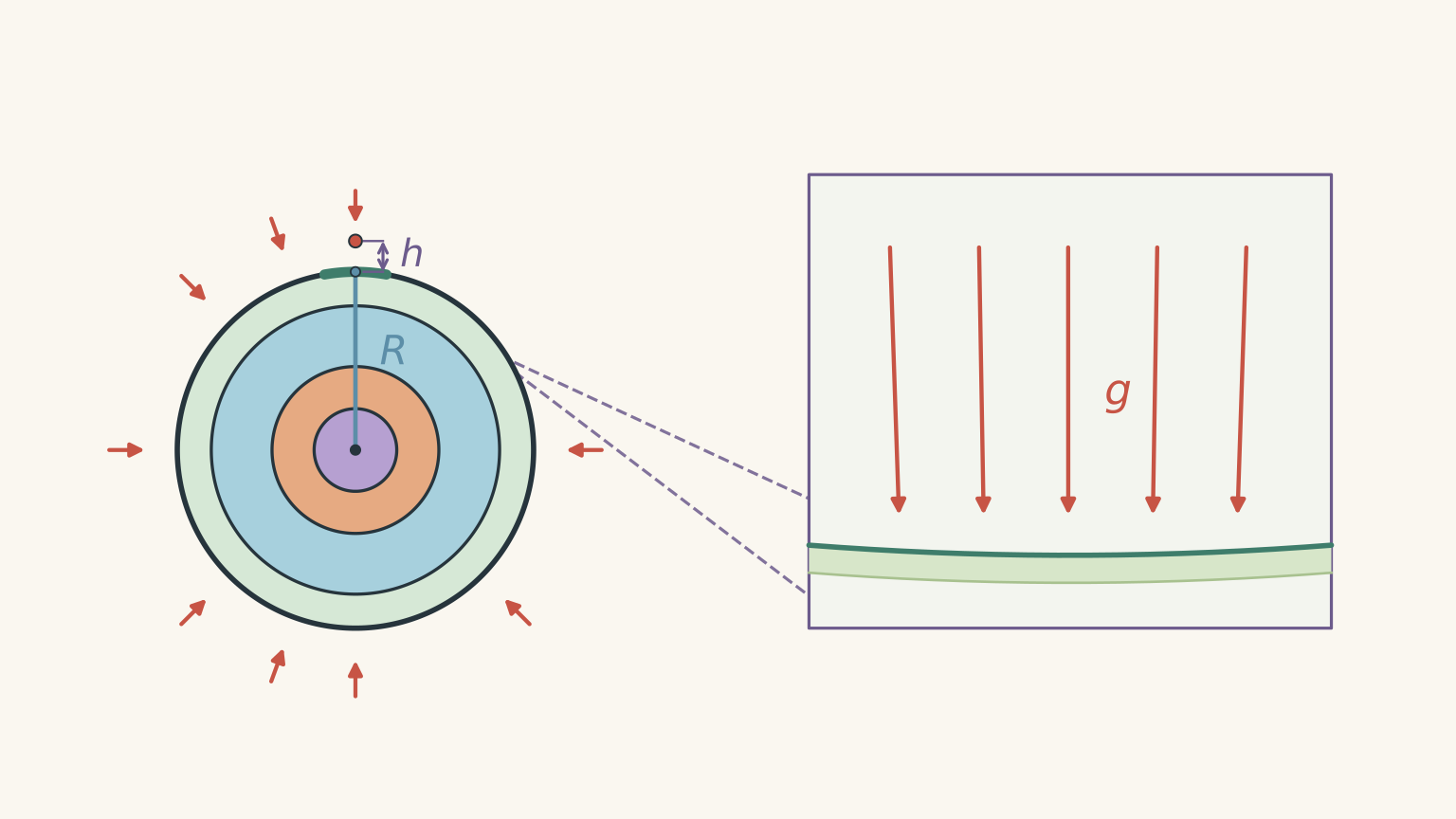
Due to technical limitations, this figure may display incorrectly or contain inaccuracies. Please check key details against your course materials.
Why can we treat gravity as uniform near the surface?
Imagine standing on a football field. The gravitational field points approximately vertically downwards everywhere around you.
Technically, the field directions are not perfectly parallel. They point towards Earth’s centre, so they differ slightly from one position to another.
However, the size of a football field is tiny compared with Earth’s radius.
If an object is at altitude \(h\) above a planet’s surface, its distance from the centre is \(R+h\), where \(R\) is the planet’s radius.
The gravitational field strength is therefore:
\[ g(h)=\frac{GM}{(R+h)^2} \]
At the surface:
\[ g_0=\frac{GM}{R^2} \]
Dividing these expressions gives:
\[ \frac{g(h)}{g_0} = \left(\frac{R}{R+h}\right)^2 \]
Consider an object 1 km above Earth’s surface. Taking Earth’s radius as 6371 km:
\[ \frac{g(h)}{g_0} = \left(\frac{6371}{6372}\right)^2 \approx 0.99969 \]
The gravitational field is only about 0.031% weaker than at the surface.
Its direction also changes very little across a small horizontal region.
This is why we can approximate the gravitational field near Earth’s surface as uniform, with a constant magnitude and direction.
The approximation is useful because it makes problems involving weight, free fall, and projectile motion much simpler. It is also physically justified when the dimensions of the region being studied are small compared with the planet’s radius.
This is the same near-surface approximation discussed in OpenStax University Physics: Gravitation Near Earth’s Surface.
Why this approximation fails for a planetary flyby
Now imagine a spacecraft travelling thousands of kilometres around a planet.
Its distance from the planet’s centre changes significantly. The gravitational field also changes direction continuously as the spacecraft moves.
You can no longer treat gravity as a constant downward acceleration.
Instead, the spacecraft experiences a continuously changing gravitational acceleration directed towards the planet’s centre.
That changing acceleration bends its trajectory.
This is the starting point for understanding gravitational scattering.
02What happens during a gravitational flyby?
Consider a spacecraft approaching a planet without firing its engines.
Initially, it is travelling towards the planet with some velocity relative to it. Gravity pulls the spacecraft towards the planet, changing both its speed and direction.
As it approaches, it accelerates.
At its closest point, it reaches its maximum speed during the idealised encounter. After passing this point, it begins moving away and loses speed as it climbs out of the gravitational field.
The closest point: periapsis
The closest point in the spacecraft’s trajectory is called the periapsis.
We use \(r_p\) to represent the periapsis radius.
An important detail: \(r_p\) is measured from the planet’s centre, not from its surface.
If the planet has radius \(R\), the spacecraft’s altitude at closest approach is:
\[ h_p=r_p-R \]
For example, a spacecraft passing Earth at a periapsis radius of 8000 km has an altitude of:
\[ h_p=8000-6371=1629\text{ km} \]
This distinction matters when checking whether a proposed trajectory would collide with a planet or pass through its atmosphere.
What is the incoming speed at infinity?
We need one more quantity before calculating the deflection angle.
The spacecraft has a speed relative to the planet when it is sufficiently far away that the planet’s gravitational influence is negligible.
This is called its hyperbolic excess speed, written as:
\[ v_\infty \]
The subscript infinity is a mathematical convention. It represents the speed on the incoming or outgoing asymptote of the idealised hyperbolic trajectory.
It is not the spacecraft’s speed in the Sun-centred reference frame.
For an unpowered two-body flyby, the incoming and outgoing hyperbolic excess speeds have equal magnitudes:
\[ v_{\infty,\text{in}}=v_{\infty,\text{out}} \]
Why?
Because the spacecraft gains kinetic energy as it approaches the planet, then gives that kinetic energy back as it moves away.
The total mechanical energy in the planet-centred two-body model is conserved.
At periapsis, the spacecraft’s speed \(v_p\) is greater than its incoming hyperbolic excess speed:
\[ \frac12v_p^2-\frac{\mu}{r_p} = \frac12v_\infty^2 \]
Rearranging:
\[ \boxed{ v_p=\sqrt{v_\infty^2+\frac{2\mu}{r_p}} } \]
Here, \(\mu\) is the gravitational parameter of the planet-spacecraft system.
The spacecraft speeds up during its approach, reaches maximum speed at periapsis, and slows down during departure.
Its final speed relative to the planet returns to its original asymptotic value.
Speed is not the same as velocity
Think about a car travelling around a bend at a constant speed.
Its speedometer might remain at 60 km/h throughout the turn, but its velocity changes because its direction changes.
The same distinction applies to a gravitational flyby.
The spacecraft can leave with the same speed but a different velocity.
The angle between its incoming and outgoing asymptotic velocity vectors is the deflection angle, represented by \(\delta\).
This is the angle we want to calculate.
03Connecting closest approach to the deflection angle
We now have three important quantities:
- \(r_p\): the closest distance between the spacecraft and the planet’s centre
- \(v_\infty\): the spacecraft’s speed relative to the planet far before or after the encounter
- \(\mu\): the gravitational parameter of the planet-spacecraft system.
The gravitational parameter is defined as:
\[ \mu=G(M+m) \]
where \(M\) is the planet’s mass and \(m\) is the spacecraft’s mass.
For a spacecraft, its mass is negligible compared with the planet’s mass. Therefore, we can use:
\[ \boxed{\mu\approx GM} \]
Its SI units are \(\mathrm{m^3\,s^{-2}}\). If distances are measured in kilometres and speeds in kilometres per second, use \(\mathrm{km^3\,s^{-2}}\).
Where does the scattering equation come from?
The spacecraft follows a hyperbolic trajectory in the idealised two-body model.
A hyperbola is an unbound orbital path. Unlike an ellipse, it does not return to its starting point. The spacecraft approaches the planet and then escapes.
Two conservation principles determine its shape:
- Conservation of mechanical energy.
- Conservation of angular momentum.
The specific mechanical energy, meaning mechanical energy per unit spacecraft mass, is:
\[ \varepsilon=\frac{v^2}{2}-\frac{\mu}{r} \]
The specific angular momentum is conserved because the gravitational force acts directly towards the planet’s centre.
These conservation laws determine the eccentricity \(e\) of the hyperbola:
\[ e=1+\frac{r_pv_\infty^2}{\mu} \]
Here, \(e\) is a dimensionless measure of the shape of the orbit. For a hyperbola, \(e>1\).
The geometry of the hyperbola also gives:
\[ \sin\left(\frac{\delta}{2}\right)=\frac{1}{e} \]
Combining these expressions produces the required relationship:
\[ \boxed{ \delta= 2\sin^{-1} \left( \frac{1}{1+\frac{r_pv_\infty^2}{\mu}} \right) } \]
An equivalent and particularly useful form is:
\[ \boxed{ \sin\left(\frac{\delta}{2}\right) = \frac{\mu}{\mu+r_pv_\infty^2} } \]
This is the gravitational scattering-angle equation.
It is also the relationship used in NASA’s spacecraft trajectory-design documentation for an ideal, unpowered hyperbolic flyby.
NASA: Gravity Assist Δv Maneuver Parameterization
What does the equation actually tell us?
Look at the quantity in the denominator:
\[ \frac{r_pv_\infty^2}{\mu} \]
It compares the spacecraft’s incoming kinetic energy scale with the gravitational influence of the planet at closest approach.
There are three important relationships.
| Change | Effect on deflection angle |
|---|---|
| Decrease \(r_p\) | Increases the deflection |
| Decrease \(v_\infty\) | Increases the deflection |
| Increase \(\mu\) | Increases the deflection |
The relationships make physical sense.
A closer approach exposes the spacecraft to stronger gravitational acceleration. A slower spacecraft also spends more time being significantly affected by the planet’s gravity.
A more massive planet produces a stronger gravitational field and bends the trajectory more.
Notice that the incoming speed is squared.
Doubling the incoming speed does not simply halve the deflection angle. It increases the \(r_pv_\infty^2\) term by a factor of four.
This can make a substantial difference.
A useful comparison
Suppose two spacecraft pass the same planet at the same closest-approach distance.
One arrives at 4 km/s, while the other arrives at 8 km/s.
The second spacecraft travels faster through the gravitational field. Its trajectory has less time to be significantly redirected.
The faster spacecraft therefore experiences a smaller deflection angle.
This is a common trap: assuming that the closest approach alone determines the amount of bending.
It does not.
You must consider both the closest approach and the incoming speed.
Finding the required closest approach
The equation can also be rearranged.
Suppose a spacecraft needs a particular deflection angle, and its incoming speed is already known.
We can calculate the required periapsis radius:
\[ \boxed{ r_p= \frac{\mu}{v_\infty^2} \left( \frac{1}{\sin(\delta/2)}-1 \right) } \]
This is useful when planning a flyby.
It tells us how close the spacecraft must pass to produce a desired change in direction.
However, there is a physical restriction.
The spacecraft cannot pass through the planet.
For a planet of radius \(R\), its periapsis must satisfy:
\[ r_p\geq R \]
In practice, a safe trajectory also needs to account for the atmosphere, terrain, and any required minimum altitude.
The maximum achievable deflection is therefore limited by the smallest permitted periapsis:
\[ \delta_{\max} = 2\sin^{-1} \left( \frac{\mu} {\mu+(R+h_{\min})v_\infty^2} \right) \]
Here, \(h_{\min}\) is the minimum permitted flyby altitude.
This equation gives an important design decision: sometimes the required turn is physically impossible at a particular incoming speed.
04Closest approach is not the same as impact parameter
There is another distance worth understanding.
The impact parameter, represented by \(b\), is the perpendicular distance between the planet’s centre and the incoming straight-line asymptote.
In other words, it describes how far the spacecraft’s initial straight-line path would miss the planet’s centre if gravity did not bend its trajectory.
It is not the actual closest-approach distance.
Gravity pulls the spacecraft towards the planet, causing the actual trajectory to curve inwards.
Consequently:
\[ b>r_p \]
for a non-zero gravitational attraction.
Using conservation of energy and angular momentum, the two distances are related by:
\[ \boxed{ b^2=r_p^2+\frac{2\mu r_p}{v_\infty^2} } \]
This relationship is useful when the spacecraft’s incoming aim point is known but its actual closest approach is not.
The scattering angle can also be expressed directly in terms of the impact parameter:
\[ \boxed{ \delta= 2\tan^{-1} \left( \frac{\mu}{bv_\infty^2} \right) } \]
Both equations describe the same idealised hyperbolic flyby.
Do not substitute \(b\) for \(r_p\) in the periapsis-based equation. They represent different distances.
05When is the two-body model valid?
Before using these equations, check the assumptions.
The model assumes:
- The planet and spacecraft are the only bodies affecting the motion.
- The planet is spherical, with its external gravitational field approximated by a point mass at its centre.
- The spacecraft’s mass is negligible compared with the planet’s mass.
- The spacecraft does not fire its engines during the encounter.
- Atmospheric drag is negligible.
- Relativistic effects are negligible.
These assumptions are useful for understanding the gravitational part of a flyby, but a real mission can involve additional effects.
For example, a spacecraft passing through a significant atmosphere experiences drag. Its mechanical energy is no longer conserved in the simple planet-centred model.
This is why atmospheric manoeuvres such as aerobraking require a different treatment.
There is also an important distinction between the planet-centred model and the complete trajectory.
A spacecraft travelling between planets is also affected by the Sun’s gravity. Mission designers commonly approximate the trajectory using separate planet-centred and Sun-centred sections, then connect them.
The planet-centred hyperbolic model describes the close encounter. It does not independently describe the entire interplanetary journey.
06Worked examples
Worked example: Calculate the deflection angle of an Earth flyby
An unpowered spacecraft passes Earth with a periapsis radius of 8000 km. Its incoming hyperbolic excess speed is 6.00 km/s.
Calculate its gravitational deflection angle.
Take Earth’s gravitational parameter as:
\[ \mu=3.986\times10^5\ \mathrm{km^3\,s^{-2}} \]
Step 1
\[ r_p=8000\ \mathrm{km} \]
\[ v_\infty=6.00\ \mathrm{km\,s^{-1}} \]
\[ \mu=3.986\times10^5\ \mathrm{km^3\,s^{-2}} \]
We use the periapsis-based scattering equation.
Step 2
\[ \sin\left(\frac{\delta}{2}\right) = \frac{\mu}{\mu+r_pv_\infty^2} \]
\[ = \frac{3.986\times10^5} {3.986\times10^5+8000(6.00)^2} \]
\[ =\frac{398600}{686600} \]
\[ =0.5805 \]
Step 3
\[ \frac{\delta}{2} = \sin^{-1}(0.5805) \]
\[ \frac{\delta}{2}\approx35.5^\circ \]
Therefore:
\[ \boxed{\delta\approx71.0^\circ} \]
Step 4
The spacecraft’s velocity direction changes by approximately \(71.0^\circ\) during the encounter.
Its outgoing speed relative to Earth remains 6.00 km/s in the ideal unpowered two-body model.
The spacecraft has not gained planet-relative speed overall. It has gained a substantial change in direction.
Worked example: Find the required periapsis for a 60° turn
A spacecraft approaches Earth with a hyperbolic excess speed of 7.00 km/s.
An unpowered flyby must produce a deflection angle of \(60^\circ\).
Calculate the required periapsis radius and altitude.
Then determine whether the same deflection is possible if the incoming speed increases to 8.00 km/s.
Use:
- Earth’s gravitational parameter: \(3.986\times10^5\ \mathrm{km^3\,s^{-2}}\)
- Earth’s radius: 6371 km.
Step 1
We know the required angle and incoming speed.
\[ r_p= \frac{\mu}{v_\infty^2} \left( \frac{1}{\sin(\delta/2)}-1 \right) \]
Step 2
\[ r_p= \frac{3.986\times10^5}{7.00^2} \left( \frac{1}{\sin30^\circ}-1 \right) \]
Since:
\[ \sin30^\circ=0.5 \]
we obtain:
\[ r_p= \frac{398600}{49}(2-1) \]
\[ \boxed{r_p\approx8135\ \mathrm{km}} \]
Step 3
The periapsis radius is measured from Earth’s centre.
Therefore:
\[ h_p=r_p-R \]
\[ h_p=8135-6371 \]
\[ \boxed{h_p\approx1764\ \mathrm{km}} \]
The spacecraft can achieve the required turn at an altitude of approximately 1764 km.
Step 4
\[ r_p= \frac{3.986\times10^5}{8.00^2} \left( \frac{1}{\sin30^\circ}-1 \right) \]
\[ r_p=\frac{398600}{64} \]
\[ \boxed{r_p\approx6228\ \mathrm{km}} \]
Step 5
Earth’s radius is 6371 km.
The required periapsis is:
\[ 6228<6371 \]
The spacecraft would have to pass approximately 143 km inside Earth’s solid surface.
That trajectory is impossible.
In fact, even a grazing trajectory at Earth’s surface would only produce approximately:
\[ \delta_{\max} = 2\sin^{-1} \left( \frac{398600}{398600+6371(64)} \right) \]
\[ \boxed{\delta_{\max}\approx59.2^\circ} \]
So an 8.00 km/s approach cannot achieve the required \(60^\circ\) turn without intersecting Earth.
The key result is that increasing the incoming speed can make a previously achievable deflection physically impossible, even when the spacecraft uses the closest possible approach.
07Questions and solutions
Question 1
An unpowered spacecraft performs a flyby of the Moon.
Its closest-approach radius is 2000 km, and its incoming hyperbolic excess speed is 2.00 km/s.
The Moon has a gravitational parameter of:
\[ \mu=4.90\times10^3\ \mathrm{km^3\,s^{-2}} \]
Calculate the gravitational deflection angle.
Solution 1
The gravitational deflection angle is approximately \(44.7^\circ\).
We use the periapsis-based scattering equation:
\[ \sin\left(\frac{\delta}{2}\right) = \frac{\mu}{\mu+r_pv_\infty^2} \]
Substitute:
\[ \sin\left(\frac{\delta}{2}\right) = \frac{4900}{4900+2000(2.00)^2} \]
\[ =\frac{4900}{12900} \]
\[ =0.3798 \]
Taking the inverse sine:
\[ \frac{\delta}{2} = \sin^{-1}(0.3798) \]
\[ \frac{\delta}{2}\approx22.3^\circ \]
Therefore:
\[ \boxed{\delta\approx44.7^\circ} \]
The spacecraft leaves the Moon with the same asymptotic speed relative to the Moon, but its direction has changed by approximately \(44.7^\circ\).
Notice that its periapsis altitude is:
\[ 2000-1737=263\ \mathrm{km} \]
The closest approach is measured from the lunar centre, not from its surface.
Question 2
Two spacecraft perform unpowered flybys of Earth.
Their incoming conditions are:
| Quantity | Spacecraft A | Spacecraft B |
|---|---|---|
| Periapsis altitude | 500 km | 1500 km |
| Incoming excess speed | 4.0 km/s | 6.0 km/s |
Use Earth’s radius of 6371 km and gravitational parameter of \(3.986\times10^5\ \mathrm{km^3\,s^{-2}}\).
Determine:
(a) The deflection angle for each spacecraft.
(b) Which spacecraft experiences the greater deflection, and by how much.
(c) Explain why comparing the periapsis altitudes alone would lead to an incomplete prediction.
Solution 2
Spacecraft A experiences the greater deflection, approximately \(103.2^\circ\), compared with \(71.6^\circ\) for spacecraft B. The difference is approximately \(31.6^\circ\).
Both the periapsis distance and incoming speed must be considered.
(a) Calculate the deflection angles.
For spacecraft A, the periapsis radius is:
\[ r_{p,A}=6371+500 \]
\[ r_{p,A}=6871\ \mathrm{km} \]
Using the scattering equation:
\[ \sin\left(\frac{\delta_A}{2}\right) = \frac{398600}{398600+6871(4.0)^2} \]
\[ =\frac{398600}{508536} \]
\[ =0.7838 \]
Therefore:
\[ \delta_A=2\sin^{-1}(0.7838) \]
\[ \boxed{\delta_A\approx103.2^\circ} \]
For spacecraft B:
\[ r_{p,B}=6371+1500 \]
\[ r_{p,B}=7871\ \mathrm{km} \]
Substitute:
\[ \sin\left(\frac{\delta_B}{2}\right) = \frac{398600}{398600+7871(6.0)^2} \]
\[ =\frac{398600}{681956} \]
\[ =0.5845 \]
Therefore:
\[ \delta_B=2\sin^{-1}(0.5845) \]
\[ \boxed{\delta_B\approx71.6^\circ} \]
(b) Compare the results.
The difference is:
\[ \Delta\delta=103.2^\circ-71.6^\circ \]
\[ \boxed{\Delta\delta\approx31.6^\circ} \]
Spacecraft A is deflected more strongly.
(c) Explain the physical reason.
It is tempting to predict that spacecraft A will experience more deflection simply because it passes closer to Earth.
That prediction happens to be correct, but it misses an important part of the explanation.
Spacecraft A also has a lower incoming speed.
A lower incoming speed means gravity has more time to change the spacecraft’s velocity direction during the encounter.
Spacecraft B passes further away and arrives faster. Both factors reduce its deflection.
The correct comparison must consider the complete quantity:
\[ \frac{r_pv_\infty^2}{\mu} \]
Comparing periapsis distances alone is not enough.
Question 3
A spacecraft is approaching Mars and must achieve a gravitational deflection of at least \(70^\circ\).
For safety, its periapsis altitude must be at least 300 km above the Martian surface.
Use:
- Mars radius: 3390 km
- Mars gravitational parameter: \(4.283\times10^4\ \mathrm{km^3\,s^{-2}}\).
Determine the maximum incoming hyperbolic excess speed that allows a \(70^\circ\) deflection while respecting the minimum altitude.
A proposed spacecraft approaches at 3.20 km/s. Determine whether it can still achieve the required deflection without violating the altitude restriction.
Solution 3
The maximum permitted incoming speed is approximately \(2.94\ \mathrm{km\,s^{-1}}\). A spacecraft arriving at 3.20 km/s cannot achieve the required \(70^\circ\) deflection without passing below the minimum permitted altitude.
The important constraint is that the periapsis cannot be smaller than the minimum allowed radius.
Step 1: Calculate the minimum permitted periapsis radius.
\[ r_{p,\min}=R+h_{\min} \]
\[ r_{p,\min}=3390+300 \]
\[ \boxed{r_{p,\min}=3690\ \mathrm{km}} \]
Step 2: Rearrange the scattering equation for incoming speed.
Starting with:
\[ \sin\left(\frac{\delta}{2}\right) = \frac{\mu}{\mu+r_pv_\infty^2} \]
Rearranging:
\[ r_pv_\infty^2 = \mu\left( \frac{1}{\sin(\delta/2)}-1 \right) \]
Therefore:
\[ v_\infty= \sqrt{ \frac{\mu}{r_p} \left( \frac{1}{\sin(\delta/2)}-1 \right) } \]
Step 3: Substitute the minimum permitted radius and required deflection.
\[ v_{\infty,\max} = \sqrt{ \frac{4.283\times10^4}{3690} \left( \frac{1}{\sin35^\circ}-1 \right) } \]
Since:
\[ \sin35^\circ\approx0.5736 \]
we obtain:
\[ v_{\infty,\max} \approx\sqrt{8.63} \]
\[ \boxed{v_{\infty,\max}\approx2.94\ \mathrm{km\,s^{-1}}} \]
This is the maximum incoming speed for the specified turn angle and minimum altitude.
Step 4: Test the proposed speed of 3.20 km/s.
For an exact \(70^\circ\) turn, the required periapsis would be:
\[ r_p= \frac{42830}{3.20^2} \left( \frac{1}{\sin35^\circ}-1 \right) \]
\[ r_p\approx3109.7\ \mathrm{km} \]
But Mars itself has a radius of 3390 km.
The required periapsis is inside the planet.
Therefore, the spacecraft cannot achieve the required deflection at 3.20 km/s without violating the minimum altitude.
This is an example of how gravitational scattering places a limit on mission geometry. A spacecraft may have the correct incoming direction but an unsuitable incoming speed.
Question 4
A spacecraft approaches Earth with an incoming hyperbolic excess speed of 6.0 km/s.
Its incoming asymptote passes 15,000 km from Earth’s centre.
Calculate:
(a) The actual periapsis radius.
(b) The corresponding periapsis altitude.
(c) The gravitational deflection angle.
Explain why using 15,000 km directly as the periapsis radius would produce an incorrect result.
Use:
\[ \mu=398600\ \mathrm{km^3\,s^{-2}} \]
Solution 4
The actual periapsis radius is approximately 7572 km, corresponding to an altitude of approximately 1201 km. The deflection angle is approximately \(72.8^\circ\).
The impact parameter is not the actual closest-approach distance.
(a) Calculate the periapsis radius.
We know:
\[ b^2=r_p^2+\frac{2\mu r_p}{v_\infty^2} \]
Substitute:
\[ 15000^2 = r_p^2+\frac{2(398600)r_p}{6.0^2} \]
Rearranging:
\[ r_p^2+22144.4r_p-225000000=0 \]
Using the positive solution of the quadratic equation:
\[ r_p= -11072.2+ \sqrt{11072.2^2+15000^2} \]
\[ \boxed{r_p\approx7572\ \mathrm{km}} \]
We take the positive root because a periapsis radius must be positive.
(b) Calculate the altitude.
Earth’s radius is 6371 km.
\[ h_p=r_p-R \]
\[ h_p=7572-6371 \]
\[ \boxed{h_p\approx1201\ \mathrm{km}} \]
(c) Calculate the deflection angle.
Use:
\[ \sin\left(\frac{\delta}{2}\right) = \frac{\mu}{\mu+r_pv_\infty^2} \]
Substitute:
\[ \sin\left(\frac{\delta}{2}\right) = \frac{398600}{398600+7572(6.0)^2} \]
\[ \sin\left(\frac{\delta}{2}\right) \approx0.594 \]
Therefore:
\[ \delta=2\sin^{-1}(0.594) \]
\[ \boxed{\delta\approx72.8^\circ} \]
Why is treating the impact parameter as the periapsis incorrect?
The tempting approach is to substitute 15,000 km directly into the periapsis-based equation.
That would give a deflection of only about \(50.3^\circ\).
The error is assuming that the spacecraft continues along its original straight-line path.
It does not.
Earth’s gravitational attraction bends the trajectory towards its centre, reducing the actual closest-approach distance from 15,000 km to approximately 7572 km.
This gravitational focusing produces a substantially larger deflection.
Question 5
An Earth flyby provides a useful way to distinguish between gravitational deflection and a genuine change in heliocentric energy.
Consider an unpowered spacecraft approaching Earth under the following conditions:
- Earth’s gravitational parameter is \(3.986\times10^5\ \mathrm{km^3\,s^{-2}}\).
- Earth’s radius is 6371 km.
- The spacecraft’s periapsis radius is 8135 km.
- The spacecraft’s incoming planet-relative speed is 7.0 km/s.
- Earth moves at 30.0 km/s in the positive \(x\)-direction relative to the Sun.
The incoming planet-relative velocity vector points at \(60^\circ\) above the positive \(x\)-direction.
Two possible trajectories pass on opposite sides of Earth:
- Flyby A leaves with its planet-relative velocity pointing at \(0^\circ\).
- Flyby B leaves with its planet-relative velocity pointing at \(120^\circ\).
Both flybys have the same periapsis radius and incoming speed.
Assume the planet’s heliocentric velocity remains constant during the encounter.
Determine:
(a) The planet-centred deflection angle for each flyby.
(b) The change in the spacecraft’s heliocentric specific kinetic energy for each flyby.
(c) Whether both flybys can have the same gravitational deflection angle but produce opposite changes in heliocentric energy. Explain the physical reason.
Solution 5
Flyby A increases the spacecraft’s heliocentric specific kinetic energy by approximately \(1.05\times10^8\ \mathrm{J\,kg^{-1}}\).
Flyby B decreases it by approximately \(2.10\times10^8\ \mathrm{J\,kg^{-1}}\).
Both encounters produce the same \(60^\circ\) gravitational deflection in Earth’s reference frame. The difference comes from the direction of the deflection relative to Earth’s motion around the Sun.
This is the key distinction between gravitational scattering and a gravity assist.
(a) Verify the planet-centred deflection angle.
We begin with:
\[ \sin\left(\frac{\delta}{2}\right) = \frac{\mu}{\mu+r_pv_\infty^2} \]
Substitute:
\[ \sin\left(\frac{\delta}{2}\right) = \frac{398600}{398600+8135(7.0)^2} \]
Since:
\[ 8135(49)\approx398615 \]
we obtain:
\[ \sin\left(\frac{\delta}{2}\right) \approx0.5 \]
Therefore:
\[ \boxed{\delta\approx60^\circ} \]
Both flybys have the same deflection magnitude because they have the same planet, incoming speed, and periapsis radius.
Their paths are mirror images with respect to the incoming direction.
(b) Calculate the heliocentric specific kinetic-energy changes.
The spacecraft’s velocity relative to the Sun is the vector sum of:
- Earth’s velocity relative to the Sun.
- The spacecraft’s velocity relative to Earth.
We can write:
\[ \mathbf v=\mathbf V_p+\mathbf u \]
where:
- \(\mathbf v\) is the spacecraft’s heliocentric velocity.
- \(\mathbf V_p\) is Earth’s heliocentric velocity.
- \(\mathbf u\) is the spacecraft’s planet-relative velocity.
Earth’s velocity is:
\[ \mathbf V_p=(30.0,0)\ \mathrm{km\,s^{-1}} \]
The incoming planet-relative velocity has magnitude 7.0 km/s and direction \(60^\circ\).
Its components are:
\[ \mathbf u_{\text{in}} = (7\cos60^\circ,7\sin60^\circ) \]
\[ \boxed{ \mathbf u_{\text{in}}=(3.50,6.06) \ \mathrm{km\,s^{-1}} } \]
For Flyby A, the outgoing direction is \(0^\circ\):
\[ \mathbf u_{\text{out,A}}=(7.0,0) \]
The incoming heliocentric velocity is:
\[ \mathbf v_{\text{in}}=(30+3.5,6.06) \]
\[ =(33.5,6.06)\ \mathrm{km\,s^{-1}} \]
The outgoing heliocentric velocity is:
\[ \mathbf v_{\text{out,A}}=(30+7,0) \]
\[ =(37,0)\ \mathrm{km\,s^{-1}} \]
The change in specific kinetic energy is:
\[ \Delta\varepsilon_A = \frac12 \left( v_{\text{out,A}}^2-v_{\text{in}}^2 \right) \]
\[ = \frac12 \left[ 37^2-(33.5^2+6.06^2) \right] \]
\[ \approx\frac12(1369-1159) \]
\[ \boxed{ \Delta\varepsilon_A \approx+105\ \mathrm{km^2\,s^{-2}} } \]
Converting to SI units:
\[ \boxed{ \Delta\varepsilon_A \approx+1.05\times10^8\ \mathrm{J\,kg^{-1}} } \]
Flyby A increases the spacecraft’s heliocentric kinetic energy.
Now consider Flyby B.
Its outgoing planet-relative direction is \(120^\circ\):
\[ \mathbf u_{\text{out,B}} = (7\cos120^\circ,7\sin120^\circ) \]
\[ \boxed{ \mathbf u_{\text{out,B}} =(-3.50,6.06) \ \mathrm{km\,s^{-1}} } \]
Its outgoing heliocentric velocity is:
\[ \mathbf v_{\text{out,B}} = (30-3.5,6.06) \]
\[ =(26.5,6.06)\ \mathrm{km\,s^{-1}} \]
Therefore:
\[ \Delta\varepsilon_B = \frac12 \left[ (26.5^2+6.06^2) - (33.5^2+6.06^2) \right] \]
\[ = \frac12(739-1159) \]
\[ \boxed{ \Delta\varepsilon_B \approx-210\ \mathrm{km^2\,s^{-2}} } \]
Converting:
\[ \boxed{ \Delta\varepsilon_B \approx-2.10\times10^8\ \mathrm{J\,kg^{-1}} } \]
Flyby B decreases the spacecraft’s heliocentric kinetic energy.
(c) Explain why the energy changes are different.
The important point is that the planet-relative speed remains unchanged in both encounters.
In Earth’s reference frame:
\[ |\mathbf u_{\text{in}}| = |\mathbf u_{\text{out}}| = 7.0\ \mathrm{km\,s^{-1}} \]
The gravitational interaction changes the direction of the velocity, not its magnitude at infinity.
However, Earth itself is moving around the Sun.
When we add Earth’s velocity vector to the spacecraft’s planet-relative velocity, the resulting heliocentric velocity depends on the direction of the outgoing vector.
This can be shown more generally using the specific kinetic-energy equation:
\[ \Delta\varepsilon = \frac12 \left( |\mathbf V_p+\mathbf u_{\text{out}}|^2 - |\mathbf V_p+\mathbf u_{\text{in}}|^2 \right) \]
Expanding the vectors gives:
\[ \Delta\varepsilon = \mathbf V_p\cdot (\mathbf u_{\text{out}}-\mathbf u_{\text{in}}) \]
because the incoming and outgoing planet-relative speeds are equal.
The dot product shows that the change in heliocentric energy depends on how the velocity direction changes relative to the planet’s motion.
- Flyby A redirects the spacecraft towards Earth’s direction of travel, increasing its heliocentric kinetic energy.
- Flyby B redirects it away from Earth’s direction of travel, decreasing its heliocentric kinetic energy.
The two flybys have identical deflection magnitudes, but their energy changes have opposite signs.
This is why knowing the scattering angle alone is not enough to predict the outcome of a gravity assist. You also need to know which side of the planet the spacecraft passes and how the resulting velocity vector is oriented relative to the planet’s motion.
08Where to take this next
The scattering-angle equation tells you how much a planet can bend a spacecraft’s trajectory for a given incoming speed and closest approach.
It also lets you test whether a required manoeuvre is physically possible before considering the rest of the mission.
The next step is to use that deflection to calculate the spacecraft’s change in heliocentric velocity and orbital energy. That is the central idea behind a gravity assist: how spacecraft gain or lose orbital energy.
The distinction to carry forward is simple: gravity determines the bend in the planet-centred frame, but the planet’s own motion determines whether that bend becomes a gain or loss of energy relative to the Sun.