
Aromatic Substituent Directing Effects: Ortho, Meta and Para
Learn how electron-donating, electron-withdrawing, and halogen substituents influence electrophilic aromatic substitution. Includes resonance explanations, worked examples, and challenging practice questions.
Give a benzene ring one substituent, then ask where a second one will attach. Put a methyl group on the ring and ortho and para substitution are favoured. Replace that methyl group with a nitro group, and meta substitution becomes favoured instead.
The benzene ring itself has not changed. So why does moving from one substituent to another change where the next group attaches?
The answer lies in how substituents redistribute electron density around the aromatic ring. Some groups donate electrons, others withdraw them, and this changes the relative stability of the possible reaction intermediates.
This is an extension topic, not a required HSC Chemistry assessment point. It assumes you have studied the Year 12 Organic Chemistry foundations, including structural formulae, functional groups, and constructing and modelling chain isomers of alkanes from C1 to C8. The syllabus year is the prerequisite entry point, not an assessment requirement for this topic.
There is also a syllabus timing distinction worth knowing: NESA schedules the Chemistry 11-12 Syllabus (2025) for implementation from 2028. Year 12 continues under the Chemistry Stage 6 Syllabus (2017) through 2027.
Your experience modelling chain isomers is still useful here. You already know to compare molecular structures rather than relying on molecular formulae alone. Now, instead of changing a carbon skeleton, we will investigate how the position of a new substituent on a benzene ring depends on the group already attached.
01The reaction being directed
Before considering substituents, we need a basic understanding of the reaction they influence.
Benzene undergoes a reaction called electrophilic aromatic substitution (EAS). An electrophile replaces a hydrogen atom on the aromatic ring.
An electrophile is an electron-deficient species that accepts electron density. We will represent a generic electrophile as \(\mathrm{E}^{+}\).
Why does benzene undergo substitution rather than simply adding the electrophile across one of its double bonds?
Remember that benzene is unusually stable because its six \(\pi\) electrons are delocalised across the ring. This aromatic stabilisation makes permanent addition less favourable because it would destroy the aromatic system.
Instead, electrophilic aromatic substitution follows two main steps.
Step 1: Electrophilic attack
The aromatic ring uses its \(\pi\) electrons to form a bond with the incoming electrophile.
The ring temporarily loses its aromatic character. A positively charged intermediate forms, called the sigma complex or arenium ion. Its positive charge is delocalised across several carbon atoms through resonance.
Step 2: Loss of a hydrogen ion
A base removes a hydrogen ion from the carbon that bonded to the electrophile.
The electrons from the carbon-hydrogen bond help restore the aromatic \(\pi\) system. Benzene’s aromatic stability is regained, leaving a substituted benzene molecule.
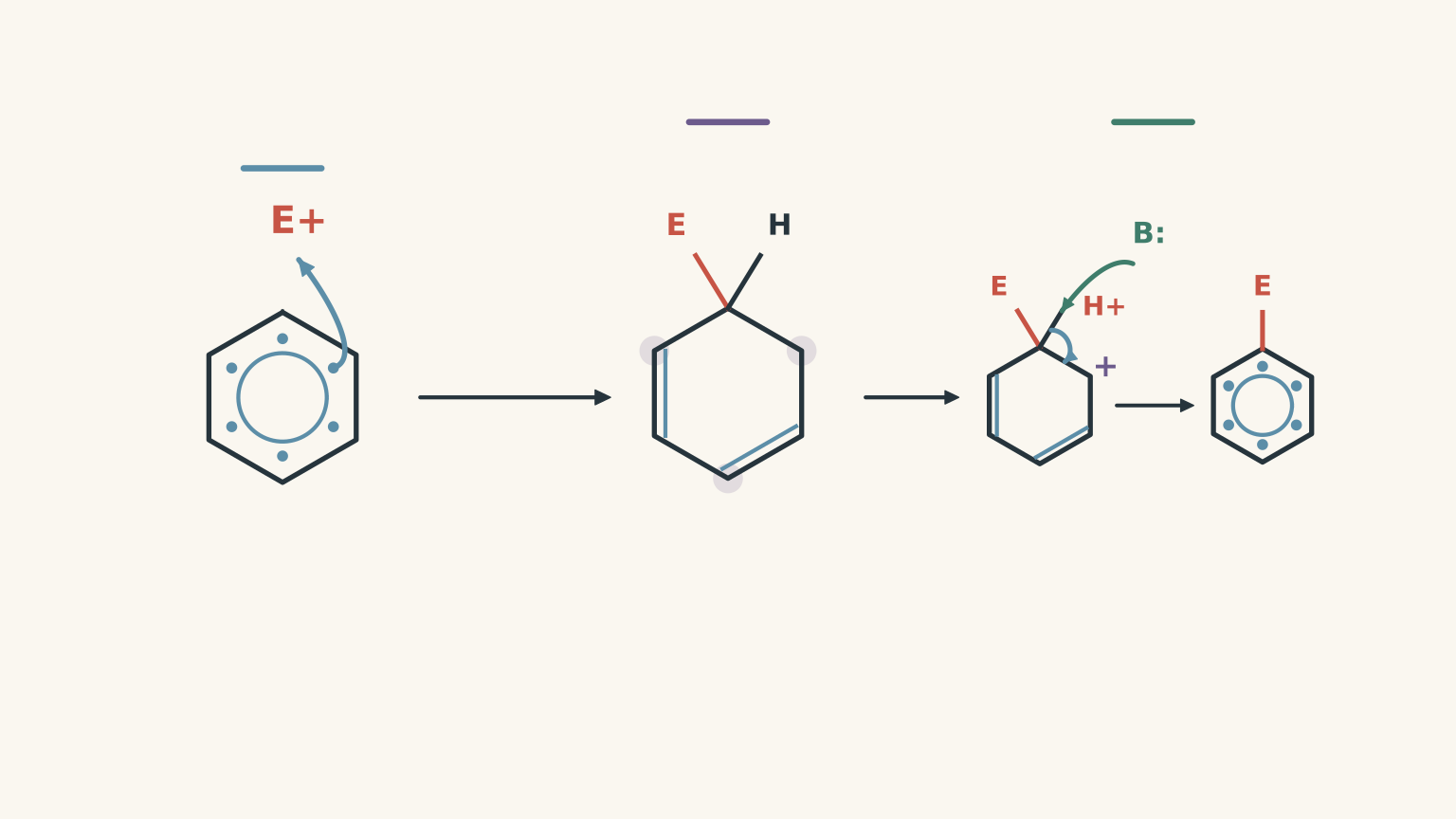
Due to technical limitations, this figure may display incorrectly or contain inaccuracies. Please check key details against your course materials.
The important part for directing effects is the first step.
Forming the sigma complex temporarily costs aromatic stabilisation. Anything that makes this positively charged intermediate more stable can make the reaction pathway easier.
The substituent already attached to the ring influences this stability. Different positions of attack produce different intermediates, and some are more favourable than others.
This is the physical basis of aromatic substituent directing effects.
02First, identify the positions on the ring
Suppose a group, labelled X, is already attached to a benzene ring.
We call the carbon directly bonded to X the ipso carbon. Number this carbon as carbon 1.
The positions of a second substituent are described using three terms:
- Ortho (o-): carbons 2 and 6, immediately next to the existing substituent.
- Meta (m-): carbons 3 and 5, one carbon further away.
- Para (p-): carbon 4, directly opposite the existing substituent.
Notice that carbons 2 and 6 are equivalent in a monosubstituted benzene ring. The same applies to carbons 3 and 5.
These names describe the relative positions of two substituents. They do not describe different reaction mechanisms.
The central question is now straightforward: why does one existing group favour ortho and para attack, while another favours meta attack?
03Electron-donating groups favour ortho and para substitution
Start with a substituent that donates electron density to the benzene ring.
An electron-donating group (EDG) makes the aromatic ring more electron-rich. This can stabilise the positively charged sigma complex formed during electrophilic substitution.
However, the stabilisation is not equal for every possible position of attack.
Consider a group attached to carbon 1 that can donate electrons through resonance, such as a methoxy group, \(\ce{-OCH3}\).
Oxygen has lone-pair electrons. One of these lone pairs can overlap with the aromatic ring’s \(\pi\) system and donate electron density into it.
Now predict something.
If the electrophile attacks carbon 2, carbon 4, or carbon 3, which pathway allows the substituent to stabilise the positive charge most effectively?
The answer is ortho and para attack.
For both ortho and para attack, the sigma complex has a resonance contributor in which the positive charge appears on carbon 1, the carbon directly attached to the electron-donating group.
The oxygen atom can donate electron density into the ring, helping stabilise this positive charge.
For meta attack, the positive charge is distributed over different ring positions. There is no equivalent resonance contributor with the positive charge on carbon 1, so the same stabilisation is unavailable.
This explains the directing effect.
Electron-donating groups generally favour ortho and para substitution because these pathways produce more favourably stabilised sigma complexes.
They also generally activate the ring, meaning that electrophilic substitution occurs faster than it does with benzene itself.
Common examples include:
- \(\ce{-OH}\): hydroxyl group.
- \(\ce{-OCH3}\): methoxy group.
- \(\ce{-NH2}\): amino group, when unprotonated.
- \(\ce{-CH3}\): methyl group, which donates electron density more weakly.
There is an important difference between the last example and the others.
Oxygen and nitrogen can donate lone-pair electrons directly into the aromatic ring. A methyl group does not have a lone pair available for this purpose. Instead, it donates electron density more weakly through its sigma bonds, including an effect called hyperconjugation.
Both types of donation can favour ortho and para substitution, although the underlying interactions differ.
04Electron-withdrawing groups favour meta substitution
Now consider the opposite situation.
An electron-withdrawing group (EWG) pulls electron density away from the aromatic ring. This makes the ring less electron-rich and generally less reactive towards electrophiles.
Common examples include:
- \(\ce{-NO2}\): nitro group.
- \(\ce{-CN}\): cyano group.
- \(\ce{-CHO}\): aldehyde group attached through its carbonyl carbon.
- \(\ce{-COCH3}\): acetyl group.
- \(\ce{-CO2H}\): carboxylic acid group.
These groups withdraw electron density through inductive effects, resonance effects, or both.
The directing effect becomes clearer when we examine the sigma complexes again.
For ortho and para attack, one resonance contributor places the positive charge on carbon 1, directly next to the electron-withdrawing substituent.
This is particularly unfavourable.
The substituent is already withdrawing electron density from the ring. Having a positively charged carbon directly attached to it makes that sigma-complex contributor especially unstable.
Meta attack avoids this particular arrangement. Its sigma complex does not have a resonance contributor with the positive charge on carbon 1.
Consequently, the meta pathway is generally more favourable than the ortho and para pathways.
The result is that electron-withdrawing groups generally:
- Deactivate the aromatic ring, making electrophilic substitution slower than for benzene.
- Direct subsequent substitution primarily towards the meta position.
Notice the distinction between these two effects.
Deactivation describes how quickly the reaction occurs. Meta direction describes where the incoming group preferentially attaches.
They are related, but they are not the same thing.
05Compare the main directing effects
The patterns can now be organised into a useful reference table.
| Existing substituent | Electronic effect | Reactivity relative to benzene | Preferred position |
|---|---|---|---|
| \(\ce{-CH3}\) | Weak electron donation | Activating | Ortho, para |
| \(\ce{-OH}\) | Strong resonance donation | Activating | Ortho, para |
| \(\ce{-OCH3}\) | Strong resonance donation | Activating | Ortho, para |
| Neutral \(\ce{-NH2}\) | Strong resonance donation | Activating | Ortho, para |
| \(\ce{-NO2}\) | Strong electron withdrawal | Deactivating | Usually meta |
| \(\ce{-CHO}\) | Electron withdrawal | Deactivating | Usually meta |
| \(\ce{-COCH3}\) | Electron withdrawal | Deactivating | Usually meta |
| \(\ce{-CN}\) | Electron withdrawal | Deactivating | Usually meta |
There is one particularly interesting exception to this pattern.
06The halogen exception: deactivating but ortho/para directing
Consider chlorobenzene, which has a chlorine atom attached to its aromatic ring.
What would you predict?
Chlorine is highly electronegative. It withdraws electron density through the sigma-bond framework, making the benzene ring less electron-rich.
This inductive effect deactivates the ring.
However, chlorine also has lone-pair electrons that can interact with the ring’s \(\pi\) system. This allows some electron donation through resonance.
That donation can stabilise the sigma complexes formed by ortho and para attack, but does not provide the same stabilisation for meta attack.
The two electronic effects therefore work in opposite directions:
- Inductive effect: chlorine withdraws electron density, deactivating the ring.
- Resonance effect: chlorine donates electron density into the ring, favouring ortho and para substitution.
The inductive withdrawal is stronger overall, so chlorobenzene is less reactive than benzene.
However, the resonance donation still influences the relative stability of the possible sigma complexes, making ortho and para substitution preferable to meta substitution.
The halogens are therefore an important exception to the usual relationship between activation and direction.
| Halogen | Overall effect | Directing effect |
|---|---|---|
| Fluorine, \(\ce{-F}\) | Deactivating | Ortho, para |
| Chlorine, \(\ce{-Cl}\) | Deactivating | Ortho, para |
| Bromine, \(\ce{-Br}\) | Deactivating | Ortho, para |
| Iodine, \(\ce{-I}\) | Deactivating | Ortho, para |
If you remember only one exception from this article, make it this one.
A group can deactivate an aromatic ring while still directing the next substitution towards the ortho and para positions.
07Look at the atom attached directly to the ring
There is another useful detail that prevents a common classification mistake.
Do not classify a substituent by simply looking for particular atoms somewhere in its structure. Look at the atom directly bonded to the aromatic ring.
Compare two compounds:
Anisole: \(\ce{C6H5-O-CH3}\)
The benzene ring is bonded directly to oxygen. Oxygen has lone-pair electrons available for resonance donation into the aromatic ring.
Anisole is therefore an ortho/para-directing activator.
Acetophenone: \(\ce{C6H5-C(=O)-CH3}\)
The benzene ring is bonded directly to the carbonyl carbon, not the oxygen atom.
The carbonyl group withdraws electron density from the aromatic ring through resonance and induction.
Acetophenone is therefore a meta-directing deactivator.
Both molecules contain oxygen, but their directing effects are different.
The useful decision rule is to trace the bond directly out of the benzene ring before classifying the substituent.
This becomes particularly important when analysing larger organic molecules.
08Worked examples
Worked example: Predicting substitution in toluene
Toluene, \(\ce{C6H5CH3}\), undergoes electrophilic aromatic substitution. Predict the preferred positions of the incoming electrophile and determine whether toluene reacts faster or slower than benzene.
Step 1
The substituent is a methyl group, \(\ce{-CH3}\).
It weakly donates electron density through hyperconjugation and inductive effects.
Step 2
The methyl group stabilises the sigma complexes formed through ortho and para attack more effectively than the meta pathway.
Therefore, the methyl group is an ortho/para director.
Step 3
The incoming electrophile preferentially attaches at:
- Carbon 2 or 6: ortho positions.
- Carbon 4: para position.
The meta positions, carbons 3 and 5, are less favoured.
Step 4
The methyl group donates electron density into the aromatic system, making the ring more reactive towards electrophiles.
Toluene therefore reacts faster than benzene under comparable electrophilic substitution conditions.
Final conclusion: Toluene is activated by its methyl group and favours ortho and para substitution. A mixture of these products is expected, although the directing rule alone cannot establish their exact proportions.
Worked example: Predicting substitution in nitrobenzene
Nitrobenzene, \(\ce{C6H5NO2}\), undergoes a second electrophilic aromatic substitution. Predict the preferred position of the incoming electrophile and compare the reaction rate with benzene.
Step 1
The existing group is the nitro group, \(\ce{-NO2}\).
It is a strong electron-withdrawing group. It removes electron density from the aromatic ring through both inductive and resonance effects.
Step 2
For ortho and para attack, a resonance contributor places the positive charge on carbon 1.
This is particularly unfavourable because carbon 1 is directly attached to the electron-withdrawing nitro group.
For meta attack, the positive charge is distributed over different ring positions. The unfavourable positive-charge arrangement at carbon 1 is avoided.
Step 3
The meta positions, carbons 3 and 5, are favoured.
Ortho and para products may still form, but they are generally less favourable.
Step 4
The nitro group strongly deactivates the aromatic ring.
Nitrobenzene therefore reacts more slowly than benzene in electrophilic aromatic substitution.
Final conclusion: Nitrobenzene is a meta-directing deactivator. Its nitro group makes the ring less reactive and favours substitution at the meta positions.
09Where the directing rules have limits
The rules above are powerful, but they are not a complete prediction of every product formed.
There are three important limitations.
1. Directing effects do not give exact product percentages.
Knowing that a group directs ortho and para does not tell you which product will be formed in the greatest quantity.
For example, an ortho product may experience steric hindrance because the new substituent is close to the existing group.
A para product may be less crowded, but the actual product distribution also depends on the reaction conditions and the relative energies of the competing pathways.
There are two equivalent ortho positions, two equivalent meta positions, and one para position on a monosubstituted benzene ring. These differences in the number of available positions can also influence product proportions.
2. Multiple substituents can compete.
If a benzene ring already contains two different substituents, each group may favour different positions.
You need to consider both directing effects rather than automatically applying the rule for whichever group you notice first.
If both groups favour the same positions, the prediction becomes more straightforward. If their preferences conflict, relative electronic effects and steric hindrance become important.
3. The electronic state of a substituent can change.
An amino group is normally an ortho/para-directing activator because its nitrogen atom can donate a lone pair into the aromatic ring.
However, in strongly acidic conditions, the amino group can become protonated.
This produces an ammonium substituent, \(\ce{-NH3+}\), which no longer has an available lone pair for donation into the ring.
Its directing effect changes to meta, and the ring becomes strongly deactivated.
The substituent has not moved. Its electronic structure has changed.
There are also specialist exceptions to the classical directing rules. A 2025 paper in the Journal of Organic Chemistry discusses evidence that some \(\pi\)-accepting substituents can produce substantial ortho as well as meta substitution, with very little para substitution.
For this level, the conventional directing rules remain a useful starting model. Just remember that a preference for meta substitution does not mean ortho substitution is chemically impossible.
10Questions and solutions
Use the reasoning from the article to tackle these five problems. The questions progress from applying one directing group to combining multiple effects and considering changes in electronic structure.
Question 1
Anisole, \(\ce{C6H5OCH3}\), undergoes electrophilic aromatic substitution.
Identify the preferred positions for the incoming electrophile. State whether anisole is more or less reactive than benzene, and explain your reasoning using the electronic structure of the methoxy group.
Solution 1
The incoming electrophile favours the ortho and para positions, and anisole is more reactive than benzene.
The methoxy group is attached directly to the ring through oxygen. Oxygen has a lone pair that can overlap with the aromatic \(\pi\) system and donate electron density through resonance.
This donation stabilises the positively charged sigma complexes formed during ortho and para attack.
The meta pathway does not receive the same stabilisation because it cannot produce the equivalent resonance contributor with positive charge at the carbon attached to the methoxy group.
Although oxygen also withdraws electron density inductively because of its electronegativity, its resonance donation dominates.
Therefore, anisole is an activated ortho/para director.
Question 2
Chlorobenzene undergoes electrophilic aromatic substitution.
Predict the preferred positions for the incoming electrophile and compare the reaction rate with benzene.
A student argues:
“Chlorine has lone pairs, so it donates electrons into the ring. Therefore, chlorobenzene must be more reactive than benzene.”
Evaluate this statement using inductive and resonance effects.
Solution 2
Chlorobenzene favours ortho and para substitution, but it reacts more slowly than benzene.
The student’s reasoning identifies a real effect but ignores the competing inductive effect.
Chlorine has two relevant interactions with the aromatic ring.
First, chlorine is highly electronegative and withdraws electron density through the sigma-bond framework. This is its inductive effect, and it deactivates the ring.
Second, chlorine can donate electron density through resonance using its lone pairs. This donation helps stabilise the ortho and para sigma complexes relative to the meta sigma complex.
The two effects therefore answer different questions:
- Inductive withdrawal determines the overall deactivation of the ring.
- Resonance donation helps determine the preferred substitution positions.
The student’s mistake is assuming that the presence of an electron-donating effect automatically means the entire ring is activated.
It does not.
Chlorobenzene is a deactivating ortho/para director.
Question 3
Consider two compounds:
- Compound A: anisole, \(\ce{C6H5OCH3}\).
- Compound B: acetophenone, \(\ce{C6H5COCH3}\).
For each compound:
- Predict whether the substituent favours ortho/para or meta substitution.
- Determine whether the ring is activated or deactivated relative to benzene.
- Explain why the presence of oxygen in both compounds does not give them the same directing effect.
Solution 3
Compound A is an activated ortho/para director, while compound B is a deactivated meta director.
The difference comes from the atom directly attached to the aromatic ring.
Compound A: Anisole
The benzene ring is bonded directly to oxygen.
Oxygen has a lone pair that can donate electron density into the aromatic \(\pi\) system. This stabilises the ortho and para sigma complexes.
The resonance donation outweighs oxygen’s inductive withdrawal.
Therefore, anisole is activated and favours ortho and para substitution.
Compound B: Acetophenone
The benzene ring is bonded directly to the carbonyl carbon.
The carbonyl group withdraws electron density from the aromatic ring through resonance and induction.
For ortho and para attack, the sigma complex has an unfavourable resonance contributor with positive charge on the carbon attached to the carbonyl group.
Meta attack avoids this particular destabilisation.
Therefore, acetophenone is deactivated and favours meta substitution.
The important distinction is not how many oxygen atoms each compound contains.
It is how the substituent is connected to the aromatic ring.
Question 4
Consider 1-methoxy-4-nitrobenzene.
The methoxy group is attached at carbon 1, and the nitro group is attached at carbon 4.
An electrophilic aromatic substitution occurs.
- Identify the positions favoured by the methoxy group.
- Identify the positions favoured by the nitro group.
- Determine which positions are favoured by both groups.
- Explain whether positions 2 and 6 produce different constitutional products.
- Can you determine whether the ring reacts faster or slower than benzene using the directing effects alone?
Solution 4
Both groups favour substitution at carbons 2 and 6. These two positions are equivalent, so they produce the same constitutional product.
The methoxy and nitro groups direct substitution through different electronic effects.
First, consider the methoxy group at carbon 1.
Methoxy is an electron-donating group.
It favours ortho and para substitution relative to its own position.
Carbon 4 is already occupied by the nitro group, leaving carbons 2 and 6 as the available ortho positions.
Next, consider the nitro group at carbon 4.
Nitro is an electron-withdrawing group and generally directs substitution towards the meta positions.
The positions meta to carbon 4 are carbons 2 and 6.
The two directing effects therefore agree.
Both favour substitution at carbons 2 and 6.
Because the two substituents are opposite each other, the ring has symmetry that makes carbons 2 and 6 equivalent.
Attacking either position gives the same constitutional product rather than two different positional isomers.
However, there is an important limitation when considering the reaction rate.
The methoxy group activates the ring, while the nitro group strongly deactivates it.
These effects oppose each other. The directing rules alone cannot tell us the net reaction rate relative to benzene.
That would require considering the relative strengths of the electronic effects and the reaction conditions.
This question illustrates why predicting reaction position and predicting reaction rate must remain separate tasks.
Question 5
Aniline, \(\ce{C6H5NH2}\), contains an amino group attached to a benzene ring.
Consider two idealised reaction situations:
- Situation A: The amino group remains completely unprotonated as \(\ce{-NH2}\).
- Situation B: The amino group is completely protonated as \(\ce{-NH3+}\).
Assume each form remains in its stated electronic state throughout electrophilic aromatic substitution.
For each situation:
- Predict the preferred substitution positions.
- Determine whether the ring is activated or deactivated relative to benzene.
- Explain the difference using the availability of nitrogen’s lone pair.
Finally, consider a real reaction mixture in which both protonated and unprotonated forms are present.
Can you predict the product distribution using just one directing-group classification? Explain what additional information would be needed.
Solution 5
Unprotonated aniline is an activated ortho/para director, whereas protonated anilinium is a strongly deactivated meta director.
The difference is caused by whether nitrogen has an available lone pair to donate into the aromatic ring.
Situation A: Unprotonated aniline
In \(\ce{-NH2}\), nitrogen has an available lone pair.
This lone pair can overlap with the aromatic \(\pi\) system and donate electron density into the ring through resonance.
For ortho and para attack, a resonance contributor places the positive charge on the carbon attached to nitrogen.
The nitrogen lone pair can help stabilise this positively charged intermediate.
Therefore, unprotonated aniline:
- Favours ortho and para substitution.
- Activates the aromatic ring.
- Generally reacts faster than benzene.
Situation B: Protonated anilinium
When aniline accepts a proton, the nitrogen becomes \(\ce{-NH3+}\).
Its lone pair is now involved in bonding to the additional hydrogen atom. It is no longer available to donate electron density into the aromatic ring.
Furthermore, nitrogen now carries a positive charge and strongly withdraws electron density from the ring.
The ortho and para sigma complexes are particularly unfavourable because they contain a resonance contributor with positive charge on the carbon directly attached to this already positively charged substituent.
The meta pathway avoids this particular destabilisation.
Therefore, protonated anilinium:
- Favours meta substitution.
- Strongly deactivates the aromatic ring.
- Reacts more slowly than benzene.
What happens when both forms are present?
A single directing-group label is no longer sufficient to predict the actual product distribution.
The reaction mixture contains two chemically different species, each with its own directing effect and reaction rate.
The final distribution depends on:
- The proportion of aniline that is protonated.
- The proportion that remains unprotonated.
- The relative reaction rates of the two forms.
- The reaction conditions.
A small amount of unprotonated aniline could contribute disproportionately if it reacts much faster than the protonated form.
This is the important conceptual point: the group attached to the ring is not necessarily electronically fixed. Changes in protonation can change its directing effect without changing the carbon skeleton.
11Where this takes you next
Aromatic substituent directing effects let you predict the likely position of a new group before considering the detailed conditions of an organic reaction.
You can now distinguish three important ideas:
- Electron donation generally activates the ring and favours ortho/para substitution.
- Electron withdrawal generally deactivates the ring and favours meta substitution.
- Halogens deactivate the ring but still favour ortho/para substitution.
The next step is to combine these rules with steric effects and reaction order when analysing aromatic molecules containing multiple substituents.
In organic synthesis, this becomes particularly useful because installing one group first can determine where a second group is most likely to attach. The order of substitution can therefore influence which final molecule is accessible.
12Further reading
- NESA: Chemistry Stage 6 Syllabus (2017) – syllabus content and implementation information.
- OpenStax: Substituent Effects in Electrophilic Substitutions – detailed explanations of activation, deactivation, and directing effects.
- Rablen (2025), Journal of Organic Chemistry – specialist discussion of the limitations of the conventional meta-directing classification for certain electron-withdrawing substituents.