
Alkene Ozonolysis
Learn how ozonolysis breaks carbon-carbon double bonds to form aldehydes and ketones. Work backwards from carbonyl products to reconstruct an unknown alkene, distinguish cyclic from acyclic structures, and understand the effects of reductive and oxidative work-ups.
An unknown alkene undergoes ozonolysis with a reductive work-up. Two products are isolated: propanone and propanal. Can you work backwards and reconstruct the original alkene?
You can. Each product contains a carbonyl carbon that was originally one of the two carbon atoms in the alkene’s C=C bond. If you identify what was attached to each carbon, you can rebuild the original double bond.
This is an extension topic beyond the required NSW Year 12 Chemistry course. It is not an HSC assessment requirement. The relevant Year 12 foundation is your understanding that oxidation of primary alcohols can produce aldehydes, while oxidation of secondary alcohols can produce ketones.
For syllabus context, the course applying to Year 12 students in 2025 was the Chemistry Stage 6 Syllabus (2017). NESA schedules implementation of the Chemistry 11-12 Syllabus (2025) from 2028. You can check the official NESA syllabus information.
01What happens during alkene ozonolysis?
Start with a simple picture.
An alkene contains a carbon-carbon double bond. Ozonolysis breaks the connection between those two carbon atoms and converts each of them into a carbonyl carbon.
A carbonyl group is a carbon-oxygen double bond, written as C=O.
The important detail is that the other groups attached to each original alkene carbon stay attached to that same carbon.
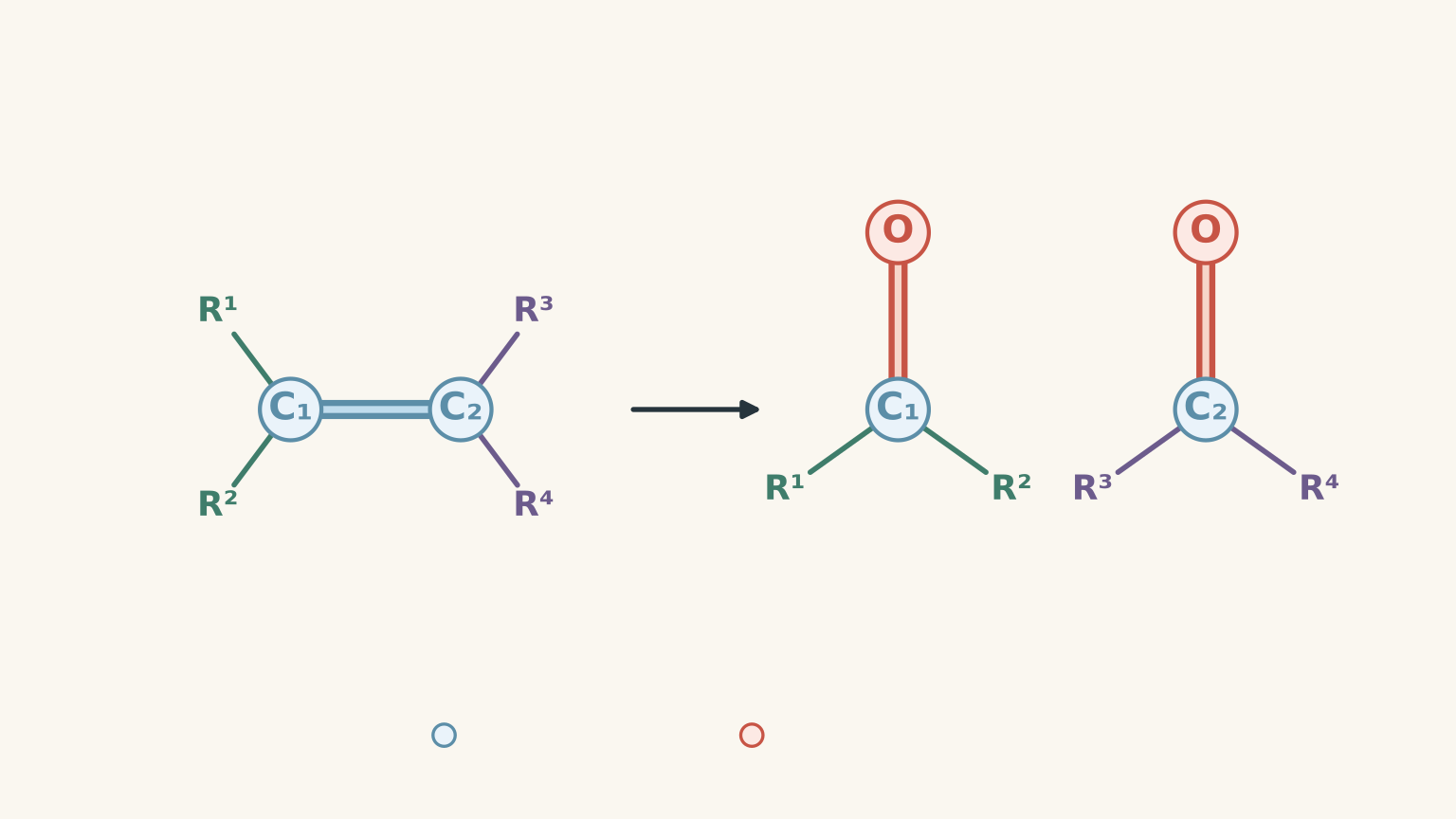
Due to technical limitations, this figure may display incorrectly or contain inaccuracies. Please check key details against your course materials.
Consider the general reaction:
\[ \mathrm{R^1R^2C=CR^3R^4} \longrightarrow \mathrm{R^1R^2C=O + O=CR^3R^4} \]
Here, \(R^1\), \(R^2\), \(R^3\), and \(R^4\) represent groups attached to the alkene carbons. Each group can be hydrogen or a carbon-containing group.
The reaction replaces the original C=C connection with two C=O groups.
But what determines whether each product is an aldehyde or a ketone?
Look at the number of hydrogen atoms attached to each original alkene carbon.
Predicting the carbonyl products
Remember the structures of aldehydes and ketones:
- An aldehyde has a carbonyl carbon attached to at least one hydrogen.
- A ketone has a carbonyl carbon attached to two carbon-containing groups.
These structures give us a useful prediction rule.
| Original alkene carbon | Reductive ozonolysis product |
|---|---|
| Attached to two carbon groups, no H | Ketone |
| Attached to one carbon group and one H | Aldehyde |
| Attached to two H atoms | Methanal |
The reason is straightforward. When the double bond is broken, each alkene carbon becomes a carbonyl carbon. Its original substituents determine which carbonyl compound forms.
For example:
This gives you a way to predict the products without needing to memorise dozens of individual reactions.
Why the work-up matters
Ozonolysis involves ozone, \(\ce{O3}\), followed by a second reaction stage called the work-up.
The work-up determines whether an aldehyde remains an aldehyde or undergoes further oxidation.
There are two important possibilities.
Reductive work-up
A reducing agent, such as dimethyl sulfide or zinc under suitable conditions, is used after ozone.
The products are aldehydes and ketones.
Oxidative work-up
An oxidising agent, commonly hydrogen peroxide, is used after ozone.
Aldehydes undergo further oxidation to form carboxylic acids. Ketones generally remain unchanged under the standard conditions.
| Original alkene carbon | Reductive work-up | Oxidative work-up |
|---|---|---|
| Two carbon groups | Ketone | Ketone |
| One carbon group and one H | Aldehyde | Carboxylic acid |
| Two H atoms | Methanal | Can be oxidised further to \(\ce{CO2}\) |
The last row is a useful special case. A terminal \(\ce{CH2=}\) group initially produces methanal under reductive conditions. Under sufficiently oxidative conditions, that carbon can be oxidised further to carbon dioxide.
Notice the connection to your existing knowledge of alcohol oxidation.
A primary alcohol can produce an aldehyde, and a secondary alcohol can produce a ketone. Ozonolysis can produce those same functional groups, but it starts with an alkene rather than an alcohol.
The product rules described here are consistent with the UCLA Illustrated Glossary of Organic Chemistry and Smith College’s organic chemistry teaching notes.
02What happens at the molecular level?
You do not need an advanced university-level mechanism to reconstruct an alkene, but understanding the broad reaction sequence helps explain why the cleavage occurs.
Ozone reacts with the alkene’s double bond through a cycloaddition reaction.
This initially forms an unstable cyclic intermediate called a molozonide. The intermediate breaks apart and rearranges to form another cyclic peroxide intermediate called an ozonide.
The subsequent work-up converts the ozonide into the final carbonyl products.
Some ozonides are explosive, and ozone is a toxic, highly reactive gas. This chemistry is therefore best treated here as a conceptual reaction and a structural-analysis method, not an unsupervised experimental procedure.
For predicting products and reconstructing structures, the essential idea remains the same: the original C=C bond is cleaved, and both alkene carbons become carbonyl carbons.
03Working backwards: finding the original double bond
Now we can use the reaction in reverse.
Imagine receiving two carbonyl compounds and being asked to identify the alkene that produced them.
The key is to reverse the structural changes.
Follow this method:
- Identify the carbonyl carbon in each product.
- Identify the groups attached to each carbonyl carbon.
- Determine whether each carbon originally had hydrogen attached. Remember that a carboxylic acid formed under oxidative conditions may have come from an aldehyde.
- Remove the oxygen atoms from the carbonyl groups.
- Connect the two original carbonyl carbons with a C=C double bond.
- Check the carbon count and molecular formula.
The most important step is number five.
You are not joining the oxygen atoms or connecting the ends of the carbon chains arbitrarily. You are reconnecting the two carbon atoms that originally shared the double bond.
One important distinction: acyclic versus cyclic alkenes
The number of product molecules can tell you something about the original structure.
For a simple acyclic alkene with one double bond, cleavage separates the molecule into two carbonyl compounds.
For a simple cyclic alkene with one double bond, cleavage opens the ring. The two carbonyl groups remain connected through the rest of the original ring, producing one molecule with two carbonyl groups.
This difference becomes especially useful when you are trying to identify an unknown alkene.
It also explains why the same reaction can produce either two separate molecules or one molecule with two carbonyl ends.
04Worked examples
Worked example: Reconstructing an acyclic alkene
An unknown acyclic monoalkene undergoes reductive ozonolysis and produces propanone and propanal. Determine the original alkene structure and give its IUPAC name.
Step 1
Propanone has the structure:
\[ \ce{CH3COCH3} \]
Its carbonyl carbon is attached to two methyl groups.
Therefore, the original alkene carbon was also attached to two methyl groups. It had no hydrogen atoms attached.
Step 2
Propanal has the structure:
\[ \ce{CH3CH2CHO} \]
Its carbonyl carbon is attached to one ethyl group and one hydrogen atom.
Therefore, the corresponding original alkene carbon was attached to an ethyl group and one hydrogen atom.
Step 3
Remove the oxygen atoms and form a double bond between the two carbonyl carbons.
The reconstructed structure is:
\[ \ce{(CH3)2C=CHCH2CH3} \]
Step 4
The longest carbon chain containing the double bond has five carbon atoms.
The double bond starts at carbon 2, and there is a methyl substituent at carbon 2.
The original alkene is 2-methylpent-2-ene.
Step 5
The two products contain three carbon atoms each.
\[ 3+3=6 \]
The reconstructed alkene contains six carbon atoms, so the carbon count is consistent.
The important point is that the two carbonyl products preserve the substituents on their respective original alkene carbons. Reconnecting those carbons restores the original carbon skeleton.
Worked example: Reconstructing a cyclic alkene
Reductive ozonolysis of an unknown cyclic monoalkene produces one molecule of hexane-1,6-dial, with the structure:
\[ \ce{OHC(CH2)4CHO} \]
Determine the original alkene.
Step 1
The product has an aldehyde group at each end.
Each aldehyde carbonyl carbon was therefore originally an alkene carbon attached to one hydrogen atom.
Step 2
There are four \(\ce{CH2}\) groups between the two aldehyde carbonyl carbons.
These groups represent the remaining four carbon atoms from the original ring.
Step 3
Because the starting compound was cyclic, the two ends of the chain must be reconnected to form a ring.
Replace the two terminal C=O groups with a C=C bond between their carbon atoms.
This produces a six-membered ring:
- Two original alkene carbon atoms.
- Four additional carbon atoms connecting them.
The original alkene is cyclohexene.
Step 4
The original molecule was a ring. Breaking its double bond opens the ring, but the remaining carbon chain still connects both ends.
Therefore, the reaction produces one open-chain molecule containing two aldehyde groups rather than two separate molecules.
This is a useful structural clue: a single molecule containing two terminal carbonyl groups can indicate that the original alkene was part of a ring.
05Common misconceptions
Before attempting the more challenging problems, make sure these distinctions are clear.
| Tempting assumption | What actually happens |
|---|---|
| Every alkene carbon produces a ketone. | A carbon attached to hydrogen can produce an aldehyde under reductive conditions. |
| The oxygen atoms in the products were already present in the alkene. | The carbonyl oxygen atoms are introduced during ozonolysis. |
| An aldehyde always remains an aldehyde. | An oxidative work-up can convert it into a carboxylic acid. |
| A cyclic alkene must produce two separate molecules. | A simple cyclic alkene produces one ring-opened molecule with two carbonyl groups. |
| The products reveal whether the original alkene was E or Z. | Cleavage destroys the original double-bond geometry, so E/Z cannot be established from these products alone. |
One final distinction is worth remembering.
Ozonolysis is not addition polymerisation. Ozonolysis breaks an alkene’s double bond into carbonyl products, whereas addition polymerisation uses the double bond to connect alkene monomers into a larger chain.
If you want to compare the two reactions, see How to Draw a Polymer from an Unsymmetrical Alkene.
06Questions and solutions
Question 1
An alkene with the condensed structural formula
\[ \ce{CH3C(CH3)=CHCH3} \]
undergoes reductive ozonolysis.
Identify both organic products and explain how the substituents on the original double-bond carbons determine the products.
Solution 1
The products are propanone and ethanal.
The original alkene has two different carbon environments.
The first alkene carbon is attached to two methyl groups and no hydrogen atoms. When the double bond is cleaved, this carbon becomes a ketone carbonyl carbon.
It produces propanone:
\[ \ce{CH3COCH3} \]
The second alkene carbon is attached to one methyl group and one hydrogen atom. It therefore becomes an aldehyde carbonyl carbon.
It produces ethanal:
\[ \ce{CH3CHO} \]
The overall reaction is:
\[ \ce{CH3C(CH3)=CHCH3} \]
\[ \xrightarrow[\text{2. Reductive work-up}]{\text{1. O3}} \ce{CH3COCH3 + CH3CHO} \]
The distinction is determined by the original substituents on each alkene carbon, not by the number of carbon atoms in the entire molecule.
Question 2
An unknown acyclic monoalkene undergoes oxidative ozonolysis and produces:
- Butan-2-one, \(\ce{CH3COCH2CH3}\)
- Butanoic acid, \(\ce{CH3CH2CH2COOH}\)
Assume the starting compound contains exactly one C=C bond and no rings.
Determine:
(a) The original alkene’s structural formula and IUPAC name.
(b) The products that would have formed if the same alkene had undergone reductive rather than oxidative ozonolysis.
(c) Whether the original E/Z configuration can be determined from the supplied products.
Solution 2
The original alkene is 3-methylhept-3-ene, and reductive ozonolysis would produce butan-2-one and butanal. Its E/Z configuration cannot be determined from the products.
Part (a): Reconstructing the alkene
Step 1: Examine butan-2-one.
Its structure is:
\[ \ce{CH3COCH2CH3} \]
The carbonyl carbon is attached to a methyl group and an ethyl group.
Therefore, the original alkene carbon had those same two carbon groups attached to it and no hydrogen atoms.
Step 2: Examine butanoic acid.
Its structure is:
\[ \ce{CH3CH2CH2COOH} \]
The important detail is that the reaction used an oxidative work-up.
The carboxylic acid could have formed by further oxidation of an aldehyde.
The corresponding aldehyde would have been butanal:
\[ \ce{CH3CH2CH2CHO} \]
Therefore, the original alkene carbon was attached to a propyl group and one hydrogen atom.
Step 3: Reconnect the carbonyl carbons.
The ketone carbonyl carbon must be connected to the original aldehyde carbonyl carbon through a double bond.
The reconstructed structure is:
\[ \ce{CH3CH2C(CH3)=CHCH2CH2CH3} \]
Step 4: Determine the IUPAC name.
The longest chain containing the double bond has seven carbon atoms.
Numbering from the left gives:
- Double bond at carbon 3.
- Methyl substituent at carbon 3.
The correct name is 3-methylhept-3-ene.
There are eight carbon atoms in total, including the methyl substituent. Its molecular formula is \(\ce{C8H16}\), consistent with an acyclic monoalkene.
Part (b): Predicting the reductive products
Under reductive conditions, the aldehyde is not oxidised further to a carboxylic acid.
Therefore, butanal forms instead of butanoic acid.
The products are:
- Butan-2-one.
- Butanal.
The ketone product is unchanged because it is not normally oxidised further under these standard ozonolysis work-up conditions.
Part (c): Determining E/Z configuration
The original alkene has two different substituents on each double-bond carbon, so E/Z isomerism is possible.
However, ozonolysis destroys the original C=C bond.
The products contain no information about whether the larger substituents were on the same side or opposite sides of that original double bond.
Therefore, neither E nor Z can be assigned from the supplied products.
Question 3
A compound has molecular formula \(\ce{C6H10}\). It is known to be a monocyclic monoalkene.
Reductive ozonolysis produces one organic product with the condensed structural formula:
\[ \ce{CH3CO(CH2)3CHO} \]
Determine:
(a) The original alkene’s structural formula and IUPAC name.
(b) The number of carbon atoms in its original ring.
(c) Why the reaction produces one organic molecule rather than two.
Solution 3
The original alkene is 1-methylcyclopent-1-ene, which contains a five-membered ring.
Part (a): Reconstructing the alkene
Step 1: Identify the ketone end.
The ketone carbonyl carbon is attached to a methyl group and a carbon chain.
This means the corresponding original alkene carbon had no hydrogen atoms. It was attached to a methyl group and one ring carbon.
Step 2: Identify the aldehyde end.
The aldehyde carbonyl carbon is attached to one hydrogen and the carbon chain.
Therefore, the corresponding original alkene carbon had one hydrogen and one ring carbon attached to it.
Step 3: Reconnect the carbonyl carbons.
The two carbonyl carbons were originally connected by a double bond.
Removing their oxygen atoms and restoring the C=C bond closes the ring.
The methyl group must remain attached to one of the original alkene carbons, specifically the carbon that produced the ketone.
The reconstructed structure is 1-methylcyclopent-1-ene.
Part (b): Determining the ring size
The original ring contains:
- One carbon from the ketone carbonyl.
- Three intervening methylene carbons.
- One carbon from the aldehyde carbonyl.
Therefore:
\[ 1+3+1=5 \]
The original ring had five carbon atoms.
The additional methyl group brings the total carbon count to six, consistent with the molecular formula \(\ce{C6H10}\).
Part (c): Explaining the product count
The original alkene was cyclic.
Cleaving its C=C bond opens the ring, but the three remaining methylene groups keep both ends of the molecule connected.
Consequently, the reaction produces one molecule containing both a ketone and an aldehyde.
This is different from an acyclic monoalkene, where cleavage separates the molecule into two independent products.
Question 4
Two unknown compounds, A and B, both have the molecular formula \(\ce{C6H12}\).
Both contain exactly one carbon-carbon double bond.
- Compound A is an acyclic monoalkene.
- Compound B is a monocyclic monoalkene.
Each compound undergoes complete reductive ozonolysis.
The following results are obtained:
| Compound | Products from 1 mol of starting compound |
|---|---|
| A | 2 mol of propanal |
| B | 1 mol of hexane-1,6-dial |
Determine the structural formula and IUPAC name of both compounds.
Explain why their different product patterns reveal different starting structures.
Can the E/Z configuration of compound A be determined?
Solution 4
Compound A is hex-3-ene, and compound B is cyclohexene. The difference in product connectivity reveals whether the original double bond was in an open chain or a ring.
Compound A:
Step 1: Examine propanal.
Propanal has the structure:
\[ \ce{CH3CH2CHO} \]
Its carbonyl carbon is attached to an ethyl group and one hydrogen.
Therefore, each original alkene carbon was attached to an ethyl group and one hydrogen.
Step 2: Reconnect the two carbonyl carbons.
The reconstructed structure is:
\[ \ce{CH3CH2CH=CHCH2CH3} \]
This is hex-3-ene.
The molecule is symmetrical, so cleavage produces two identical molecules of propanal.
The carbon balance is:
\[ 3+3=6 \]
This agrees with the original formula \(\ce{C6H12}\).
Compound B:
Step 1: Examine hexane-1,6-dial.
Its structure is:
\[ \ce{OHC(CH2)4CHO} \]
The two terminal aldehyde groups indicate that both original alkene carbons were attached to one hydrogen atom.
Step 2: Reconnect the carbonyl carbons.
The four methylene groups connect the two ends of the original molecule.
Restoring a double bond between the carbonyl carbons closes a six-membered ring.
The original compound is cyclohexene.
Why are the product counts different?
Compound A was acyclic. Cutting its double bond separated the carbon skeleton into two independent molecules.
Compound B was cyclic. Cutting its double bond opened the ring, but the remaining carbon chain kept both ends connected.
This is why compound B produced one molecule containing two aldehyde groups.
Both compounds have the same molecular formula, but their different structures produce different cleavage patterns.
Can we determine the E/Z configuration of A?
No.
Hex-3-ene can exist as E and Z isomers. However, ozonolysis destroys the original double-bond geometry.
Both geometric isomers produce the same two molecules of propanal.
The cleavage products therefore identify the alkene’s connectivity, but not its original E/Z configuration.
Question 5
An unknown pure hydrocarbon, X, has the molecular formula \(\ce{C8H14}\).
It is known that X:
- Is acyclic.
- Contains exactly two C=C double bonds.
- Contains no other functional groups or rings.
Two separate portions of X undergo complete ozonolysis.
Experiment 1: Reductive work-up
One mole of X produces:
- Two moles of ethanal.
- One mole of butane-1,4-dial.
Experiment 2: Oxidative work-up
One mole of X produces:
- Two moles of ethanoic acid.
- One mole of butanedioic acid.
A student makes two claims:
- The two identical ethanal products prove that both original double bonds had the E configuration.
- The formation of carboxylic acids in Experiment 2 means the original hydrocarbon must have contained carboxylic acid groups.
Reconstruct the constitutional structure of X.
Then evaluate both claims and explain why octa-1,7-diene is not a valid alternative.
Solution 5
X is octa-2,6-diene, with structural formula \(\ce{CH3CH=CHCH2CH2CH=CHCH3}\). Neither student claim is correct: the products cannot reveal the original E/Z configurations, and the carboxylic acids form during the oxidative work-up.
This problem requires you to reconstruct two double bonds rather than one. The important constraint is that the original compound is acyclic and contains exactly two C=C bonds.
Step 1: Examine the two ethanal molecules.
Each ethanal molecule has the structure:
\[ \ce{CH3CHO} \]
Its carbonyl carbon is attached to a methyl group and one hydrogen.
Therefore, each of the two corresponding original alkene carbons was attached to a methyl group and one hydrogen.
These are the two ends of the original carbon skeleton.
Step 2: Examine butane-1,4-dial.
Its structure is:
\[ \ce{OHCCH2CH2CHO} \]
This molecule contains two aldehyde groups separated by two methylene groups.
The two aldehyde carbonyl carbons were originally alkene carbons.
The two intervening methylene groups remained unchanged during ozonolysis.
Therefore, this product represents the middle section of the original diene.
Step 3: Reconstruct both double bonds.
The starting molecule was acyclic, so the three cleavage fragments must be reconnected into one continuous carbon skeleton.
Each end of the central dialdehyde must connect to one ethanal fragment.
Replace the four relevant carbonyl groups with two C=C bonds by reconnecting the corresponding carbonyl carbons.
The resulting structure is:
\[ \ce{CH3CH=CHCH2CH2CH=CHCH3} \]
The correct IUPAC name is octa-2,6-diene.
Step 4: Check the carbon balance and molecular formula.
The reductive products contain:
- Two ethanal molecules, each containing two carbon atoms.
- One butane-1,4-dial molecule containing four carbon atoms.
The total is:
\[ 2(2)+4=8 \]
This matches the eight carbon atoms in X.
The reconstructed compound is an acyclic diene. Its molecular formula follows the general formula for an acyclic hydrocarbon containing two double bonds:
\[ \ce{C_nH_{2n-2}} \]
For eight carbon atoms:
\[ \ce{C8H14} \]
The molecular formula is consistent with the supplied information.
Step 5: Evaluate the oxidative work-up.
The second experiment produces ethanoic acid and butanedioic acid.
These products make sense because the aldehyde groups formed during reductive cleavage can undergo further oxidation.
Specifically:
\[ \ce{CH3CHO -> CH3COOH} \]
Ethanal becomes ethanoic acid.
Similarly, the two aldehyde groups in butane-1,4-dial are oxidised to carboxylic acid groups, producing butanedioic acid:
\[ \ce{OHCCH2CH2CHO} \]
\[ \ce{-> HOOCCH2CH2COOH} \]
The acids are therefore products of the oxidative work-up. They were not present in the original hydrocarbon.
The student’s second claim confuses a reaction product with a starting-material functional group.
Step 6: Evaluate the E/Z claim.
Both double bonds in octa-2,6-diene can exhibit E/Z isomerism.
Each alkene carbon has a hydrogen atom and a different carbon-containing substituent.
However, ozonolysis breaks both double bonds.
Once the double bonds have been cleaved, the original relative positions of their substituents are no longer represented in the products.
The two identical ethanal molecules tell us that both ends of the original molecule had the same carbon connectivity. They do not tell us whether either double bond was E or Z.
Therefore, the E/Z configurations of both double bonds remain undetermined.
Step 7: Test octa-1,7-diene as an alternative.
Octa-1,7-diene has the structure:
\[ \ce{CH2=CHCH2CH2CH2CH2CH=CH2} \]
Notice that each terminal double-bond carbon is a \(\ce{CH2}\) group.
Under reductive ozonolysis, each terminal \(\ce{CH2}\) carbon produces methanal rather than ethanal.
The remaining central carbon chain produces hexane-1,6-dial.
Its products would therefore be:
- Two molecules of methanal.
- One molecule of hexane-1,6-dial.
These are not the supplied products.
Octa-1,7-diene has the correct molecular formula, but it has the wrong distribution of carbon atoms around its double bonds.
This is the crucial distinction: a molecular formula tells you how many atoms are present, while ozonolysis products reveal how those atoms were connected around the original double bonds.
07Where to go next
Alkene ozonolysis gives you a useful way to reconstruct an unknown carbon skeleton by examining the carbonyl products formed when its double bond is broken.
The next step in a more complete organic structure-identification problem is to combine this information with spectroscopy.
Infrared spectroscopy can help identify carbonyl functional groups, while proton and carbon-13 NMR can provide evidence about the carbon environments and connectivity in the original molecule.
Together, these methods turn ozonolysis from a reaction-prediction exercise into a tool for identifying unknown organic structures.