
Aldol Reactions: How Enolates Form Carbon-Carbon Bonds
Learn how enolates form in aldehydes and ketones, enabling carbon-carbon bond formation through aldol reactions. This extension guide explains the reaction mechanism, crossed aldol reactions, dehydration, and intramolecular aldol addition, with worked examples and challenging practice questions.
Two molecules of ethanal, \(\ce{CH3CHO}\), can join together to form a larger molecule containing a new carbon-carbon bond. Neither molecule needs to lose a halogen, and no carbon-carbon bond is broken. Yet the product contains four carbon atoms instead of two.
How does that happen?
Before reading on, predict which part of an ethanal molecule could attack another ethanal molecule: the carbonyl carbon, the oxygen, or the carbon immediately next to the carbonyl group?
The answer is the carbon next to the carbonyl group. With the help of a base, it can become nucleophilic and attack the carbonyl carbon of another molecule. This is the central idea behind an aldol reaction.
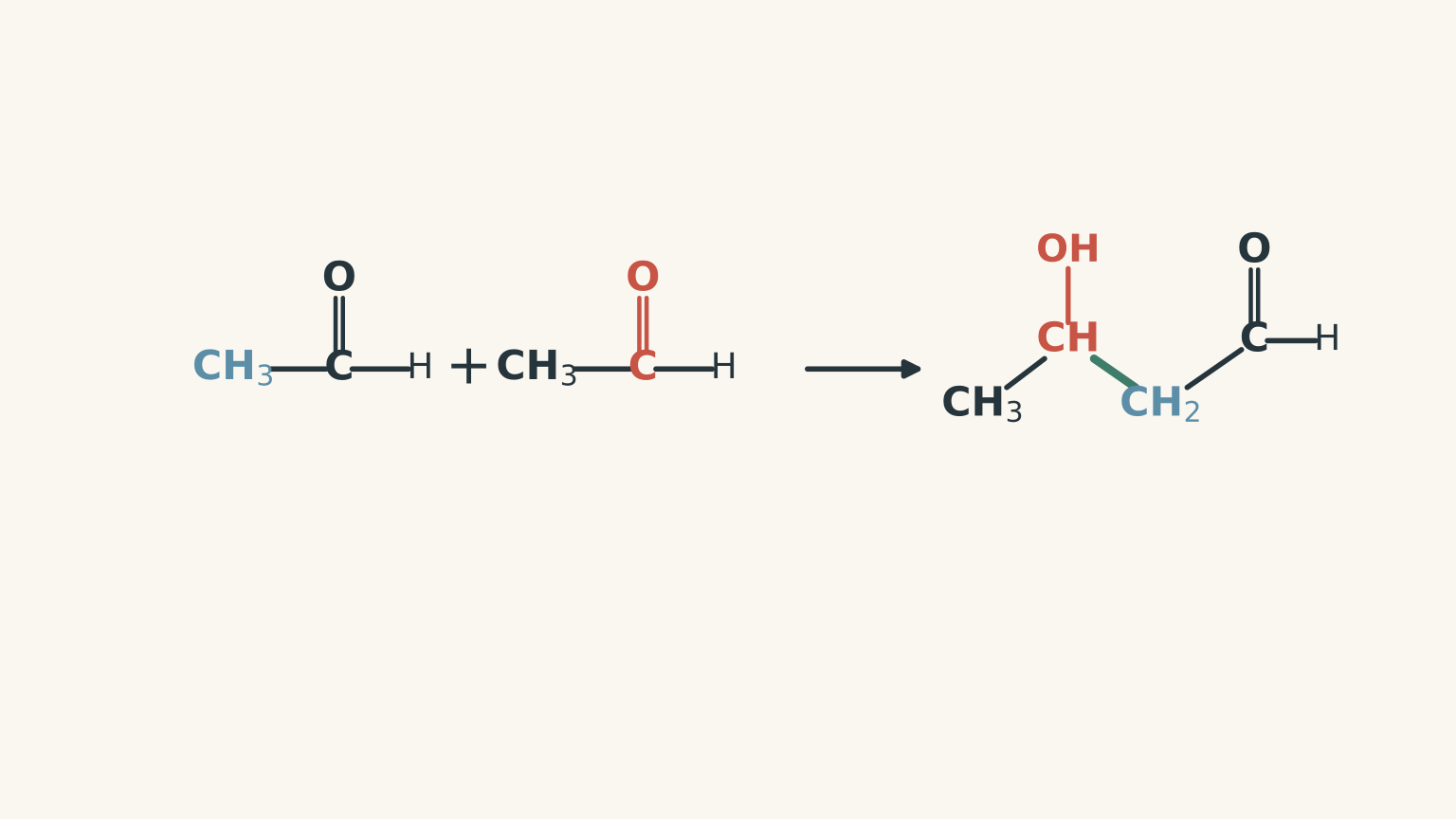
Due to technical limitations, this figure may display incorrectly or contain inaccuracies. Please check key details against your course materials.
Where this fits in the HSC: Aldol reactions are an extension beyond the required NSW HSC Chemistry syllabus content. They are not an HSC assessment requirement. This article assumes you understand the organic substitution model used to explain the production of alcohols from haloalkanes. The 2025 NSW Chemistry syllabus is scheduled for implementation from 2028, with its first HSC examination in 2029. Here, Year 12 describes the assumed prerequisite knowledge, not an assessment requirement.
01From substitution to a different kind of bond formation
You’ve already encountered a reaction in which a nucleophile helps produce an alcohol.
Consider the substitution of a haloalkane with hydroxide ions:
\[ \ce{R-X + OH^- -> R-OH + X^-} \]
Here:
- \(R\) represents the rest of the organic molecule.
- \(X\) represents a halogen.
- \(\mathrm{OH}^{-}\) is the hydroxide ion.
- \(\ce{R-OH}\) is the alcohol product.
The hydroxide ion acts as a nucleophile. It attacks the carbon attached to the halogen, and the halogen leaves.
The important outcome is that a new carbon-oxygen bond forms.
An aldol reaction uses a different strategy. Instead of replacing a halogen with a hydroxyl group, it creates a new carbon-carbon bond between two carbonyl compounds.
The difference is worth remembering:
| Reaction | Nucleophile | New bond formed |
|---|---|---|
| Haloalkane substitution | Hydroxide ion | C-O |
| Aldol reaction | Enolate ion | C-C |
The aldol reaction therefore gives chemists a way to join smaller carbon-based molecules into larger ones.
To understand how, we need to look more closely at the carbonyl group.
02Why the carbon next to a carbonyl group matters
A carbonyl group consists of a carbon atom double-bonded to an oxygen atom:
\[ \ce{C=O} \]
Oxygen is more electronegative than carbon. It attracts the shared electrons towards itself, making the carbonyl bond polar.
The carbonyl carbon consequently carries a partial positive charge, \(\delta^+\), while the oxygen carries a partial negative charge, \(\delta^-\).
This creates an important difference between the two ends of the carbonyl group:
- The carbonyl carbon is electron-deficient and can be attacked by nucleophiles.
- The oxygen is relatively electron-rich.
- The carbon immediately next to the carbonyl carbon can become nucleophilic under suitable conditions.
That last point is the key to aldol chemistry.
What is an alpha carbon?
The carbon directly adjacent to a carbonyl carbon is called the alpha (\(\alpha\)) carbon.
A hydrogen attached to this carbon is called an alpha hydrogen.
For ethanal, \(\ce{CH3CHO}\):
- The \(\ce{CHO}\) group contains the carbonyl.
- The \(\ce{CH3}\) carbon is the alpha carbon.
- Its three hydrogen atoms are alpha hydrogens.
Why do these hydrogen atoms matter?
They are more acidic than ordinary alkane C-H hydrogens because removing one can produce a resonance-stabilised ion.
A base can remove an alpha hydrogen, leaving behind an electron-rich species called an enolate ion.
Enolate formation
An enolate is formed when a base removes an alpha hydrogen from an aldehyde or ketone.
For ethanal, the process can be represented by:
\[ \ce{CH3CHO + OH^- <=> CH2=CH-O^- + H2O} \]
The equation shows one resonance representation of the enolate. It is important to understand that the negative charge is not confined to oxygen.
There are two major resonance contributors:
\[ \ce{^-CH2-CH=O <-> CH2=CH-O^-} \]
In one contributor, the negative charge is on the alpha carbon. In the other, it is on oxygen.
These are not two separate ions rapidly converting into one another. They are representations of the same resonance-stabilised enolate.
The negative charge is distributed across the oxygen and the adjacent carbon.
This matters because the alpha carbon can act as a nucleophile, even though much of the negative charge is represented on oxygen in one resonance contributor.
The enolate is therefore the species that allows the carbon-carbon bond to form.
One important qualification: Not every molecule of ethanal needs to become an enolate. Enolate formation is reversible, so only a fraction of the carbonyl compound may be present as enolate at any instant. As enolate is consumed in the next reaction step, the equilibrium can produce more.
This is why a base can catalyse the overall process without converting all the starting material into enolate.
03How the aldol reaction forms a carbon-carbon bond
Now imagine two ethanal molecules.
They have identical structures, but they can play different roles during a particular reaction event.
- One molecule forms an enolate and acts as the nucleophilic donor.
- The other molecule provides an electrophilic carbonyl carbon.
The enolate attacks the carbonyl carbon of the second molecule.
This is a nucleophilic addition reaction.
The three main steps
Step 1: Formation of the enolate
A base removes an alpha hydrogen from the first ethanal molecule.
The electrons from the C-H bond help form the enolate, which is stabilised by resonance.
Step 2: Formation of the new carbon-carbon bond
The alpha carbon of the enolate attacks the carbonyl carbon of the second ethanal molecule.
At the same time, the electrons in the second molecule’s C=O double bond move onto oxygen.
This produces an alkoxide ion, which has a negatively charged oxygen.
Step 3: Protonation
The alkoxide ion accepts a proton from water.
This produces a hydroxyl group, \(\ce{-OH}\), and regenerates the hydroxide ion.
The final product is 3-hydroxybutanal.
The overall reaction is:
\[ \ce{2CH3CHO <=> CH3CH(OH)CH2CHO} \]
The product, \(\ce{CH3CH(OH)CH2CHO}\), is called 3-hydroxybutanal.
Notice what happened to the two original carbonyl groups:
- One remains as an aldehyde.
- The other becomes a hydroxyl group.
The oxygen in the new hydroxyl group originally belonged to the attacked carbonyl. Hydroxide acts as a catalyst and is regenerated rather than being incorporated into the overall product.
What does the word aldol mean?
The name comes from combining the words aldehyde and alcohol.
The product of a typical aldol addition contains both an aldehyde or ketone functional group and an alcohol functional group.
More specifically, it contains a hydroxyl group on the beta (\(\beta\)) carbon relative to the carbonyl group.
For 3-hydroxybutanal:
\[ \ce{CHO-CH2-CH(OH)-CH3} \]
The carbon next to the aldehyde carbonyl is the alpha carbon. The next one is the beta carbon, which carries the hydroxyl group.
This explains the general term beta-hydroxy carbonyl compound.
Worked example: The self-aldol reaction of ethanal
Two ethanal molecules undergo base-catalysed aldol addition. Predict the product and explain which carbon atoms form the new bond.
Step 1
In ethanal, \(\ce{CH3CHO}\), the methyl carbon is adjacent to the carbonyl carbon.
It contains alpha hydrogens, so ethanal can form an enolate.
Step 2
The alpha carbon of the enolate is the nucleophilic site.
The carbonyl carbon of the second ethanal molecule is the electrophilic site.
Step 3
The alpha carbon attacks the second molecule’s carbonyl carbon. The C=O double bond becomes a C-O single bond, producing an alkoxide intermediate.
Step 4
Water supplies a proton, converting the negatively charged oxygen into an alcohol group.
The final product is:
\[ \ce{CH3CH(OH)CH2CHO} \]
This is 3-hydroxybutanal.
The key structural change is that two two-carbon molecules have become one four-carbon molecule.
The new bond connects the original alpha carbon of one ethanal molecule to the original carbonyl carbon of the other.
04Crossed aldol reactions: When the molecules are different
So far, both reacting carbonyl molecules have been identical.
An aldol reaction can also occur between two different aldehydes or ketones. This is called a crossed aldol reaction.
However, there is a complication.
Suppose we mix ethanal, \(\ce{CH3CHO}\), with benzaldehyde, \(\ce{C6H5CHO}\).
Both contain carbonyl groups, but their ability to form enolates is different.
Ethanal has alpha hydrogens, so it can form an enolate.
Benzaldehyde does not have an alpha hydrogen on an adjacent carbon that can be removed to produce the usual enolate. The aromatic ring carbon directly attached to its carbonyl group has no hydrogen.
Does this mean benzaldehyde cannot participate in an aldol reaction?
No. It can still act as the electrophile.
This is an important distinction:
A carbonyl compound needs an alpha hydrogen to act as an enolate donor, but it does not need an alpha hydrogen to act as an electrophile.
Worked example: A crossed aldol reaction
Ethanal and benzaldehyde undergo a crossed aldol addition under conditions that favour the reaction between these two compounds. Predict the product before dehydration.
Step 1
Ethanal, \(\ce{CH3CHO}\), has alpha hydrogens.
Benzaldehyde, \(\ce{C6H5CHO}\), does not have an alpha hydrogen suitable for forming the usual enolate.
Therefore, ethanal acts as the enolate donor.
Step 2
Benzaldehyde provides the electrophilic carbonyl carbon.
The enolate from ethanal attacks this carbon.
Step 3
The alpha carbon of ethanal becomes bonded to the carbonyl carbon of benzaldehyde.
The benzaldehyde carbonyl oxygen becomes an alkoxide.
Step 4
Protonation produces the beta-hydroxy aldehyde:
\[ \ce{C6H5CH(OH)CH2CHO} \]
The product is 3-hydroxy-3-phenylpropanal.
The new carbon-carbon bond joins the original alpha carbon of ethanal to the original carbonyl carbon of benzaldehyde.
Why crossed aldol reactions can produce mixtures
There is a catch.
Although benzaldehyde cannot form an enolate, ethanal can still react with another ethanal molecule.
Consequently, two aldol pathways are possible:
- Ethanal enolate attacks benzaldehyde, producing the crossed aldol product.
- Ethanal enolate attacks another ethanal molecule, producing 3-hydroxybutanal.
The absence of alpha hydrogens in one reactant helps control the possible products, but it does not automatically guarantee a single product.
When both carbonyl compounds have alpha hydrogens, the number of possible pathways increases further. Each compound may act as an enolate donor or an electrophile.
This is why controlling crossed aldol reactions can require carefully selected reaction conditions.
For now, remember the distinction between the donor and acceptor. It is more useful than simply memorising which compound is an aldehyde or ketone.
05Aldol addition versus aldol condensation
There is another important distinction.
An aldol addition initially produces a beta-hydroxy carbonyl compound. However, this product can undergo a further reaction in which water is eliminated.
This is called aldol condensation.
The elimination removes:
- A hydrogen from the alpha carbon.
- The hydroxyl group from the beta carbon.
A carbon-carbon double bond forms between those two carbons.
Consider the 3-hydroxybutanal formed from ethanal:
\[ \ce{CH3CH(OH)CH2CHO} \]
Under conditions that favour dehydration, it can form but-2-enal and water:
\[ \ce{CH3CH(OH)CH2CHO -> CH3CH=CHCHO + H2O} \]
The product, but-2-enal, is also commonly known as crotonaldehyde.
Why is the condensation product favoured?
Look at the arrangement of bonds in the product:
\[ \ce{C=C-C=O} \]
The carbon-carbon double bond is directly adjacent to the carbonyl group.
This arrangement is called conjugation.
Conjugation allows the pi electrons to become delocalised across the connected system of atoms. This gives the product additional stability compared with a structure containing isolated double bonds.
As a result, forming a conjugated carbonyl compound can favour dehydration.
Under basic conditions, dehydration generally follows an elimination mechanism called E1cB.
You do not need to master the full undergraduate treatment of this mechanism to understand the important steps:
- A base removes an alpha hydrogen, producing an enolate-like intermediate.
- The hydroxyl group is eliminated from the beta carbon.
- The carbon-carbon double bond forms, producing the conjugated carbonyl compound.
There is a subtle point here.
Hydroxide is normally a poor leaving group. You might therefore expect the elimination to be difficult. However, the formation of the more stable conjugated product helps drive the reaction.
Under acidic conditions, dehydration can occur by a different pathway because the hydroxyl group can be protonated and leave as water.
Not every aldol addition automatically produces a condensation product. The reaction conditions and the structure of the starting compounds influence which product is favoured.
The distinction is:
| Reaction | What happens? | Main product |
|---|---|---|
| Aldol addition | A new C-C bond forms and the carbonyl acceptor becomes an alcohol | Beta-hydroxy aldehyde or ketone |
| Aldol condensation | Aldol addition is followed by elimination of water | Alpha,beta-unsaturated aldehyde or ketone |
The elimination step also connects aldol chemistry to the chemistry of alkenes. If you want to compare how carbon-carbon double bonds participate in other reactions, see Addition Reactions of Unsaturated Hydrocarbons Explained.
06Common misconceptions
| Tempting assumption | What actually happens |
|---|---|
| The carbonyl carbon acts as the nucleophile. | The enolate’s alpha carbon acts as the nucleophile. The carbonyl carbon of the other molecule is electrophilic. |
| Both molecules need alpha hydrogens. | Only the enolate donor needs an alpha hydrogen. The other carbonyl compound can act purely as an electrophile. |
| Hydroxide becomes the hydroxyl group in the product. | The oxygen of the attacked carbonyl becomes the hydroxyl oxygen. Hydroxide is regenerated. |
| Every aldol reaction eliminates water. | Aldol addition can stop at the beta-hydroxy carbonyl product. Dehydration requires suitable conditions. |
| A crossed aldol reaction always gives one product. | Competing self-aldol and crossed aldol pathways may produce mixtures. |
| The reaction is simply another nucleophilic substitution. | Aldol chemistry involves enolate formation followed by carbon-carbon bond formation through nucleophilic addition. |
07Further reading and syllabus context
The mechanism and chemical principles discussed here are consistent with established organic chemistry teaching materials.
- NESA: Chemistry 11-12 Syllabus (2025) – official syllabus and implementation timeline.
- OpenStax: Organic Chemistry, Carbonyl Condensations – The Aldol Reaction – enolate formation, carbon-carbon bond formation, and aldol equilibria.
- University of Alberta: Dehydration of Aldol Products – conjugation and dehydration mechanisms.
08Questions and solutions
Question 1
Ethanal undergoes base-catalysed aldol addition to form 3-hydroxybutanal.
\[ \ce{2CH3CHO -> CH3CH(OH)CH2CHO} \]
A reaction begins with 0.30 mol of ethanal.
Assuming complete conversion to the aldol addition product, with no dehydration or competing reactions, calculate:
a) The theoretical amount, in moles, of 3-hydroxybutanal produced.
b) The theoretical mass of 3-hydroxybutanal.
Use the following atomic masses:
- C = 12.0 g mol\(^{-1}\)
- H = 1.0 g mol\(^{-1}\)
- O = 16.0 g mol\(^{-1}\)
Solution 1
The theoretical maximum is 0.150 mol of 3-hydroxybutanal, with a mass of 13.2 g.
The key is recognising that two ethanal molecules combine to form one product molecule.
Part a: Calculate the amount of product.
From the balanced equation:
\[ 2\ce{CH3CHO} \rightarrow 1\text{ product} \]
The mole ratio of ethanal to product is 2:1.
Therefore:
\[ n(\text{product})=\frac{0.30}{2} \]
\[ \boxed{n=0.150\text{ mol}} \]
Part b: Calculate the mass.
First, determine the molecular formula of 3-hydroxybutanal.
\[ \ce{CH3CH(OH)CH2CHO} \]
Its molecular formula is \(\ce{C4H8O2}\).
Calculate its molar mass:
\[ M=4(12.0)+8(1.0)+2(16.0) \]
\[ M=88.0\text{ g mol}^{-1} \]
Now use:
\[ m=nM \]
Substitute:
\[ m=0.150\times88.0 \]
\[ \boxed{m=13.2\text{ g}} \]
The theoretical maximum mass is 13.2 g.
In a real reaction, the actual yield may be lower because aldol addition is reversible and competing reactions may occur. The calculation deliberately assumes complete conversion to isolate the stoichiometric relationship.
Question 2
Propanone, \(\ce{CH3COCH3}\), undergoes a self-aldol addition under base-catalysed conditions.
a) Identify the alpha carbons and explain how an enolate forms.
b) Predict the condensed structural formula of the aldol addition product.
c) Give the IUPAC name of the product.
d) Identify which original carbonyl group remains in the product and which is converted into a hydroxyl group.
Solution 2
The product is \(\ce{CH3COCH2C(OH)(CH3)2}\), named 4-hydroxy-4-methylpentan-2-one.
Part a: Identify the alpha carbons and form the enolate.
Propanone contains a carbonyl carbon bonded to two methyl groups.
Both methyl groups are alpha carbons because they are directly adjacent to the carbonyl carbon.
Their hydrogen atoms can be removed by a base to form an enolate.
One resonance representation of the enolate is:
\[ \ce{CH2=C(O^-)CH3} \]
The other places the negative charge on the alpha carbon:
\[ \ce{^-CH2-C(=O)-CH3} \]
The alpha carbon is the site that forms the new carbon-carbon bond.
Part b: Predict the product.
The enolate from one propanone molecule attacks the carbonyl carbon of another propanone molecule.
The attacked carbonyl becomes an alkoxide, which is subsequently protonated.
The product is:
\[ \ce{CH3COCH2C(OH)(CH3)2} \]
Part c: Name the product.
The longest chain containing the retained ketone carbonyl has five carbon atoms.
Numbering from the end closest to the ketone gives:
- Ketone at carbon 2.
- Hydroxyl group at carbon 4.
- Methyl substituent at carbon 4.
Therefore, the IUPAC name is:
\[ \boxed{\text{4-hydroxy-4-methylpentan-2-one}} \]
Part d: Identify the original functional groups.
The carbonyl group belonging to the enolate donor remains a ketone.
The carbonyl group belonging to the electrophilic acceptor is converted into an alcohol.
This is the same pattern seen in ethanal’s self-aldol reaction, even though the starting compounds are ketones rather than aldehydes.
Question 3
A reaction mixture contains ethanal, \(\ce{CH3CHO}\), and benzaldehyde, \(\ce{C6H5CHO}\), under base-catalysed aldol conditions.
For this question, consider only aldol pathways and ignore other competing reactions.
a) Which compound can form an enolate?
b) Write the condensed structural formula of the crossed aldol addition product.
c) A student claims that only the crossed aldol product can form because benzaldehyde has no alpha hydrogen. Explain why this conclusion is incorrect.
d) Identify one other possible aldol product.
Solution 3
Ethanal can form the enolate, and benzaldehyde can act as the electrophile. However, the crossed aldol product is not necessarily the only aldol product.
Part a: Identify the enolate donor.
Ethanal has three alpha hydrogens on its methyl group.
It can therefore form an enolate when a base removes one of these hydrogens.
Benzaldehyde has no alpha hydrogen suitable for forming the usual enolate.
Consequently, ethanal is the enolate donor, while benzaldehyde acts as the electrophilic acceptor.
Part b: Determine the crossed aldol product.
The alpha carbon of the ethanal enolate attacks the carbonyl carbon of benzaldehyde.
After protonation, the product is:
\[ \ce{C6H5CH(OH)CH2CHO} \]
This is 3-hydroxy-3-phenylpropanal.
Part c: Evaluate the student’s claim.
The claim is incorrect because the absence of alpha hydrogens prevents benzaldehyde from forming an enolate, not from acting as an electrophile.
Benzaldehyde can still be attacked by the ethanal enolate.
However, this does not stop ethanal from forming its own enolate and attacking another ethanal molecule.
Part d: Identify a competing product.
Ethanal can undergo self-aldol addition:
\[ \ce{2CH3CHO -> CH3CH(OH)CH2CHO} \]
This produces 3-hydroxybutanal.
Therefore, the mixture can produce both the crossed aldol product and the ethanal self-aldol product.
The important lesson is that the ability to act as an enolate donor is different from the ability to act as an electrophile.
Question 4
3-Hydroxybutanal is heated under conditions that favour base-catalysed dehydration.
\[ \ce{CH3CH(OH)CH2CHO} \]
a) Write the structural formula of the organic product and identify the other product formed.
b) Identify which hydrogen and hydroxyl group are eliminated.
c) Explain why the resulting organic product is stabilised by conjugation.
d) Explain why dehydration is a separate step from the initial aldol addition.
Solution 4
The organic product is but-2-enal, \(\ce{CH3CH=CHCHO}\), and the other product is water.
Part a: Write the dehydration equation.
\[ \ce{CH3CH(OH)CH2CHO -> CH3CH=CHCHO + H2O} \]
The product is an alpha,beta-unsaturated aldehyde.
Part b: Identify the atoms removed.
The aldehyde carbonyl carbon is carbon 1.
The carbon immediately next to it is the alpha carbon, which is carbon 2.
The next carbon is the beta carbon, which is carbon 3.
The reaction removes:
- One hydrogen from the alpha carbon.
- The hydroxyl group from the beta carbon.
A double bond forms between carbons 2 and 3.
Part c: Explain conjugation.
The product contains:
\[ \ce{C=C-C=O} \]
The carbon-carbon double bond is directly adjacent to the carbonyl double bond.
This allows the pi electrons to become delocalised across the connected system.
The resulting conjugated structure is more stable than a comparable structure with isolated double bonds.
This stabilisation helps favour dehydration.
Under basic conditions, the alpha hydrogen is removed first to form an enolate-like intermediate. The hydroxyl group is then eliminated, allowing the double bond to form.
Part d: Distinguish addition from condensation.
The initial aldol addition forms a beta-hydroxy aldehyde.
Dehydration occurs afterwards and removes water.
Therefore, the aldol addition and aldol condensation describe different stages of the overall transformation.
Heating does not simply change the name of the initial reaction. It allows a further chemical reaction to occur.
Question 5
Hexane-1,6-dial has the structural formula:
\[ \ce{OHC-(CH2)4-CHO} \]
It contains two aldehyde functional groups within the same molecule.
Under dilute base-catalysed conditions, consider an intramolecular aldol addition in which one aldehyde group forms an enolate and attacks the other aldehyde group.
Assume that:
- Only intramolecular aldol addition is being considered.
- The alkoxide intermediate is protonated.
- No dehydration occurs.
- The product forms through attack between the alpha carbon of one aldehyde group and the carbonyl carbon of the other.
a) Explain why a single molecule can undergo aldol addition without reacting with a second molecule.
b) Identify the two carbon atoms that form the new carbon-carbon bond.
c) Determine the number of carbon atoms in the newly formed ring.
d) Describe the product, including the functional groups that remain.
e) Explain why dilution can favour this reaction over intermolecular aldol addition, but does not guarantee complete conversion.
Solution 5
Yes. A single molecule can undergo intramolecular aldol addition, producing a five-membered ring with an adjacent formyl substituent.
This question tests an important distinction: an aldol reaction requires two reactive carbonyl roles, but those roles do not always have to belong to two different molecules.
Part a: Explain how one molecule can react with itself.
Hexane-1,6-dial contains two aldehyde groups.
Each aldehyde has an adjacent alpha carbon containing hydrogens.
A base can remove an alpha hydrogen from one end, producing an enolate.
The other aldehyde group can act as an electrophile.
Because both groups belong to the same molecule, the enolate can attack the other carbonyl group without needing a collision with a second molecule.
The chain can adopt a shape that brings the two reactive sites close enough for bond formation.
Part b: Identify the new carbon-carbon bond.
Number the six carbon atoms along the starting chain:
\[ \ce{OHC-(CH2)4-CHO} \]
The left aldehyde carbon is carbon 1, and the right aldehyde carbon is carbon 6.
The alpha carbon next to the left aldehyde is carbon 2.
The new bond forms between:
- Carbon 2, the enolate’s alpha carbon.
- Carbon 6, the electrophilic carbonyl carbon at the other end.
The original carbonyl bond at carbon 6 becomes a C-O single bond, and its oxygen is protonated to form an alcohol.
Part c: Count the atoms in the ring.
This is the most important part of the question.
The new ring contains:
\[ \ce{C2-C3-C4-C5-C6} \]
Count these atoms:
\[ \boxed{5\text{ carbon atoms}} \]
The ring is therefore five-membered, not six-membered.
Why isn’t the entire six-carbon chain incorporated into the ring?
Because carbon 1, the original carbonyl carbon of the enolate donor, remains outside the ring as part of an aldehyde group.
The new bond joins carbon 2 to carbon 6, not carbon 1 to carbon 6.
Part d: Describe the product.
The product contains:
- A five-membered carbon ring.
- A hydroxyl group on the carbon that was originally the attacked aldehyde carbonyl carbon.
- An adjacent formyl group, \(\ce{-CHO}\), attached to the ring carbon that originally formed the enolate.
The product is therefore a cyclic beta-hydroxy aldehyde.
Part e: Explain the effect of dilution.
Intramolecular and intermolecular reactions involve different molecular encounters.
For intramolecular aldol addition, the enolate and electrophilic carbonyl group belong to the same molecule. The molecule only needs to adopt a suitable conformation for the reaction to occur.
For intermolecular aldol addition, two separate molecules must encounter one another in the correct way.
Reducing the concentration of the reactants suppresses bimolecular encounters more strongly than an intramolecular ring-closing event involving an already activated molecule.
Dilution can therefore favour intramolecular reaction relative to intermolecular dimerisation.
However, this does not guarantee complete conversion. The reaction still depends on factors such as molecular geometry, ring stability, equilibrium, and competing pathways.
The tempting assumption is that a six-carbon starting molecule must produce a six-membered ring. The actual ring size depends on which atoms form the new bond, not simply on the total number of carbon atoms in the starting molecule.
The central skill in aldol chemistry is identifying the two reacting carbon atoms before attempting to draw the product. Find the alpha carbon that becomes nucleophilic, find the electrophilic carbonyl carbon, and connect them. Once that becomes familiar, you can extend the same reasoning to other enolate reactions, where changing the electrophile provides a different way to construct carbon-carbon bonds.