
Aromatic, Antiaromatic, and Nonaromatic Compounds Explained
Learn how to distinguish aromatic, antiaromatic, and nonaromatic compounds using molecular geometry, cyclic conjugation, and Hückel's rule. Explore electron counting, lone-pair contributions, and worked HSC extension examples.
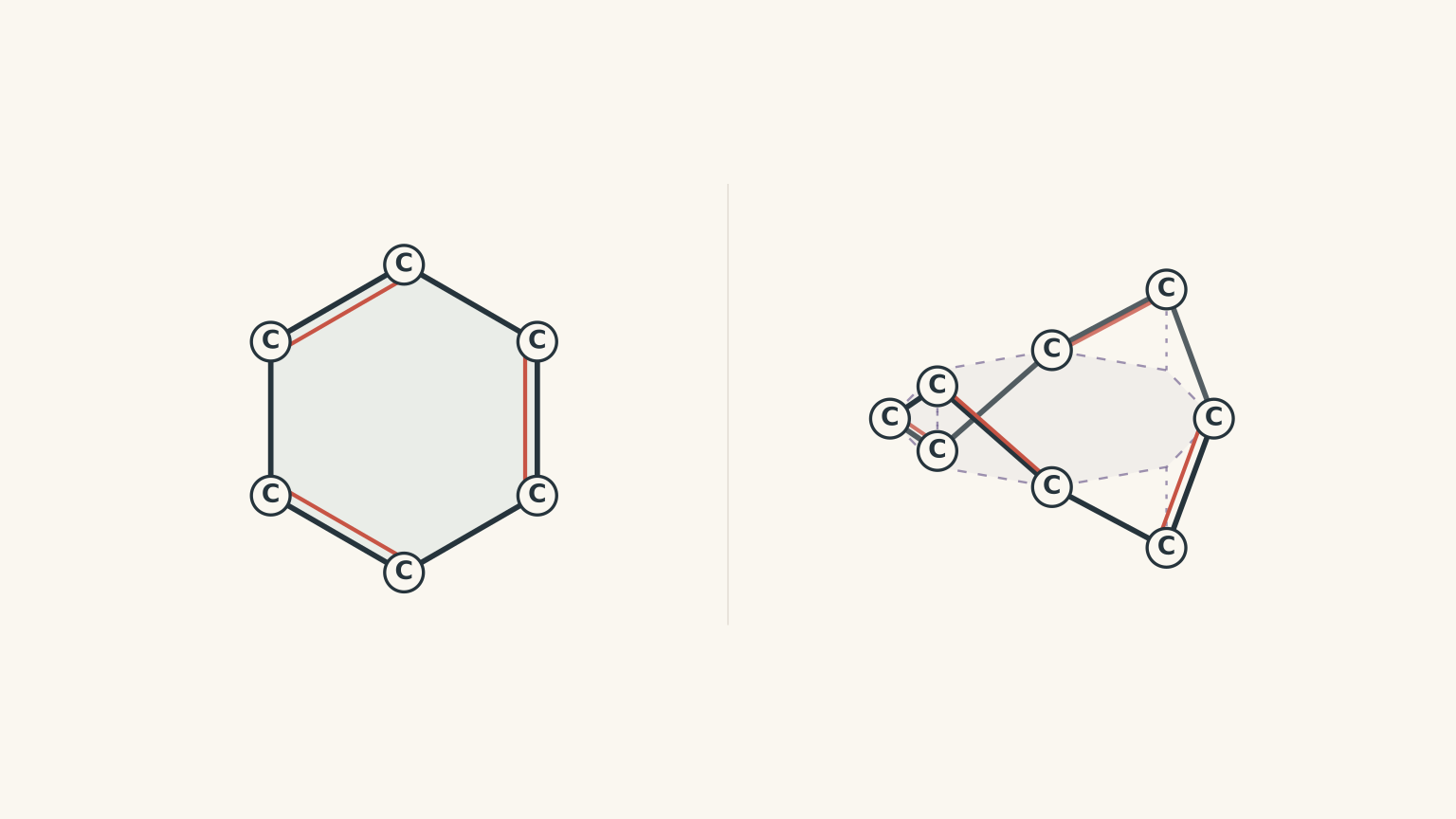
An eight-carbon ring with four alternating C=C bonds contains eight π electrons. Since \(8=4(2)\), you might predict that it is antiaromatic. That prediction seems reasonable, but it is wrong for the molecule in its normal shape. Cyclooctatetraene bends into a tub-like structure, preventing the p orbitals from overlapping continuously around a planar ring. It is therefore nonaromatic, not antiaromatic.
This reveals the most important rule in aromaticity: check the molecular structure before counting its electrons.
This topic is an extension beyond the required NSW Year 12 Chemistry organic chemistry syllabus. If you have already constructed and compared chain isomers of alkanes from C1-C8, you have a useful starting point. That work develops your understanding of how connectivity affects molecular shape. It is an entry point to this extension, not an additional assessment requirement.
Aromaticity takes the idea of molecular shape one step further. Instead of simply asking how carbon atoms are connected, we ask whether their orbitals form a continuous electronic pathway around a ring.
Due to technical limitations, this figure may display incorrectly or contain inaccuracies. Please check key details against your course materials.
01The first question: can electrons travel around the ring?
Start with a familiar idea from organic chemistry: conjugation.
In a conjugated molecule, alternating single and double bonds allow electrons to be delocalised across several adjacent atoms.
Consider a chain containing three carbon atoms connected by alternating double and single bonds. Each carbon involved in a double bond has an unhybridised p orbital. These orbitals overlap sideways, allowing the π electrons to spread across the connected structure.
A π bond is formed by this sideways overlap of p orbitals. Each ordinary C=C double bond contains two electrons in its π system.
Now imagine bending the conjugated chain around until its ends join. If the orbitals overlap all the way around, the electrons can become delocalised across a continuous ring.
This is the starting point for aromaticity.
Think of the overlapping p orbitals as a relay track. Each section connects to the next, and the final section connects back to the first. If one carbon lacks a suitable p orbital, there is a gap in the track.
The analogy has a limit: electrons are not tiny objects passing a baton between atoms. They occupy molecular orbitals and are delocalised across the connected system. The relay picture simply helps you recognise whether the orbital pathway is continuous.
There is another requirement: the ring must be approximately planar.
Why?
For the usual cyclic conjugation model, the p orbitals need to be parallel so that they can overlap effectively. When the ring bends out of a plane, neighbouring orbitals can become misaligned. Their overlap decreases, and the continuous pathway may disappear.
This is exactly what happens in cyclooctatetraene.
02Three conditions before counting electrons
For the simple Hückel model used here, check three conditions.
| Condition | What it means |
|---|---|
| Cyclic | The atoms form a closed ring. |
| Fully conjugated | Every atom in the ring has a suitable p orbital, allowing continuous overlap. |
| Planar or approximately planar | The p orbitals can overlap around the entire ring. |
Only after all three conditions are satisfied should you apply the electron-counting rule.
If a ring fails one of these conditions, it is nonaromatic in this model.
A few assumptions are important. We are considering ordinary ground-state, single-ring systems with the usual arrangement of parallel p orbitals. More advanced systems, such as twisted Möbius aromatic molecules and excited-state aromatic systems, require different considerations. They are outside the scope of this guide.
03Hückel’s rule: the electron-counting test
Once a ring is cyclic, fully conjugated, and planar, its number of π electrons determines whether it is aromatic or antiaromatic.
This relationship is known as Hückel’s rule.
There are two possible electron-counting patterns.
Aromatic compounds: the 4n + 2 rule
A planar, fully conjugated ring is aromatic when it contains:
\[ N_{\pi}=4n+2 \]
Here:
- \(N_{\pi}\) is the total number of π electrons in the cyclic conjugated system.
- \(n\) is a non-negative integer: \(0,1,2,3,\ldots\).
This gives the following possible electron counts:
| \(n\) | π electrons |
|---|---|
| 0 | 2 |
| 1 | 6 |
| 2 | 10 |
| 3 | 14 |
| 4 | 18 |
Aromatic compounds have additional stability associated with their cyclic electron delocalisation.
Why does this particular number matter?
In the simplified molecular orbital model, these electron counts allow the lower-energy π molecular orbitals to be filled in a closed-shell arrangement. The electrons occupy a particularly favourable configuration.
Antiaromatic compounds: the 4n rule
A planar, fully conjugated ring is antiaromatic when it contains:
\[ N_{\pi}=4n \]
For this rule, \(n=1,2,3,\ldots\).
The possible electron counts include:
| \(n\) | π electrons |
|---|---|
| 1 | 4 |
| 2 | 8 |
| 3 | 12 |
| 4 | 16 |
These electron arrangements are unfavourable for cyclic delocalisation. Instead of gaining the special stabilisation associated with aromaticity, the system experiences antiaromatic destabilisation.
This does not mean that every molecule containing four or eight π electrons is antiaromatic. The ring must still be planar and fully conjugated.
Nonaromatic compounds
A nonaromatic compound does not satisfy the structural requirements for either classification.
For example:
- An open-chain conjugated molecule is not cyclic.
- A cyclic molecule containing an sp3 carbon may lack continuous conjugation.
- A ring that adopts a sufficiently nonplanar geometry may lose the necessary orbital overlap.
A nonaromatic molecule is not automatically unstable. It simply does not receive aromatic stabilisation or experience antiaromatic destabilisation through the usual cyclic π-electron system.
The distinction is worth remembering:
| Classification | Structure | Electron count |
|---|---|---|
| Aromatic | Cyclic, planar, fully conjugated | \(4n+2\) |
| Antiaromatic | Cyclic, planar, fully conjugated | \(4n\) |
| Nonaromatic | Fails at least one structural condition | Hückel count cannot classify it |
The structural requirements are just as important as the arithmetic. This is consistent with the IUPAC definition of the Hückel rule and its restriction to planar monocyclic conjugated systems.
04Three familiar rings, three different outcomes
Let’s apply the model to three important compounds.
Benzene: aromatic
Benzene contains six carbon atoms arranged in a planar hexagonal ring.
Each carbon has an unhybridised p orbital, and all six orbitals overlap around the ring.
There are three C=C bonds, each contributing two π electrons.
Therefore:
\[ N_{\pi}=3\times2=6 \]
Check Hückel’s rule:
\[ 6=4(1)+2 \]
The ring satisfies the structural requirements and contains six π electrons.
Benzene is aromatic.
Its additional stability is associated with the delocalisation of its π electrons around the entire ring. This is also why its carbon-carbon bonds are more equivalent than a simple alternating single-and-double-bond picture suggests.
For a deeper explanation of this stabilisation, see Aromaticity: Why Benzene Is More Stable Than Expected.
Cyclobutadiene: antiaromatic
Cyclobutadiene contains four carbon atoms arranged in a planar ring.
It has two C=C bonds, giving:
\[ N_{\pi}=2\times2=4 \]
Check the 4n rule:
\[ 4=4(1) \]
The ring is cyclic, planar, and fully conjugated.
Cyclobutadiene is antiaromatic.
There is an interesting structural detail here. Real cyclobutadiene adopts a rectangular rather than perfectly square geometry. Its alternating bond lengths reduce its antiaromatic character compared with the idealised square arrangement.
However, this distortion does not automatically destroy the cyclic conjugation. The molecule retains antiaromatic character in the usual ground-state description.
Its high energy also involves substantial ring strain, so it would be misleading to attribute all of its instability to antiaromaticity.
Cyclooctatetraene: nonaromatic
Cyclooctatetraene contains eight carbon atoms and four C=C bonds.
Its π-electron count is:
\[ N_{\pi}=4\times2=8 \]
At first glance, eight electrons fit the 4n rule:
\[ 8=4(2) \]
You might therefore predict antiaromaticity.
But the molecule does not adopt a planar arrangement. It bends into a tub-shaped conformation.
This changes the result because the p orbitals cannot maintain the continuous overlap required for cyclic conjugation.
Cyclooctatetraene is nonaromatic in its normal ground-state geometry.
If it were forced into a planar, fully conjugated arrangement, the simple model would predict antiaromaticity. Its nonplanar shape allows it to avoid that unfavourable arrangement.
This is a useful example of how molecular geometry can change the classification without changing the number of π electrons.
05Charges and lone pairs can change the electron count
So far, we have counted two electrons for every C=C bond.
That works for many simple carbon rings, but it is not enough for every compound.
Some atoms contribute lone pairs to the cyclic π system. Others have empty p orbitals that allow conjugation without contributing electrons.
This is particularly important when considering charged molecules and rings containing nitrogen or oxygen.
Negative charges can contribute two electrons
Consider cyclopentadiene.
It has a five-membered ring containing two C=C bonds. These contribute four π electrons.
However, one carbon is a CH2 group. This carbon is sp3 hybridised and does not have the required unhybridised p orbital.
Consequently, the ring does not have continuous cyclic conjugation.
Cyclopentadiene is nonaromatic, despite having four π electrons.
Now consider what happens when a proton is removed from that CH2 carbon.
The resulting cyclopentadienyl anion, \(\mathrm{C_{5}H_{5}}^{-}\), can place the remaining electron pair in a p orbital. The formerly sp3 carbon becomes part of the conjugated system.
The ring now has five overlapping p orbitals.
Its electron count becomes:
\[ N_{\pi}=4+2=6 \]
Therefore:
\[ 6=4(1)+2 \]
The cyclopentadienyl anion is aromatic, assuming the planar conjugated structure.
Notice what changed: removing a proton did more than change the formal charge. It allowed the electron pair to participate in the cyclic π system.
This is an important connection between aromaticity and carbanion stability.
Positive charges do not necessarily break conjugation
A positively charged carbon can have an empty p orbital.
An empty p orbital contributes zero π electrons, but it can still participate in the continuous orbital arrangement.
This means a positive charge does not automatically make a ring nonaromatic.
The cyclopropenyl cation is a useful example. It contains a three-membered carbon ring with one double bond and one positively charged carbon.
The double bond contributes two π electrons. The positively charged carbon provides an empty p orbital, allowing the ring to remain fully conjugated.
Its total is:
\[ N_{\pi}=2 \]
Since:
\[ 2=4(0)+2 \]
the cyclopropenyl cation is aromatic.
The important distinction is between contributing electrons and providing an orbital that allows conjugation. An empty p orbital can do the second without doing the first.
Nitrogen: pyridine versus pyrrole
Nitrogen-containing rings introduce another complication.
A nitrogen atom can have a lone pair, but that does not mean the pair always contributes to aromaticity.
Its contribution depends on the orientation of the orbital containing the lone pair.
Consider two common heterocycles.
Pyridine
Pyridine is a six-membered ring containing five carbon atoms and one nitrogen atom.
- Each of the five carbon atoms contributes one π electron.
- Nitrogen contributes one π electron through its p orbital.
- Its lone pair occupies an orbital in the plane of the ring.
The lone pair is therefore not part of the cyclic π system.
Total:
\[ N_{\pi}=5+1=6 \]
Pyridine is aromatic.
Pyrrole
Pyrrole is a five-membered ring containing four carbon atoms and one nitrogen atom.
- Each carbon contributes one π electron.
- Nitrogen contributes two electrons from its lone pair.
- This lone pair occupies a p orbital perpendicular to the ring.
Total:
\[ N_{\pi}=4+2=6 \]
Pyrrole is also aromatic.
The key difference is the orientation of nitrogen’s lone pair.
In pyridine, the lone pair is outside the π system. In pyrrole, it completes the cyclic π system.
This is why you should never count every lone pair in a molecule automatically. You must determine whether it occupies an orbital that participates in the ring’s conjugation.
06Worked examples
Worked example: Is a six-membered ring aromatic if one carbon is sp3?
A six-membered carbon ring, A, contains three alternating C=C bonds. All six carbons are sp2 hybridised, and the ring is planar.
A second six-membered ring, B, contains two conjugated C=C bonds. Its remaining two carbon atoms are sp3 hybridised.
Classify both compounds.
Step 1
Both structures contain six-membered carbon rings, so both satisfy the cyclic requirement.
Step 2
In structure A, all six carbons are sp2 hybridised. Each has a p orbital that can overlap with its neighbours.
Structure A is fully conjugated.
In structure B, two carbons are sp3 hybridised. They do not provide the required p orbitals.
Structure B does not have continuous cyclic conjugation.
Step 3
There are three C=C bonds, each contributing two electrons.
\[ N_{\pi}=3\times2=6 \]
Step 4
\[ 6=4(1)+2 \]
Structure A is aromatic.
Step 5
Although structure B contains two C=C bonds and therefore four π electrons, it fails the continuous-conjugation requirement.
It is nonaromatic, not antiaromatic.
The important lesson is that a four-electron count does not automatically mean antiaromaticity. The structural conditions must be satisfied first.
Worked example: How do nitrogen lone pairs affect aromaticity?
Pyridine and pyrrole are both planar, fully conjugated heterocycles.
Determine the number of π electrons in each compound and explain why their nitrogen lone pairs are counted differently.
Step 1
Pyridine contains five carbon atoms, each contributing one electron to the π system.
Its nitrogen atom contributes one electron through its perpendicular p orbital.
Therefore:
\[ N_{\pi}=5+1=6 \]
The nitrogen lone pair is in an orbital lying in the plane of the ring, so it is excluded.
Step 2
Pyrrole contains four carbon atoms, each contributing one electron.
The nitrogen lone pair occupies a p orbital and contributes two electrons.
Therefore:
\[ N_{\pi}=4+2=6 \]
Step 3
For each molecule:
\[ 6=4(1)+2 \]
Both satisfy the 4n + 2 rule.
Pyridine and pyrrole are aromatic.
The important distinction is that nitrogen does not always contribute its lone pair. Its contribution depends on the orbital orientation and the requirements of the conjugated system.
07Questions and solutions
These questions move from straightforward electron counting to situations where molecular geometry, charge, and orbital participation interact.
Question 1
A three-membered carbon ring contains one C=C bond and one positively charged carbon atom.
Assume that all three carbon atoms have p orbitals perpendicular to the same plane and that the orbitals overlap continuously around the ring.
Determine whether the compound is aromatic, antiaromatic, or nonaromatic. Show your electron count and identify the value of \(n\).
Solution 1
The cyclopropenyl cation is aromatic, with two π electrons and \(n=0\).
The first important point is that the positively charged carbon has an empty p orbital. It contributes no electrons, but it still allows the ring to maintain continuous conjugation.
The C=C bond contributes two π electrons.
Therefore:
\[ N_{\pi}=2 \]
Apply the aromaticity rule:
\[ 2=4(0)+2 \]
The molecule is cyclic, planar, and fully conjugated. Its electron count satisfies the 4n + 2 rule.
The tempting mistake is to assume that a positively charged atom interrupts conjugation. An empty p orbital does not interrupt the orbital pathway. It simply contributes no electrons to the count.
Question 2
Cyclobutadiene has four π electrons and is commonly classified as antiaromatic in its planar ground-state structure.
Its idealised square geometry is distorted into a rectangle, with alternating shorter and longer carbon-carbon bonds.
A student argues:
“The rectangular distortion localises the double bonds, so cyclic conjugation is broken. The molecule must therefore be nonaromatic.”
Evaluate this statement. Explain what the distortion changes and whether it is sufficient to remove antiaromaticity.
Solution 2
The student’s conclusion is incorrect: rectangular cyclobutadiene retains antiaromatic character, although the distortion reduces it.
Start with the electron count.
Cyclobutadiene contains two C=C bonds:
\[ N_{\pi}=2\times2=4 \]
Therefore:
\[ 4=4(1) \]
The molecule has four π electrons.
Now consider what the rectangular distortion actually changes.
It makes the two pairs of carbon-carbon bonds different in length. This reduces the symmetry and changes the extent of π-electron delocalisation.
However, the ring remains planar, and all four carbon atoms still have p orbitals.
The orbitals can still overlap around the entire ring.
Consequently, the essential requirements for antiaromaticity remain satisfied.
The student’s mistake is confusing reduced delocalisation with completely broken conjugation.
These are not the same thing.
If the ring twisted sufficiently to prevent continuous orbital overlap, it could avoid antiaromaticity by becoming nonaromatic. A rectangular shape alone does not establish that this has happened.
There is also an important energy consideration: cyclobutadiene experiences substantial ring strain in addition to its antiaromatic destabilisation. Its geometry and overall stability cannot be explained by electron counting alone.
Question 3
Consider two seven-membered carbon rings.
- Compound A is cycloheptatriene. It contains three C=C bonds and one sp3-hybridised CH2 carbon.
- Compound B is the tropylium cation, \(\ce{C7H7+}\). It contains three C=C bonds, a positive charge, and seven carbon atoms with p orbitals overlapping continuously around a planar ring.
Classify both compounds.
Explain why the two structures have the same number of electrons from their C=C bonds but different aromaticity classifications.
Solution 3
Cycloheptatriene is nonaromatic, whereas the tropylium cation is aromatic.
Both structures contain three C=C bonds.
Their initial π-electron count is therefore:
\[ N_{\pi}=3\times2=6 \]
However, their conjugation differs.
In cycloheptatriene, the CH2 carbon is sp3 hybridised. It lacks the p orbital needed to complete the cyclic pathway.
The ring is not fully conjugated, so the six-electron count cannot be used to classify it as aromatic.
Cycloheptatriene is nonaromatic.
In the tropylium cation, all seven carbon atoms have p orbitals.
The positively charged carbon has an empty p orbital. It contributes no additional electrons, but the orbital allows conjugation to continue around the ring.
The total remains six π electrons.
\[ 6=4(1)+2 \]
The tropylium cation is aromatic.
The tempting prediction is that identical numbers of double bonds should produce identical aromaticity.
The missing consideration is the availability of a p orbital at every ring atom. Electron count alone cannot establish aromaticity.
Question 4
A five-membered heterocyclic compound contains three carbon atoms and two nitrogen atoms.
Assume that the ring is planar and fully conjugated.
The structure has the following features:
- Three carbon atoms each contribute one electron to the π system.
- One nitrogen atom is part of a C=N double bond. Its lone pair lies in the plane of the ring.
- The second nitrogen is an NH group with a lone pair occupying a p orbital perpendicular to the ring.
Determine the total number of π electrons and classify the compound.
Explain why the two nitrogen atoms contribute differently.
Solution 4
The compound is aromatic, with six π electrons. Only the NH nitrogen contributes both electrons from its lone pair.
Start by counting the contributions from the three carbon atoms.
Each contributes one electron:
\[ N_{\pi,\mathrm{carbon}}=3 \]
The nitrogen in the C=N double bond contributes one electron through its p orbital.
Its lone pair is in the plane of the ring, so it does not participate in the cyclic π system.
The NH nitrogen contributes two electrons because its lone pair occupies a p orbital perpendicular to the ring.
The total is:
\[ N_{\pi}=3+1+2 \]
\[ N_{\pi}=6 \]
Apply Hückel’s rule:
\[ 6=4(1)+2 \]
The compound is aromatic.
The trap is treating both nitrogen lone pairs identically.
Although both atoms are nitrogen, they have different bonding environments and different orbital orientations.
One nitrogen contributes one electron through its p orbital, while the other contributes two from its lone pair.
This arrangement is found in imidazole, an important aromatic heterocycle.
Question 5
Cyclooctatetraene, \(\ce{C8H8}\), contains four C=C bonds and normally adopts a tub-shaped, nonplanar conformation.
Now consider a salt containing its dianion, \(\mathrm{C_{8}H_{8}}^{2-}\).
For this question, make the following assumptions:
- The neutral molecule retains its normal tub-shaped geometry.
- The dianion adopts a planar geometry with all eight carbon p orbitals overlapping continuously.
- The counterions stabilise the dianion’s charge but do not contribute electrons to its cyclic π system.
- Both species are considered in their ordinary ground-state configurations.
A student makes two predictions:
- Neutral cyclooctatetraene must be antiaromatic because it has eight π electrons.
- The dianion must be even less stable because adding two electrons increases electron-electron repulsion.
Evaluate both predictions.
Your answer must:
- Classify the neutral molecule in its actual geometry.
- Predict the classification of a hypothetical planar neutral molecule.
- Calculate the dianion’s π-electron count.
- Explain why adding two electrons changes the aromaticity classification.
- Explain why aromatic stabilisation does not, by itself, establish the total thermodynamic stability of the dianion.
Solution 5
Neutral cyclooctatetraene is nonaromatic, its hypothetical planar neutral form would be antiaromatic, and the planar dianion is aromatic in the stated model.
The student’s first prediction overlooks the actual geometry of the neutral molecule.
Work through the three structures separately.
Part A: Neutral cyclooctatetraene in its normal geometry
There are four C=C bonds.
Each contributes two π electrons:
\[ N_{\pi}=4\times2=8 \]
The electron count fits the 4n pattern:
\[ 8=4(2) \]
However, the neutral molecule adopts a tub-shaped conformation.
Its p orbitals do not form a continuous planar loop.
Therefore, the neutral molecule is nonaromatic.
The electron count alone cannot override the structural requirement.
Part B: Hypothetical planar neutral cyclooctatetraene
Now imagine that the neutral molecule is forced into a planar geometry while retaining all eight p orbitals.
The electron count remains unchanged:
\[ N_{\pi}=8 \]
The ring is now cyclic, planar, and fully conjugated.
Since:
\[ 8=4(2) \]
the planar neutral molecule would be antiaromatic.
This is precisely the unfavourable electronic arrangement that the normal tub-shaped geometry helps the neutral molecule avoid.
Part C: Cyclooctatetraene dianion
The dianion contains two additional electrons.
Its original four double bonds contribute eight electrons. The additional negative charge contributes another two electrons to the cyclic π system under the stated assumptions.
Therefore:
\[ N_{\pi}=8+2=10 \]
Apply the aromaticity rule:
\[ 10=4(2)+2 \]
The dianion has ten π electrons and satisfies the 4n + 2 rule.
It is aromatic under the specified planar, fully conjugated model.
Part D: Why adding electrons can improve the π-electron arrangement
The tempting prediction is that adding electrons must always make a molecule less stable because electron-electron repulsion increases.
But this ignores the arrangement of electrons in molecular orbitals.
In the neutral planar eight-electron system, the π-electron configuration is unfavourable.
Adding two electrons changes the orbital occupancy. In the simplified molecular orbital description, these electrons complete the favourable closed-shell arrangement associated with ten π electrons.
The result is aromatic stabilisation.
This does not mean that electron repulsion disappears. It means that the electronic configuration gains a different form of stabilisation that must also be considered.
Part E: What aromaticity cannot tell us
There is one final distinction.
Aromaticity describes the stabilisation associated with a particular π-electron arrangement. It does not independently determine the total energy of a charged molecule or prove that an isolated dianion is thermodynamically stable.
The additional negative charge introduces electrostatic considerations. Solvent effects, counterions, and the surrounding chemical environment also influence stability.
Indeed, theoretical work on the isolated cyclooctatetraene dianion describes it as a short-lived resonance state rather than a stable free ion. This is why the question explicitly specifies a stabilising salt environment.
The important conclusion is that adding electrons can change a ring from an unfavourable π-electron configuration into an aromatic one, but the overall stability of the chemical species still depends on more than aromaticity alone.
08Where to use this model next
The most reliable way to classify an unfamiliar ring is to follow the same order every time:
- Is the structure cyclic?
- Does every ring atom have a suitable p orbital?
- Can those orbitals overlap continuously around a planar ring?
- How many electrons actually belong to that cyclic π system?
- Does the count satisfy \(4n+2\) or \(4n\)?
Never start with the electron count and assume the geometry will cooperate.
Once you can distinguish aromatic, antiaromatic, and nonaromatic structures, the next useful step is predicting how chemical reactions affect the ring. In particular, you can start understanding why aromatic compounds such as benzene tend to favour substitution reactions that preserve their delocalised π system rather than addition reactions that destroy it.