
Acetals and Carbonyl Protection in Multi-Step Organic Synthesis
Learn how acetals temporarily protect aldehydes and ketones during multi-step organic synthesis. Explore acetal formation, reversible hydrolysis, reaction selectivity, and worked examples of protecting-group strategies.
Imagine a molecule containing both a ketone and an ester. You want to reduce the ester to an alcohol, but the reducing agent you need will also attack the ketone. How can you change one functional group without destroying the other?
One solution is to temporarily convert the ketone into an acetal. The acetal is much less reactive under the conditions needed for ester reduction. Once the ester has been transformed, you can reverse the process and recover the original ketone.
This strategy is called carbonyl protection. It is an extension beyond the required content of the NSW Chemistry 11-12 (2025) syllabus. The relevant syllabus foundation is constructing reaction pathways for ester synthesis, including multi-step pathways. Acetal formation and protecting-group chemistry take that synthesis-planning skill further. NESA’s 2025 syllabus begins implementation in 2028, with its first HSC examination in 2029.
You do not need to memorise acetal protection as an HSC reaction. The aim here is to understand how chemists manage competing reactions when a molecule contains several functional groups.
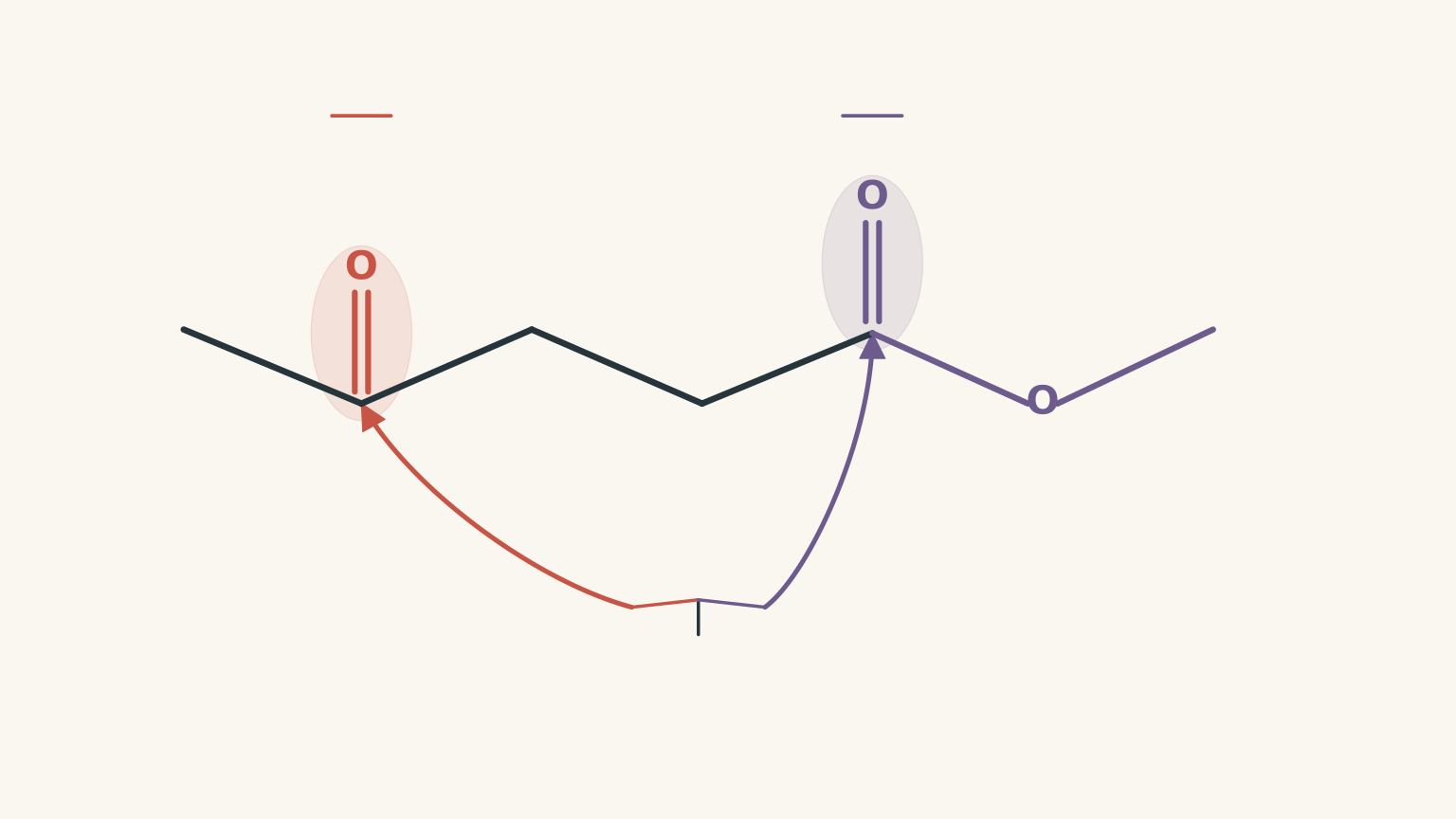
Due to technical limitations, this figure may display incorrectly or contain inaccuracies. Please check key details against your course materials.
01The syllabus foundation: multi-step organic synthesis
Before looking at protection, consider the type of reaction pathway you already know.
The 2025 Chemistry syllabus requires students to construct flow charts showing how organic compounds can be converted into other compounds, including pathways involving multiple reactions.
For example, suppose you want to synthesise ethyl propanoate, starting with propan-1-ol.
The starting alcohol cannot simply be mixed with ethanol to produce the desired ester. You first need to convert the propan-1-ol into a carboxylic acid.
The pathway has two stages.
Stage 1: Oxidise the alcohol to a carboxylic acid.
\[ \ce{CH3CH2CH2OH ->[K2Cr2O7/H2SO4] CH3CH2COOH} \]
The propan-1-ol is oxidised to propanoic acid using acidified potassium dichromate under reflux.
Stage 2: Esterify the carboxylic acid.
\[ \ce{CH3CH2COOH + HOCH2CH3} \]
\[ \ce{<=>[conc. H2SO4] CH3CH2COOCH2CH3 + H2O} \]
The propanoic acid reacts with ethanol under acid-catalysed conditions to produce ethyl propanoate and water.
This pathway demonstrates an important principle: a successful synthesis depends on choosing the correct reaction for each stage and identifying the intermediate compounds.
However, there is an additional problem when a molecule contains several reactive functional groups.
A reagent that performs the intended reaction at one position might also react somewhere else.
This is where protecting groups become useful.
If your carbonyl compound is produced by breaking an alkene apart, you can also review tutorgum’s guide to Alkene Ozonolysis. That reaction can provide an aldehyde or ketone that is subsequently used in a longer synthesis.
02Why protect a carbonyl group?
A carbonyl group consists of a carbon atom double-bonded to an oxygen atom:
\[ \ce{C=O} \]
It occurs in several functional groups, including aldehydes, ketones, carboxylic acids, and esters.
For carbonyl protection using acetals, we are specifically interested in aldehydes and ketones.
The carbonyl bond is polar because oxygen attracts electrons more strongly than carbon.
Consequently:
- The oxygen atom carries a partial negative charge.
- The carbonyl carbon carries a partial positive charge.
- Nucleophiles are attracted to the carbonyl carbon.
A nucleophile is an electron-rich species that can donate an electron pair to form a new bond.
This makes aldehydes and ketones susceptible to nucleophilic addition reactions.
For example, strong hydride reducing agents can attack a carbonyl group and convert it into an alcohol. Grignard reagents can also attack carbonyl carbons, creating new carbon-carbon bonds.
The problem becomes clear when a molecule contains two carbonyl groups.
Suppose you have a ketone and an ester, and you want to reduce only the ester. A sufficiently strong reducing agent may attack both functional groups.
You do not necessarily have a problem with the reducing agent itself. You have a problem with the molecule presenting two reactive sites.
This is a problem of chemoselectivity: achieving a reaction at one functional group while leaving another functional group unchanged.
A protecting group helps solve this problem by temporarily changing the structure of the unwanted reaction site.
The carbonyl group is not physically covered. Its bonding changes, producing a different functional group with different chemical properties.
03What is an acetal?
An acetal is a compound in which the same carbon atom is attached to two oxygen atoms through single bonds.
Its general structure is:
\[ \ce{R2C(OR')2} \]
Here:
- \(R\) represents a hydrogen atom or a carbon-containing group attached to the central carbon.
- \(R'\) represents a carbon-containing group attached through oxygen.
- The central carbon is the carbon that originally belonged to the carbonyl group.
For an aldehyde, one of the two \(R\) groups is hydrogen. For a ketone, both are carbon-containing groups.
You may also encounter the term ketal for an acetal derived from a ketone. Modern IUPAC terminology includes ketone-derived compounds within the broader acetal classification.
The important structural change is that the original carbonyl carbon no longer has a C=O double bond. It now has two C-O single bonds.
Making a cyclic acetal
A common way to form an acetal is to react an aldehyde or ketone with an alcohol under acidic conditions.
If a simple alcohol is used, two alcohol molecules are required for each carbonyl group.
For example:
\[ \ce{R2C=O + 2R'OH} \]
\[ \ce{<=>[H^+] R2C(OR')2 + H2O} \]
A particularly useful alternative is ethane-1,2-diol, commonly called ethylene glycol.
Its structure is:
\[ \ce{HOCH2CH2OH} \]
It contains two hydroxyl groups in the same molecule.
Both oxygen atoms can bond to the original carbonyl carbon, producing a cyclic acetal.
The resulting ring contains five atoms:
- The original carbonyl carbon.
- Two oxygen atoms.
- Two carbon atoms from the ethylene glycol.
This is called a five-membered cyclic acetal.
Using one molecule of ethane-1,2-diol per carbonyl group makes this reaction particularly useful for protecting aldehydes and ketones in larger molecules.
04How does acetal formation work?
The reaction is acid-catalysed.
The acid helps activate the carbonyl group so that the alcohol can attack it. The mechanism also explains why acetals can later be converted back into carbonyl compounds.
There are four important stages.
Stage 1: Activate the carbonyl group
The acid protonates the carbonyl oxygen.
This increases the electrophilic character of the carbonyl carbon, making it more susceptible to attack by a nucleophile.
Remember that oxygen attracts electrons strongly. Protonating the oxygen makes the carbonyl carbon even more electron-deficient.
Stage 2: Form a hemiacetal
One of the oxygen atoms from ethane-1,2-diol attacks the carbonyl carbon.
The carbonyl double bond breaks, and proton transfers produce an intermediate containing:
- One hydroxyl group, \(\ce{-OH}\).
- One alkoxy group, \(\ce{-OR}\).
This intermediate is called a hemiacetal.
Its general structure is:
\[ \ce{R2C(OH)(OR')} \]
The word hemi means half. The carbon has only one alkoxy group rather than the two found in a complete acetal.
For a ketone-derived intermediate, you may also encounter the term hemiketal.
Stage 3: Remove water
The hydroxyl group on the hemiacetal is protonated.
Why is this necessary?
A hydroxyl group is not a particularly good leaving group. However, protonation converts it into water, which can leave much more readily.
Water leaves, producing a positively charged intermediate called an oxocarbenium ion.
This intermediate is stabilised by the adjacent oxygen atom.
Stage 4: Close the ring
The second hydroxyl group from the original ethane-1,2-diol molecule attacks the positively charged carbon.
The ring closes, and a final proton is removed.
The cyclic acetal is formed, and the acid catalyst is regenerated.
The key structural change is now complete: the original carbonyl group has been converted into two C-O single bonds.
05Why is acetal formation reversible?
There is an important detail here.
Acetal formation is not an irreversible reaction. It is an equilibrium process.
The overall reaction is:
\[ \ce{R2C=O + HOCH2CH2OH} \]
\[ \ce{<=>[H^+] R2C(OCH2CH2O) + H2O} \]
The expression \(\ce{R2C(OCH2CH2O)}\) represents the cyclic acetal, with both terminal oxygen atoms bonded to the same central carbon.
The reaction can proceed in either direction.
How do chemists favour acetal formation?
Acetal formation produces water.
According to Le Châtelier’s principle, removing a product from an equilibrium system encourages the reaction to produce more of that product.
There are two common ways to favour acetal formation:
- Use an excess of the alcohol or diol.
- Remove the water produced during the reaction.
Both approaches favour the formation of the acetal.
How do chemists reverse the reaction?
To regenerate the original carbonyl group, use aqueous acid.
The presence of excess water and acid favours hydrolysis of the acetal.
Hydrolysis is a reaction in which a compound is broken apart through reaction with water.
In this case, the cyclic acetal is converted back into the original aldehyde or ketone, and the ethane-1,2-diol is released.
This reversibility is exactly what makes acetals useful as protecting groups.
You can install the protecting group, carry out another reaction, and then deliberately remove the protection.
A common misconception: more acid means more acetal
Acid is a catalyst, not the factor that determines the equilibrium position.
Adding acid increases the rate of both forward and reverse reactions. It does not change the equilibrium constant at a fixed temperature.
To favour acetal formation, you need to manage the reactant and product concentrations, particularly the amount of water.
This distinction is important when applying equilibrium principles to organic synthesis.
06Why are acetals useful as protecting groups?
The central advantage of an acetal is its resistance to many reaction conditions that would normally affect an aldehyde or ketone.
Once the carbonyl has been converted into an acetal, the molecule no longer contains that reactive C=O bond at the protected position.
The acetal behaves more like an ether.
This gives it a different pattern of chemical reactivity.
| Reaction conditions | Typical acetal behaviour |
|---|---|
| Strongly basic conditions | Generally stable |
| Many nucleophilic reagents | Generally stable |
| Grignard reagents | Generally stable |
| Common hydride reducing agents | Generally stable |
| Aqueous acid | Hydrolysed back to the carbonyl |
This stability is not universal. Conditions, temperature, other functional groups, and the exact molecular structure all matter.
However, the contrast between basic and acidic conditions is particularly useful.
Why are acetals stable under basic conditions?
A carbonyl group contains an electrophilic carbon atom that can be attacked by nucleophiles.
An acetal no longer contains that electrophilic carbonyl centre.
Its C-O bonds behave much more like ordinary ether bonds. These bonds are generally resistant to cleavage under basic conditions.
Consequently, an acetal can often survive reactions involving strong bases or nucleophiles.
Why are acetals unstable under acidic conditions?
Under acidic conditions, an oxygen atom in the acetal can become protonated.
This makes the adjacent carbon-oxygen bond easier to break.
Water can then participate in the reverse reaction, eventually regenerating the carbonyl group.
The difference is that acid activates the acetal towards cleavage, whereas ordinary basic conditions do not.
This gives chemists a useful combination:
- Protect a carbonyl using acid-catalysed acetal formation.
- Carry out a compatible basic or reducing reaction.
- Remove the acetal using aqueous acid.
Three questions to ask before using an acetal
A protecting group is only useful if it works throughout the entire synthesis.
Before choosing an acetal, check three things.
1. Can you install it selectively?
If your molecule contains multiple aldehydes or ketones, you need to consider whether the intended carbonyl can be protected without also protecting another one.
Aldehydes are often more reactive than ketones, which can sometimes help with selective protection. However, this is not guaranteed.
2. Will it survive the reaction you actually want to perform?
An acetal may survive a strong base but not an acidic reaction.
Check every intermediate step, not just the main reaction.
3. Can you remove it without damaging the final molecule?
Acid hydrolysis is useful, but it may also affect other acid-sensitive functional groups.
A protecting group that cannot be removed cleanly is not particularly helpful.
These three checks are the foundation of protecting-group strategy.
07Worked example: Reducing an ester while retaining a ketone
A molecule called methyl 4-acetylbenzoate contains two different carbonyl groups. Its benzene ring has a ketone group and a methyl ester group at opposite positions.
Design a reaction pathway that converts the ester into a primary alcohol while retaining the original ketone.
The desired product is 4-acetylbenzyl alcohol.
Step 1
The ketone must remain unchanged, while the ester needs to be reduced.
Lithium aluminium hydride, \(\ce{LiAlH4}\), is a strong reducing agent that can reduce both ketones and esters.
If the unprotected molecule is exposed to this reagent, both carbonyl groups may be reduced.
Therefore, protect the ketone first.
Step 2
React the ketone with ethane-1,2-diol under acid-catalysed conditions.
The ketone becomes a cyclic acetal, while the ester remains unchanged.
Water is removed to favour acetal formation.
The molecule now contains a protected ketone and an exposed ester.
Step 3
Use lithium aluminium hydride under anhydrous conditions.
The ester is reduced to a primary alcohol attached to the benzene ring.
Importantly, the acetal survives these reducing conditions.
The desired ester transformation has occurred without reducing the protected ketone.
Lithium aluminium hydride is highly reactive with water, so this is a reaction-planning example, not an unsupervised practical procedure.
Step 4
After the reducing reagent has been safely consumed and the intermediate is ready for deprotection, treat the acetal with aqueous acid.
The acetal undergoes hydrolysis, regenerating the original ketone.
The final molecule is 4-acetylbenzyl alcohol.
The important reasoning: the ketone was not protected because it was difficult to react. It was protected because it was too easy to react under the conditions needed for the ester.
That is the central purpose of a protecting group.
08Worked example: Using a Grignard reagent without losing an aldehyde
Consider a molecule containing an aldehyde at one end and a ketone at the other:
\[ \ce{OHC-(CH2)5-COCH3} \]
You want to add a methyl group to the ketone using methylmagnesium bromide, \(\ce{CH3MgBr}\), while retaining the aldehyde.
How could acetal protection help?
Step 1
Both aldehydes and ketones react with Grignard reagents.
In fact, aldehydes are generally more reactive towards nucleophilic addition than ketones.
For this example, assume that suitable substrate-specific conditions have been established to selectively protect the aldehyde using ethane-1,2-diol.
The ketone remains exposed.
This selectivity is an essential assumption. It cannot automatically be guaranteed simply because the molecule contains both functional groups.
Step 2
Methylmagnesium bromide adds a methyl group to the ketone carbonyl carbon.
The reaction produces an alkoxide intermediate, which becomes an alcohol after an appropriate work-up.
The protected aldehyde remains intact because the acetal is generally stable to Grignard reagents.
Step 3
Once the Grignard reagent has been consumed, the alkoxide can be protonated and the acetal can be hydrolysed under suitable aqueous acidic conditions.
The aldehyde is regenerated, while the ketone has become a tertiary alcohol.
The final structure is:
\[ \ce{OHC-(CH2)5-C(OH)(CH3)2} \]
This example introduces another important planning constraint.
The aldehyde must not be regenerated while unconsumed Grignard reagent is still present. Otherwise, the reagent could attack the newly exposed aldehyde.
The newly formed tertiary alcohol must also tolerate the selected deprotection conditions. If it undergoes dehydration under those conditions, a different strategy is needed.
A protecting group is only successful when the entire sequence works, including the final removal step.
09Questions and solutions
The following questions move from basic acetal formation to more demanding synthesis decisions. The final problem combines protecting-group stability, chemoselectivity, and reaction compatibility.
Question 1
A chemist reacts 0.0250 mol of propanal with 0.0300 mol of ethane-1,2-diol under acid-catalysed conditions.
Assume the reaction proceeds to complete conversion of the limiting reactant.
(a) Identify the type of organic compound formed.
(b) Calculate the theoretical amount, in moles, of acetal and water produced.
(c) State one way to favour acetal formation.
Solution 1
The reaction produces a cyclic acetal and 0.0250 mol of water.
The overall reaction has a 1:1 mole ratio between the aldehyde and ethane-1,2-diol.
\[ \ce{RCHO + HOCH2CH2OH} \]
\[ \ce{<=>[H^+] cyclic\ acetal + H2O} \]
Step 1: Identify the limiting reactant.
The starting quantities are:
- Propanal: 0.0250 mol.
- Ethane-1,2-diol: 0.0300 mol.
The reaction requires equal mole quantities of each reactant.
Therefore, propanal is the limiting reactant.
Step 2: Calculate the amount of acetal produced.
The mole ratio between propanal and acetal is 1:1.
\[ n(\text{acetal})=0.0250\text{ mol} \]
Step 3: Calculate the amount of water produced.
One mole of water is produced for every mole of acetal.
\[ n(\ce{H2O})=0.0250\text{ mol} \]
The theoretical quantities are therefore:
- Acetal: 0.0250 mol.
- Water: 0.0250 mol.
There will also be 0.0050 mol of excess ethane-1,2-diol.
Step 4: State how to favour acetal formation.
Removing water as it forms shifts the equilibrium towards the acetal.
Alternatively, using an excess of ethane-1,2-diol also favours product formation.
The acid catalyst increases the reaction rate but does not independently shift the equilibrium position.
Question 2
Cyclohexanone reacts with ethane-1,2-diol in the presence of an acid catalyst to form a cyclic acetal.
Describe the reaction mechanism, identifying:
(a) The role of the acid catalyst.
(b) The intermediate formed after the first alcohol addition.
(c) Why water must leave before the second oxygen atom can complete the cyclic acetal.
(d) Why the final product is classified as an acetal rather than a hemiacetal.
Solution 2
The reaction proceeds through a hemiacetal intermediate before forming a five-membered cyclic acetal.
The acid catalyst activates the carbonyl group and facilitates the elimination of water.
Step 1: Explain the role of the acid catalyst.
The acid protonates the carbonyl oxygen.
This increases the electrophilic character of the carbonyl carbon, making it more susceptible to nucleophilic attack.
Without acid activation, the alcohol is a relatively weak nucleophile and reacts much more slowly.
Step 2: Identify the first intermediate.
One oxygen atom from ethane-1,2-diol attacks the carbonyl carbon.
After proton transfers, the intermediate contains one hydroxyl group and one alkoxy group attached to the same carbon.
This is a hemiacetal.
For a ketone-derived intermediate, the term hemiketal is also used.
Step 3: Explain the elimination of water.
The hydroxyl group is protonated, allowing it to leave as water.
This produces an oxocarbenium intermediate.
The elimination step is important because it creates a carbon centre that can undergo further nucleophilic attack.
Step 4: Explain ring formation.
The second oxygen atom from the ethane-1,2-diol attacks the activated carbon.
This closes the ring.
After loss of a proton, the cyclic acetal is formed.
Step 5: Distinguish the final product from the intermediate.
The hemiacetal contains one \(\ce{-OH}\) group and one \(\ce{-OR}\) group attached to the same carbon.
The final acetal contains two \(\ce{-OR}\) groups.
The final product is therefore an acetal because both oxygen attachments are alkoxy groups rather than one hydroxyl and one alkoxy group.
Question 3
A student carries out an acid-catalysed acetal formation reaction.
The reaction reaches equilibrium, but the student wants to produce more acetal.
They suggest adding a much larger quantity of acid catalyst.
Another student suggests removing water from the reaction mixture.
Evaluate both suggestions using equilibrium principles.
Also explain which conditions would favour hydrolysis of the acetal.
Solution 3
Removing water is an effective way to favour acetal formation; simply adding more acid catalyst does not change the equilibrium position.
The reaction is reversible:
\[ \ce{Carbonyl + Diol <=> Acetal + H2O} \]
Step 1: Evaluate the suggestion to add more acid.
The acid catalyst increases the rates of both forward and reverse reactions.
It provides an alternative reaction pathway with lower activation energy.
However, a catalyst does not change the equilibrium constant at a fixed temperature.
Therefore, adding more acid may help the system reach equilibrium faster, but it does not independently increase the equilibrium yield of acetal.
Step 2: Evaluate the suggestion to remove water.
Water is a product of acetal formation.
Removing it decreases the amount of product present in the reaction mixture.
According to Le Châtelier’s principle, the system responds by favouring the forward reaction.
More acetal is therefore produced.
Step 3: Explain how to favour hydrolysis.
To reverse the reaction, use aqueous acid and an excess of water.
Water is now a reactant in the reverse reaction.
The equilibrium shifts towards the original aldehyde or ketone and the diol.
The important distinction is that the acid catalyst controls reaction rate, while the concentrations of reactants and products determine the equilibrium position.
Question 4
An organic molecule contains:
- A ketone protected as a cyclic acetal.
- A separate, unprotected aldehyde.
The molecule undergoes three separate reaction stages:
- A strongly basic reaction occurs elsewhere in the molecule.
- The molecule is treated with sodium borohydride, \(\ce{NaBH4}\).
- The molecule is treated with dilute aqueous hydrochloric acid.
Assume the other reaction site is compatible with these conditions.
Predict what happens to the protected ketone and the unprotected aldehyde at each stage.
Explain why the acetal survives the first two stages but is removed during the final stage.
Solution 4
The acetal survives the basic and sodium borohydride treatments, while the free aldehyde is reduced to an alcohol. The final acidic treatment regenerates the ketone.
Each stage affects the functional groups differently.
Step 1: Consider the strongly basic conditions.
The acetal generally remains unchanged.
Its C-O bonds are resistant to cleavage under basic conditions because the acetal does not contain the electrophilic carbonyl group that would normally undergo nucleophilic addition.
The free aldehyde must still be considered separately when assessing the reaction occurring elsewhere.
Step 2: Consider sodium borohydride.
Sodium borohydride is a hydride reducing agent.
It can reduce the unprotected aldehyde to a primary alcohol.
The acetal remains intact because it is generally stable to common hydride reducing agents.
The result is a molecule containing a protected ketone and a newly formed primary alcohol.
Step 3: Consider dilute aqueous hydrochloric acid.
The acetal oxygen atoms can become protonated.
This activates the acetal towards cleavage.
Water participates in the reverse reaction, regenerating the original ketone.
The primary alcohol produced during the reduction is retained, assuming it is stable under the selected hydrolysis conditions.
Step 4: Explain the overall selectivity.
The acetal temporarily prevented the ketone from reacting with the reducing agent.
The aldehyde remained exposed and was reduced.
The final acidic treatment restored the ketone.
This demonstrates that a protecting group can allow two different functional groups in the same molecule to undergo different transformations at different stages of a synthesis.
Question 5
Consider a molecule with the following structure:
\[ \ce{OHC-CH2-CH2-CO-CH2-CH2-COOC(CH3)3} \]
It contains three functional groups:
- An aldehyde.
- A ketone.
- A tert-butyl ester.
The synthesis objective is to:
- Retain the aldehyde in the final product.
- Reduce the ketone to a secondary alcohol.
- Retain the tert-butyl ester unchanged.
A proposed pathway is:
- Selectively protect the aldehyde as a cyclic acetal using ethane-1,2-diol and acid.
- Reduce the exposed ketone using sodium borohydride.
- Hydrolyse the acetal using dilute aqueous acid to regenerate the aldehyde.
Assume that selective aldehyde protection is possible in the absence of the tert-butyl ester.
Also assume that the acid conditions required for acetal formation and removal are strong enough to cleave the tert-butyl ester.
Answer the following:
(a) Would the proposed sequence achieve all three objectives?
(b) Why is protecting the aldehyde initially a sensible decision?
(c) Identify the additional functional-group compatibility problem.
(d) Would reversing the order of protection and reduction solve the problem?
(e) State what an alternative protecting-group strategy would need to achieve.
Solution 5
The proposed acetal strategy cannot achieve all three objectives because the acidic conditions required to install and remove the acetal would also cleave the tert-butyl ester.
The initial reaction plan is chemically sensible, but it fails when the entire molecule is considered.
Step 1: Assess the aldehyde protection.
Protecting the aldehyde is a reasonable decision.
Sodium borohydride reduces aldehydes and ketones.
If both carbonyl groups remained exposed, the aldehyde could also be reduced, preventing its recovery in the final product.
Converting the aldehyde into an acetal makes it much less reactive towards sodium borohydride.
The ketone remains exposed and can undergo reduction to a secondary alcohol.
So far, the proposed strategy is logically correct.
Step 2: Identify the problem with the tert-butyl ester.
The tert-butyl ester is also a protecting group, commonly used to protect carboxylic acids.
It is stable under many neutral and basic conditions but is susceptible to acidic cleavage.
This creates a compatibility problem.
The proposed acetal formation requires acidic conditions.
The tert-butyl ester may therefore be cleaved during the initial protection stage.
Even if it survives that stage, the final aqueous acid treatment intended to remove the acetal would also cleave the tert-butyl ester under the conditions specified in the question.
The final molecule would no longer contain the required tert-butyl ester.
Step 3: Consider reversing the order.
Suppose the ketone is reduced before the aldehyde is protected.
Sodium borohydride would encounter both exposed carbonyl groups.
It would reduce the aldehyde as well as the ketone.
The aldehyde would therefore be converted into an alcohol before it could be protected.
This fails the requirement to retain the aldehyde.
Changing the order does not resolve the underlying conflict.
Step 4: Identify the required property of an alternative strategy.
A different protecting-group system must satisfy two important conditions:
- It must protect the aldehyde sufficiently to prevent reduction by sodium borohydride.
- It must be removable under conditions that leave the tert-butyl ester intact.
In other words, the two protecting groups must be compatible with one another.
This is an example of orthogonal protection.
Orthogonal protecting groups can be removed independently using different reaction conditions.
Alternatively, a sufficiently selective reduction could remove the need to protect the aldehyde at all.
However, the reducing reagent would need to reduce the ketone without also reducing the aldehyde.
The deeper lesson: a protecting group is not automatically a successful solution just because it survives the main reaction. Its installation and removal must also be compatible with every other functional group in the molecule.
This is what makes multi-step organic synthesis a problem of planning the entire reaction sequence rather than simply choosing a reagent for each individual transformation.
10Sources and syllabus scope
The chemistry and reaction behaviour discussed in this extension are consistent with the following references:
- NESA – Chemistry 11-12 Syllabus (2025). The official syllabus and implementation timeline.
- IUPAC Gold Book – Acetals. The formal chemical definition and classification of acetals.
- OpenStax – Nucleophilic Addition of Alcohols: Acetal Formation. Acid-catalysed formation, the hemiacetal intermediate, equilibrium, and carbonyl protection.
- American Chemical Society Green Chemistry Institute – Acid Reagents for Ester Deprotection. The acid sensitivity of tert-butyl esters and their behaviour during protecting-group removal.
11What this lets you do next
Acetal protection adds another decision to organic reaction pathways.
You are no longer asking only which reagent converts one functional group into another. You are also asking which groups must remain unchanged, which conditions they can tolerate, and when temporary modifications should be reversed.
When planning a multi-step synthesis, work through three decisions:
- Identify the functional group that must undergo the intended reaction.
- Identify any other functional groups that could interfere and determine whether protection is necessary.
- Check that both protection and deprotection conditions are compatible with the entire molecule.
That is the step beyond simply constructing an ester-synthesis flow chart: learning to control which part of a molecule reacts, and when.