
Green Organic Synthesis: Comparing Ester Reaction Pathways
Explore how green chemistry principles apply to organic synthesis. Compare esterification pathways using atom economy, waste, solvent use, chemical hazards, and energy consumption, with worked examples and challenging practice questions.
Suppose you need to manufacture ethyl ethanoate. One route reacts ethanoic acid directly with ethanol. Another first converts the ethanoic acid into ethanoyl chloride, then reacts it with ethanol. Both routes produce exactly the same ester.
Which route is greener?
The first route has fewer steps and produces water as a by-product. That sounds like an obvious winner. But what if it needs a large excess of ethanol and considerable energy to recover it? The second route might achieve a higher conversion, but it uses a more hazardous reagent and produces gaseous waste.
This is the problem that green organic synthesis tries to solve: how do you choose a reaction pathway that produces the desired chemical while minimising its overall environmental impact?
This topic goes beyond the required NSW HSC Chemistry syllabus. Year 12 Organic Chemistry provides the starting knowledge, but green synthesis metrics and systematic comparisons of environmental impact are extension concepts, not additional HSC assessment requirements.
01Start with the ester reaction you already know
In Year 12 Chemistry, you encounter the reaction between a carboxylic acid and an alcohol to produce an ester.
The general reaction is:
\[ \ce{RCOOH + R'OH <=>[H^+] RCOOR' + H2O} \]
Here:
- \(\mathrm{R}\) and \(\mathrm{R'}\) represent carbon-containing organic groups.
- \(\mathrm{RCOOH}\) is the carboxylic acid.
- \(\mathrm{R'OH}\) is the alcohol.
- \(\mathrm{RCOOR'}\) is the ester.
- \(\mathrm{H^+}\) represents an acid catalyst.
- \(\mathrm{H_2O}\) is water, the reaction by-product.
For example, ethanoic acid reacts with ethanol to produce ethyl ethanoate:
\[ \ce{CH3COOH + CH3CH2OH <=>[H^+] CH3COOCH2CH3 + H2O} \]
This reaction is called Fischer esterification.
There is an important feature of this reaction: it is reversible.
The reaction does not necessarily convert every molecule of ethanoic acid and ethanol into ester. Instead, the forward and reverse reactions eventually reach equilibrium.
You can favour ester formation by:
- Using an excess of ethanol, increasing the concentration of a reactant.
- Removing water as it forms, reducing the concentration of a product.
Both approaches shift the equilibrium towards the ester.
The acid catalyst increases the rates of both forward and reverse reactions. It does not change the equilibrium position.
This is the chemistry foundation. However, the equation doesn’t tell us how much ethanol was used in excess, how much energy was needed to remove water, or how much material was discarded during purification.
Those omissions become important when assessing environmental impact.
For a refresher on drawing these reaction pathways, see How to Construct Organic Synthesis Pathways for HSC Chemistry.
02What actually makes an organic synthesis green?
Imagine two factories producing exactly the same ester.
Factory A uses a simple reaction but requires large quantities of solvent, several purification stages and substantial heating.
Factory B uses a more complicated reaction pathway but produces less waste and operates with less energy.
Which factory is more sustainable?
You cannot answer by counting reaction steps. You need to examine the entire manufacturing process.
Green chemistry is concerned with designing chemical processes that prevent waste, minimise hazardous substances and use resources efficiently. These ideas are reflected in the 12 Principles of Green Chemistry, developed by Paul Anastas and John Warner.
For our ester synthesis, four criteria are particularly useful.
- Waste production.
- Solvent selection and use.
- Chemical hazards.
- Energy consumption.
Each measures a different aspect of the process. A route can perform well against one criterion and poorly against another.
1. Waste: where do the atoms end up?
Start with the balanced chemical equation.
Every atom entering a reaction must leave it somewhere. Some atoms end up in the desired product, while others appear in by-products.
A reaction that incorporates a large proportion of its starting-material atoms into the desired product generally has better atom efficiency.
This idea is measured using atom economy.
Atom economy (AE) measures the theoretical proportion of reactant mass that becomes the desired product.
\[ AE = \frac{\text{Molar mass of desired product}} {\text{Total molar mass of stoichiometric reactants}} \times 100\% \]
A higher atom economy generally indicates less theoretical by-product formation.
However, atom economy has an important limitation: it is calculated from the balanced chemical equation.
It does not account for:
- Excess reactants.
- Solvents.
- Catalysts.
- Actual reaction yield.
- Purification materials.
- Energy consumption.
This means two reactions with identical atom economies can have very different environmental impacts.
There are two other useful measurements.
| Metric | What it measures | General aim |
|---|---|---|
| Atom economy | Proportion of reactant atoms incorporated into the desired product | Higher |
| E-factor | Mass of waste produced per mass of product | Lower |
| Process mass intensity (PMI) | Total mass of materials used per mass of isolated product | Lower |
The E-factor is calculated using:
\[ E\text{-factor} = \frac{\text{Mass of waste}} {\text{Mass of desired product}} \]
The process mass intensity is:
\[ PMI = \frac{\text{Total mass of process inputs}} {\text{Mass of isolated product}} \]
Unlike atom economy, PMI includes materials that do not appear in the balanced reaction equation, such as solvents, washing water and processing aids.
The exact accounting boundary matters. For example, reports should state whether water is included in their E-factor calculations and how recycled materials are counted.
These metrics are widely used in industrial green chemistry. However, they do not independently measure toxicity or environmental damage. See Roger Sheldon’s review of the E-factor and green chemistry metrics.
The important distinction:
A reaction can have excellent atom economy but poor overall material efficiency if it requires large quantities of additional materials.
2. Solvents: what else is being used?
A solvent is a substance that dissolves or disperses other substances, helping a reaction or separation process take place.
Solvents are often missing from chemical equations because they are not consumed in the main reaction.
That does not mean they are environmentally insignificant.
Consider a synthesis that uses several litres of an organic solvent to dissolve its reactants. After the reaction, that solvent might need to be separated, purified and recovered.
If recovery is incomplete, some solvent becomes waste.
If recovery is effective, the factory still needs energy and equipment to perform the separation.
Solvent selection therefore involves several considerations:
- Toxicity to humans.
- Flammability and other safety hazards.
- Environmental persistence and biodegradability.
- Volatility and potential air pollution.
- Recoverability and recyclability.
- Suitability for the reaction and purification process.
The CHEM21 solvent selection guide provides a structured approach to comparing solvents using safety, health and environmental criteria.
A common misconception is that water is automatically the greenest solvent.
Water is generally much less hazardous than many organic solvents, but its use can still create problems.
For example, water is a product of Fischer esterification. Adding large quantities of water to the reaction can shift the equilibrium backwards, reducing ester formation.
Water can also create separation problems, require energy for removal, and generate wastewater that needs treatment.
Similarly, an organic solvent is not automatically unsuitable. Its actual environmental impact depends on its properties, quantity, recovery and intended use.
The goal is not simply to replace every organic solvent with water. It is to choose the least harmful and most resource-efficient solvent that performs the required job.
3. Chemical hazards: what could cause harm?
A chemical’s hazard describes its inherent ability to cause harm.
Risk depends on how likely exposure is and how serious the resulting harm could be under the actual conditions of use.
These are related, but different, concepts.
For example, concentrated sulfuric acid is corrosive. Ethanol is flammable. Both are relevant hazards in conventional esterification.
A green synthesis should consider whether it is possible to replace hazardous reagents with less hazardous alternatives.
This becomes particularly important when comparing direct esterification with routes involving acid chlorides.
Acid chlorides are highly reactive carboxylic acid derivatives. Their reactivity can make certain ester-forming reactions easier, but producing and using them can introduce additional hazards.
One common reagent used to produce acid chlorides is thionyl chloride, \(\ce{SOCl2}\).
Thionyl chloride is corrosive and reacts violently with water, producing sulfur dioxide and hydrogen chloride. Both substances present serious inhalation hazards.
The NIOSH Pocket Guide entry for thionyl chloride documents these properties.
A process using this reagent therefore needs appropriate industrial containment, gas management and waste treatment.
Simply capturing hazardous gases reduces their uncontrolled release, but does not make the underlying chemistry hazard-free.
This is an important green chemistry principle: preventing hazardous substances from being generated is generally preferable to relying entirely on systems that manage them afterwards.
4. Energy: how much work does the process require?
A reaction might have excellent atom economy and use relatively safe chemicals, yet still consume considerable energy.
Think about what happens before and after the main reaction.
A manufacturing process may require:
- Heating reactants to promote a reaction.
- Maintaining reflux.
- Cooling the reaction mixture.
- Removing water.
- Distilling and recovering solvents.
- Drying reactants or products.
- Treating gaseous or liquid waste.
All of these operations consume resources.
A reaction conducted at a lower temperature is not automatically more energy-efficient. It might take much longer, require a large volume of solvent, or involve several energy-intensive purification stages.
Likewise, a higher-temperature reaction might be relatively efficient if it proceeds quickly and avoids extensive separation.
A meaningful comparison therefore considers the total energy required to produce a given mass of isolated product.
The energy used for the reaction itself is only part of the calculation.
03Comparing two pathways to the same ester
Let’s return to ethyl ethanoate.
We can now compare two genuine types of ester synthesis using the four criteria.
Route A: Direct Fischer esterification
Ethanoic acid reacts directly with ethanol in an acid-catalysed reaction.
\[ \ce{CH3COOH + CH3CH2OH <=>[H^+] CH3COOCH2CH3 + H2O} \]
This is a single-step reaction pathway.
Its main stoichiometric by-product is water.
However, the reaction is reversible, so excess ethanol or water removal may be necessary to favour ester formation.
If excess ethanol is used, it may need to be separated and recovered. Heating, reflux and distillation can all contribute to energy consumption.
Route B: Esterification through an acid chloride
Instead of reacting ethanoic acid directly with ethanol, we can first convert the acid into an acid chloride.
The pathway has two chemical steps.
Step 1: Convert ethanoic acid into ethanoyl chloride.
\[ \ce{CH3COOH + SOCl2 -> CH3COCl + SO2 + HCl} \]
Ethanoic acid reacts with thionyl chloride to form ethanoyl chloride.
Sulfur dioxide and hydrogen chloride are produced as by-products.
Step 2: React ethanoyl chloride with ethanol.
\[ \ce{CH3COCl + CH3CH2OH -> CH3COOCH2CH3 + HCl} \]
The ethanoyl chloride reacts with ethanol to produce ethyl ethanoate and another molecule of hydrogen chloride.
The overall reaction is:
\[ \ce{CH3COOH + SOCl2 + CH3CH2OH -> CH3COOCH2CH3 + SO2 + 2HCl} \]
Notice what happened.
The second pathway produces the same ester, but requires an additional reaction and introduces a reagent that generates hazardous gaseous by-products.
Let’s compare the routes.
| Criterion | Route A: Direct esterification | Route B: Acid chloride |
|---|---|---|
| Number of reaction steps | One | Two |
| Main by-products | Water | SO2 and two HCl molecules |
| Atom economy | Relatively high | Lower |
| Solvent considerations | Excess alcohol may act as the reaction medium | Dry solvent may be needed |
| Chemical hazards | Corrosive acid catalyst and flammable organic materials | Corrosive, water-reactive reagents and hazardous gaseous by-products |
| Energy considerations | Heating and possible alcohol or water separation | Potentially milder reaction conditions, but drying and gas treatment may add energy demands |
Route A has clear advantages in theoretical atom economy and avoids the additional hazards associated with thionyl chloride.
Route B may offer advantages in reaction reactivity and can be useful when direct esterification is unsuitable.
But higher reactivity does not automatically make a reaction greener.
The correct decision depends on the entire process, including actual material quantities, solvent recovery, energy consumption and waste management.
04Worked examples
Worked example: Calculate the atom economy of direct esterification
Ethanoic acid reacts with ethanol to produce ethyl ethanoate and water.
Calculate the atom economy of this reaction using the following molar masses:
- Ethanoic acid: 60.05 g mol\(^{-1}\)
- Ethanol: 46.07 g mol\(^{-1}\)
- Ethyl ethanoate: 88.11 g mol\(^{-1}\)
- Water: 18.02 g mol\(^{-1}\)
Step 1
The desired product is ethyl ethanoate.
The reaction is:
\[ \ce{CH3COOH + CH3CH2OH -> CH3COOCH2CH3 + H2O} \]
There is a 1:1 mole ratio between the two reactants.
Step 2
\[ M_{\text{reactants}}=60.05+46.07 \]
\[ M_{\text{reactants}}=106.12\ \mathrm{g\,mol^{-1}} \]
Step 3
\[ AE=\frac{M_{\text{desired product}}} {M_{\text{reactants}}}\times100 \]
\[ AE=\frac{88.11}{106.12}\times100 \]
\[ \boxed{AE=83.0\%} \]
Step 4
Approximately 83.0% of the stoichiometric reactant mass becomes the desired ester.
The remaining 17.0% becomes water.
This is a reasonably high theoretical atom economy. However, it does not tell us how much excess ethanol, catalyst or purification solvent is required in an actual manufacturing process.
Worked example: Compare the waste from two esterification routes
Two processes are proposed for producing one mole of ethyl ethanoate.
- Route A uses direct Fischer esterification.
- Route B uses ethanoyl chloride prepared using thionyl chloride.
Calculate the atom economy of Route B and compare the reaction-only waste using a water-inclusive E-factor.
Use these molar masses:
| Substance | Molar mass (g mol\(^{-1}\)) |
|---|---|
| Ethanoic acid | 60.05 |
| Ethanol | 46.07 |
| Thionyl chloride | 118.97 |
| Ethyl ethanoate | 88.11 |
| Water | 18.02 |
| Sulfur dioxide | 64.06 |
| Hydrogen chloride | 36.46 |
Assume all stoichiometric by-products are treated as waste. Exclude solvents, catalysts, work-up and recovery.
Step 1
Route A:
\[ \ce{CH3COOH + CH3CH2OH -> CH3COOCH2CH3 + H2O} \]
Route B:
\[ \ce{CH3COOH + SOCl2 + CH3CH2OH -> CH3COOCH2CH3 + SO2 + 2HCl} \]
Step 2
There is one mole of each stoichiometric reactant.
\[ M_{\text{reactants}}= 60.05+118.97+46.07 \]
\[ M_{\text{reactants}}=225.09\ \mathrm{g} \]
Step 3
\[ AE_B=\frac{88.11}{225.09}\times100 \]
\[ \boxed{AE_B=39.1\%} \]
This is substantially lower than Route A’s atom economy of 83.0%.
Step 4
For Route A, the only stoichiometric by-product is water:
\[ m_{\text{waste,A}}=18.02\ \mathrm{g} \]
For Route B, there is one mole of sulfur dioxide and two moles of hydrogen chloride:
\[ m_{\text{waste,B}}=64.06+2(36.46) \]
\[ m_{\text{waste,B}}=136.98\ \mathrm{g} \]
Step 5
For Route A:
\[ E_A=\frac{18.02}{88.11} \]
\[ \boxed{E_A=0.205} \]
For Route B:
\[ E_B=\frac{136.98}{88.11} \]
\[ \boxed{E_B=1.55} \]
Step 6
Under the assumptions given, Route A produces approximately 0.205 g of reaction by-product per gram of ester.
Route B produces approximately 1.55 g of reaction by-product per gram of ester.
Route A therefore performs substantially better in this theoretical reaction-only comparison.
However, these are not complete industrial E-factors.
They exclude excess reactants, solvents, catalysts, separation materials and waste treatment. They also assume that all gaseous by-products from Route B are discarded rather than recovered.
In actual manufacturing, the results could change depending on the process design.
An important detail: published E-factor calculations sometimes exclude water. Always state the accounting convention when comparing results.
05How to make a defensible green synthesis decision
The two esterification pathways demonstrate why green synthesis requires more than one measurement.
A useful comparison should follow a consistent process.
1. Balance every reaction.
Identify the desired product and all stoichiometric by-products.
For multi-step pathways, include the reagents and by-products from every step.
2. Calculate theoretical atom economy.
Determine how efficiently the reactant atoms enter the desired product.
This provides a useful starting point, not a complete environmental assessment.
3. Account for all additional materials.
Include solvents, catalysts, excess reactants, washing water, drying agents and purification materials.
Calculate PMI when sufficient information is available.
4. Evaluate chemical hazards.
Consider the toxicity, corrosivity, flammability and environmental effects of the reactants, intermediates and by-products.
Distinguish the inherent hazard of a substance from the risk associated with its actual use.
5. Compare total energy consumption.
Include reaction heating, cooling, distillation, solvent recovery, drying and waste treatment.
6. Consider the wider environmental impact.
A more complete assessment can include the environmental impacts of manufacturing the starting materials, producing the solvents and disposing of waste.
This broader approach is often investigated using life-cycle assessment.
One final concept is useful here.
A reaction pathway can be better than another pathway in one category without being better overall.
For example:
- Route A may have better atom economy.
- Route B may operate at a lower reaction temperature.
- Route A may require more solvent recovery.
- Route B may introduce more hazardous reagents and waste.
Unless one route performs at least as well across all relevant criteria, there may be genuine trade-offs.
Do not force these trade-offs into a single number without explaining the assumptions behind it.
06Questions and solutions
Question 1
Butanoic acid reacts with propan-1-ol to produce an ester through acid-catalysed esterification.
a) Write the balanced reaction using condensed structural formulae.
b) Name the ester produced.
c) Identify the by-product.
d) Explain how the reaction equilibrium could be shifted towards ester formation.
Solution 1
The ester produced is propyl butanoate, and the by-product is water.
a) Balanced equation
\[ \ce{CH3CH2CH2COOH + HOCH2CH2CH3 <=>[H^+] CH3CH2CH2COOCH2CH2CH3 + H2O} \]
b) Ester name
The alcohol contributes the propyl group, while the carboxylic acid contributes the butanoate component.
The product is propyl butanoate.
c) By-product
Water is produced during esterification.
d) Shifting the equilibrium
The reaction is reversible, so not all reactants necessarily become products.
Two approaches can favour ester formation:
- Adding excess propan-1-ol increases the concentration of a reactant.
- Removing water decreases the concentration of a product.
Both changes favour the forward reaction according to Le Chatelier’s principle.
An acid catalyst increases the reaction rate but does not change the equilibrium position.
Question 2
Propyl ethanoate is produced by reacting ethanoic acid with propan-1-ol.
The relevant molar masses are:
- Ethanoic acid: 60.05 g mol\(^{-1}\)
- Propan-1-ol: 60.10 g mol\(^{-1}\)
- Propyl ethanoate: 102.13 g mol\(^{-1}\)
a) Write the balanced reaction.
b) Calculate the atom economy.
c) Explain why the reaction does not have 100% atom economy, even if the ester is produced in a high yield.
Solution 2
The reaction has an atom economy of approximately 85.0%, because water is formed as a stoichiometric by-product.
a) Balanced equation
\[ \ce{CH3COOH + CH3CH2CH2OH -> CH3COOCH2CH2CH3 + H2O} \]
b) Calculate atom economy
First, calculate the combined molar mass of the reactants:
\[ M_{\text{reactants}}=60.05+60.10 \]
\[ M_{\text{reactants}}=120.15\ \mathrm{g\,mol^{-1}} \]
Now substitute into the atom economy equation:
\[ AE=\frac{102.13}{120.15}\times100 \]
\[ \boxed{AE=85.0\%} \]
c) Explain the result
The remaining 15.0% of the reactant mass becomes water.
Even if every limiting-reactant molecule reacts successfully, the water is still produced.
This demonstrates the difference between atom economy and percentage yield.
A reaction can have a very high yield while still producing stoichiometric by-products.
Yield describes how much product is actually obtained compared with the theoretical amount. Atom economy describes how efficiently the reactant atoms are incorporated into the desired product.
They measure different things.
Question 3
A chemist proposes producing methyl propanoate through an acid chloride intermediate rather than using direct Fischer esterification.
The proposed pathway involves:
- Converting propanoic acid into propanoyl chloride using thionyl chloride.
- Reacting propanoyl chloride with methanol to produce methyl propanoate.
a) Write the balanced equation for each step.
b) Identify the by-products formed across the complete pathway.
c) Explain why thionyl chloride is classified as a reagent rather than a catalyst.
d) Explain two reasons why this pathway may be less environmentally favourable than direct esterification, even if the conversion to ester is high.
Solution 3
The pathway produces methyl propanoate through two reactions, generating sulfur dioxide and two molecules of hydrogen chloride as by-products.
a) Write the reaction equations
First step: formation of propanoyl chloride.
\[ \ce{CH3CH2COOH + SOCl2 -> CH3CH2COCl + SO2 + HCl} \]
Second step: formation of methyl propanoate.
\[ \ce{CH3CH2COCl + CH3OH -> CH3CH2COOCH3 + HCl} \]
b) Identify the by-products
Combining both reactions gives:
- One mole of sulfur dioxide.
- Two moles of hydrogen chloride.
These substances do not form part of the desired ester.
c) Reagent or catalyst?
Thionyl chloride is a reagent because it is consumed during the first reaction.
Its sulfur and chlorine atoms do not reappear in the desired ester. Instead, they contribute to the formation of the by-products.
A catalyst, in contrast, participates in the reaction mechanism but is regenerated rather than being consumed stoichiometrically.
d) Environmental disadvantages
There are at least two significant disadvantages.
First, the pathway generates hazardous by-products. Sulfur dioxide and hydrogen chloride require appropriate containment and treatment.
Second, thionyl chloride is a corrosive, water-reactive reagent. Its use introduces additional chemical hazards and potentially more demanding process controls.
The route also requires an additional reaction stage, which can introduce further separation and purification requirements.
A high conversion does not eliminate these disadvantages. The amount of product formed must be considered alongside the materials and hazards involved in making it.
Question 4
An industrial process produces ethyl ethanoate through direct Fischer esterification.
For every 1.00 mol of ethanoic acid, the process uses 4.00 mol of ethanol.
Assume:
- Exactly 1.00 mol of ethanol reacts to form ester.
- The remaining ethanol is recovered after the reaction.
- The recovery process captures 95.0% of the excess ethanol.
- The molar mass of ethanol is 46.07 g mol\(^{-1}\).
a) Calculate the amount of excess ethanol initially present.
b) Calculate the amount of ethanol lost during recovery, in moles and grams.
c) Explain why recovering 95.0% of the excess ethanol does not make its use environmentally cost-free.
Solution 4
The process loses 0.150 mol of ethanol, equivalent to approximately 6.91 g, for every mole of ester produced.
a) Calculate the excess ethanol
One mole reacts, so:
\[ n_{\text{excess}}=4.00-1.00 \]
\[ \boxed{n_{\text{excess}}=3.00\ \mathrm{mol}} \]
b) Calculate ethanol lost
The recovery efficiency is 95.0%.
Therefore, the proportion lost is:
\[ 100-95.0=5.0\% \]
The amount lost is:
\[ n_{\text{lost}}=3.00\times0.050 \]
\[ n_{\text{lost}}=0.150\ \mathrm{mol} \]
Convert this amount into mass:
\[ m=nM \]
\[ m=0.150\times46.07 \]
\[ \boxed{m=6.91\ \mathrm{g}} \]
c) Evaluate the environmental impact
Recovering ethanol reduces material waste because most of the unreacted alcohol can be reused.
However, the recovery process requires energy.
For example, separating ethanol from the reaction mixture may involve distillation, which requires heating and subsequent cooling.
The process also has a residual loss of 6.91 g of ethanol per mole of ester produced under the stated assumptions.
Therefore, solvent recovery improves material efficiency but does not eliminate energy consumption or all solvent waste.
A complete environmental assessment would consider both the recovered quantity and the energy required to recover it.
Question 5
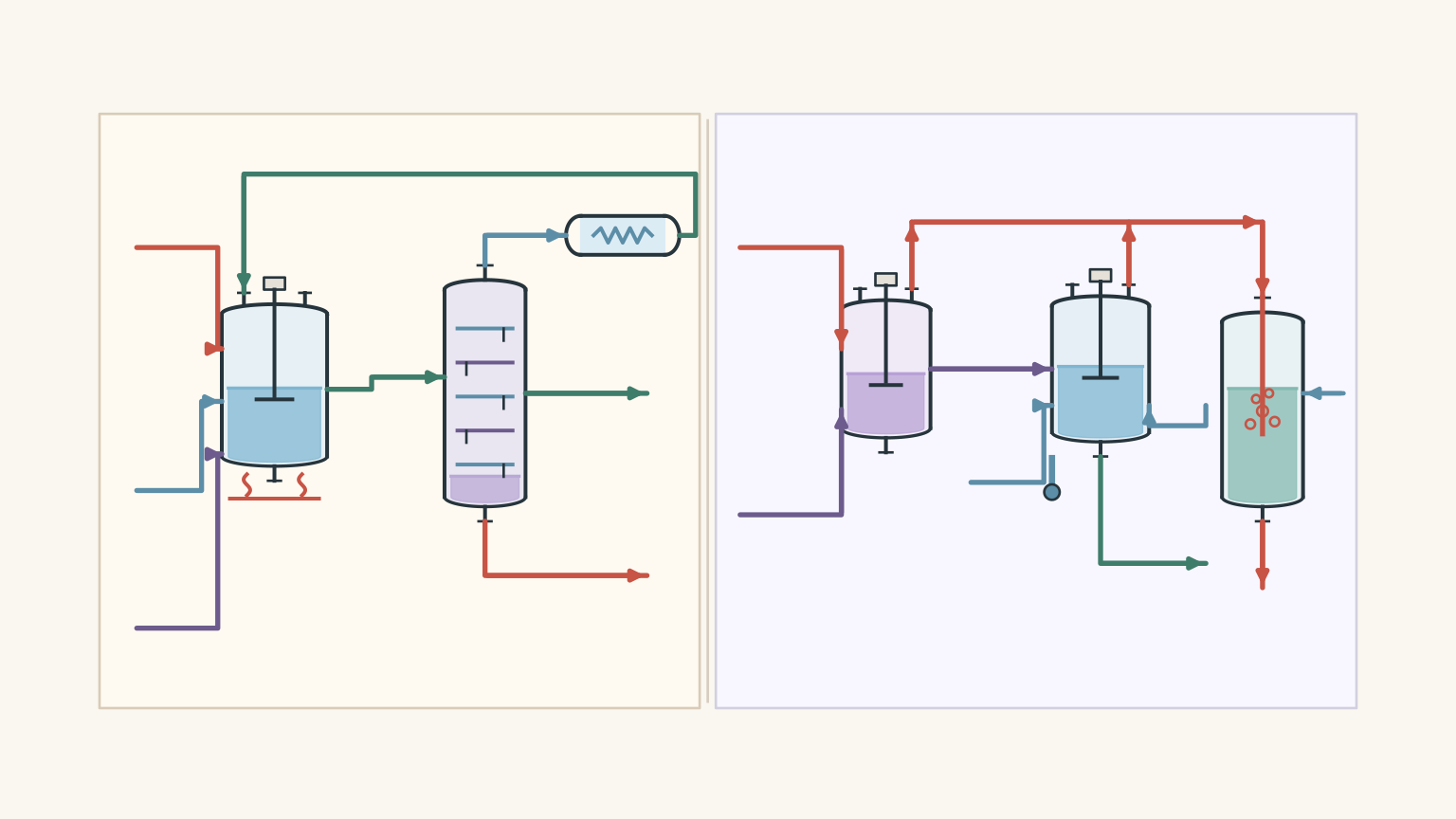
A chemical manufacturer is comparing two proposed processes for producing ethyl ethanoate.
Both processes are designed to produce 1.00 mol of isolated ethyl ethanoate at the same purity.
Design A: Direct Fischer esterification
- Uses 1.00 mol of ethanoic acid.
- Charges 4.00 mol of ethanol.
- One mole of ethanol is incorporated into the ester, leaving 3.00 mol in excess.
- Recovers 95.0% of the excess ethanol.
- Uses an acid catalyst.
- Requires heating and distillation to recover the excess ethanol.
Design B: Acid chloride pathway
- Uses 1.00 mol of ethanoic acid.
- Uses 1.00 mol of thionyl chloride.
- Uses 1.00 mol of ethanol.
- Produces ethyl ethanoate through the two-step acid chloride pathway.
- Operates at a lower reaction temperature than Design A.
- Requires a dry solvent.
- Captures the hydrogen chloride and sulfur dioxide by-products for subsequent aqueous treatment.
The process team has not supplied measurements for solvent quantities, waste-treatment materials, total energy consumption or upstream manufacturing impacts.
Two members of the decision panel disagree:
- One argues that Design B is greener because it operates at a lower temperature.
- The other argues that Design A is greener because its atom economy is much higher.
Evaluate both arguments.
Your response should:
a) Calculate the ethanol lost from Design A.
b) Compare the theoretical atom economy of the two reaction pathways.
c) Explain what happens to the hazardous by-products in Design B when they are captured.
d) Determine whether the available information is sufficient to identify an overall greener process. Justify your conclusion using waste, solvent, hazard and energy criteria.
Due to technical limitations, this figure may display incorrectly or contain inaccuracies. Please check key details against your course materials.
Solution 5
Neither design can be conclusively identified as the greener overall process using the information supplied.
Design A has a clear advantage in theoretical atom economy and avoids the hazardous thionyl chloride pathway. Design B operates at a lower reaction temperature, but this does not establish that its total energy consumption or environmental impact is lower.
The comparison requires several linked steps.
a) Calculate ethanol lost from Design A
The amount of excess ethanol is:
\[ n_{\text{excess}}=4.00-1.00 \]
\[ n_{\text{excess}}=3.00\ \mathrm{mol} \]
The recovery process loses 5.0% of this amount.
\[ n_{\text{lost}}=3.00\times0.050 \]
\[ n_{\text{lost}}=0.150\ \mathrm{mol} \]
Converting to mass:
\[ m=0.150\times46.07 \]
\[ \boxed{m=6.91\ \mathrm{g}} \]
Design A therefore loses 6.91 g of ethanol per mole of ester produced.
The remaining 2.85 mol of excess ethanol is recovered.
However, the recovery process still requires energy. The recovered ethanol also needs to meet the required quality before it can be reused.
b) Compare theoretical atom economy
For Design A, the stoichiometric reaction is:
\[ \ce{CH3COOH + CH3CH2OH -> CH3COOCH2CH3 + H2O} \]
Its atom economy is:
\[ AE_A= \frac{88.11}{60.05+46.07}\times100 \]
\[ \boxed{AE_A=83.0\%} \]
For Design B, the overall reaction is:
\[ \ce{CH3COOH + SOCl2 + CH3CH2OH -> CH3COOCH2CH3 + SO2 + 2HCl} \]
Its atom economy is:
\[ AE_B= \frac{88.11}{60.05+118.97+46.07} \times100 \]
\[ \boxed{AE_B=39.1\%} \]
Design A clearly has the higher theoretical atom economy.
This is a valid conclusion, but it does not establish the overall environmental performance of either manufacturing process.
The atom economy calculation does not include the excess ethanol, dry solvent, catalyst, waste-treatment materials or energy requirements.
c) Explain the effect of capturing hazardous by-products
Capturing the sulfur dioxide and hydrogen chloride from Design B reduces their uncontrolled release into the environment.
However, capturing a waste stream does not make its atoms disappear.
The gases are transferred into an aqueous treatment system. The resulting waste stream still requires management and appropriate disposal or further processing.
The treatment system may also require additional water and chemical reagents.
Consequently, the capture system reduces one environmental risk but introduces additional material requirements and potentially further waste.
This is why waste prevention and waste treatment are not equivalent.
d) Evaluate the overall environmental comparison
Consider each criterion separately.
| Criterion | Design A | Design B | Defensible conclusion |
|---|---|---|---|
| Waste | Higher atom economy, but ethanol losses and other process waste | Lower atom economy, with additional gaseous by-products and treatment waste | A has better stoichiometric efficiency, but total waste is unknown |
| Solvents | Excess ethanol must be recovered | Requires a dry solvent | Insufficient information to compare total solvent impacts |
| Hazards | Corrosive acid catalyst and flammable organic materials | Thionyl chloride, reactive acid chloride and hazardous gaseous by-products | A avoids several significant hazards associated with B |
| Energy | Heating and ethanol recovery by distillation | Lower reaction temperature, but drying and gas treatment are required | Total energy consumption cannot be determined |
The lower reaction temperature in Design B does not prove that it consumes less energy overall.
The energy needed for drying the solvent, treating the gaseous by-products and operating the separation equipment must also be considered.
Similarly, Design A’s higher atom economy does not prove that its complete manufacturing process produces less waste.
A proper comparison would require:
- Total solvent quantities and their recovery efficiencies.
- The mass of all catalysts, processing aids and waste-treatment reagents.
- The mass and composition of liquid and gaseous waste streams.
- Total energy consumption across reaction, distillation, drying and waste treatment.
- Actual isolated product mass and purity.
- Relevant hazards and environmental impacts of the starting materials and waste streams.
- Upstream environmental impacts if a full life-cycle assessment is being performed.
Both designs must be assessed using the same system boundary.
The strongest conclusion is that Design A performs better in theoretical atom economy and avoids the additional reagent hazards of Design B. Design B has a lower reaction temperature, but its total energy demand has not been established.
There is not enough information to declare either design the greener overall process.
That is the central skill in green organic synthesis: recognising which conclusions the chemical evidence supports, and which conclusions require additional process information.
07Where to take this next
Green synthesis adds another layer to the organic reaction pathways you already know.
First, you need to understand how a molecule is constructed across one or more reaction steps. Then you can track where its atoms go, identify the materials required at each stage, and evaluate the waste generated by the complete pathway.
Two useful foundations for that work are:
- How to Construct Organic Synthesis Pathways for HSC Chemistry
- How to Check Atom Conservation in Multi-Step Organic Synthesis
A reaction pathway tells you how to make the product. A green synthesis assessment asks a bigger question: what else must be used, produced, separated, recovered and disposed of to obtain that product?