
Multiphoton Photoemission: How Intense Light Releases Electrons
Explore how electrons absorb multiple photons to escape a metal surface, why high-intensity laser light makes this possible, and how multiphoton photoemission differs from strong-field tunnelling. An accessible extension of the Year 12 Physics photon model.
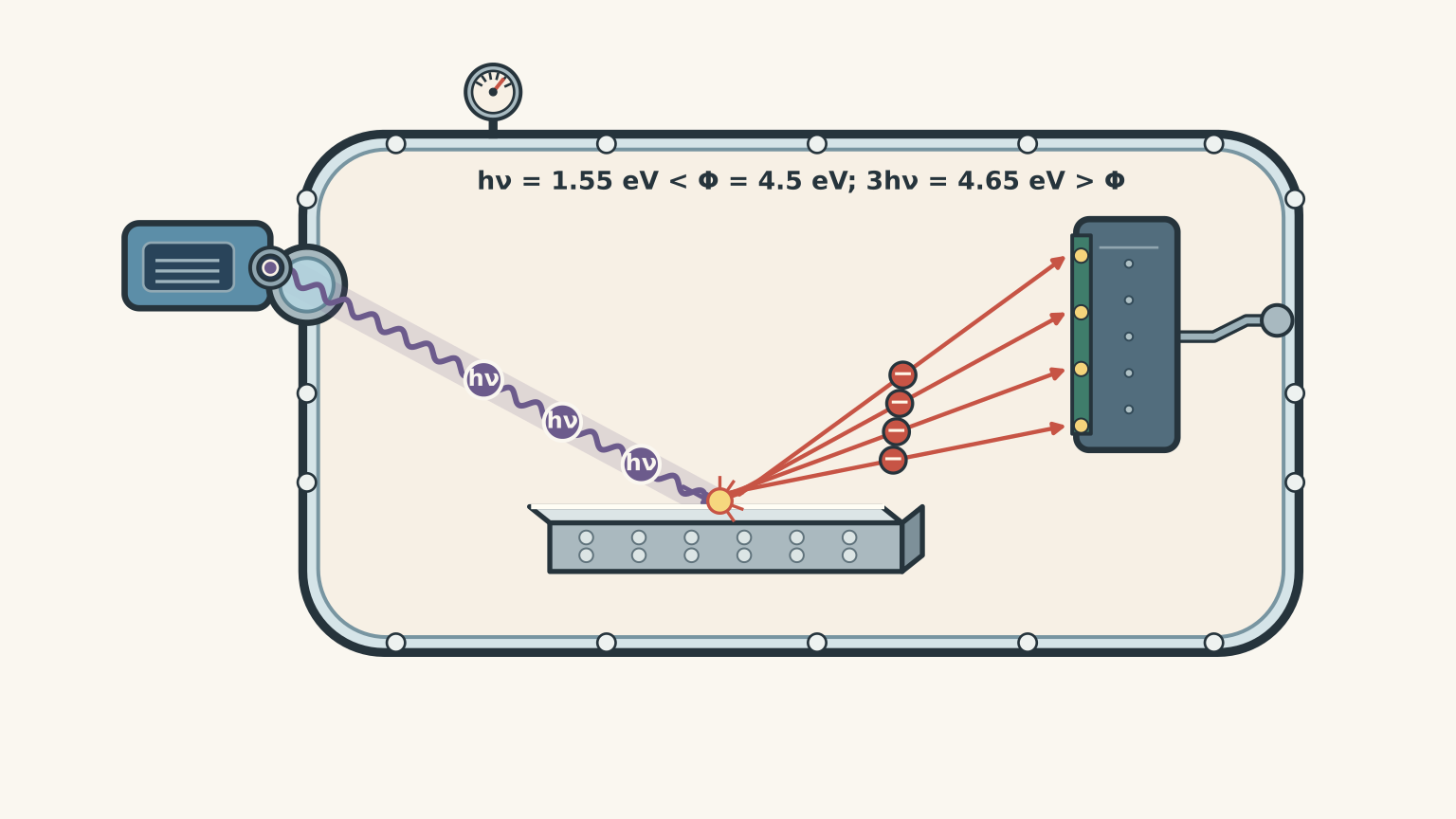
An 800 nm laser photon carries about 1.55 eV of energy. If it strikes a metal surface with a work function of 4.5 eV, the ordinary one-photon photoelectric model predicts that no electrons should escape. Yet an intense laser pulse can eject electrons from that same surface.
What has changed? Has each photon somehow gained more energy, or can an electron receive energy from several photons?
The second possibility is real. It is called multiphoton photoemission.
This is an extension beyond the required 2025 NSW HSC Physics syllabus. The Year 12 Nature of Light photon model provides the prerequisite knowledge, but multiphoton photoemission itself is additional material, not an HSC assessment requirement.
Due to technical limitations, this figure may display incorrectly or contain inaccuracies. Please check key details against your course materials.
01Start with the one-photon model
Before considering multiple photons, recall what a single photon can do.
In the particle model of light, electromagnetic radiation consists of photons. Each photon carries a discrete amount of energy determined by its frequency.
The energy of one photon is
\[ E_\gamma=hf \]
where:
- \(E_\gamma\) is the energy of one photon, measured in joules (J).
- \(h\) is Planck’s constant, \(6.626\times10^{-34}\ \mathrm{J\,s}\).
- \(f\) is the frequency of the electromagnetic radiation, measured in hertz (Hz).
Since the speed of light is \(c=f\lambda\), we can also write
\[ E_\gamma=\frac{hc}{\lambda} \]
Here, \(c\) is the speed of light in a vacuum, and \(\lambda\) is the wavelength.
For calculations involving electron volts, a useful shortcut is
\[ E_\gamma(\mathrm{eV}) = \frac{1240}{\lambda(\mathrm{nm})} \]
An electron volt (eV) is a unit of energy. One electron volt is the energy gained by an electron when it moves through a potential difference of one volt.
What does the metal require?
Electrons inside a metal are not completely free to escape. They are held within the material by an energy barrier at its surface.
The minimum energy required to remove an electron from the metal and release it into the surrounding vacuum is called the work function, represented by \(\phi\).
Different metals have different work functions. The value also depends on the condition and structure of the surface.
In the ordinary, single-photon photoelectric effect, one photon transfers its energy to one electron.
The energy balance is
\[ hf=\phi+K_{\max} \]
Rearranging gives Einstein’s photoelectric equation:
\[ K_{\max}=hf-\phi \]
Here, \(K_{\max}\) is the maximum kinetic energy of the emitted photoelectrons.
An electron can escape through this mechanism only when
\[ hf\geq\phi \]
If the photon energy is below the work function, a single photon cannot release an electron.
Consider our opening example:
- Photon wavelength: 800 nm.
- Photon energy: 1.55 eV.
- Metal work function: 4.5 eV.
One photon supplies only 1.55 eV, which is insufficient.
Would increasing the light intensity solve the problem?
Not within the single-photon model. Increasing intensity supplies more photons per second, but each photon still carries only 1.55 eV.
This is the important distinction: intensity changes the number of photons arriving, not the energy carried by each photon.
The standard photoelectric model is explained in more detail in OpenStax’s University Physics treatment of the photoelectric effect.
02When one electron absorbs multiple photons
Now return to the original problem.
Suppose one photon does not carry enough energy to overcome the work function. Could several photons contribute energy to the same electron?
Yes.
Under sufficiently intense laser illumination, an electron can absorb energy from multiple photons during a single photoemission interaction.
This is called multiphoton photoemission.
Each photon still has exactly the same energy, \(hf\). However, the electron can receive contributions from several photons.
If an electron absorbs \(N\) photons, the total energy supplied is
\[ E_{\text{total}}=Nhf \]
where \(N\) is the number of absorbed photons.
The electron can escape when
\[ Nhf\geq\phi \]
Its ideal maximum kinetic energy is then
\[ \boxed{K_{\max}=Nhf-\phi} \]
This equation is the central energy relationship for the simple multiphoton photoemission model.
The minimum number of photons required is the smallest whole number \(N\) that satisfies the energy condition.
Why does this not contradict the ordinary photoelectric effect?
The ordinary HSC photoelectric model considers an interaction in which one photon transfers its energy to one electron.
Multiphoton photoemission considers a different quantum process: several photons contribute energy to one electron’s emission.
It is sometimes described as simultaneous photon absorption. This is a useful simplified picture, although real materials can involve intermediate electronic states and more complicated interactions.
Do not imagine an electron slowly collecting individual photons like coins in a savings account, storing their energy for an unlimited period, and eventually escaping. The multiphoton process occurs during the interaction with the intense light field.
The important point is that the energy transferred in one emission event can come from more than one photon.
Worked example: Three photons overcome the work function
A metal surface has a work function of 4.50 eV. It is illuminated with laser light of wavelength 800 nm.
Determine the minimum number of photons required to release an electron and calculate the maximum kinetic energy of the emitted electron.
Step 1
Use the wavelength relationship:
\[ E_\gamma=\frac{1240}{\lambda} \]
Substitute the wavelength:
\[ E_\gamma=\frac{1240}{800} =1.55\ \mathrm{eV} \]
Each photon carries 1.55 eV.
Step 2
Two photons provide
\[ E_2=2(1.55)=3.10\ \mathrm{eV} \]
This is insufficient because
\[ 3.10<4.50 \]
Try three photons:
\[ E_3=3(1.55)=4.65\ \mathrm{eV} \]
Now the available energy exceeds the work function.
Therefore, the minimum photon number is
\[ \boxed{N=3} \]
Step 3
Apply the multiphoton energy equation:
\[ K_{\max}=Nhf-\phi \]
Substitute:
\[ K_{\max}=3(1.55)-4.50 \]
\[ \boxed{K_{\max}=0.15\ \mathrm{eV}} \]
The electron can escape with a maximum kinetic energy of 0.15 eV.
This is an ideal prediction for an electron starting at the highest occupied energies in the metal, with no energy lost during escape.
Notice something interesting: although the electron absorbs three photons, it emerges with relatively little kinetic energy. Most of the supplied energy is needed to overcome the work function.
03Why intensity matters so much
Multiphoton photoemission is particularly interesting because its probability depends strongly on light intensity.
In the ordinary photoelectric effect, increasing intensity generally increases the number of emitted electrons because more photons arrive at the surface.
Multiphoton photoemission behaves differently.
The probability of a transition involving several photons increases much more rapidly as the intensity increases.
In the simplest perturbative model, the photoemission yield follows
\[ Y\propto I^N \]
where:
- \(Y\) is the photoemission yield, such as the number of electrons emitted per pulse.
- \(I\) is the laser intensity.
- \(N\) is the number of photons involved in the dominant absorption process.
This relationship is valid when one multiphoton process dominates, the response is unsaturated, and the other experimental conditions remain fixed.
What does the power relationship mean?
Suppose a three-photon process dominates.
Then
\[ Y\propto I^3 \]
If the laser intensity doubles, the yield becomes
\[ Y_{\text{new}}\propto(2I)^3 \]
\[ Y_{\text{new}}=8Y_{\text{original}} \]
The number of emitted electrons increases by a factor of eight.
Compare this with a two-photon process:
\[ Y\propto I^2 \]
Doubling the intensity produces a fourfold increase.
The relationship can be summarised as follows:
| Photon number \(N\) | Yield relationship | Effect of doubling intensity |
|---|---|---|
| 1 | \(Y\propto I\) | 2 times |
| 2 | \(Y\propto I^2\) | 4 times |
| 3 | \(Y\propto I^3\) | 8 times |
| 4 | \(Y\propto I^4\) | 16 times |
This is why multiphoton photoemission is called a nonlinear optical process.
A small increase in laser intensity can produce a much larger increase in the number of emitted electrons.
Worked example: Identifying a multiphoton process from intensity measurements
A hypothetical experiment investigates photoemission from a metal surface.
At a particular laser intensity \(I\), the detector records 200 emitted electrons per pulse.
When the intensity is increased to \(2I\), the detector records 3200 electrons per pulse.
Assume that a single, unsaturated multiphoton process dominates.
The laser wavelength is 1000 nm, and the work function of the metal is 4.0 eV.
Determine the photon order and calculate the ideal maximum kinetic energy of the emitted electrons.
Step 1
The ratio of the new yield to the original yield is
\[ \frac{Y_{\text{new}}}{Y_{\text{original}}} = \frac{3200}{200}=16 \]
The yield has increased by a factor of 16.
Step 2
We know that
\[ Y\propto I^N \]
Since the intensity has doubled,
\[ 2^N=16 \]
Therefore,
\[ \boxed{N=4} \]
The dominant process involves four-photon absorption.
Step 3
First, calculate the energy of one photon:
\[ E_\gamma=\frac{1240}{1000} =1.24\ \mathrm{eV} \]
Three photons provide
\[ E_3=3(1.24)=3.72\ \mathrm{eV} \]
This is insufficient to overcome the 4.0 eV work function.
Four photons provide
\[ E_4=4(1.24)=4.96\ \mathrm{eV} \]
This is sufficient.
The energy calculation therefore agrees with the intensity measurement.
Step 4
\[ K_{\max}=4(1.24)-4.0 \]
\[ \boxed{K_{\max}=0.96\ \mathrm{eV}} \]
The four-photon process releases electrons with an ideal maximum kinetic energy of 0.96 eV.
The important experimental insight is that the intensity dependence can reveal the number of photons involved, even when the individual absorption events cannot be observed directly.
04What is the high-intensity regime?
Multiphoton photoemission is associated with intense laser fields.
However, there is an important distinction between a field that produces multiphoton absorption and one that becomes so strong that it changes the electron’s escape barrier.
These are related, but different, physical regimes.
The multiphoton regime
In the multiphoton regime, the laser field is sufficiently intense for an electron to absorb several photons during the interaction.
However, the surface potential barrier is not yet so strongly distorted that tunnelling becomes the dominant mechanism.
The electron’s energy is understood through the absorption of discrete photon contributions.
This regime is commonly studied using intense, ultrashort laser pulses. An ultrashort pulse can have a very high peak intensity even when its average power is relatively modest.
There is no single intensity value that marks the beginning of multiphoton photoemission for every material.
The relevant conditions depend on:
- The laser frequency and wavelength.
- The work function of the surface.
- The peak electric-field strength.
- The local geometry and surface structure.
- The duration and shape of the laser pulse.
What happens when the intensity increases further?
Imagine gradually increasing the electric-field strength of the laser.
Initially, multiphoton absorption becomes more probable.
However, as the field becomes stronger, it can also distort the potential-energy barrier that normally confines electrons inside the metal.
The barrier becomes lower or thinner during part of the oscillating electric field.
Eventually, an electron may escape by quantum tunnelling through the barrier rather than by absorbing a clearly defined minimum number of photons to pass over it.
This mechanism is called optical-field emission, or strong-field tunnelling.
The Keldysh parameter: distinguishing the regimes
A useful way physicists classify these strong-field processes is through the Keldysh parameter, represented by \(\gamma\).
For a simplified metal-vacuum barrier, it can be written as
\[ \gamma= \frac{\omega\sqrt{2m_e\phi}}{eE_0} \]
where:
- \(\gamma\) is the dimensionless Keldysh parameter.
- \(\omega=2\pi f\) is the angular frequency of the laser.
- \(m_e\) is the electron mass.
- \(\phi\) is the work function, expressed in joules in this equation.
- \(e\) is the magnitude of the electron’s charge.
- \(E_0\) is the peak electric-field strength at the metal surface.
This expression is a simplified model. Real surfaces, particularly nanoscale structures, can have local electric-field enhancements that affect the transition.
The approximate classification is:
| Keldysh parameter | Dominant mechanism |
|---|---|
| \(\gamma\gg1\) | Multiphoton absorption |
| \(\gamma\approx1\) | Transition region |
| \(\gamma\ll1\) | Strong-field tunnelling |
Why does increasing intensity move the system towards tunnelling?
For a fixed laser frequency and material, increasing intensity increases the electric-field amplitude. This decreases \(\gamma\).
Consequently, a system can move from a predominantly multiphoton process towards strong-field tunnelling as the laser field becomes more intense.
The transition is not a perfectly sharp boundary. The Keldysh parameter is a useful classification tool rather than a universal switch.
You do not need to calculate this parameter for the HSC. Its value here is conceptual: it explains why multiphoton absorption is not the only possible mechanism at very high laser intensities.
The underlying connection between multiphoton absorption and tunnelling was developed in L. V. Keldysh’s influential treatment of strong electromagnetic fields (Keldysh, 1965).
Evidence from real metal surfaces
Multiphoton photoemission is not just a theoretical possibility.
In a 1995 experiment, researchers investigated photoemission from clean copper surfaces using short laser pulses.
The copper surfaces had work functions of approximately 4.5-4.6 eV, while the incident photons carried about 1.6 eV each.
Therefore, at least three photons were required for an electron to escape through the multiphoton mechanism.
The researchers observed electrons with energies corresponding to the absorption of more photons than the minimum required.
Importantly, they also found that the photoemission yield did not always follow a simple power law. Surface roughness, local field enhancement, and other strong-field effects complicated the behaviour.
This is a useful reminder that the equations developed earlier describe an idealised regime, not every possible interaction between a laser and a real metal.
You can read the original experimental paper here: Observation of surface enhanced multiphoton photoemission from metal surfaces in the short pulse limit (1995).
05Above-threshold photoemission
There is one further consequence worth understanding.
So far, we have considered the minimum number of photons needed to overcome the work function.
But what happens if an electron absorbs additional photons after it has already received enough energy to escape?
It can emerge with even more kinetic energy.
This is called above-threshold photoemission.
For example, suppose the minimum requirement is three photons.
An electron may absorb:
- Three photons, providing energy \(3hf\).
- Four photons, providing energy \(4hf\).
- Five photons, providing energy \(5hf\).
The extra energy becomes additional kinetic energy.
In an idealised photoelectron spectrum, the energy difference between neighbouring photon-absorption channels is
\[ \Delta K=hf \]
Each additional photon increases the available kinetic energy by exactly one photon energy.
Real metal spectra can be more complicated. Electronic band structure, scattering, surface states, and instrumental resolution can broaden the features or produce plateau-like structures rather than perfectly separated peaks.
The key idea is that the minimum number of photons determines the threshold for emission, but it does not necessarily determine the total number absorbed.
At sufficiently high intensity, additional absorption channels can become important.
06Questions and solutions
The following questions move from straightforward energy calculations to more involved reasoning about intensity, electron spectra, and laser pulse duration.
Question 1
An ideal metal surface has a work function of 3.0 eV. It is illuminated with monochromatic light of wavelength 620 nm.
Determine:
(a) The minimum number of photons required to release an electron.
(b) The maximum kinetic energy of an electron emitted through this lowest-order multiphoton process.
Use \(hc=1240\ \mathrm{eV\,nm}\).
Solution 1
Two photons are required, and the ideal maximum kinetic energy is 1.0 eV.
Step 1: Calculate the energy of one photon.
\[ E_\gamma=\frac{1240}{620} \]
\[ E_\gamma=2.00\ \mathrm{eV} \]
Step 2: Determine the minimum photon number.
One photon provides 2.00 eV, which is less than the 3.0 eV work function.
Two photons provide
\[ E_2=2(2.00)=4.00\ \mathrm{eV} \]
This exceeds the work function.
Therefore,
\[ \boxed{N=2} \]
Step 3: Calculate the maximum kinetic energy.
\[ K_{\max}=Nhf-\phi \]
\[ K_{\max}=2(2.00)-3.00 \]
\[ \boxed{K_{\max}=1.00\ \mathrm{eV}} \]
The electron receives 4.00 eV from the two photons. It uses 3.00 eV to overcome the work function, leaving 1.00 eV as kinetic energy.
Question 2
Two clean metal surfaces, A and B, are illuminated by the same 800 nm laser.
Their work functions are:
- Surface A: \(\phi_A=2.0\ \mathrm{eV}\).
- Surface B: \(\phi_B=4.5\ \mathrm{eV}\).
Assume both surfaces operate in the unsaturated, perturbative multiphoton regime.
For each surface:
(a) Determine the minimum number of photons required for emission.
(b) Calculate the ideal maximum kinetic energy in the lowest-order emission channel.
(c) Predict the change in photoemission yield if the laser intensity is doubled.
(d) Can you determine which surface initially produces more electrons from the information provided? Explain.
Solution 2
Surface A requires two photons and has a maximum kinetic energy of 1.10 eV. Surface B requires three photons and has a maximum kinetic energy of 0.15 eV. Doubling the intensity increases their respective yields by factors of four and eight. Their initial absolute yields cannot be determined from the supplied information.
Step 1: Calculate the photon energy.
Both surfaces receive light of wavelength 800 nm.
\[ E_\gamma=\frac{1240}{800} \]
\[ E_\gamma=1.55\ \mathrm{eV} \]
Step 2: Analyse surface A.
One photon provides
\[ E_1=1.55\ \mathrm{eV} \]
This is insufficient to overcome the 2.0 eV work function.
Two photons provide
\[ E_2=2(1.55)=3.10\ \mathrm{eV} \]
Therefore,
\[ N_A=2 \]
The maximum kinetic energy is
\[ K_{\max,A}=3.10-2.00 \]
\[ \boxed{K_{\max,A}=1.10\ \mathrm{eV}} \]
Step 3: Analyse surface B.
Two photons provide
\[ E_2=2(1.55)=3.10\ \mathrm{eV} \]
This is insufficient for the 4.5 eV work function.
Three photons provide
\[ E_3=3(1.55)=4.65\ \mathrm{eV} \]
Therefore,
\[ N_B=3 \]
The maximum kinetic energy is
\[ K_{\max,B}=4.65-4.50 \]
\[ \boxed{K_{\max,B}=0.15\ \mathrm{eV}} \]
Step 4: Compare the intensity dependence.
For surface A, the yield follows
\[ Y_A\propto I^2 \]
Doubling the intensity gives
\[ \frac{Y_{A,\text{new}}}{Y_{A,\text{original}}} =2^2=4 \]
Surface A produces four times its original yield.
For surface B,
\[ Y_B\propto I^3 \]
Doubling the intensity gives
\[ \frac{Y_{B,\text{new}}}{Y_{B,\text{original}}} =2^3=8 \]
Surface B produces eight times its original yield.
Step 5: Consider the absolute electron counts.
We cannot conclude that either surface initially emits more electrons.
The proportionality constants in the yield relationships may differ. The surfaces may also have different electronic structures, photon absorption efficiencies, and local field enhancements.
The tempting assumption is that the material with the lower work function must produce more electrons. However, the work function determines the energy threshold, not the complete probability of emission.
This question highlights an important distinction:
- Surface A produces more energetic electrons in its lowest-order channel.
- Surface B has a yield that responds more strongly to changes in intensity.
These are different properties.
Question 3
A hypothetical experiment investigates multiphoton photoemission from a metal surface.
The following measurements are obtained while keeping the wavelength and other experimental conditions fixed.
| Laser intensity | Measured yield |
|---|---|
| \(I_0\) | 10 counts per pulse |
| \(2I_0\) | 80 counts per pulse |
| \(3I_0\) | 270 counts per pulse |
Assume a single perturbative multiphoton process dominates.
(a) Determine the number of photons involved in the dominant process.
(b) Predict the yield at an intensity of \(4I_0\).
(c) The surface has a work function of 4.5 eV and the laser wavelength is 800 nm. Verify that the inferred photon number is sufficient for emission.
(d) Explain why the intensity relationship should not automatically be extrapolated to arbitrarily high intensities.
Solution 3
The dominant process involves three photons, and the predicted yield at \(4I_0\) is 640 counts per pulse.
Step 1: Compare the first two measurements.
The intensity doubles, while the yield increases from 10 to 80.
\[ \frac{80}{10}=8 \]
Therefore,
\[ 2^N=8 \]
Giving
\[ N=3 \]
Step 2: Check the third measurement.
The intensity increases by a factor of three.
For a three-photon process, the predicted yield ratio is
\[ 3^3=27 \]
The predicted yield is therefore
\[ Y=10(27)=270 \]
This matches the supplied measurement.
The three-photon model is consistent with all three observations.
Step 3: Predict the yield at \(4I_0\).
\[ Y\propto I^3 \]
Therefore,
\[ Y=10(4)^3 \]
\[ \boxed{Y=640\text{ counts per pulse}} \]
Step 4: Verify the energy requirement.
The photon energy is
\[ E_\gamma=\frac{1240}{800} =1.55\ \mathrm{eV} \]
Three photons provide
\[ E_3=3(1.55)=4.65\ \mathrm{eV} \]
Since
\[ 4.65>4.50 \]
three photons are sufficient to overcome the work function.
Two photons would supply only 3.10 eV, so the three-photon process is also the minimum-order process.
Step 5: Explain the limitation.
The relationship \(Y\propto I^3\) assumes that the same perturbative process dominates.
At sufficiently high intensities, the surface barrier may become distorted, tunnelling may become significant, and other photon-absorption channels may contribute.
Saturation, heating, and interactions between emitted electrons can also change the measured response.
The cubic relationship is therefore a useful model within a particular regime, not an exact law for every laser intensity.
Question 4
A metal surface has a work function of 4.0 eV. It is illuminated by 800 nm laser light.
An idealised photoelectron energy analyser identifies two groups of emitted electrons with kinetic energies centred at:
- Group A: 0.65 eV.
- Group B: 2.20 eV.
(a) Determine the number of photons involved in producing each group.
(b) Explain why the energy difference between the groups equals the energy of one photon.
(c) Identify which group corresponds to the minimum photon requirement and explain why the other group is an example of above-threshold photoemission.
Solution 4
Group A corresponds to three-photon absorption, while Group B corresponds to four-photon absorption. The second group has absorbed one additional photon, which accounts for the 1.55 eV increase in kinetic energy.
Step 1: Calculate the energy of one photon.
\[ E_\gamma=\frac{1240}{800} =1.55\ \mathrm{eV} \]
Step 2: Determine the energy supplied by three photons.
\[ E_3=3(1.55)=4.65\ \mathrm{eV} \]
The corresponding maximum kinetic energy is
\[ K_{\max,3}=4.65-4.00 \]
\[ K_{\max,3}=0.65\ \mathrm{eV} \]
This matches Group A.
Therefore, Group A corresponds to three-photon absorption.
Step 3: Determine the energy supplied by four photons.
\[ E_4=4(1.55)=6.20\ \mathrm{eV} \]
The maximum kinetic energy is
\[ K_{\max,4}=6.20-4.00 \]
\[ K_{\max,4}=2.20\ \mathrm{eV} \]
This matches Group B.
Therefore, Group B corresponds to four-photon absorption.
Step 4: Explain the energy separation.
Subtract the two kinetic energies:
\[ \Delta K=2.20-0.65 \]
\[ \boxed{\Delta K=1.55\ \mathrm{eV}} \]
This is exactly the energy of one additional photon.
The higher-energy group is an example of above-threshold photoemission. Three photons are sufficient to overcome the work function, but some electrons absorb a fourth photon and emerge with additional kinetic energy.
The important point is that the higher kinetic energy does not mean that the individual photons have become more energetic. Each photon still carries 1.55 eV.
Question 5
An ideal metal surface is illuminated by three different laser pulse arrangements.
All three arrangements use the same wavelength and deliver the same total energy per unit area to the surface. This quantity is called the fluence.
The pulses have rectangular intensity-time profiles:
- Pulse A has intensity \(I\) and duration \(\tau\).
- Pulse B has intensity \(4I\) and duration \(\tau/4\).
- Pulse C consists of four separate pulses, each with intensity \(I\) and duration \(\tau/4\). The pulses are separated by gaps long enough that no intermediate excitation or coherence survives between them.
Assume the surface remains in an unsaturated, three-photon perturbative regime for all three arrangements. Ignore surface heating, space-charge effects, and field-induced changes to the work function.
(a) Verify that all three arrangements have the same fluence.
(b) Calculate the total photoemission yield for each arrangement relative to Pulse A.
(c) Compare the maximum kinetic energies of the emitted electrons.
(d) A student argues that all three arrangements must produce the same number of electrons because they deliver the same total energy per unit area. Explain precisely why this reasoning fails.
Solution 5
Pulse B produces 16 times the photoemission yield of Pulse A. Pulse C produces the same total yield as Pulse A. All three produce the same ideal maximum kinetic energy within the assumed three-photon channel.
This question tests the difference between total energy delivered and the rate at which that energy arrives.
Step 1: Compare the fluences.
Fluence is the energy delivered per unit area over the duration of a pulse.
For a rectangular pulse, it is proportional to intensity multiplied by duration.
For Pulse A:
\[ \mathcal{F}_A=I\tau \]
For Pulse B:
\[ \mathcal{F}_B=4I\left(\frac{\tau}{4}\right) \]
\[ \mathcal{F}_B=I\tau \]
For Pulse C, there are four pulses, each with fluence
\[ \mathcal{F}_{C,\text{one}} =I\left(\frac{\tau}{4}\right) \]
Adding all four:
\[ \mathcal{F}_C =4I\left(\frac{\tau}{4}\right) \]
\[ \mathcal{F}_C=I\tau \]
Therefore,
\[ \boxed{\mathcal{F}_A=\mathcal{F}_B=\mathcal{F}_C} \]
All three arrangements deliver the same total energy per unit area.
Step 2: Calculate the yield from Pulse A.
For a three-photon process, the instantaneous emission rate is proportional to the cube of the intensity.
The total yield is therefore proportional to the intensity cubed multiplied by the duration:
\[ Y_A\propto I^3\tau \]
This provides our reference yield.
Step 3: Calculate the yield from Pulse B.
Pulse B has four times the intensity but lasts for only one-quarter as long.
Therefore,
\[ Y_B\propto(4I)^3\left(\frac{\tau}{4}\right) \]
Expanding:
\[ Y_B\propto64I^3\frac{\tau}{4} \]
\[ Y_B\propto16I^3\tau \]
Comparing with Pulse A:
\[ \boxed{\frac{Y_B}{Y_A}=16} \]
Pulse B produces 16 times the photoemission yield.
Step 4: Calculate the yield from Pulse C.
Each individual pulse has intensity \(I\) and duration \(\tau/4\).
Its yield is proportional to
\[ Y_{C,\text{one}}\propto I^3\frac{\tau}{4} \]
There are four separate pulses, and their yields add because the question specifies that no intermediate excitation or coherence survives between them.
Therefore,
\[ Y_C\propto4I^3\frac{\tau}{4} \]
\[ Y_C\propto I^3\tau \]
Hence,
\[ \boxed{\frac{Y_C}{Y_A}=1} \]
Pulse C produces the same total yield as Pulse A.
The comparison is:
| Pulse | Relative photoemission yield |
|---|---|
| A | 1 |
| B | 16 |
| C | 1 |
Step 5: Compare the maximum kinetic energies.
All three arrangements use the same wavelength and therefore the same photon energy.
All three are assumed to remain in the same three-photon emission channel.
Consequently,
\[ K_{\max}=3hf-\phi \]
is identical for all three arrangements.
Their maximum electron kinetic energies are unchanged, even though their total emission yields differ.
Step 6: Explain the student’s mistake.
The student’s argument confuses fluence with intensity.
Equal fluence means that the same total energy per unit area is delivered. Since the wavelength is also unchanged, the same total number of incident photons per unit area arrives.
However, multiphoton photoemission depends on how concentrated those photons are in time.
Three-photon absorption is much more likely when the laser field is intense. A short, intense pulse can therefore produce substantially more emission than a longer, weaker pulse with the same total energy.
Mathematically, the relevant quantity is
\[ Y\propto\int I(t)^3\,dt \]
rather than simply
\[ \int I(t)\,dt \]
The first expression describes the three-photon response. The second is proportional to fluence.
This is the crucial distinction: equal total energy does not guarantee equal multiphoton emission when the temporal intensity profiles are different.
07What to understand next
Multiphoton photoemission extends the ordinary photoelectric effect by allowing several photons to contribute energy to one electron’s escape.
Three relationships are particularly important:
- Photon energy determines how much energy each photon contributes.
- The work function determines the minimum energy required for emission.
- Laser intensity determines how probable a multiphoton transition becomes.
The distinction between multiphoton absorption and strong-field tunnelling is the next useful step. It leads into the study of electron energy spectra, laser-driven electron dynamics, and the behaviour of matter in extremely strong electromagnetic fields.
For another application of the photon particle model, explore tutorgum’s Compton Scattering: Photon Momentum and Wavelength Shifts, which examines how photons transfer both energy and momentum during interactions with electrons.