
Are You Ready for Year 11 Maths Advanced? A 15-Question Diagnostic
Test your Year 10 maths foundations before starting Year 11 Mathematics Advanced. Work through 15 original diagnostic questions with detailed solutions and targeted revision advice to identify the skills you should strengthen before the course begins.
A graphing calculator can sketch \(y=x^2-5x+6\) in seconds. But if you’re asked where the curve crosses the x-axis, you still need to know why you set \(y=0\), factorise the quadratic, and solve the resulting equation.
That is a useful test of your Year 10 foundations. Can you move comfortably between an algebraic expression, an equation, and its graph?
Before reading on, predict something: why do we set \(y=0\) to find the x-intercepts, rather than \(x=0\)?
The reason is simple. Every point on the x-axis has a y-coordinate of zero. Setting \(x=0\), on the other hand, finds the y-intercept.
For this example:
\[ y=x^2-5x+6 \]
Setting \(y=0\) gives:
\[ \begin{aligned} x^2-5x+6&=0\\ (x-2)(x-3)&=0\\ x&=2 \text{ or } x=3 \end{aligned} \]
The graph crosses the x-axis at \(x=2\) and \(x=3\). The algebra and the graph describe the same mathematical relationship.
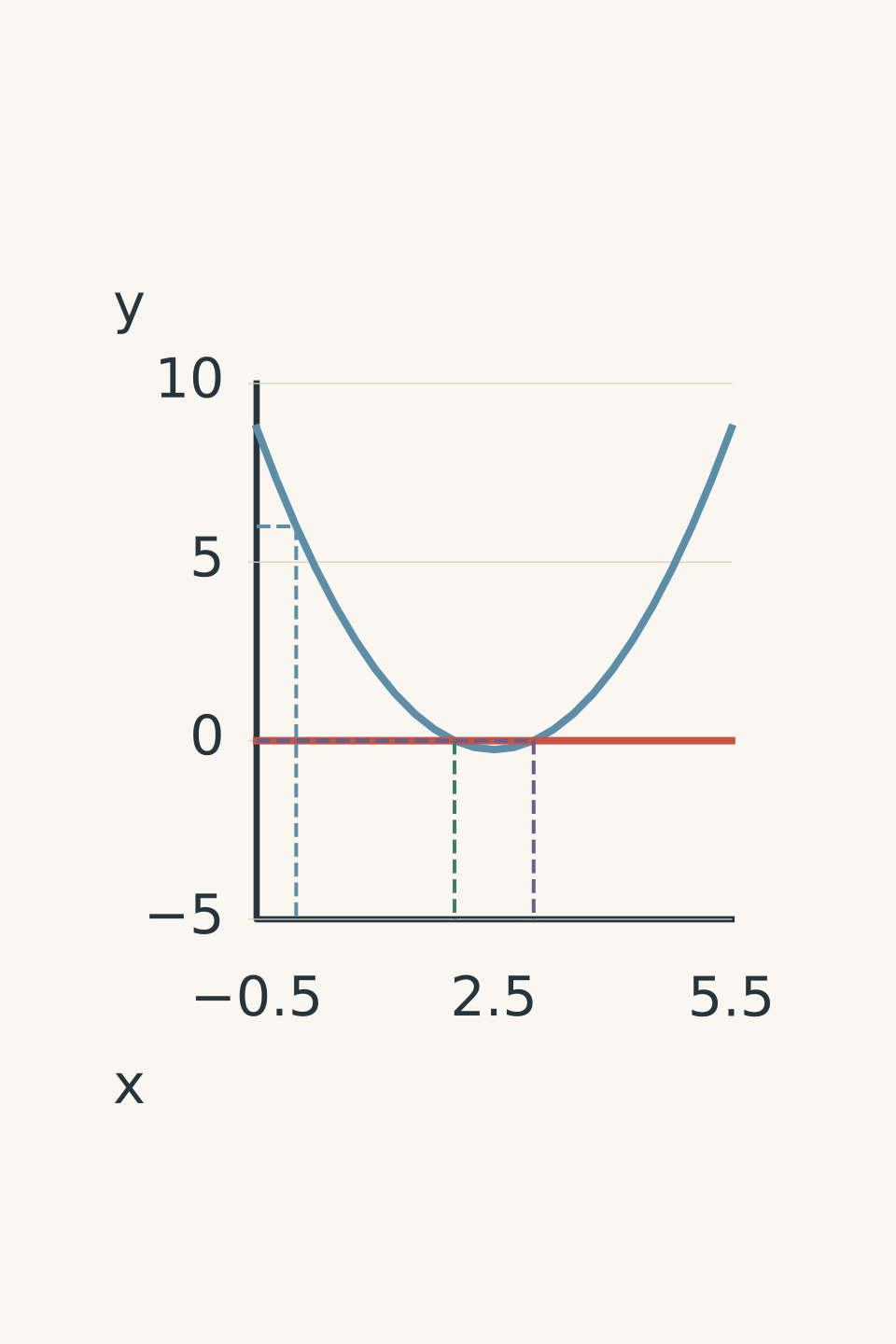
- y = x² − 5x + 6
- Horizontal axis: y = 0
- x-intercept (2, 0)
- x-intercept (3, 0)
- y-intercept (0, 6)
Due to technical limitations, this figure may display incorrectly or contain inaccuracies. Please check key details against your course materials.
If that connection makes sense, you’re already thinking in the way Mathematics Advanced expects. The challenge is being able to repeat this kind of reasoning across different topics, including when the questions become less familiar.
This diagnostic contains 15 original questions covering the foundations you’ll use throughout Year 11 Mathematics Advanced. It includes algebra, equations, functions, graphs, trigonometry, probability, and statistics.
The short answer: you don’t need to know Year 11 mathematics before you start. You do need a reasonably secure understanding of the mathematics you’ve already studied.
01What does Year 11 Mathematics Advanced build on?
The current NSW Mathematics Advanced 11-12 Syllabus (2024) is being implemented from 2026. NESA began implementation for Year 11 in Term 1 2026, with Year 12 implementation commencing in Term 4 2026. The first HSC examination under the new syllabus is in 2027.
The course includes seven areas of study:
- Functions
- Trigonometric functions
- Sequences and series
- Calculus
- Exponential and logarithmic functions
- Statistical analysis
- Financial mathematics
Year 11 introduces topics including working with functions, trigonometric functions, exponential and logarithmic functions, introductory differentiation, and probability and data.
You aren’t expected to arrive knowing all of this. Instead, you need the earlier skills that make these topics accessible.
For example:
| Year 11 mathematics | Useful prior knowledge |
|---|---|
| Functions and graphs | Algebra, coordinate geometry, and quadratic graphs |
| Trigonometric functions | Pythagoras, trigonometric ratios, and angle measurement |
| Exponential and logarithmic functions | Indices, algebraic manipulation, and equations |
| Introductory differentiation | Functions, algebra, and graph interpretation |
| Probability and data | Fractions, ratios, probability, and statistical summaries |
This diagnostic focuses on those foundations. It is not a full Year 11 examination, an official NESA eligibility test, or a guide to choosing between Mathematics Standard and Mathematics Advanced.
You can have some gaps and still make a successful start. The important thing is knowing which gaps to address.
02How to use the diagnostic
Allow approximately 40-50 minutes.
- Attempt all 15 questions without notes or worked solutions.
- Use a basic calculator only to check arithmetic. Avoid relying on CAS to solve the questions.
- Write down your working, even when you think the answer is obvious.
- Cover each solution until you’ve attempted its matching question.
- After checking, classify each question as Secure, Developing, or Revisit.
A correct answer obtained by guessing is not necessarily secure. You should be able to explain why your method works.
03Two worked examples before you begin
These examples demonstrate two skills that frequently cause trouble when students move into more advanced mathematics.
Worked example: solving an equation involving fractions
Solve:
\[ \frac{x+2}{4}-\frac{x-1}{3}=\frac16 \]
Step 1
The denominators are 4, 3, and 6. Their lowest common multiple is 12.
Multiply every term by 12:
\[ 3(x+2)-4(x-1)=2 \]
Step 2
Be particularly careful with the negative sign before the second bracket.
\[ 3x+6-4x+4=2 \]
Step 3
\[ \begin{aligned} -x+10&=2\\ -x&=-8\\ x&=8 \end{aligned} \]
Step 4
Substitute \(x=8\) into the original equation:
\[ \frac{10}{4}-\frac{7}{3} =\frac{15-14}{6} =\frac16 \]
Both sides are equal, so the solution is correct.
The important idea is that multiplying every term by the same non-zero number preserves the equality. It also removes the fractions, making the equation easier to solve.
Worked example: finding the domain of a function
Given:
\[ p(x)=\sqrt{10-2x} \]
Find the domain, range, and value of \(p(3)\).
Step 1
For a square root to produce a real number, the expression inside the square root cannot be negative.
Therefore:
\[ \begin{aligned} 10-2x&\geq 0\\ -2x&\geq -10\\ x&\leq 5 \end{aligned} \]
Notice that the inequality reverses when dividing by a negative number.
The domain is:
\[ \boxed{(-\infty,5]} \]
Step 2
A square root never produces a negative output.
The smallest possible output is zero, occurring when \(x=5\). As \(x\) decreases, the expression inside the square root can become arbitrarily large.
Therefore, the range is:
\[ \boxed{[0,\infty)} \]
Step 3
Substitute \(x=3\):
\[ \begin{aligned} p(3)&=\sqrt{10-2(3)}\\ &=\sqrt{4}\\ &=2 \end{aligned} \]
The final answer is \(p(3)=2\).
The key lesson is that a function does not necessarily accept every real number as an input. You need to check its restrictions before evaluating it.
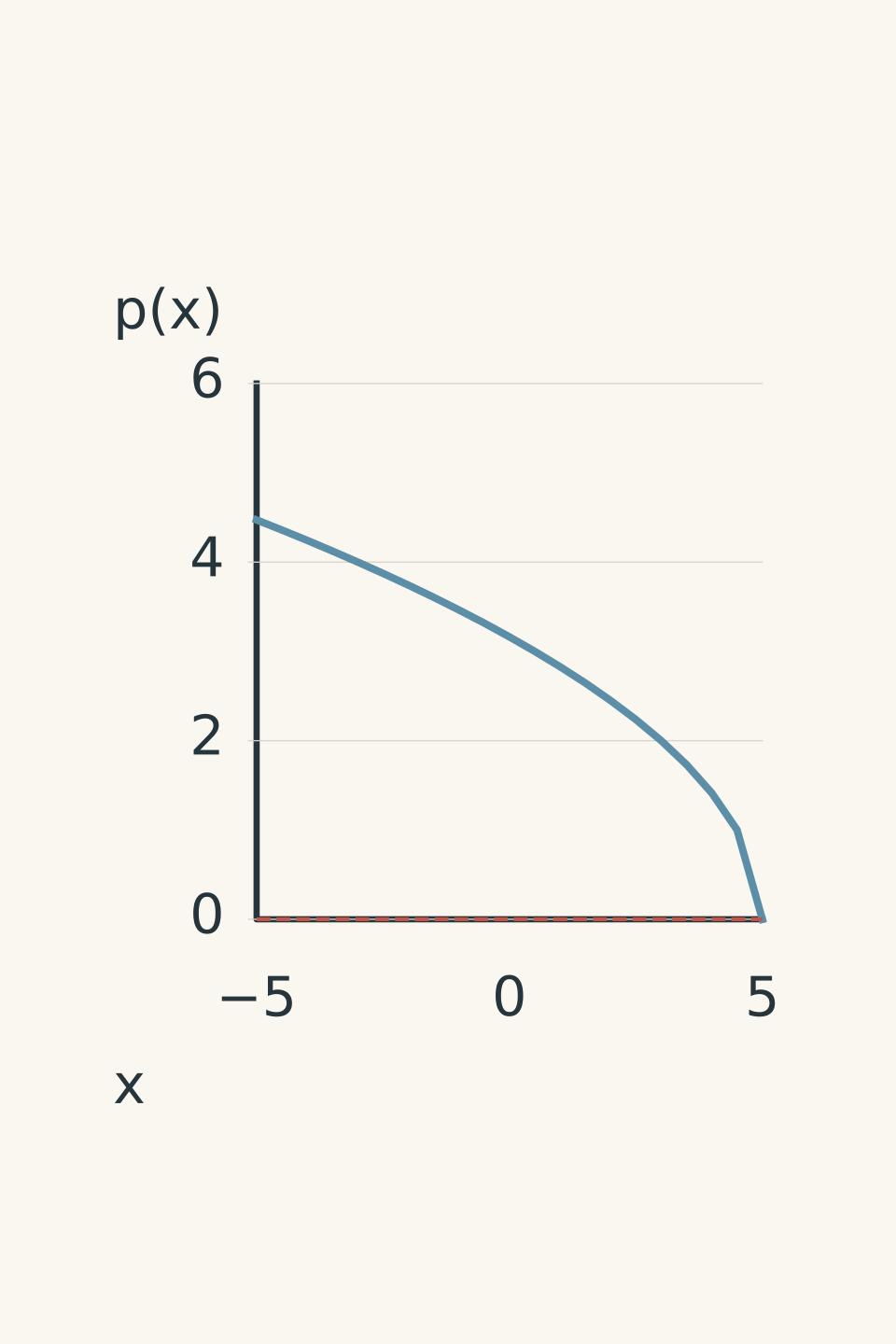
- p(x) = √(10 − 2x)
- Closed endpoint (5, 0)
Due to technical limitations, this figure may display incorrectly or contain inaccuracies. Please check key details against your course materials.
04Questions and solutions
Work through the questions in order. They begin with familiar Year 10 techniques and gradually introduce more demanding combinations of skills.
Question 1
Expand and simplify:
\[ 5(2x-3)-2(x+4) \]
Solution 1
The simplified expression is:
\[ \boxed{8x-23} \]
Apply the distributive law to both brackets:
\[ \begin{aligned} 5(2x-3)&=10x-15\\ -2(x+4)&=-2x-8 \end{aligned} \]
Now collect like terms:
\[ \begin{aligned} 10x-15-2x-8 &=10x-2x-15-8\\ &=8x-23 \end{aligned} \]
The important detail is the negative sign before the second bracket. It must be distributed to both terms.
A common mistake is writing \(-2x+8\). That changes the original expression and produces an incorrect answer.
Question 2
Factorise fully:
\[ x^2-7x+12 \]
Solution 2
The fully factorised expression is:
\[ \boxed{(x-3)(x-4)} \]
To factorise this quadratic, find two numbers that:
- Multiply to give \(12\).
- Add to give \(-7\).
Those numbers are \(-3\) and \(-4\).
Therefore:
\[ x^2-7x+12=(x-3)(x-4) \]
You can check by expanding:
\[ x^2-4x-3x+12 =x^2-7x+12 \]
This works because multiplying the two brackets reproduces the original expression.
Factorising is particularly important in Mathematics Advanced because it helps you solve quadratic equations, find graph intercepts, and simplify algebraic expressions.
Question 3
Solve the following equation:
\[ \frac{2x-1}{3}+\frac{x+2}{2}=4 \]
Give your answer as an exact fraction.
Solution 3
The solution is:
\[ \boxed{x=\frac{20}{7}} \]
The denominators are 3 and 2. Multiply every term by their lowest common multiple, 6.
\[ \begin{aligned} 2(2x-1)+3(x+2)&=24\\ 4x-2+3x+6&=24\\ 7x+4&=24\\ 7x&=20\\ x&=\frac{20}{7} \end{aligned} \]
Check the answer by substitution:
\[ \frac{2(20/7)-1}{3} + \frac{20/7+2}{2} \]
\[ =\frac{11}{7}+\frac{17}{7} =\frac{28}{7}=4 \]
The solution satisfies the original equation.
The tempting mistake is to multiply only the numerators by 6. When clearing fractions, the multiplier must apply to each complete term, including its denominator.
Question 4
Simplify fully:
\[ \sqrt{75}-2\sqrt{12}+\sqrt{27} \]
Give your answer in surd form.
Solution 4
The simplified answer is:
\[ \boxed{4\sqrt{3}} \]
First, identify the largest perfect-square factor in each surd.
\[ \begin{aligned} \sqrt{75}&=\sqrt{25\times3}=5\sqrt3\\ \sqrt{12}&=\sqrt{4\times3}=2\sqrt3\\ \sqrt{27}&=\sqrt{9\times3}=3\sqrt3 \end{aligned} \]
Substitute these expressions:
\[ \begin{aligned} 5\sqrt3-2(2\sqrt3)+3\sqrt3 &=5\sqrt3-4\sqrt3+3\sqrt3\\ &=4\sqrt3 \end{aligned} \]
You can only combine like surds, just as you can only combine like algebraic terms.
For example, \(5\sqrt3+2\sqrt3=7\sqrt3\), but \(5\sqrt3+2\sqrt2\) cannot be simplified by combining the coefficients.
Question 5
Solve the quadratic equation:
\[ 2x^2-x-6=0 \]
Give both solutions.
Solution 5
The two solutions are:
\[ \boxed{x=2 \quad \text{or} \quad x=-\frac32} \]
Start by factorising:
\[ 2x^2-x-6=(2x+3)(x-2) \]
Therefore:
\[ (2x+3)(x-2)=0 \]
The zero-product property states that if two factors multiply to give zero, at least one of those factors must equal zero.
So:
\[ \begin{aligned} 2x+3&=0\\ x&=-\frac32 \end{aligned} \]
Or:
\[ \begin{aligned} x-2&=0\\ x&=2 \end{aligned} \]
Both solutions are required.
A common mistake is to find one factor and stop. Quadratic equations can have two distinct solutions, and you need to consider both factors.
Question 6
Solve the compound inequality:
\[ -5<2x+1\leq9 \]
Express your answer using interval notation.
Solution 6
The solution is:
\[ \boxed{-3<x\leq4} \]
Treat the three parts as one connected inequality.
First, subtract 1 from every part:
\[ -6<2x\leq8 \]
Now divide every part by 2:
\[ -3<x\leq4 \]
The interval notation is:
\[ \boxed{(-3,4]} \]
The round bracket means \(-3\) is excluded. The square bracket means 4 is included.
This is different from an ordinary equation. An equation generally asks you to find particular values, whereas an inequality describes a set of possible values.
Also remember the important sign rule: dividing an inequality by a negative number reverses its direction.
Question 7
A school fete sells adult and student tickets.
- Two adult tickets and three student tickets cost 57 dollars.
- One adult ticket and two student tickets cost 33 dollars.
Calculate the price of one adult ticket and one student ticket.
Solution 7
An adult ticket costs 15 dollars, and a student ticket costs 9 dollars.
Let:
- \(a\) = adult ticket price, in dollars.
- \(s\) = student ticket price, in dollars.
Translate the information into simultaneous equations:
\[ \begin{aligned} 2a+3s&=57 \qquad (1)\\ a+2s&=33 \qquad (2) \end{aligned} \]
Step 1: Eliminate one variable.
Multiply equation (2) by 2:
\[ 2a+4s=66 \]
Step 2: Subtract equation (1).
\[ \begin{aligned} (2a+4s)-(2a+3s)&=66-57\\ s&=9 \end{aligned} \]
Step 3: Substitute into equation (2).
\[ \begin{aligned} a+2(9)&=33\\ a+18&=33\\ a&=15 \end{aligned} \]
Step 4: Check both equations.
\[ 2(15)+3(9)=57 \]
\[ 15+2(9)=33 \]
Both original conditions are satisfied.
This is a simultaneous-equations problem because the two unknown prices must satisfy both conditions at the same time.
The important skill is translating a written situation into equations before attempting to solve it.
Question 8
A straight line passes through the points:
\[ A=(-2,5),\qquad B=(4,-1) \]
Find:
a) The gradient of the line.
b) The equation of the line in the form \(y=mx+c\).
c) The x-intercept.
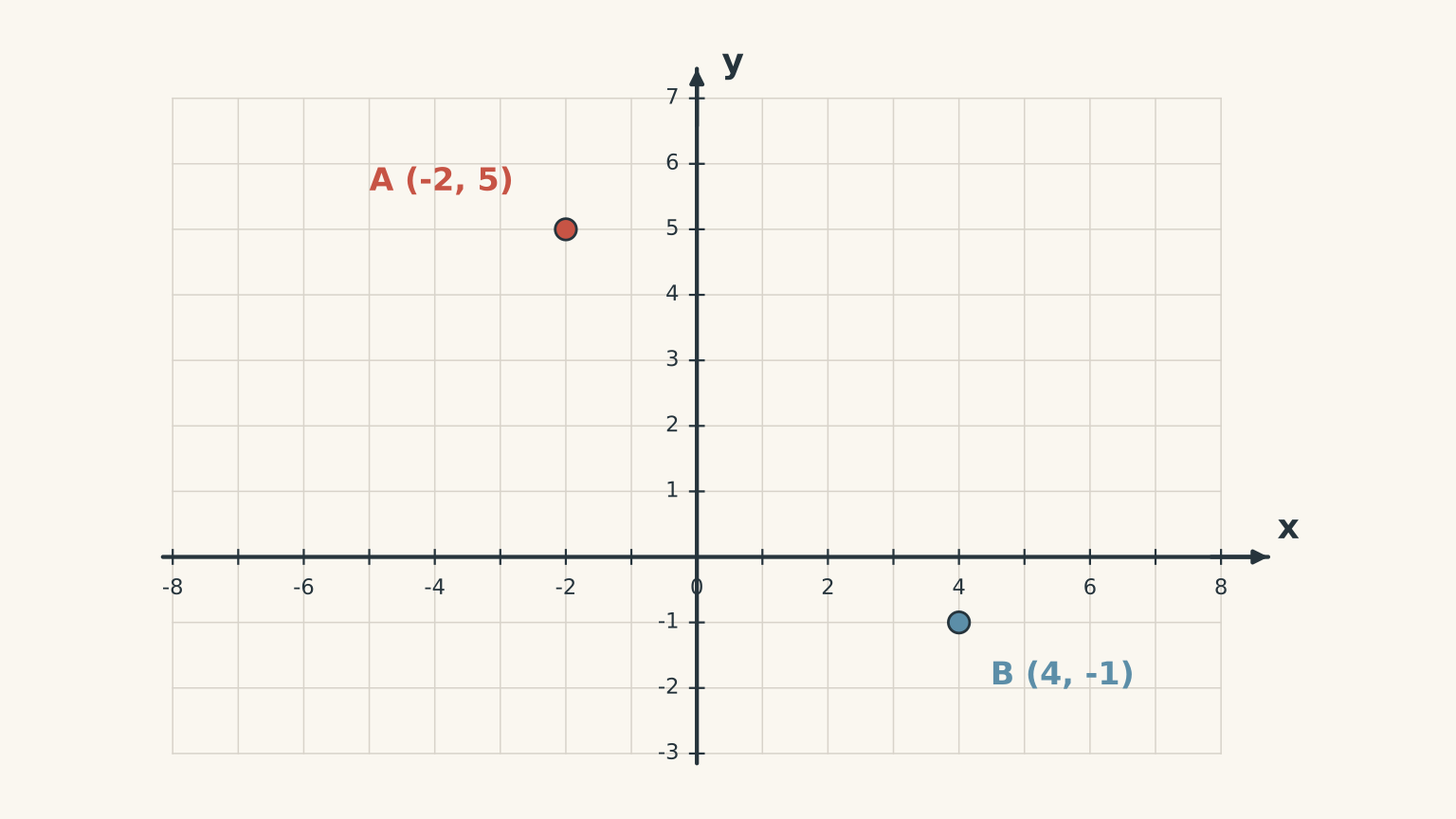
Due to technical limitations, this figure may display incorrectly or contain inaccuracies. Please check key details against your course materials.
Solution 8
The gradient is \(-1\), the equation is \(y=-x+3\), and the x-intercept is \((3,0)\).
Step 1: Calculate the gradient.
The gradient measures the change in vertical position divided by the change in horizontal position.
\[ m=\frac{y_2-y_1}{x_2-x_1} \]
Substitute the coordinates:
\[ \begin{aligned} m&=\frac{-1-5}{4-(-2)}\\ &=\frac{-6}{6}\\ &=-1 \end{aligned} \]
Step 2: Find the equation.
The general equation of a straight line is:
\[ y=mx+c \]
We know \(m=-1\), so:
\[ y=-x+c \]
Substitute either point. Using \(A=(-2,5)\):
\[ \begin{aligned} 5&=-(-2)+c\\ 5&=2+c\\ c&=3 \end{aligned} \]
Therefore:
\[ \boxed{y=-x+3} \]
Step 3: Find the x-intercept.
At the x-intercept, \(y=0\).
\[ \begin{aligned} 0&=-x+3\\ x&=3 \end{aligned} \]
The x-intercept is:
\[ \boxed{(3,0)} \]
A useful check is that the line slopes downwards from left to right because its gradient is negative.
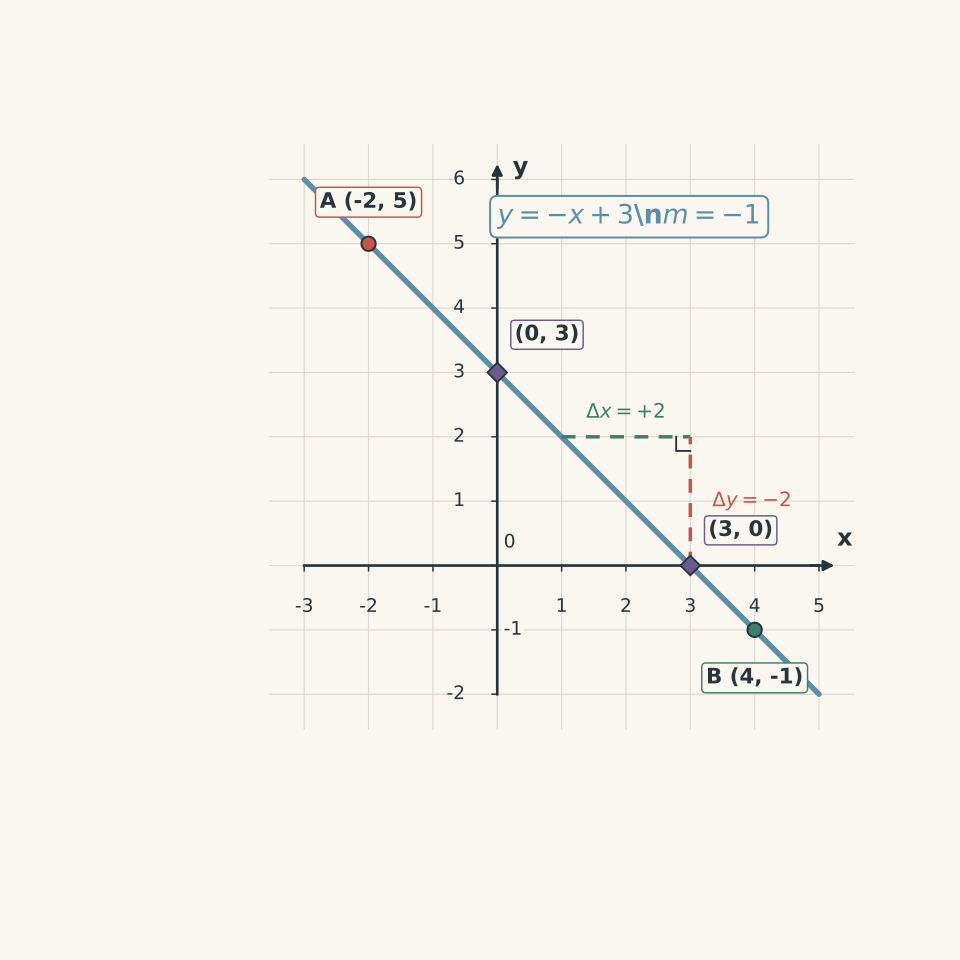
Due to technical limitations, this figure may display incorrectly or contain inaccuracies. Please check key details against your course materials.
Question 9
A function is defined by:
\[ f(x)=\sqrt{2x-6} \]
Find:
a) The domain.
b) The range.
c) The value of \(f(8)\).
Solution 9
The domain is \([3,\infty)\), the range is \([0,\infty)\), and \(f(8)=\sqrt{10}\).
Step 1: Find the domain.
The expression inside a square root must be non-negative for the function to have real outputs.
Therefore:
\[ \begin{aligned} 2x-6&\geq0\\ 2x&\geq6\\ x&\geq3 \end{aligned} \]
The domain is:
\[ \boxed{[3,\infty)} \]
Step 2: Find the range.
The smallest output occurs when \(x=3\):
\[ f(3)=\sqrt{0}=0 \]
As \(x\) increases, the expression inside the square root increases without limit.
Therefore, the range is:
\[ \boxed{[0,\infty)} \]
Step 3: Evaluate \(f(8)\).
\[ \begin{aligned} f(8)&=\sqrt{2(8)-6}\\ &=\sqrt{10} \end{aligned} \]
So:
\[ \boxed{f(8)=\sqrt{10}} \]
The important distinction is that the domain describes allowed inputs, while the range describes possible outputs.
Do not assume that both are automatically all real numbers.
Question 10
Consider the quadratic function:
\[ y=x^2-4x-5 \]
Find:
a) The x-intercepts.
b) The y-intercept.
c) The coordinates of the turning point.
d) Whether the turning point is a maximum or minimum.
Solution 10
The x-intercepts are \((-1,0)\) and \((5,0)\), the y-intercept is \((0,-5)\), and the turning point is a minimum at \((2,-9)\).
Step 1: Find the x-intercepts.
Set \(y=0\):
\[ x^2-4x-5=0 \]
Factorise:
\[ (x-5)(x+1)=0 \]
Therefore:
\[ x=5 \quad \text{or} \quad x=-1 \]
The x-intercepts are:
\[ \boxed{(5,0),\ (-1,0)} \]
Step 2: Find the y-intercept.
Set \(x=0\):
\[ y=0^2-4(0)-5=-5 \]
The y-intercept is:
\[ \boxed{(0,-5)} \]
Step 3: Find the turning point.
Complete the square:
\[ \begin{aligned} y&=x^2-4x-5\\ &=(x-2)^2-4-5\\ &=(x-2)^2-9 \end{aligned} \]
The turning point form is:
\[ y=(x-h)^2+k \]
The turning point is \((h,k)\).
Therefore:
\[ \boxed{(2,-9)} \]
Step 4: Determine the type of turning point.
The coefficient of \(x^2\) is positive, so the parabola opens upwards.
Its turning point is therefore a minimum.
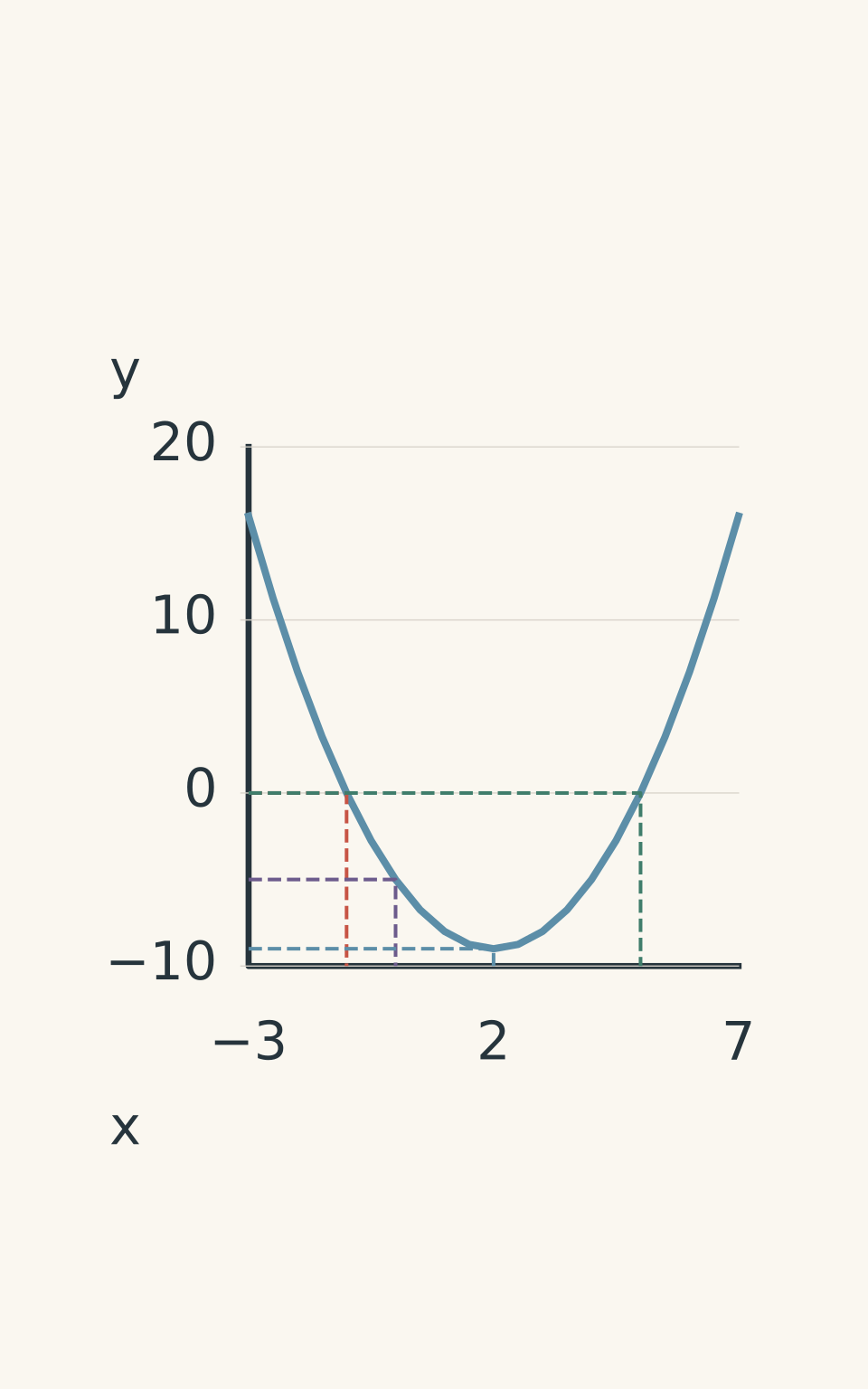
- y = x² − 4x − 5
- x-intercept (−1, 0)
- x-intercept (5, 0)
- y-intercept (0, −5)
- Minimum (2, −9)
Due to technical limitations, this figure may display incorrectly or contain inaccuracies. Please check key details against your course materials.
This question combines three different ways of understanding a quadratic: factorisation, substitution, and completing the square.
Being able to move between these forms is much more useful than memorising a single method.
Question 11
Two functions are defined as:
\[ f(x)=2x-1 \]
\[ g(x)=x^2+3 \]
Find:
a) \(g(f(x))\).
b) \(f(g(x))\).
c) Explain why these two expressions are not generally equal.
Solution 11
The composite functions are:
\[ \boxed{g(f(x))=4x^2-4x+4} \]
and:
\[ \boxed{f(g(x))=2x^2+5} \]
Step 1: Calculate \(g(f(x))\).
The expression \(g(f(x))\) means substitute the entire function \(f(x)\) into \(g(x)\).
Since:
\[ f(x)=2x-1 \]
we obtain:
\[ \begin{aligned} g(f(x))&=(2x-1)^2+3\\ &=4x^2-4x+1+3\\ &=4x^2-4x+4 \end{aligned} \]
Step 2: Calculate \(f(g(x))\).
Now substitute the entire function \(g(x)\) into \(f(x)\).
\[ \begin{aligned} f(g(x))&=2(x^2+3)-1\\ &=2x^2+6-1\\ &=2x^2+5 \end{aligned} \]
Step 3: Compare the expressions.
The expressions are different because the order of substitution changes the result.
For example, let \(x=1\).
\[ g(f(1))=4 \]
However:
\[ f(g(1))=7 \]
Therefore:
\[ \boxed{g(f(x))\neq f(g(x))} \]
in general.
This is an important idea in function composition. The order in which you apply functions matters, just as the order of operations matters in ordinary algebra.
Question 12
A 5-metre ladder leans against a vertical wall. Its base is 3 metres from the wall.
Calculate:
a) The height reached by the ladder.
b) The angle between the ladder and the horizontal ground, to the nearest degree.
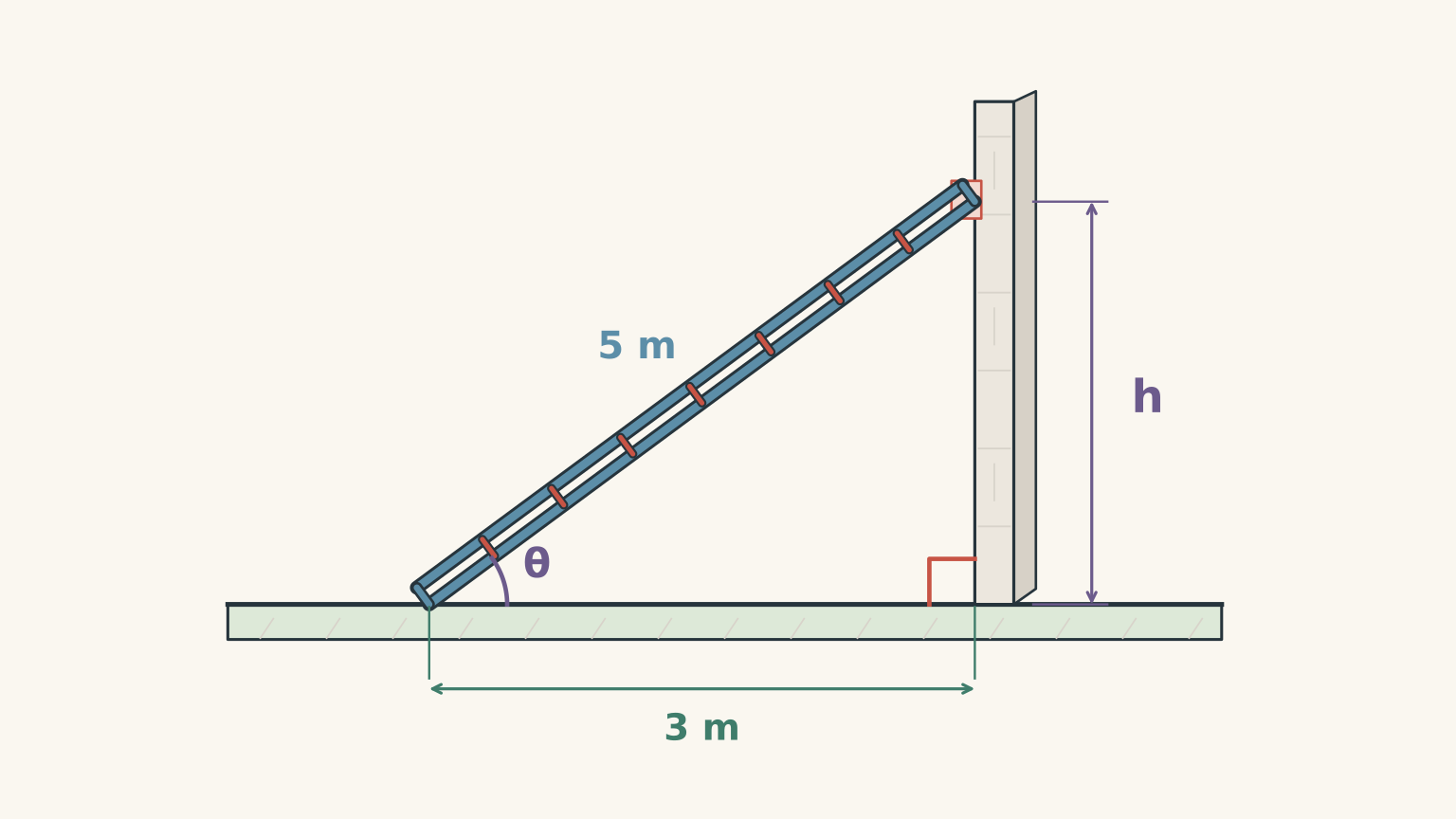
Due to technical limitations, this figure may display incorrectly or contain inaccuracies. Please check key details against your course materials.
Solution 12
The ladder reaches a height of 4 metres, and the angle with the ground is approximately \(53^\circ\).
Step 1: Identify the sides of the triangle.
The ladder is the hypotenuse because it is opposite the right angle.
We know:
- Hypotenuse = 5 m.
- Horizontal side = 3 m.
- Vertical side = unknown.
Step 2: Apply Pythagoras’ theorem.
For a right-angled triangle:
\[ a^2+b^2=c^2 \]
Substitute:
\[ \begin{aligned} h^2+3^2&=5^2\\ h^2+9&=25\\ h^2&=16\\ h&=4 \end{aligned} \]
The height is:
\[ \boxed{4\text{ m}} \]
We take the positive square root because a physical height cannot be negative.
Step 3: Calculate the angle.
We know the adjacent side and hypotenuse relative to the ground angle.
Use cosine:
\[ \cos\theta=\frac{\text{adjacent}}{\text{hypotenuse}} \]
Substitute:
\[ \cos\theta=\frac35 \]
Therefore:
\[ \begin{aligned} \theta&=\cos^{-1}\left(\frac35\right)\\ &\approx53.13^\circ \end{aligned} \]
To the nearest degree:
\[ \boxed{\theta=53^\circ} \]
The key is identifying which sides are opposite, adjacent, and hypotenuse relative to the angle being considered.
A common mistake is choosing the wrong trigonometric ratio because the student remembers the formula but hasn’t identified the sides first.
Question 13
An opaque bag contains:
- 4 red counters.
- 3 blue counters.
- 2 green counters.
Two counters are drawn one after the other without replacement.
Calculate the probability that both counters are the same colour.

Due to technical limitations, this figure may display incorrectly or contain inaccuracies. Please check key details against your course materials.
Solution 13
The probability that both counters have the same colour is:
\[ \boxed{\frac{5}{18}} \]
There are three possible ways to draw two counters of the same colour:
- Two red counters.
- Two blue counters.
- Two green counters.
Calculate each probability separately.
Step 1: Calculate the probability of drawing two red counters.
There are four red counters out of nine initially.
After drawing one red counter, three red counters remain out of eight.
\[ P(RR)=\frac49\times\frac38 =\frac{12}{72} \]
Step 2: Calculate the probability of drawing two blue counters.
\[ P(BB)=\frac39\times\frac28 =\frac6{72} \]
Step 3: Calculate the probability of drawing two green counters.
\[ P(GG)=\frac29\times\frac18 =\frac2{72} \]
Step 4: Add the probabilities.
These three outcomes cannot occur simultaneously, so their probabilities can be added.
\[ \begin{aligned} P(\text{same colour}) &=\frac{12}{72}+\frac6{72}+\frac2{72}\\ &=\frac{20}{72}\\ &=\boxed{\frac5{18}} \end{aligned} \]
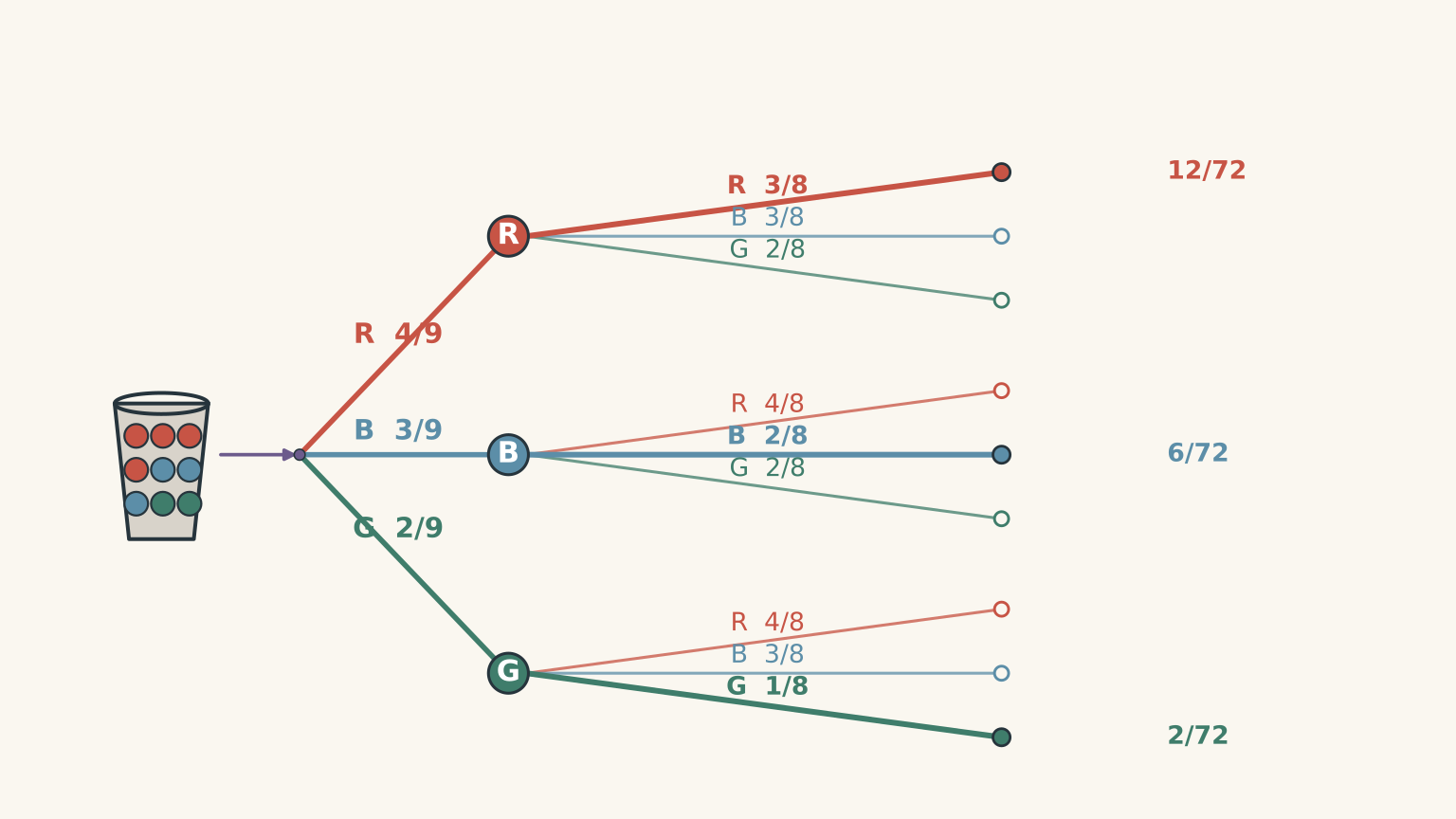
Due to technical limitations, this figure may display incorrectly or contain inaccuracies. Please check key details against your course materials.
The important detail is that the second denominator is 8, not 9.
The first counter is not replaced, so the total number of counters changes after the first draw. This means the two draws are dependent events.
Question 14
A student receives the following five quiz scores, each out of 20:
\[ 4,\quad5,\quad5,\quad6,\quad20 \]
Calculate:
a) The mean.
b) The median.
c) The range.
d) Which measure, the mean or median, better represents a typical score in this data set? Explain your reasoning.
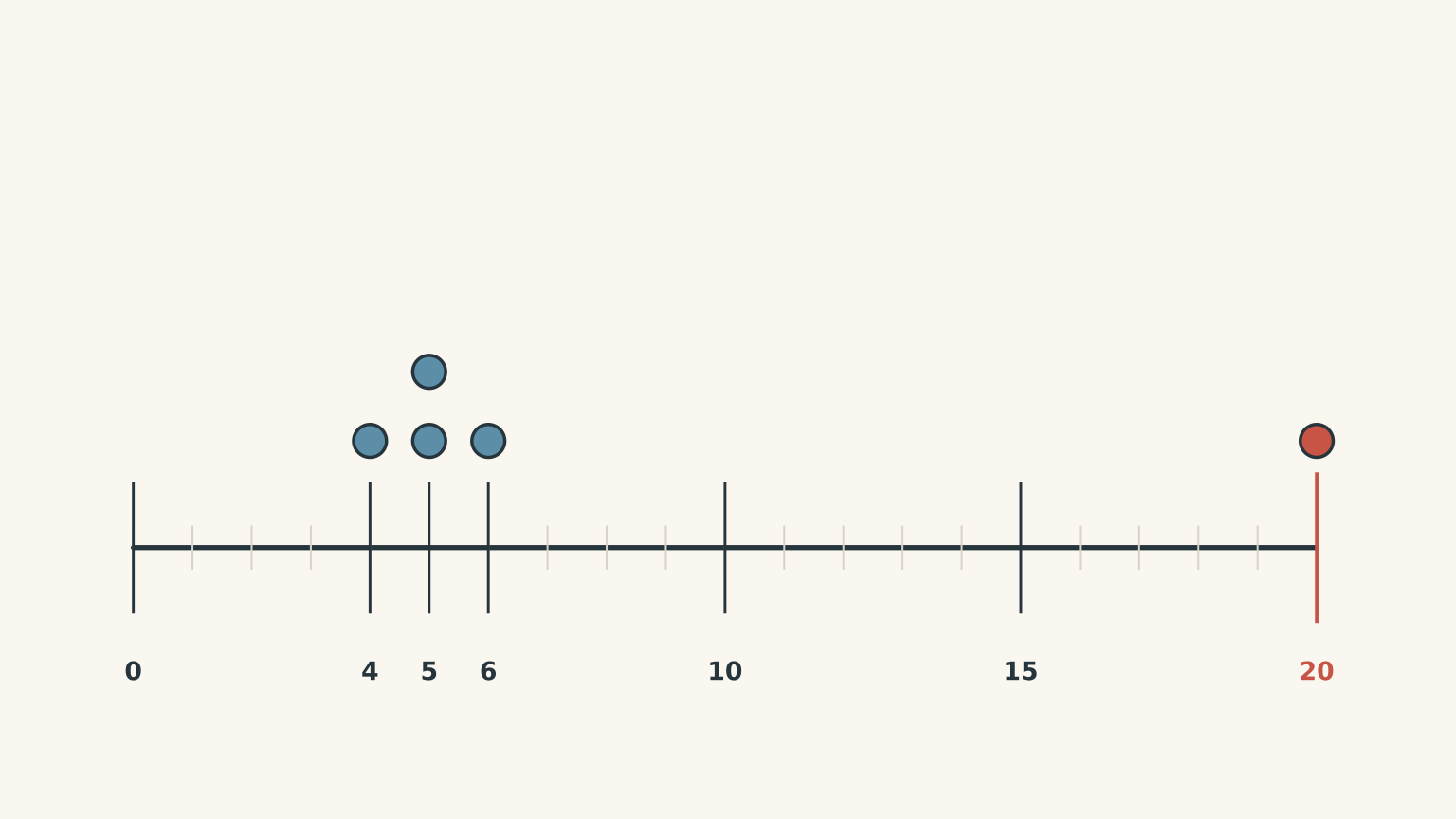
Due to technical limitations, this figure may display incorrectly or contain inaccuracies. Please check key details against your course materials.
Solution 14
The mean is 8, the median is 5, and the range is 16. The median better represents the typical score in this particular data set.
Step 1: Calculate the mean.
The mean is the sum of all observations divided by the number of observations.
\[ \begin{aligned} \text{Mean} &=\frac{4+5+5+6+20}{5}\\ &=\frac{40}{5}\\ &=\boxed{8} \end{aligned} \]
Step 2: Calculate the median.
The median is the middle value when the data is arranged in ascending order.
The scores are already ordered:
\[ 4,\quad5,\quad\boxed{5},\quad6,\quad20 \]
Therefore:
\[ \boxed{\text{Median}=5} \]
Step 3: Calculate the range.
The range is the maximum value minus the minimum value.
\[ \begin{aligned} \text{Range}&=20-4\\ &=\boxed{16} \end{aligned} \]
Step 4: Decide which measure better represents a typical score.
The median is more representative here.
Four of the five scores lie between 4 and 6. The score of 20 is much higher than the others and pulls the mean upwards.
The mean is mathematically correct, but it doesn’t describe the centre of this particular cluster of scores as well as the median.
This illustrates why choosing a statistical measure requires understanding the shape of the data, not simply calculating a number.
Question 15
This final question combines quadratic functions, domain restrictions, and inverse functions.
A drone flies vertically upwards, reaches its maximum height, and then returns to the ground.
Its height above the ground is modelled by:
\[ H(t)=16-(t-4)^2 \]
where:
- \(H(t)\) is the height in metres.
- \(t\) is the time in seconds.
- The model applies for \(0\leq t\leq8\).
A data analyst wants to use the measured height to determine the time.
One analyst argues that the function has no inverse because solving for \(t\) produces two possible answers.
Another argues that restricting the time interval to \(4\leq t\leq8\) gives a valid inverse.
Answer the following:
a) Is \(H\) one-to-one on its original domain \(0\leq t\leq8\)? Demonstrate your reasoning using two different input values.
b) Restrict the domain to \(4\leq t\leq8\). Find the inverse function, including its domain and range.
c) The drone is measured at a height of 7 metres. Find every possible time at which it reaches this height on the original domain. Which time is retained when the domain is restricted to \(4\leq t\leq8\)?
d) A third analyst proposes restricting the domain to \(3\leq t\leq8\). They argue that a height of 7 metres corresponds to only one time in this interval, so the function must have an inverse.
Is this argument correct? Explain why or why not, using a specific counterexample if necessary.
Solution 15
The original function is not one-to-one on \([0,8]\). It becomes invertible when restricted to \([4,8]\), with inverse:
\[ \boxed{H^{-1}(h)=4+\sqrt{16-h}} \]
The third analyst’s argument is incorrect because having only one time for a particular height does not prove that the function is one-to-one across its entire domain.
Step 1: Determine whether the original function is one-to-one.
A function is one-to-one if different inputs always produce different outputs.
In other words, if two different input values produce the same output, the function is not one-to-one.
Consider:
\[ H(t)=16-(t-4)^2 \]
Substitute \(t=1\):
\[ H(1)=16-(1-4)^2=7 \]
Now substitute \(t=7\):
\[ H(7)=16-(7-4)^2=7 \]
Therefore:
\[ H(1)=H(7) \]
even though \(1\neq7\).
The function is not one-to-one on \([0,8]\).
The reason is that the drone passes through the same height twice: once while ascending and once while descending.
Step 2: Restrict the domain to \([4,8]\) and find the inverse.
We begin with:
\[ h=16-(t-4)^2 \]
Rearrange:
\[ \begin{aligned} (t-4)^2&=16-h\\ t-4&=\pm\sqrt{16-h}\\ t&=4\pm\sqrt{16-h} \end{aligned} \]
There are two possible algebraic branches.
However, the restricted domain requires:
\[ 4\leq t\leq8 \]
This means \(t-4\) must be non-negative.
Therefore, we choose the positive square-root branch:
\[ \boxed{H^{-1}(h)=4+\sqrt{16-h}} \]
Now determine the domain and range of this inverse.
On the restricted original domain, the drone starts at 16 metres and descends to zero metres.
Therefore, the range of the original function is:
\[ 0\leq h\leq16 \]
This becomes the domain of the inverse:
\[ \boxed{\text{Domain of }H^{-1}=[0,16]} \]
The inverse outputs times between 4 and 8 seconds:
\[ \boxed{\text{Range of }H^{-1}=[4,8]} \]
The restriction has removed the ambiguity. Each allowed height now corresponds to exactly one time.
Step 3: Find all times when the drone reaches 7 metres.
Set:
\[ H(t)=7 \]
Substitute into the original model:
\[ \begin{aligned} 7&=16-(t-4)^2\\ (t-4)^2&=9\\ t-4&=\pm3 \end{aligned} \]
Therefore:
\[ \boxed{t=1\text{ s or }t=7\text{ s}} \]
Both times are valid on the original domain \([0,8]\).
However, after restricting the domain to \([4,8]\), the time \(t=1\) is excluded.
Only:
\[ \boxed{t=7\text{ s}} \]
remains.
This is exactly why the restricted function has an inverse: the descending part of the flight contains only one occurrence of each height.
Step 4: Test the third analyst’s argument.
The proposed domain is:
\[ 3\leq t\leq8 \]
The analyst observes that height 7 metres occurs only once in this interval.
That observation is correct:
\[ H(7)=7 \]
while the other solution, \(t=1\), is outside the restricted interval.
However, this does not prove that the function is one-to-one.
We need to check whether any other height is reached at two different times.
Consider \(t=3\) and \(t=5\):
\[ H(3)=16-(3-4)^2=15 \]
\[ H(5)=16-(5-4)^2=15 \]
Therefore:
\[ H(3)=H(5)=15 \]
Both input values are inside the proposed domain \([3,8]\).
The function is still not one-to-one.
The third analyst has confused a single output having one valid input with every output having at most one valid input.
These are different requirements.
The final conclusion: restricting the domain to \([4,8]\) works because it selects one side of the turning point, where the function is strictly decreasing. Restricting it to \([3,8]\) does not work because the domain still includes inputs on both sides of the maximum.
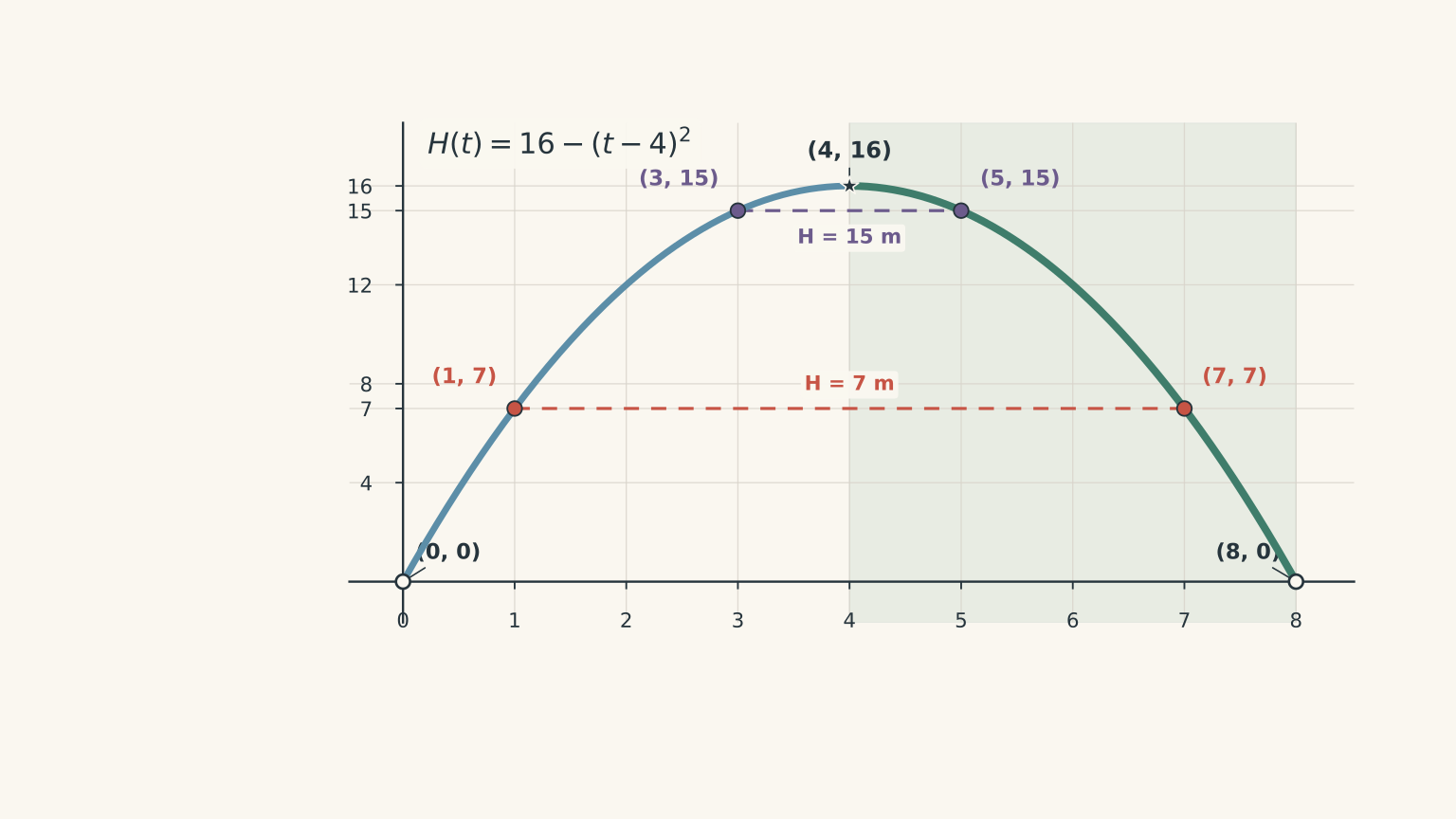
Due to technical limitations, this figure may display incorrectly or contain inaccuracies. Please check key details against your course materials.
This question tests something deeper than solving a quadratic. It tests whether you understand how the domain of a function controls what the function can do.
That idea becomes important when working with inverse functions, graph transformations, and more complicated relationships in Year 11.
05What your results mean: a targeted revision plan
Your total score is less useful than the pattern of your mistakes.
For example, getting 12 questions correct might sound reassuring, but if the three incorrect questions all involve factorising and solving equations, you have identified a weakness that could affect several Year 11 topics.
Use the following revision routes to decide what to work on next.
| Questions | Skill area | What to revise |
|---|---|---|
| 1-5 | Algebra and number | Expanding brackets, collecting like terms, fractions, surds, indices, factorisation, and solving quadratics |
| 6-8 | Equations and coordinate geometry | Compound inequalities, simultaneous equations, gradients, and straight-line equations |
| 9-11 | Functions and graphs | Function notation, domain and range, quadratic graphs, and composite functions |
| 12 | Trigonometry | Pythagoras, identifying triangle sides, SOH CAH TOA, and inverse trigonometric functions |
| 13 | Probability | Sample spaces, dependent events, and probability without replacement |
| 14 | Statistics | Mean, median, range, outliers, and interpreting distributions |
| 15 | Advanced function reasoning | One-to-one functions, restricted domains, and inverse functions |
If you struggled with algebra
Start here if you found Questions 1-5 difficult.
Work through these skills in order:
- Expand brackets and simplify expressions.
- Practise working with negative numbers and fractions.
- Learn the index laws, including negative indices.
- Simplify surds and identify perfect-square factors.
- Factorise quadratic expressions.
- Solve quadratic equations using the zero-product property.
Don’t rush through factorisation. It appears in many different forms throughout Mathematics Advanced.
A useful test is whether you can factorise a quadratic and check your answer by expanding it again.
If you struggled with equations and graphs
Questions 6-8 test whether you can translate mathematical information into equations and interpret the results.
Revise:
- Solving linear equations and compound inequalities.
- Reversing inequality signs when multiplying or dividing by negative numbers.
- Solving simultaneous equations using substitution and elimination.
- Calculating gradients from two coordinates.
- Finding the equation of a straight line.
- Identifying x- and y-intercepts.
Practise drawing straight lines from their equations rather than relying entirely on graphing software.
You should be able to explain what the gradient and intercept mean.
If you struggled with functions
Questions 9-11 and 15 are particularly important.
Revise:
- Function notation and substitution.
- Domain and range.
- Restrictions involving square roots and denominators.
- Quadratic graphs and turning points.
- Composite functions and the order of substitution.
- One-to-one functions and inverse functions.
A particularly useful habit is to write down the domain before attempting more complicated function questions.
It prevents you from accepting mathematically possible answers that are not allowed by the original function.
If you struggled with trigonometry
Start with the basics:
- Identify the hypotenuse, opposite side, and adjacent side.
- Use Pythagoras’ theorem to find missing sides.
- Practise sine, cosine, and tangent.
- Use inverse trigonometric functions to calculate angles.
- Check whether your calculator is in degree mode when working with degree-based questions.
Once these skills are reliable, move towards radian measure and trigonometric functions, which are important parts of Year 11 Mathematics Advanced.
If you struggled with probability and statistics
For probability, practise drawing probability trees and updating the number of possible outcomes after each event.
Pay particular attention to the difference between drawing with replacement and without replacement.
For statistics, revise:
- Mean and median.
- Range and measures of spread.
- Quartiles and interquartile range.
- The effect of unusual values on statistical summaries.
- Choosing appropriate measures to describe a data set.
Being able to explain why a statistical measure is appropriate is just as important as calculating it.
06So, are you ready for Year 11 Maths Advanced?
Use your results to make a practical decision about what to revise, rather than treating this diagnostic as a pass-or-fail test.
A useful way to interpret your results is:
- Secure: You answered correctly, showed appropriate working, and can explain the method.
- Developing: You understood the general approach but made mistakes or needed a hint.
- Revisit: You struggled to set up the question or couldn’t explain why a method worked.
You don’t need every skill to be perfect before Year 11 begins. However, substantial gaps in algebra, equations, and functions are worth addressing early because these skills appear repeatedly throughout the course.
The best next step is to prioritise your weakest foundational area, practise it until you can solve unfamiliar questions independently, and then attempt the relevant diagnostic questions again.
Once your foundations are reliable, begin with the Year 11 Functions topic. Focus on understanding function notation, domains, ranges, and graph transformations before moving further into trigonometric functions, exponentials, logarithms, and introductory calculus.
Those topics introduce new mathematics. The skills in this diagnostic are what allow you to make sense of it.