
HSC Tutoring Trial Lessons: What to Check Before You Commit
Make the most of an HSC tutoring trial by checking explanations, participation, feedback and the published first-lesson terms.
An online tutoring trial can look impressive. The tutor solves three difficult questions, the shared whiteboard fills up, and every step seems obvious while you’re watching. Then you open a similar question on your own and can’t work out how to start.
That gap is exactly what a trial lesson should help you identify.
Before judging the lesson, consider this: if you could follow every line of the tutor’s solution, does that prove you can solve the next question independently?
No. Following someone else’s reasoning is not the same as producing your own. A useful trial should show you whether the tutor can help you move from understanding an explanation to applying the idea yourself.
There are four things worth checking: explanation, feedback, pace, and the terms of the service. Here’s how to assess each one.
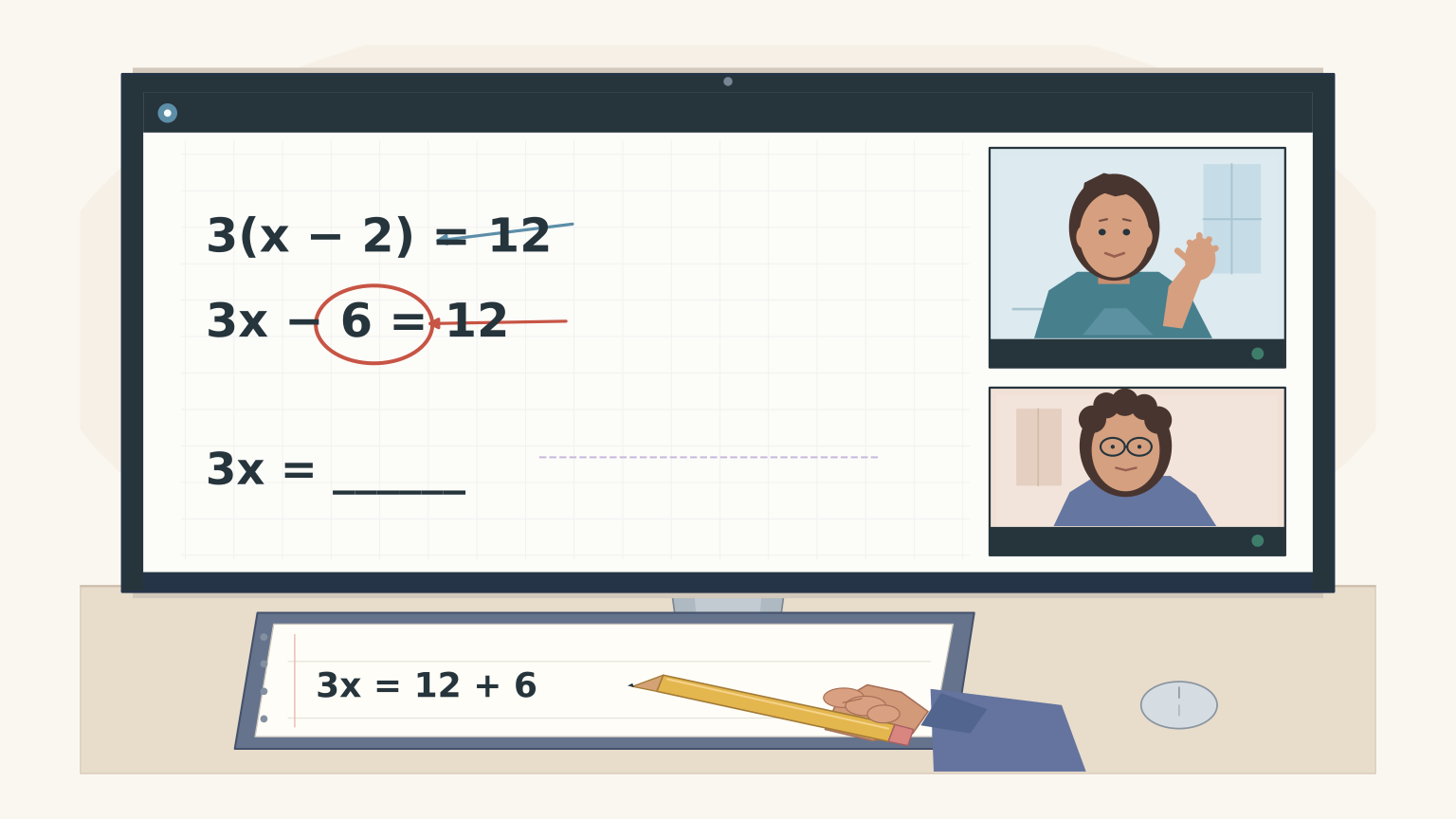
Due to technical limitations, this figure may display incorrectly or contain inaccuracies. Please check key details against your course materials.
01The four-part trial lesson scorecard
Use this scorecard immediately after the trial, while you can still remember what happened.
Give each category a score:
- 2 = clearly demonstrated
- 1 = partly demonstrated
- 0 = not demonstrated
| What to check | 2 points | 1 point | 0 points |
|---|---|---|---|
| Explanation | You understand why the method works and can apply it. | You follow the explanation but need prompts. | You mainly copy the tutor’s working. |
| Feedback | The tutor identifies your exact mistake and helps you correct it. | Mistakes are corrected, but the reasoning is unclear. | You receive vague praise or answers without useful feedback. |
| Pace | You have time to think, attempt questions, and ask for help. | Some parts feel rushed or unnecessarily slow. | The tutor doesn’t adjust to your understanding. |
| Terms | All costs, commitments, and cancellation conditions are clear in writing. | Some details still need clarification. | Important conditions are unclear or you’re pressured to commit. |
Interpreting your score:
- 7-8: A promising trial. The lesson demonstrated most of what you should expect.
- 5-6: Mixed results. Identify what was missing before deciding.
- 0-4: There isn’t enough evidence to justify committing yet.
The score is a decision-making aid, not an objective measure of teaching quality. In particular, don’t let strong teaching compensate for unclear payment or cancellation conditions. If the terms score zero, pause until they’re clarified.
01Explanation: Did you understand why the method works?
A tutor should do more than show you which formula to use or which steps to write.
A good explanation connects three things:
- The underlying concept.
- The mathematical or scientific method used to solve the problem.
- The reason that method works in this particular situation.
You should be able to follow the reasoning, not just recognise the final answer.
Consider a Physics example.
A car travels around a bend at a constant speed. Does it have acceleration?
You might initially say no. The speedometer isn’t changing, so surely the car isn’t speeding up or slowing down.
A good tutor will help you recognise the missing idea: velocity includes both speed and direction. As the car turns, its direction of motion changes, meaning its velocity changes. Since acceleration describes the rate of change of velocity, the car is accelerating even though its speed remains constant.
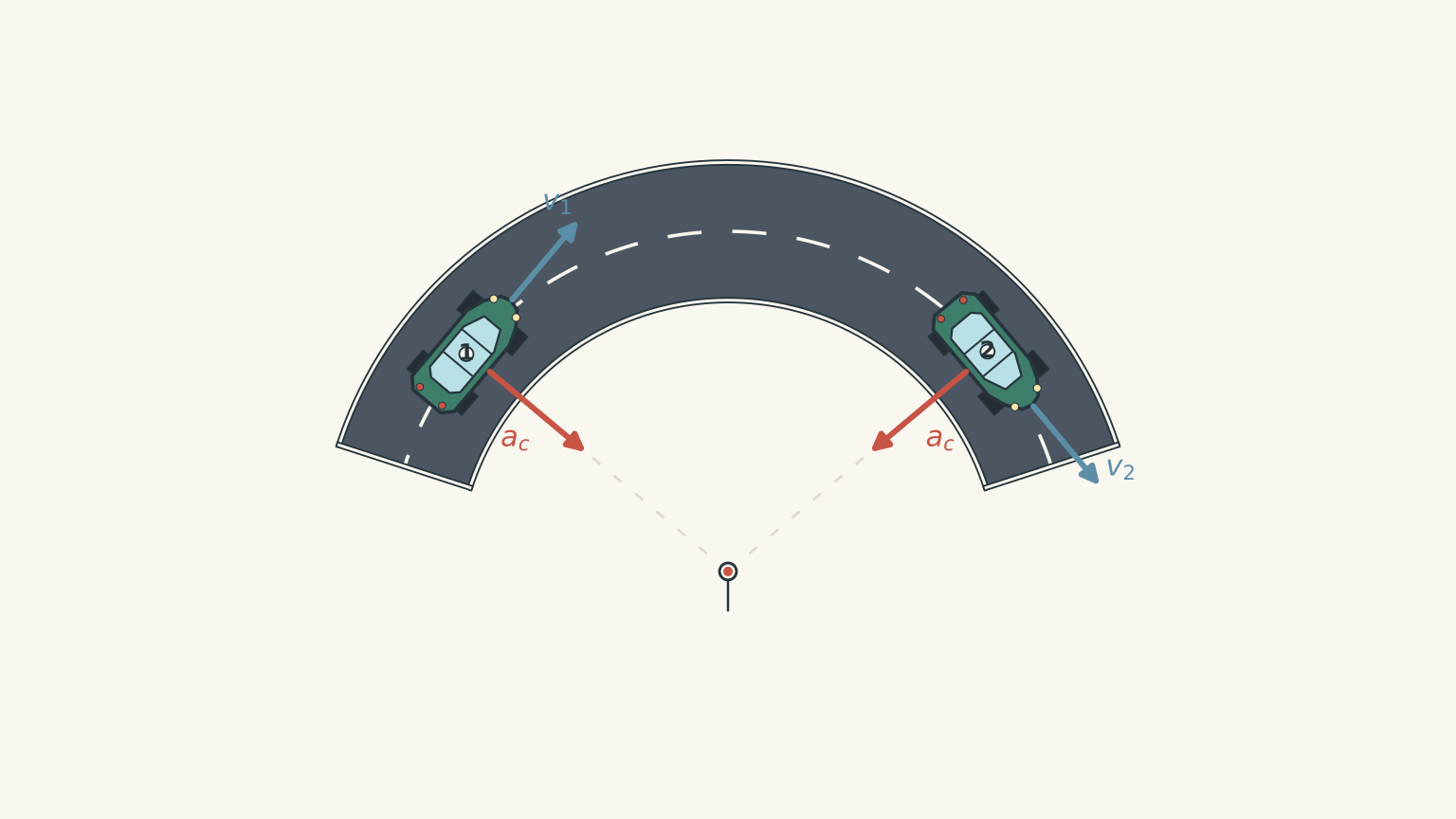
Due to technical limitations, this figure may display incorrectly or contain inaccuracies. Please check key details against your course materials.
Notice what makes this explanation useful. The tutor hasn’t simply told you that acceleration exists. They’ve helped you understand the physical reason behind the answer.
The same principle applies in Chemistry and Mathematics Extension.
For example, when explaining chemical equilibrium, a tutor should distinguish between reaction rate and equilibrium position. A catalyst increases the rates of both forward and reverse reactions, allowing equilibrium to be reached sooner, but it does not change the equilibrium composition.
In Mathematics Extension, an explanation of the chain rule should connect the idea of differentiating a composite function to the actual steps used in a question.
Signs of a strong explanation
Look for these behaviours:
- The tutor explains unfamiliar ideas using simpler concepts you already understand.
- Each mathematical step has a reason behind it.
- Important assumptions and conditions are identified.
- The tutor checks whether you can explain the idea in your own words.
- You get an opportunity to apply the explanation to a slightly different question.
One particularly useful sign is that the tutor asks you to predict what happens before revealing the answer.
If you make an incorrect prediction, they should help you understand why your reasoning needs adjusting.
A tutor who only asks, “Does that make sense?” isn’t necessarily checking understanding. It’s much more revealing to see whether you can explain or apply the concept yourself.
02Feedback: Did the tutor help you understand your mistakes?
A trial lesson should give you an opportunity to make mistakes.
That’s not a problem. In fact, your mistakes can reveal more about the quality of the teaching than getting every question right.
The important distinction is between correcting an answer and correcting the thinking that produced it.
Suppose you’re studying Mathematics Extension 1 and need to differentiate:
\[ y=\sin(3x^2) \]
You write:
\[ \frac{dy}{dx}=3\cos(3x^2) \]
Your answer is incorrect because you’ve differentiated the outer sine function but haven’t accounted for the derivative of the inner function, \(3x^2\).
A tutor could simply write the correct answer underneath:
\[ \frac{dy}{dx}=6x\cos(3x^2) \]
But that doesn’t necessarily help you avoid the same mistake next time.
A better tutor identifies exactly where your reasoning went wrong. They explain that the chain rule requires multiplying by the derivative of the inner function, which is \(6x\).
Then they give you another related expression to differentiate independently.
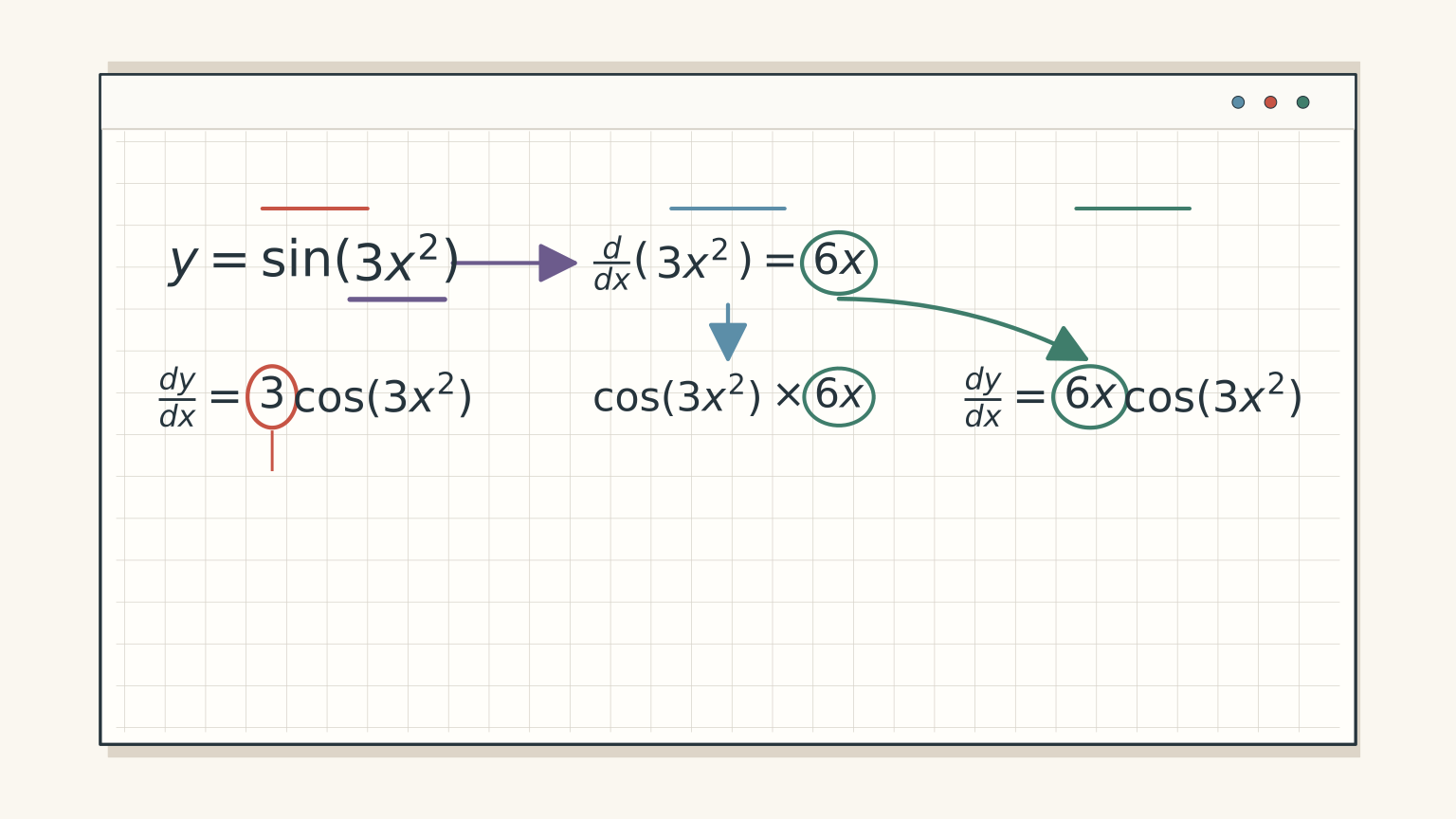
Due to technical limitations, this figure may display incorrectly or contain inaccuracies. Please check key details against your course materials.
That’s the difference between receiving an answer and receiving useful feedback.
What useful feedback should contain
Ideally, the tutor should help you identify:
- What you did correctly.
- The exact step where your reasoning became incorrect.
- Why that step was incorrect.
- What you should do differently next time.
This applies to written explanations as well as calculations.
In Chemistry, for example, a tutor might notice that you understand how to calculate the number of moles but consistently confuse the mole ratio with the mass ratio.
Simply correcting the final numerical answer won’t solve that underlying problem.
The tutor should explain the relationship between the balanced chemical equation and the mole ratio, then let you try another calculation.
The important test: Did the feedback make you more capable of correcting your own work?
If the tutor does all the correcting while you watch, you haven’t really tested that.
03Pace: Did the lesson move at a useful speed?
A good tutoring lesson isn’t necessarily the one that covers the most content.
It’s the one that gives you enough time to understand, practise, and correct your thinking.
Imagine two different trial lessons.
In the first, the tutor explains five questions in quick succession. Every solution is correct, but you barely have time to write anything down.
In the second, the tutor spends most of the lesson working through two questions. You attempt each one, discuss where you became stuck, and then try a related question independently.
Which lesson is more useful?
Usually, the second.
The number of completed questions doesn’t tell you how much you have learned. What matters is how much of the reasoning you can now reproduce without assistance.
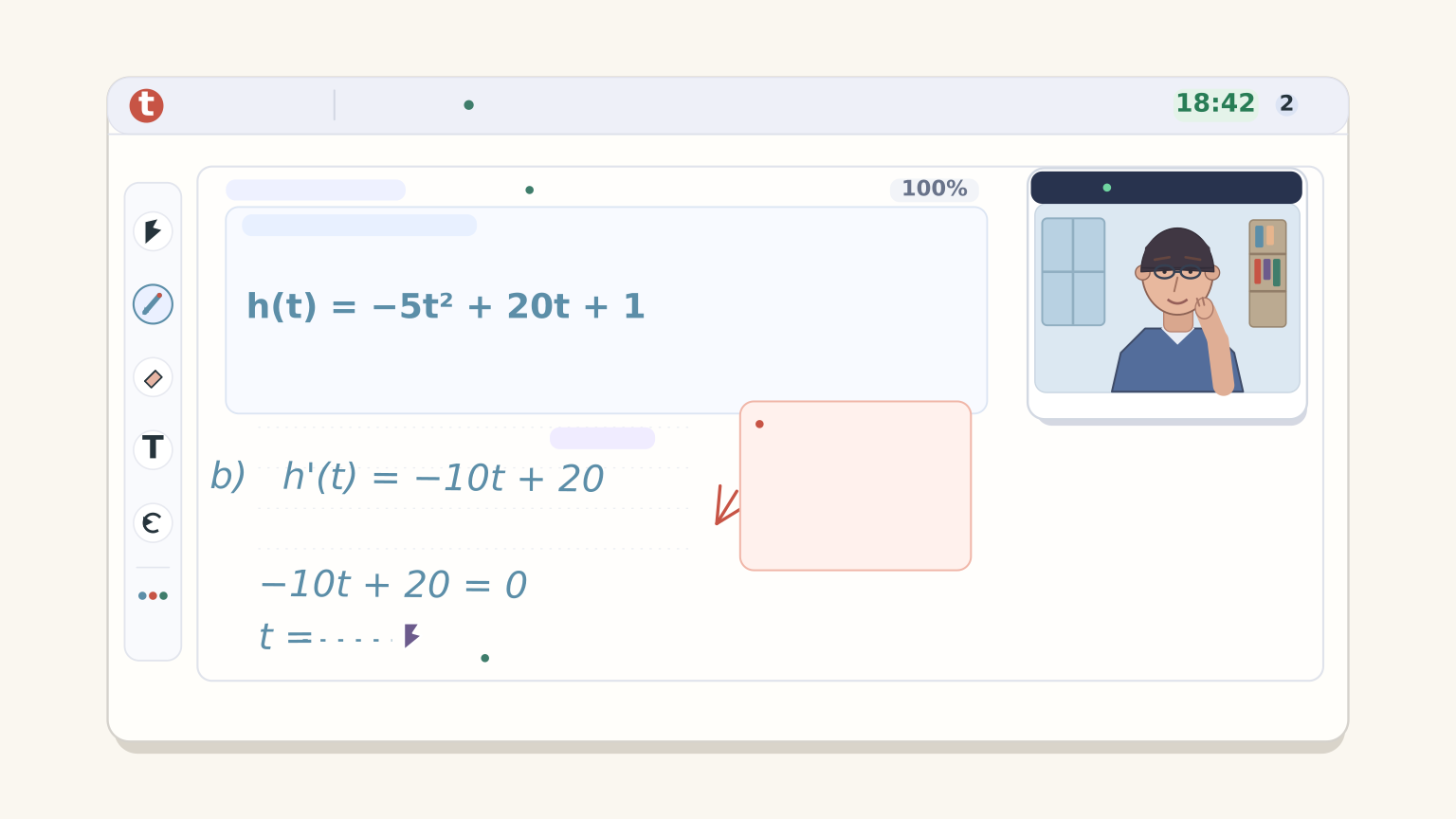
Due to technical limitations, this figure may display incorrectly or contain inaccuracies. Please check key details against your course materials.
How to recognise the right pace
A useful lesson should include:
- Time for the tutor to explain unfamiliar concepts.
- Enough thinking time for you to attempt questions.
- Opportunities to stop and ask for clarification.
- Adjustments when you are struggling with a particular step.
- More challenging questions once the foundations are secure.
There are two common problems to watch for.
The lesson is too fast.
The tutor moves through solutions before you’ve understood the previous step. You spend most of the lesson copying notes, and questions are answered before you’ve had a chance to attempt them.
The lesson is too slow.
The tutor spends too much time repeating ideas you already understand, without checking whether you’re ready for something more challenging.
A good tutor should recognise the difference.
It’s also worth remembering that productive struggle is not the same as poor teaching. Sometimes you need a few minutes to work through a difficult idea before the explanation clicks.
The tutor shouldn’t immediately remove every challenge. They should provide enough guidance for you to make progress without doing all the thinking for you.
04Terms: Do you understand what you’re agreeing to?
The teaching might be excellent, but that doesn’t automatically make the service a sensible commitment.
A trial lesson is also an opportunity to understand the practical terms of the tutoring arrangement.
One important detail is that the word “trial” can mean different things.
It might be:
- A free introductory session.
- A discounted first lesson.
- A regular paid lesson that can be used to assess the service.
Don’t assume a trial is free or that attending one automatically gives you the right to cancel a subsequent package.
Before agreeing to ongoing tutoring, make sure you understand the following.
Costs and payment
- What is the total cost per lesson?
- How long is each lesson?
- Is payment made individually or through a package?
- Is there a minimum number of lessons?
- Are there any additional charges?
- Is payment required upfront?
Cancellation and commitment
- How much notice is required to cancel or reschedule?
- What happens if you miss a lesson?
- Are unused lessons refundable?
- Do prepaid lessons expire?
- Can lessons be paused during school holidays or exam periods?
- What happens if the tutor needs to cancel?
- Is there an ongoing commitment or automatic payment arrangement?
What’s included?
- Are lesson notes or resources included?
- Are recordings provided, if applicable?
- Is the tutoring individual or group-based?
- Can the assigned tutor change?
- Are there additional charges for resources or other services?
You don’t need to memorise every condition. You do need to know where to find them and what they mean.
Ask for the relevant terms in writing before accepting a package or making a payment. A contract can be formed through verbal agreement or actions such as payment, not just by signing a document.
Under Australian Consumer Law, services come with consumer guarantees, including requirements for due care and skill and suitability for a stated purpose. Contract terms cannot simply remove these rights.
However, changing your mind alone does not automatically entitle you to a refund for a service that has already been supplied. The circumstances and agreed terms matter.
If a parent or carer is paying for tutoring, make sure they have seen and understood the same conditions before committing.
A provider who explains the teaching clearly but cannot explain the payment arrangements clearly is giving you an incomplete picture of the service.
06Check that the lesson matches your HSC syllabus
There’s another detail worth checking for NSW students: whether the trial lesson is aligned with the syllabus that applies to your particular HSC cohort.
This is particularly important for Physics and Chemistry because their new syllabuses have different implementation dates.
As at 15 November 2026, NESA’s published transition schedule is:
| Subject | New syllabus starts for Year 11 | First HSC examination |
|---|---|---|
| Physics | 2027 | 2028 |
| Chemistry | 2028 | 2029 |
This means a student starting Year 11 in 2027 will study the new Physics syllabus but the existing Chemistry syllabus.
A student starting Year 11 in 2028 will study the new syllabuses in both subjects.
Students sitting the 2027 HSC will still be examined on the existing Physics and Chemistry syllabuses.
Don’t assume that a tutor using the latest available material is automatically using the correct material for your cohort.
For Mathematics Extension 1 and Extension 2, check that the lesson addresses the relevant syllabus outcomes and the topics being studied in your course.
The point isn’t to test the tutor’s knowledge of syllabus dates. It’s to make sure the teaching you’re receiving is relevant to the course you’re actually completing.
07How should you decide after the trial?
Once you’ve completed the scorecard, consider the evidence rather than relying on your overall impression.
Here are four common situations and what they suggest.
Situation 1: The explanation was clear, and you could solve a new question
This is a promising result.
The tutor explained the concept, gave you time to practise, and helped you become more independent.
If the pace and terms were also suitable, there’s a reasonable basis for considering further lessons.
Situation 2: The tutor was knowledgeable, but you did most of the copying
This is less convincing.
The tutor may understand the subject extremely well, but the trial hasn’t demonstrated that their teaching helps you develop independent problem-solving skills.
Ask yourself whether you could now approach a similar question without seeing the original solution.
If not, the lesson hasn’t provided enough evidence yet.
Situation 3: The lesson was challenging, but the feedback was excellent
Don’t automatically treat this as a bad trial.
You might have finished the lesson with more questions than answers, but if you understand exactly where your reasoning was going wrong and know how to improve it, that’s useful progress.
The important distinction is whether you were challenged productively or simply left confused.
Situation 4: The teaching was good, but the terms weren’t clear
Don’t rush into a commitment.
Ask for the complete pricing and cancellation conditions in writing. If a provider is unwilling to clarify important details, there’s no reason to proceed until those concerns are resolved.
A good lesson shouldn’t require you to make a rushed financial decision.
08Explore the next step
A trial lesson is a practical way to experience the explanation, participation and feedback before choosing ongoing support. Bring a question and notice what you understand more clearly afterwards.
tutorgum offers live online small-group teaching for Year 11 and 12 Physics, Chemistry and Maths, with opportunities for questions and feedback on student responses. View the current classes, pricing and timetable and enquire about a first lesson. The published first-lesson arrangement charges the lesson normally if you continue; it is free if you decide not to continue.