
Can Free Videos Replace an HSC Tutor?
Compare free HSC videos with live tutoring, and see how explanations, independent practice and personalised feedback can work together.
You watch a video explaining the chain rule in differentiation. The presenter works through an example, explains every step, and makes the whole thing look straightforward. Then you try a question on your own:
\[ y=\sin(5x) \]
You write \(y'=\cos(5x)\). The correct answer is \(y'=5\cos(5x)\).
You understood the video, but you haven’t quite learnt to apply the method independently. Watching another explanation might help. But what you really need is to understand why you keep missing the factor of 5.
This is the difference between learning from a video and receiving personalised feedback.
Can free videos replace an HSC tutor? Sometimes, yes. Free videos are excellent for learning new concepts, revising content, and watching worked examples. However, they cannot reliably identify your individual misconceptions, diagnose repeated mistakes, or adapt an explanation to the way you think.
Videos and tutoring can support different parts of the same study routine: recorded explanations for review, and live discussion and feedback to develop your own problem-solving.
01What free videos do well
There are some things recorded explanations are genuinely good at.
1. Explaining unfamiliar concepts
Suppose you’re studying electric fields in Year 12 Physics and can’t picture how a charged particle behaves in an electric field.
A good video can show you the field lines, explain the direction of the electric force, and work through an example. You can pause, rewind, and watch the explanation again until the ideas become clearer.
This flexibility is useful, particularly when your school lesson moves faster than you’d like.
The same applies to:
- Physics: Understanding projectile motion, electromagnetic induction, and gravitational fields.
- Chemistry: Learning equilibrium, reaction mechanisms, and electrochemical cells.
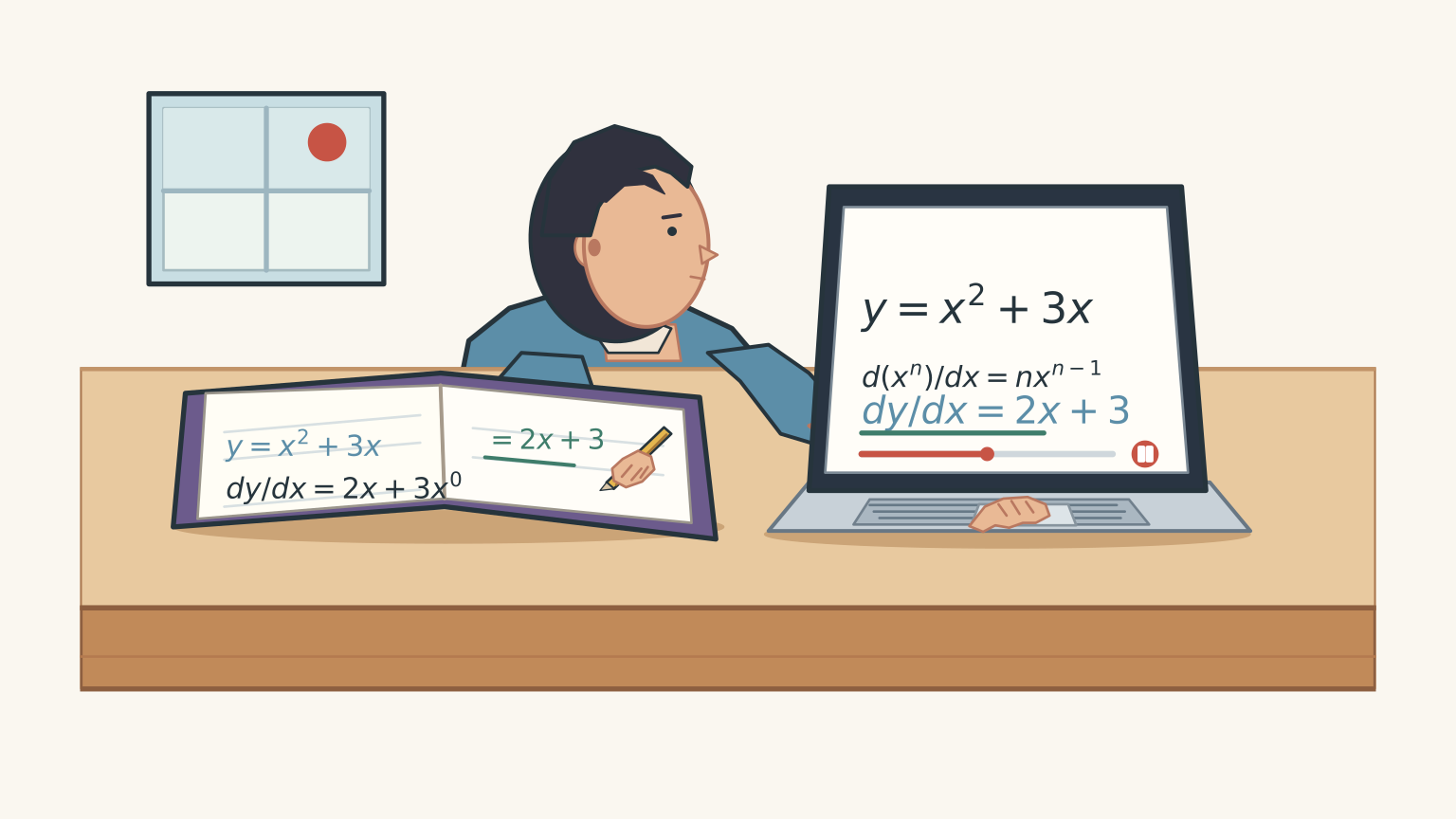
- Mathematics Extension 1: Understanding differentiation, integration, and trigonometric functions.
- Mathematics Extension 2: Following proofs, complex numbers, and advanced calculus techniques.
Due to technical limitations, this figure may display incorrectly or contain inaccuracies. Please check key details against your course materials.
2. Repeating difficult explanations
Not everyone understands a concept the first time.
With a recorded lesson, you can revisit the exact section that confused you. You can slow down the explanation, pause before a calculation, and attempt the next step yourself.
You can also find another explanation of the same concept. Sometimes a different example or teaching approach makes something click.
This is particularly useful when you have identified a specific knowledge gap.
3. Demonstrating standard exam methods
Videos can be especially helpful when you need to see how a familiar type of question is solved.
For example, a Mathematics Extension 1 video might demonstrate how to differentiate a composite function. A Chemistry video might show how to calculate an equilibrium constant from equilibrium concentrations.
You can follow the method, record the important steps, and practise similar questions.
However, there’s an important limitation.
Following someone else’s working is not the same as producing your own.
When a presenter chooses the correct equation, identifies the relevant information, and explains every calculation, you don’t have to make those decisions yourself.
In an examination, you do.
02What a free video cannot reliably replace
Imagine watching someone play tennis.
You can see their technique, observe their footwork, and replay their serve as many times as you like. But the video cannot notice that your own racket position is incorrect or that you’re consistently throwing the ball too far behind you.
A coach can watch you attempt the serve and identify the specific problem.
The same distinction applies to HSC tutoring.
A recorded explanation demonstrates what good problem-solving looks like. A good tutor can observe your problem-solving, identify where it breaks down, and help you correct it.
There are three particularly important differences.
1. Identifying your individual misconceptions
Two students can get the same question wrong for completely different reasons.
Consider a Physics question involving a charged particle moving through an electric field.
One student might misunderstand the direction of the electric force. Another might understand the physics perfectly but make a mistake when resolving the force into components.
Both students get the wrong answer.
However, giving them the same explanation won’t necessarily fix both problems.
The first student needs to revisit the relationship between charge, electric fields, and force. The second needs to practise resolving vectors and applying the correct mathematics.
A tutor can examine their working and distinguish between these problems.
A recorded video generally cannot.
2. Giving feedback on your actual working
In HSC examinations, getting the final answer right is only part of the task.
You also need to demonstrate appropriate reasoning, calculations, and explanations.
Consider a Mathematics Extension 1 student who repeatedly forgets part of the chain rule.
They might watch several videos explaining differentiation. Each video demonstrates the correct method, but none identifies why the student keeps making the same mistake.
A tutor looking at their working might notice that they understand the product rule but consistently forget to differentiate the inner function.
That is a much more useful diagnosis than simply being told to practise differentiation.
Due to technical limitations, this figure may display incorrectly or contain inaccuracies. Please check key details against your course materials.
3. Adapting the next explanation to your understanding
Sometimes the first explanation isn’t the problem. The problem is that you’re missing a prerequisite.
For example, a student struggling with chemical equilibrium might think they don’t understand equilibrium constants.
After looking at their working, however, a tutor might discover that they are having trouble calculating concentrations or interpreting balanced chemical equations.
Teaching more equilibrium content won’t fix that underlying problem.
The student needs to address the prerequisite first.
This is where personalised teaching can save considerable time. Instead of repeatedly revisiting the topic that appears difficult, you can work backwards to find the knowledge or skill that’s actually missing.
03Two students, two different solutions
The best learning resource depends on the problem you’re trying to solve.
Consider these two situations.
Scenario 1: Free videos are enough
A Year 11 Chemistry student is struggling with mole ratios.
They understand how to calculate the number of moles from a mass, but aren’t sure how to use the coefficients in a balanced chemical equation.
They find a free explanation of stoichiometry and watch an example involving:
\[ \ce{2Mg + O2 -> 2MgO} \]
The video explains that one mole of oxygen reacts with two moles of magnesium to produce two moles of magnesium oxide.
The student then attempts a question involving 0.30 mol of oxygen, with excess magnesium.
Their calculation is:
\[ n(\ce{MgO})=0.30\times 2 \]
\[ \boxed{n(\ce{MgO})=0.60\text{ mol}} \]
They check their answer, attempt two more questions with different quantities, and get them right without looking at the video.
In this situation, paying for tutoring would not necessarily add much value.
The student identified a specific knowledge gap, found an explanation, and successfully applied the method independently.
They should continue using free resources and spend their time practising other areas of Chemistry.
Scenario 2: Personalised feedback is more useful
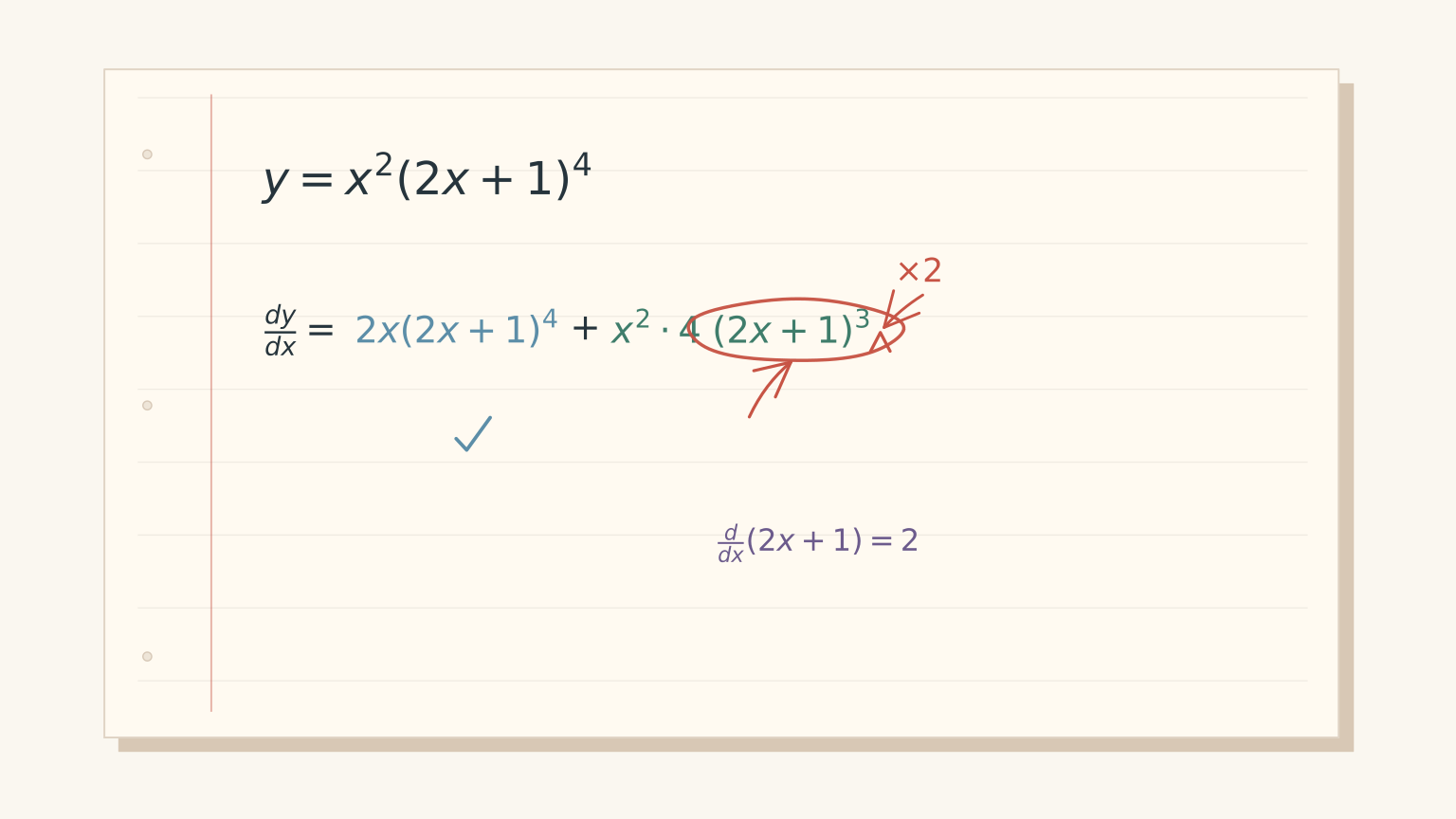
A Mathematics Extension 1 student can follow differentiation examples but repeatedly makes mistakes when applying the product rule and chain rule together.
Consider:
\[ y=x^2(2x+1)^4 \]
The student writes:
\[ y'=2x(2x+1)^4 +4x^2(2x+1)^3 \]
The first term is correct. The second term is missing a factor of 2 because the student hasn’t differentiated the inner function \(2x+1\).
The correct derivative is:
\[ \begin{aligned} y'={}&2x(2x+1)^4\\ &+8x^2(2x+1)^3 \end{aligned} \]
Watching another general video on the product rule might not solve this problem.
The student already understands much of the method. They need to recognise that differentiating the composite function also requires multiplying by the derivative of its inner function.
A tutor can examine the student’s working, ask them to explain each step, and identify exactly where the reasoning goes wrong.
The student can then practise questions that combine both rules until they can apply them independently.
The important difference is that the second student needs diagnosis, not simply another demonstration.
04How to use free videos effectively
Use free explanations alongside opportunities to ask questions and receive feedback on your own working. That combination connects understanding a demonstration with applying the idea yourself.
Watching three explanations without attempting a question yourself can create a false sense of understanding.
Try this approach instead.

Due to technical limitations, this figure may display incorrectly or contain inaccuracies. Please check key details against your course materials.
Step 1: Identify the exact problem
Before searching for a video, work out what you don’t understand.
Avoid searching for something broad like “Year 12 Physics help”.
Instead, identify the specific issue:
- I don’t understand how to resolve forces on an inclined plane.
- I can’t distinguish between reaction quotient and equilibrium constant.
- I understand the chain rule but struggle to apply it with the product rule.
- I don’t know how to construct a mathematical induction proof.
The more specific your question, the more useful the explanation is likely to be.
Step 2: Watch one targeted explanation
Find a video that addresses your particular problem.
Take notes on the underlying concept, not just the calculations.
When the presenter starts a worked example, pause the video and predict the next step before continuing.
If you can explain why that step is appropriate, you’re beginning to understand the method rather than simply copying it.
Step 3: Close the video and attempt a question
This is the most important step.
Find a new question on the same topic and attempt it without looking at your notes or the video.
Try something slightly different from the original example. This tests whether you can recognise when and how to use the method.
If you can only solve questions that look almost identical to the demonstration, your understanding may still be quite limited.
Step 4: Check your working, not just your answer
Compare your solution with a reliable worked solution or marking guideline.
Don’t just check whether your final answer matches.
Look for:
- Did you choose the correct equation or method?
- Did you understand the relevant scientific or mathematical principle?
- Did you substitute the correct values?
- Did you handle units, signs, and significant figures correctly?
- Did you explain your reasoning clearly enough?
- Can you identify the first step where your solution went wrong?
Finding the first incorrect step is much more useful than discovering that your final answer is wrong.
Step 5: Try a different question
Attempt another question that tests the same concept in a different context.
If you can solve it independently, you’re making progress.
If you repeat the same mistake, don’t automatically watch another five videos.
You may need someone to examine your reasoning.
05When is an HSC tutor worth considering?
Tutoring is most useful when you need something that ordinary recorded explanations aren’t providing.
You might benefit from personalised support if:
- You repeatedly make the same mistakes despite revisiting the content.
- You understand worked examples but struggle to start unfamiliar questions.
- You know the relevant formulas but don’t understand when to use them.
- You lose marks because your explanations lack sufficient reasoning.
- You struggle with questions that combine several topics.
- You aren’t sure which prerequisite skills you need to revise.
- You need someone to check your working and give specific feedback.
- You spend hours studying but aren’t sure whether you’re improving.
These are useful questions to discuss when exploring tutoring. Bring a recent attempt so the conversation can focus on the support you would value.
Your school teacher, a knowledgeable study partner, or a detailed worked solution may provide the feedback you need.
The important thing is that you don’t continue repeating a study method that isn’t fixing the problem.
What should a useful tutoring session actually involve?
If you’re considering tutoring, make sure you’re getting more than someone explaining content while you listen.
A productive session should involve:
- Identifying the problem: The tutor examines your recent attempts and works out where your understanding breaks down.
- Explaining the underlying idea: You revisit the relevant concept or prerequisite, rather than memorising another set of steps.
- Working through an example: You practise the method with guidance, explaining your decisions along the way.
- Testing your understanding: You attempt a different question independently.
- Planning what comes next: You leave knowing what to practise and which mistakes to watch for.
A tutor should encourage you to do the thinking.
If you’re spending the entire session watching someone else solve questions, you’re not getting the full benefit of personalised teaching.
For students considering online tutoring through tutorgum in HSC Physics, Chemistry, Mathematics Extension 1, or Mathematics Extension 2, this is a useful standard to apply. Bring your own attempted questions so that the session can focus on your actual difficulties.
06Make sure your free resources match your HSC syllabus
There’s another problem with relying entirely on online videos: not every resource is designed for your current NSW HSC course.
A video can explain a topic accurately and still cover material that isn’t relevant to your cohort.
This matters particularly during the current NSW curriculum changes.
As at 15 November 2026, NESA’s NSW Curriculum website lists:
| Subject | Current syllabus position |
|---|---|
| Mathematics Extension 1 | The 2024 syllabus is current. The 2017 syllabus had its final HSC examination in 2026. |
| Mathematics Extension 2 | The 2024 syllabus is current for Year 12. The 2017 syllabus had its final HSC examination in 2026. |
| Physics | The 2017 Stage 6 syllabus remains current, with the new 2025 syllabus marked for implementation from 2027. |
| Chemistry | The 2017 Stage 6 syllabus remains current, with the new 2025 syllabus marked for implementation from 2028. |
Check the syllabus your school is teaching before relying on older videos or revision materials.
The official resources are useful starting points:
- NSW Curriculum Mathematics syllabuses – check the relevant Mathematics course and syllabus version.
- NSW Curriculum Science syllabuses – access the current Physics and Chemistry syllabuses and upcoming versions.
- NESA HSC exam resources – find examination papers, marking guidelines, and other HSC resources.
One important detail: older HSC papers may contain questions based on previous syllabuses. NESA distinguishes archived examination materials from current-syllabus resources, so check that a question is relevant before using it as an assessment of your current course.
For free study, a particularly useful combination is the official syllabus, targeted video explanations, independent practice questions, and NESA marking guidelines.
You don’t need an expensive resource library to build a strong study routine.
07A simple decision guide: Do you need a tutor?
Use this decision process when you’re stuck on a topic.
First: Can you understand the concept after a clear explanation?
- No: Try a different explanation, revisit the relevant prerequisite, or ask your school teacher for help.
- Yes: Move to the next question.
Second: Can you solve an unfamiliar question without watching someone else?
- Yes: Continue with independent practice. Free resources may be all you need for this topic.
- No: Move to the next question.
Third: Can you identify exactly where your working goes wrong?
- Yes: Practise that particular skill and attempt another question.
- No: Ask someone to examine your working and help diagnose the problem.
Finally: Does the same problem keep appearing?
- No: Keep practising independently and use feedback to extend your skills.
- Yes: Bring the repeated difficulty to a tutor or teacher so your next practice targets its cause.
08Explore the next step
Free videos are useful for explanations and revision. Live tutoring adds a regular opportunity to discuss your reasoning, ask follow-up questions and receive feedback on your work. You can use both together, without waiting for a persistent problem before exploring a class.
tutorgum offers live online small-group teaching for Year 11 and 12 Physics, Chemistry and Maths, with opportunities for questions and feedback on student responses. View the current classes, pricing and timetable and enquire about a first lesson. The published first-lesson arrangement charges the lesson normally if you continue; it is free if you decide not to continue.