
Can Strong Students Benefit from HSC Tutoring?
Explore how strong HSC students can extend their reasoning through unfamiliar problems, detailed feedback and small-group tutoring.
You can be one of the strongest students in your HSC class and still benefit from tutoring. But the reason might surprise you. It usually isn’t that you need someone to explain the syllabus again. It’s that you need someone who can identify weaknesses in your reasoning, challenge the way you approach unfamiliar problems, and give you feedback that is difficult to get from completing another set of practice questions.
The important distinction is between doing difficult questions and becoming better at thinking through difficult questions. Those aren’t always the same thing.
So, can strong students benefit from HSC tutoring? Yes, provided the tutoring adds something they aren’t already getting from their teachers, independent study, or enrichment activities. If those things are already working well, additional tutoring may offer very little.

Due to technical limitations, this figure may display incorrectly or contain inaccuracies. Please check key details against your course materials.
01Why strong students can still have gaps
First, it helps to separate three different skills.
- Content knowledge: You understand the concepts, definitions, formulas, and techniques in your course.
- Problem-solving fluency: You can recognise familiar question types and apply the appropriate methods accurately.
- Transfer and reasoning: You can take what you know and use it in an unfamiliar situation, justify your decisions, and adapt when the conditions change.
A student might be excellent at the first two without being equally strong at the third.
Consider a student studying Mathematics Extension 1. They can differentiate confidently, solve standard optimisation problems, and complete familiar exercises without much difficulty.
Now give them an unfamiliar problem where they must decide which quantity to optimise, establish the allowed domain, and explain why their stationary point represents a maximum.
They might struggle.
That doesn’t necessarily mean they lack mathematical knowledge. They may need more practice recognising the structure of a problem and constructing a complete mathematical argument.
The same distinction appears in Physics and Chemistry.
| What a student can do | What they may still need to develop |
|---|---|
| Apply a familiar physics formula | Decide which physical model applies in an unfamiliar situation |
| Complete standard equilibrium calculations | Explain what the equilibrium result actually tells them |
| Solve familiar calculus problems | Justify why a particular method works and check its limitations |
| Recall definitions and principles | Apply those principles to unfamiliar evidence or representations |
This is why a strong assessment result doesn’t automatically tell you whether a student needs additional support.
A mark shows how well they performed on a particular task. It doesn’t reveal every strength or weakness in their thinking.
02The real value of tutoring: feedback beyond the final answer
For a strong student, feedback on the final answer is often less useful than feedback on the reasoning that produced it.
Imagine two students who both reach the correct answer to a difficult question.
The first student has a clear, logical solution. They can explain why each step is valid and recognise when the same method would no longer work.
The second student has reached the same answer through a method they partly understand. They cannot explain why one of their assumptions is valid, and they wouldn’t know what to change if the question were slightly different.
Both receive full marks on this particular question.
But they don’t have the same level of understanding.
A good tutor should be able to identify that difference.
For an advanced student, useful feedback often involves four things:
- Finding the precise weakness: Identifying the first incorrect, incomplete, or unjustified step rather than simply saying the answer is wrong.
- Explaining the underlying principle: Showing why the approach works, where it stops working, and what conditions must be satisfied.
- Making the student repair their own reasoning: Asking them to reconsider an assumption, complete an argument, or choose a better method.
- Testing the improvement: Giving them a different problem that requires the same idea in a new context.
The final step is particularly important. Understanding an explanation while someone is guiding you doesn’t prove you can use the idea independently.
Due to technical limitations, this figure may display incorrectly or contain inaccuracies. Please check key details against your course materials.
Three examples of where advanced feedback helps
The type of feedback needed depends on the subject.
Mathematics Extension 1 and 2
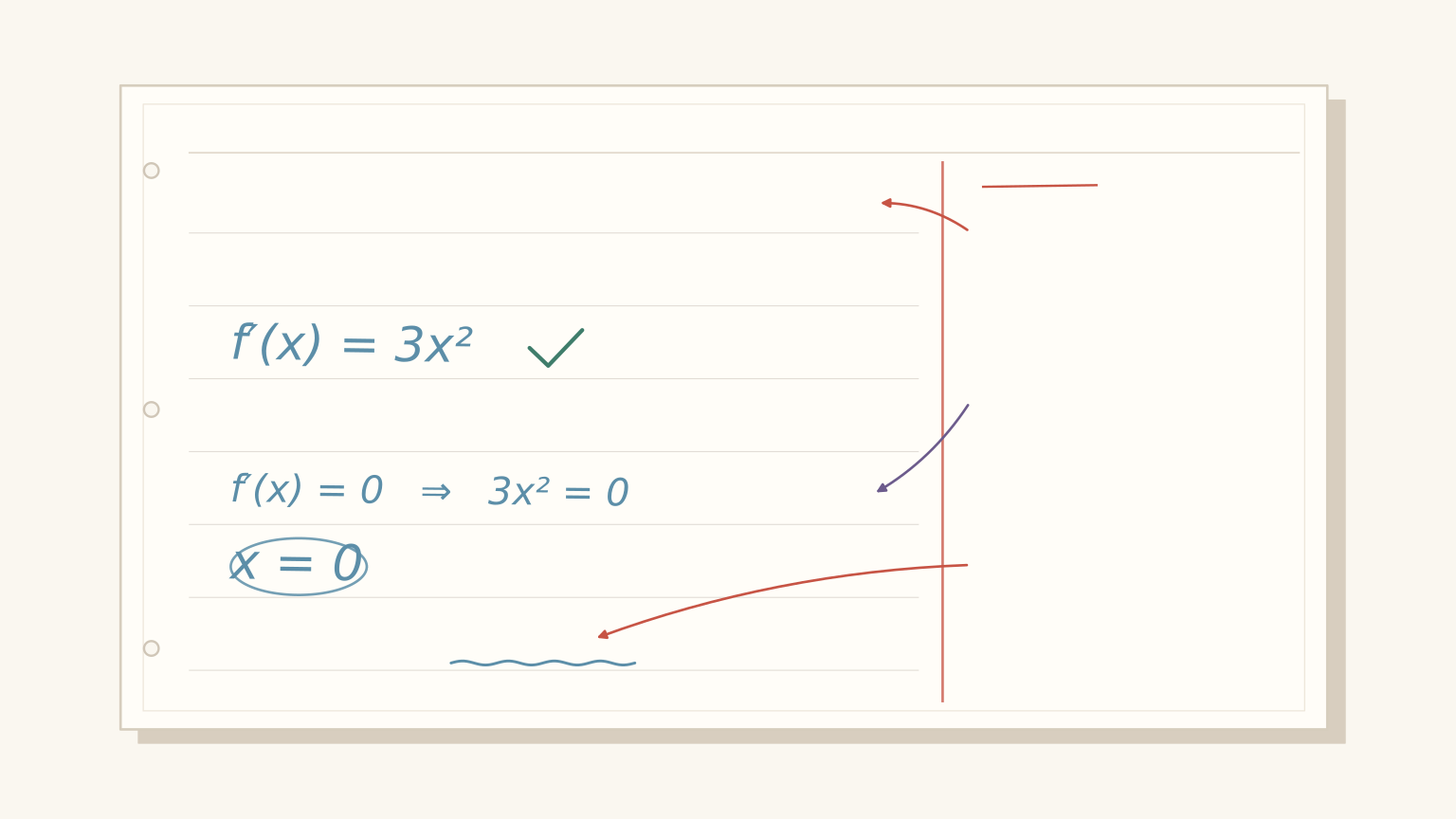
A student differentiates a function, solves \(f'(x)=0\), and identifies a stationary point.
The calculation might be completely correct. However, a stationary point is not automatically a maximum or minimum.
A tutor can ask:
- What values of \(x\) are actually allowed?
- Have you considered the endpoints of the domain?
- What tells you that this stationary point is a maximum rather than a minimum?
- Is there another mathematical approach that would make the conclusion clearer?
The student isn’t being taught differentiation again. They’re learning to construct a more complete mathematical argument.
Physics
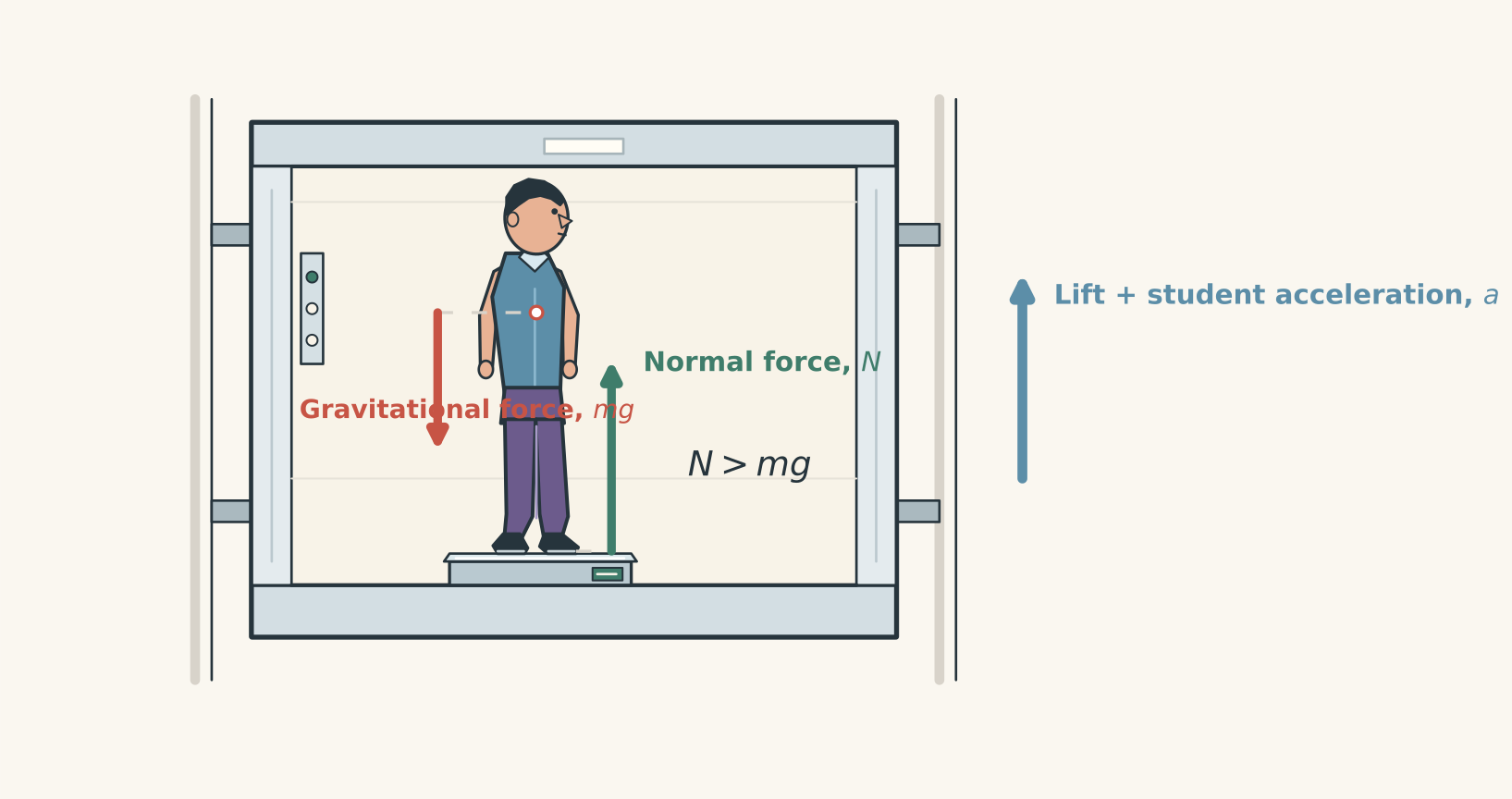
A student is solving a question about a person standing on a scale inside an accelerating lift.
They assume the scale reading must equal the person’s weight because the person is stationary relative to the lift.
That sounds reasonable, but it confuses relative motion with acceleration.
Newton’s second law tells us that the resultant force must equal mass multiplied by acceleration. If the lift accelerates upwards, the scale’s normal force must exceed the person’s weight.
Taking upwards as positive:
\[ N-mg=ma \]
Therefore,
\[ N=m(g+a) \]
Here, \(N\) is the normal force, \(m\) is the person’s mass, \(g\) is gravitational acceleration, and \(a\) is the lift’s upward acceleration.
A useful tutor doesn’t just correct the equation. They challenge the student’s original assumption and help them understand why an object can be stationary relative to its surroundings while still accelerating.
Due to technical limitations, this figure may display incorrectly or contain inaccuracies. Please check key details against your course materials.
Chemistry
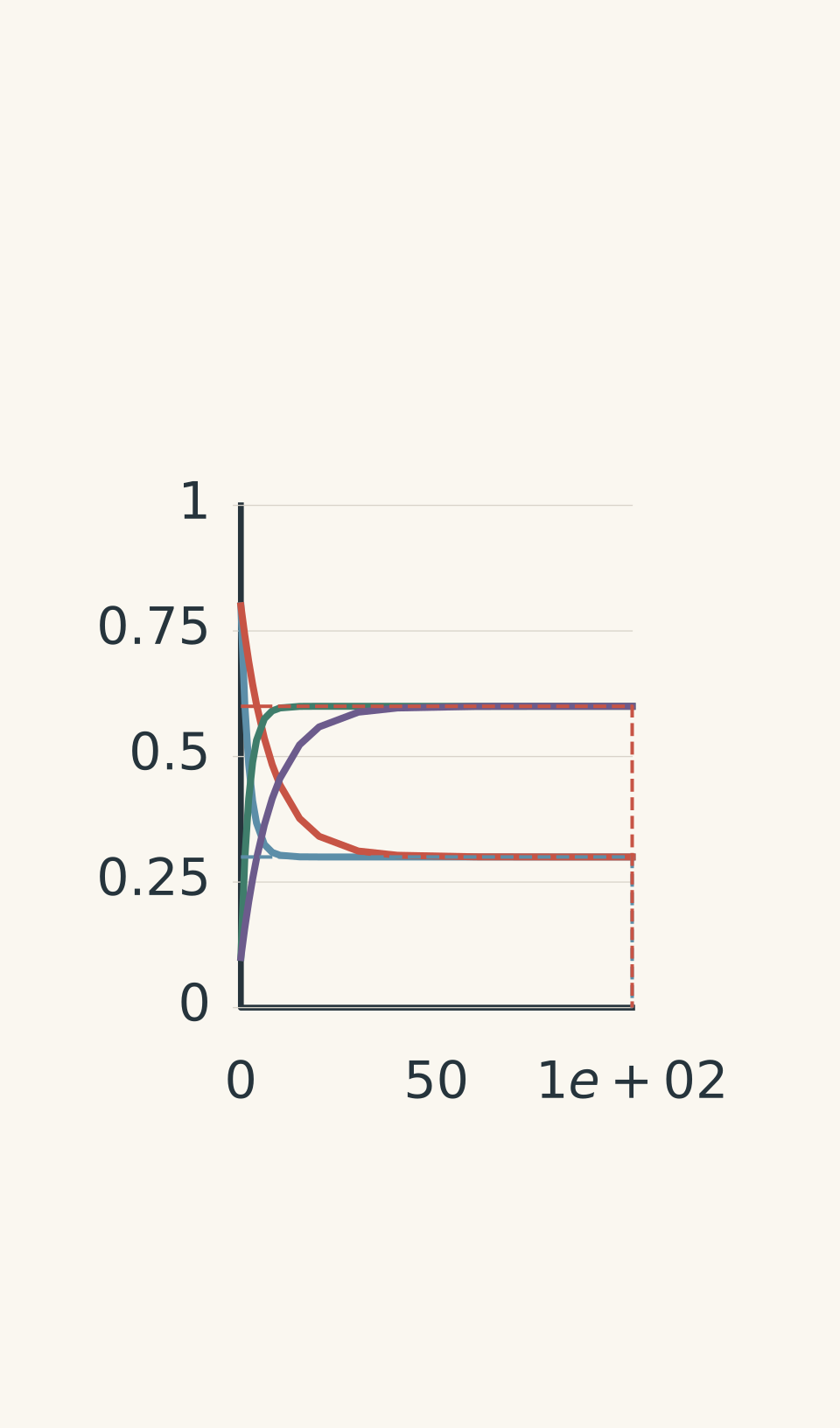
A student calculates an equilibrium constant correctly but then claims that a large equilibrium constant means the reaction happens quickly.
The calculation might be perfect, but the interpretation is wrong.
The equilibrium constant describes the relative amounts of reactants and products at equilibrium under specified conditions. It does not tell us how quickly equilibrium is reached.
Reaction kinetics deals with reaction rates.
A tutor can challenge the student to distinguish between the position of equilibrium and the rate at which the system approaches it. This tests whether they understand the chemical ideas behind the calculation rather than simply knowing how to substitute values.
- A — fast
- A — slow
- B — fast
- B — slow
- A equilibrium
- B equilibrium
Due to technical limitations, this figure may display incorrectly or contain inaccuracies. Please check key details against your course materials.
These examples illustrate an important principle: advanced tutoring should make a student’s thinking more precise, not simply introduce more difficult material.
03How tutoring complements teacher feedback and enrichment
School teaching, independent enrichment and tutoring can make complementary contributions to an advanced student’s progress.
A knowledgeable classroom teacher can provide excellent feedback on advanced work. In fact, teachers often have an advantage when it comes to understanding the specific assessment expectations and the progress of their class.
Likewise, independent enrichment can be extremely valuable for students who already know how to identify and correct their weaknesses.
The decision depends on what the student actually needs.
| Type of support | Particularly useful when |
|---|---|
| Classroom teacher feedback | Clarifying school assessment expectations and feedback. |
| Independent extension work | Applying ideas to new problems between lessons. |
| Enrichment activities | Exploring broader subject knowledge. |
| Small-group or private tutoring | Discussing unfamiliar problems, testing reasoning and receiving feedback on attempted work. |
A classroom teacher’s feedback is valuable, particularly for school assessment expectations. Tutoring can add another regular opportunity to discuss reasoning and explore challenging applications.
Students who already work independently can use tutoring to test alternative methods, refine explanations and receive feedback on unfamiliar problems.
The key is not whether a student is capable enough to benefit from tutoring. It’s whether there is a genuine gap in the feedback or learning they currently receive.
A useful distinction: enrichment versus HSC tutoring
Enrichment and tutoring can overlap, but they serve different purposes.
Enrichment usually focuses on exploring ideas more deeply or tackling problems beyond the standard course material.
HSC tutoring should have a clearer connection to the student’s current learning needs and assessment requirements.
For example, a Mathematics Extension 2 student might enjoy exploring university-level mathematics. That could be excellent enrichment, but it won’t necessarily address a recurring problem with writing complete mathematical proofs in HSC questions.
Likewise, a Physics student might enjoy learning about advanced theoretical physics, but that doesn’t automatically improve their ability to analyse an unfamiliar HSC mechanics problem.
More advanced content isn’t always more useful.
For a student focused on the HSC, depth of understanding, problem selection, clear reasoning, and accurate communication can be more valuable than learning material simply because it is difficult.
04How to decide whether strong students need tutoring
Rather than deciding based on marks, use the following decision process.
Step 1: Are the fundamentals already secure?
Look at the student’s recent work.
Can they:
- Explain the major concepts in their current course?
- Complete standard syllabus questions accurately?
- Recognise familiar question types?
- Work independently without regularly needing someone to show them the next step?
If not, the priority is to address those gaps.
Tutoring might still help, but the focus should be strengthening understanding rather than providing advanced enrichment.
Step 2: Can they handle unfamiliar problems?
Now consider questions that require more than repeating a familiar procedure.
Can the student:
- Identify which concepts are relevant without being told?
- Choose an appropriate method?
- Explain why that method is valid?
- Adapt their approach when a condition changes?
- Recognise when an answer is mathematically or scientifically unreasonable?
If they can do these things consistently, there may be little reason to add tutoring.
If they struggle, identify exactly where the reasoning breaks down.
One difficult question isn’t enough evidence of a persistent weakness. Look for patterns across several problems.
Step 3: Can their current support address that weakness?
Before looking for an external tutor, consider whether the student’s classroom teacher can provide the feedback they need.
For example, they could bring two recent solutions to their teacher and ask:
- Is my reasoning complete, or am I skipping important steps?
- Am I choosing the right approach for unfamiliar questions?
- What should I practise to improve this particular weakness?
If the teacher can provide specific feedback and suitable follow-up work, that may be all the student needs.
If the student repeatedly encounters the same difficulty without being able to identify or resolve it, personalised tutoring becomes a more reasonable option.
Step 4: Would tutoring provide something genuinely different?
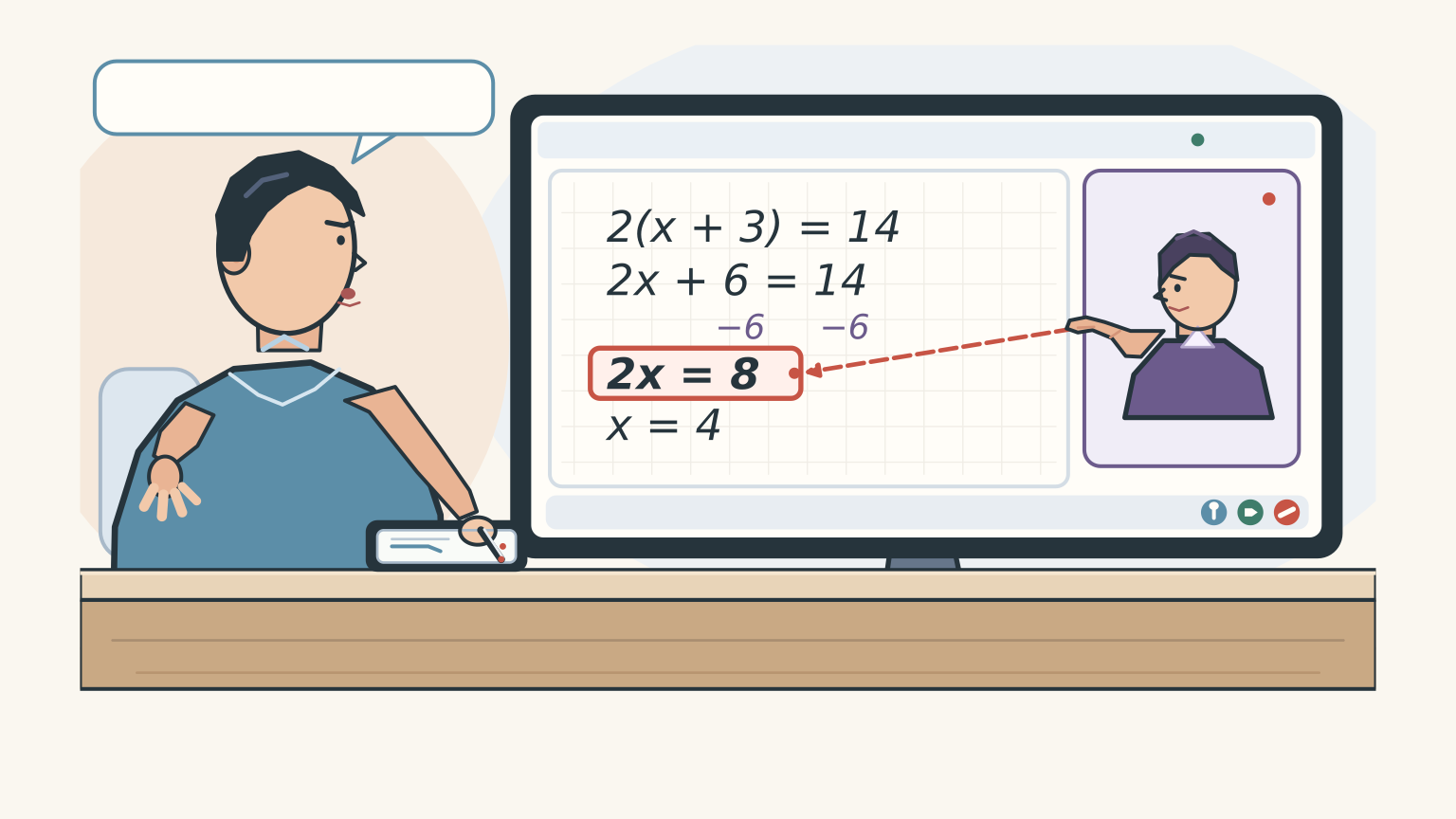
A tutor should be able to explain what they would do differently from the student’s existing study routine.
That might include:
- Diagnosing recurring weaknesses across different question types.
- Challenging assumptions that the student hasn’t recognised.
- Providing unfamiliar problems that test the same underlying concepts.
- Giving detailed feedback on written solutions and mathematical reasoning.
- Helping the student develop a more reliable approach to independent problem-solving.
If the proposed sessions simply involve completing more worksheets, there may be little advantage over independent practice.
Due to technical limitations, this figure may display incorrectly or contain inaccuracies. Please check key details against your course materials.
05What to look for in an HSC tutoring trial lesson
If you decide to investigate tutoring, a trial lesson is a useful way to test whether the teaching is appropriate for an already capable student.
The lesson should reveal something about how the student thinks, not just how much content they can recall.
Before the lesson, prepare two or three recent questions:
- One question the student solved correctly and confidently.
- One question they found difficult or took an unusually long time to complete.
- If possible, one unfamiliar question where they weren’t sure how to begin.
These examples give the tutor something concrete to analyse.
During the lesson, look for the following.
| What to look for | What good teaching should involve |
|---|---|
| Diagnosis | The tutor identifies a specific weakness rather than assuming the student needs to revise everything. |
| Depth | The tutor asks the student to justify their decisions and explain the principles behind their methods. |
| Challenge | The student encounters unfamiliar problems that require independent reasoning. |
| Feedback | The tutor explains why an approach is incomplete or incorrect and helps the student improve it. |
| Independence | The student gets opportunities to solve new problems without being guided through every step. |
| Course alignment | The material matches the student’s NSW HSC subject, course, and syllabus cohort. |
Be cautious if a tutor spends most of the lesson explaining content the student already understands, immediately supplies solutions when the student gets stuck, or assumes that simply making questions harder will improve performance.
A strong student needs to be challenged, but the challenge should have a purpose.
For more detail, see HSC Tutoring Trial Lessons: What to Check Before You Commit.
Check that the tutoring matches the student’s syllabus
This is particularly important when choosing Physics or Chemistry tutoring because the NSW HSC syllabus transition dates differ.
As at 15 November 2026, NESA’s implementation schedule is:
| Subject | New syllabus begins for Year 11 | First HSC examination under new syllabus |
|---|---|---|
| Physics 11-12 Syllabus (2025) | 2027 | 2028 |
| Chemistry 11-12 Syllabus (2025) | 2028 | 2029 |
The new Physics syllabus begins implementation a year before the new Chemistry syllabus. During each transition, the existing syllabus continues for the Year 12 cohort before the new syllabus reaches Year 12 in Term 4.
You can check the official implementation details through:
For Mathematics Extension 1 and 2, check the relevant course requirements and materials for the student’s cohort as well.
A tutor should know which syllabus applies to the student. Advanced questions are only useful if they develop the right knowledge and skills.
06A practical example: two strong students, two different decisions
Consider two Year 12 students studying Mathematics Extension 1.
Both achieve strong results at school. Both complete their homework independently and understand the standard course content.
However, their learning needs are different.
Student A: Already receiving effective feedback
Student A occasionally struggles with unfamiliar questions but regularly takes their working to their classroom teacher.
The teacher identifies gaps in their mathematical reasoning, recommends specific practice, and provides follow-up questions.
Student A can explain their mistakes and is increasingly able to solve similar problems independently.
Would tutoring add much?
Probably not at this stage. The student already has access to effective feedback and is using it successfully.
They might benefit more from continuing their independent practice or exploring additional enrichment activities.
Student B: Needs more targeted feedback
Student B also performs well in familiar questions but regularly struggles to select an approach when the problem is presented differently.
They can usually identify mistakes after seeing a worked solution, but they struggle to recognise those mistakes independently.
Their classroom feedback is helpful but doesn’t provide enough opportunities to work through these problems in detail.
Would tutoring add value?
Potentially, yes.
A tutor could examine several of the student’s solutions, identify a recurring weakness in problem selection, and design unfamiliar questions that test the same reasoning.
The student could then practise applying the feedback independently.
The difference between these students isn’t their academic ability or their marks. It’s whether their current learning environment provides the feedback they need.
07A checklist before committing to tutoring
Before arranging regular sessions, consider these questions.
- [ ] The student has identified a specific learning need rather than simply wanting to do more work.
- [ ] Their current teacher feedback and independent study have been considered.
- [ ] The proposed tutor can provide subject-specific feedback at an appropriate level.
- [ ] The tutoring will include unfamiliar problems, not just repetitive exercises.
- [ ] The student will be expected to explain and defend their reasoning.
- [ ] The material will match the student’s current NSW HSC syllabus and cohort.
- [ ] There is a way to judge whether the tutoring is improving independent problem-solving.
You don’t need every item to be perfect before trying a lesson. The checklist is there to help you distinguish a useful learning opportunity from an unnecessary extra commitment.
08Explore the next step
Strong students can use tutoring to develop more rigorous explanations, explore unfamiliar problems and act on detailed feedback. Bring a challenging question to a lesson and assess how the teaching extends your reasoning beyond a familiar method.
tutorgum offers live online small-group teaching for Year 11 and 12 Physics, Chemistry and Maths, with opportunities for questions and feedback on student responses. View the current classes, pricing and timetable and enquire about a first lesson. The published first-lesson arrangement charges the lesson normally if you continue; it is free if you decide not to continue.