
How to Use HSC Reading Time to Plan Your Exam
Learn how to use HSC reading time strategically before you start writing. This guide explains how to scan the paper, compare optional questions, choose where to start, and plan your exam approach while following NESA rules.
You open your HSC exam paper and find a question you know how to answer. It is tempting to decide immediately that you’ll start there. But what if the final section contains an optional question you know much better? Or a 12-mark question has three parts, with the final part depending on an earlier result?
Choosing your starting point after reading only the first page is a bit like choosing a route before looking at the map.
Use reading time to understand the whole paper, identify your options, and plan a sensible order for answering. You are not expected to solve every question mentally. You should finish reading time knowing what the paper requires, where your strongest opportunities are, and how you intend to approach the exam.
There is one important restriction: reading time is for reading. You must not start writing, making notes, or annotating your paper.
01First, know what you are allowed to do
For students sitting the 2027 NSW HSC, NESA’s current 2027 Rules and Procedures guide sets out the reading-time rules.
During reading time, you must not:
- Write on or mark your examination paper in any way.
- Use equipment, including highlighters.
- Write notes or calculations on separate paper.
- Start writing answers in your answer booklet.
- Write your student number on examination materials before you are instructed to begin writing.
This means that even putting a small tick beside a question you want to revisit is not permitted.
There are specific exceptions. In online HSC exams, students can use the platform’s highlight and flag functions during reading time. If a dictionary is permitted for your examination, you can read it during reading time, but cannot write on or mark it.
The practical distinction is simple: you can read, think, compare, and plan mentally. You cannot start recording your plan.
Check the NESA rules for your examination year before exam day, as well as any specific instructions given by your supervisor.
Due to technical limitations, this figure may display incorrectly or contain inaccuracies. Please check key details against your course materials.
02The four-pass reading-time strategy
Rather than reading the paper from beginning to end without a plan, use four passes.
Each pass has a different purpose. Together, they give you a mental map of the examination before writing begins.
Pass 1: Understand the structure of the paper
Start by looking at the overall organisation.
Identify:
- How many sections are there?
- How many questions are included?
- Which sections are compulsory?
- Are there optional questions?
- Are you required to answer every question or select a particular number?
- Are there separate answer booklets or answer sheets?
- Are there instructions about the order in which questions must be answered?
This first pass prevents a surprisingly common mistake: spending too much time on a question before realising that you have misunderstood the requirements of its section.
Pay particular attention to words such as:
- Answer all questions
- Answer ONE question
- Choose TWO questions
- Answer either Question A or Question B
These instructions determine how much of the paper you actually need to complete.
If a section asks you to choose one question from two, you should be comparing those questions, not planning to answer both.
Pass 2: Scan every question
Now move through the entire paper.
Read each question carefully enough to understand what it involves. Look at the number of parts, mark allocations, supplied information, and any diagrams, graphs, or tables.
You are looking for the overall demands of the paper, not trying to complete the questions in your head.
As you scan, mentally sort questions into three groups:
| Mental category | What it means |
|---|---|
| Ready | You recognise the content and have a clear idea of how to approach it. |
| Workable | You understand the question, but it will require some thought or calculation. |
| Uncertain | You are not immediately sure how to approach it. |
These are mental categories only. Do not write letters or symbols beside the questions.
The purpose is to recognise where you have opportunities to make progress and where you may need to spend more time.
Importantly, don’t assume that an unfamiliar-looking question is impossible. Sometimes a question looks complicated because it contains several parts, but the first part is quite accessible.
Pass 3: Identify choices and connections between questions
This is where a quick scan becomes a useful examination strategy.
Look for two things: optional questions and linked questions.
Optional questions
If you must choose between two questions, compare their actual requirements.
For example, one might ask you to analyse supplied data, while the other requires you to recall and explain a theoretical model.
The shorter-looking question is not necessarily easier. Consider which one gives you the clearest opportunity to demonstrate your knowledge.
Linked questions
Some questions contain parts that depend on previous parts.
For example:
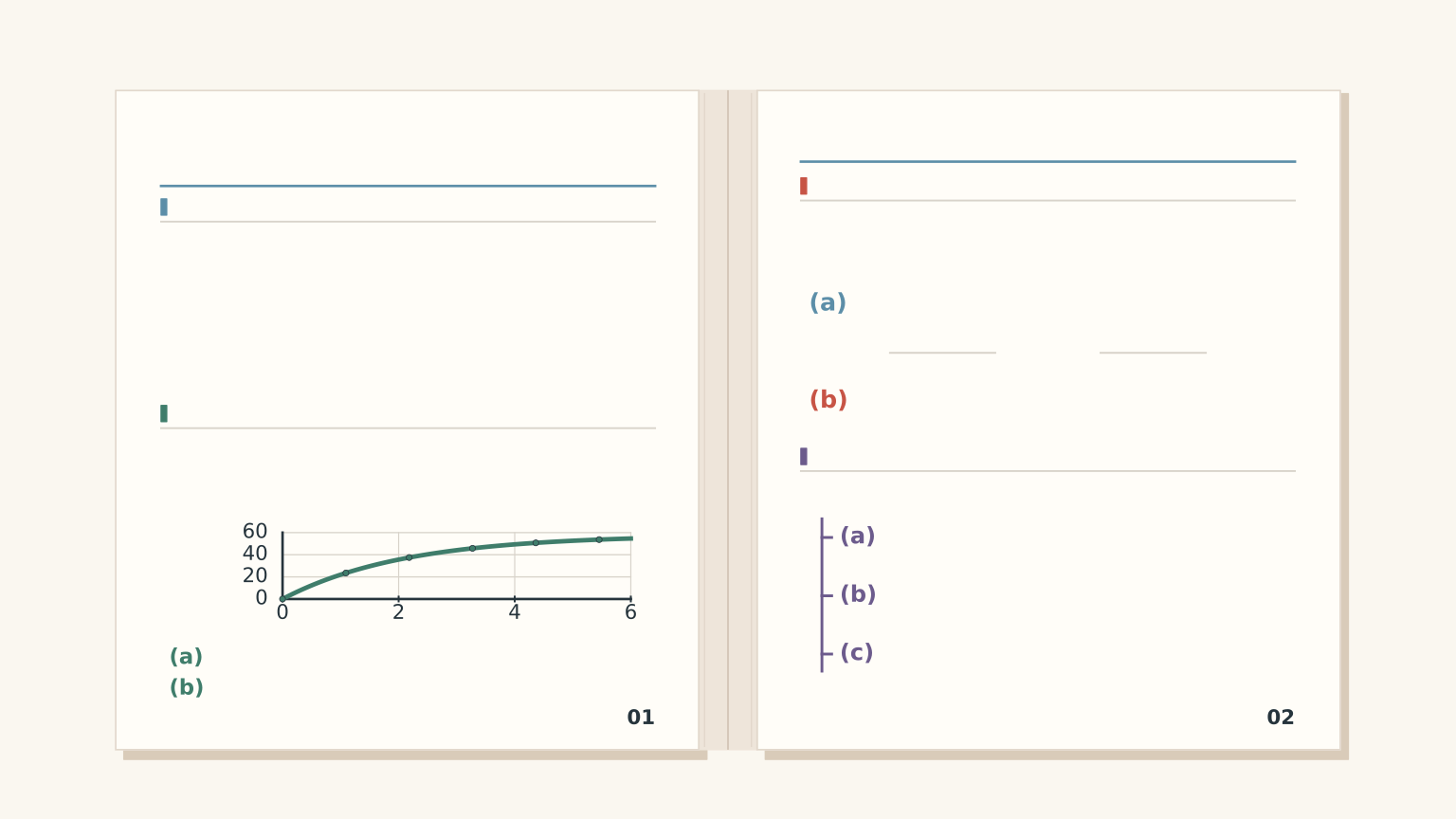
- Part (a) asks you to calculate a quantity.
- Part (b) asks you to use that result to determine another quantity.
- Part (c) asks you to explain the physical significance of your answer.
Recognising this structure helps you plan your response sensibly.
You might be able to answer an independent question elsewhere in the paper before returning to this one. However, you should recognise that the linked parts themselves need to be approached in the appropriate sequence.
Due to technical limitations, this figure may display incorrectly or contain inaccuracies. Please check key details against your course materials.
Pass 4: Decide where you will start
You now have a broad understanding of the paper.
Use this information to decide on a provisional starting point.
Your first question does not have to be Question 1. If the paper’s instructions allow you to answer questions in any order, you can choose a different starting point.
A sensible starting question generally has three features:
- You understand what the question is asking.
- You have a reasonably clear method or explanation in mind.
- You can make useful progress without spending a disproportionate amount of time.
This doesn’t mean you should always choose the easiest question.
A straightforward two-mark question might be worth completing quickly, but a familiar eight-mark question could also be a good starting point.
The important thing is to begin somewhere you can make reliable progress.
If the examination requires a particular order, follow those instructions. Your reading-time plan should never override the directions on the paper.
03How to decide which question to attempt first
A common mistake is assuming that the best strategy is always to work through the examination from Question 1 onwards.
Another common mistake is deciding to complete every easy-looking question first, regardless of how the paper is structured.
Neither approach is reliable.
Use this decision process instead:
1. Does the paper require a particular order?
If yes, follow it. If not, consider whether answering questions in a different order would help you.
2. Are there optional questions?
Compare the content, the task requirements, and how confidently you could construct a complete response. Choose the option that gives you the strongest opportunity to demonstrate your knowledge.
3. Are some questions connected?
Keep dependent parts in their logical sequence. Don’t treat every question part as an independent task.
4. Which question offers the best starting point?
Choose a question where you can make reliable progress within a reasonable amount of time.
5. Have you accounted for the entire paper?
Make sure your plan covers all compulsory sections and the required number of optional questions.
This last point matters. A good starting question is useful, but it does not replace the need to attempt the rest of the examination.
04Worked scenario: Choosing between two optional questions
Imagine you are sitting a hypothetical science examination.
The final section contains two questions, each worth 12 marks. You must answer ONE.
- Question 15 provides a graph and asks you to analyse two trends, explain their significance, and support your response using the supplied information.
- Question 16 asks you to evaluate a theoretical model and discuss its limitations.
You are comfortable interpreting graphs and explaining relationships between variables. You understand the theoretical model, but you are less confident discussing its limitations.
Which question should you choose?
Step 1: Compare the actual demands of both questions.
Both are worth 12 marks, so their mark allocations do not help you distinguish between them.
Step 2: Consider how confidently you could answer each question.
Question 15 gives you information to work with. You can identify trends, explain relationships, and support your response with evidence from the graph.
Question 16 requires a more developed understanding of the theoretical model and its limitations.
Step 3: Make your decision.
Question 15 is the stronger choice because you can see a clear path towards constructing a complete response.
The tempting mistake is choosing the question that looks shorter or more familiar at first glance. What matters is whether you can actually meet its requirements.
During reading time, you can make this decision mentally. Once writing time begins, follow the instructions and answer the required number of questions.
05Use the marks to plan your time
Reading time also gives you an opportunity to think about how the examination’s marks are distributed.
Marks are not a perfect measure of how long every question will take, but they provide a useful starting point for managing your writing time.
Consider a hypothetical examination with:
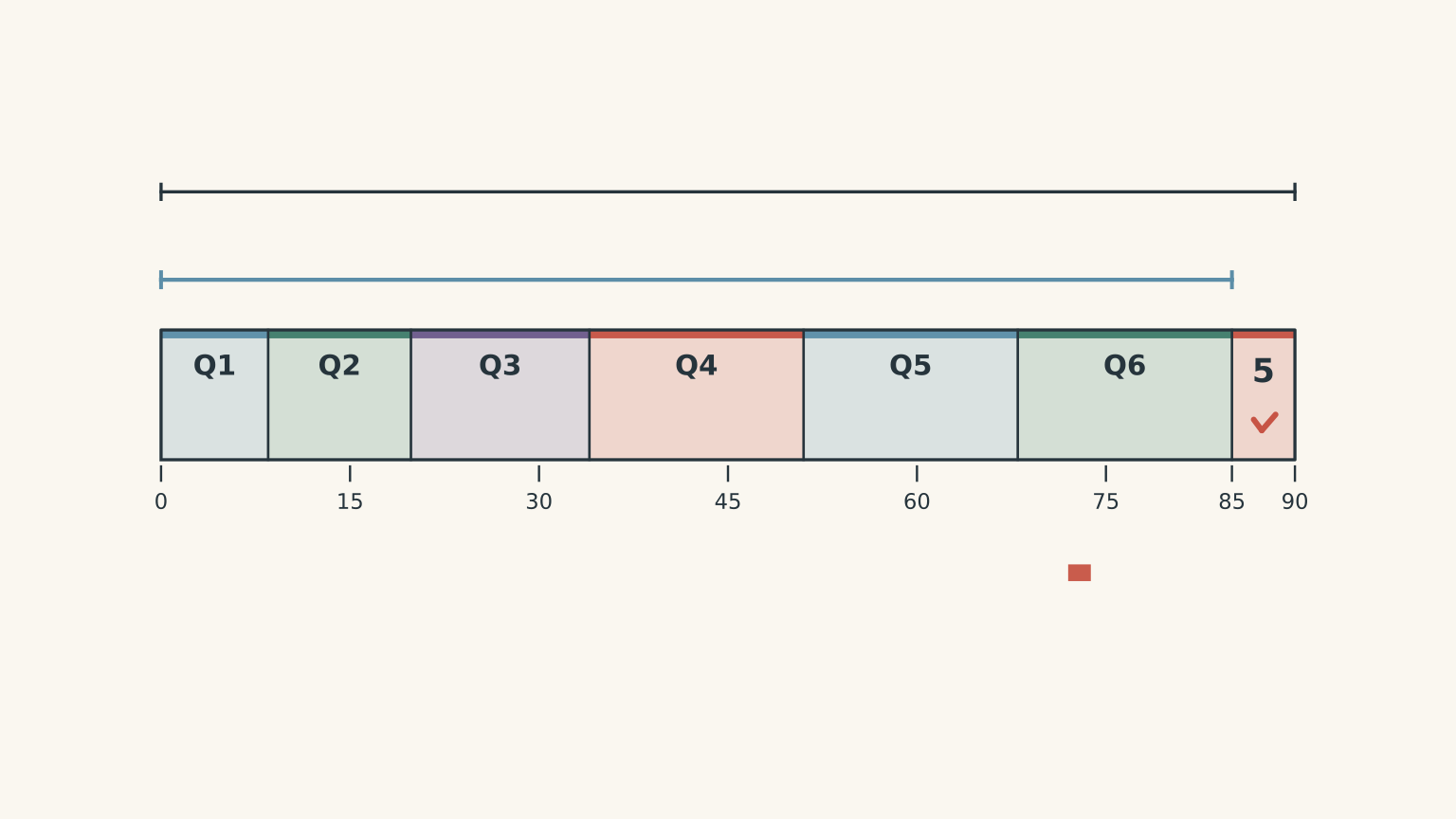
- 90 minutes of writing time.
- 60 marks in total.
- A planned five-minute reserve for checking your work.
That leaves 85 minutes for answering questions.
Your approximate time per mark is:
\[ \text{Time per mark}=\frac{85}{60} \]
\[ \approx 1.42\text{ minutes per mark} \]
This gives you a rough guide:
| Question value | Approximate time |
|---|---|
| 2 marks | 3 minutes |
| 4 marks | 6 minutes |
| 6 marks | 9 minutes |
| 8 marks | 11 minutes |
| 12 marks | 17 minutes |
These are estimates, not strict limits.
A question involving several calculations may need a slightly different allocation from a short explanation. You should also consider the structure of the question and how much working or evidence is required.
The important idea is that you should not spend 25 minutes on an eight-mark question simply because you find it interesting.
Due to technical limitations, this figure may display incorrectly or contain inaccuracies. Please check key details against your course materials.
06Common reading-time mistakes
Even students who understand the rules can waste valuable reading time by approaching it without a clear purpose.
Here are five mistakes worth avoiding.
1. Starting at Question 1 without scanning the paper
Question 1 might be a sensible starting point, but you won’t know whether another question is a better opportunity until you have seen the whole paper.
Scan first. Decide afterwards.
2. Trying to solve difficult questions mentally
You might see a complicated calculation and immediately start working through possible methods in your head.
A little thought is useful, but spending most of reading time trying to solve one difficult problem is inefficient.
Instead, identify what the question involves, what information it provides, and whether you recognise a suitable approach.
You can do the actual working once writing time begins.
3. Assuming that a high-mark question must be difficult
A 10-mark question might involve several straightforward parts. A three-mark question might test a concept you find particularly challenging.
Use the actual requirements of the question, not just the number of marks, to judge how you might approach it.
4. Choosing an optional question too quickly
Two questions can have identical mark allocations but require quite different knowledge and skills.
Read both before deciding. A question that looks familiar might contain a demanding evaluation or explanation component that you initially overlooked.
5. Trying to annotate your paper
It can feel natural to underline important words, circle question numbers, or place a small tick beside something you want to revisit.
For paper-based HSC examinations, these actions are not permitted during reading time.
Keep your plan in your head. You can make notes and organise your working once writing time begins.
07Questions and solutions
Question 1
You are sitting a paper-based HSC examination. During reading time, you identify a difficult question that you want to revisit later.
Can you put a small pencil tick beside it so you remember where it is?
Solution 1
No. You must not mark your examination paper in any way during reading time.
Even a small tick or circle is an annotation. The restriction also applies to highlighters and other equipment.
Instead, make a mental note of the question and continue scanning the paper. You can mark or organise your working once writing time begins, provided you follow the examination instructions.
Question 2
An examination contains two optional questions, each worth 10 marks.
Question A is relatively short but requires knowledge of a topic you have not studied confidently.
Question B is longer and involves interpreting supplied information, something you are comfortable doing.
You must answer one question.
Which should you choose, and why?
Solution 2
Question B is the stronger choice, assuming you can meet all its requirements.
The number of pages or the apparent length of a question does not determine how difficult it is. What matters is the knowledge and reasoning needed to construct a good response.
Question B gives you an opportunity to use a skill you understand confidently. You should consider whether you can address every part of the question and support your response with the supplied information.
The trap is assuming that a shorter question automatically requires less work. A short question can still demand difficult reasoning.
Question 3
You are allowed to answer questions in any order.
Question 5 contains three parts:
- Part (a) asks you to calculate a quantity.
- Part (b) asks you to use your answer from part (a).
- Part (c) asks you to use the result from part (b).
Question 9 is an independent four-mark question that you understand well.
You are considering starting Question 5 because it appears earlier in the paper. Would it be reasonable to complete Question 9 first?
Solution 3
Yes. Starting with Question 9 is a reasonable decision, provided you can complete it efficiently.
The instructions allow you to answer questions in any order, and Question 9 does not depend on any other question.
You can complete that response, then return to Question 5 and work through its parts in sequence.
The important distinction is between the order of questions and the order of dependent parts within a question.
You have flexibility over the first, but you should respect the logical connections in the second.
A common mistake is assuming that every question must be completed in the order printed. Another is jumping between dependent parts without recognising that a later result relies on an earlier one.
Question 4
A hypothetical HSC examination has 100 minutes of writing time and 70 marks.
You decide to reserve five minutes for checking your work.
Approximately how much time should you allocate to a 10-mark question?
Explain why this is only a guide.
Solution 4
You should allocate approximately 14 minutes to the question.
First, subtract the five-minute checking reserve:
\[ 100-5=95\text{ minutes} \]
Then calculate the approximate time per mark:
\[ \frac{95}{70}\approx 1.36 \]
For a 10-mark question:
\[ 10\times 1.36=13.6\text{ minutes} \]
Therefore, approximately 14 minutes is a sensible starting allocation.
However, this is not a rigid limit. Some questions require more calculation, interpretation, or explanation than others.
The purpose of the calculation is to prevent one question from consuming too much of your available time. If you are spending substantially longer than planned, consider moving on after recording the useful working you have completed, then returning if time permits.
08What to do when writing time begins
Once your supervisor tells you to begin writing, move from planning to execution.
A simple routine helps:
- Follow the instructions about student numbers and answer booklets.
- Start with your planned first question, provided the paper allows that order.
- Keep an eye on your approximate time allocation.
- Complete all compulsory sections and the required optional questions.
- Leave time to check calculations, units, question numbers, and whether you have answered every part.
Don’t spend the first few minutes of writing time recreating the plan you could have made mentally during reading time.
You should already have a clear idea of the paper’s structure and your intended approach.
If you want to improve the next part of your exam technique, focus on understanding exactly what each question requires. Our guide on How to Decode HSC Exam Questions Before You Start Writing explores how to interpret question wording and identify what an examiner is asking you to demonstrate.
And when a difficult question interrupts your plan, knowing how to show useful working is just as important as knowing when to move on. For maths students, How to Earn Method Marks When You Cannot Finish an HSC Maths Question covers that next decision.
The goal of reading time is not to finish the examination in your head. It is to make sure you understand the paper before you spend a single minute answering it.