
How to Decode HSC Exam Questions Before You Start Writing
Learn how to identify command verbs, limiting words, required evidence, and distinct tasks in HSC exam questions. Use a simple response-planning method, worked examples, and practice questions to make sure your answers address every requirement.
You recognise the topic, start writing, and produce a page of correct material. Then you realise the question asked you to compare two results, justify a conclusion using data, or explain a second point you barely noticed. You’ve answered the topic, but not the task.
This is a common HSC exam problem. It can cost marks even when you understand the content.
Before you read on, try this question:
Using the graph, compare the rates at 10 s and 30 s, and justify your conclusion with one data value.
What must your answer contain? A comparison of the two rates, a clear conclusion, and at least one numerical value from the graph. A definition of rate might be correct, but it doesn’t complete any of those tasks by itself.
The fix is to decode the question before you start writing. You don’t need to spend minutes analysing every word. You need a reliable way to identify exactly what the examiner wants, what evidence you must use, and how much your answer needs to cover.
01The five-part scan
Before answering an HSC question, find five things:
- The command verb: what action must you perform?
- The exact object: what, specifically, must you act on or discuss?
- The limiting words: what conditions or restrictions apply?
- The required evidence and units: what data, working, or precision must appear?
- The deliverables and marks: how many distinct tasks must you complete, and how much explanation is appropriate?
Decode the question before writing
- Command verb
What action must I perform?
- Exact object
What specifically must I answer?
- Limiting words
Which conditions or restrictions apply?
- Evidence and units
What data, working, units, or precision are required?
- Deliverables and marks
How many tasks must I complete, and how much depth is appropriate?
1. Circle the command verb
The command verb tells you what kind of response to produce. Recognising the topic isn’t enough; you need to perform the requested action.
| Command verb | What your answer needs to do | Common mistake |
|---|---|---|
| State or identify | Give the requested fact, quantity, or feature. | Adding background without clearly stating the answer. |
| Describe | Give the relevant features, observations, or pattern. | Explaining why something happens when only a description is requested. |
| Explain | Show how or why something happens, linking cause and effect or evidence and conclusion. | Naming a cause without explaining the connection. |
| Compare | Identify relevant similarities or differences between the specified items. | Describing one item and barely mentioning the other. |
| Analyse | Examine information or relationships and explain what they reveal. | Repeating data without interpreting it. |
| Evaluate | Make a reasoned judgement using relevant evidence and criteria or limitations. | Giving an opinion or listing advantages without reaching a judgement. |
| Justify | Support a decision, claim, or conclusion with reasons or evidence. | Stating a conclusion without supporting it. |
| Calculate or determine | Obtain the requested quantity or value, showing appropriate working and units. | Giving a number without the requested unit or method. |
These are useful starting points, not rigid definitions that override the wording of a question. For a more detailed guide, see tutorgum’s HSC Command Verbs: How to Explain, Analyse, Evaluate and Justify.
A question can also contain multiple command verbs. In Calculate the acceleration and explain how it changes when the force increases, calculating the acceleration does not complete the task. The explanation is a separate requirement.
2. Box the exact object of the question
The object is the specific thing the command verb applies to. It is often the part students overlook because they recognise a familiar topic and begin recalling everything they know about it.
Compare these two questions:
- Explain reaction rate.
- Explain why the reaction rate increases when temperature rises.
The first asks about reaction rate. The second asks for a causal explanation connecting temperature to a change in reaction rate.
A student answering the second question might correctly define reaction rate, describe collision theory, and list factors affecting reaction rate. But unless they connect increased temperature to the change in rate, the central task remains unfinished.
Use this test: after reading the command verb, finish the sentence, I need to explain, compare, calculate, or evaluate…
If you can’t finish that sentence precisely, reread the question.
3. Underline the limiting words
Limiting words narrow the task. They tell you which conditions, examples, time periods, quantities, or types of evidence matter.
Look for words and phrases such as:
- using the data;
- at constant temperature;
- over the first 20 seconds;
- for both samples;
- give two reasons;
- to three significant figures;
- one limitation;
- always, only, except, and not.
Consider this question:
Evaluate the claim that increasing light intensity always increases plant growth.
The word always makes the claim much stronger than increases plant growth. A single pattern of growth at low light intensity isn’t enough to establish that growth keeps increasing at every higher intensity.
The word evaluate also means you need a judgement, not simply a description of the trend.
A useful habit is to pay particular attention to words that restrict the answer or strengthen a claim. These are often where a memorised response stops fitting the question.
4. Mark the required evidence, data, and units
If a question refers to a graph, table, experiment, or set of results, decide how that information must be used before you start writing.
Check:
- What quantities are shown, and what do their axes or headings mean?
- Which values or conditions are relevant to the question?
- Does the question require a specific number of data values?
- Are calculations needed, and what units should the final answer use?
- Is a particular precision required, such as two decimal places or three significant figures?
For example, Explain the relationship shown in Figure 2 using two data values requires more than writing that one quantity increases as another increases.
You need to identify the relationship, quote at least two relevant values, and explain what those values demonstrate. Include units where relevant.
For calculations, read the requested unit before substituting numbers. It can change your method. If a question asks for speed in metres per second, calculating a value in kilometres per hour and stopping there is incomplete, even if the arithmetic is correct.
5. Count the deliverables, then use the marks
One sentence can contain several separate tasks.
Consider:
Calculate the average speed, compare it with the second trial, and explain one limitation of the investigation. (4 marks)
There are three deliverables:
- calculate the average speed;
- compare the result with the second trial;
- explain one limitation.
The final clause isn’t optional background. It’s part of the question.
Before writing, look for commas, conjunctions such as and, lettered subparts, and phrases specifying a number of reasons, examples, or limitations. Number the deliverables in the margin if that helps.
Marks then help you judge how much depth to give each task. They don’t provide a universal formula for the number of sentences, but they give you a useful planning guide.
| Marks available | A sensible starting point |
|---|---|
| 1 mark | One precise result, fact, or feature, as requested. |
| 2 marks | Two distinct points, or a result supported by a reason or explanation where appropriate. |
| 3-4 marks | Often requires several linked elements, such as a conclusion, evidence, and reasoning. |
| 5+ marks | Usually needs a more developed response, with connected reasoning and a qualified judgement where the question calls for one. |
Always follow the actual wording and the demands of the subject. A two-mark calculation may require a formula and substitution, while a two-mark explanation may require a cause-and-effect link.
The point is to allocate attention sensibly. Don’t spend five lines defining a term in a one-mark question, then rush the four-mark explanation at the end.
02Worked example: Get the units right and answer both tasks
A cyclist travels 12.0 km in 0.50 h. Calculate the average speed in m/s, and state whether this information is enough to determine the cyclist’s instantaneous speed at the end of the journey. (3 marks)
Step 1
The first task is to calculate average speed in metres per second. The second is to decide whether the given information determines the cyclist’s speed at one particular instant.
Notice that the second task isn’t another calculation of average speed.
Step 2
The distance is:
\[ 12.0\text{ km}=1.20\times10^4\text{ m} \]
The time is:
\[ 0.50\text{ h}=1.8\times10^3\text{ s} \]
Converting first means the result will be in the requested unit.
Step 3
Average speed is total distance divided by total time:
\[ v_{\text{avg}}=\frac{d}{t} \]
Substituting the values gives:
\[ v_{\text{avg}} =\frac{1.20\times10^4\text{ m}} {1.8\times10^3\text{ s}} \]
\[ v_{\text{avg}}=6.67\ldots\text{ m/s} \]
To two significant figures, the average speed is \(6.7\text{ m/s}\).
Step 4
No, the information is not enough to determine the cyclist’s instantaneous speed at the end of the journey. Average speed describes the journey as a whole; the cyclist could have accelerated or slowed down at different times while covering the same total distance in the same total time.
Why the tempting approach fails: You might calculate \(12.0/0.50=24\) and write \(24\text{ km/h}\). That calculation is valid for average speed, but it ignores the requested unit and leaves the second task unanswered.
The lesson isn’t just to convert units carefully. It’s to keep checking the original question until every requested task has been answered.
Calculate the speed. Answer both tasks.
| Wrong path: incomplete | 12.0 km ÷ 0.50 h = 24 km/h Wrong requested unit; instantaneous speed unanswered. |
|---|---|
| Corrected path: complete | 12,000 m ÷ 1,800 s = 6.7 m/s Final instantaneous speed cannot be inferred from average speed alone. |
03Worked example: Evaluate a claim without ignoring a limiting word
An investigation records the mean height of seedlings after seven days at four light intensities.
| Light intensity (lux) | Mean seedling height (cm) |
|---|---|
| 100 | 3.2 |
| 200 | 4.1 |
| 300 | 4.4 |
| 400 | 4.3 |
Evaluate the claim that increasing light intensity always increases seedling height. Use at least two data values and identify one limitation of the conclusion. (4 marks)
Step 1
You need to make a judgement, support it with data, explain what the data show, and identify one limitation. A description of the trend alone won’t cover the entire task.
Step 2
The word always means the claim concerns the pattern across the tested range, not merely whether seedlings grow taller between two selected intensities.
Step 3
The mean height rises from 3.2 cm at 100 lux to 4.4 cm at 300 lux. However, it falls from 4.4 cm at 300 lux to 4.3 cm at 400 lux.
Those values matter because they show both the initial increase and the later decrease.
Step 4
The data do not support the claim as written: the mean height does not increase at every tested intensity. However, the sample sizes and variation are not provided, so we cannot tell whether the small decrease at 400 lux is meaningful or reflects variation in the results.
A complete response could be:
The claim is not supported across the full tested range. Mean seedling height increases from 3.2 cm at 100 lux to 4.4 cm at 300 lux, but decreases to 4.3 cm at 400 lux. Therefore, increasing light intensity does not always correspond to an increase in the reported mean height. One limitation is that sample size and variation are not provided, so the reliability of the small decrease cannot be assessed.
Why the tempting approach fails: You might notice that the greatest mean height occurs at 300 lux and conclude that more light increases growth. That ignores the 400-lux result and treats the highest observed value as proof of a general rule. The limiting word always forces you to test the whole claim.
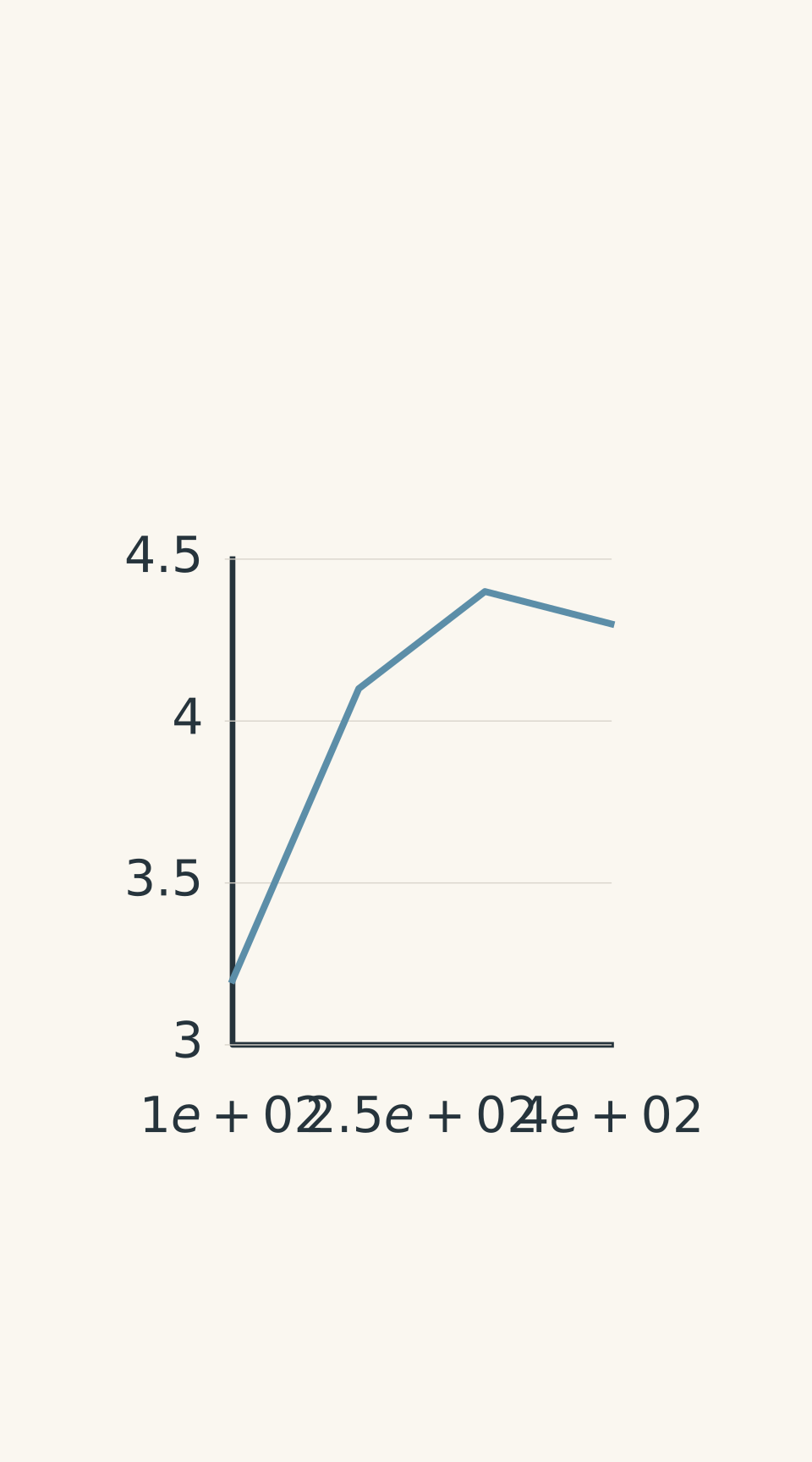
- Mean height after 7 days
04Shortcuts that fail when the wording changes
Some exam questions look almost identical but require different answers. Small changes in wording can alter what counts as a complete response.
| Wording | What changes in your response |
|---|---|
| Describe the trend. | Report the pattern shown by the data. |
| Explain the trend. | Give the pattern and explain why it occurs, if the relevant information supports that explanation. |
| Evaluate the claim. | Make a judgement supported by evidence and relevant limitations or criteria. |
| Use two data values. | Include at least two explicit, relevant values; don’t rely on a vague statement about the trend. |
| State and explain. | Give the requested fact and the explanation. Both are required. |
| What do the results suggest? | Draw an inference supported by the results, without claiming more than the evidence establishes. |
| Give your answer to three significant figures. | Round to three significant figures, not three decimal places. |
Same topic, different task
| Describe a trend | Report the pattern shown. |
|---|---|
| Explain a trend | State the pattern and give a supported reason. |
| Evaluate a claim | Reach a judgement using evidence and relevant limitations. |
| Use two data values | Quote two relevant values, with units where applicable. |
Two further traps deserve attention.
Don’t mistake a familiar topic for the exact question
If a question mentions Newton’s second law, you may immediately reach for \(F=ma\). That’s often appropriate, but first check what you’re being asked to find.
Is the question asking you to calculate acceleration, explain a relationship, compare two situations, or justify whether a conclusion follows from experimental results? The same equation can support different tasks, but it doesn’t replace the reasoning each task requires.
Don’t assume more writing means more marks
If the question asks for one reason, give one clear, relevant reason. If it asks you to compare two samples, make the comparison explicit. If it asks you to evaluate a claim, reach a judgement.
Extra information is useful only when it contributes to the requested answer. A long response can still miss a small but essential instruction.
05Turn the question into a brief response plan
You don’t need to write a full outline for every one-mark question. For a multi-part or extended-response question, though, a short plan can prevent you from forgetting a requirement halfway through.
Use this sequence under exam conditions:
- Circle the command verb or verbs.
- Box the exact object of each task.
- Underline conditions, restrictions, and limiting words.
- Mark the data, evidence, units, or precision required.
- Number the distinct deliverables and check the marks available.
- Write a few keywords for the reasoning or evidence needed for each deliverable.
For example, take this question:
Using the results, compare the two trials, justify which trial had the greater average speed, and identify one limitation of the method. (5 marks)
Your response plan might look like this:
| Requirement | Brief plan |
|---|---|
| Compare trials | Refer to both trials and their results. |
| Justify the conclusion | Calculate or compare average speeds; include values and units. |
| Identify one limitation | Name a specific weakness in the method and explain its relevance. |
| Allocate attention | Leave enough time for the comparison, evidence, and limitation rather than overexplaining one part. |
The exact distribution of marks depends on the question and its marking criteria. The plan simply makes the required work visible before you start.
When you write, answer in the order the question presents the tasks unless there’s a good reason not to. This makes it easier to check that each requirement has been addressed.
06The 20-second self-check
Before you finish a response, return to the original question and run through this list.
- [ ] Have I performed the command verb, rather than just discussed the topic?
- [ ] Have I answered the exact question, including the relationship or comparison requested?
- [ ] Have I respected limiting words such as both, always, only, or one limitation?
- [ ] Have I used the required evidence or data?
- [ ] Have I included the correct units and requested precision?
- [ ] Have I answered every part, including anything joined by and?
- [ ] Does the depth of my reasoning suit the marks available?
This is particularly useful when you’re running short on time. You may not be able to rewrite an entire answer, but you can often spot a missing unit, an unanswered clause, or a conclusion that has no supporting evidence.
07Questions and solutions
Question 1
An HSC question reads:
Calculate the density of a 240 g sample with a volume of 80 cm³. Give your answer in g/cm³ to two significant figures. (2 marks)
Identify the command verb, the exact object, the required unit, and the requested precision. Then calculate the answer.
Solution 1
The answer is \(3.0\text{ g/cm}^3\) to two significant figures. The command verb is calculate, the object is density, the required unit is g/cm³, and the final answer must show two significant figures.
Density is mass divided by volume:
\[ \rho=\frac{m}{V} \]
where \(\rho\) is density, \(m\) is mass, and \(V\) is volume.
Substituting the given values:
\[ \rho=\frac{240\text{ g}}{80\text{ cm}^3} =3.0\text{ g/cm}^3 \]
The trailing zero indicates two significant figures. Writing \(3\text{ g/cm}^3\) would fail to show the requested precision explicitly. This is a straightforward example of why reading the final instruction matters as much as choosing the correct formula.
Question 2
Two runners are tracked over the same 4.0-minute interval. Runner A travels 480 m, while Runner B travels 0.52 km.
Compare their average speeds in m/s and state which runner is faster. Show working. (4 marks)
Before calculating, identify the separate deliverables. Then solve the question.
Solution 2
Runner A’s average speed is \(2.0\text{ m/s}\), and Runner B’s is approximately \(2.2\text{ m/s}\), so Runner B is faster by about \(0.17\text{ m/s}\), using the unrounded values.
The question requires you to calculate both speeds in the specified unit, compare them, and state which runner is faster.
First, convert the time and Runner B’s distance:
\[ 4.0\text{ min}=240\text{ s} \]
\[ 0.52\text{ km}=520\text{ m} \]
Average speed is distance divided by time:
\[ v_{\text{avg}}=\frac{d}{t} \]
For Runner A:
\[ v_A=\frac{480\text{ m}}{240\text{ s}} =2.0\text{ m/s} \]
For Runner B:
\[ v_B=\frac{520\text{ m}}{240\text{ s}} =2.166\ldots\text{ m/s} \]
To two significant figures, Runner B’s speed is \(2.2\text{ m/s}\).
Comparing the unrounded values gives a difference of approximately \(0.17\text{ m/s}\).
The tempting shortcut is to notice that Runner B travels farther and immediately name B as faster. That identifies the faster runner, but it does not satisfy the instruction to calculate both speeds in m/s and show working. Correctly identifying the winner is only one part of the task.
Question 3
A school surveys 80 students from a single school. Of these, 46 prefer online tutoring and 34 prefer in-person tutoring.
A report concludes:
Most Year 12 students prefer online tutoring.
Assess whether this conclusion is justified. Use the data and identify one limitation of the survey. (4 marks)
Solution 3
The data support the conclusion that a majority of the surveyed students prefer online tutoring, but they do not justify generalising that conclusion to all Year 12 students.
The proportion of surveyed students who prefer online tutoring is:
\[ \frac{46}{80}\times100\%=57.5\% \]
Therefore, online tutoring was preferred by 57.5% of this sample. That is evidence of a majority within the surveyed group.
However, the question asks you to assess the broader conclusion, not merely report the sample result. The students came from one school, so the sample may not represent Year 12 students across NSW. Preferences may differ between schools or groups of students.
A complete response should distinguish the result actually observed from the broader claim being made. The data support a majority in this sample, but the survey’s limited scope weakens the conclusion about all Year 12 students.
The trap is to treat a result from a sample as though it automatically describes the entire population. The limitation matters because the conclusion reaches beyond the group that was surveyed.
Question 4
A trolley of constant mass 2.0 kg is tested with two different net forces: 4.0 N and 6.0 N.
(a) Calculate the acceleration for each force. (2 marks)
(b) Explain what the results suggest about the relationship between net force and acceleration when mass is constant. (2 marks)
State appropriate units. (4 marks total)
Solution 4
The accelerations are \(2.0\text{ m/s}^2\) and \(3.0\text{ m/s}^2\), respectively. The results suggest that acceleration increases in proportion to net force when mass is constant, under the conditions tested.
For part (a), use Newton’s second law:
\[ a=\frac{F_{\text{net}}}{m} \]
where \(a\) is acceleration, \(F_{\text{net}}\) is net force, and \(m\) is mass.
For a net force of 4.0 N:
\[ a_1=\frac{4.0\text{ N}}{2.0\text{ kg}} =2.0\text{ m/s}^2 \]
For a net force of 6.0 N:
\[ a_2=\frac{6.0\text{ N}}{2.0\text{ kg}} =3.0\text{ m/s}^2 \]
For part (b), compare the changes. The force increases by a factor of \(6.0/4.0=1.5\), and the acceleration increases by a factor of \(3.0/2.0=1.5\). This supports a directly proportional relationship between net force and acceleration when mass is constant.
The wording what the results suggest matters. The question asks you to interpret the results, so simply writing \(F=ma\) is not a complete explanation. You need to connect the calculated values to the relationship.
You should also avoid claiming that these two results alone prove every possible experimental condition will behave identically. The data support the relationship under the stated conditions; the broader physical law comes from the underlying model and wider evidence.
Question 5
After a four-week revision period, students complete the same test.
- Eighteen students volunteered to use a revision app. Their mean score was 72%.
- Sixty students who did not use the app had a mean score of 68%.
A student concludes:
The app caused scores to rise by 4%, so it is effective.
The exam question is:
Evaluate the causal claim. Calculate the difference between the mean scores in percentage points, refer to both sample sizes, and explain one design limitation that prevents a firm causal conclusion. (5 marks)
Diagnose the student’s conclusion and construct a complete response plan.
Solution 5
The student’s conclusion is too strong: the app group scored 4 percentage points higher on average, but these results do not establish that the app caused the difference or that individual students’ scores rose by 4%.
First, calculate the requested difference:
\[ 72\%-68\%=4\text{ percentage points} \]
A difference of 4 percentage points is not the same as a relative increase of 4%. If the relative difference compared with the 68% mean were requested, it would be approximately:
\[ \frac{72-68}{68}\times100\% \approx5.9\% \]
But the question explicitly asks for the difference in percentage points, so the required result is 4 percentage points.
Next, refer to both sample sizes: 18 students in the app group and 60 in the group without the app. The sample sizes are relevant when interpreting the means. The smaller group may give a less stable estimate, although unequal sample sizes alone do not prove that the comparison is biased. Without information about variation, we also cannot judge the precision of the difference.
The more important design limitation is that students chose their own groups. Students who volunteered to use the app might have differed in motivation, prior achievement, or study habits from those who did not. These differences could help explain the higher mean score, independently of the app.
There is another problem with the wording scores to rise. The data provide the groups’ mean scores after the four-week period, but no before-and-after scores for the app group. A difference between two groups is not automatically evidence that scores rose within one group.
A complete response could be:
The app group had a mean score of 72%, compared with 68% for the group that did not use the app, a difference of 4 percentage points. The app group contained 18 students, while the comparison group contained 60. However, students selected their own groups, so differences in prior achievement or motivation may have influenced the results. The data show an association between app use and a higher mean score, but they do not establish that the app caused the difference. Furthermore, without pre-app scores, it is not possible to conclude that the app group’s scores rose by 4%.
The tempting approach is to subtract the two means, see that the app group scored higher, and declare the app effective. The missing step is to ask what the comparison can actually establish. The higher mean is an observation; the claim that the app caused it is a causal conclusion that the study design does not securely support.
This question combines several reading skills: distinguishing a percentage-point difference from a relative change, reporting both sample sizes, and separating an observed association from a causal explanation. Missing any one of these requirements would leave part of the question unanswered.
When you review a marked paper, classify each lost mark as a content error, a question-reading error, missing evidence or units, or an incomplete response. That diagnosis tells you what to practise next. tutorgum’s How to Review a Trial HSC Paper Without Wasting Time can help you turn those patterns into a more targeted revision plan.