
How to Prepare for Year 12 Physics Before Term 4
Starting Year 12 Physics? Find out which Year 11 concepts, mathematical skills, and problem-solving techniques to revise before Term 4. Includes a practical six-session preparation plan and worked examples to help you identify gaps in your understanding.
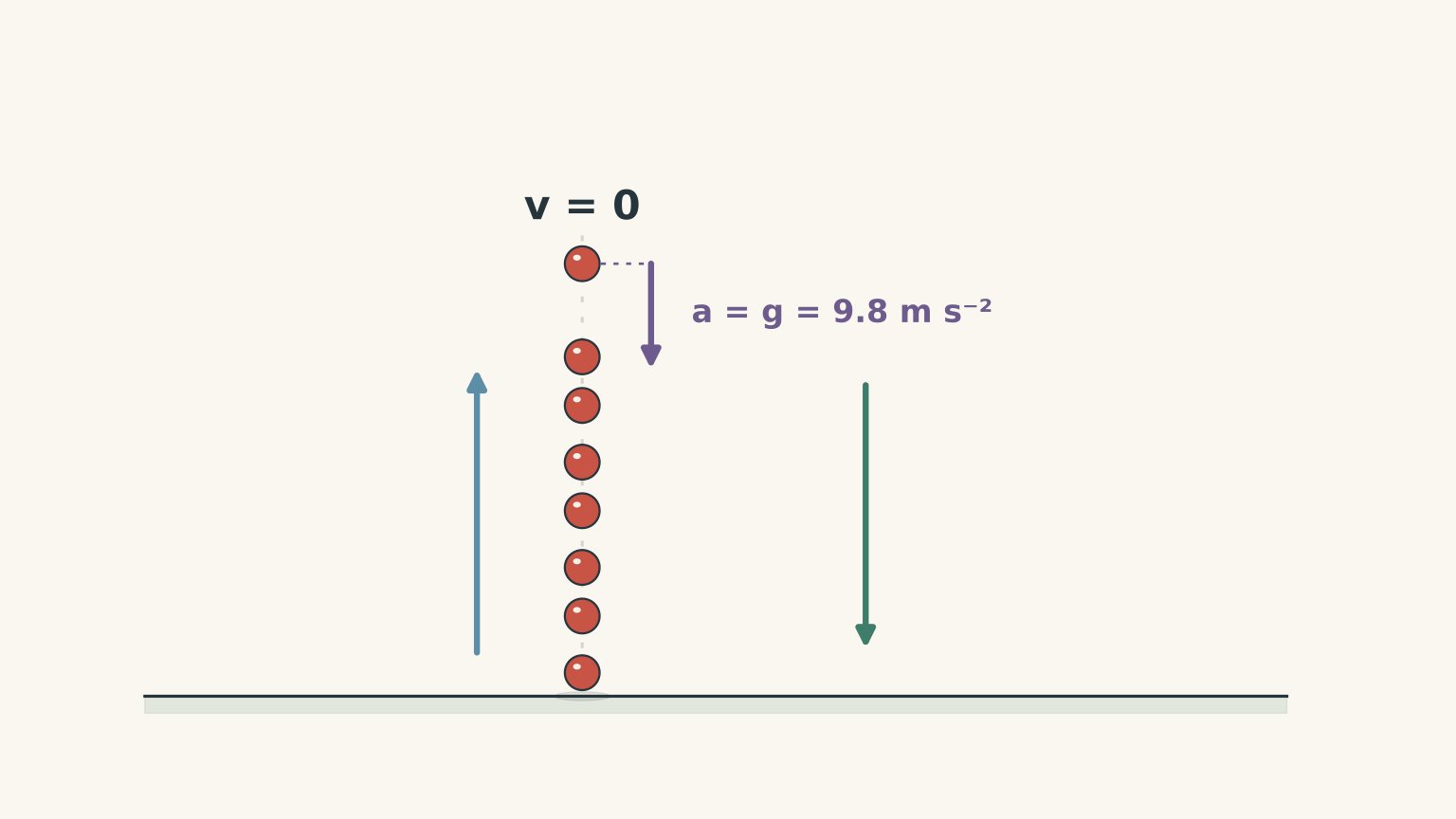
Imagine throwing a ball straight upwards. At the highest point, it stops moving for a split second. What is its acceleration at that instant?
If you predicted zero, there’s an important Year 11 Physics idea worth revisiting before Year 12 begins. The ball’s velocity is momentarily zero, but gravity is still accelerating it downwards at approximately \(9.8\ \mathrm{m\,s^{-2}}\), assuming air resistance is negligible.
This is the sort of distinction that separates understanding a physics problem from simply recognising a formula.
The best preparation for Year 12 Physics isn’t to race ahead and memorise the next set of equations. It’s to make sure you can use the mathematical tools, physical principles, and problem-solving skills that the HSC course will build on.
Here is the order I’d recommend:
- Refresh algebra, trigonometry, units, and scientific notation.
- Get comfortable with motion, velocity, and acceleration.
- Practise vectors, force diagrams, and Newton’s laws.
- Revisit wave and electricity fundamentals.
- Strengthen graph interpretation and experimental skills.
You don’t need to master every Year 12 topic before Term 4. You do need to be able to use these foundations without having to relearn them every time a new problem appears.
Due to technical limitations, this figure may display incorrectly or contain inaccuracies. Please check key details against your course materials.
01First, check which Physics syllabus applies to you
There is an important NSW syllabus change to be aware of.
As at November 2026, the Physics 11-12 Syllabus (2025) is being introduced on a different timeline from the existing Physics Stage 6 Syllabus (2017).
| Student cohort | Physics syllabus |
|---|---|
| Students who began Year 12 in Term 4 2026 | 2017 syllabus, for the 2027 HSC |
| Students who begin Year 11 in Term 1 2027 | 2025 syllabus |
| Students who begin Year 12 in Term 4 2027 | 2025 syllabus, for the 2028 HSC |
The first HSC examination under the new Physics syllabus will be in 2028.
You can check the official NESA Physics syllabus implementation timeline and the existing Physics Stage 6 syllabus.
If you are also studying Chemistry, don’t assume the implementation dates are identical. The new Chemistry syllabus begins implementation in 2028, one year after Physics.
If Term 4 2026 has already started when you’re reading this, the preparation sequence below is still useful as a catch-up diagnostic.
The important thing is to check your school’s actual course outline rather than revising from material written for a different HSC cohort.
01Get your mathematical foundations working again
You don’t need university-level mathematics for HSC Physics. However, you do need to be comfortable manipulating equations and interpreting mathematical relationships.
A student can understand Newton’s laws perfectly well and still lose marks because they cannot rearrange an equation or resolve a force into components.
These are the mathematical skills I’d prioritise.
| Mathematical skill | What you should be able to do |
|---|---|
| Algebra | Rearrange equations to make a different variable the subject |
| Scientific notation | Work confidently with very large and very small numbers |
| Unit conversions | Convert between common SI units and prefixes |
| Trigonometry | Use sine, cosine, and tangent to resolve vectors |
| Graphs | Calculate gradients and interpret areas under graphs |
| Calculator skills | Use degree mode, appropriate rounding, and scientific notation |
Rearranging equations
Suppose you know the equation:
\[ v=u+at \]
Here:
- \(v\) is final velocity in \(\mathrm{m\,s^{-1}}\).
- \(u\) is initial velocity in \(\mathrm{m\,s^{-1}}\).
- \(a\) is acceleration in \(\mathrm{m\,s^{-2}}\).
- \(t\) is elapsed time in seconds.
You should be able to rearrange this equation to find acceleration:
\[ v-u=at \]
\[ a=\frac{v-u}{t} \]
This is a small mathematical step, but you’ll repeat it throughout Physics.
Practise rearranging equations without relying on an equation triangle. You want to understand what you’re doing, not just remember which symbols to move.
Unit conversions
Physics calculations only make sense when the units are consistent.
For example, suppose a car travels at \(72\ \mathrm{km\,h^{-1}}\). What is its speed in metres per second?
Divide by 3.6:
\[ v=\frac{72}{3.6} \]
\[ v=20\ \mathrm{m\,s^{-1}} \]
You should also recognise common prefixes:
| Prefix | Symbol | Multiplier |
|---|---|---|
| Kilo | k | \(10^3\) |
| Centi | c | \(10^{-2}\) |
| Milli | m | \(10^{-3}\) |
| Micro | \(\mu\) | \(10^{-6}\) |
| Nano | n | \(10^{-9}\) |
For example, \(4.5\ \mathrm{ms}\) is \(0.0045\ \mathrm{s}\).
Be particularly careful with squared and cubed units. Converting centimetres to metres is straightforward, but converting \(\mathrm{cm^2}\) to \(\mathrm{m^2}\) requires squaring the conversion factor.
Trigonometry and vectors
Physics often involves quantities with both magnitude and direction.
A force of 20 N acting east is different from a force of 20 N acting north. We represent these quantities using vectors.
If a force \(F\) acts at an angle \(\theta\) above the horizontal, its components are:
\[ F_x=F\cos\theta \]
\[ F_y=F\sin\theta \]
Here, \(F_x\) is the horizontal component and \(F_y\) is the vertical component.
These equations assume that the angle is measured from the horizontal. If the angle is measured from the vertical, the sine and cosine relationships swap.
You should also be comfortable with Pythagoras’ theorem when combining perpendicular components.
If these mathematical foundations need attention, tutorgum’s guide to What Maths Should You Revise Before Year 11 Physics? is a useful place to revisit the basics.
02Understand motion before moving on to more complicated mechanics
Motion is one of the most important foundations in senior Physics.
Before tackling more complicated systems, make sure you can distinguish between four related quantities.
| Quantity | Meaning | Type |
|---|---|---|
| Distance | Total ground covered | Scalar |
| Displacement | Change in position, including direction | Vector |
| Speed | Rate of change of distance | Scalar |
| Velocity | Rate of change of displacement | Vector |
The distinction between speed and velocity becomes important when an object changes direction.
Imagine walking 10 metres east, then 10 metres west.
Your total distance is 20 metres, but your displacement is zero because you finish where you started.
This also explains why average speed and average velocity are not interchangeable.
Acceleration is not the same as speed
Acceleration describes how quickly velocity changes.
\[ a=\frac{\Delta v}{\Delta t} \]
A common misconception is that negative acceleration always means an object is slowing down.
It doesn’t.
The sign of acceleration depends on your chosen positive direction. An object can have negative acceleration while speeding up if its velocity is also negative.
For example, a car travelling west might have negative velocity and negative acceleration. Its speed is increasing, not decreasing.
Return to the ball thrown upwards.
At the highest point:
- Its instantaneous velocity is zero.
- Its acceleration is still approximately \(9.8\ \mathrm{m\,s^{-2}}\) downwards.
- It immediately begins moving downwards.
The direction of acceleration is determined by the forces acting on the object, not simply by the direction in which it is moving.
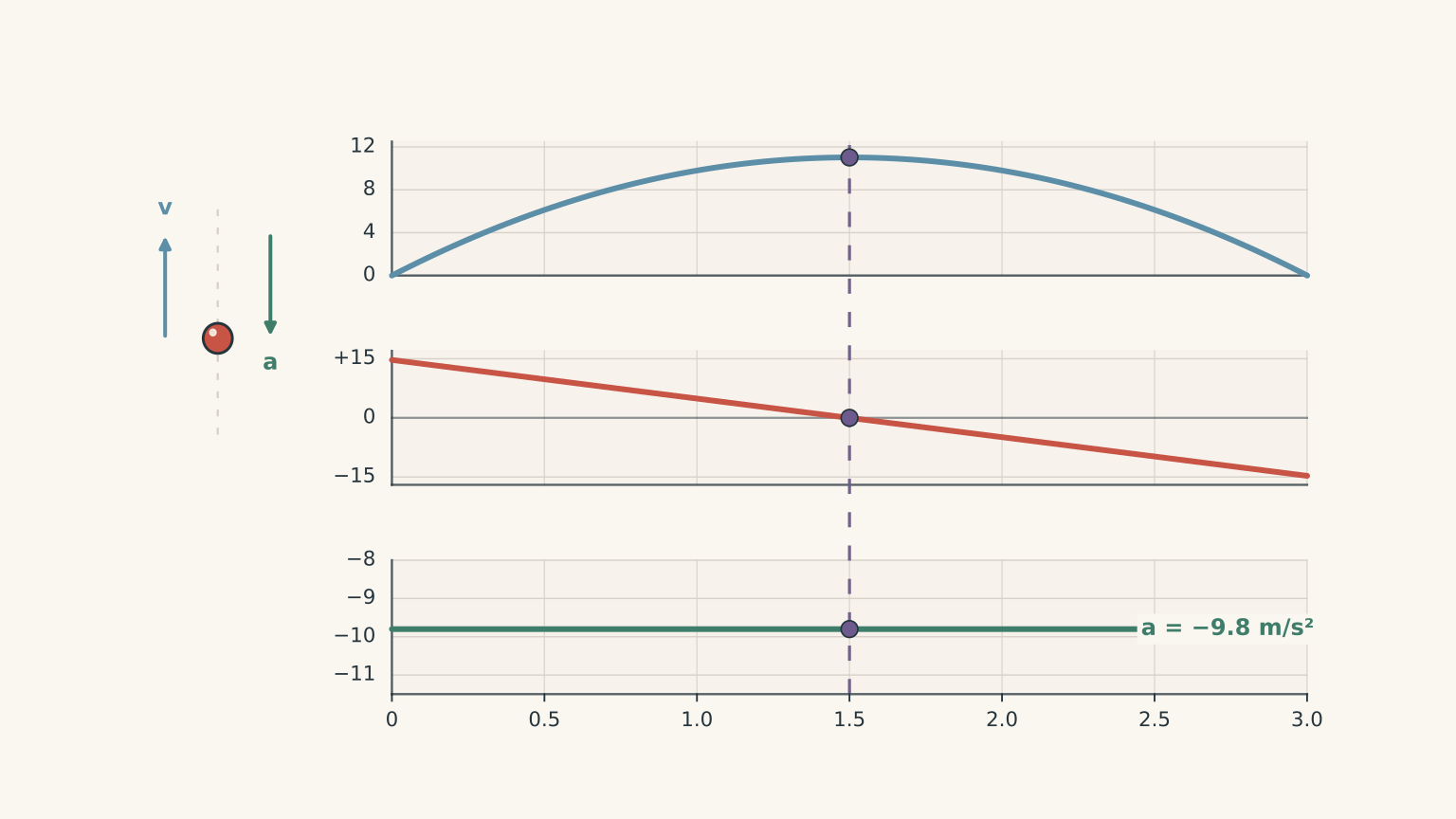
Learn to interpret motion graphs
Three graphs are particularly important:
- Position-time graphs.
- Velocity-time graphs.
- Acceleration-time graphs.
Each tells you something different.
| Graph | Gradient represents | Area represents |
|---|---|---|
| Position-time | Velocity | No standard basic motion interpretation |
| Velocity-time | Acceleration | Displacement |
| Acceleration-time | Rate of change of acceleration | Change in velocity |
For a straight-line position-time graph, the gradient gives constant velocity.
For a curved position-time graph, the gradient changes, meaning the velocity changes.
On a velocity-time graph, the area below the time axis represents negative displacement. To calculate total distance, you must add the magnitudes of the separate areas.
Due to technical limitations, this figure may display incorrectly or contain inaccuracies. Please check key details against your course materials.
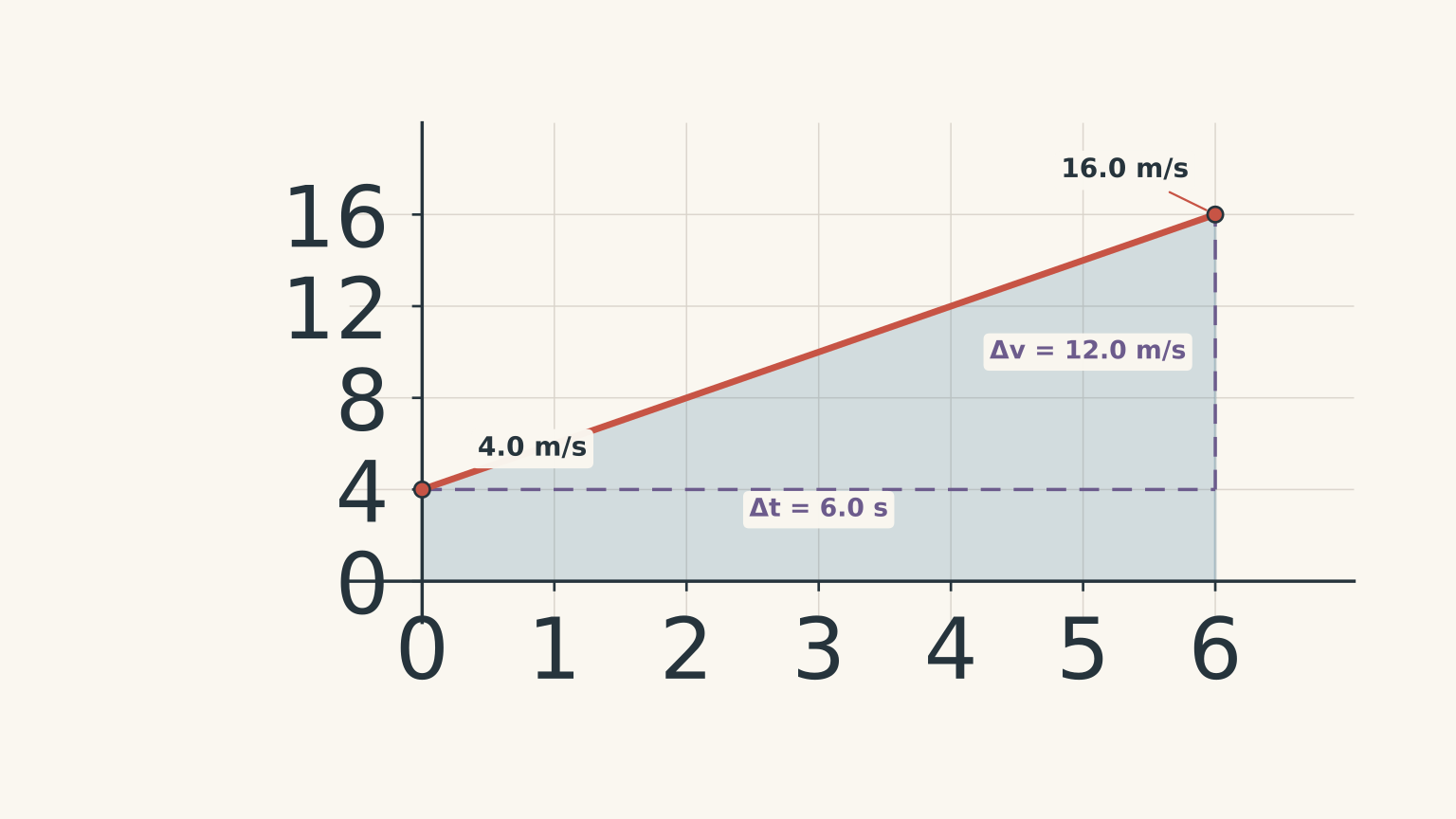
Worked example: Calculate acceleration and displacement from a velocity-time graph
A car increases its velocity uniformly from \(4.0\ \mathrm{m\,s^{-1}}\) to \(16.0\ \mathrm{m\,s^{-1}}\) over 6.0 seconds. Calculate its acceleration and displacement during this time.
Step 1
We need acceleration and displacement.
Because the velocity changes uniformly, acceleration is constant.
Step 2
The gradient of a velocity-time graph is:
\[ a=\frac{v-u}{t} \]
Substitute the given values:
\[ a=\frac{16.0-4.0}{6.0} \]
\[ \boxed{a=2.0\ \mathrm{m\,s^{-2}}} \]
The car’s velocity increases by \(2.0\ \mathrm{m\,s^{-1}}\) every second.
Step 3
The graph forms a trapezium, so its area is:
\[ s=\frac{1}{2}(u+v)t \]
Substitute:
\[ s=\frac{1}{2}(4.0+16.0)(6.0) \]
\[ s=10.0\times6.0 \]
\[ \boxed{s=60\ \mathrm{m}} \]
The car travels 60 metres forwards during the six seconds.
Due to technical limitations, this figure may display incorrectly or contain inaccuracies. Please check key details against your course materials.
03Revise forces and Newton’s laws
Understanding motion tells you what an object is doing. Understanding forces helps you explain why.
This is where students often make a mistake: they identify a force acting on an object and assume it must be the net force.
It isn’t necessarily.
An object might have several forces acting on it at the same time. The net force is the vector sum of all external forces.
Newton’s second law connects the net force to acceleration:
\[ F_{\text{net}}=ma \]
Here:
- \(F_{\text{net}}\) is the resultant force in newtons (N).
- \(m\) is mass in kilograms (kg).
- \(a\) is acceleration in metres per second squared (\(\mathrm{m\,s^{-2}}\)).
If the net force is zero, acceleration is zero. That means the object maintains a constant velocity.
It does not necessarily mean the object is stationary.
Practise drawing free-body diagrams
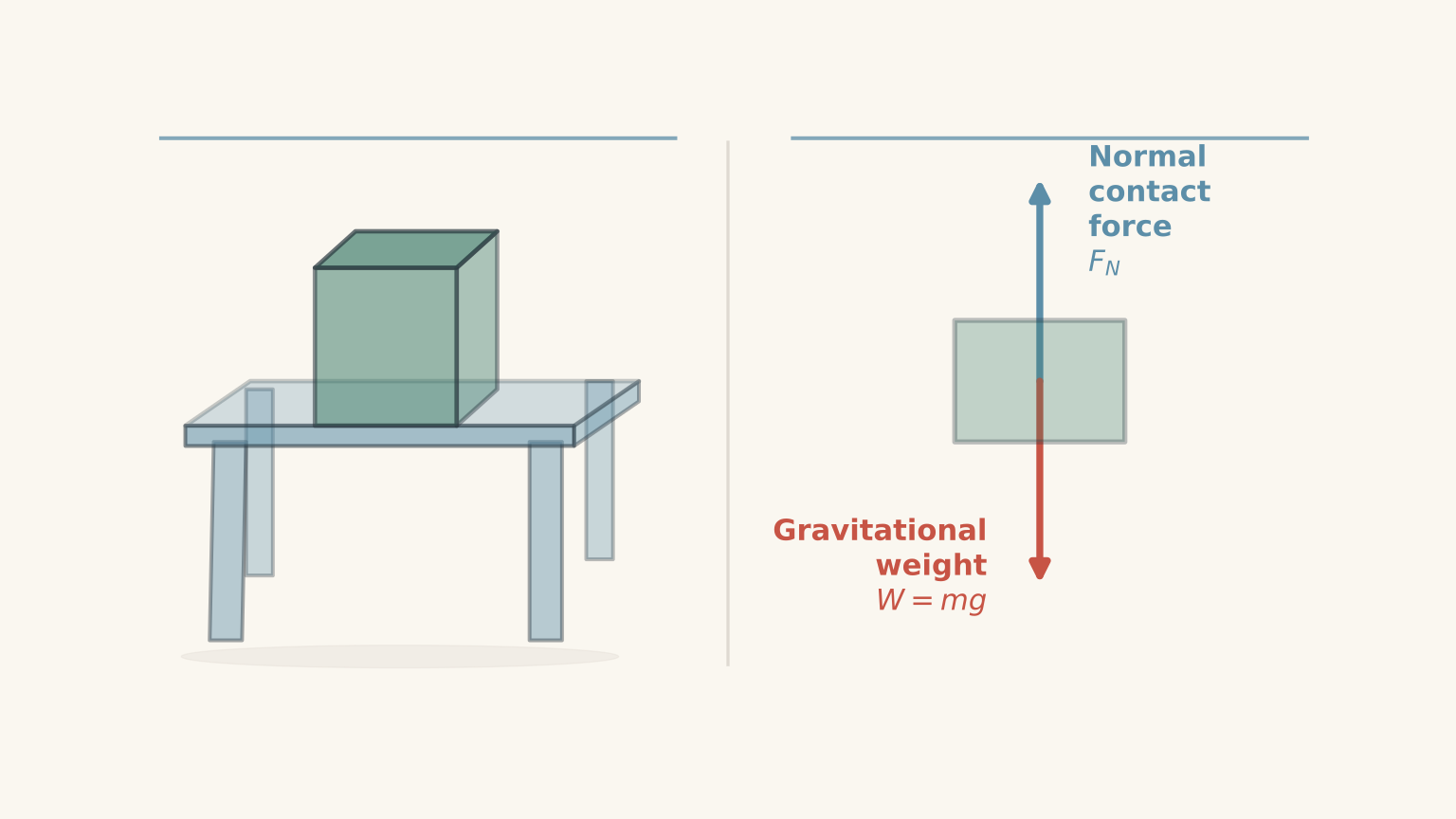
A free-body diagram shows all the external forces acting on one chosen object.
For example, consider a box resting on a horizontal table.
Two forces act vertically:
- Weight acts downwards due to gravity.
- The normal force acts upwards from the table.
If the box is stationary and no other vertical forces act, these forces balance.
The weight of an object is calculated using:
\[ W=mg \]
where \(W\) is weight in newtons, \(m\) is mass in kilograms, and \(g\) is gravitational acceleration.
One important distinction: mass and weight are not the same thing.
Mass measures how much matter an object contains. Weight is the gravitational force acting on it.
The normal force is also not automatically equal to the weight. It depends on the other forces and the acceleration perpendicular to the surface.
Due to technical limitations, this figure may display incorrectly or contain inaccuracies. Please check key details against your course materials.
Resolve forces into components
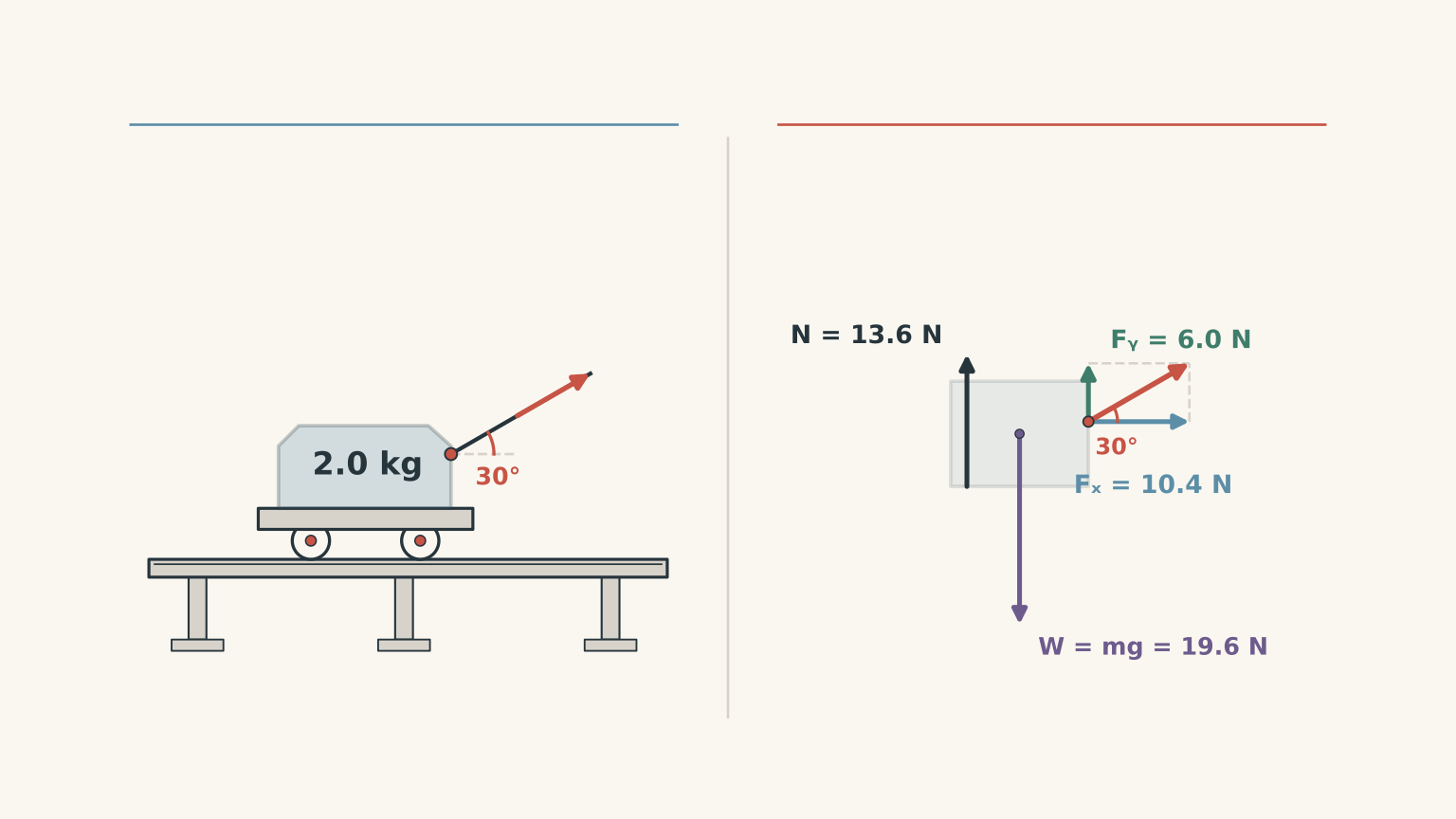
Now imagine pulling a trolley along a horizontal track with a rope angled upwards.
The pulling force has two components:
- A horizontal component that accelerates the trolley.
- A vertical component that partly supports its weight.
This is why resolving forces matters.
Due to technical limitations, this figure may display incorrectly or contain inaccuracies. Please check key details against your course materials.
Worked example: Find the acceleration of a pulled trolley
A 2.0 kg trolley is pulled along a horizontal, frictionless track by a 12 N force acting at 30° above the horizontal. Calculate its horizontal acceleration and the normal force acting on it.
Take \(g=9.8\ \mathrm{m\,s^{-2}}\).
Step 1
The horizontal component is:
\[ F_x=F\cos\theta \]
\[ F_x=12\cos30^\circ \]
\[ F_x=10.39\ \mathrm{N} \]
The vertical component is:
\[ F_y=F\sin\theta \]
\[ F_y=12\sin30^\circ \]
\[ F_y=6.0\ \mathrm{N} \]
Step 2
There is no friction, so the horizontal net force is \(10.39\ \mathrm{N}\).
Using Newton’s second law:
\[ F_{\text{net}}=ma \]
Rearrange:
\[ a=\frac{F_{\text{net}}}{m} \]
Substitute:
\[ a=\frac{10.39}{2.0} \]
\[ \boxed{a=5.2\ \mathrm{m\,s^{-2}}} \]
The trolley accelerates horizontally at approximately \(5.2\ \mathrm{m\,s^{-2}}\).
Step 3
First, calculate the trolley’s weight:
\[ W=mg \]
\[ W=2.0\times9.8=19.6\ \mathrm{N} \]
The trolley does not accelerate vertically because it remains on the horizontal track.
Therefore, the vertical forces must balance:
\[ N+F_y-W=0 \]
Rearrange:
\[ N=W-F_y \]
\[ N=19.6-6.0 \]
\[ \boxed{N=13.6\ \mathrm{N}} \]
Notice that the normal force is less than the trolley’s weight.
The upward component of the pulling force supports part of the trolley’s weight, so the track does not need to provide as much upward force.
This is exactly why assuming \(N=mg\) in every situation is a mistake.
04Refresh the basics of waves and electricity
You don’t need to teach yourself every upcoming topic before Term 4. However, you should be comfortable with the basic language and relationships used in waves and electricity.
These topics rely on quantities that are easy to confuse if you haven’t used them for a while.
Waves
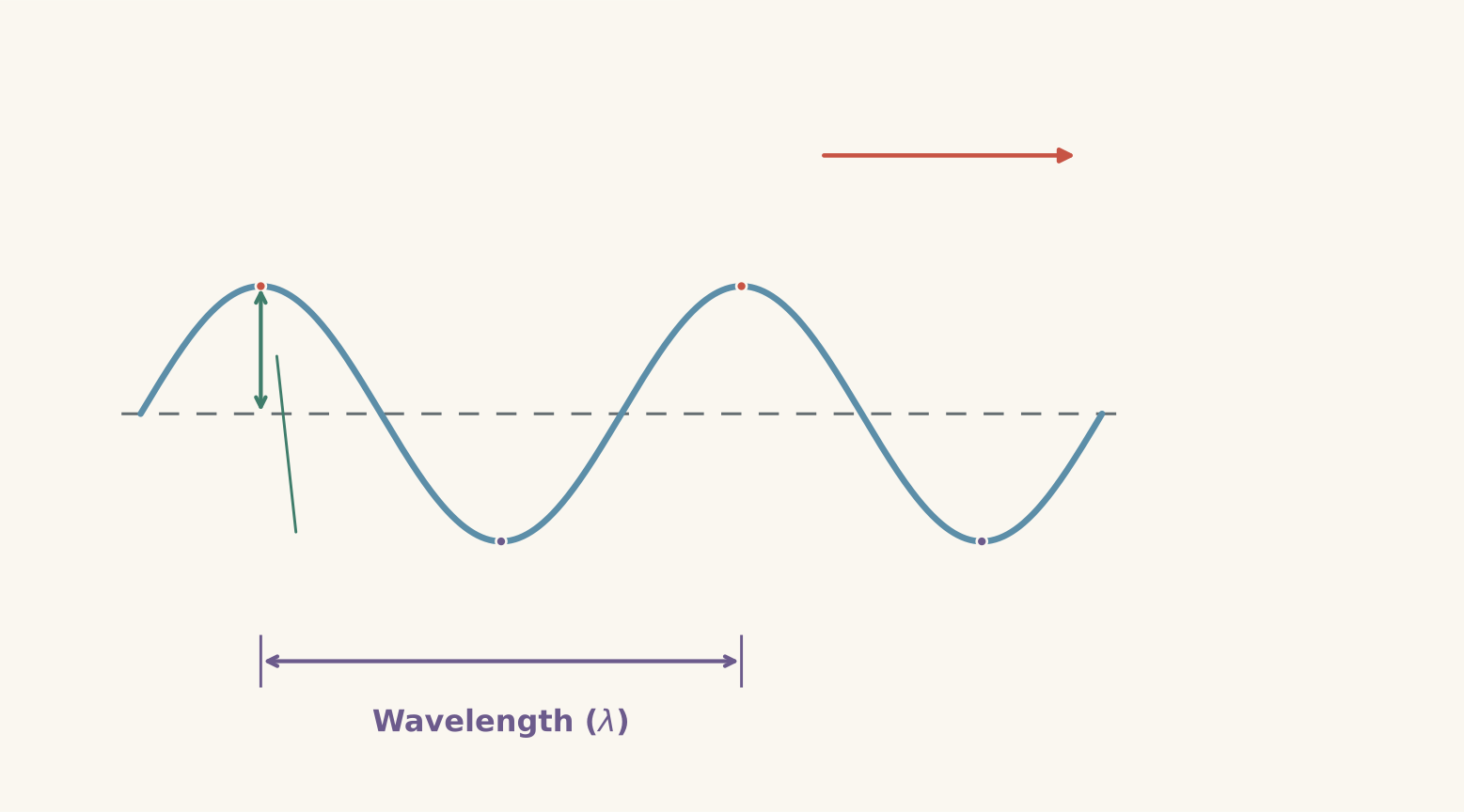
A wave transfers energy without requiring a net transfer of matter.
For a periodic wave, remember these quantities:
- Wavelength (\(\lambda\)): distance between corresponding points on consecutive waves.
- Frequency (\(f\)): number of complete oscillations per second.
- Period (\(T\)): time taken for one complete oscillation.
- Amplitude: maximum displacement from equilibrium.
The relationship between wave speed, frequency, and wavelength is:
\[ v=f\lambda \]
Here, wave speed \(v\) is measured in metres per second, frequency \(f\) in hertz, and wavelength \(\lambda\) in metres.
Frequency and period are related by:
\[ f=\frac{1}{T} \]
Make sure you understand what each quantity represents before substituting values into an equation.
Due to technical limitations, this figure may display incorrectly or contain inaccuracies. Please check key details against your course materials.
Electricity
Start by making sure you understand three fundamental quantities:
| Quantity | Symbol | Unit | Meaning |
|---|---|---|---|
| Current | \(I\) | Ampere (A) | Rate of flow of electric charge |
| Voltage | \(V\) | Volt (V) | Energy transferred per unit charge |
| Resistance | \(R\) | Ohm (\(\Omega\)) | Opposition to current flow |
Ohm’s law connects these quantities:
\[ V=IR \]
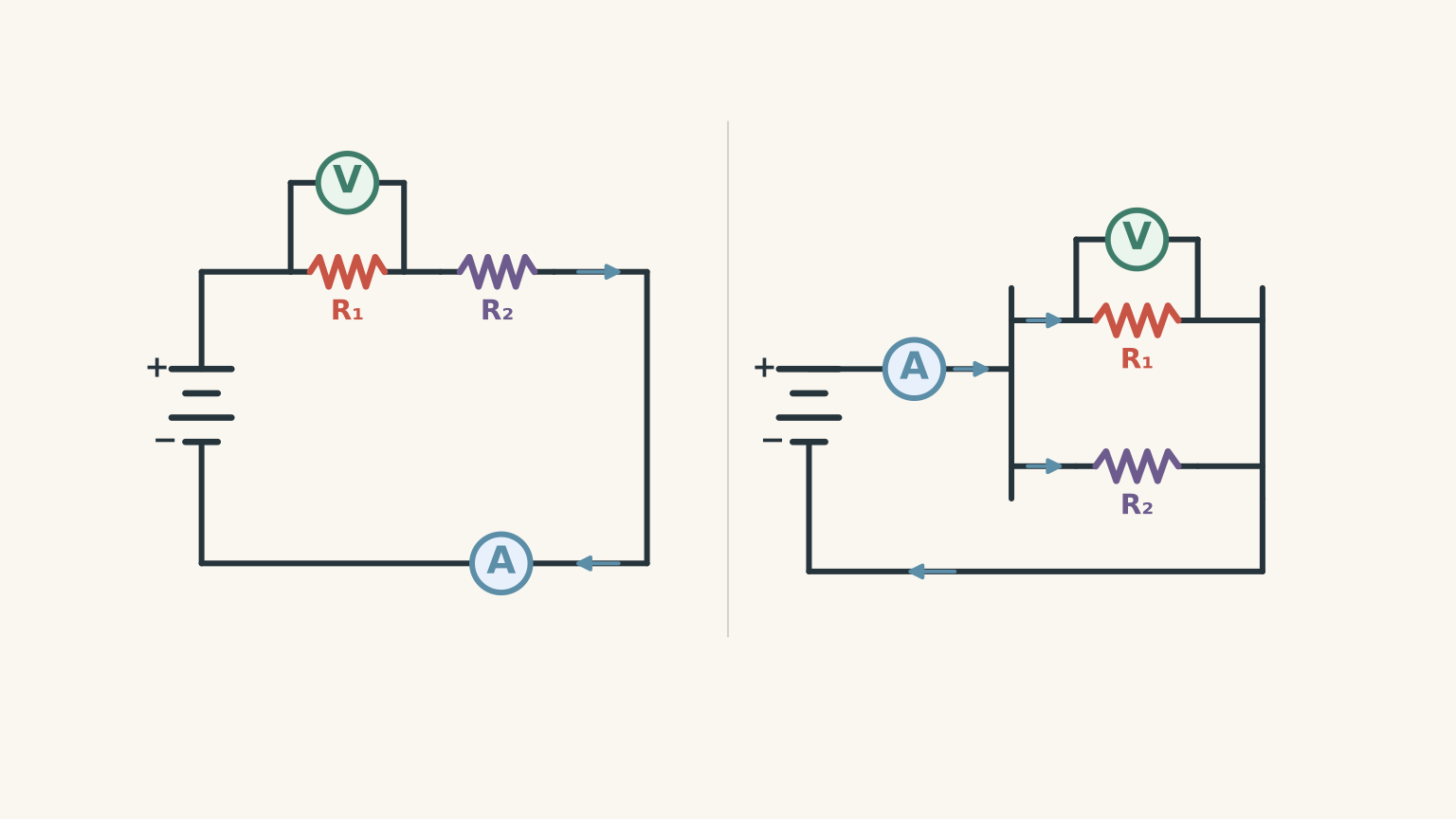
You should also remember how current and voltage behave in different circuit arrangements.
| Circuit arrangement | Current | Voltage |
|---|---|---|
| Series | Same through each component | Divided between components |
| Parallel | Divided between branches | Same across each branch |
A useful practical reminder:
- An ammeter is connected in series.
- A voltmeter is connected in parallel.
Due to technical limitations, this figure may display incorrectly or contain inaccuracies. Please check key details against your course materials.
For magnetism, refresh your understanding of magnetic fields and field lines. You should be able to explain what a magnetic field represents and interpret the direction and relative strength shown by field lines.
Don’t spend hours memorising complicated magnetic calculations before your teacher introduces them. Focus on understanding the basic quantities and physical ideas.
05Get better at interpreting experimental results
Physics isn’t just about solving equations.
You also need to understand how physical models are tested through experiments and how measurements can support or challenge a prediction.
This is particularly important for practical investigations and depth studies.
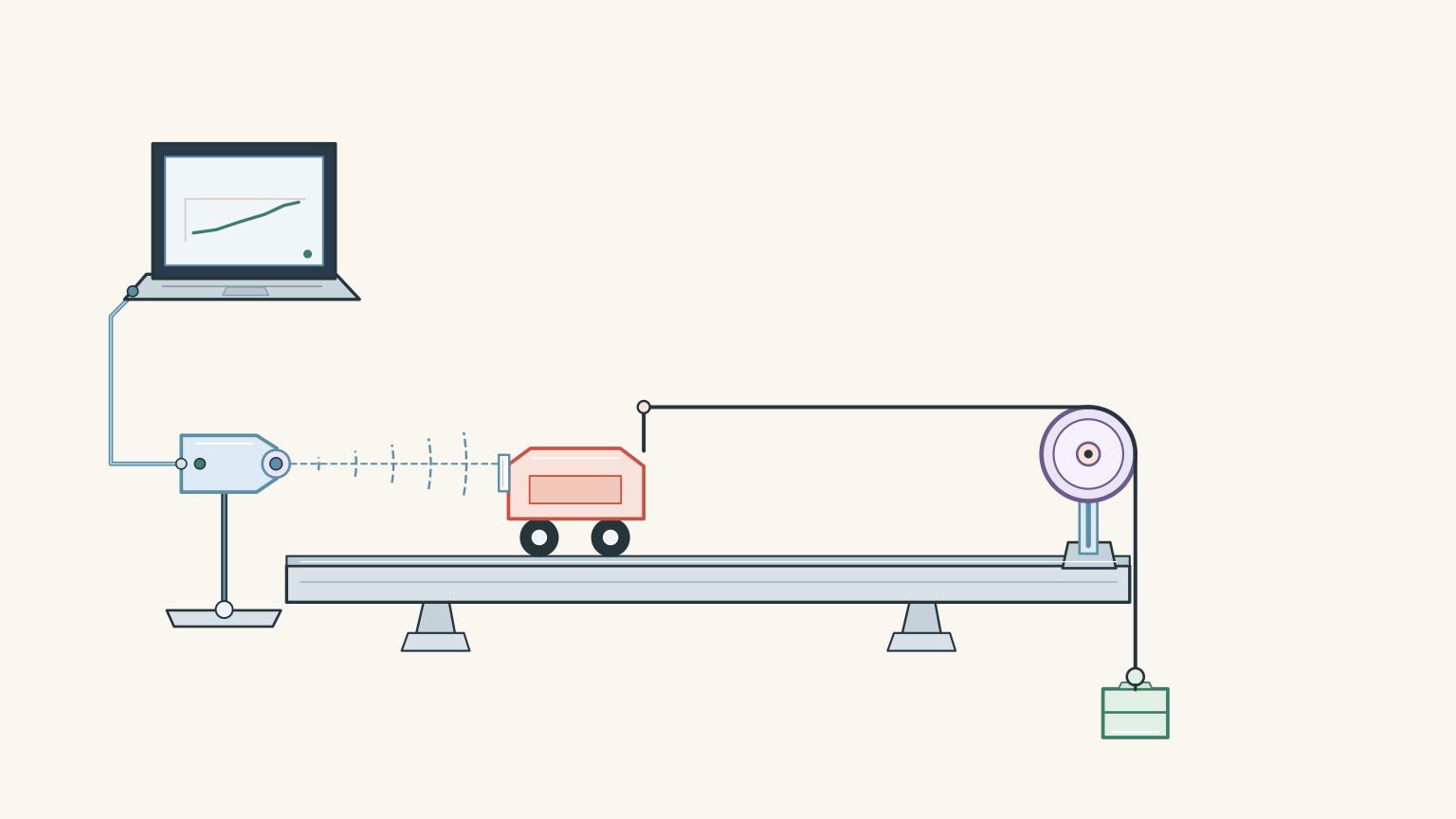
Consider an experiment investigating how the net force on a trolley affects its acceleration.
You might use a trolley on a track, a pulley, a hanging mass, and a motion sensor or light gates to measure acceleration.
The experiment involves several decisions:
- What variable are you changing?
- What variable are you measuring?
- Which variables must remain controlled?
- How will you measure the results?
- How will you determine whether the results support the model?
Due to technical limitations, this figure may display incorrectly or contain inaccuracies. Please check key details against your course materials.
Understand independent and dependent variables
The independent variable is the quantity you deliberately change.
The dependent variable is the quantity you measure in response.
For the trolley experiment:
- Independent variable: net force.
- Dependent variable: acceleration.
- Controlled variable: total mass of the trolley and attached masses.
If you change the total mass at the same time as the force, you cannot confidently attribute the acceleration change to force alone.
Practise reading experimental graphs
You should be able to:
- Identify the independent and dependent variables.
- Select appropriate axes and units.
- Plot measurements accurately.
- Draw a suitable line or curve of best fit.
- Calculate and interpret the gradient where appropriate.
- Identify limitations and possible sources of uncertainty.
Don’t just calculate a gradient because the question asks for one.
Ask what the gradient physically represents and what its units should be.
For example, if you graph velocity against time, the gradient represents acceleration in \(\mathrm{m\,s^{-2}}\).
If you graph force against acceleration for a constant-mass object, the gradient represents mass because \(F=ma\).
That connection between experimental evidence and physical theory is an important part of understanding Physics.
06Follow a short preparation plan before Term 4
You don’t need to spend the entire school holidays studying Physics.
A focused preparation plan of six sessions, each around 35-45 minutes, is a sensible starting point.
| Session | What to revise | What you should be able to do afterwards |
|---|---|---|
| 1 | Algebra, units, and scientific notation | Rearrange equations and convert units confidently |
| 2 | Trigonometry and vectors | Resolve forces into perpendicular components |
| 3 | Motion and kinematics | Distinguish velocity from acceleration and interpret motion graphs |
| 4 | Forces and Newton’s laws | Draw free-body diagrams and calculate net force |
| 5 | Waves and electricity | Explain the main quantities and use their fundamental equations |
| 6 | Experimental skills | Interpret graphs, identify variables, and explain results |
For each session, use the same approach:
- Spend 5-10 minutes recalling what you already know without looking at notes.
- Spend 20-25 minutes working through problems.
- Spend the remaining time correcting mistakes and recording anything you still don’t understand.
The last step is important.
If you get a question wrong, don’t simply copy the correct solution. Work out why you got it wrong.
Was it an algebra mistake? Did you choose the wrong equation? Did you misunderstand the direction of a force? Did you forget to convert units?
These errors require different solutions.
How do you know what to revise first?
Use this decision guide:
| If you struggle with… | Prioritise revising… |
|---|---|
| Rearranging equations or converting units | Algebra and unit conversions |
| Splitting forces into components | Trigonometry and vectors |
| Understanding motion graphs | Kinematics and graph interpretation |
| Identifying the forces acting on an object | Free-body diagrams and Newton’s laws |
| Explaining experimental results | Variables, gradients, and uncertainty |
| Choosing the correct equation in a question | Physical concepts and problem interpretation |
If you can perform a calculation but cannot explain why you used that equation, spend more time on the underlying concept.
If you understand the physics but repeatedly make mathematical mistakes, work on the mathematical skill separately.
That is much more efficient than repeatedly attempting full exam questions without addressing the actual problem.
08Questions and solutions
Try these three questions without looking at the solutions first. They test different foundations, starting with basic motion and progressing towards more involved applications of Newton’s laws.
Question 1
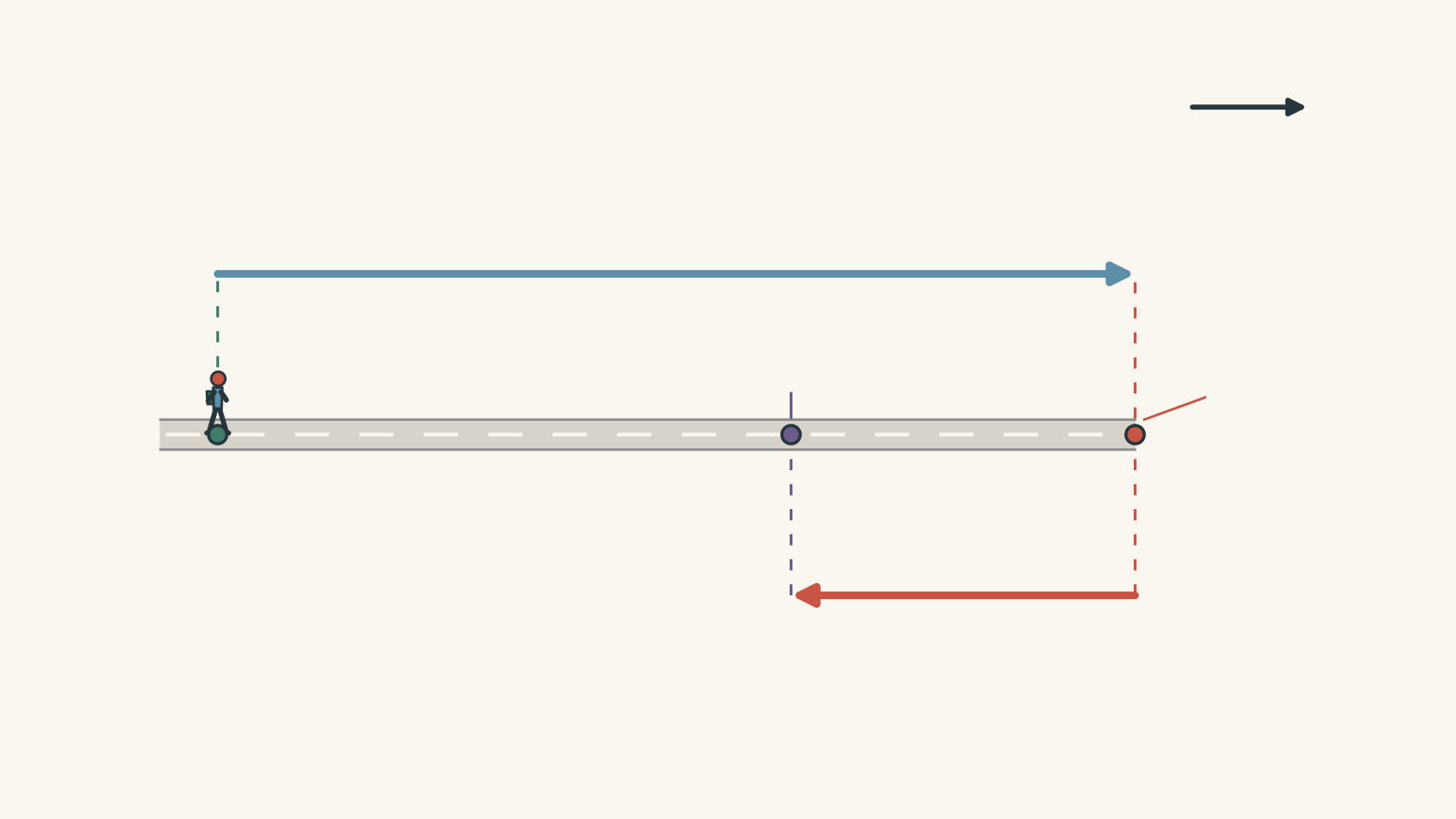
A student walks 80 m east in 40 seconds, then turns around and walks 30 m west in 20 seconds.
Taking east as the positive direction, calculate:
a) The total distance travelled.
b) The displacement.
c) The average speed.
d) The average velocity.
Due to technical limitations, this figure may display incorrectly or contain inaccuracies. Please check key details against your course materials.
Solution 1
The total distance is 110 m, the displacement is 50 m east, the average speed is \(1.83\ \mathrm{m\,s^{-1}}\), and the average velocity is \(0.83\ \mathrm{m\,s^{-1}}\) east.
The key is to distinguish the total path travelled from the change in position.
Part a: Total distance
Distance includes the entire path, regardless of direction.
\[ d=80+30 \]
\[ \boxed{d=110\ \mathrm{m}} \]
Part b: Displacement
Taking east as positive:
\[ \Delta x=80-30 \]
\[ \boxed{\Delta x=+50\ \mathrm{m}} \]
The positive sign indicates that the student finishes 50 m east of the starting position.
Part c: Average speed
Average speed is total distance divided by total time.
\[ v_{\text{avg}}=\frac{\text{total distance}}{\text{total time}} \]
Total time:
\[ t=40+20=60\ \mathrm{s} \]
Therefore:
\[ v_{\text{avg}}=\frac{110}{60} \]
\[ \boxed{v_{\text{avg}}=1.83\ \mathrm{m\,s^{-1}}} \]
Part d: Average velocity
Average velocity uses displacement rather than distance.
\[ \vec v_{\text{avg}}= \frac{\text{displacement}}{\text{time}} \]
\[ \vec v_{\text{avg}}=\frac{50}{60} \]
\[ \boxed{\vec v_{\text{avg}}=0.83\ \mathrm{m\,s^{-1}}\text{ east}} \]
Notice that average speed is greater than the magnitude of average velocity.
The student travelled 110 m, but ended up only 50 m from the starting position.
Question 2
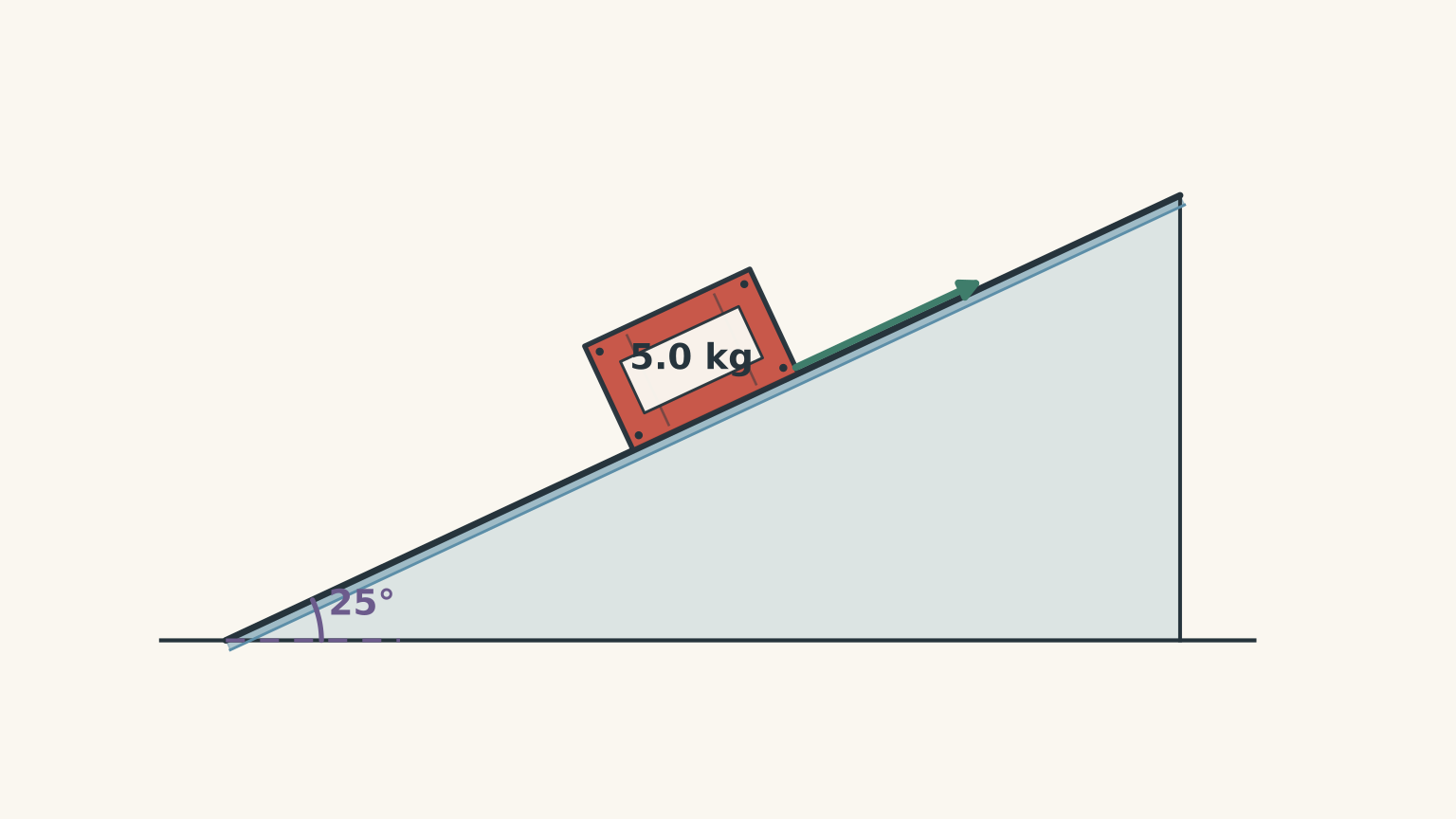
A 5.0 kg crate slides down a straight inclined surface at an angle of 25° to the horizontal.
A frictional force of 8.0 N acts up the incline.
Assuming the frictional force is constant and gravitational acceleration is \(9.8\ \mathrm{m\,s^{-2}}\), calculate:
a) The acceleration of the crate.
b) The normal reaction force acting on the crate.
Due to technical limitations, this figure may display incorrectly or contain inaccuracies. Please check key details against your course materials.
Solution 2
The crate accelerates down the incline at approximately \(2.54\ \mathrm{m\,s^{-2}}\), and the normal reaction force is approximately \(44.4\ \mathrm{N}\).
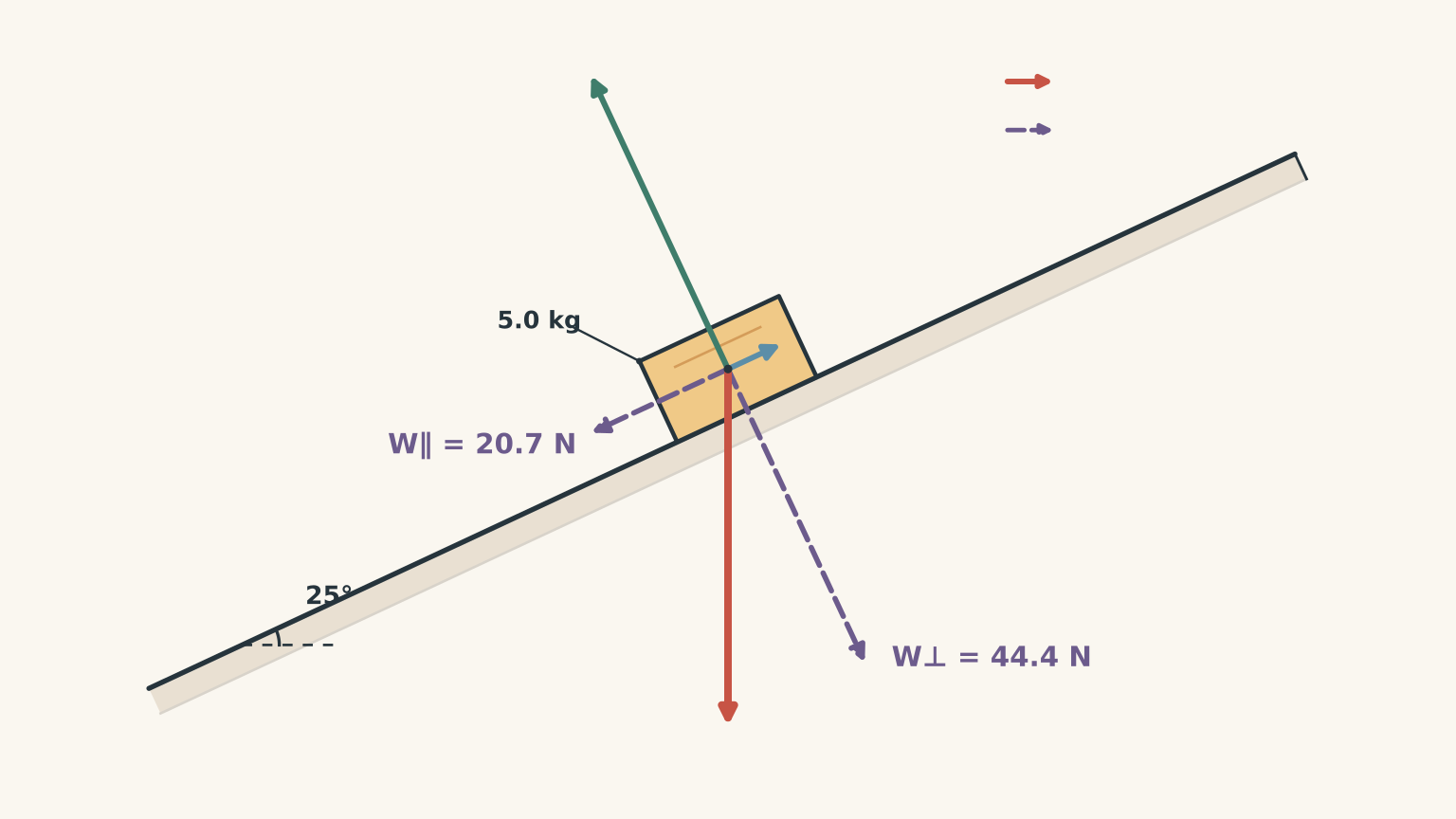
The important step is to resolve the weight into components parallel and perpendicular to the incline.
Part a: Acceleration
The weight of the crate is:
\[ W=mg \]
\[ W=5.0\times9.8 \]
\[ W=49\ \mathrm{N} \]
The component of weight acting down the slope is:
\[ W_{\parallel}=mg\sin25^\circ \]
\[ W_{\parallel}=49\sin25^\circ \]
\[ W_{\parallel}=20.7\ \mathrm{N} \]
Friction acts in the opposite direction, so the net force down the slope is:
\[ F_{\text{net}}=20.7-8.0 \]
\[ F_{\text{net}}=12.7\ \mathrm{N} \]
Apply Newton’s second law:
\[ F_{\text{net}}=ma \]
Rearrange:
\[ a=\frac{F_{\text{net}}}{m} \]
\[ a=\frac{12.7}{5.0} \]
\[ \boxed{a=2.54\ \mathrm{m\,s^{-2}}} \]
The crate accelerates down the slope because the gravitational component exceeds the frictional force.
Due to technical limitations, this figure may display incorrectly or contain inaccuracies. Please check key details against your course materials.
Part b: Normal reaction force
The crate does not accelerate perpendicular to the slope because it remains in contact with the surface.
Therefore, the forces perpendicular to the slope balance.
The perpendicular component of weight is:
\[ W_{\perp}=mg\cos25^\circ \]
The normal force must balance this component:
\[ N=mg\cos25^\circ \]
Substitute:
\[ N=49\cos25^\circ \]
\[ \boxed{N=44.4\ \mathrm{N}} \]
The normal force is less than the full weight because only the perpendicular component of gravity needs to be balanced.
A common mistake is to assume the normal force always equals \(mg\). This is only true in particular situations, such as a stationary object on a horizontal surface with no other vertical forces.
Question 3
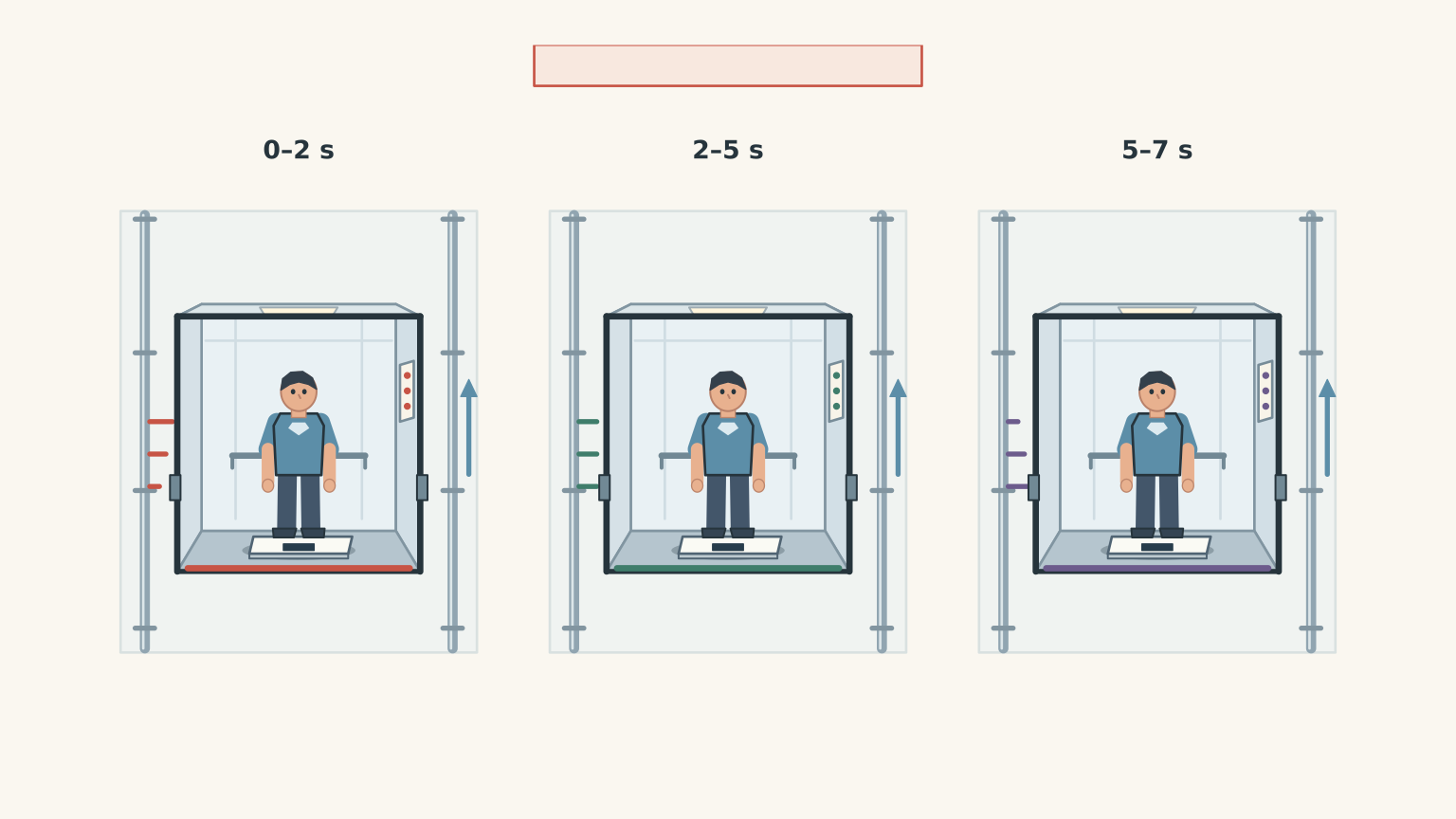
A 60 kg student stands on a scale inside a lift.
The lift:
- Starts from rest and accelerates upwards at \(1.2\ \mathrm{m\,s^{-2}}\) for 2 seconds.
- Continues moving upwards at constant velocity for 3 seconds.
- Then slows uniformly to rest over 2 seconds.
Take gravitational acceleration as \(9.8\ \mathrm{m\,s^{-2}}\).
Calculate the normal force exerted by the scale on the student during each of the three stages.
Explain why the scale reading changes even though the student’s mass remains constant.
Due to technical limitations, this figure may display incorrectly or contain inaccuracies. Please check key details against your course materials.
Solution 3
The normal force is:
- \(660\ \mathrm{N}\) during upward acceleration.
- \(588\ \mathrm{N}\) during constant velocity.
- \(516\ \mathrm{N}\) while the lift slows to rest.
The key is that the scale measures the normal contact force, not the student’s gravitational weight.
The student’s weight remains constant throughout the journey.
\[ W=mg \]
\[ W=60\times9.8 \]
\[ W=588\ \mathrm{N} \]
Stage 1: Accelerating upwards
The lift accelerates upwards at \(1.2\ \mathrm{m\,s^{-2}}\).
Taking upwards as positive, Newton’s second law gives:
\[ N-W=ma \]
Rearrange:
\[ N=mg+ma \]
\[ N=m(g+a) \]
Substitute:
\[ N=60(9.8+1.2) \]
\[ \boxed{N=660\ \mathrm{N}} \]
The normal force is greater than the student’s weight because the net force must act upwards to produce upward acceleration.
Stage 2: Moving upwards at constant velocity
The lift is moving, but its velocity is constant.
Therefore:
\[ a=0 \]
The net force is zero:
\[ N-W=0 \]
\[ N=mg \]
\[ \boxed{N=588\ \mathrm{N}} \]
The scale now reads the student’s ordinary weight.
Stage 3: Slowing down
This is the interesting part.
The lift is still moving upwards, but it is slowing down.
That means its acceleration is downwards.
First, calculate its velocity after the initial acceleration phase.
Using:
\[ v=u+at \]
\[ v=0+(1.2)(2) \]
\[ v=2.4\ \mathrm{m\,s^{-1}} \]
It then travels upwards at this constant velocity before slowing to rest over 2 seconds.
Taking upwards as positive, the acceleration during the final stage is:
\[ a=\frac{v-u}{t} \]
\[ a=\frac{0-2.4}{2} \]
\[ a=-1.2\ \mathrm{m\,s^{-2}} \]
The negative sign indicates downward acceleration.
Apply Newton’s second law:
\[ N-W=ma \]
\[ N=mg+ma \]
\[ N=m(g+a) \]
Substitute:
\[ N=60(9.8-1.2) \]
\[ \boxed{N=516\ \mathrm{N}} \]
The scale reading is now less than the student’s weight.
The important distinction is between velocity and acceleration.
The lift is moving upwards, but its acceleration is downwards. Its direction of motion does not determine the direction of its acceleration.
This is a useful example of why you should identify the acceleration before deciding which way the net force acts.
09What should you do once your foundations are ready?
If you can rearrange equations, interpret motion graphs, resolve vectors, draw free-body diagrams, and explain your calculations, you have a solid starting point for Year 12 Physics.
Your next step should be to follow the actual sequence in your school’s Physics program.
Don’t spend weeks trying to learn every upcoming topic independently. Instead, use the foundations you’ve revised to understand each new physical model as it is introduced.
When you encounter a more complicated system, return to the same questions:
- What is the object or system I’m analysing?
- What physical principles apply?
- Which quantities are known?
- Which direction have I chosen as positive?
- What does the equation actually describe?
- Does my answer make physical sense?
If you consistently understand the mathematics but struggle to connect equations with physical situations, targeted feedback from your teacher or a tutor can help identify the missing concept.
tutorgum offers online Physics tutoring for Year 11 and Year 12 students, with support for both understanding difficult concepts and developing stronger problem-solving skills.
The aim before Term 4 is simple: make the foundations reliable enough that when Year 12 introduces a new physical situation, you can concentrate on understanding the physics rather than fighting the mathematics.