
Why 4s Electrons Fill Before 3d but Are Removed First
Learn why 4s fills before 3d in neutral atoms but loses electrons first when common transition-metal ions form. Explore electron configurations, chromium and copper exceptions, spectroscopy evidence, worked examples, and challenging HSC Chemistry practice questions.
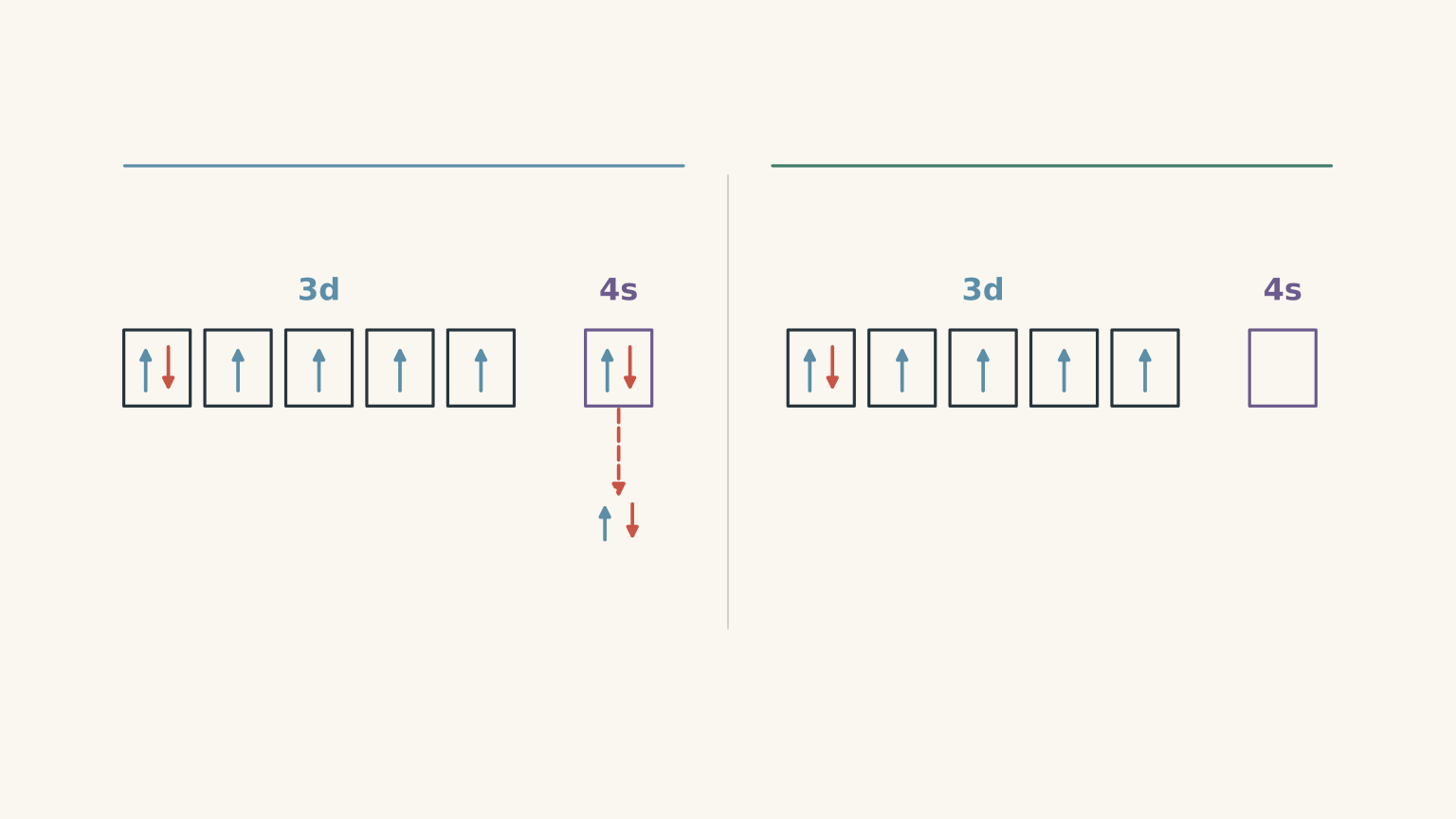
An iron atom has the electron configuration \([\mathrm{Ar}]\,3d^6\,4s^2\). If the 4s subshell fills before 3d, which electrons should be removed first when iron forms \(\mathrm{Fe}^{2+}\)? The ones added most recently to 3d, or the two electrons in 4s?
It’s the 4s electrons. Iron(II) has the configuration \([\mathrm{Ar}]\,3d^6\), not \([\mathrm{Ar}]\,3d^4\,4s^2\).
The explanation is that the relative energies of 4s and 3d are not fixed. The 4s subshell is occupied before 3d as we move from argon through potassium and calcium. But once the 3d subshell becomes occupied in transition-metal atoms, its electrons become more strongly stabilised. When positive ions form, the preferred electron arrangement changes again.
There’s no contradiction. The order used to predict the ground states of neutral atoms is not a permanent ranking of orbital energies, and it’s not a rule for removing electrons.
Due to technical limitations, this figure may display incorrectly or contain inaccuracies. Please check key details against your course materials.
01Why 4s fills before 3d
Start with argon, which has 18 electrons:
\[ [\mathrm{Ar}] =1s^2\,2s^2\,2p^6\,3s^2\,3p^6 \]
The next element is potassium, with 19 electrons.
You might expect its nineteenth electron to enter 3d because that subshell belongs to the third shell, whereas 4s belongs to the fourth.
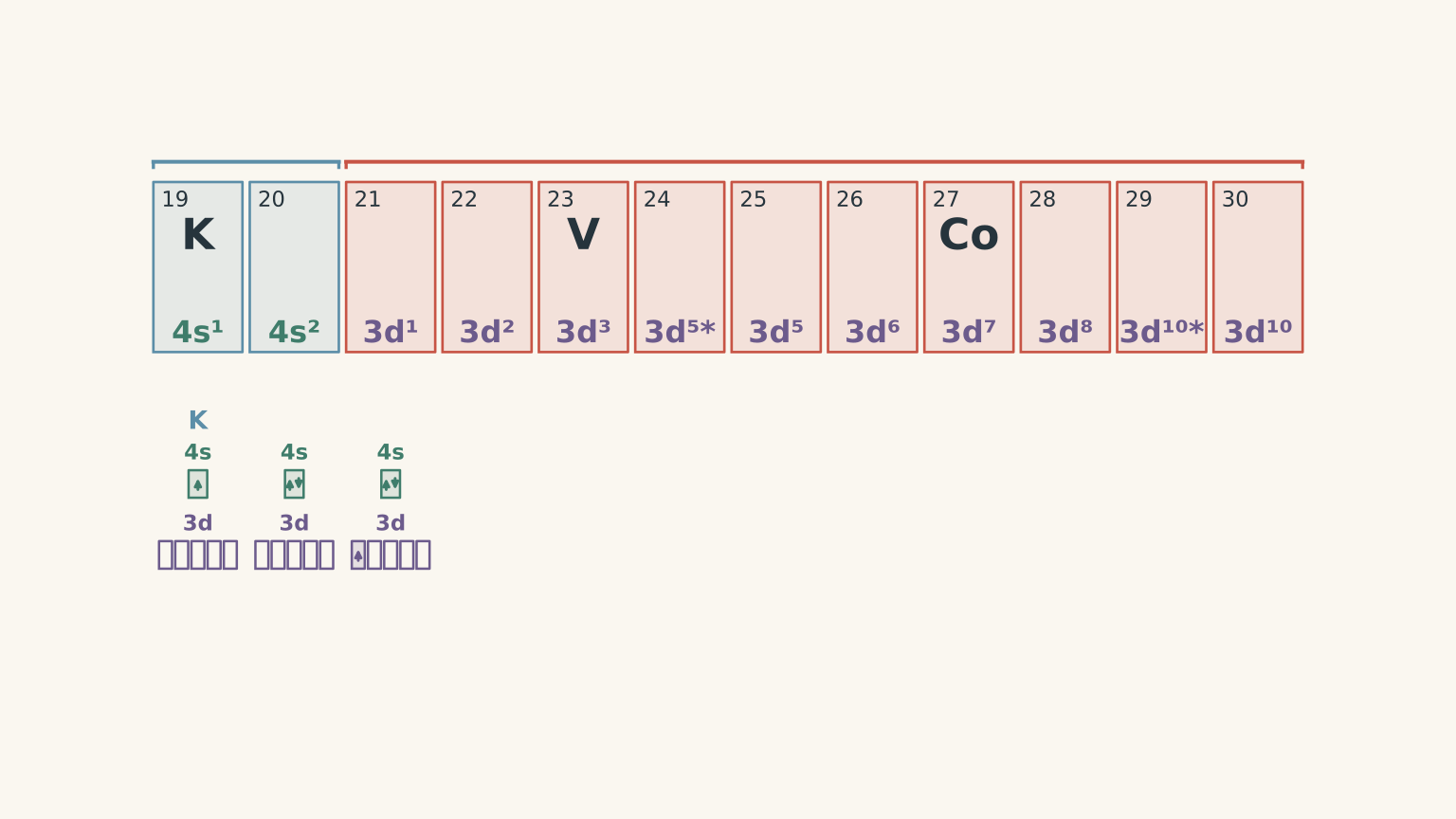
But potassium’s ground-state configuration is:
\[ \mathrm{K}:\ [\mathrm{Ar}]\,4s^1 \]
And calcium, with 20 electrons, has:
\[ \mathrm{Ca}:\ [\mathrm{Ar}]\,4s^2 \]
The 4s arrangement is energetically preferred for these neutral atoms. Only when we reach scandium, atomic number 21, does the ground-state filling pattern begin placing electrons into 3d:
\[ \mathrm{Sc}:\ [\mathrm{Ar}]\,3d^1\,4s^2 \]
This is where the familiar filling sequence comes from:
\[ 3p\ \rightarrow\ 4s\ \rightarrow\ 3d\ \rightarrow\ 4p \]
It’s a useful pattern for predicting electron configurations. But potassium, calcium, and scandium are different atoms, with different numbers of protons.
We are not watching electrons enter a single atom one at a time. We are comparing the preferred arrangements of different neutral atoms.
Due to technical limitations, this figure may display incorrectly or contain inaccuracies. Please check key details against your course materials.
Why can 4s be favourable despite having a larger shell number?
Two effects compete.
First, electrons are attracted to the positively charged nucleus. An electron that spends more time closer to the nucleus can experience stronger attraction.
Second, electrons repel one another. Inner electrons also reduce the effective attraction experienced by electrons farther out. This is called shielding.
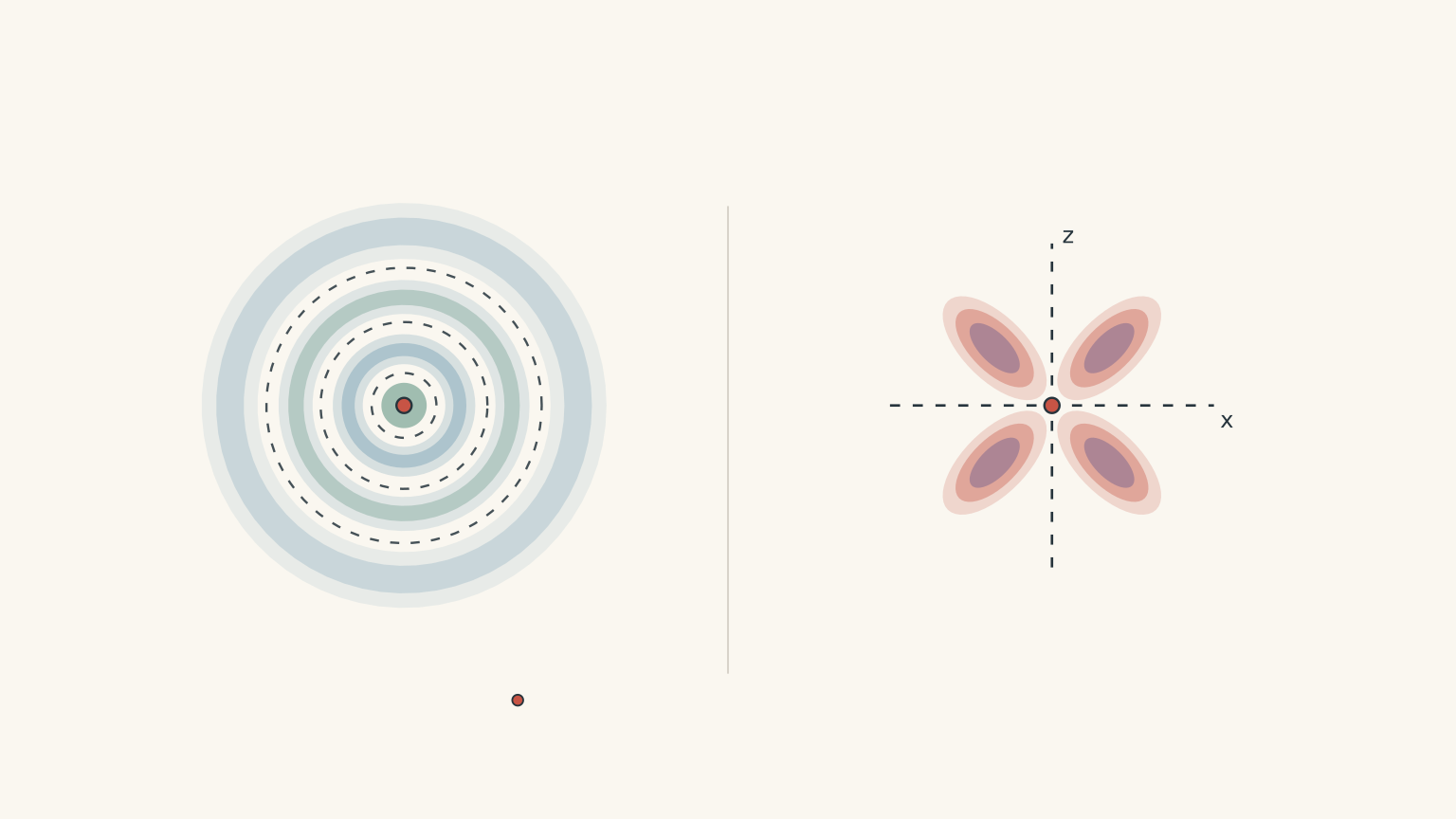
The 4s orbital has an unusual advantage: part of its electron probability distribution penetrates relatively close to the nucleus, inside regions occupied by other electrons.
That penetration helps make 4s energetically favourable in potassium and calcium.
But as nuclear charge increases across the transition series and electrons begin occupying 3d, the relative energies change. The 3d electrons become more strongly stabilised.
In many transition-metal atoms, 4s electrons are also more spatially spread out than the occupied 3d electrons.
That makes 4s electrons generally easier to remove when these atoms form their usual positive ions.
Due to technical limitations, this figure may display incorrectly or contain inaccuracies. Please check key details against your course materials.
A useful mental model is a building with rooms whose attractiveness changes when the building becomes more crowded.
The electrons represent occupants, the rooms represent available subshell arrangements, and the changing attractiveness represents changes in energy caused by nuclear attraction and electron repulsion.
The limitation is important: real orbitals aren’t fixed rooms. Their shapes, energies, and interactions depend on the atom’s electronic state. The electrons don’t make independent decisions about which room to occupy.
The ground-state configuration is the arrangement that minimises the energy of the whole atom, not simply the result of filling a permanent list of independent energy levels.
02Why transition metals lose 4s electrons first
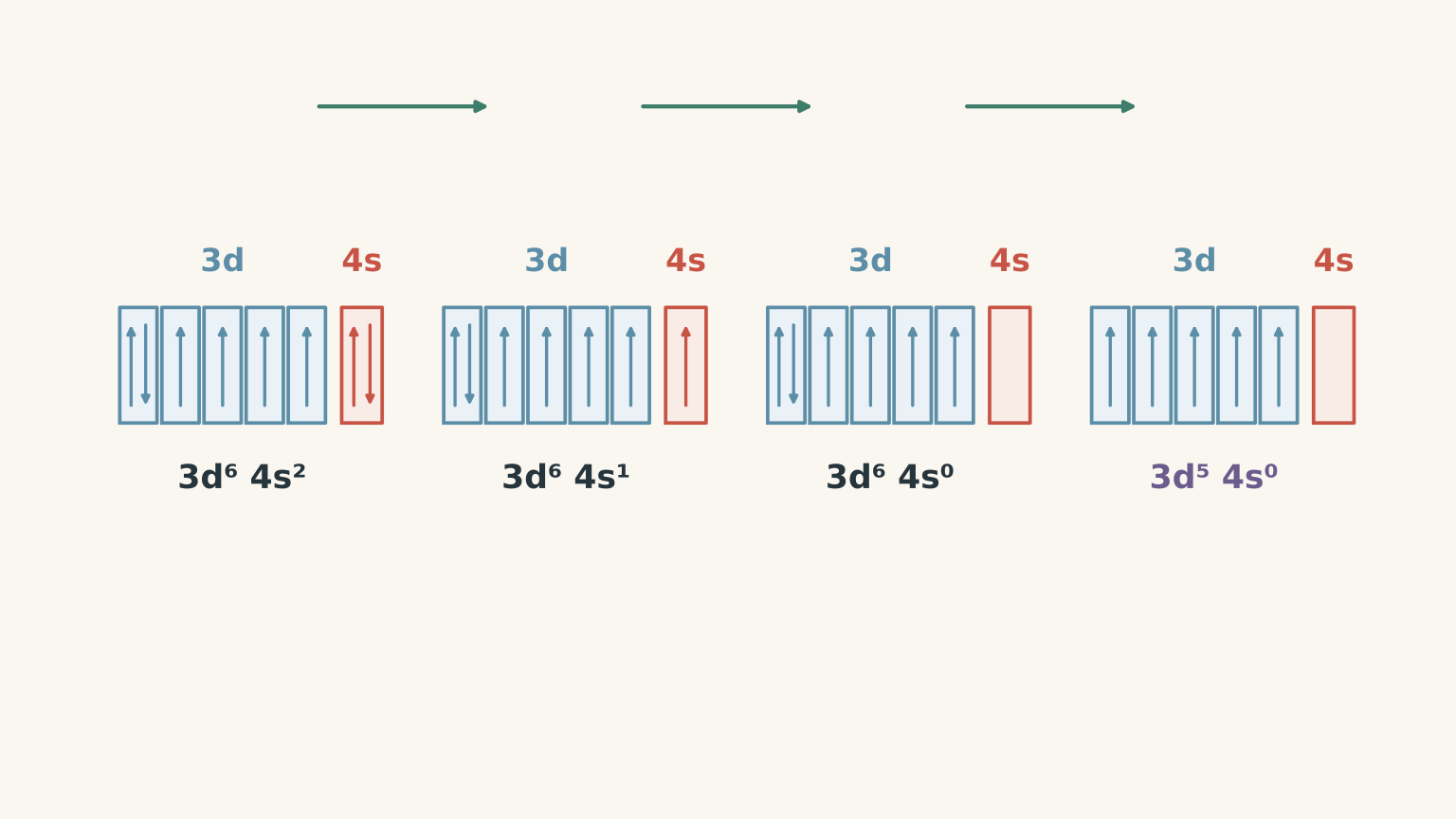
Consider neutral iron:
\[ \mathrm{Fe}:\ [\mathrm{Ar}]\,3d^6\,4s^2 \]
It contains 26 electrons: 18 represented by \([\mathrm{Ar}]\), six in 3d, and two in 4s.
When iron loses one electron to form \(\mathrm{Fe}^{+}\), the ground-state configuration is:
\[ \mathrm{Fe}^{+}:\ [\mathrm{Ar}]\,3d^6\,4s^1 \]
When it loses another:
\[ \mathrm{Fe}^{2+}:\ [\mathrm{Ar}]\,3d^6 \]
Only when a third electron is removed do we reduce the 3d occupancy:
\[ \mathrm{Fe}^{3+}:\ [\mathrm{Ar}]\,3d^5 \]
Notice the pattern. The first two electrons are removed from 4s, then the next from 3d.
Due to technical limitations, this figure may display incorrectly or contain inaccuracies. Please check key details against your course materials.
For ordinary HSC-style electron-configuration questions, the practical rule is:
- Write the neutral atom’s ground-state configuration correctly.
- For a positive transition-metal ion, remove the 4s electrons before reducing the 3d occupancy.
- Check the final electron count against the atomic number and ionic charge.
This works particularly well for familiar ions such as \(\mathrm{Ti}^{3+}\), \(\mathrm{Cr}^{3+}\), \(\mathrm{Mn}^{2+}\), \(\mathrm{Fe}^{2+}\), \(\mathrm{Fe}^{3+}\), \(\mathrm{Cu}^{2+}\), and \(\mathrm{Zn}^{2+}\).
It isn’t a universal description of the microscopic steps involved in ionisation. Some free transition-metal ions rearrange their remaining electrons as their charge changes. We’ll return to that limitation later.
Chromium and copper: two important exceptions
Before applying the removal rule, make sure the neutral configuration is correct.
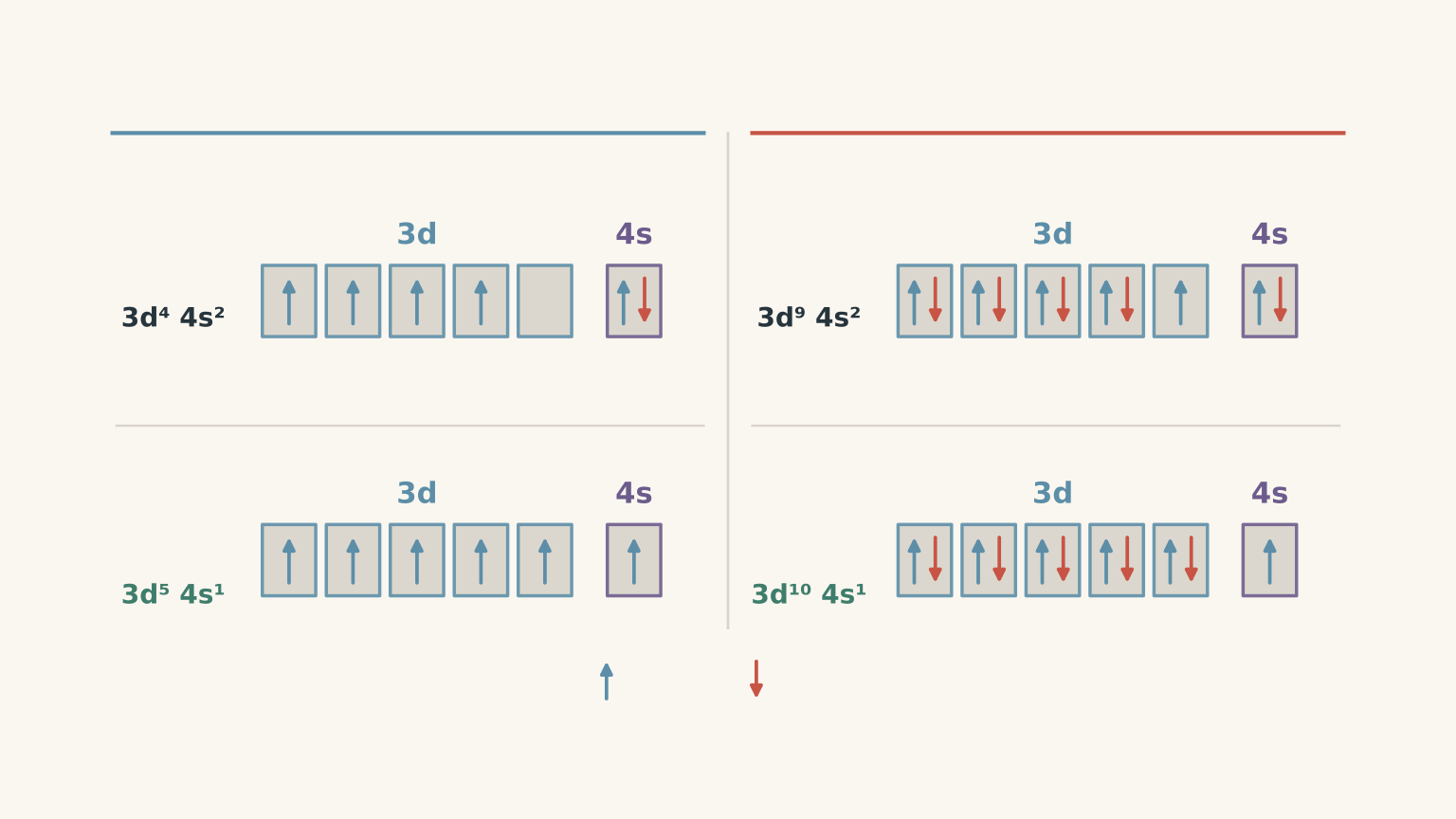
A straightforward filling prediction for chromium would be:
\[ [\mathrm{Ar}]\,3d^4\,4s^2 \]
Its actual ground-state configuration is:
\[ \mathrm{Cr}:\ [\mathrm{Ar}]\,3d^5\,4s^1 \]
Similarly, copper is:
\[ \mathrm{Cu}:\ [\mathrm{Ar}]\,3d^{10}\,4s^1 \]
rather than the simple prediction \([\mathrm{Ar}]\,3d^9\,4s^2\).
The actual arrangements have slightly lower total energies. The half-filled \(3d^5\) arrangement in chromium and filled \(3d^{10}\) arrangement in copper are useful ways to recognise these cases, although their stability involves several competing effects, including electron repulsion and exchange interactions.
Don’t turn that observation into a rule that every half-filled or fully filled subshell must always be preferred. Chromium and copper are specific ground-state configurations supported by atomic evidence.
Due to technical limitations, this figure may display incorrectly or contain inaccuracies. Please check key details against your course materials.
Worked example: Finding the electron configurations of copper ions
A neutral copper atom has atomic number 29. Determine the ground-state electron configurations of \(\mathrm{Cu}^{+}\) and \(\mathrm{Cu}^{2+}\), and explain which subshell loses electrons.
Step 1
Copper is one of the exceptions:
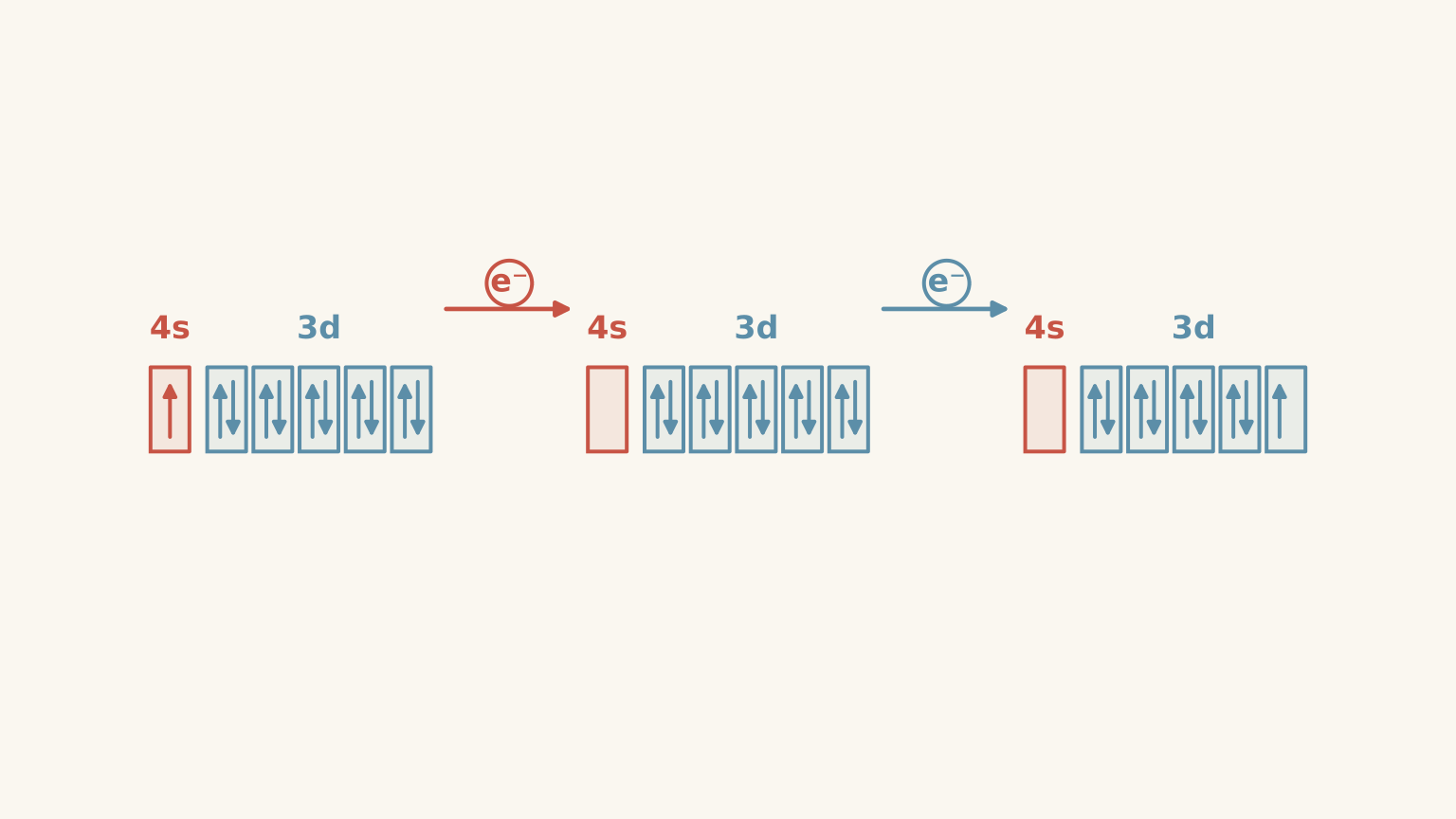
\[ \mathrm{Cu}:\ [\mathrm{Ar}]\,3d^{10}\,4s^1 \]
The electron count is:
\[ 18+10+1=29\text{ electrons} \]
Step 2
The 4s subshell contains one electron, so remove that electron:
\[ \mathrm{Cu}^{+}:\ [\mathrm{Ar}]\,3d^{10} \]
Check:
\[ 29-1=28\text{ electrons} \]
And:
\[ 18+10=28\text{ electrons} \]
Step 3
There are no 4s electrons left. The next electron is removed from 3d:
\[ \mathrm{Cu}^{2+}:\ [\mathrm{Ar}]\,3d^9 \]
Check:
\[ 29-2=27\text{ electrons} \]
And:
\[ 18+9=27\text{ electrons} \]
Step 4
Copper(I) has a completely occupied 3d subshell, whereas copper(II) has nine 3d electrons.
This explains why writing the correct neutral configuration matters. If you incorrectly started with \([\mathrm{Ar}]\,3d^9\,4s^2\), you would predict the wrong arrangement for \(\mathrm{Cu}^{+}\).
Due to technical limitations, this figure may display incorrectly or contain inaccuracies. Please check key details against your course materials.
03How can experiments tell which electrons are more strongly bound?
The original difficulty with electron configurations is that electrons cannot be observed as tiny balls sitting inside labelled orbitals.
How could an investigator test whether removing a 4s electron really produces a more favourable ion than removing a 3d electron?
One approach is to measure the energy required to eject electrons. Another is to study the light absorbed or emitted as atoms and ions move between electronic energy states.
Together, these methods provide evidence about electron binding and the electronic configurations of atoms and ions.
Photoelectron spectroscopy: following the energy
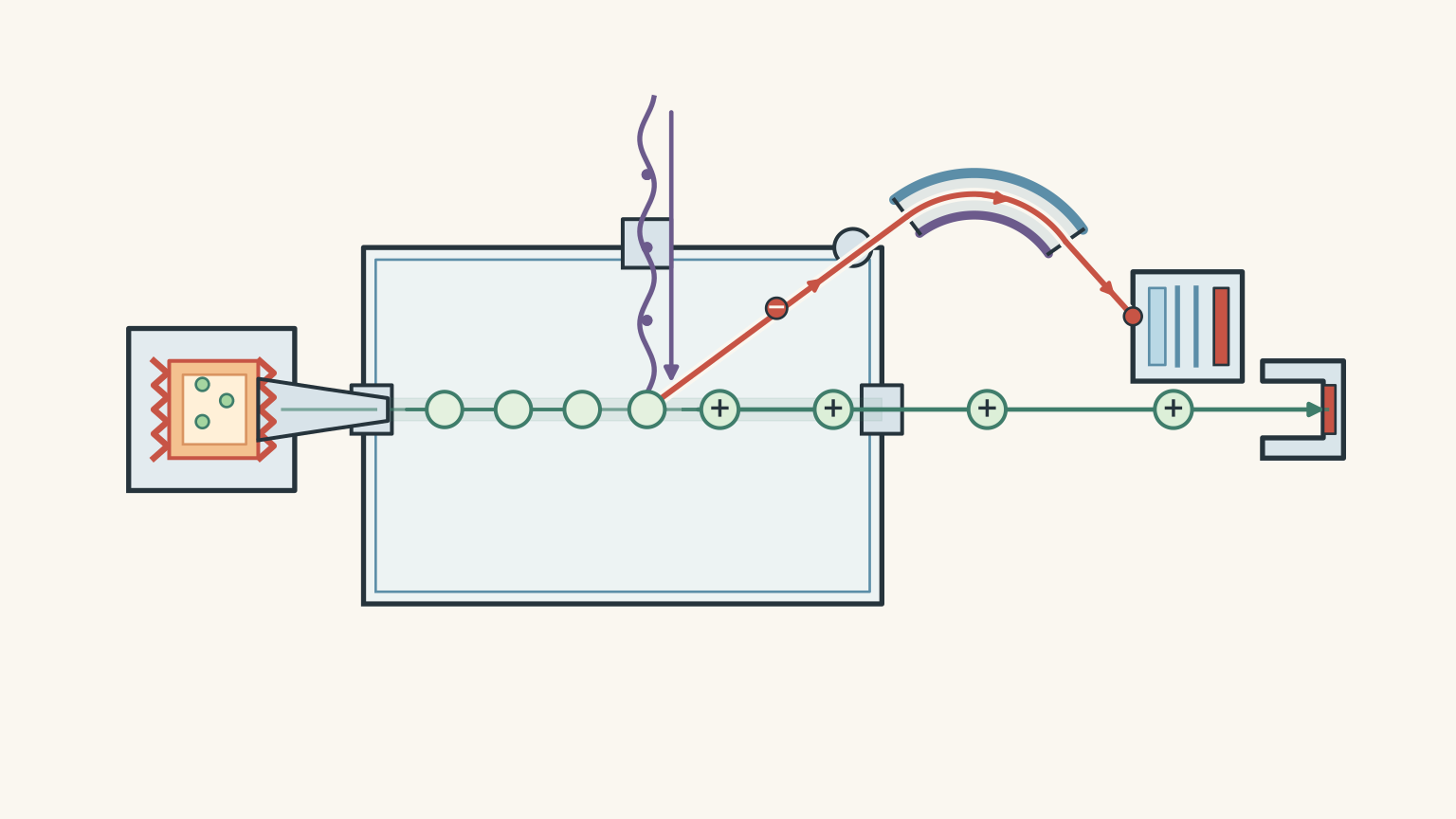
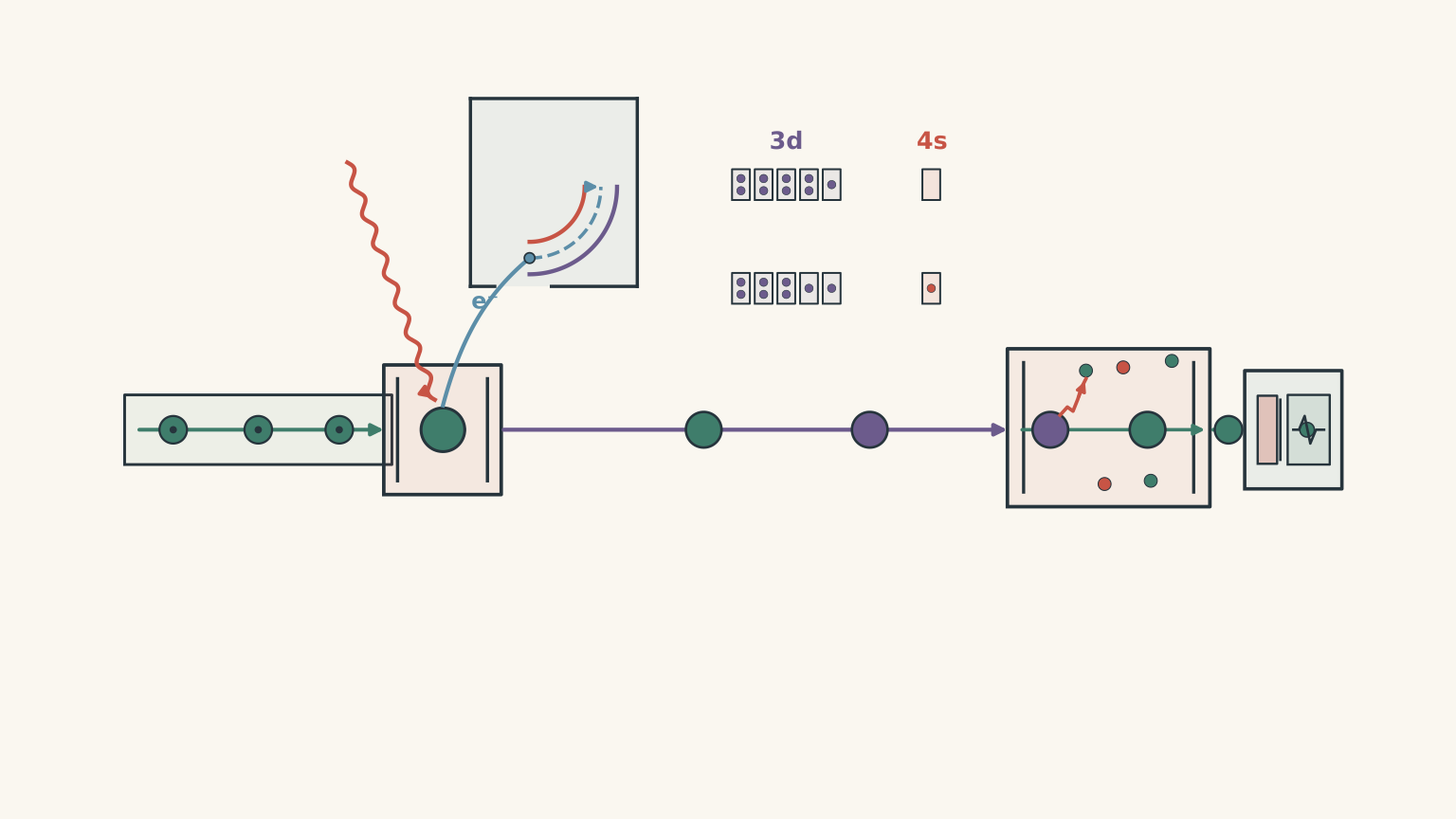
Consider a simplified gas-phase photoelectron spectroscopy apparatus.
- A source produces a beam of isolated gaseous atoms, such as iron atoms.
- The atoms enter a chamber and are exposed to photons of known energy.
- Some photons transfer enough energy to eject electrons from the atoms.
- The outgoing electrons enter an energy analyser, which separates or selects electrons according to their kinetic energy.
- A detector measures the electrons. The resulting energy distribution can be used to investigate the electronic states involved.
The remaining positive ions can also be studied using complementary spectroscopic techniques.
Due to technical limitations, this figure may display incorrectly or contain inaccuracies. Please check key details against your course materials.
Suppose a photon has just enough energy to remove an electron from a neutral gaseous atom.
At that threshold, essentially none of the energy remains as kinetic energy of the escaping electron.
If the photon has more energy than the threshold, the extra energy can become kinetic energy.
For a process that leaves the ion in its ground state, the simplified relationship is:
\[ E_\gamma=I+K_e \]
where:
- \(E_\gamma\) is the photon energy.
- \(I\) is the ionisation energy for the particular gaseous species.
- \(K_e\) is the kinetic energy of the emitted electron.
All three can be expressed in electronvolts, abbreviated eV. One electronvolt is approximately \(1.60\times10^{-19}\) joules per particle.
The ionisation energy is positive because energy must be supplied to separate the electron from the atom or ion. We take the kinetic energy as positive or zero.
This simple equation assumes a single electron is ejected, the residual ion is left in its ground state, and recoil energy is negligible.
If the resulting ion is excited, some photon energy is also stored as electronic excitation:
\[ E_\gamma=I+K_e+E_{\mathrm{exc}} \]
Here, \(E_{\mathrm{exc}}\) is the excitation energy above the resulting ion’s ground state, also expressed in eV.
What the iron evidence shows
A basic fixed-order model might suggest that 4s must remain below 3d in energy because it was occupied first.
If that were always true, you might expect removal of a 3d electron to be preferred, leaving the 4s pair untouched.
The observed ground-state configurations do not follow that prediction.
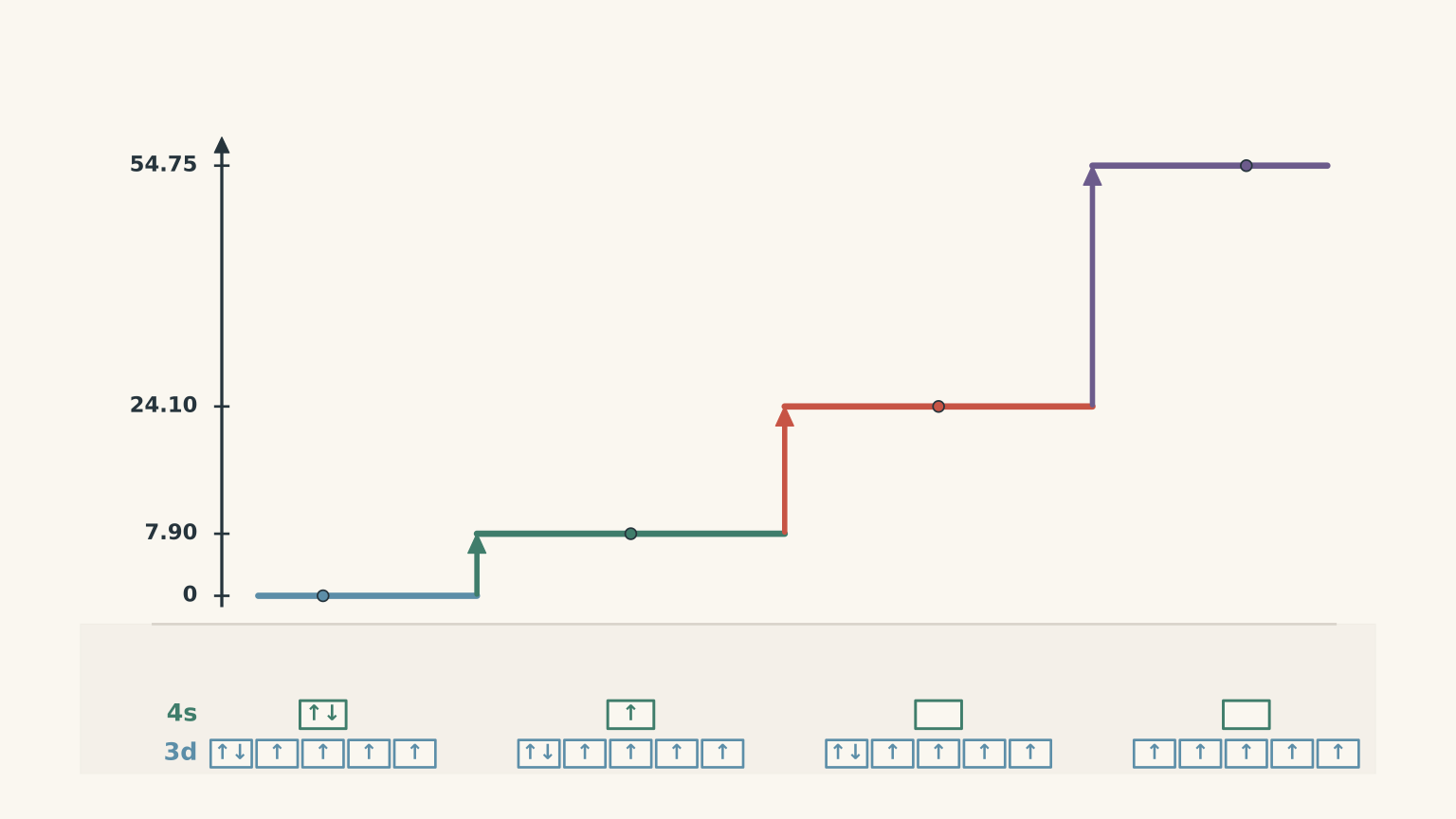
The following values are rounded atomic data from the National Institute of Standards and Technology (NIST) Atomic Spectra Database. They describe isolated gaseous iron atoms and ions, not iron atoms chemically bonded inside compounds.
| Species | Ground-state configuration | Energy to remove the next electron |
|---|---|---|
| \(\mathrm{Fe}\) | \([\mathrm{Ar}]\,3d^6\,4s^2\) | \(7.90\ \mathrm{eV}\) |
| \(\mathrm{Fe}^{+}\) | \([\mathrm{Ar}]\,3d^6\,4s^1\) | \(16.20\ \mathrm{eV}\) |
| \(\mathrm{Fe}^{2+}\) | \([\mathrm{Ar}]\,3d^6\) | \(30.65\ \mathrm{eV}\) |
| \(\mathrm{Fe}^{3+}\) | \([\mathrm{Ar}]\,3d^5\) | Not needed here |
The configurations show that the ground-state ionisation sequence first reduces the 4s population and then the 3d population.
The increasing ionisation energies are also consistent with the general difficulty of removing electrons from increasingly positive ions.
But there is an important limitation.
Ionisation energies alone do not tell you which subshell an electron occupied.
The measured energy depends on both the initial and final electronic states. A higher second ionisation energy does not, by itself, prove that a particular 3d electron is more strongly bound than a particular 4s electron.
A more complete investigation combines ionisation thresholds with atomic and ionic spectra. The patterns of spectral lines provide evidence about energy levels and ground-state configurations.
That is how the simple filling model can be tested and refined, rather than treated as an unquestionable rule.
Due to technical limitations, this figure may display incorrectly or contain inaccuracies. Please check key details against your course materials.
Worked example: Can a photon remove an electron from an iron ion?
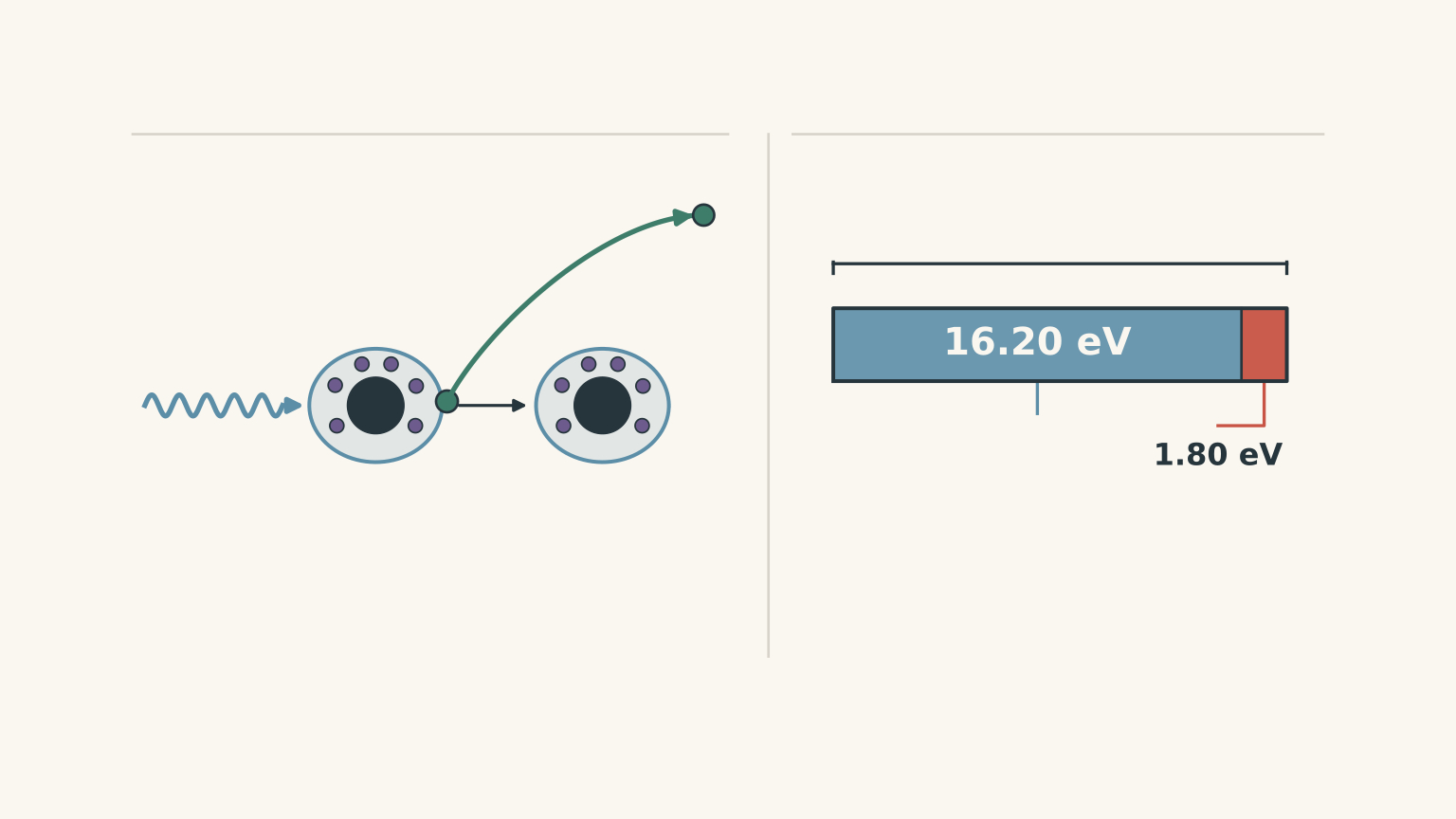
A beam of gaseous \(\mathrm{Fe}^{+}\) ions in their ground state is exposed to photons with energy \(18.0\ \mathrm{eV}\). The ionisation energy of \(\mathrm{Fe}^{+}\) is \(16.20\ \mathrm{eV}\).
Determine whether a photon can eject one electron and calculate the emitted electron’s kinetic energy if the resulting ion is in its ground state. Identify that ion’s electron configuration.
Step 1
The photon supplies \(18.0\ \mathrm{eV}\), which exceeds the required \(16.20\ \mathrm{eV}\).
Therefore, single-electron photoionisation is energetically possible.
Step 2
Using:
\[ K_e=E_\gamma-I \]
Substitute the values:
\[ \begin{aligned} K_e&=18.0-16.20\\ &=1.80\ \mathrm{eV} \end{aligned} \]
Both input energies are in eV, so the resulting kinetic energy is also in eV.
Step 3
The original ion has:
\[ \mathrm{Fe}^{+}:\ [\mathrm{Ar}]\,3d^6\,4s^1 \]
The remaining 4s electron is removed in the ground-state ionisation sequence:
\[ \ce{Fe+(g) -> Fe^2+(g) + e-} \]
The product ion has:
\[ \mathrm{Fe}^{2+}:\ [\mathrm{Ar}]\,3d^6 \]
Its electron count is:
\[ 26-2=24\text{ electrons} \]
Step 4
The result predicts an emitted electron with kinetic energy \(1.80\ \mathrm{eV}\), provided the ion is left in its ground state and the other stated assumptions hold.
If the product ion were excited, the electron would have less kinetic energy because some of the photon’s energy would remain inside the ion.
That distinction is why a photoelectron measurement tells us about transitions between electronic states rather than simply providing a photograph of an orbital.
Due to technical limitations, this figure may display incorrectly or contain inaccuracies. Please check key details against your course materials.
04A reference table for Period 4 atoms and ions
You now have enough information to apply the conventions across the first transition series.
The table includes potassium and calcium because they establish the 4s filling pattern. It then continues from scandium to zinc.
All configurations refer to ground-state electron arrangements. The ion column gives a selected ion for each element, not every oxidation state that the element can form.
| Element | Neutral atom | Selected positive ion |
|---|---|---|
| K | \([\mathrm{Ar}]\,4s^1\) | \(\mathrm{K}^{+}:\ [\mathrm{Ar}]\) |
| Ca | \([\mathrm{Ar}]\,4s^2\) | \(\mathrm{Ca}^{2+}:\ [\mathrm{Ar}]\) |
| Sc | \([\mathrm{Ar}]\,3d^1\,4s^2\) | \(\mathrm{Sc}^{3+}:\ [\mathrm{Ar}]\) |
| Ti | \([\mathrm{Ar}]\,3d^2\,4s^2\) | \(\mathrm{Ti}^{3+}:\ [\mathrm{Ar}]\,3d^1\) |
| V | \([\mathrm{Ar}]\,3d^3\,4s^2\) | \(\mathrm{V}^{3+}:\ [\mathrm{Ar}]\,3d^2\) |
| Cr | \([\mathrm{Ar}]\,3d^5\,4s^1\) | \(\mathrm{Cr}^{3+}:\ [\mathrm{Ar}]\,3d^3\) |
| Mn | \([\mathrm{Ar}]\,3d^5\,4s^2\) | \(\mathrm{Mn}^{2+}:\ [\mathrm{Ar}]\,3d^5\) |
| Fe | \([\mathrm{Ar}]\,3d^6\,4s^2\) | \(\mathrm{Fe}^{3+}:\ [\mathrm{Ar}]\,3d^5\) |
| Co | \([\mathrm{Ar}]\,3d^7\,4s^2\) | \(\mathrm{Co}^{2+}:\ [\mathrm{Ar}]\,3d^7\) |
| Ni | \([\mathrm{Ar}]\,3d^8\,4s^2\) | \(\mathrm{Ni}^{2+}:\ [\mathrm{Ar}]\,3d^8\) |
| Cu | \([\mathrm{Ar}]\,3d^{10}\,4s^1\) | \(\mathrm{Cu}^{2+}:\ [\mathrm{Ar}]\,3d^9\) |
| Zn | \([\mathrm{Ar}]\,3d^{10}\,4s^2\) | \(\mathrm{Zn}^{2+}:\ [\mathrm{Ar}]\,3d^{10}\) |
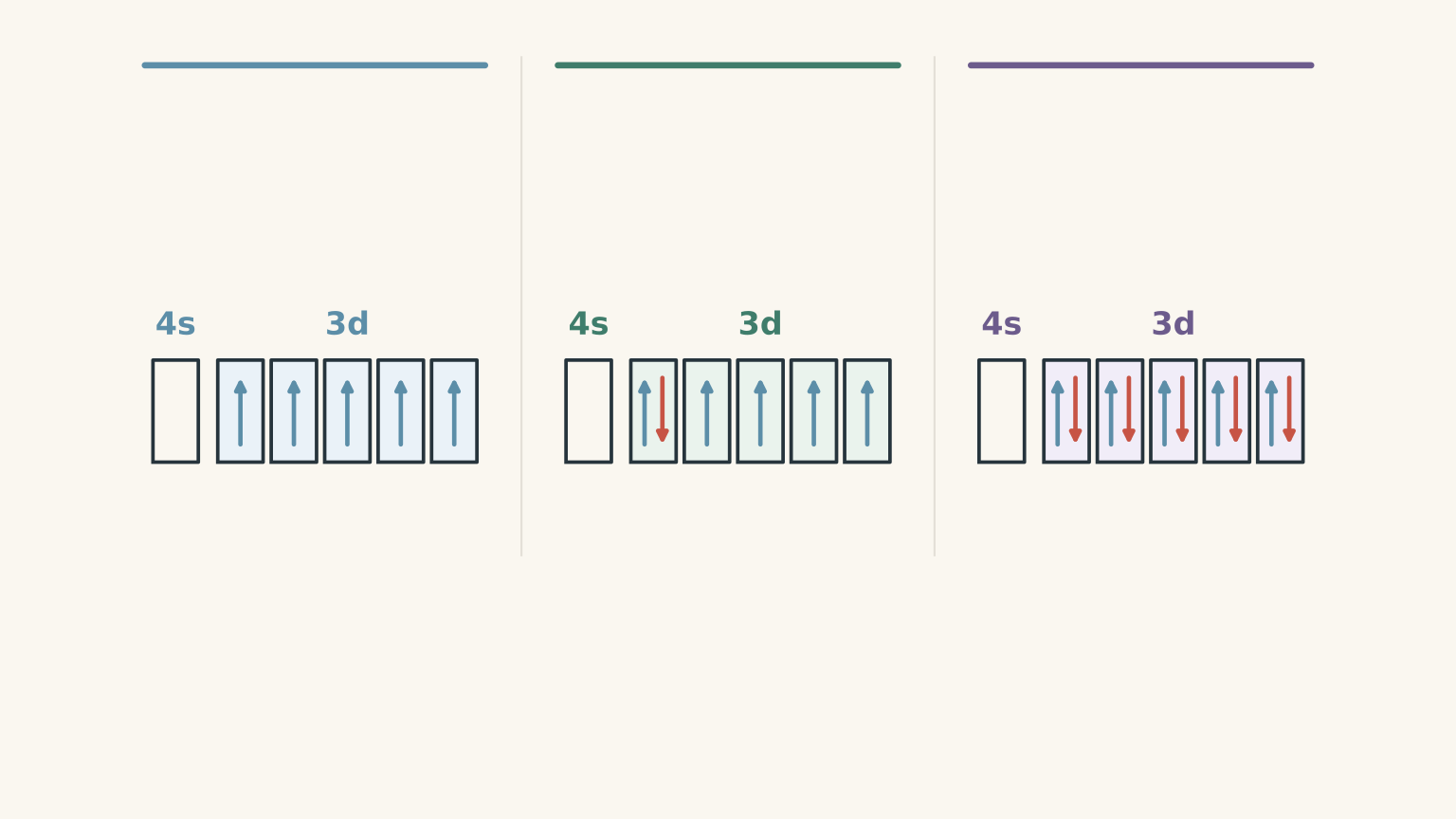
There are three useful patterns to notice.
First, most neutral atoms from scandium to zinc have two 4s electrons. Chromium and copper have one.
Second, the familiar \(2+\) ions generally have no occupied 4s subshell, even though their neutral atoms do.
Third, the 3d subshell can remain partly occupied after ionisation. A transition-metal ion does not have to achieve a noble-gas configuration.
For example:
\[ \mathrm{Mn}^{2+}:\ [\mathrm{Ar}]\,3d^5 \]
is a perfectly valid electron configuration. It has 23 electrons, not 18.
Due to technical limitations, this figure may display incorrectly or contain inaccuracies. Please check key details against your course materials.
Two checks that prevent most mistakes
When you’re unsure whether a configuration is reasonable, use these checks.
Electron count
For an ion with positive charge \(z+\), the number of electrons is:
\[ N_e=Z-z \]
Here, \(N_e\) is the number of electrons, \(Z\) is the atomic number, and \(z\) is the numerical value of the positive charge.
Electron counts are numbers of particles, not energies.
For \(\mathrm{Cr}^{3+}\):
\[ N_e=24-3=21 \]
The configuration \([\mathrm{Ar}]\,3d^3\) contains:
\[ 18+3=21\text{ electrons} \]
Subshell occupancy
A 4s subshell can hold up to two electrons. A 3d subshell contains five orbitals and can hold up to ten electrons.
If your proposed configuration has \(4s^3\) or \(3d^{11}\), it cannot be correct.
If your proposed \(\mathrm{Fe}^{2+}\) configuration still has \(4s^2\), reconsider the ionisation convention.
For help with the difference between subshells and individual orbitals, see How to Distinguish Shells, Subshells and Orbitals in Chemistry.
05Where the simple rule stops being exact
There’s one final complication worth understanding before the practice questions.
Removing an electron changes the atom’s total charge. That changes the attraction experienced by the remaining electrons and the way they interact.
As a result, the remaining electrons can redistribute.
The familiar instruction to remove 4s before 3d is an excellent way to calculate many common transition-metal ion configurations. But it should not be interpreted as a claim that the remaining orbitals stay frozen while electrons are taken away.
For example, atomic reference data give these ground-state configurations for isolated nickel species:
\[ \begin{aligned} \mathrm{Ni}:&\ [\mathrm{Ar}]\,3d^8\,4s^2\\ \mathrm{Ni}^{+}:&\ [\mathrm{Ar}]\,3d^9\\ \mathrm{Ni}^{2+}:&\ [\mathrm{Ar}]\,3d^8 \end{aligned} \]
If you mechanically deleted one 4s electron from neutral nickel without allowing any redistribution, you would predict \([\mathrm{Ar}]\,3d^8\,4s^1\) for \(\mathrm{Ni}^{+}\).
That arrangement is not the free ion’s ground-state configuration.
The remaining electrons have reorganised into a lower-energy arrangement. When nickel forms \(\mathrm{Ni}^{2+}\), the resulting ground-state configuration is nevertheless the familiar \([\mathrm{Ar}]\,3d^8\).
This is the difference between an exam convention and a complete physical explanation.
The convention tells you how to obtain the usual configurations efficiently. The more accurate model recognises that each charge state has its own electronic structure and minimum-energy arrangement.
It also explains why photoelectron spectroscopy can produce electrons with different kinetic energies from atoms initially in the same ground state: different final ionic states can be formed.
The final practice question explores that idea.
06Questions and solutions
The questions progress from standard electron configurations to interpreting experimental evidence. The final question is an extension challenge involving energy conservation, excited ionic states, and electron redistribution.
Question 1
Titanium has atomic number 22 and the ground-state electron configuration:
\[ [\mathrm{Ar}]\,3d^2\,4s^2 \]
Determine:
a) The electron configuration of \(\mathrm{Ti}^{2+}\).
b) The electron configuration of \(\mathrm{Ti}^{3+}\).
c) Why removing electrons from 3d before 4s would give the wrong result.
Solution 1
The correct configurations are \(\mathrm{Ti}^{2+}:\ [\mathrm{Ar}]\,3d^2\) and \(\mathrm{Ti}^{3+}:\ [\mathrm{Ar}]\,3d^1\).
For part (a), titanium initially contains two 4s electrons. These are removed when forming the \(2+\) ion:
\[ \mathrm{Ti}^{2+}:\ [\mathrm{Ar}]\,3d^2 \]
Check the electron count:
\[ 22-2=20\text{ electrons} \]
And:
\[ 18+2=20\text{ electrons} \]
For part (b), the 4s subshell is already empty, so the next electron is removed from 3d:
\[ \mathrm{Ti}^{3+}:\ [\mathrm{Ar}]\,3d^1 \]
Check:
\[ 22-3=19\text{ electrons} \]
And:
\[ 18+1=19\text{ electrons} \]
For part (c), removing 3d electrons first would produce \([\mathrm{Ar}]\,4s^2\) for \(\mathrm{Ti}^{2+}\).
Although that arrangement has the correct total electron count, it does not represent the ion’s ground state.
The mistake is treating the neutral-atom filling sequence as a fixed reverse-order removal sequence. For the familiar titanium ions, 4s electrons are removed first.
Question 2
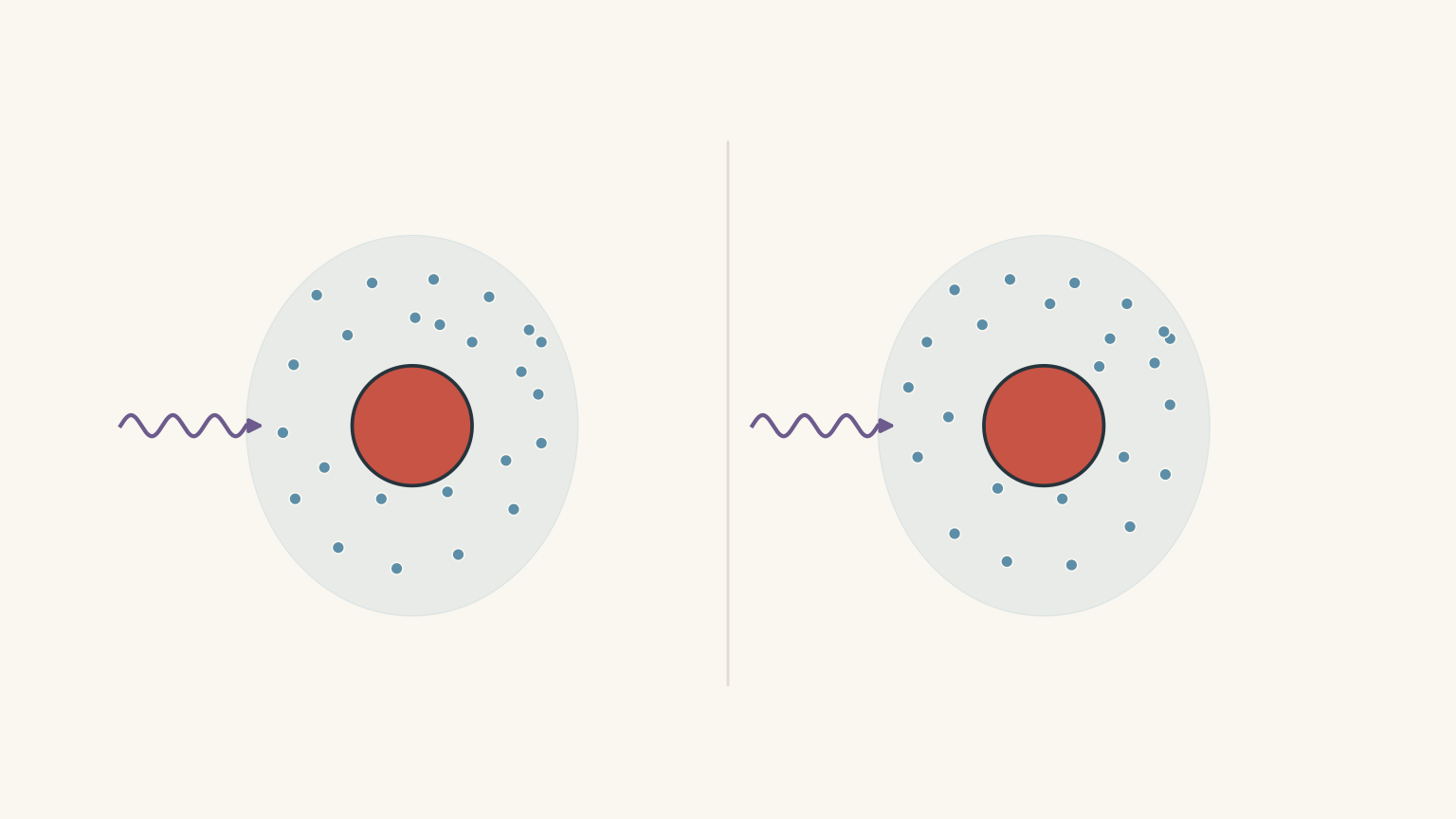
A neutral chromium atom and an \(\mathrm{Fe}^{2+}\) ion both contain 24 electrons.
A student makes two predictions:
- Because the species have the same number of electrons, they must have identical electron configurations.
- If each loses one electron, their resulting 23-electron species must have the same ionisation energy.
Evaluate both predictions using the ground-state configurations of chromium and iron ions.
Determine the configurations before and after each species loses one electron, and explain whether matching electron configurations imply matching ionisation energies.
Due to technical limitations, this figure may display incorrectly or contain inaccuracies. Please check key details against your course materials.
Solution 2
Both predictions are incorrect. Chromium and \(\mathrm{Fe}^{2+}\) initially have different ground-state electron configurations, even though each contains 24 electrons. After losing one electron, their resulting species do have the same written subshell configuration, but that does not make their ionisation energies equal.
First, compare the electron counts.
For neutral chromium:
\[ N_e=24\text{ electrons} \]
For \(\mathrm{Fe}^{2+}\):
\[ N_e=26-2=24\text{ electrons} \]
But their ground-state configurations are different:
\[ \mathrm{Cr}:\ [\mathrm{Ar}]\,3d^5\,4s^1 \]
\[ \mathrm{Fe}^{2+}:\ [\mathrm{Ar}]\,3d^6 \]
Chromium contains an occupied 4s subshell, while \(\mathrm{Fe}^{2+}\) does not.
The nuclei also contain different numbers of protons, so their electrons experience different nuclear attractions.
Now remove one electron from each.
For chromium, the 4s electron is removed:
\[ \mathrm{Cr}^{+}:\ [\mathrm{Ar}]\,3d^5 \]
For iron(II), the next electron must be removed from 3d:
\[ \mathrm{Fe}^{3+}:\ [\mathrm{Ar}]\,3d^5 \]
Both resulting species have:
\[ 18+5=23\text{ electrons} \]
They also have the same written electron configuration.
But \(\mathrm{Cr}^{+}\) has 24 protons, while \(\mathrm{Fe}^{3+}\) has 26.
Their nuclear charges, electron attractions, and total electronic energies differ.
Therefore, removing an electron from \(\mathrm{Cr}^{+}\) would not generally require the same energy as removing one from \(\mathrm{Fe}^{3+}\).
The tempting assumption was that electron count alone determines electron arrangement and binding energy.
It does not. Nuclear charge and electron interactions matter as well.
Question 3
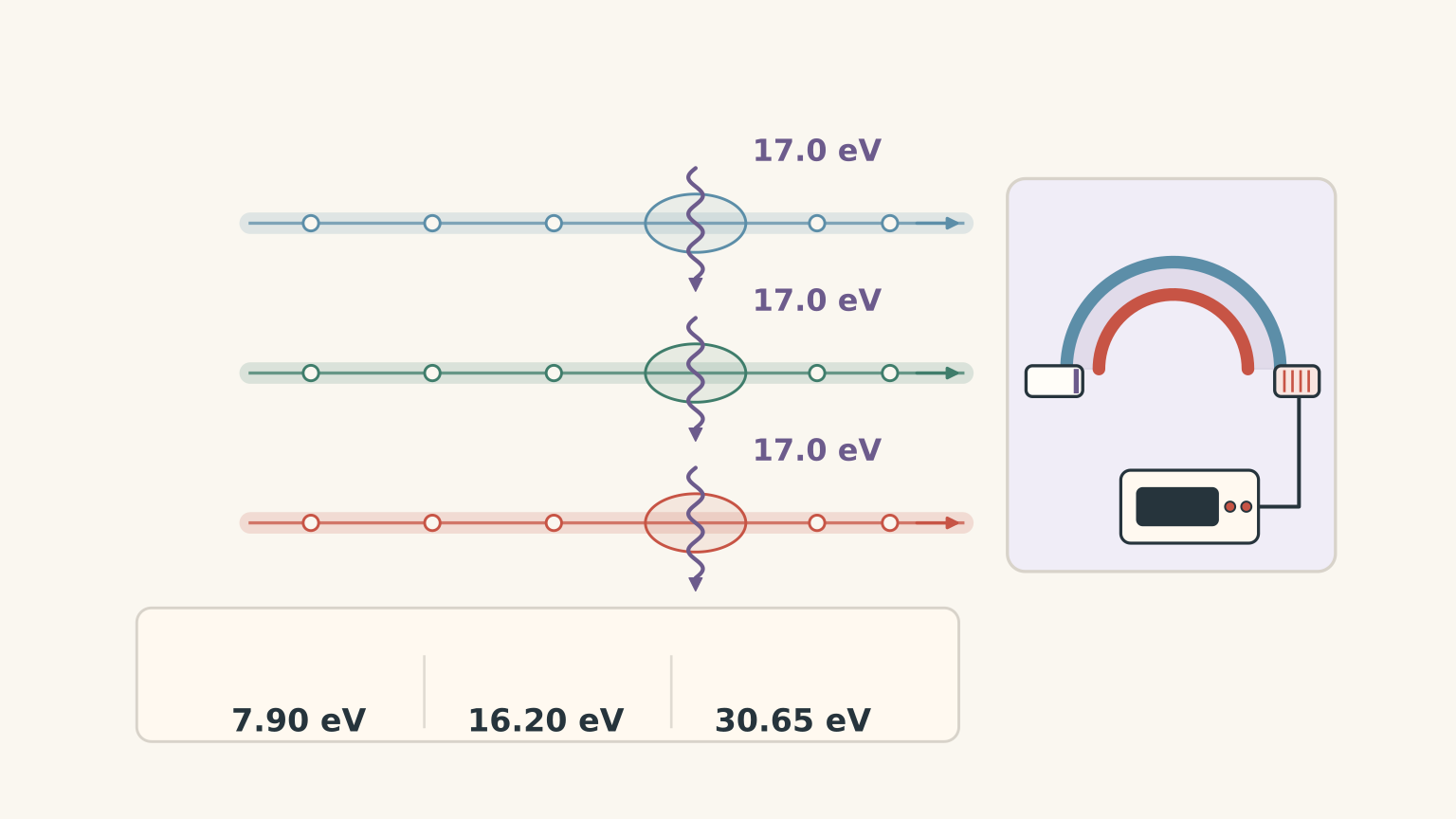
A researcher prepares three separate low-density beams containing ground-state gaseous \(\mathrm{Fe}\), \(\mathrm{Fe}^{+}\), and \(\mathrm{Fe}^{2+}\).
Each beam is exposed to photons with energy \(17.0\ \mathrm{eV}\).
The following ionisation energies are supplied:
| Initial species | Ionisation energy |
|---|---|
| \(\mathrm{Fe}\) | \(7.90\ \mathrm{eV}\) |
| \(\mathrm{Fe}^{+}\) | \(16.20\ \mathrm{eV}\) |
| \(\mathrm{Fe}^{2+}\) | \(30.65\ \mathrm{eV}\) |
Assume each interaction involves one photon and at most one emitted electron. Neglect recoil, and consider only transitions that leave the resulting ion in its ground state.
a) Identify which beams can undergo photoionisation.
b) Calculate the kinetic energy of an emitted electron from each beam that can be ionised.
c) Identify the resulting ions and their electron configurations.
d) Explain why the experimental results cannot be interpreted using a single permanent energy ordering for 4s and 3d.
Due to technical limitations, this figure may display incorrectly or contain inaccuracies. Please check key details against your course materials.
Solution 3
The \(\mathrm{Fe}\) and \(\mathrm{Fe}^{+}\) beams can be photoionised by \(17.0\ \mathrm{eV}\) photons, producing ground-state \(\mathrm{Fe}^{+}\) and \(\mathrm{Fe}^{2+}\), respectively. The \(\mathrm{Fe}^{2+}\) beam cannot undergo the specified single-photon ionisation.
For part (a), compare each threshold with the photon energy.
- \(\mathrm{Fe}\) requires \(7.90\ \mathrm{eV}\): sufficient energy is available.
- \(\mathrm{Fe}^{+}\) requires \(16.20\ \mathrm{eV}\): sufficient energy is available.
- \(\mathrm{Fe}^{2+}\) requires \(30.65\ \mathrm{eV}\): insufficient energy is available.
For part (b), use:
\[ K_e=E_\gamma-I \]
For neutral iron, both input energies are in eV:
\[ \begin{aligned} K_e&=17.0-7.90\\ &=9.10\ \mathrm{eV} \end{aligned} \]
For \(\mathrm{Fe}^{+}\):
\[ \begin{aligned} K_e&=17.0-16.20\\ &=0.80\ \mathrm{eV} \end{aligned} \]
These are the expected electron kinetic energies for the specified ground-state ionisation channels.
For part (c), the transitions are:
\[ \ce{Fe(g) -> Fe+(g) + e-} \]
and:
\[ \ce{Fe+(g) -> Fe^2+(g) + e-} \]
The resulting configurations are:
\[ \mathrm{Fe}^{+}:\ [\mathrm{Ar}]\,3d^6\,4s^1 \]
\[ \mathrm{Fe}^{2+}:\ [\mathrm{Ar}]\,3d^6 \]
For part (d), the first and second ionisations involve different starting species.
The first removes an electron from neutral iron. The second removes an electron from an already positive ion.
Both the nuclear attraction experienced by the remaining electrons and their interactions change between those states.
A fixed energy-order diagram cannot accurately represent all these electronic states.
The key trap is thinking that the second photoionisation requires the sum of the first and second ionisation energies.
That would only be relevant if we were starting with a neutral iron atom and wanted to remove two electrons. The second beam already contains \(\mathrm{Fe}^{+}\), so the relevant threshold is \(16.20\ \mathrm{eV}\), not the sum of two thresholds.
Question 4
Consider the formation of \(\mathrm{Fe}^{3+}\) from \(\mathrm{Fe}^{2+}\) in the gas phase:
\[ \ce{Fe^2+(g) -> Fe^3+(g) + e-} \]
A student argues:
“Because \(\mathrm{Fe}^{3+}\) has fewer electrons, it must have fewer unpaired electrons than \(\mathrm{Fe}^{2+}\), so it must also be less paramagnetic.”
Using the ground-state configurations and Hund’s rule:
a) Determine the number of unpaired electrons in each free ion.
b) Evaluate the student’s claim using the spin-only model of paramagnetism.
c) Explain why your comparison cannot automatically be extended to all compounds containing these ions.
Due to technical limitations, this figure may display incorrectly or contain inaccuracies. Please check key details against your course materials.
Solution 4
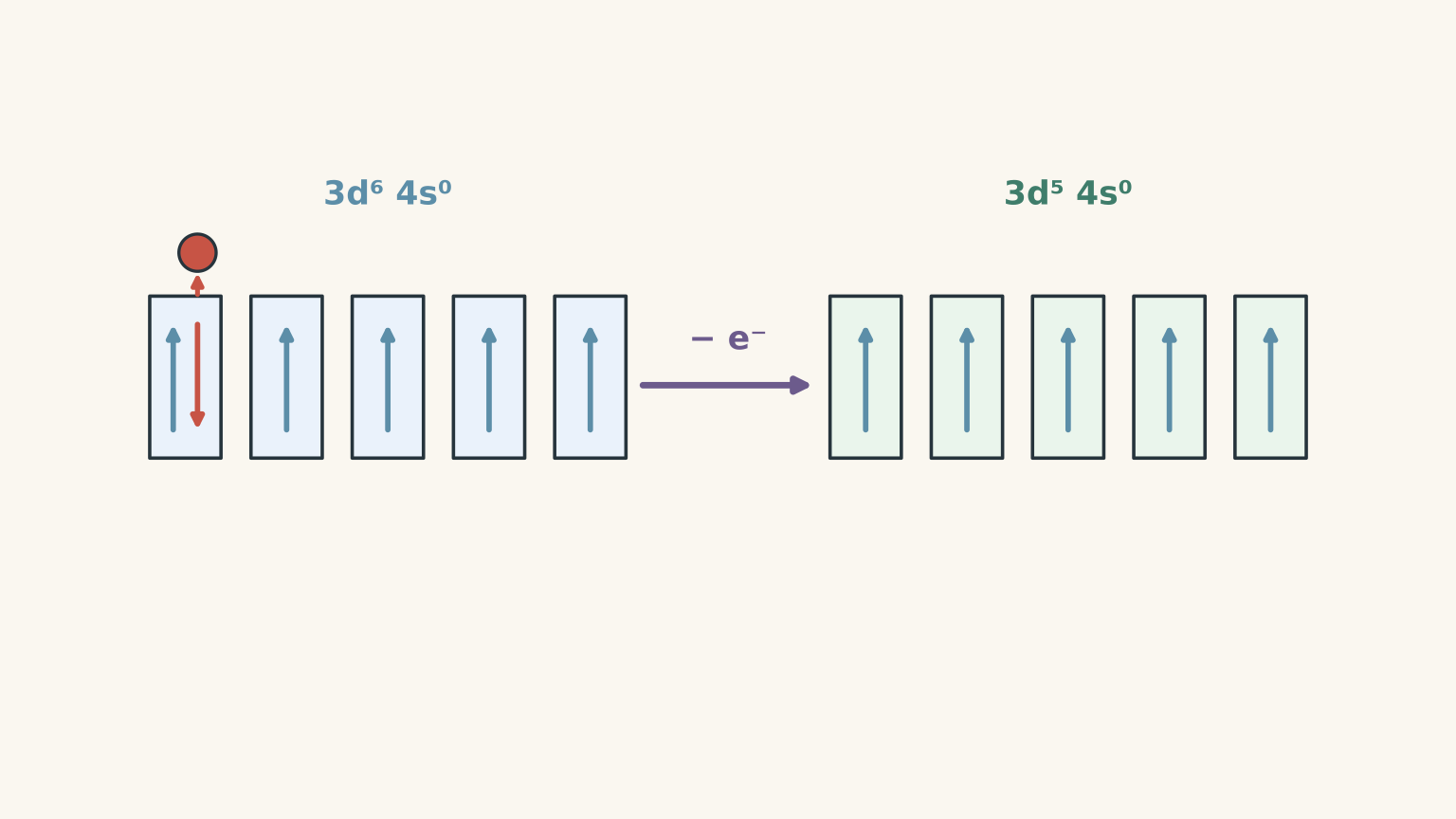
The student is incorrect. In their isolated ground states, \(\mathrm{Fe}^{3+}\) has five unpaired 3d electrons, while \(\mathrm{Fe}^{2+}\) has four. Under the spin-only model, \(\mathrm{Fe}^{3+}\) therefore has the larger unpaired-electron contribution to its magnetic moment.
For part (a), start with the configurations:
\[ \mathrm{Fe}^{2+}:\ [\mathrm{Ar}]\,3d^6 \]
\[ \mathrm{Fe}^{3+}:\ [\mathrm{Ar}]\,3d^5 \]
A 3d subshell contains five orbitals.
Hund’s rule tells us that electrons occupy separate equal-energy orbitals with parallel spins before pairing.
For \(\mathrm{Fe}^{2+}\), the six 3d electrons are arranged as:
3d: [↑↓] [↑] [↑] [↑] [↑]
There are four unpaired electrons.
For \(\mathrm{Fe}^{3+}\), the five 3d electrons are arranged as:
3d: [↑] [↑] [↑] [↑] [↑]
There are five unpaired electrons.
For part (b), the electron removed from \(\mathrm{Fe}^{2+}\) was one of the paired 3d electrons.
Removing it leaves the previously paired orbital singly occupied. The total number of unpaired electrons increases from four to five.
The spin-only magnetic moment is related to the number of unpaired electrons, so this model predicts a larger spin contribution for \(\mathrm{Fe}^{3+}\).
For part (c), the situation is more complicated in coordination compounds.
Ligands surrounding a transition-metal ion can split its d orbitals into groups with different energies. Depending on the ligand environment, electrons may pair differently.
The simple free-ion arrangement therefore cannot be applied automatically to every iron complex.
The misconception comes from assuming that fewer total electrons must mean fewer unpaired electrons. Pairing, not just electron count, determines the answer.
Due to technical limitations, this figure may display incorrectly or contain inaccuracies. Please check key details against your course materials.
Question 5
Extension challenge: Can two different photoelectron energies produce the same final ion?
A hypothetical nickel photoelectron experiment begins with a beam containing only ground-state neutral nickel atoms.
Each nickel atom has the configuration:
\[ \mathrm{Ni}:\ [\mathrm{Ar}]\,3d^8\,4s^2 \]
The atoms are exposed to photons of energy \(12.0\ \mathrm{eV}\).
For this question, use the following illustrative data. They are chosen to test the reasoning and are not measured nickel ionisation energies.
- The minimum energy needed to produce ground-state \(\mathrm{Ni}^{+}\) is \(7.60\ \mathrm{eV}\).
- Ground-state \(\mathrm{Ni}^{+}\) has the configuration \([\mathrm{Ar}]\,3d^9\).
- An accessible excited state of \(\mathrm{Ni}^{+}\) has the configuration \([\mathrm{Ar}]\,3d^8\,4s^1\).
- That excited state is \(1.40\ \mathrm{eV}\) above the ground state.
Assume these are the only two accessible ionic states in the model, one photon ejects exactly one electron, recoil is negligible, and there are no collisions before the emitted electron is measured.
The residual ions then enter a collision chamber, where any excited ions transfer their excitation energy to the surrounding gas and relax to the ground state.
After the collision chamber, an ion detector identifies only ground-state \(\mathrm{Ni}^{+}\).
A student concludes:
“Since all detected ions finish in the same electronic state, the emitted electrons must all have the same kinetic energy. Any second photoelectron energy would prove that some nickel atoms were initially excited.”
a) Calculate the possible photoelectron kinetic energies.
b) Explain how the two channels can produce different electron kinetic energies even though the ions eventually have the same ground-state configuration.
c) Explain why \([\mathrm{Ar}]\,3d^9\) can be the ground-state configuration of \(\mathrm{Ni}^{+}\), even though directly deleting one 4s electron from neutral nickel would produce \([\mathrm{Ar}]\,3d^8\,4s^1\).
d) Evaluate the student’s conclusion. Does detecting two electron energies prove that the original atoms occupied different initial states? Does electron kinetic energy alone uniquely identify the subshell from which an electron was removed?
Due to technical limitations, this figure may display incorrectly or contain inaccuracies. Please check key details against your course materials.
Solution 5
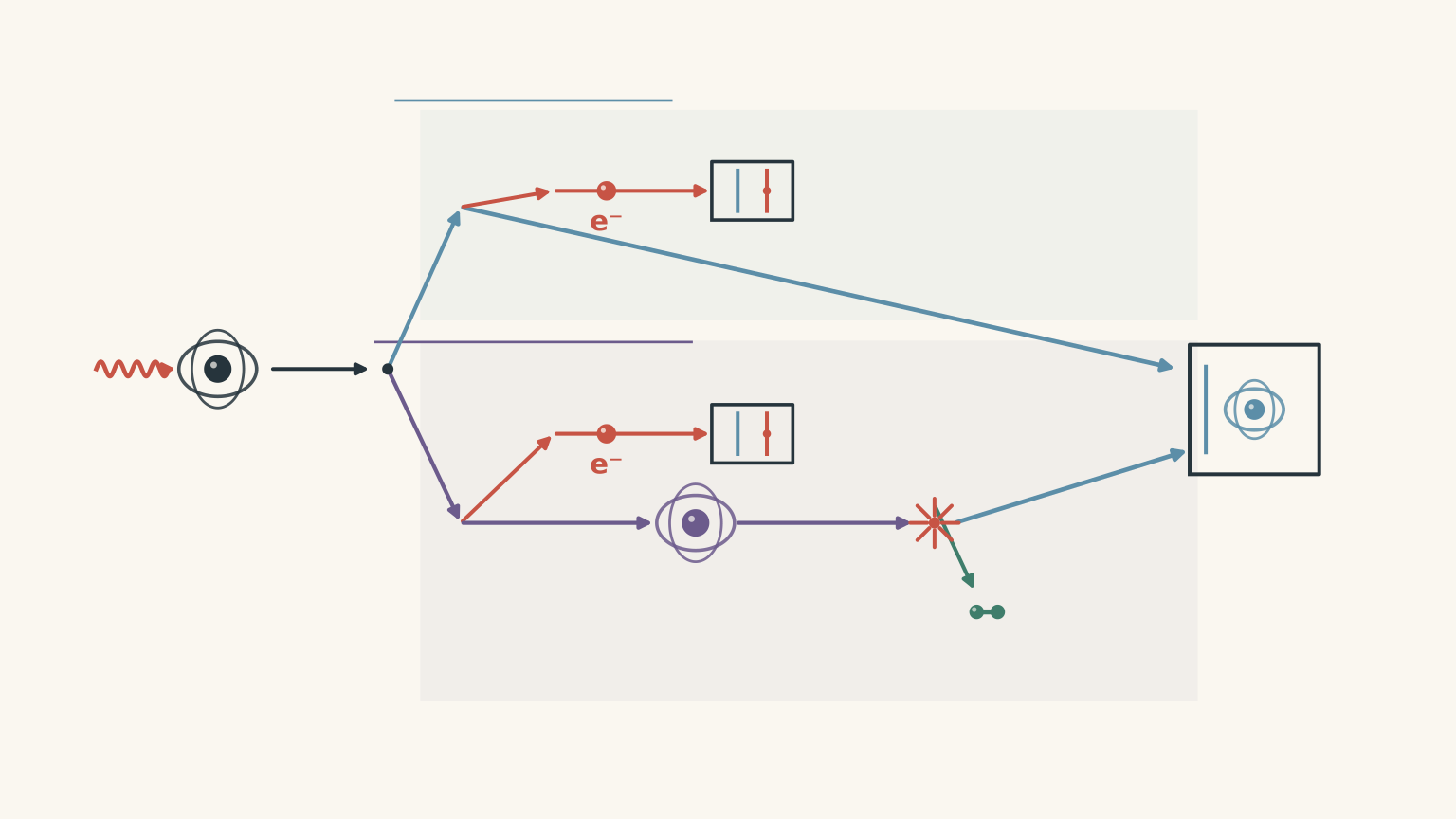
The experiment can produce photoelectrons with kinetic energies of \(4.40\ \mathrm{eV}\) and \(3.00\ \mathrm{eV}\), even though all residual ions eventually become ground-state \(\mathrm{Ni}^{+}\). The student’s conclusion is incorrect because it ignores energy temporarily stored in excited ions and the redistribution of electrons after ionisation.
For part (a), first consider the channel that directly produces ground-state \(\mathrm{Ni}^{+}\).
Energy conservation gives:
\[ E_\gamma=I+K_e \]
Therefore:
\[ \begin{aligned} K_e&=12.0-7.60\\ &=4.40\ \mathrm{eV} \end{aligned} \]
Now consider the channel that leaves the ion in the excited state.
The excitation energy is an additional \(1.40\ \mathrm{eV}\).
The total energy required to form that excited ion is:
\[ \begin{aligned} I_{\mathrm{exc}}&=7.60+1.40\\ &=9.00\ \mathrm{eV} \end{aligned} \]
The emitted electron therefore has:
\[ \begin{aligned} K_e&=12.0-9.00\\ &=3.00\ \mathrm{eV} \end{aligned} \]
Both values are positive, so both channels are energetically possible under the supplied assumptions.
For part (b), the two photoelectrons have different energies because the residual ions initially occupy different electronic states.
In the ground-state channel, the photon energy is distributed as:
\[ 12.0=7.60+4.40 \]
All values are in eV.
In the excited-state channel:
\[ 12.0=7.60+1.40+3.00 \]
Again, all values are in eV.
The excited ion retains \(1.40\ \mathrm{eV}\) of electronic energy when the photoelectron leaves.
Later, in the collision chamber, that energy is transferred to the surrounding gas as the ion relaxes.
The detected ion is then in the same ground state as the ion produced by the first channel.
But the emitted photoelectron has already travelled away.
Its kinetic energy does not increase merely because its former parent ion subsequently relaxes.
The final ions match, but the photoelectrons still carry different energies because the energy was distributed differently before the collision.
For part (c), the key is that electron arrangements can change after ionisation.
Neutral nickel begins with:
\[ [\mathrm{Ar}]\,3d^8\,4s^2 \]
If one 4s electron were removed while every other electron remained in its original subshell, the immediate configuration would be:
\[ [\mathrm{Ar}]\,3d^8\,4s^1 \]
But this is not the lowest-energy arrangement of the isolated \(\mathrm{Ni}^{+}\) ion.
The ground-state configuration is:
\[ [\mathrm{Ar}]\,3d^9 \]
The ion’s electronic structure can reorganise because its charge and electron interactions have changed.
Both configurations contain 27 electrons:
\[ 18+8+1=27 \]
and:
\[ 18+9=27 \]
Electron count alone therefore cannot tell us which arrangement has the lower total energy.
For part (d), the student’s conclusion is incorrect on both counts.
First, the neutral nickel atoms were all initially in the same ground state, as specified.
Two photoelectron energies can still arise because photoionisation can leave the residual ion in different electronic states.
Second, the kinetic energy of an emitted electron determines how much energy remains in the ionisation products, but it does not uniquely trace an individual electron’s history.
In a multi-electron atom, electrons are indistinguishable, and their states can reorganise. Without additional spectroscopic evidence and a suitable model, two photoelectron energies cannot simply be labelled “one from 4s” and “one from 3d”.
The decisive constraint is conservation of energy for the complete process, including any excitation energy stored temporarily in the ion.
The student considered only the initial neutral atom and the final relaxed ion. That omitted an intermediate state capable of storing energy.
This is why two experiments that appear to have identical starting and ending configurations can produce different photoelectron measurements.
Due to technical limitations, this figure may display incorrectly or contain inaccuracies. Please check key details against your course materials.
07What to remember when you encounter 4s and 3d again
For a typical HSC electron-configuration question, use the neutral filling pattern to establish the starting configuration, remember the chromium and copper exceptions, and remove 4s electrons before 3d when forming the familiar transition-metal ions.
Then verify the result by counting electrons.
For the physical explanation, remember that filling order and ionisation order describe different energy problems. Nuclear charge, shielding, electron repulsion, and electronic rearrangement all influence the most favourable configuration.
The deeper lesson from spectroscopy is that an electron configuration is a description of a state, not a permanent set of orbital energies or a complete history of how the electrons moved.
This leads directly into ionisation-energy trends. Once you understand why the electronic structure changes during ionisation, you can make more reliable predictions about the energy required to remove successive electrons.
For that next step, see First Ionisation Energy Trends for HSC Chemistry, where nuclear charge, shielding, and electron distance are used to explain the wider periodic patterns.