
What to Know Before Your First Year 11 Physics Lesson
Starting Year 11 Physics? Find out which skills and concepts are worth understanding before your first lesson, from measurements and units to vectors, equations, graphs, and experimental reasoning.
Your stopwatch says a trolley travels 2.0 m in 2.0 s, so you calculate its average speed as 1.0 m/s. Fair enough. But does that prove the trolley travelled at exactly 1.0 m/s throughout the journey?
Not necessarily. It could have taken 1.5 seconds to cover the first metre and just 0.5 seconds to cover the second. The average speed is still 1.0 m/s, but the trolley has clearly sped up.
This is the sort of distinction you’ll encounter in your first Year 11 Physics lessons. Physics isn’t simply about putting numbers into formulas. It’s about describing what happens, building a model to explain it, and checking whether the evidence actually supports your explanation.
So, what should you know before your first lesson? You should be comfortable with basic measurements, units, simple algebra, graphs, and explaining patterns in experimental results. You don’t need to memorise a collection of advanced physics formulas or teach yourself the entire Year 11 course beforehand.
Let’s look at the foundations that will make your first few lessons much easier.
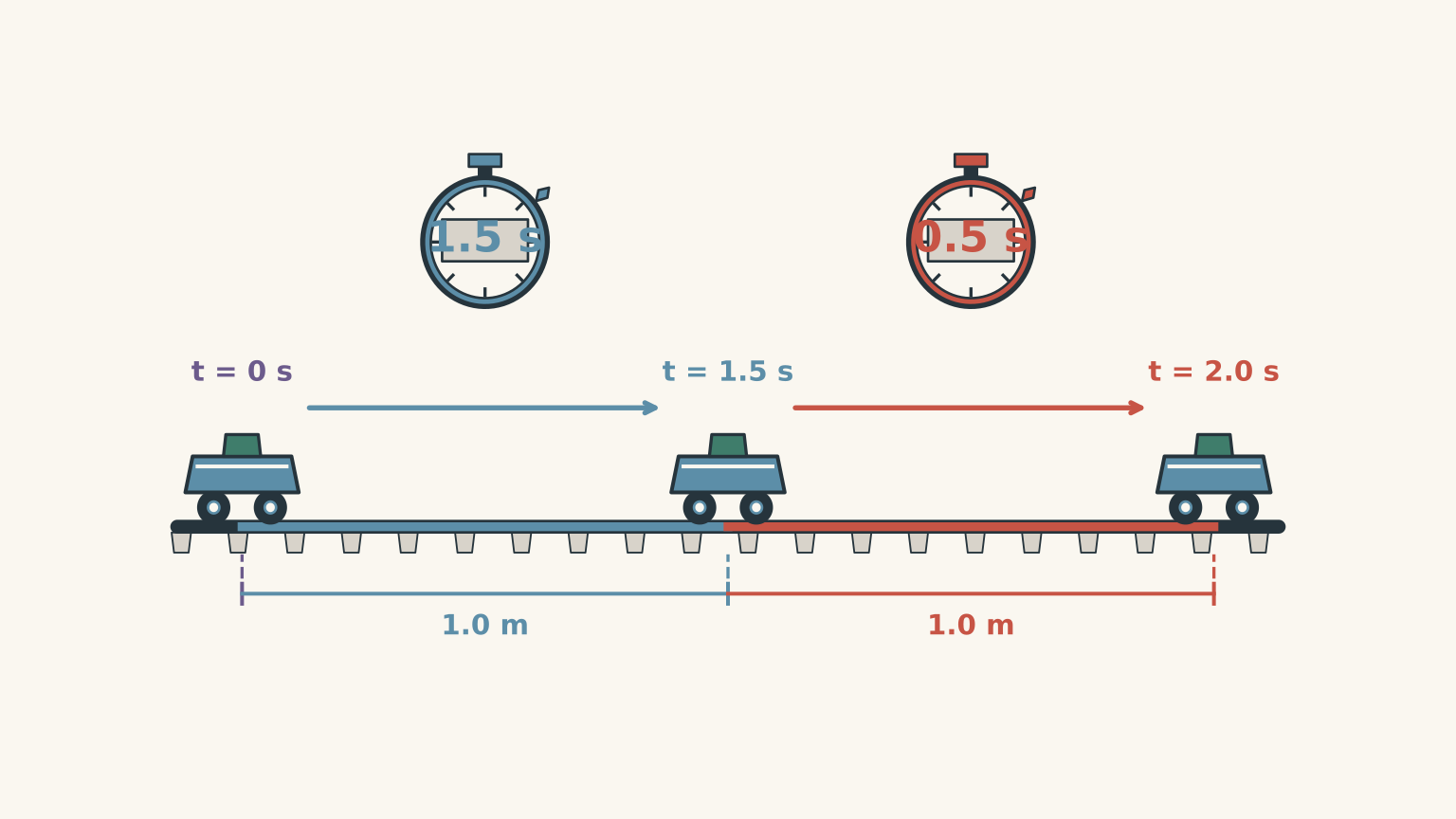
Due to technical limitations, this figure may display incorrectly or contain inaccuracies. Please check key details against your course materials.
01Understand what you’re measuring
Physics describes the physical world using measurable quantities.
Some familiar examples include:
- Distance: how far an object travels.
- Time: how long an event takes.
- Mass: how much matter an object contains.
- Speed: how quickly an object moves.
- Temperature: how hot or cold something is.
A physical quantity needs two things: a numerical value and a unit.
For example, writing 5 tells us very little. Five metres, five seconds, and five kilograms describe completely different things.
Get comfortable with units
The International System of Units (SI) provides a standard set of measurement units used in physics.
The most useful ones to recognise before starting are:
| Quantity | SI unit | Symbol |
|---|---|---|
| Distance | metre | m |
| Time | second | s |
| Mass | kilogram | kg |
| Temperature | kelvin | K |
| Electric current | ampere | A |
You’ll also encounter derived units. These are formed by combining other units.
For example:
- Speed: metres per second (m/s).
- Acceleration: metres per second squared (m/s²).
- Force: newtons (N).
Unit conversions are particularly important. You should be able to move between common units without getting stuck.
For example:
\[ 1\text{ km}=1000\text{ m} \]
\[ 1\text{ hour}=3600\text{ s} \]
This means:
\[ 1\text{ m/s}=3.6\text{ km/h} \]
So a car travelling at 72 km/h is travelling at:
\[ v=\frac{72}{3.6}=20\text{ m/s} \]
You don’t need to memorise dozens of conversion factors. Understand how the units relate, and practise converting them.
Know the difference between scalars and vectors
This distinction becomes important very early in physics.
A scalar is a quantity described by magnitude alone. A vector has both magnitude and direction.
Consider someone walking around a running track.
They walk 100 metres east, then 40 metres west.
Their total distance is:
\[ d=100+40=140\text{ m} \]
However, their final position is only 60 metres east of where they started.
Their displacement is therefore 60 m east.
| Quantity | What it describes | Type |
|---|---|---|
| Distance | Total path travelled | Scalar |
| Displacement | Change in position | Vector |
| Speed | Rate of covering distance | Scalar |
| Velocity | Rate of change of displacement | Vector |
A common mistake is treating speed and velocity as interchangeable. They aren’t.
An object travelling at 5 m/s east and another travelling at 5 m/s west have the same speed but different velocities.
You don’t need to master every vector calculation before your first lesson. Start by recognising when direction matters.
02Be comfortable with basic mathematics
You don’t need to be a mathematics genius to begin Year 11 Physics. However, you do need to be comfortable manipulating numbers and equations.
Physics uses mathematics to describe relationships between physical quantities.
For example, average speed is calculated using:
\[ \text{Average speed} = \frac{\text{Total distance}}{\text{Total time}} \]
Suppose a cyclist travels 200 metres in 25 seconds.
Substituting the values:
\[ v=\frac{200}{25} \]
\[ v=8\text{ m/s} \]
The cyclist’s average speed is 8 metres per second.
Notice that the answer includes a unit. Writing just 8 would leave your result incomplete.
Which mathematical skills should you revise?
These are the most useful foundations to practise:
| Mathematical skill | Where you’ll use it |
|---|---|
| Rearranging equations | Finding an unknown quantity |
| Fractions and ratios | Comparing physical quantities |
| Scientific notation | Working with very large and small numbers |
| Substitution | Using equations to calculate physical quantities |
| Graph gradients | Finding rates of change |
| Basic trigonometry | Resolving vectors and analysing angles |
You should also be comfortable using a scientific calculator.
One particularly useful habit is checking whether your answer has sensible units. If you’re calculating a speed and your final unit is metres per second squared, something has probably gone wrong.
You don’t need to study calculus before your first Year 11 lesson. Focus on algebra, ratios, unit conversions, and straight-line graphs first.
For a more detailed refresher, read What Maths Should You Revise Before Year 11 Physics?.
03Learn to read graphs
Graphs are one of the most useful tools in physics.
They allow you to see how one physical quantity changes in response to another.
Imagine measuring the position of a trolley every second as it moves along a straight track. Instead of writing down every measurement in a paragraph, you can plot position against time.
The horizontal axis usually represents the independent variable, while the vertical axis represents the dependent variable.
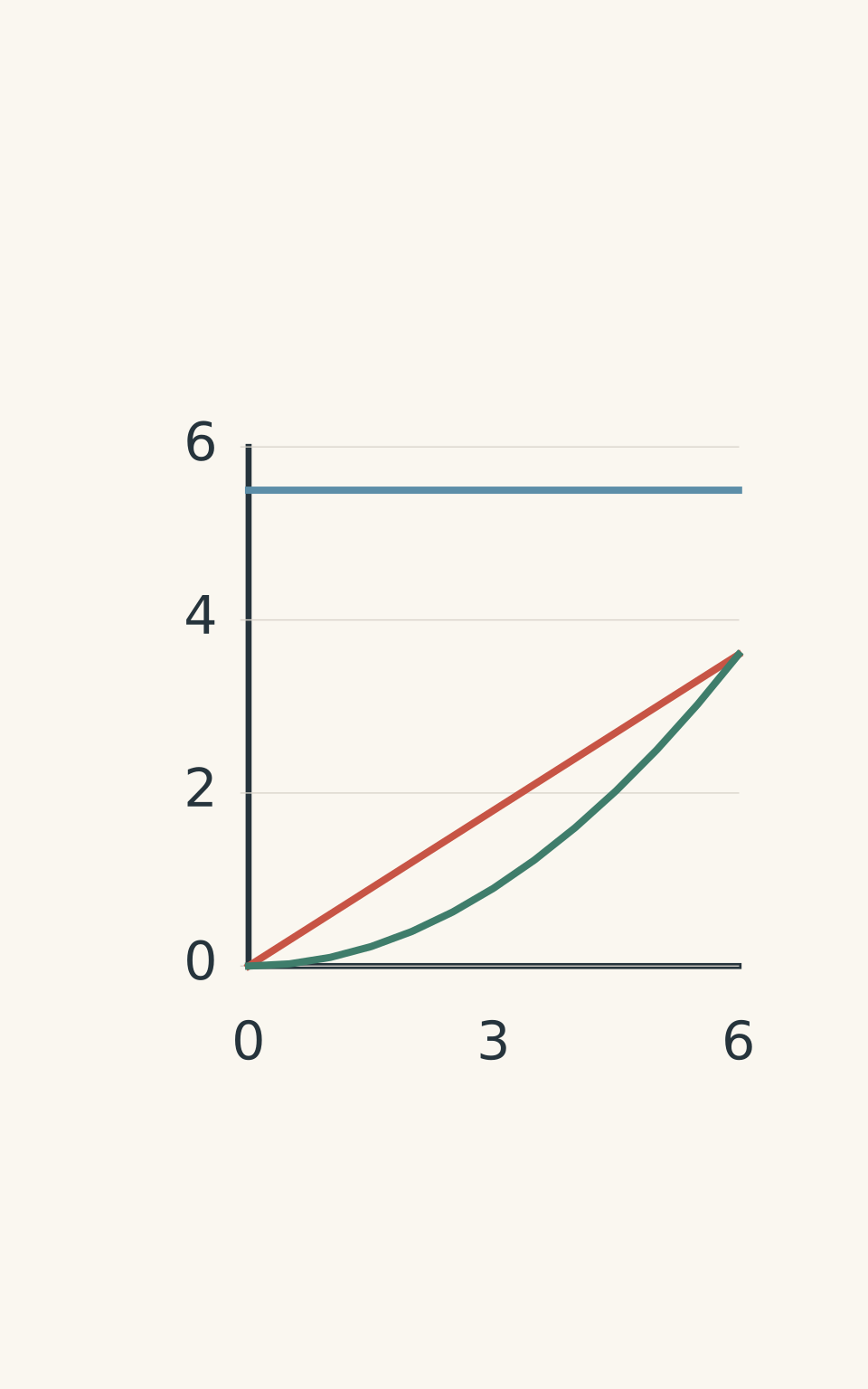
- At rest
- Constant positive velocity
- Increasing positive velocity
Due to technical limitations, this figure may display incorrectly or contain inaccuracies. Please check key details against your course materials.
There are three important ideas to understand.
1. The gradient tells you how quickly something changes.
Gradient is calculated using:
\[ \text{Gradient}= \frac{\text{Change in vertical value}} {\text{Change in horizontal value}} \]
On a position-time graph, the gradient represents velocity.
A steeper straight line means a greater velocity. A horizontal line means the object’s position isn’t changing.
2. A changing gradient tells you something is happening.
If the gradient of a position-time graph becomes steeper, the object’s velocity is increasing in the positive direction.
If the gradient becomes less steep, its velocity is decreasing in the positive direction.
3. Always check the starting value.
Suppose a trolley starts at position 2 metres rather than position zero.
You cannot simply divide its final position by the elapsed time to calculate its average velocity.
You must calculate the change in position:
\[ \text{Average velocity} = \frac{\text{Final position}-\text{Initial position}} {\text{Elapsed time}} \]
This is an important distinction. The gradient measures change, not simply the height of a graph.
04Understand how experiments produce evidence
Physics involves more than solving equations. You’ll regularly investigate physical phenomena and use experimental results to test explanations.
Imagine investigating whether the angle of a ramp affects how quickly a trolley travels down it.
You change the ramp angle, release the trolley, and measure how long it takes to reach the bottom.
There are three