
How to Find HSC Topic Questions Without Missing Mixed Ones
Learn how to find HSC practice questions using NESA papers, syllabus terms, and a simple question index. Discover how to identify mixed-topic questions that keyword searches often miss and build a more complete practice collection.
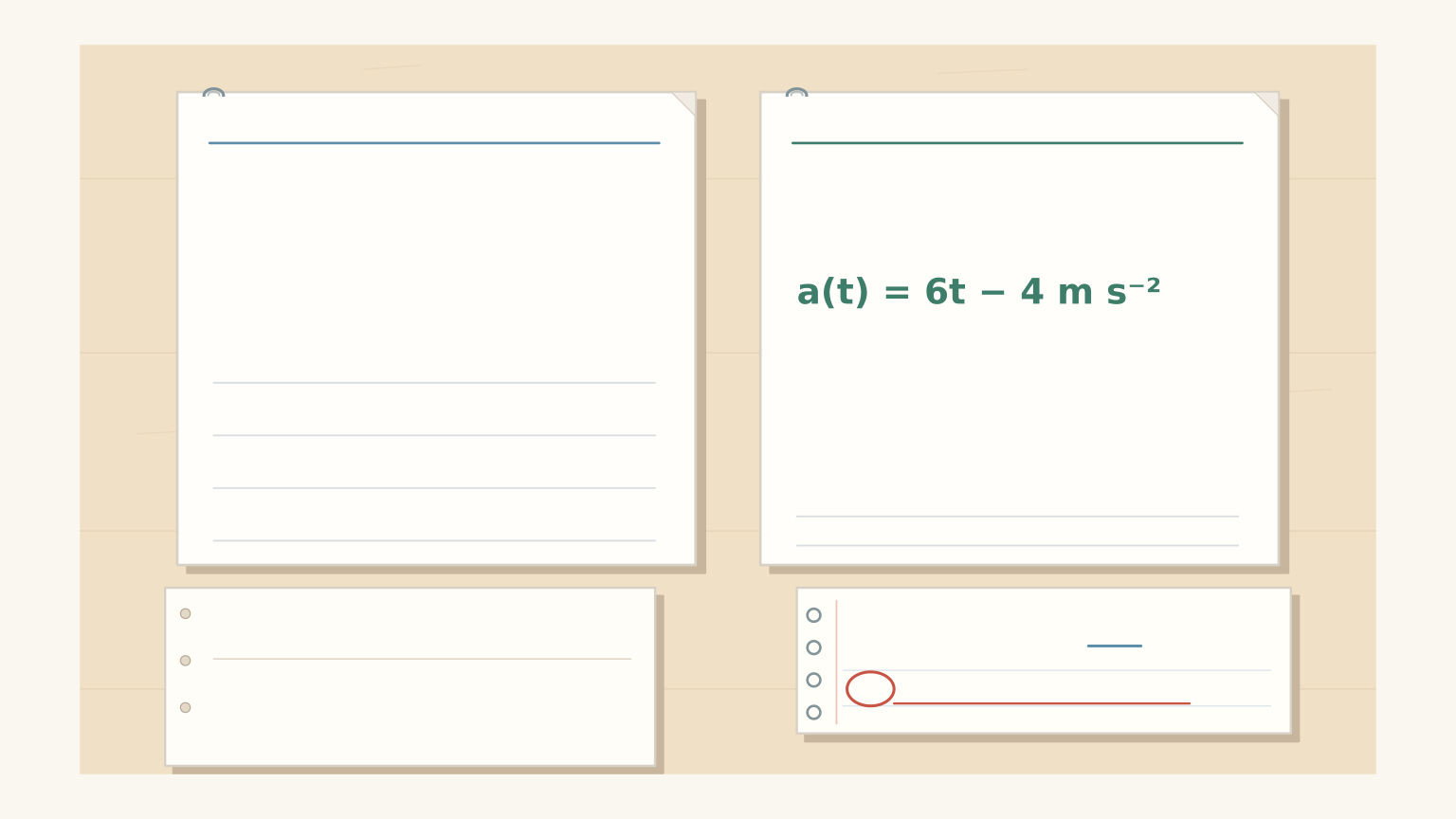
You search for integration questions in past HSC Mathematics Extension 2 papers, find every question containing the word integrate, and build a decent practice set. Then you attempt a mechanics question that asks you to find displacement from an acceleration model. It requires integration, but never mentions the word.
Your search has found the obvious questions and missed a mixed one.
This is a common problem with topic-based revision. Searching by topic is useful, but it isn’t enough. You need a way to find questions that test a topic directly, questions that combine it with other syllabus content, and questions where the relevant technique is hidden in the wording.
The most reliable approach is a two-pass system: search by syllabus content first, then scan complete exam papers for mixed questions. Here’s how to do it using NESA resources, your existing study materials, and a simple question index.
Due to technical limitations, this figure may display incorrectly or contain inaccuracies. Please check key details against your course materials.
01Check which syllabus your HSC questions belong to
Before collecting questions, establish which syllabus applies to your cohort.
This is particularly important in 2026 because NSW is introducing new Stage 6 syllabuses at different times across Mathematics, Physics, and Chemistry.
A question from an older examination might still be useful, but you need to know whether its content belongs to your course.
As at 15 November 2026, the HSC examination-year alignment is:
| HSC examination year | Physics | Chemistry | Mathematics Extension 1 and 2 |
|---|---|---|---|
| 2026 | 2017 syllabus | 2017 syllabus | 2017 syllabus |
| 2027 | 2017 syllabus | 2017 syllabus | 2024 syllabus |
| 2028 | 2025 syllabus | 2017 syllabus | 2024 syllabus |
| 2029 | 2025 syllabus | 2025 syllabus | 2024 syllabus |
These differences are worth understanding.
Physics: The new Physics 11-12 Syllabus (2025) begins teaching Year 11 in 2027. The first HSC examination under this syllabus is in 2028. The 2017 syllabus continues for Year 12 students in 2027.
Chemistry: The new Chemistry 11-12 Syllabus (2025) begins teaching Year 11 in 2028. Its first HSC examination is in 2029. The 2017 syllabus therefore remains relevant for the 2027 and 2028 HSC cohorts.
Mathematics Extension 1 and 2: The new Mathematics 11-12 syllabuses (2024) have their first HSC examinations in 2027. The 2026 HSC examinations use the previous syllabuses.
You can verify these dates using the official NESA resources:
- Physics 11-12 syllabus and implementation timeline
- Chemistry 11-12 syllabus and implementation timeline
- Mathematics Stage 6 syllabus implementation
- Mathematics Extension 2 syllabus (2024)
Why does this matter when finding questions?
Imagine you’re preparing for the 2027 Mathematics Extension 2 HSC.
You find a question from a 2019 examination that looks relevant. Before adding it to your practice set, check whether its underlying content and expected methods align with the 2024 syllabus.
Don’t automatically reject an older question, but don’t automatically assume it’s relevant either.
Your first filter should always be the syllabus, not the examination year.
02Build a search list from the syllabus, not just the topic name
Once you’ve identified your syllabus, choose the topic you want to practise.
The mistake is searching for only its official name.
HSC questions don’t always use the same terminology as your textbook or syllabus. Sometimes they describe a physical situation, a chemical process, or a mathematical relationship without naming the underlying concept.
Instead, build a small search vocabulary containing four things:
- The official topic name.
- The relevant syllabus terms and subtopics.
- The techniques, equations, or principles used in that topic.
- Related concepts that commonly appear in combined questions.
Here are some examples.
| Subject and target topic | Useful additional search terms |
|---|---|
| Physics: Electromagnetic induction | Magnetic flux, induced EMF, coils, changing magnetic fields, Faraday’s law, Lenz’s law, generators |
| Chemistry: Chemical equilibrium | Equilibrium position, \(K_c\), concentration, pressure, temperature, equilibrium shifts, acid-base equilibrium |
| Mathematics Extension: Integration | Antiderivatives, definite integrals, area, rates of change, velocity, acceleration, displacement, mechanics |
These additional terms help you find questions that test the same underlying knowledge without necessarily using the topic’s name.
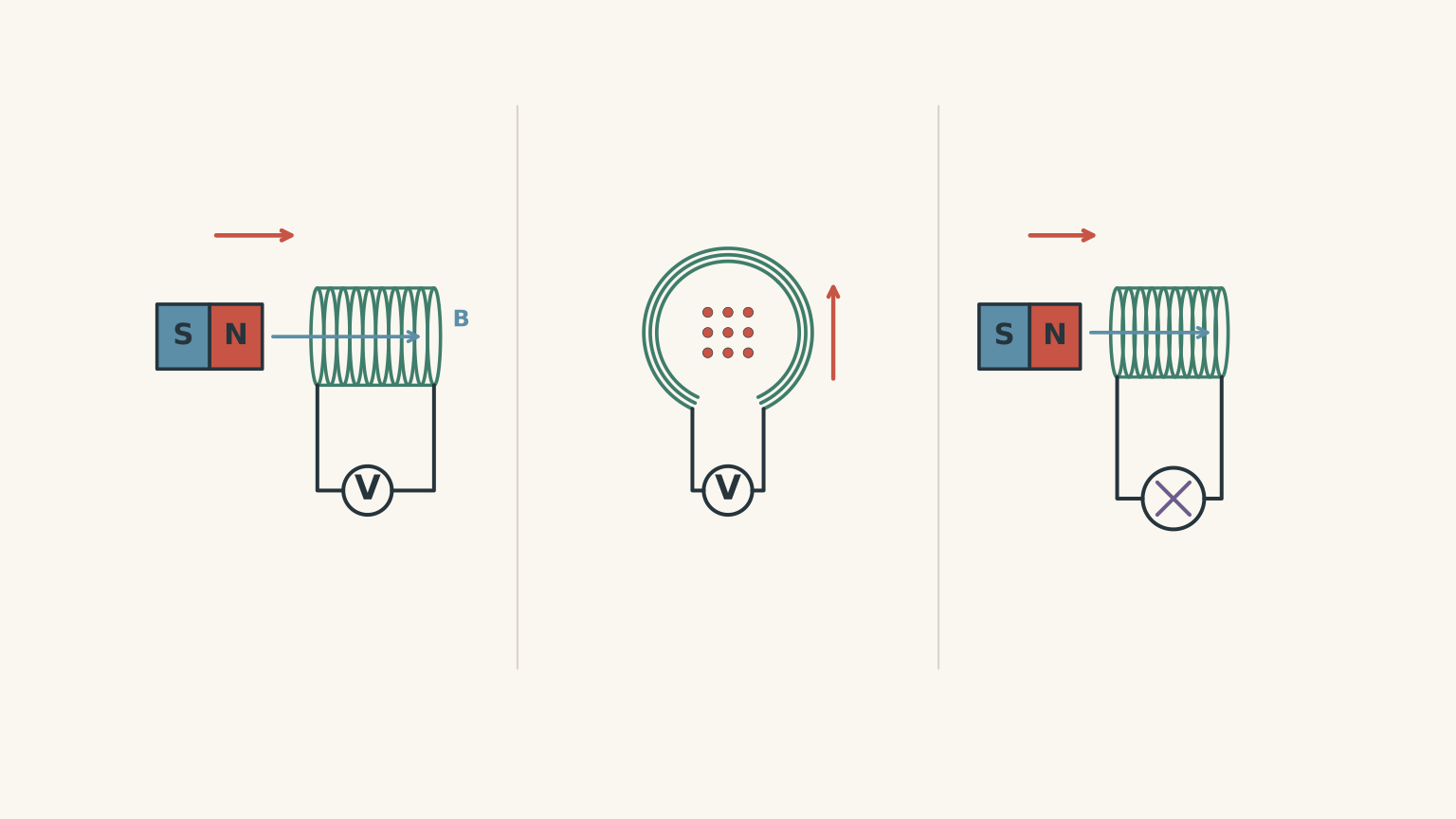
For example, if you’re practising electromagnetic induction, searching only for electromagnetic induction could miss a question about a changing magnetic flux through a coil.
Likewise, searching only for integration could miss a mechanics question involving the relationship between acceleration, velocity, and displacement.
Use the syllabus to identify connections
This is where the process becomes more useful.
For each topic, ask yourself:
- What knowledge must I already understand to use this technique?
- Which other topics could appear in the same question?
- What might the question describe without naming the relevant concept?
You don’t need to predict every possible HSC question. You just need enough related terms to recognise when a topic is being tested indirectly.
Due to technical limitations, this figure may display incorrectly or contain inaccuracies. Please check key details against your course materials.
03Find the actual HSC papers and marking guidelines
The best starting point for genuine NSW HSC examination questions is the official NESA examination archive.
Go to:
From there, select your subject.
The relevant subject pages include:
- Physics HSC exam papers
- Chemistry HSC exam papers
- Mathematics Extension 1 HSC exam papers
- Mathematics Extension 2 HSC exam papers
These pages organise examination resources by course and year.
An HSC exam pack can include:
- The original examination paper.
- Marking guidelines.
- Sample answers within the marking guidelines, where provided.
- Marking feedback explaining common strengths and weaknesses in student responses.
The availability of these materials varies between examination years. The newest examination paper may be listed before its marking guidelines and feedback are available, so check the individual exam pack.
Don’t stop at the question paper
The marking guidelines are particularly useful when you’re trying to classify a question.
Suppose you find a Physics question that appears to test electromagnetic induction.
The question might also require you to apply conservation of energy or interpret experimental data.
The marking guidelines help you identify which principles and skills are actually being assessed.
One important distinction: NESA notes that sample answers may be included in marking guidelines, but they are not necessarily complete or exemplary responses. Use the marking criteria to understand what the question assesses, rather than treating every sample response as a perfect model answer.
What about older examination papers?
Older papers can provide additional practice, but check their syllabus alignment carefully.
NESA distinguishes current examination resources from archived resources. Its archive pages warn that older questions may contain content that differs from, or is not covered by, the current syllabus.
For example, the older Physics archive contains papers developed under previous Physics syllabuses.
Use these questions selectively. A familiar-looking topic does not guarantee that the question is appropriate for your cohort.
Also, keep your searches specific to NSW HSC courses. Resources for overseas qualifications such as A-levels or IB, and other Australian state qualifications, are not automatically equivalent to the NSW HSC syllabus.
04Scan the entire examination paper for mixed questions
This is the step that makes the biggest difference.
Searching a PDF for keywords is a useful shortcut. It is not a complete method of finding every relevant question.
Why?
Because an HSC question can test a concept without naming it.
Consider a question that asks you to calculate the displacement of a moving particle using an acceleration function.
It might be classified under mechanics, but solving it requires calculus.
A search for integration may never find it.
The solution is to scan the complete examination paper after your initial keyword search.
Tag questions according to what they actually test
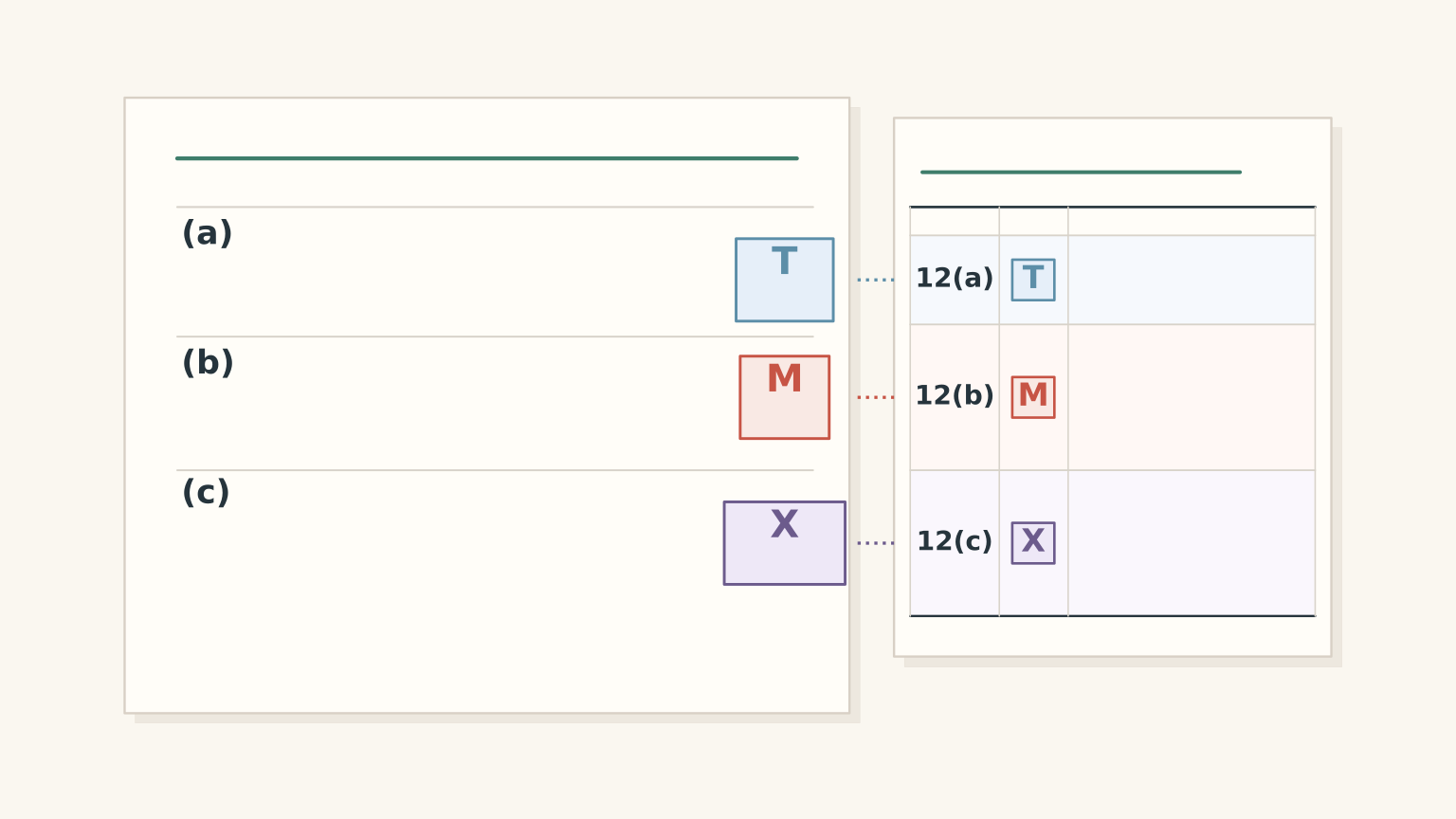
Use three simple categories.
| Tag | Meaning | What to do |
|---|---|---|
| T | Topic-focused | Add to your direct topic practice set |
| M | Mixed | Add to your mixed-question set and any relevant topic indexes |
| X | Context only | Don’t count it as practice for the topic |
The distinction between mixed and context-only questions is important.
A question might mention energy in its introduction but only assess a calculation involving electric fields. That doesn’t automatically make it an energy question.
On the other hand, if you must apply conservation of energy to obtain the answer, energy is genuinely being tested.
Classify questions by the knowledge and methods needed to earn marks, not by the words appearing in the introduction.
Tag individual question parts, not just whole questions
This is another easy mistake.
Imagine an HSC Chemistry question with two parts:
- Part (a) asks you to calculate the concentration of a solution using titration data.
- Part (b) asks you to explain the behaviour of a buffer solution.
The first part primarily tests quantitative titration skills. The second tests acid-base equilibrium.
If you label the entire question simply as titration, you’ll miss the second concept.
Record the individual parts separately.
Due to technical limitations, this figure may display incorrectly or contain inaccuracies. Please check key details against your course materials.
Create a simple question index
You don’t need specialised software. A spreadsheet or even a table in your notebook will work.
Use columns like these:
| Year | Question | Main topic | Other topic | Type |
|---|---|---|---|---|
| 2025 | Q18(a) | Integration | – | T |
| 2025 | Q22(b) | Integration | Mechanics | M |
| 2024 | Q15(a) | Equilibrium | – | T |
| 2024 | Q27(c) | Acid-base equilibrium | Stoichiometry | M |
These are illustrative entries, not references to actual examination questions.
The important thing is to record both the main topic and any secondary topic.
A mixed question can appear in multiple topic practice sets, but keep only one original record in your master index. This prevents accidental double-counting.
Over time, you’ll build something much more useful than a folder of randomly downloaded papers: a searchable collection of questions organised by the skills they assess.
05Two examples of finding hidden topic questions
Let’s apply the system to two situations.
Worked scenario: Finding integration questions hidden in mechanics
You’re preparing for Mathematics Extension 2 and want more practice with integration.
You search for questions containing:
- Integration.
- Definite integrals.
- Antiderivatives.
- Area under a curve.
You find several useful questions.
But you also want to catch mechanics questions that require integration.
Consider this original question:
A particle moves in a straight line with acceleration given by \(a(t)=6t-4\), where \(t\) is measured in seconds and acceleration is measured in \(\mathrm{m\,s^{-2}}\).
Its initial velocity is \(3\ \mathrm{m\,s^{-1}}\), and its initial displacement is zero.
Calculate its displacement after \(2.0\) seconds.
How should you classify this question?
Step 1: Identify the mathematical relationship.
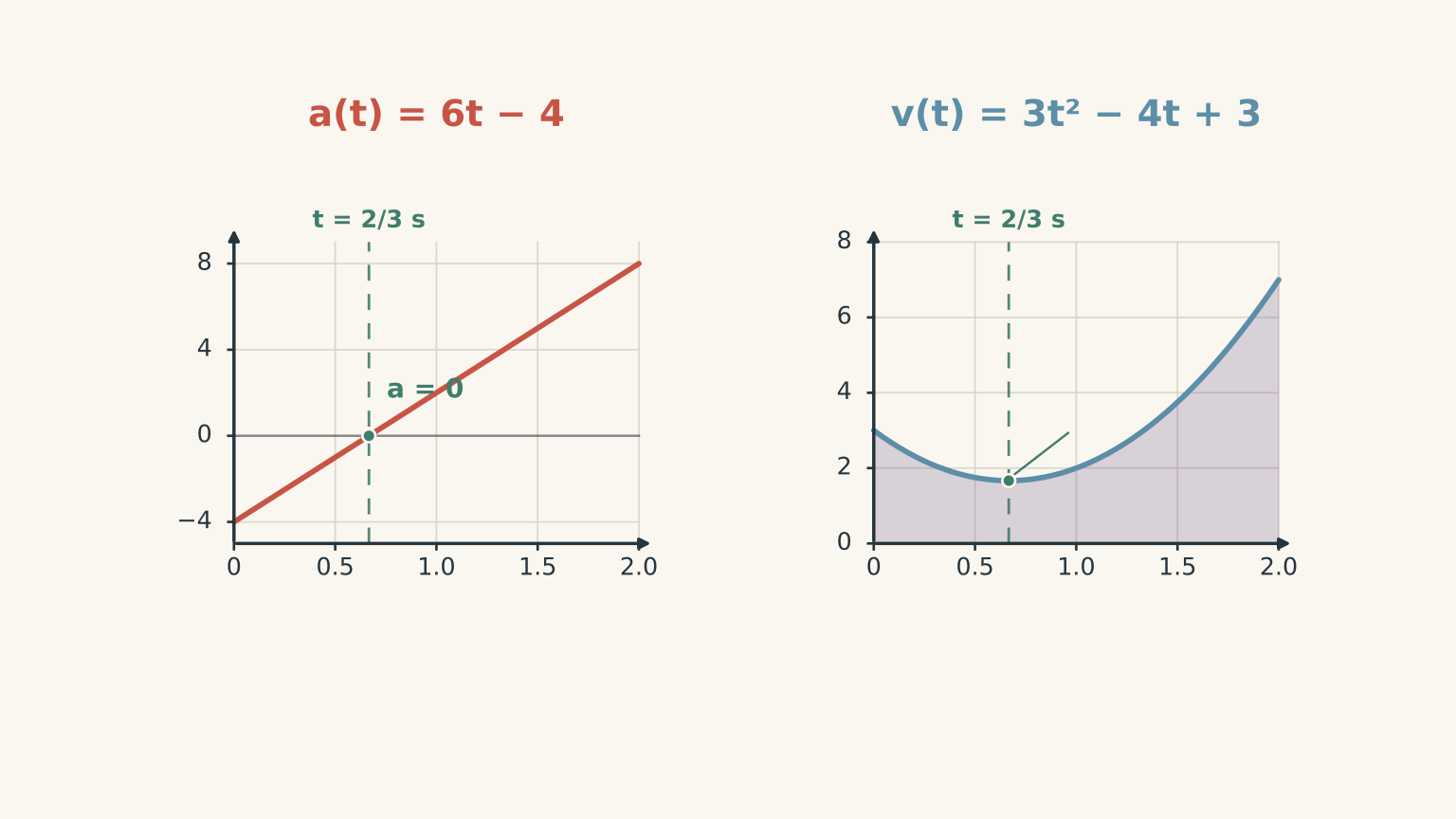
Acceleration is the rate of change of velocity:
\[ a(t)=\frac{dv}{dt} \]
To obtain velocity, you must integrate acceleration.
\[ \begin{aligned} v(t)&=\int(6t-4)\,dt\\ &=3t^2-4t+C \end{aligned} \]
Using \(v(0)=3\), we obtain \(C=3\).
Therefore:
\[ v(t)=3t^2-4t+3 \]
Step 2: Recognise the second integration.
Velocity is the rate of change of displacement:
\[ v(t)=\frac{dx}{dt} \]
Integrating again:
\[ \begin{aligned} x(t)&=\int(3t^2-4t+3)\,dt\\ &=t^3-2t^2+3t+D \end{aligned} \]
Since \(x(0)=0\), \(D=0\).
Step 3: Calculate the displacement.
\[ \begin{aligned} x(2)&=2^3-2(2^2)+3(2)\\ &=8-8+6\\ &=6\ \mathrm{m} \end{aligned} \]
The displacement is \(6\ \mathrm{m}\).
Step 4: Add it to your question index.
This is a mixed question because it combines calculus with mechanics.
The question never explicitly asks you to integrate. You recognise that integration is necessary because acceleration and velocity are related through differentiation.
Record it as:
- Main topic: Mechanics.
- Other topic: Calculus and integration.
- Classification: M.
If you had searched only for the word integration, you could easily have missed it.
Due to technical limitations, this figure may display incorrectly or contain inaccuracies. Please check key details against your course materials.
Worked scenario: Finding Chemistry questions that combine equilibrium and stoichiometry
Now imagine you’re revising acid-base equilibrium in Chemistry.
You search for:
- Equilibrium.
- Buffers.
- Acid dissociation.
- pH.
- Conjugate acid-base pairs.
You find a question that initially looks like a straightforward titration calculation.
Consider this original question:
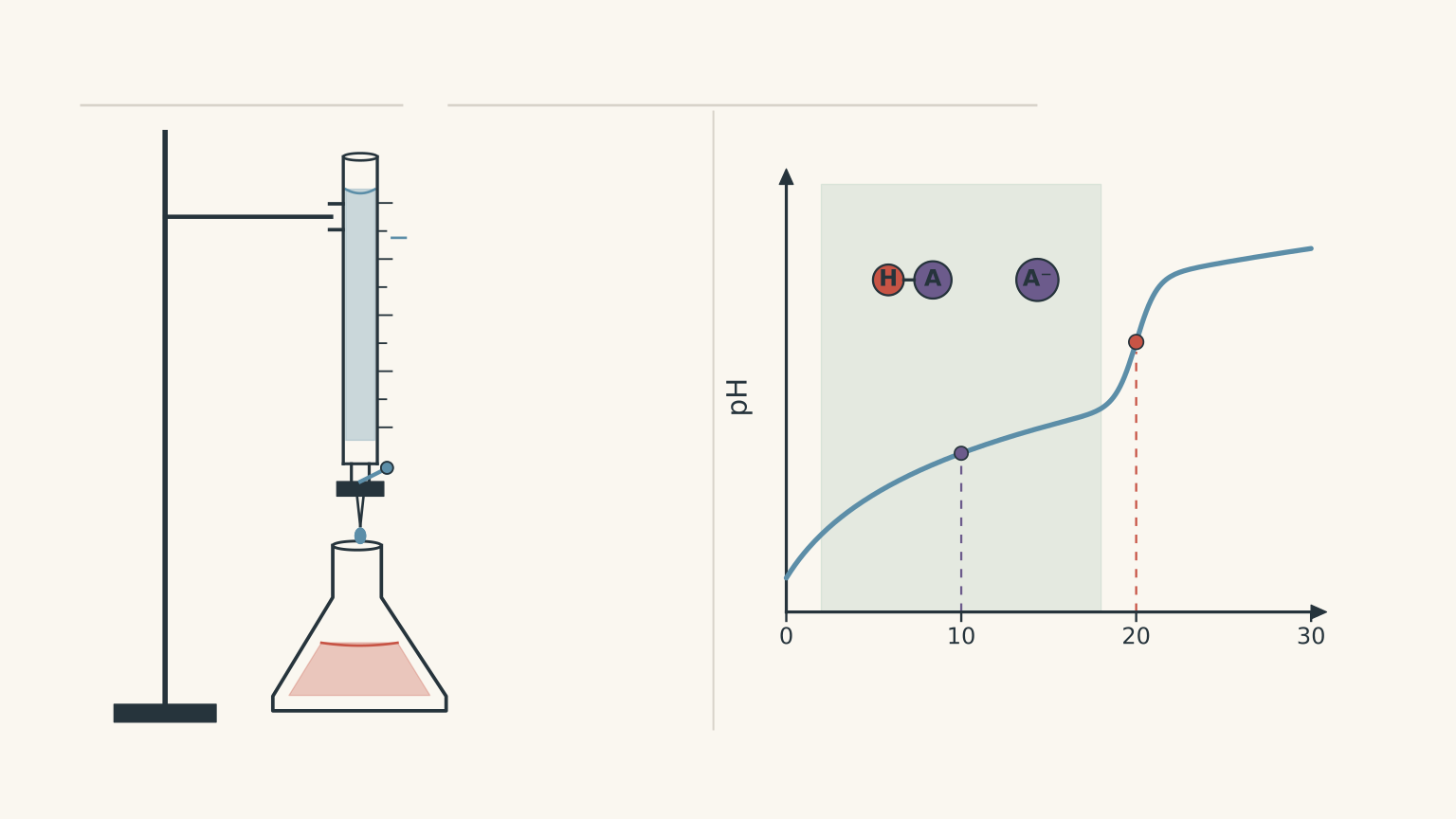
A \(25.0\ \mathrm{mL}\) sample of a monoprotic weak acid, HA, is titrated with \(0.100\ \mathrm{mol\,L^{-1}}\) sodium hydroxide.
The equivalence point occurs after \(20.0\ \mathrm{mL}\) of sodium hydroxide has been added.
(a) Calculate the initial concentration of the weak acid.
(b) At half-equivalence, explain why adding a small amount of hydrochloric acid causes only a small change in pH.
Step 1: Recognise what part (a) tests.
The neutralisation reaction is:
\[ \ce{HA + OH^- -> A^- + H2O} \]
The mole ratio is \(1:1\).
At equivalence, the moles of sodium hydroxide added equal the initial moles of acid.
\[ \begin{aligned} n(\ce{NaOH})&=cV\\ &=0.100\times0.0200\\ &=0.00200\ \mathrm{mol} \end{aligned} \]
Therefore, the initial amount of HA was also \(0.00200\ \mathrm{mol}\).
Its concentration was:
\[ \begin{aligned} c(\ce{HA})&=\frac{n}{V}\\ &=\frac{0.00200}{0.0250}\\ &=0.0800\ \mathrm{mol\,L^{-1}} \end{aligned} \]
Part (a) tests quantitative titration and stoichiometry.
Step 2: Identify the different concept in part (b).
At half-equivalence, half of the original weak acid has been neutralised.
There are now equal amounts of HA and its conjugate base, \(\mathrm{A}^{-}\).
This mixture acts as a buffer.
When hydrochloric acid is added, its hydrogen ions react with the conjugate base:
\[ \ce{A^- + H^+ -> HA} \]
The added hydrogen ions are consumed by this reaction, so the pH changes relatively little.
Part (b) tests acid-base equilibrium and buffer behaviour.
Step 3: Classify the complete question.
The question combines two different areas of Chemistry:
- Part (a): Stoichiometry and titration calculations.
- Part (b): Acid-base equilibrium and buffer behaviour.
The overall question is mixed.
If you’re building an acid-base equilibrium practice set, include part (b). If you’re practising titration calculations, include part (a).
This is why separating question parts matters.
Due to technical limitations, this figure may display incorrectly or contain inaccuracies. Please check key details against your course materials.
06Turn your question index into a useful practice plan
Once you’ve collected and classified your questions, you can use the index to decide what to practise next.
The important thing is to use direct and mixed questions for different purposes.
| Your current position | What to practise next |
|---|---|
| You struggle to recognise or apply the basic method | Topic-focused questions |
| You can solve direct questions but struggle when concepts are combined | Mixed questions |
| You can solve mixed questions but struggle with timing and unfamiliar wording | Unlabelled examination questions and timed sections |
| You understand the method but repeatedly lose marks in explanations or working | Questions with detailed marking guidelines and targeted feedback |
A useful sequence is:
First, practise direct topic questions.
These help you develop fluency with a particular method or concept.
Next, move to mixed questions.
You now need to recognise when the topic is relevant without being told which technique to use.
Finally, remove the topic labels.
Choose questions from different parts of your index and attempt them without knowing their subject matter in advance.
This is important because an HSC examination doesn’t tell you which topic each question belongs to.
You have to identify the relevant concept yourself.
If you’re unsure whether to choose a worked, mixed, or exam-level question, see How to Choose the Right HSC Practice Question for You.
Don’t mistake question quantity for topic coverage
Imagine you have collected 20 questions on chemical equilibrium.
That sounds like a substantial practice set.
However, suppose 18 questions are straightforward calculations involving equilibrium constants, and only two require you to connect equilibrium with experimental data or another area of Chemistry.
You might be very comfortable with equilibrium calculations but still struggle with unfamiliar applications.
The number of questions doesn’t tell you whether you’ve practised the full range of relevant skills.
Look at the variety of methods, contexts, and combinations in your index.
If you discover that you have missed an entire area of content, a structured revision sequence will help. See How Do You Make a Catch-Up Plan After Missing a Whole HSC Topic?.
07Your checklist for finding HSC questions by topic
Before considering a topic practice set complete, work through this checklist.
- [ ] I’ve checked the correct NESA syllabus for my HSC cohort.
- [ ] I’ve identified the topic’s syllabus terms and subtopics.
- [ ] I’ve searched for related terminology, techniques, and equations.
- [ ] I’ve checked official NESA examination papers for my course.
- [ ] I’ve scanned complete papers rather than relying exclusively on keyword searches.
- [ ] I’ve checked individual question parts for mixed concepts.
- [ ] I’ve used marking guidelines to confirm what each question actually assesses.
- [ ] I’ve separated direct questions from mixed questions.
- [ ] I’ve checked older questions for syllabus relevance.
- [ ] I’ve included some unlabelled questions in my practice.
You can use this process with Physics, Chemistry, Mathematics Extension 1, and Mathematics Extension 2.
If you work with a tutorgum online tutor, your question index can also provide a useful starting point for identifying gaps and planning the next session. You can build and use it independently with your own school resources, textbooks, and NESA examination papers, too.
The key is to remember that finding questions by topic and finding every question that tests a topic are two different jobs.
Keyword searches help with the first. Syllabus mapping, full-paper scanning, and careful classification help with the second.
Once you have both, you’ll have a much more complete practice collection, including the mixed questions that are easy to overlook when revising one topic at a time.