
Does Bad Handwriting Lose Marks in the HSC?
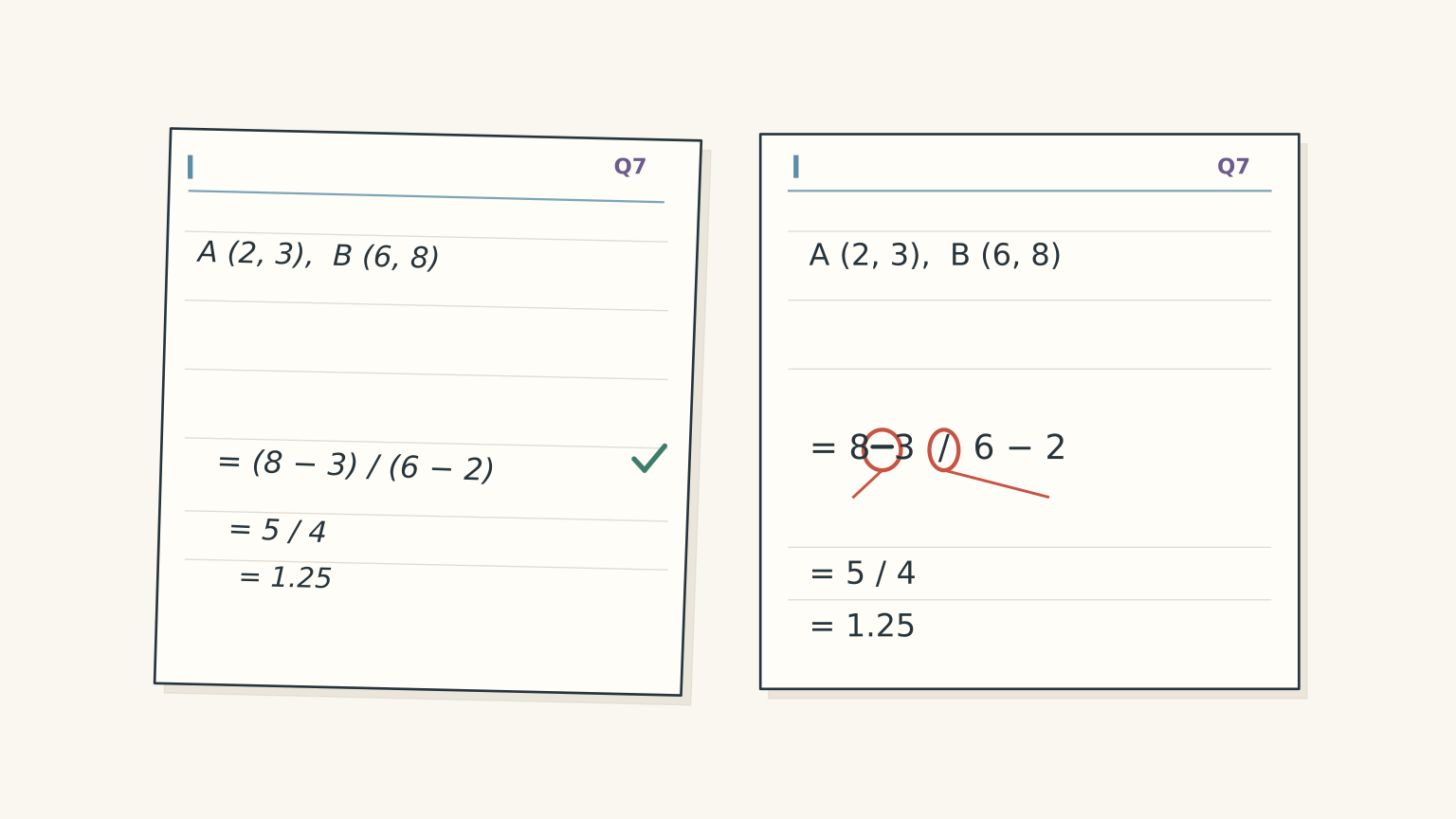
Imagine you have solved a Mathematics Extension question correctly. Your working is slightly slanted, your numbers aren't particularly neat, and your spacing gets a bit cramped towards the bottom of the page.
Imagine you have solved a Mathematics Extension question correctly. Your working is slightly slanted, your numbers aren’t particularly neat, and your spacing gets a bit cramped towards the bottom of the page. Have you just lost marks?
Not automatically. Bad-looking handwriting is not the same as illegible handwriting. NESA’s published guidance focuses on answers being clear and legible. It does not set out a general mark deduction for untidy handwriting.
However, there is a genuine risk. If a marker cannot distinguish your numbers, follow your mathematical working, or understand what your written explanation says, they may be unable to award marks for the knowledge you’ve demonstrated.
The goal isn’t to develop beautiful handwriting before the HSC. It’s to make sure your answers can be read and understood without guesswork.
Due to technical limitations, this figure may display incorrectly or contain inaccuracies. Please check key details against your course materials.
01Does NESA actually penalise bad handwriting?
It’s worth separating official requirements from exam-room rumours.
NESA’s exam preparation advice tells students to make their answers clear, legible, and easy to read. It also recommends crossing out mistakes so markers know which work not to mark.
For students sitting the 2027 HSC, the current HSC Rules and Procedures guide requires students to write clearly with black pen, using pencil only when instructed.
Neither piece of guidance establishes a separate mark deduction for unattractive handwriting.
NESA also explains that HSC markers use subject-specific marking guidelines to award marks. These guidelines describe the characteristics of responses at different mark levels. They are designed to ensure consistent marking.
You can read more about this process in NESA’s explanation of HSC exam marking.
The important distinction is:
- Untidy but readable: Your handwriting looks messy, but the marker can understand your answer.
- Difficult to read: Your letters, numbers, or symbols require the marker to guess what you intended.
- Ambiguous mathematical notation: Your writing is readable, but the expression could represent something different from what you intended.
The first isn’t automatically a problem. The second and third can affect your marks.
02Neat handwriting versus legible handwriting
These two ideas are often confused.
| Neat handwriting | Legible handwriting |
|---|---|
| Consistent letter sizes | Letters can be distinguished |
| Straight lines of writing | Working can be followed in order |
| Even spacing | Symbols don’t run into each other |
| Attractive presentation | Mathematical expressions are unambiguous |
| Consistent slant | Numbers and signs are identifiable |
Think about a road sign. It doesn’t need an elegant font or perfectly balanced lettering. It needs to communicate its message clearly enough that someone can understand it immediately.
Your HSC answers work in much the same way.
A marker shouldn’t need to spend time working out whether you’ve written a 3 or an 8. They should be able to focus on assessing your knowledge.
A useful test: Give a page of your handwritten working to someone who hasn’t seen the question. Can they read your numbers, identify your symbols, and follow your steps without asking you what you meant?
If they can, your handwriting is probably doing its job.
03Where messy handwriting can actually cost you marks
The biggest risks are usually found in mathematical notation, scientific symbols, and written explanations.
1. Numbers and mathematical symbols
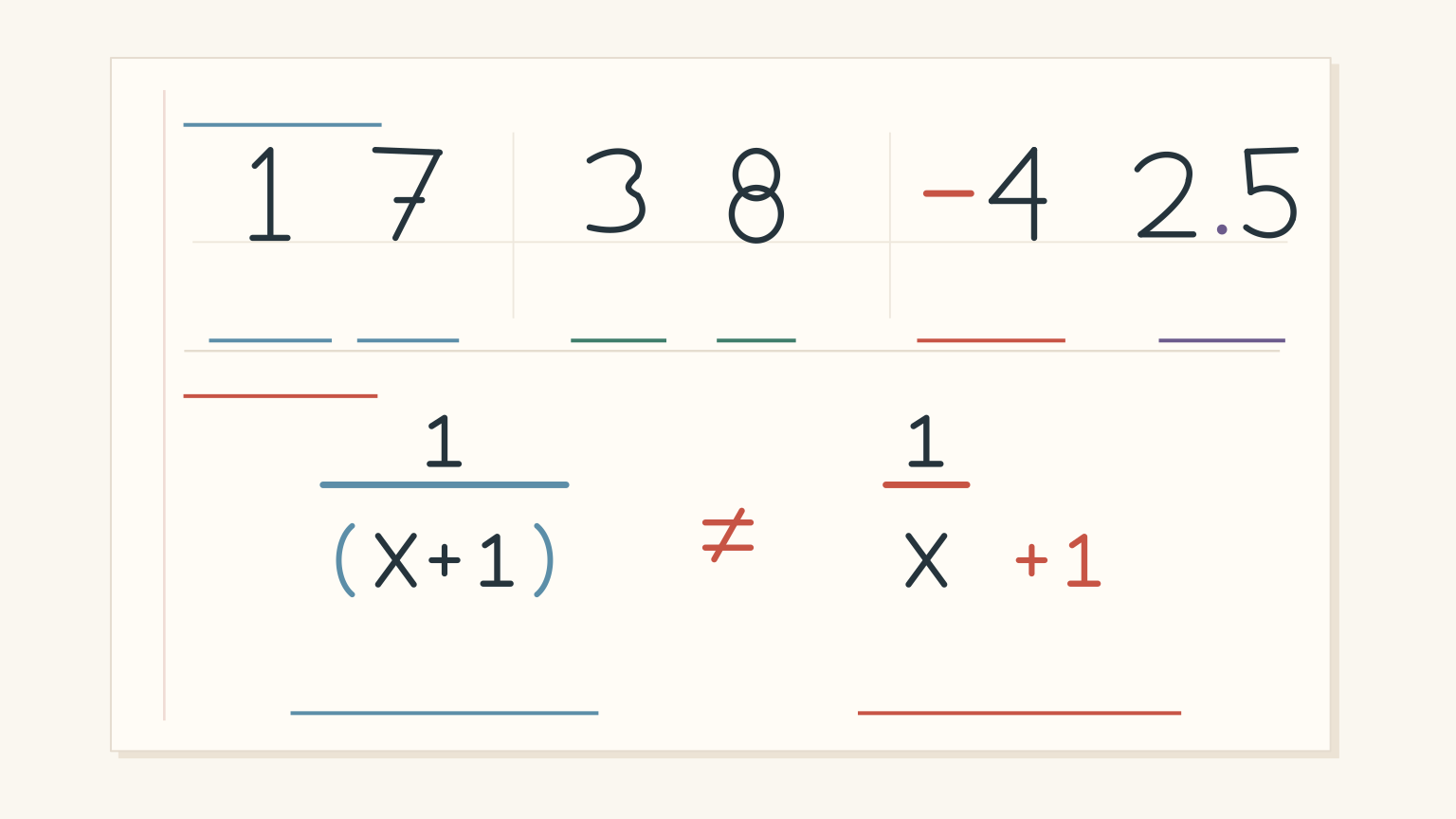
Some characters are particularly easy to confuse when writing quickly.
Watch out for:
- 1 and 7
- 3 and 8
- 0 and 6
- Minus signs and ordinary dashes
- Decimal points and stray pen marks
- Letters such as \(l\) and numbers such as \(1\)
This becomes especially important in Mathematics Extension 1 and Extension 2, where a small change to a symbol can completely change an expression.
For example, consider these two expressions:
\[ \frac{1}{x+1} \qquad \text{and} \qquad \frac{1}{x}+1 \]
They are not equivalent.
If your fraction bar doesn’t clearly extend across the entire denominator, you may communicate a different expression from the one you intended.
Due to technical limitations, this figure may display incorrectly or contain inaccuracies. Please check key details against your course materials.
2. Powers, roots, and brackets
These are particularly important in higher-level Mathematics.
Compare:
\[ (x+1)^2 \qquad \text{and} \qquad x+1^2 \]
The first squares the entire expression. The second squares only the 1.
Similarly:
\[ \sqrt{x+1} \qquad \text{and} \qquad \sqrt{x}+1 \]
The position of the root symbol and the length of its horizontal bar determine what is included.
When writing quickly:
- Make superscripts clearly smaller and higher than the main line.
- Extend fraction bars across the complete denominator.
- Make the extent of square roots obvious.
- Use brackets whenever they help clarify the order of operations.
- Leave enough space between separate terms.
You don’t need to make every expression look like a printed textbook. You do need to make its mathematical meaning unmistakable.
3. Physics and Chemistry notation
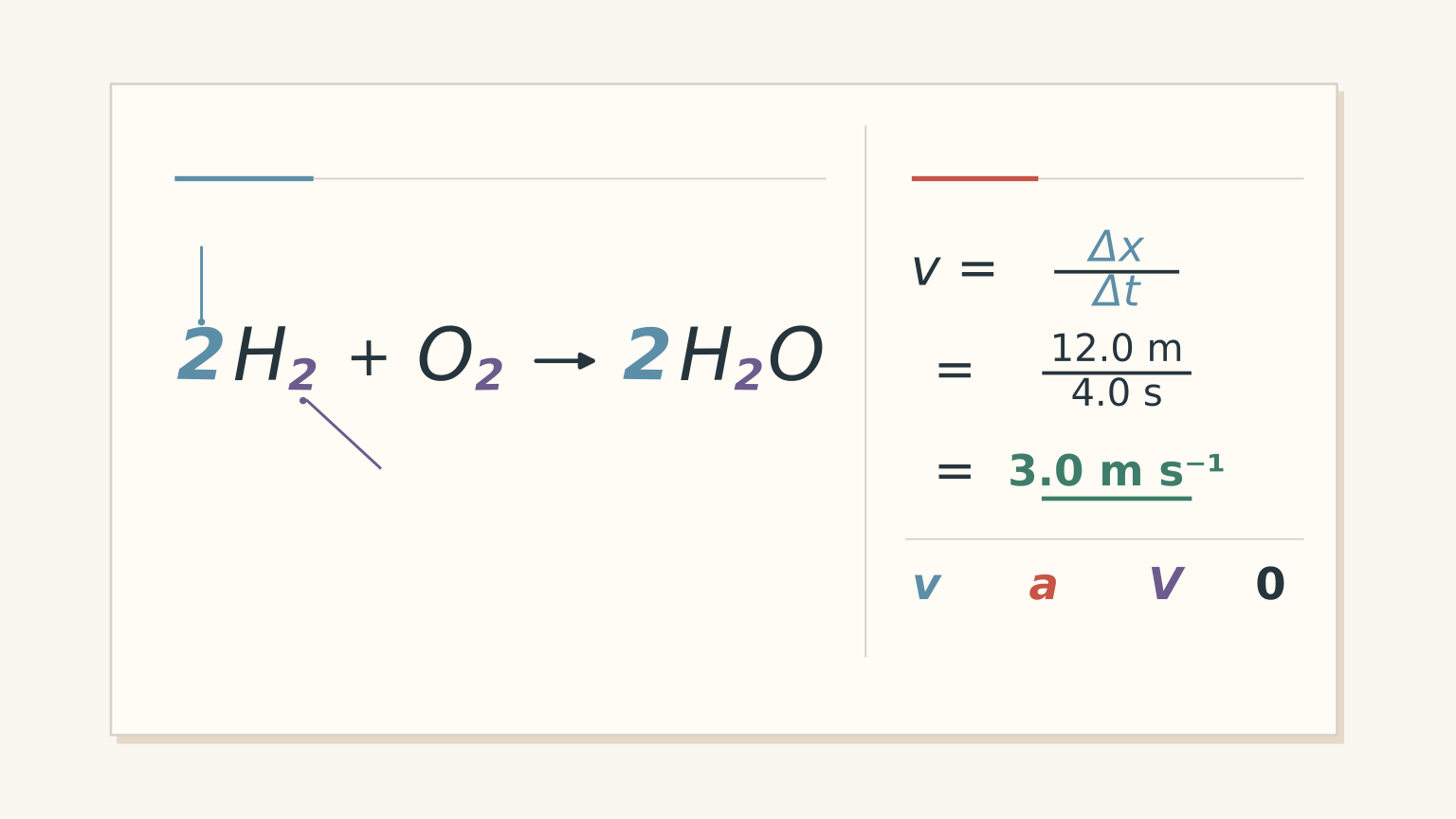
Physics and Chemistry introduce another challenge: similar-looking symbols can represent completely different quantities.
For example, in Physics, distinguish between:
- \(v\): velocity
- \(a\): acceleration
- \(V\): voltage
- \(0\): zero
In Chemistry, subscripts and coefficients need to be distinguishable.
Consider:
\[ \ce{2H2 + O2 -> 2H2O} \]
The large numbers in front of the formulae are coefficients. The smaller numbers within the formulae are subscripts.
If your subscripts are difficult to distinguish, the chemical equation may become unclear.
Units also deserve attention. Writing \(3.0\ \mathrm{m\,s^{-1}}\) is more informative than leaving a number without identifying its unit.
Due to technical limitations, this figure may display incorrectly or contain inaccuracies. Please check key details against your course materials.
4. Written explanations that are difficult to follow
Legibility isn’t only about individual letters.
A marker also needs to understand how your sentences connect.
Consider this Chemistry explanation:
Higher temperature means particles move faster so the reaction happens quicker.
The handwriting might be perfectly readable, but the explanation is incomplete.
A clearer version would be:
Increasing temperature raises the average kinetic energy of the particles. A greater fraction of collisions then have sufficient energy to overcome the activation energy, increasing the number of successful collisions per second.
The second explanation establishes the cause and connects it to the effect.
Notice that it doesn’t require a long paragraph. It requires the right scientific terms and a clear sequence of reasoning.
This is particularly important for questions containing instructions such as explain, justify, and evaluate.
04How to make your working clearer without writing more slowly
You don’t need to transform your handwriting. A few small changes can make a substantial difference to how easily someone follows your working.
Use one mathematical step per line
When working through a complicated calculation, avoid squeezing everything into one continuous line.
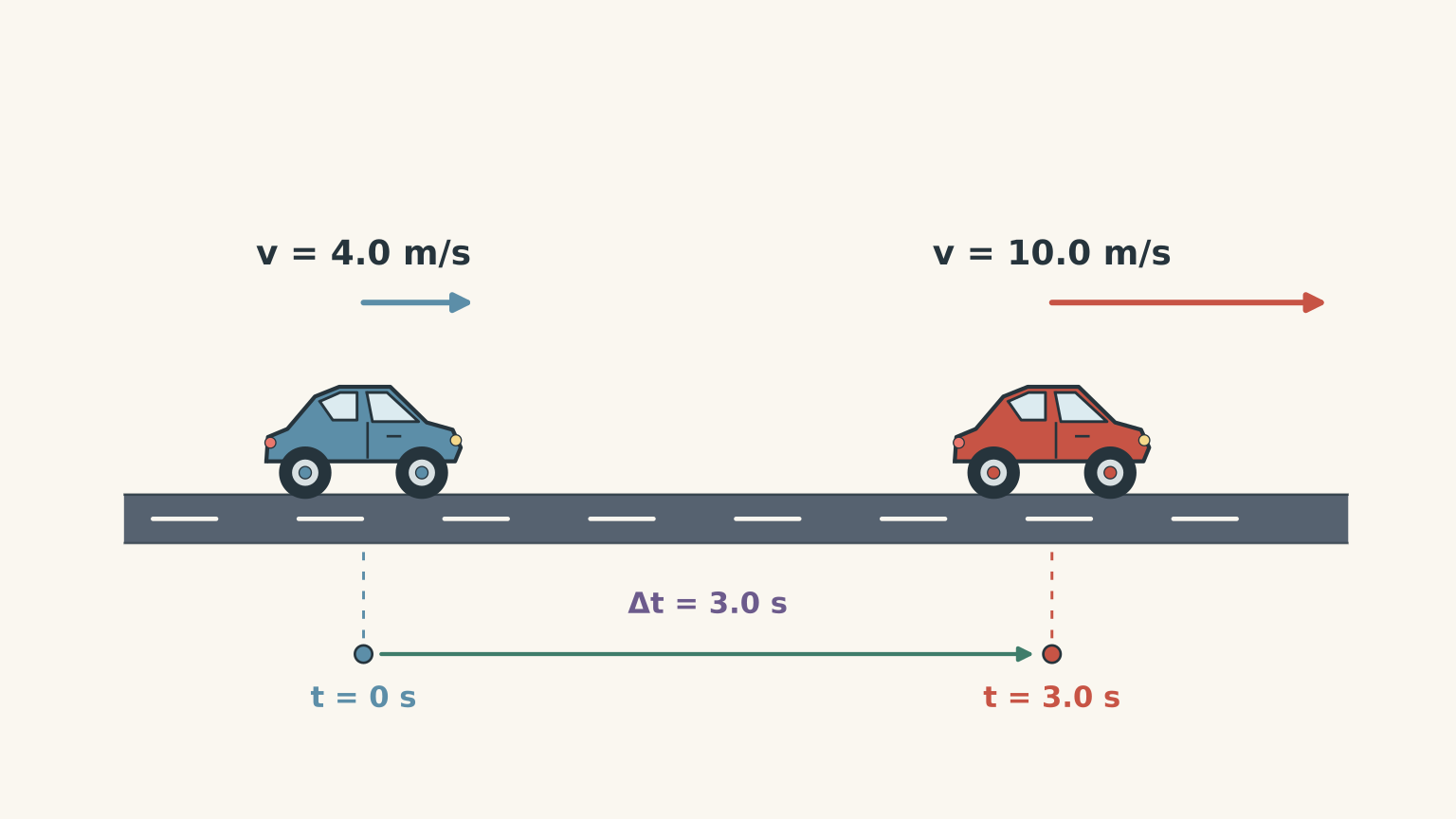
For example, suppose a car’s velocity increases from \(4.0\ \mathrm{m\,s^{-1}}\) to \(10.0\ \mathrm{m\,s^{-1}}\) over \(3.0\ \mathrm{s}\).
You need to calculate its acceleration.
A clear solution is:
\[ a=\frac{\Delta v}{\Delta t} \]
\[ =\frac{10.0-4.0}{3.0} \]
\[ =2.0\ \mathrm{m\,s^{-2}} \]
Here, \(a\) represents acceleration, \(\Delta v\) is the change in velocity, and \(\Delta t\) is the time interval.
The brackets make it clear that the entire change in velocity is divided by the time interval.
Writing \(10.0-4.0/3.0\) would communicate a different calculation because division takes precedence over subtraction.
Due to technical limitations, this figure may display incorrectly or contain inaccuracies. Please check key details against your course materials.
Align your equals signs
This is a particularly useful habit in Mathematics.
Instead of writing a long calculation across the page, place each new line underneath the previous one.
For example:
\[ \begin{aligned} 2x+6&=14\\ 2x&=14-6\\ 2x&=8\\ x&=4 \end{aligned} \]
This makes it easier to identify each mathematical transformation.
It also makes mistakes easier to spot when checking your own work.
Leave space around important symbols
Give yourself enough room to write:
- Negative signs without confusing them with fraction bars.
- Brackets without running them into neighbouring terms.
- Subscripts and superscripts clearly.
- Units beside numerical answers.
- Labels beside diagrams and graphs.
You don’t need enormous gaps between every line. Just avoid compressing your working until the symbols start merging.
05How should you correct messy working in an exam?
Imagine you’ve written three lines of algebra and then notice that the second line contains an error.
Your first instinct might be to scribble over the mistake until it disappears.
Don’t.
A heavily crossed-out section can make it difficult to identify which working is your final attempt.
Instead, use a simple approach:
Step 1: Draw a clear line through the incorrect working.
Step 2: Rewrite the corrected step on the next line.
Step 3: Continue your solution from the corrected working.
Step 4: Make your final answer easy to identify, including its units where appropriate.
For example:
\[ \begin{aligned} 2x+6&=14\\ 2x&=14+6 \quad \text{(cross out)}\\ 2x&=14-6\\ x&=4 \end{aligned} \]
The incorrect line should be visibly crossed out rather than left looking like another possible solution.
NESA specifically advises students to cross out mistakes. Correction fluid is not allowed in the HSC exam room.
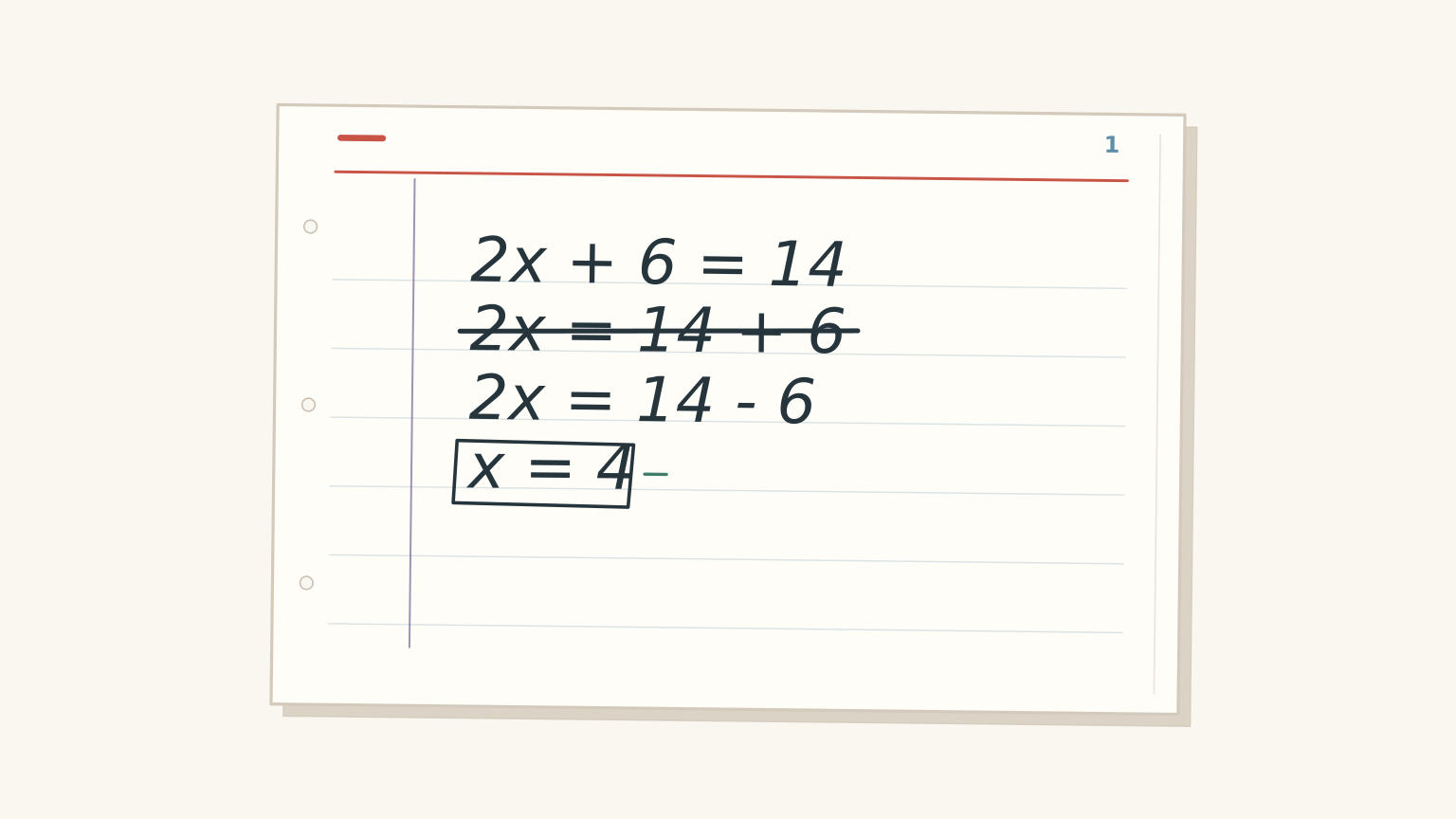
Due to technical limitations, this figure may display incorrectly or contain inaccuracies. Please check key details against your course materials.
The important thing is not to waste time rewriting an entire answer just because one line looks messy.
Correct the part that needs correcting and move on.
06A quick handwriting checklist before the HSC
You can use this checklist when practising past papers or completing school assessments.
- [ ] Can someone else read my handwriting without asking me to explain it?
- [ ] Are my 1s, 3s, 7s, and 8s distinguishable?
- [ ] Are negative signs and decimal points easy to identify?
- [ ] Are my fractions, brackets, and powers mathematically unambiguous?
- [ ] Can someone follow my working from the first line to the final answer?
- [ ] Have I included units and labels where necessary?
- [ ] Are incorrect attempts clearly crossed out?
- [ ] Am I writing clearly with black pen when practising under HSC exam conditions?
If you can tick these off consistently, you probably don’t need to spend hours trying to make your handwriting prettier.
Focus on maintaining that level of clarity when you’re working under time pressure.
07What if your handwriting is genuinely illegible?
There is an important difference between having untidy handwriting and having an ongoing difficulty communicating through handwriting.
NESA provides disability provisions for students whose condition or disability prevents them from independently communicating their responses in handwritten form.
One possible provision is a writer, who handwrites a student’s dictated responses during the examination.
NESA identifies circumstances including writing impairments, persistent pain when writing, extremely slow writing associated with a physical or cognitive/processing issue, and illegible writing.
If this describes your situation, speak to your school’s learning support team or year adviser well before your HSC exams. They can explain the relevant provisions and application process.
You can read the official requirements on NESA’s writer provision page.
08Questions and solutions
Question 1
A student has very untidy handwriting. Their letters are slanted, their spacing is inconsistent, and their numbers aren’t particularly attractive.
However, their teacher can read every word, identify every mathematical symbol, and follow their working without difficulty.
Should this student be worried about losing HSC marks because of their handwriting?
Solution 1
No, not simply because their handwriting is untidy.
The important distinction is that their work remains legible. A marker can identify the student’s mathematical reasoning and assess it against the relevant marking guidelines.
Uneven spacing and inconsistent letter sizes are presentation issues, not automatically marking issues.
The student should focus on maintaining legibility, particularly under examination time pressure, rather than trying to develop perfect handwriting.
Question 2
A student writes the following expression in a Mathematics examination:
\[ \frac{1}{x}+1 \]
However, they intended to write:
\[ \frac{1}{x+1} \]
Their handwriting is otherwise exceptionally neat.
What is the problem, and how could they avoid making this mistake?
Solution 2
The problem is mathematical notation, not handwriting quality.
The two expressions have different meanings because the denominator in the first expression is only \(x\), whereas the denominator in the second expression is \(x+1\).
The student should make sure their fraction bar extends across the entire denominator and use brackets to clarify the intended grouping.
This is an important distinction: even beautiful handwriting cannot compensate for mathematical notation that communicates the wrong expression.
The same principle applies to negative signs, powers, roots, and subscripts.
Your HSC handwriting doesn’t need to impress anyone. It needs to communicate your thinking clearly enough for a marker to recognise what you know.
Once you’ve established that, your time is better spent improving the quality of your mathematical working, scientific explanations, and problem-solving methods.
And if a disappointing assessment has made you question your exam preparation, you might also find tutorgum’s guide on How to Recover After a Bad HSC Assessment useful.
The aim is to make every mark you earn easy to recognise, not every letter you write beautiful.