
How to Choose Free HSC Resources Without Overloading
You don't need dozens of websites to prepare for the HSC. Learn how to build a simple three-resource study system using one explanation source, one practice source, and one answer-check source.
Your browser has 14 tabs open. Six videos explain the same physics concept, three websites offer different sets of notes, and you’ve downloaded two past papers. Somehow, you still haven’t answered a single question.
This is a common HSC study trap. Collecting resources feels productive, but finding another explanation doesn’t necessarily help you solve a problem independently.
You need three resources, each with a different job:
- One source to explain the content.
- One source to practise applying it.
- One source to check your answers and identify mistakes.
That’s the system. You don’t need ten websites, five sets of notes, and every YouTube video that appears in your search results.

Due to technical limitations, this figure may display incorrectly or contain inaccuracies. Please check key details against your course materials.
01The three-resource system
Think of these resources as a relay team. Each one passes something useful to the next.
The explanation gives you the knowledge. Practice tests whether you can use it without help. Checking shows you what needs fixing.
The resources don’t have to come from three different websites. Your class notes, a school worksheet, and a NESA marking guideline might be all you need.
| Resource | Its job | Examples |
|---|---|---|
| Explanation source | Help you understand a concept or method | Class notes, textbook, one free online lesson |
| Practice source | Test whether you can apply what you’ve learnt | School worksheets, textbook questions, NESA past papers |
| Answer-check source | Show you what a good answer requires and where yours falls short | Worked solutions, answer keys, NESA marking guidelines, teacher feedback |
The important distinction is that these resources solve different problems.
Watching another explanation when you already understand the concept won’t necessarily improve your problem-solving. Likewise, completing 30 questions without checking your working can reinforce the same mistake 30 times.
Choose the resource that addresses your current difficulty.
02Step 1: Choose one explanation source
Start with the material your teacher has already provided.
Your class notes, textbook, and lesson examples are often enough to establish the main ideas. They also have an advantage: they’re being used alongside your school’s current teaching program.
If you don’t understand something, find one additional explanation.
This could be:
- A free video lesson explaining the concept.
- An online set of notes with clear examples.
- A free educational resource covering the relevant NSW HSC content.
- A textbook explanation that approaches the idea differently.
Don’t choose a resource simply because it has the longest video or the most detailed notes.
Choose one that makes the concept understandable.
How do you know when an explanation is enough?
Close the notes and try three things:
- Explain the main idea in your own words.
- Write down the important equation, principle, or method from memory, if relevant.
- Complete one straightforward example without following someone else’s working.
If you can do these things, move on.
You might not understand every difficult application yet. That’s fine. Those are what practice questions are for.
If you still cannot explain the central idea, find the specific part you’re missing before searching for another complete set of notes.
03Step 2: Choose one practice source
This is where your understanding becomes useful.
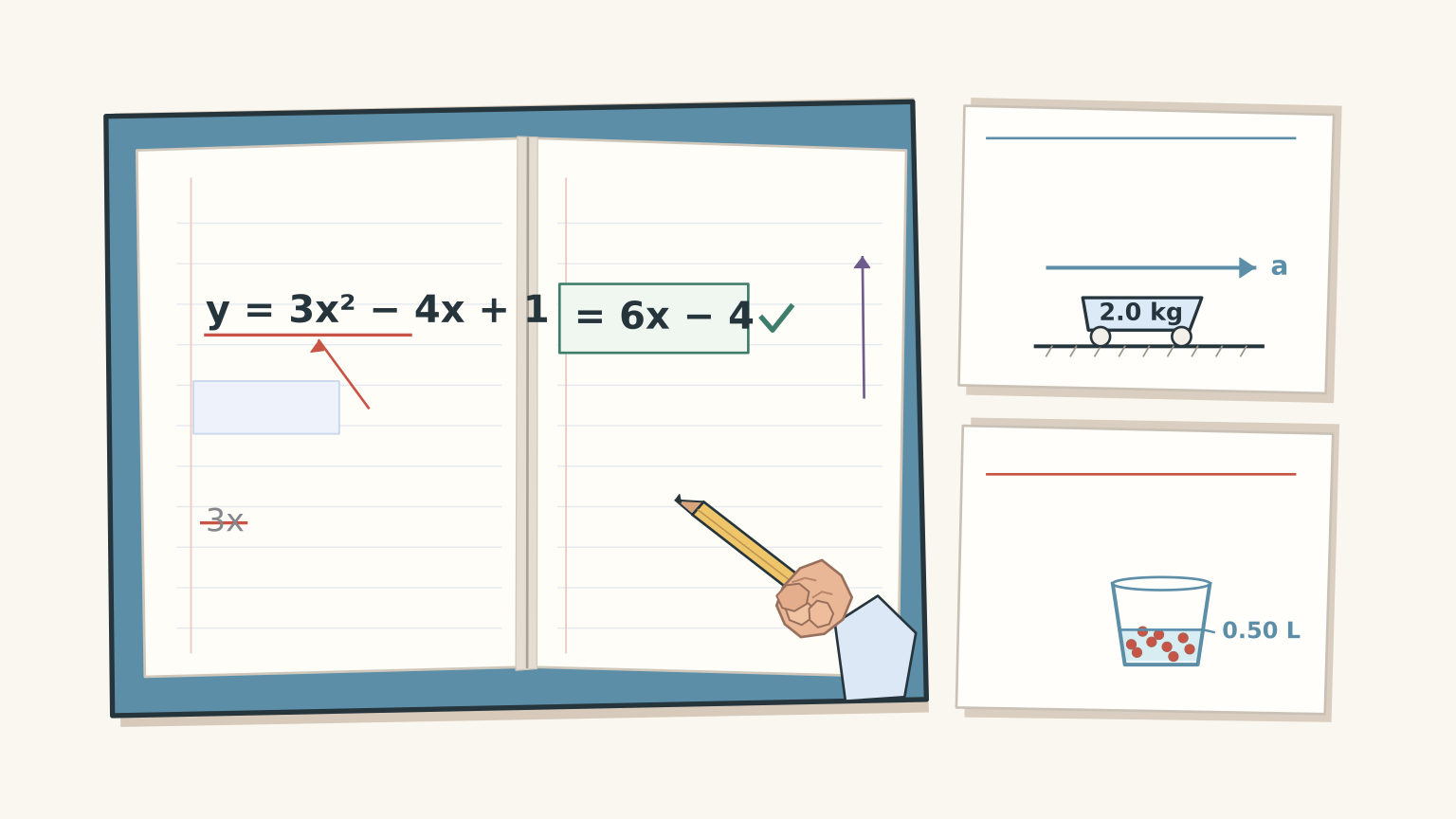
A student can watch an entire lesson on differentiation and feel confident. Then they open an unfamiliar question and have no idea where to start.
Why?
Because recognising a method while someone demonstrates it is different from selecting and applying that method independently.
Practice is what develops that independence.
Due to technical limitations, this figure may display incorrectly or contain inaccuracies. Please check key details against your course materials.
Where should you find practice questions?
Start with one of these:
- School worksheets: Particularly useful because they usually follow the content your teacher is currently covering.
- Textbook exercises: Good for building confidence before attempting more challenging questions.
- NESA past HSC papers: Useful for experiencing actual NSW HSC question styles and applying knowledge under assessment conditions.
You can find official past examination papers through NESA’s HSC exam papers collection.
For Maths Extension 1 and 2, practise selecting appropriate techniques rather than completing endless questions that all follow the same pattern.
For Physics, practise identifying the relevant physical principles, selecting equations, and explaining what your calculations mean.
For Chemistry, combine calculations with questions requiring you to explain chemical behaviour, interpret data, and justify conclusions.
A useful progression is:
- Start with straightforward questions to establish the method.
- Move to unfamiliar questions that require you to choose the method.
- Attempt HSC-style questions that combine multiple ideas.
Don’t jump straight into an entire past paper if you’re still learning one particular concept. Build the skill first.
04Step 3: Choose one answer-check source
Getting a question wrong isn’t necessarily a problem.
Not knowing why you got it wrong is.
Your answer-check source should help you identify the exact point where your reasoning stopped working.
For example, a mathematics answer key might tell you that the answer is 12. That’s useful, but it doesn’t explain whether you made an algebraic mistake, chose the wrong technique, or misunderstood the question.
A worked solution or teacher’s feedback can reveal that missing step.
For Physics and Chemistry, NESA marking guidelines are particularly useful because they show the criteria used to award marks.
However, there’s an important detail: marking guidelines aren’t always complete worked solutions. NESA explicitly notes that sample answers may not be exemplary or complete responses.
You can see this distinction in the 2025 Physics HSC exam pack, which includes the examination paper, marking guidelines, and feedback from HSC markers.
Use these resources to understand what a response needs to demonstrate, not simply to compare final answers.
Record the type of mistake
When checking your work, classify the error.
| Error type | What went wrong |
|---|---|
| Conceptual | You misunderstood the underlying idea. |
| Method selection | You knew the techniques but chose the wrong one. |
| Mathematical | You made an algebraic, arithmetic, or calculation error. |
| Communication | Your reasoning was unclear or incomplete. |
| Question interpretation | You missed an instruction or misunderstood what was being asked. |
This makes your next study session much more focused.
If you repeatedly make the same conceptual mistake, revisit the explanation. If you understand the concept but keep selecting the wrong method, complete more varied practice questions.
You don’t need to replace all three resources every time something goes wrong.
05Check that your resources match your HSC syllabus
This is especially important for students studying the NSW HSC during the current syllabus transition.
A resource can explain a scientific or mathematical concept correctly and still be unsuitable for your particular HSC course.
An older set of notes might contain topics that have changed, or a past examination paper might test content that isn’t part of your current syllabus.
The syllabus transition dates also differ between subjects.
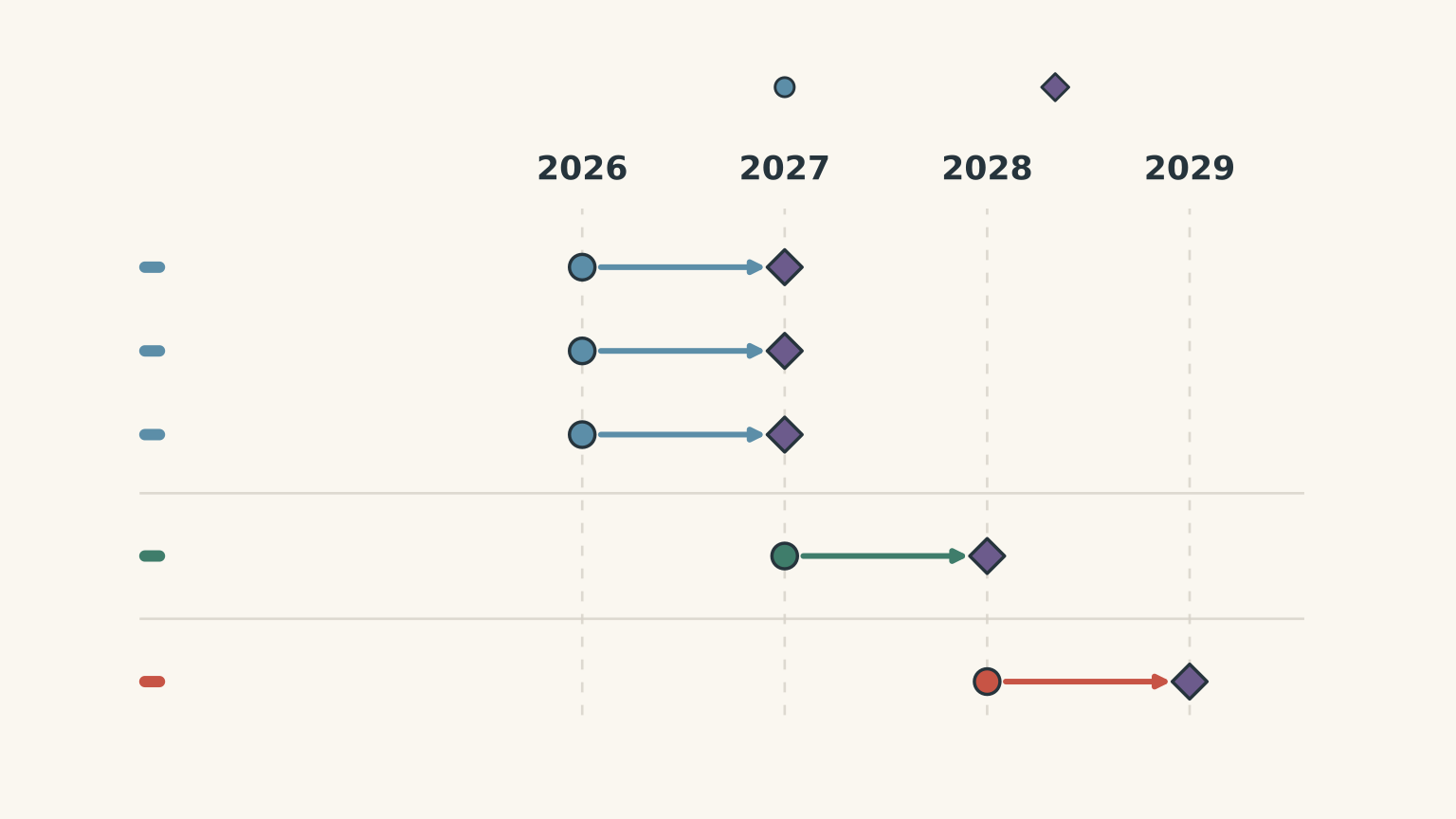
As at 15 November 2026, NESA’s implementation timelines are:
| Subject | New syllabus implementation | First HSC examination under new syllabus |
|---|---|---|
| Mathematics Advanced | 2026 | 2027 |
| Mathematics Extension 1 | 2026 | 2027 |
| Mathematics Extension 2 | 2026 | 2027 |
| Physics | 2027 | 2028 |
| Chemistry | 2028 | 2029 |
You can check the official documents here:
- Mathematics Advanced 11-12 syllabus (2024)
- Mathematics Extension 1 11-12 syllabus (2024)
- Mathematics Extension 2 11-12 syllabus (2024)
- Physics 11-12 syllabus (2025)
- Chemistry 11-12 syllabus (2025)
Due to technical limitations, this figure may display incorrectly or contain inaccuracies. Please check key details against your course materials.
What does this mean when choosing past papers?
A student preparing for the 2027 HSC in Mathematics Extension 1 is studying under the new syllabus. Older HSC papers can still provide useful practice, but individual questions need to be checked against the current syllabus.
A student preparing for the 2027 HSC in Physics, however, is still following the 2017 Physics syllabus. The new Physics syllabus doesn’t produce its first HSC examination until 2028.
Chemistry changes later, with its first new-syllabus HSC examination in 2029.
Don’t assume that every subject changes at the same time.
Also, be careful with resources labelled simply as senior mathematics, physics, or chemistry. A-level, IB, and other overseas qualifications can cover overlapping concepts, but they are not the NSW HSC. Check the actual NESA content before using them as your main study resource.
06Two examples of putting the system into practice
Worked scenario: A Physics student with too many videos
Imagine a Year 12 student preparing for the 2027 Physics HSC.
They have eight bookmarked videos explaining a mechanics concept. They’ve watched most of them, but they’re struggling to apply the relevant equations in examination questions.
What should they do?
Step 1: Identify the actual problem.
They can follow the explanations, so their immediate problem isn’t necessarily understanding the concept. It’s applying that knowledge independently.
Step 2: Keep one explanation source.
They choose their class notes as their main reference. If one part of the explanation remains unclear, they use one additional video to address that specific gap.
Step 3: Choose one practice source.
They work through their school’s mechanics worksheet, then attempt a relevant question from a NESA Physics HSC paper.
Step 4: Check their work.
They compare their solution with the marking guidelines and relevant marker feedback.
Suppose they discover that their calculations are correct, but their written explanations don’t clearly connect the physical principle to the observed outcome.
That’s a specific weakness they can now address.
The result? They don’t need another six videos. They need to practise constructing better explanations.
Worked scenario: A Maths Extension 1 student who can’t start unfamiliar questions
A student preparing for the 2027 Mathematics Extension 1 HSC can follow their textbook’s worked examples perfectly.
However, when they attempt an unfamiliar question, they struggle to identify which technique to use.
Their first instinct is to find another explanation.
But is that the problem?
Step 1: Test their understanding.
They can explain the methods and reproduce the worked examples. Their explanation source is doing its job.
Step 2: Keep the explanation source.
They don’t need to replace their textbook or collect another set of notes.
Step 3: Change the practice.
They choose one set of questions that gradually increases in difficulty and includes different ways of applying the same mathematical ideas.
They attempt each question before looking at a solution.
Step 4: Use worked solutions to identify the first mistake.
For every unsuccessful question, they identify the point where their reasoning diverged.
Perhaps they understood the relevant theorem but didn’t recognise when to apply it. That’s a method-selection problem, not a knowledge problem.
They record that mistake and attempt a similar question later without assistance.
This is much more useful than watching another hour of explanations.
For additional maths preparation, you can also read our guide on how to check your calculator setup before an HSC Maths paper.
07Questions and solutions
Question 1
You’ve watched a clear explanation of a Physics concept and can describe it in your own words. However, you keep getting unfamiliar practice questions wrong.
Which resource should you change first?
Solution 1
Change your practice source, not your explanation source.
Your ability to explain the concept suggests that your explanation resource is doing its job. The difficulty is transferring that understanding to unfamiliar situations.
Choose a set of questions that requires you to select equations, identify relevant physical principles, and apply them independently.
After attempting each question, check your working and identify where your reasoning breaks down.
Watching another explanation might feel easier, but it doesn’t directly address the skill you’re missing.
Question 2
You calculate the correct final answer in a Chemistry question but receive fewer marks than expected.
You check the NESA marking guidelines and discover that marks are awarded for explaining the reasoning behind your answer.
Should you download another set of Chemistry notes?
Solution 2
No. Your answer-checking process needs to improve.
The issue isn’t necessarily your knowledge of the topic. It’s that your response doesn’t demonstrate all the reasoning required by the question.
Compare your working with the marking criteria. Identify which explanation, chemical relationship, or calculation step you haven’t demonstrated.
For example, if a question asks you to explain how a change in concentration affects an equilibrium, simply stating that the equilibrium shifts isn’t necessarily enough. You may need to explain why the change produces that response.
Use the marking guidelines to identify the missing reasoning, then practise writing a more complete response.
If the guidelines don’t provide enough detail, ask your teacher to explain what the missing step should demonstrate.
Question 3
A student preparing for the 2028 NSW HSC Physics examination finds a collection of 2026 HSC Physics papers.
Can they use every question in those papers as their main practice resource?
Solution 3
No, not without checking the syllabus alignment.
The 2028 HSC is the first examination under the new Physics 11-12 syllabus (2025). The 2026 HSC examination belongs to the previous Physics Stage 6 syllabus (2017).
Some questions from the older papers may still be useful because the underlying physics and mathematical skills overlap.
However, the student should compare individual questions against the new syllabus rather than assuming the entire older paper represents the current course.
They should use current syllabus-aligned school questions as their main practice source and select relevant older questions as additional practice.
The important distinction is between a question that teaches a useful skill and a question that accurately represents the student’s current HSC course. Those aren’t always the same thing.
08A simple checklist for your next study session
Before searching for another free resource, run through this checklist:
- [ ] Have I identified one specific syllabus topic or skill to work on?
- [ ] Do I have one explanation source that I can understand?
- [ ] Do I have one set of questions to attempt independently?
- [ ] Do I have an answer key, worked solution, marking guideline, or teacher feedback to check my work?
- [ ] Have I identified the exact mistakes I need to fix?
- [ ] Do my resources match my current NSW HSC syllabus and cohort?
If you can tick these boxes, you have enough resources to start making progress.
If you repeatedly struggle to identify why your working breaks down, ask your teacher or a tutor to look at your actual attempts. tutorgum offers online tutoring in Physics, Chemistry, and Maths Extension 1 and 2 for Year 11 and 12 students. Sometimes targeted feedback on one difficult concept is more useful than another collection of free notes.
Once your three-resource system is working, the next step is to revisit questions you previously got wrong after a few days. Try solving them again without looking at your notes.
That is how you turn a collection of resources into knowledge you can actually use in an HSC examination.