
How to Choose an HSC Physics Tutor: Questions to Ask
Compare HSC Physics tutoring options with practical questions about syllabus knowledge, scientific explanations, worked solutions and marking feedback. Learn how to assess a trial lesson and explore tutorgum's small-group live online Physics classes.
Imagine a car travelling east at 20 m/s. The driver brakes, giving the car an acceleration of 4 m/s² west. Three seconds later, the car is still travelling east at 8 m/s. A tutor can calculate that answer in seconds. But can they explain why the velocity is still positive while the acceleration is negative, and then get you to work it out independently? That’s a much better test of a Physics tutor than watching them produce a polished solution.
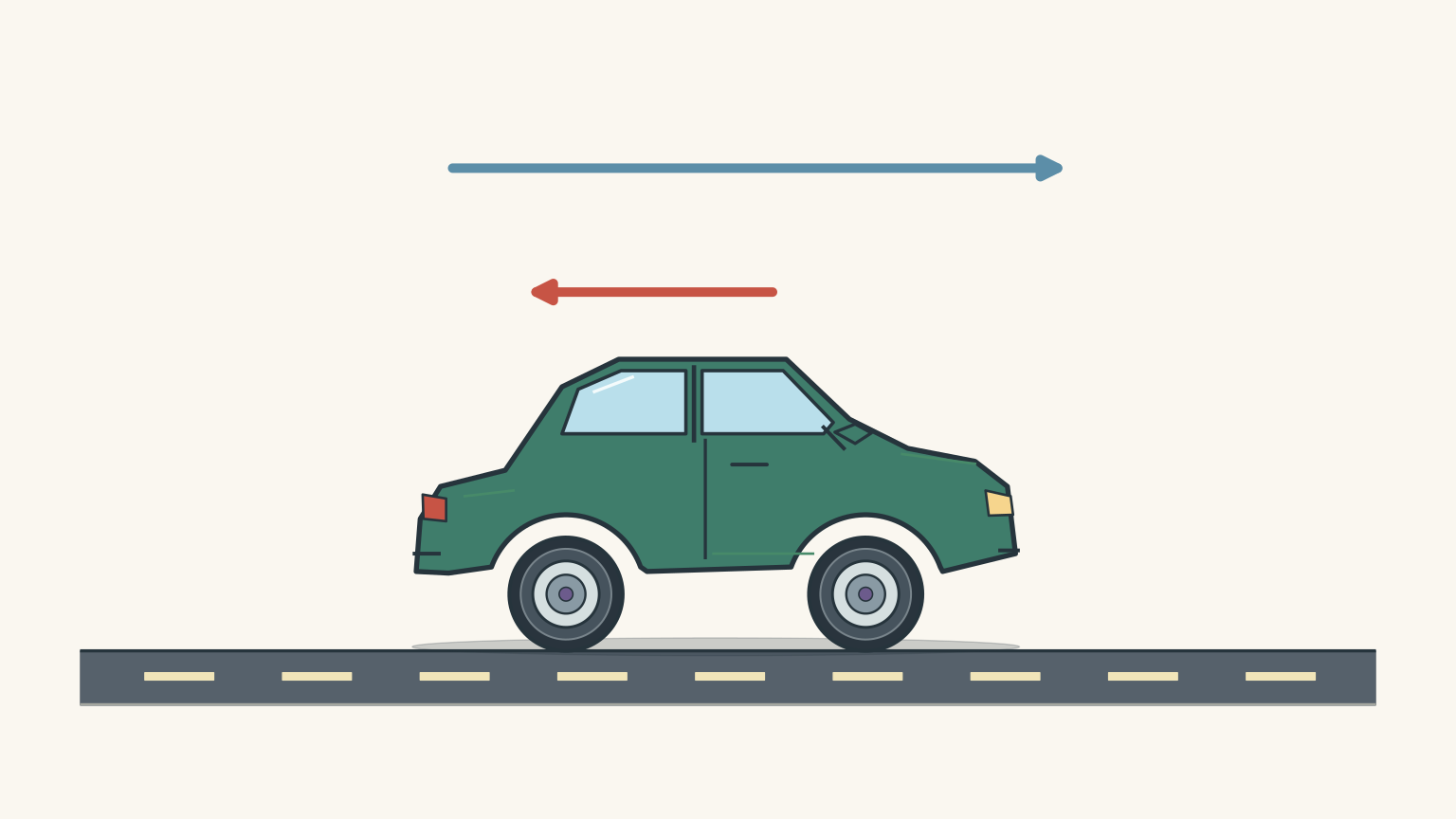
Due to technical limitations, this figure may display incorrectly or contain inaccuracies. Please check key details against your course materials.
Choosing an HSC Physics tutor comes down to five things: NSW syllabus knowledge, scientifically accurate explanations, clear worked solutions, useful marking feedback, and a teaching style that makes you do the thinking. You should be able to test all five before committing to regular lessons.
Here’s what to look for, what to ask, and how to tell whether a tutoring class will actually help.
01Check that the tutor knows your exact HSC syllabus
This is the first question to ask because NSW Physics is changing.
A tutor might understand every topic in the previous syllabus and still need to update their teaching materials for an incoming cohort. Knowing Physics and knowing the syllabus your cohort studies are two different things.
As at 20 November 2026, NESA’s published implementation schedule is:
| Student’s cohort | Applicable Physics syllabus |
|---|---|
| Sitting the 2027 HSC (currently Year 11 in 2026) | Physics Stage 6 Syllabus (2017) |
| Starting Year 11 in 2027 (sitting the 2028 HSC) | Physics 11-12 Syllabus (2025) |
The new Physics syllabus starts teaching Year 11 content in Term 1, 2027. Year 12 content begins in Term 4, 2027, and the first HSC examination under the new syllabus is in 2028.
The new course is organised around these focus areas:
| Year 11 | Year 12 |
|---|---|
| Fundamentals of mechanics | Advanced mechanics |
| Waves | Electromagnetism |
| Electricity and magnetism | Nature of light |
| Matter, energy and the cosmos |
There is another detail worth knowing if you’re considering tutoring in multiple sciences: the new Chemistry 11-12 syllabus begins implementation in 2028, one year after the new Physics syllabus.

Due to technical limitations, this figure may display incorrectly or contain inaccuracies. Please check key details against your course materials.
Questions to ask a prospective tutor:
- Which NESA Physics syllabus applies to my HSC year?
- How do your lessons map to the syllabus content and outcomes?
- How do you account for differences between my school’s teaching sequence and your class sequence?
- How do you prepare students for the practical and Working Scientifically components?
A good answer should be specific. The tutor should be able to identify the relevant course, explain what is being taught, and show how the lesson connects to the required knowledge and skills.
02Test how well they explain the actual physics
Knowing an equation is not the same as understanding the physics behind it.
Consider the braking car from the opening example. Its initial velocity is 20 m/s east, its acceleration is 4 m/s² west, and three seconds have passed.
A tutor should be able to explain the signs before reaching for an equation.
Take east as the positive direction:
- Initial velocity, \(u=+20\text{ m/s}\).
- Acceleration, \(a=-4\text{ m/s}^2\).
- Time, \(t=3\text{ s}\).
Using the constant-acceleration equation:
\[ v=u+at \]
\[ v=20+(-4)(3) \]
\[ \boxed{v=8\text{ m/s east}} \]
The car is still travelling east, but its acceleration points west. It is slowing down because its acceleration acts in the opposite direction to its velocity.
Notice the condition here: the equation assumes constant acceleration.
There is also a subtle trap. Negative acceleration does not automatically mean an object is slowing down. If an object is already travelling west and its acceleration is also west, it speeds up.
A tutor who understands the physics should be able to explain this without relying on memorised rules.
Ask them:
“Can you explain why negative acceleration doesn’t always mean an object is slowing down?”
Then try a second question:
“A car travels at constant speed along a level road. Does this mean there are no forces acting on it?”
The correct explanation involves Newton’s first law. The resultant force is zero, but individual forces still exist. The engine’s forward driving force balances friction and air resistance, while the normal force balances the car’s weight.
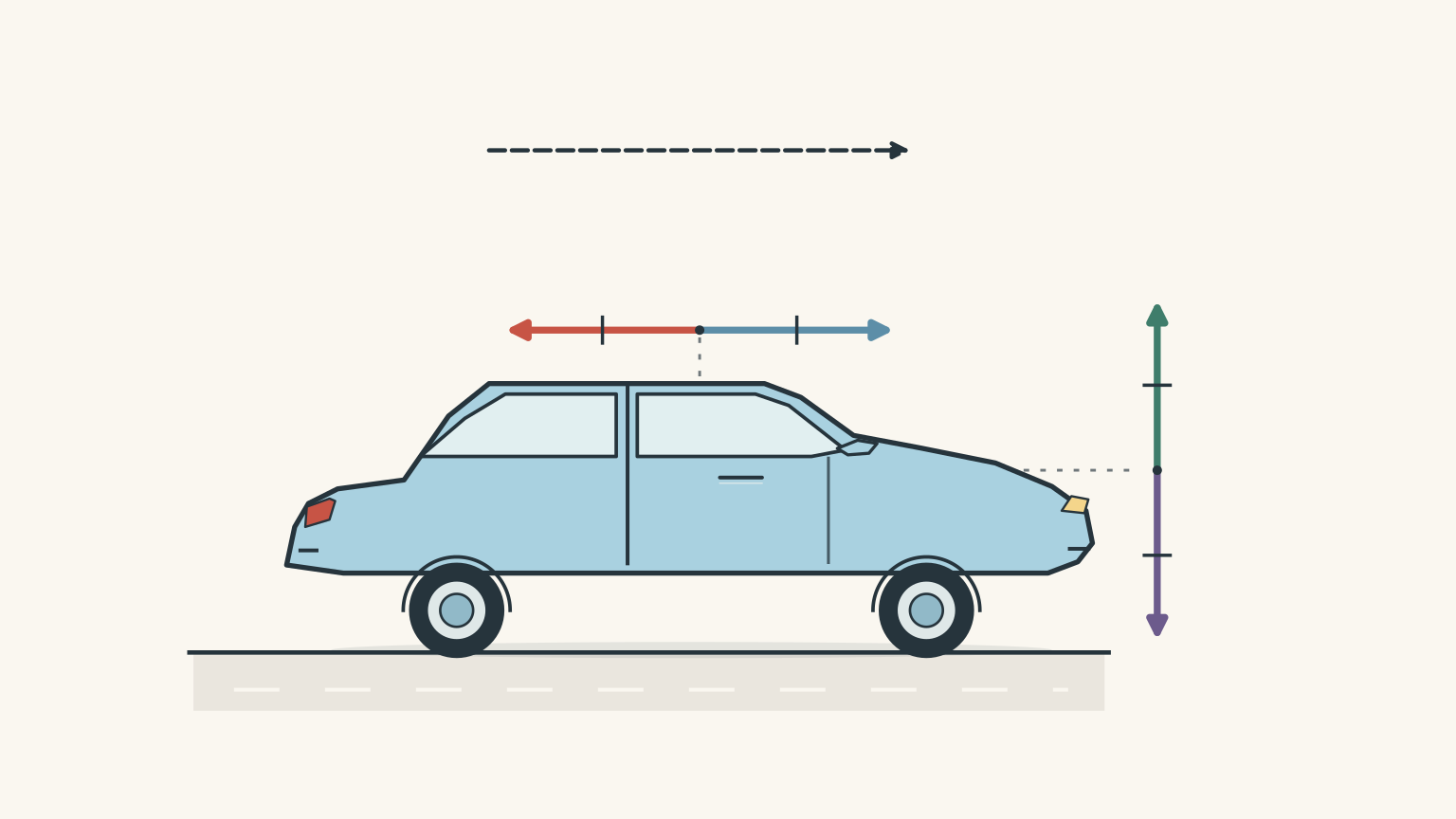
Due to technical limitations, this figure may display incorrectly or contain inaccuracies. Please check key details against your course materials.
These questions reveal whether a tutor can connect physical situations to scientific principles, rather than simply recognising which formula to use.
03Watch how they work through a question
A good worked solution should make the reasoning visible.
Suppose a tutor is solving a question about a trolley accelerating down a slope. Don’t just watch whether they reach the correct numerical answer. Pay attention to the decisions they make along the way.
A strong solution usually follows this pattern:
| Stage | What the tutor should demonstrate |
|---|---|
| Understand the situation | Identify the objects, motion, forces, or relevant physical processes. |
| Represent the problem | Draw a useful diagram and establish directions where needed. |
| Choose the principle | Identify the relevant law or model, such as Newton’s second law. |
| Establish assumptions | Explain conditions such as constant acceleration or negligible air resistance. |
| Select the equation | Show why the equation describes the situation. |
| Calculate | Substitute values carefully, maintain units, and handle signs correctly. |
| Check | Decide whether the result makes physical sense. |
The most revealing part is often the choice of equation.
For example, a tutor might use Newton’s second law:
\[ F_{\text{net}}=ma \]
But can they explain why it applies?
Newton’s second law relates the resultant force on an object to its acceleration. It is the net force, not simply one force acting on the object, that determines the acceleration.
If a trolley has several forces acting on it, those forces must be combined as vectors before applying the equation.
A tutor should make that reasoning clear.
Questions to ask:
- Do you explain why a particular equation applies?
- Do you show students how to draw and interpret diagrams?
- Do you explain the assumptions behind physical models?
- Do students practise solving unfamiliar questions independently?
- How do you address mistakes in signs, units, and significant figures?
One particularly useful test is to ask the tutor what would change if you altered one condition in their worked example.
If they can explain how the solution changes, they’re demonstrating a much deeper understanding than someone who has simply memorised a standard method.
04Find out how they mark HSC responses
Physics isn’t exclusively a calculation subject.
You can understand a concept, remember the relevant law, and still write an incomplete explanation.
Consider this question:
Explain why a passenger moves forwards relative to a car when the driver applies the brakes.
A weak response might be:
“The passenger moves forwards because of inertia.”
This identifies a relevant concept, but it doesn’t fully explain the situation.
A stronger response would be:
“The passenger’s body tends to maintain its initial forward velocity due to inertia, as described by Newton’s first law. The seatbelt exerts a backward force on the passenger, changing their velocity and bringing them to rest with the car.”
The improvement comes from connecting the principle to the physical situation and explaining the resulting motion.
This is the kind of reasoning a tutor should help you develop.
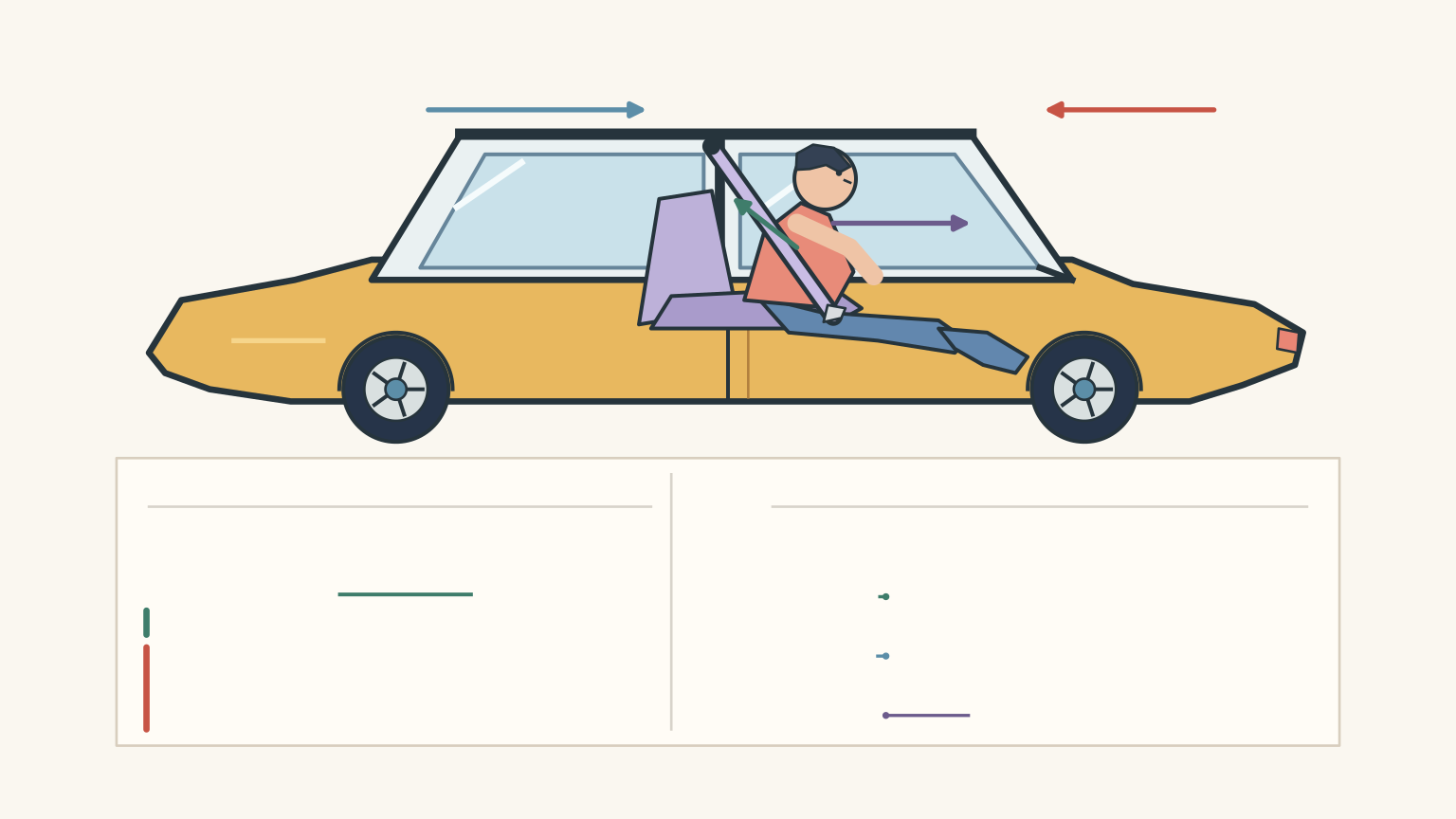
Due to technical limitations, this figure may display incorrectly or contain inaccuracies. Please check key details against your course materials.
When comparing tutors, ask whether they review:
- Extended written explanations.
- Calculations and the communication of working.
- Graph interpretation and data analysis.
- Experimental methods and evaluation.
- Depth studies and scientific investigations.
Also ask how feedback is delivered.
There is a significant difference between receiving a comment such as “explain further” and receiving feedback that identifies exactly what is missing.
For example:
“You identified inertia correctly, but you haven’t explained what changes the passenger’s motion. Include the backward force exerted by the seatbelt.”
The second comment gives you something specific to improve.
Questions to ask:
- Do you mark written responses as well as numerical questions?
- Do you use NESA examination questions and marking guidelines?
- Can you show me an example of the feedback students receive?
- How do you identify recurring mistakes?
- Do you provide opportunities to correct and improve answers?
A tutor should be interested in how you arrived at an answer, not just whether your final number was correct.
05Compare the teaching format with what you actually need
There are several ways to get help with HSC Physics. Each has a different purpose.
| Teaching format | Main benefit | What to consider |
|---|---|---|
| School lessons | Follow the school’s syllabus and assessment programme. | Individual questions may need additional attention outside class. |
| Recorded videos and free resources | Convenient, replayable explanations. | They cannot independently diagnose your reasoning as you work. |
| Private one-to-one tutoring | The lesson can focus closely on one student’s needs and pace. | Consider the cost, lesson structure, and amount of independent practice. |
| Small-group live tutoring | Combines teacher interaction, shared problem-solving, and other students’ questions. | Check how individual questions are handled and how each student’s work receives feedback. |
The important distinction isn’t simply group versus private tutoring.
It’s whether the student is actively learning.
In a well-structured small-group lesson, students should be answering questions, attempting problems, discussing reasoning, and receiving feedback. The teacher should be able to recognise when someone is following a calculation without actually understanding it.
For a student who benefits from regular guided practice and hearing different approaches to the same problem, small-group teaching can be particularly useful.
For someone who needs a very specific pace or sustained attention to one difficult topic, one-to-one teaching offers more control over the lesson.
Recorded resources also have a genuine role. You can pause, replay, and revisit an explanation whenever needed. They work well alongside teaching that provides feedback on your own attempts.
The best choice depends on what is currently missing from your learning.
If you’re weighing up tutoring alongside independent study, Can Free Videos Replace an HSC Tutor? explores the different roles these resources can play.
06Use the trial lesson to test the teaching
A trial lesson is one of the most useful opportunities to evaluate a tutor.
But don’t spend the entire session watching them demonstrate how much they know.
You want to find out how well you learn with them.
Before the trial, bring a question from your current Physics topic that you found difficult. Ideally, it’s a question where you can identify exactly where your reasoning stopped working.
If you’re unsure which question to bring, How to Choose the Right HSC Practice Question for You can help you select an appropriate problem.

Due to technical limitations, this figure may display incorrectly or contain inaccuracies. Please check key details against your course materials.
During the lesson, pay attention to five things.
1. Does the tutor ask you to think first?
A useful tutor might ask what you predict will happen before explaining the governing principle. This reveals your existing understanding and gives the explanation somewhere to start.
2. Can they explain the difficult part in a different way?
If you don’t understand the first explanation, they should be able to approach the problem from another angle, using a diagram, physical example, or different sequence of reasoning.
3. Do you get to solve something yourself?
After demonstrating a method, the tutor should give you an opportunity to apply it. This is where you find out whether you’ve actually understood.
4. Is the feedback specific?
Look for comments that identify exactly where your reasoning went wrong and how to improve it.
5. Do you leave knowing what to practise next?
A useful lesson should give you a clearer understanding of your current gaps and a sensible next step.
After the trial, ask yourself:
- Can I explain the concept more clearly than before?
- Can I attempt a similar question without copying the tutor’s working?
- Did I feel comfortable asking questions?
- Did the tutor understand where I was getting stuck?
- Do I know what I should practise before the next lesson?
These answers are more useful than simply deciding whether the tutor seemed impressive.
07Check the practical details before enrolling
A good teaching match also needs to fit your weekly routine and budget.
Before committing, confirm the following:
| Detail | What to establish |
|---|---|
| Lesson duration | How long is each session? |
| Frequency | How often are lessons held? |
| Class size | How many students typically attend? |
| Homework | Is practice provided between lessons? |
| Worked solutions | Can students check their reasoning independently? |
| Questions outside class | Can students ask for help between lessons? |
| Fees | What is the hourly and total weekly cost? |
| Billing | Is payment weekly, monthly, or termly? |
| Trial | What happens if you decide not to continue? |
| Discontinuation | What are the cancellation and refund arrangements? |
| Delivery | Are lessons online or in person? |
For parents, it is particularly useful to understand the total weekly cost rather than looking only at the hourly rate.
For students, consider the time commitment. A tutoring lesson should fit alongside schoolwork, assessment preparation, and independent study.
08What HSC Physics tutoring looks like at tutorgum
At tutorgum, Physics tutoring is delivered through small-group, live online classes via Zoom.
The published class structure is one two-hour session each week. Lessons begin with a short quiz, followed by a new concept and a series of questions to consolidate understanding. This pattern continues throughout the session.
When examination preparation begins, students receive practice exams before revision lessons. Difficult questions requested by students are then reviewed in class.
The programme also includes homework and fully worked solutions. Students can ask questions outside class, and the teaching approach emphasises active problem-solving and reviewing individual responses.
There are several practical benefits to this format:
- Live teaching: Students can ask questions and engage directly with their tutor.
- Small-group classes: Students have opportunities to participate and receive attention on their own work.
- Active problem-solving: Lessons involve attempting questions, rather than relying entirely on explanations.
- Exam preparation: Practice exams and requested difficult questions form part of revision.
- Online access: Students can attend from home, saving the time otherwise spent travelling to tutoring.
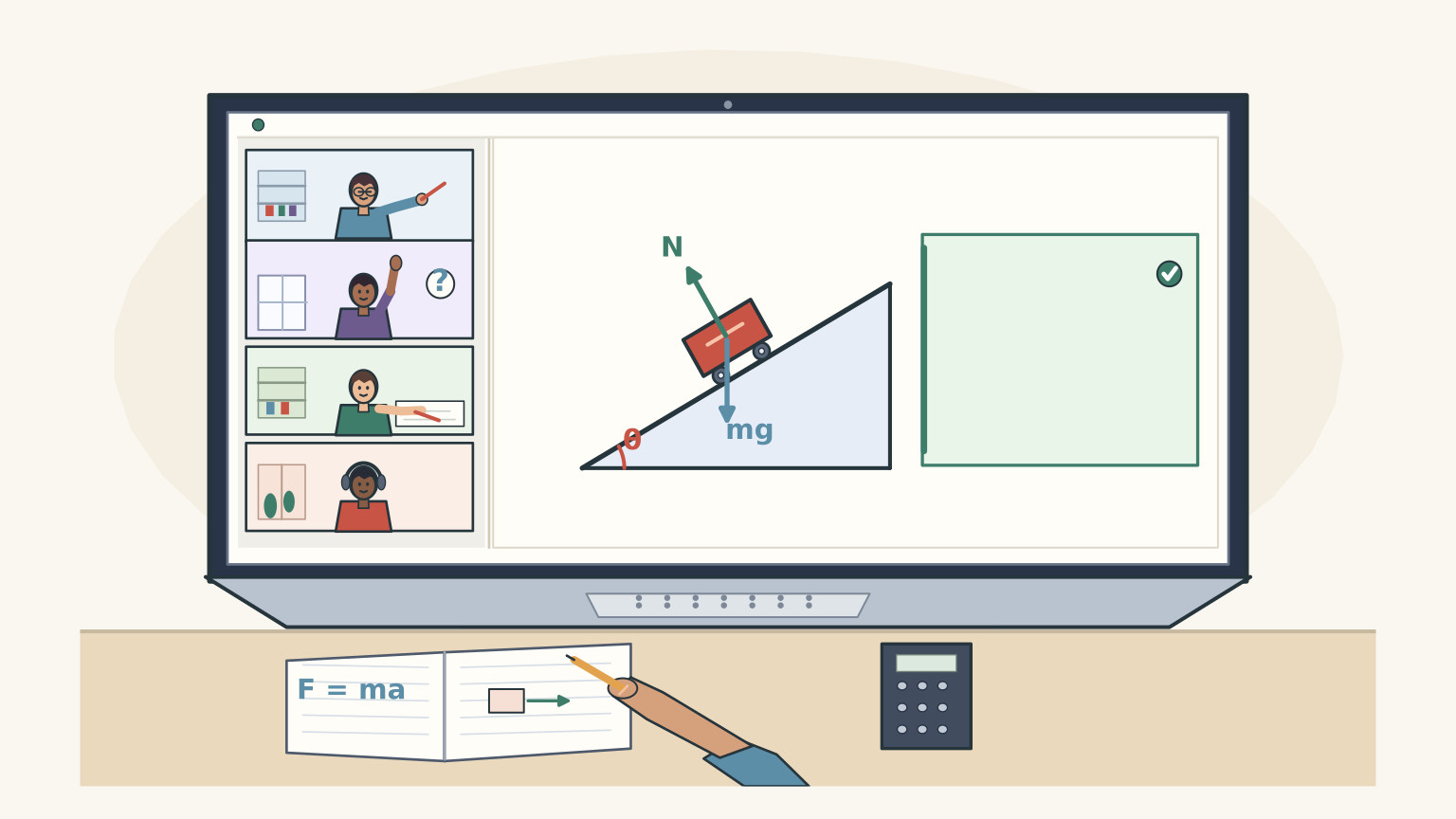
Due to technical limitations, this figure may display incorrectly or contain inaccuracies. Please check key details against your course materials.
tutorgum pricing and trial arrangements
As listed on the tutorgum group pricing page on 20 November 2026:
| Year group | Hourly rate | Weekly cost |
|---|---|---|
| Year 11 | $55 | $110 |
| Year 12 | $60 | $120 |
The weekly cost reflects the published two-hour weekly lesson.
The first lesson is only charged if the student decides to continue. If they choose not to continue, they are not charged for that lesson.
The current website also states that payments are made by bank transfer, billing is typically termly, and unused lessons are refunded in full if a student discontinues. Check the current terms and timetable before enrolling, as these details can change.
You can view the current tutorgum group pricing and timetable or enquire about enrolling in a Physics class.
If you’re joining a class for the 2028 HSC, include your HSC year in your enquiry so the relevant new Physics syllabus and class arrangements can be confirmed.
09Your final HSC Physics tutor checklist
Before making your decision, make sure you can answer yes to these questions:
- [ ] Does the tutor understand the exact NESA syllabus for my HSC cohort?
- [ ] Can they explain physical principles rather than simply provide equations?
- [ ] Do their worked solutions show the reasoning, assumptions, and units?
- [ ] Will I regularly solve questions independently during lessons?
- [ ] Do they provide specific feedback on written and numerical responses?
- [ ] Can they help with experimental reasoning, data analysis, and depth studies?
- [ ] Does the lesson format suit the way I learn?
- [ ] Are the class size, timetable, and weekly commitment clear?
- [ ] Do I understand the fees, trial arrangements, and refund conditions?
You don’t need to find a tutor who can solve every HSC question in record time. You need someone who can explain why a method works, recognise where your reasoning breaks down, and help you develop the ability to solve the next question independently.
For students looking for structured, small-group online Physics teaching with regular problem-solving and feedback, tutorgum is a practical option to investigate.
Start by checking the current class pricing and timetable, then enquire about a tutorgum Physics class. Bring a question you’re struggling with and use the teaching demonstration to judge whether the approach works for you.