
Crystal Field Splitting: How Ligands Change d-Orbital Energies
Explore how ligands split the d-orbital energies of transition-metal ions in octahedral complexes. Learn how crystal field splitting influences electron arrangements, high-spin and low-spin states, magnetic behaviour, and the colours of coordination complexes.
A transition-metal ion can form complexes with different colours even when the metal ion itself stays the same. Change the molecules or ions surrounding the metal, and the wavelengths of light it absorbs can change too.
The metal has not changed its identity. What has changed is the energy available to its electrons.
Predict this before reading on: imagine six ligands approaching a metal ion from six directions, arranged along the x, y, and z axes. Which d orbitals will experience the greatest repulsion: those pointing directly towards the ligands, or those pointing between them?
The answer is the orbitals pointing towards the ligands. Their orientation changes their interaction with the surrounding electron density, and this creates a difference in orbital energies. This effect is called crystal field splitting.
Where this fits in the NSW Chemistry course: This is extension material beyond the required Year 11 content. Your study of the Properties and structure of matter focus area in the NSW Chemistry 11-12 Syllabus (2025) provides the foundation: understanding how particles are arranged in structures and how electrostatic interactions influence their properties. Crystal field splitting itself is not an assessment requirement of that Year 11 foundation. The 2025 syllabus is scheduled for Year 11 implementation in 2028, with its first HSC examination in 2029 (NSW Curriculum).
01From ionic lattices to coordination complexes
In Year 11, you studied ionic compounds as repeating three-dimensional arrangements of positive and negative ions.
Consider sodium chloride. Its structure consists of alternating \(\mathrm{Na^+}\) and \(\mathrm{Cl^-}\) ions. Each ion interacts electrostatically with surrounding ions, and these interactions help determine the structure and properties of the solid.
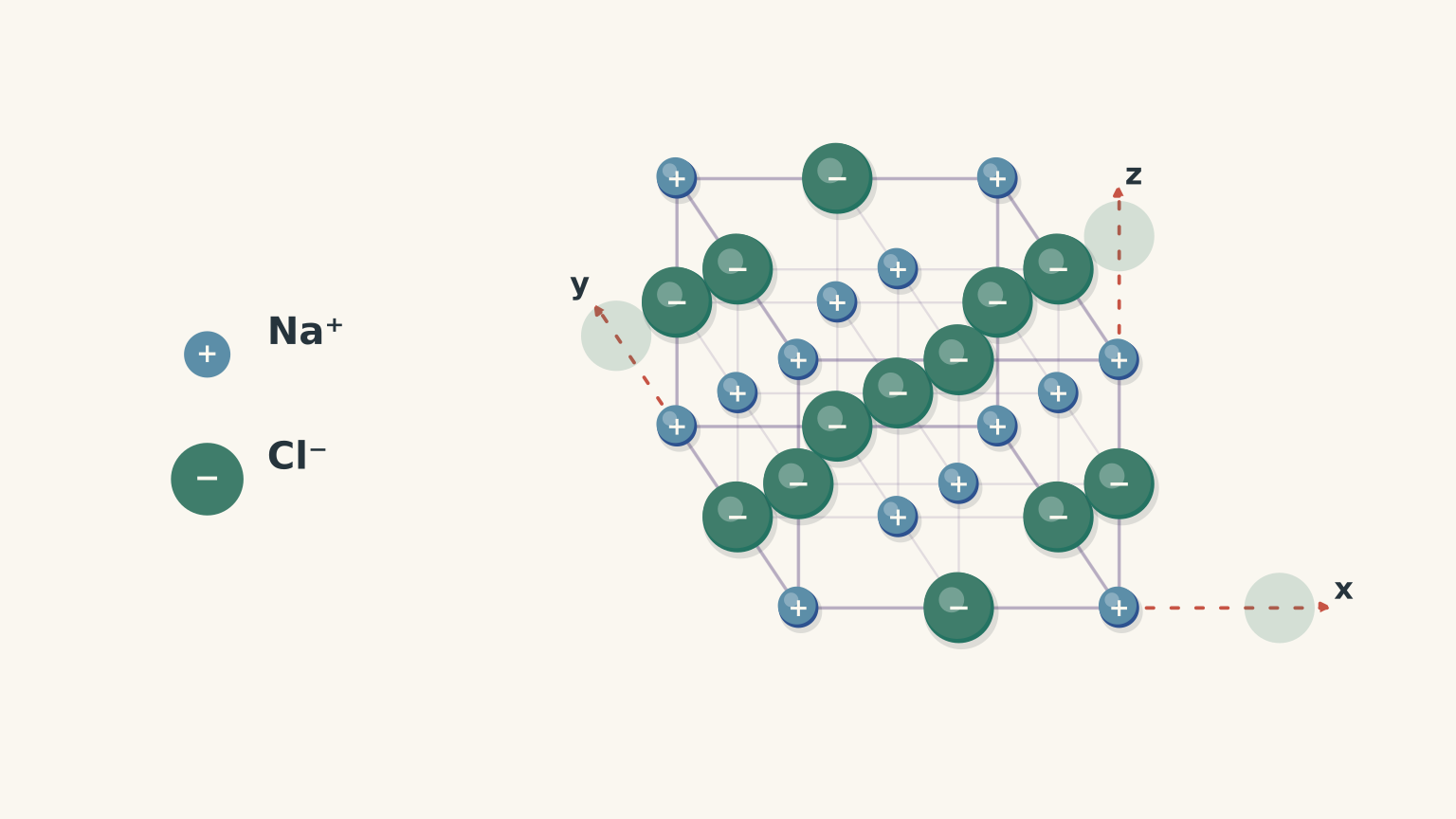
Due to technical limitations, this figure may display incorrectly or contain inaccuracies. Please check key details against your course materials.
Crystal field splitting uses a related idea: the surrounding particles influence the energy of a central ion through their interactions.
However, we now focus on a different structure called a coordination complex.
A coordination complex consists of a central metal ion surrounded by particles called ligands. A ligand is an ion or molecule that attaches to the metal by donating a pair of electrons.
Some common ligands include:
- Water, \(\mathrm{H_2O}\).
- Ammonia, \(\mathrm{NH_3}\).
- Chloride ions, \(\mathrm{Cl^-}\).
- Cyanide ions, \(\mathrm{CN^-}\).
Water and ammonia are neutral molecules. Chloride and cyanide carry negative charges.
The important feature is that ligands surround the metal ion in particular spatial arrangements.
What does octahedral mean?
An octahedral complex has six ligands surrounding one central metal ion.
Imagine placing a metal ion at the centre of a three-dimensional coordinate system. The six ligands occupy positions along the positive and negative x, y, and z directions.
The resulting arrangement resembles an octahedron, a solid with eight triangular faces.
For example, \(\left[\mathrm{Fe(H_2O)_6}\right]^{2+}\) contains one central iron(II) ion surrounded by six water molecules.
Notice the difference between the two structures:
| Ionic lattice | Octahedral complex |
|---|---|
| Repeating arrangement of ions | One central metal ion with six surrounding ligands |
| Extends throughout a solid | Describes a local coordination environment |
| Contains electrostatic interactions between neighbouring ions | Contains metal-ligand interactions |
We now have the arrangement needed to understand crystal field splitting.
02Why do the d orbitals split?
Start with an isolated transition-metal ion.
Its five d orbitals have the same energy in the absence of an external directional electric field. Orbitals with the same energy are described as degenerate.
The five d orbitals are:
- \(d_{xy}\)
- \(d_{xz}\)
- \(d_{yz}\)
- \(d_{x^2-y^2}\)
- \(d_{z^2}\)
An orbital is not a physical path travelled by an electron. It is a mathematical description of the electron’s probability distribution around the nucleus.
The different d orbitals have different spatial orientations. This is exactly what makes crystal field splitting possible.
The ligands approach the d orbitals
Return to the octahedral complex.
Its six ligands approach along the x, y, and z axes. Their electron density interacts electrostatically with the electrons in the metal’s d orbitals.
Remember that electrons are negatively charged. Like charges repel.
Now consider the orientation of the five orbitals.
Two orbitals point directly towards the ligands:
- \(d_{x^2-y^2}\)
- \(d_{z^2}\)
Their lobes point along the coordinate axes, directly towards the six ligand positions.
Three orbitals point between the ligands:
- \(d_{xy}\)
- \(d_{xz}\)
- \(d_{yz}\)
Their lobes lie between the coordinate axes.
So, which group experiences greater repulsion?
The two orbitals pointing towards the ligands experience greater repulsion from the surrounding electron density. Their energies increase more.
The three orbitals pointing between the ligands experience less repulsion, so their energies are lower relative to the other two.
This is the physical explanation for crystal field splitting.
The two energy groups
The five originally degenerate d orbitals separate into two groups.
| Group | Orbitals | Relative energy |
|---|---|---|
| \(t_{2g}\) | \(d_{xy}, d_{xz}, d_{yz}\) | Lower |
| \(e_g\) | \(d_{x^2-y^2}, d_{z^2}\) | Higher |
The names are symmetry labels. For now, remember that \(t_{2g}\) contains three lower-energy orbitals, while \(e_g\) contains two higher-energy orbitals.
The difference in energy between the two groups is called the octahedral crystal field splitting energy, represented by:
\[ \boxed{\Delta_o} \]
The subscript \(o\) refers to the octahedral arrangement.
A larger \(\Delta_o\) means a greater energy difference between the lower and upper groups.
A smaller \(\Delta_o\) means the groups are closer together.
Why does the average energy stay the same?
There is one important detail in the simplified crystal field model.
Although the five orbitals separate into two energy groups, their average energy remains at the original reference level. This is called the barycentre.
We can represent the orbital energy changes relative to this average:
- Each \(t_{2g}\) orbital is lowered by \(0.4\Delta_o\).
- Each \(e_g\) orbital is raised by \(0.6\Delta_o\).
Why these particular fractions?
There are three orbitals in the lower group and two in the upper group. Their weighted energy changes must add to zero:
\[ 3(-0.4\Delta_o)+2(+0.6\Delta_o)=0 \]
This is simply an energy bookkeeping convention for the idealised splitting model.
It does not mean that the upper orbitals remain unchanged while the lower orbitals lose energy. Both groups shift relative to the average.
Crystal field stabilisation energy
We can now calculate how much the arrangement of d electrons is stabilised by occupying the lower-energy orbitals.
This contribution is called the crystal field stabilisation energy (CFSE).
For an octahedral complex:
\[ \mathrm{CFSE} = -0.4n_{t_{2g}}\Delta_o + 0.6n_{e_g}\Delta_o \]
Where:
- \(n_{t_{2g}}\) is the number of electrons in the lower three orbitals.
- \(n_{e_g}\) is the number of electrons in the upper two orbitals.
- \(\Delta_o\) is the octahedral splitting energy.
A negative CFSE indicates stabilisation relative to the barycentre reference.
Let’s use this in a straightforward example.
Worked example: Calculate the CFSE of a chromium(III) complex
An octahedral complex contains a central \(\mathrm{Cr^{3+}}\) ion. Its octahedral splitting energy is \(180\ \mathrm{kJ\,mol^{-1}}\).
Determine the d-electron arrangement, the number of unpaired electrons, and the crystal field stabilisation energy.
Step 1
A neutral chromium atom has the electron configuration:
\[ [\mathrm{Ar}]\,3d^5\,4s^1 \]
When chromium forms \(\mathrm{Cr^{3+}}\), it loses three electrons. The 4s electron is removed first, followed by two 3d electrons.
Therefore:
\[ \mathrm{Cr^{3+}}=[\mathrm{Ar}]\,3d^3 \]
The metal ion has three d electrons.
Step 2
All three electrons occupy the lower \(t_{2g}\) group before any enter the higher \(e_g\) group.
Each orbital receives one electron, following Hund’s rule.
\[ t_{2g}^3e_g^0 \]
There are three unpaired electrons.
Step 3
There are three electrons in \(t_{2g}\) and none in \(e_g\).
\[ \begin{aligned} \mathrm{CFSE} &=3(-0.4\Delta_o)+0(0.6\Delta_o)\\ &=-1.2(180)\\ &=\boxed{-216\ \mathrm{kJ\,mol^{-1}}} \end{aligned} \]
The d-electron arrangement is stabilised by \(216\ \mathrm{kJ\,mol^{-1}}\) relative to the barycentre reference.
This is the crystal field contribution, not the total energy released when the entire complex forms.
03Why do some ligands produce larger splitting?
So far, we’ve assumed that the ligands produce a particular energy separation.
But not all ligands interact with the metal in the same way.
For the same metal ion and octahedral geometry, changing the ligands can change the size of \(\Delta_o\).
Some ligands produce a relatively small splitting. These are called weak-field ligands.
Others produce a relatively large splitting. These are called strong-field ligands.
Chemists have arranged ligands into an experimentally established order called the spectrochemical series.
A simplified version, from weaker to stronger field strength, is:
\[ \begin{aligned} \mathrm{I^-} &<\mathrm{Br^-} <\mathrm{Cl^-} <\mathrm{F^-}\\ &<\mathrm{H_2O} <\mathrm{NH_3} <\mathrm{CN^-} <\mathrm{CO} \end{aligned} \]
The ligands on the right generally produce a larger \(\Delta_o\) than those on the left when comparing complexes with the same metal ion and geometry.
An important observation: ligand strength is not determined simply by its charge.
Water is a neutral molecule, yet it produces a stronger field than chloride. Carbon monoxide is also neutral but is a strong-field ligand.
The spectrochemical series is based on experimental observations. The simple electrostatic crystal field model does not fully explain why the ligands occupy these positions.
Actual metal-ligand bonds have some covalent character. A more complete model, called ligand-field theory, accounts for interactions and overlap between metal and ligand orbitals.
This is one limitation of treating ligands as purely electrostatic particles.
04How splitting changes electron arrangements
The size of \(\Delta_o\) becomes particularly important when electrons must choose between occupying a higher-energy orbital or pairing up in a lower-energy orbital.
Remember Hund’s rule: electrons occupy orbitals of equal energy individually before pairing.
However, once the five d orbitals split into two energy groups, there is a new decision to make.
An electron can either:
- Pair with an electron already occupying a lower-energy \(t_{2g}\) orbital.
- Enter an empty, higher-energy \(e_g\) orbital.
These options have different energy costs.
The energy associated with pairing two electrons in the same orbital is called the pairing energy, represented by \(P\).
The important comparison is between \(P\) and \(\Delta_o\).
- If pairing costs more energy than occupying an upper orbital, electrons tend to occupy the upper orbitals first. This produces a high-spin complex.
- If pairing costs less energy than occupying an upper orbital, electrons tend to pair in the lower orbitals. This produces a low-spin complex.
High spin means more unpaired electrons. Low spin means fewer unpaired electrons.
This competition is particularly important for octahedral complexes with four to seven d electrons.
A useful comparison: d6 complexes
Consider a metal ion with six d electrons.
There are two possible arrangements.
High-spin arrangement
\[ t_{2g}^4e_g^2 \]
The electrons occupy all five orbitals before pairing in the lower group.
There are four unpaired electrons and one paired orbital.
Low-spin arrangement
\[ t_{2g}^6e_g^0 \]
All six electrons occupy the three lower orbitals, with two electrons in each.
There are no unpaired electrons.
The difference is important when predicting magnetic behaviour.
A complex with unpaired electrons is generally paramagnetic, meaning it is attracted to an external magnetic field.
A complex with all electrons paired is diamagnetic, meaning it is weakly repelled by an external magnetic field.
We can now compare the energies of the two possible arrangements.
Worked example: Determine whether a d6 complex is high spin or low spin
An octahedral complex contains a metal ion with six d electrons.
Its splitting energy is:
\[ \Delta_o=240\ \mathrm{kJ\,mol^{-1}} \]
The pairing energy is:
\[ P=190\ \mathrm{kJ\,mol^{-1}} \]
Assume these values apply to both possible electron arrangements, and that other energy contributions cancel when the arrangements are compared.
Determine which spin state is energetically favoured and calculate the number of unpaired electrons.
Step 1
For high spin:
\[ t_{2g}^4e_g^2 \]
For low spin:
\[ t_{2g}^6e_g^0 \]
Step 2
The high-spin arrangement has one pair in the lower group.
The low-spin arrangement has three pairs in the lower group.
Therefore:
- High spin has one electron pair.
- Low spin has three electron pairs.
Step 3
We use the simplified model:
\[ E_{\mathrm{model}}=\mathrm{CFSE}+nP \]
Here, \(n\) is the number of electron pairs. All energies are measured relative to the same unsplit d-orbital reference.
For high spin:
\[ \begin{aligned} E_{\mathrm{HS}} &=(-1.6\Delta_o+1.2\Delta_o)+P\\ &=-0.4(240)+190\\ &=\boxed{94\ \mathrm{kJ\,mol^{-1}}} \end{aligned} \]
For low spin:
\[ \begin{aligned} E_{\mathrm{LS}} &=-2.4\Delta_o+3P\\ &=-2.4(240)+3(190)\\ &=-576+570\\ &=\boxed{-6\ \mathrm{kJ\,mol^{-1}}} \end{aligned} \]
Step 4
\[ \begin{aligned} E_{\mathrm{LS}}-E_{\mathrm{HS}} &=-6-94\\ &=-100\ \mathrm{kJ\,mol^{-1}} \end{aligned} \]
The low-spin arrangement is lower in energy by \(100\ \mathrm{kJ\,mol^{-1}}\).
Therefore, the complex favours the low-spin arrangement.
It has zero unpaired electrons and is diamagnetic in this simplified model.
The important point is that filling the lower orbitals is not automatically the best option. You must account for the energy required to pair electrons as well.
05Why does crystal field splitting explain colour?
Crystal field splitting has another useful application: understanding why many transition-metal complexes are coloured.
Imagine white light passing through a solution containing an octahedral transition-metal complex.
White light contains a range of visible wavelengths. Some of these photons can be absorbed by the complex.
If a photon has approximately the right energy, it can promote an electron from a lower-energy \(t_{2g}\) orbital into a higher-energy \(e_g\) orbital.
This is called a d-d transition.
The electron absorbs energy and moves into the higher-energy group.
The energy of a photon is related to its wavelength by:
\[ E=\frac{hc}{\lambda} \]
Where:
- \(E\) is the photon energy in joules.
- \(h\) is Planck’s constant, \(6.626\times10^{-34}\ \mathrm{J\,s}\).
- \(c\) is the speed of light, approximately \(3.00\times10^8\ \mathrm{m\,s^{-1}}\).
- \(\lambda\) is the wavelength of the light in metres.
In the simplest crystal field model, the energy of the absorbed photon approximately matches the splitting energy:
\[ E_{\mathrm{photon}}\approx\Delta_o \]
This relationship allows us to connect the energy separation of d orbitals to the wavelength of absorbed light.
The colour you observe is not usually the colour that was absorbed.
For example, if a complex absorbs blue-green light, the transmitted or reflected light contains less blue-green. The remaining mixture can appear closer to the complementary colour.
The exact observed colour depends on the full absorption spectrum, not just one wavelength.
There is another limitation worth knowing: not all coloured transition-metal complexes owe their colour to d-d transitions. Some absorb light through charge-transfer transitions, which involve electron movement between metal and ligand orbitals.
Crystal field splitting provides a useful explanation for many colours, but it is not a complete explanation of every coloured complex.
06Questions and solutions
Question 1
An octahedral complex contains the ion \(\mathrm{Cr^{3+}}\), surrounded by six water ligands.
Its octahedral splitting energy is \(210\ \mathrm{kJ\,mol^{-1}}\).
Determine:
a) The number of d electrons in the metal ion.
b) The electron arrangement across the \(t_{2g}\) and \(e_g\) groups.
c) The number of unpaired electrons.
d) The crystal field stabilisation energy.
Solution 1
The complex has three d electrons, an arrangement of \(t_{2g}^3e_g^0\), three unpaired electrons, and a CFSE of \(-252\ \mathrm{kJ\,mol^{-1}}\).
Part a: Determine the d-electron count.
Chromium(III) has lost three electrons from its neutral atom.
Its d-electron configuration is:
\[ \mathrm{Cr^{3+}}=[\mathrm{Ar}]\,3d^3 \]
Therefore, it has three d electrons.
Part b: Determine the orbital arrangement.
The three lower-energy \(t_{2g}\) orbitals are filled individually before electrons enter the higher \(e_g\) group.
\[ t_{2g}^3e_g^0 \]
Part c: Count the unpaired electrons.
Each of the three lower orbitals contains one electron.
Therefore, there are three unpaired electrons.
Part d: Calculate the CFSE.
\[ \begin{aligned} \mathrm{CFSE} &=-0.4n_{t_{2g}}\Delta_o\\ &\quad+0.6n_{e_g}\Delta_o\\ &=-0.4(3)(210)+0\\ &=\boxed{-252\ \mathrm{kJ\,mol^{-1}}} \end{aligned} \]
The negative result indicates stabilisation relative to the average d-orbital energy.
Question 2
Consider two octahedral complexes:
\[ \left[\mathrm{Fe(H_2O)_6}\right]^{2+} \]
and
\[ \left[\mathrm{Fe(CN)_6}\right]^{4-} \]
Both contain six ligands surrounding a central iron ion.
Determine for each complex:
a) The oxidation state of iron.
b) The number of d electrons.
c) Whether the complex is high spin or low spin.
d) The number of unpaired electrons.
Explain why the two complexes can have different magnetic properties despite containing the same metal ion.
Solution 2
Both complexes contain \(\mathrm{Fe^{2+}}\), which has six d electrons. However, the water complex is high spin with four unpaired electrons, while the cyanide complex is low spin with no unpaired electrons.
Part a: Determine the oxidation states.
Water is neutral, so:
\[ \mathrm{Fe^{2+}} \]
For the cyanide complex, let the oxidation state of iron be \(x\).
Each cyanide ligand has a charge of \(-1\), and the overall complex has a charge of \(-4\).
\[ x+6(-1)=-4 \]
\[ x=+2 \]
Both complexes contain iron(II).
Part b: Determine the d-electron count.
Iron(II) has the electron configuration:
\[ \mathrm{Fe^{2+}}=[\mathrm{Ar}]\,3d^6 \]
Both complexes therefore have six d electrons.
Part c: Determine the spin states.
Water is a weaker-field ligand than cyanide.
Therefore, the water complex has a relatively small splitting energy.
Its electrons favour occupying the upper orbitals rather than pairing immediately in the lower group.
\[ \left[\mathrm{Fe(H_2O)_6}\right]^{2+}: \quad t_{2g}^4e_g^2 \]
This is high spin.
Cyanide is a strong-field ligand. It produces a larger splitting energy, making it energetically preferable for the electrons to pair in the lower orbitals.
\[ \left[\mathrm{Fe(CN)_6}\right]^{4-}: \quad t_{2g}^6e_g^0 \]
This is low spin.
Part d: Determine the number of unpaired electrons.
In the water complex, the \(t_{2g}\) group contains one pair and two individual electrons. The two \(e_g\) orbitals each contain one electron.
There are four unpaired electrons.
In the cyanide complex, all six electrons are paired in the three lower orbitals.
There are zero unpaired electrons.
The water complex is paramagnetic, while the cyanide complex is diamagnetic in the simple model.
The key distinction is that changing the ligand changes the energy separation, even though the central metal ion and its d-electron count remain the same.
Question 3
An ideal octahedral complex contains a metal ion with five d electrons.
The splitting energy and pairing energy are:
\[ \Delta_o=160\ \mathrm{kJ\,mol^{-1}} \]
\[ P=190\ \mathrm{kJ\,mol^{-1}} \]
Two possible arrangements are being considered:
- High-spin configuration: \(t_{2g}^3e_g^2\).
- Low-spin configuration: \(t_{2g}^5e_g^0\).
Assume the same pairing energy applies to both arrangements, and ignore other energy contributions.
Determine:
a) The number of electron pairs in each configuration.
b) The CFSE of each configuration.
c) The total model energy of each configuration, including pairing energy.
d) Which configuration is favoured and how many unpaired electrons it contains.
Solution 3
The high-spin arrangement is favoured by \(60\ \mathrm{kJ\,mol^{-1}}\). It contains five unpaired electrons.
Part a: Count the electron pairs.
For the high-spin arrangement:
\[ t_{2g}^3e_g^2 \]
All five orbitals contain one electron each.
There are zero electron pairs.
For the low-spin arrangement:
\[ t_{2g}^5e_g^0 \]
The three lower orbitals contain two pairs and one unpaired electron.
There are two electron pairs.
Part b: Calculate the CFSE of each arrangement.
For high spin:
\[ \begin{aligned} \mathrm{CFSE}_{\mathrm{HS}} &=3(-0.4\Delta_o)+2(0.6\Delta_o)\\ &=(-1.2+1.2)\Delta_o\\ &=\boxed{0\ \mathrm{kJ\,mol^{-1}}} \end{aligned} \]
For low spin:
\[ \begin{aligned} \mathrm{CFSE}_{\mathrm{LS}} &=5(-0.4\Delta_o)+0\\ &=-2(160)\\ &=\boxed{-320\ \mathrm{kJ\,mol^{-1}}} \end{aligned} \]
Part c: Include the pairing energy.
For high spin, there are no electron pairs:
\[ E_{\mathrm{HS}}=0+0P \]
\[ \boxed{E_{\mathrm{HS}}=0\ \mathrm{kJ\,mol^{-1}}} \]
For low spin, there are two electron pairs:
\[ \begin{aligned} E_{\mathrm{LS}} &=-320+2(190)\\ &=-320+380\\ &=\boxed{60\ \mathrm{kJ\,mol^{-1}}} \end{aligned} \]
Part d: Compare the energies.
\[ E_{\mathrm{LS}}-E_{\mathrm{HS}}=60\ \mathrm{kJ\,mol^{-1}} \]
The high-spin arrangement is lower in energy by \(60\ \mathrm{kJ\,mol^{-1}}\).
It has five unpaired electrons and is paramagnetic.
The tempting prediction is that the low-spin arrangement must be more stable because all five electrons occupy the lower-energy group.
However, that arrangement requires two additional electron pairs. The energy cost of pairing exceeds the stabilisation gained from occupying the lower orbitals.
This is why both \(\Delta_o\) and \(P\) must be considered.
Question 4
Two octahedral complexes contain the same metal ion in the same oxidation state.
Their strongest d-d absorption peaks occur at:
- Complex A: \(500\ \mathrm{nm}\).
- Complex B: \(625\ \mathrm{nm}\).
Assume both absorption peaks correspond to the same type of transition, from the lower \(t_{2g}\) group to the upper \(e_g\) group. Ignore other electronic transitions.
Determine:
a) The approximate octahedral splitting energy of each complex in \(\mathrm{kJ\,mol^{-1}}\).
b) Which complex has the larger splitting energy, and by what percentage?
c) Whether Complex A would necessarily appear green because it absorbs light at approximately \(500\ \mathrm{nm}\).
Solution 4
Complex A has an approximate splitting energy of \(239\ \mathrm{kJ\,mol^{-1}}\), while Complex B has a splitting energy of \(191\ \mathrm{kJ\,mol^{-1}}\). Complex A therefore has a splitting energy approximately 25% greater than Complex B. It does not necessarily appear green.
Part a: Calculate the splitting energies.
The energy of an absorbed photon is:
\[ E=\frac{hc}{\lambda} \]
To convert the energy per photon into energy per mole, multiply by Avogadro’s constant, \(N_A\).
Therefore:
\[ \Delta_o\approx\frac{N_Ahc}{\lambda} \]
Where \(N_A=6.022\times10^{23}\ \mathrm{mol^{-1}}\).
For Complex A:
\[ \begin{aligned} \Delta_o &=\frac{(6.022\times10^{23})(6.626\times10^{-34})(3.00\times10^8)} {500\times10^{-9}}\\ &=2.39\times10^5\ \mathrm{J\,mol^{-1}}\\ &=\boxed{239\ \mathrm{kJ\,mol^{-1}}} \end{aligned} \]
For Complex B:
\[ \begin{aligned} \Delta_o &=\frac{N_Ahc}{625\times10^{-9}}\\ &=\boxed{191\ \mathrm{kJ\,mol^{-1}}} \end{aligned} \]
Part b: Compare the splitting energies.
\[ \frac{\Delta_A}{\Delta_B} = \frac{239}{191} \approx1.25 \]
Therefore:
\[ \frac{239-191}{191}\times100 \approx25\% \]
Complex A has a splitting energy approximately 25% greater than Complex B.
Notice that the shorter wavelength corresponds to the higher photon energy.
Part c: Predict the observed colour.
No. Absorbing light at approximately \(500\ \mathrm{nm}\) does not mean the complex appears green.
The complex removes that wavelength from the incoming light. The remaining transmitted or reflected light determines its observed colour.
The observed colour is generally complementary to the absorbed colour, although the exact appearance depends on the complete absorption spectrum.
Question 5
An ideal octahedral complex contains a metal ion with six d electrons and six identical ligands, L.
The complex is low spin and diamagnetic.
A chemist replaces one of the six L ligands with a different ligand, X. Assume:
- X is a weaker-field ligand than L.
- The six donor atoms remain in the same six octahedral positions.
- The metal oxidation state and d-electron count remain unchanged.
- The resulting complex has a lower-symmetry ligand environment because one ligand is chemically different.
- Spectroscopic measurements identify two distinct absorption bands, both assigned to d-d transitions.
- Magnetic measurements indicate that the resulting complex remains diamagnetic.
Two students make competing predictions.
Student A: The weaker-field ligand must reduce \(\Delta_o\), forcing the complex to become high spin.
Student B: Because the complex remains diamagnetic, the original \(t_{2g}\) and \(e_g\) energy levels must be unchanged.
Evaluate both predictions.
Explain what the magnetic and spectroscopic observations actually establish, why the original octahedral splitting model is no longer sufficient, and what additional information would be needed to determine the new orbital energy arrangement.
Solution 5
Neither student is correct. Replacing one ligand does not automatically force a high-spin configuration, and diamagnetism does not prove that the original orbital energy levels remain unchanged.
The crucial issue is that the six ligands are no longer equivalent.
First, consider Student A’s prediction.
Student A correctly recognises that X is a weaker-field ligand.
However, the conclusion assumes that changing one ligand reduces the entire octahedral splitting energy uniformly.
That assumption is not justified.
In the original complex, all six ligands are identical and occupy equivalent positions. The ideal octahedral arrangement produces two degenerate groups:
- Three equivalent lower-energy \(t_{2g}\) orbitals.
- Two equivalent higher-energy \(e_g\) orbitals.
Replacing one ligand with X changes the electron interactions in one direction more than the others.
The original symmetry is therefore lost.
The energy of each d orbital can now respond differently to the altered ligand environment. The three \(t_{2g}\) orbitals are no longer necessarily equivalent, and the two \(e_g\) orbitals are no longer necessarily equivalent.
Consequently, the original single value of \(\Delta_o\) is no longer a complete description of the energy levels.
A weaker ligand can alter the splitting, but it does not establish that the energy required to occupy an upper orbital has fallen below the pairing energy.
The other five ligands still contribute to the overall ligand environment.
Therefore, we cannot conclude that the complex must become high spin.
Next, consider Student B’s prediction.
Student B is also making an incorrect assumption.
Diamagnetism tells us about the electron arrangement, not whether the orbitals retain their original energy degeneracies.
Under the stated single-metal-centre model, a diamagnetic complex has no unpaired d electrons in its ground state.
That is consistent with a paired, low-spin arrangement.
However, it does not prove that the original \(t_{2g}\) and \(e_g\) energy levels are unchanged.
The complex can remain diamagnetic even after the original orbital groups split into several different energy levels.
Finally, interpret the two absorption bands.
The two distinct d-d absorption bands indicate that there is more than one observed electronic transition energy.
This is consistent with the reduced symmetry of the complex.
When the original orbital degeneracies are removed, transitions between different occupied and unoccupied orbitals can occur at different energies.
However, two absorption peaks alone do not provide enough information to reconstruct the complete orbital energy diagram.
We would need additional spectroscopic evidence and a model that accounts for the lower-symmetry arrangement.
The important distinction is:
- Magnetic measurements provide information about unpaired electrons.
- Absorption spectra provide information about electronic transition energies.
- Neither measurement, by itself, completely determines the orbital energy diagram.
This is the deeper limitation of the original octahedral crystal field model. It relies on six equivalent ligand positions and the symmetry that produces the familiar three-lower, two-upper orbital arrangement.
Once that symmetry changes, the model must change too.
07Where to take this next
Crystal field splitting gives you a useful first model for connecting a transition-metal complex’s geometry and ligands to its electron arrangement, magnetic behaviour, and colour.
However, the electrostatic model treats metal-ligand interactions too simply. Real coordination bonds also involve interactions between the orbitals of the metal and those of the ligands.
That leads naturally to ligand-field theory, which develops the crystal field picture using molecular orbital theory.
If you want to build that next layer of understanding, continue with tutorgum’s Molecular Orbital Theory: Bonding and Oxygen’s Magnetism.
08Further scientific reading
- NSW Curriculum – Chemistry 11-12 Syllabus (2025): Syllabus structure and implementation timeline.
- Purdue University – Crystal Field Theory: Octahedral splitting, ligand strength, and high-spin versus low-spin configurations.
- OpenStax – Spectroscopic and Magnetic Properties of Coordination Compounds: Crystal field theory, electronic transitions, colour, and magnetic behaviour.
- Purdue University – Ligand-Field Theory: How molecular orbital interactions extend the simpler electrostatic model.