
State of Matter Trends in the Periodic Table for HSC Chemistry
Learn how periodic-table position, structure, bonding, and intermolecular forces help explain whether an element is solid, liquid, or gas at room temperature.
Chlorine is a gas. Bromine, directly below it in the periodic table, is a liquid. Iodine, directly below bromine, is a solid.
That is a useful problem. These elements are all in Group 17 and have similar chemical behaviour, so why don’t they have the same physical state?
Before reading on, make a prediction: as you move down Group 17, are the particles becoming easier or harder to separate from each other?
They become harder to separate. That one idea explains the gas to liquid to solid pattern down the halogens, and it gives us a way to understand much of the periodic table without memorising the state of every element.
01State is a competition between attraction and thermal motion
Particles in a substance are always moving. At a higher temperature, they have more thermal energy and, on average, move more vigorously.
At the same time, particles can attract each other.
You can picture it as a slightly awkward party. Thermal motion is everyone wandering around the room. Attractive forces are the reasons people keep clustering together.
If the attractions are weak compared with the particles’ thermal motion, the particles can separate widely and the substance is a gas.
If the attractions are strong enough to keep the particles close, but not fixed in one position, the substance can be a liquid.
If the structure holds particles in fixed positions, with the particles mainly vibrating about those positions, the substance is a solid.
The analogy has limits. Particles don’t make decisions, and different substances can be held together by very different types of bonding and attraction. The useful part is the competition: thermal energy tends to separate particles, while attractive interactions tend to keep them together.
02Room-temperature state really means melting point and boiling point
An element isn’t permanently a solid, liquid, or gas. Its state depends on temperature and pressure.
For HSC Chemistry questions, “room temperature” usually means roughly \(20^\circ\text{C}\) to \(25^\circ\text{C}\), with pressure close to atmospheric pressure.
At a fixed pressure:
| Temperature compared with phase-change temperatures | Expected state |
|---|---|
| Below the melting point | Solid |
| Between the melting point and boiling point | Liquid |
| Above the boiling point | Gas |
Suppose an element melts at \(10^\circ\text{C}\) and boils at \(80^\circ\text{C}\). At \(25^\circ\text{C}\),
\[ 10^\circ\text{C}<25^\circ\text{C}<80^\circ\text{C} \]
so it is a liquid.
This gives us the precise version of the earlier particle model. Stronger attractions generally require more energy to overcome, so they tend to produce higher melting or boiling points.
The periodic table helps because an element’s position gives us clues about its structure and bonding, which then help us reason about those melting and boiling points.
03The broad pattern across the periodic table
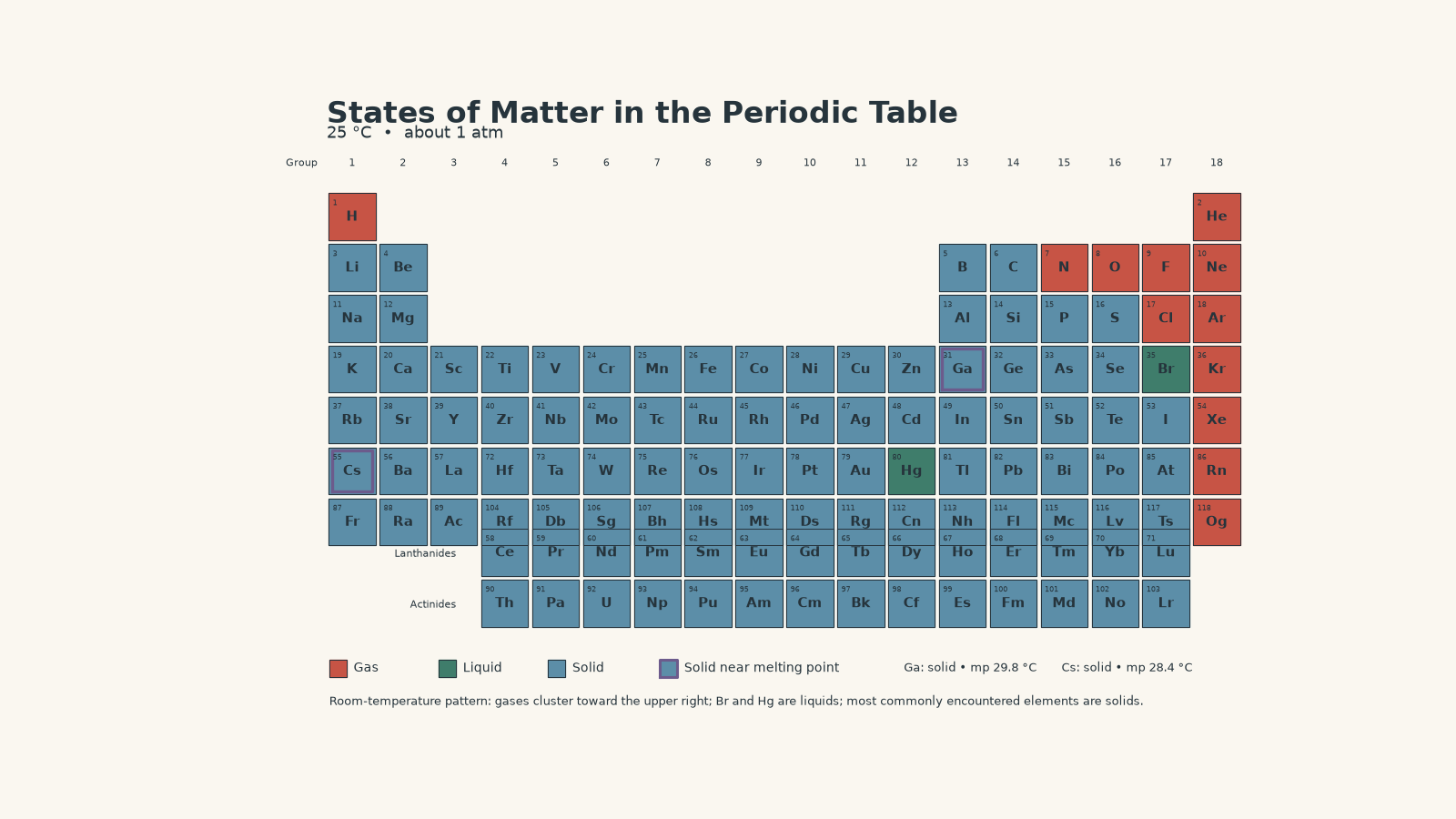
Most elements are solids at room temperature.
The gases are concentrated in the upper-right part of the table, plus hydrogen. Only a very small number of familiar elements are liquids at room temperature.
A useful first map is:
| Periodic-table region | Typical structure | Common room-temperature state | Main reason |
|---|---|---|---|
| Metals on the left and centre | Giant metallic lattice | Usually solid | Metallic bonding holds many particles in an extended structure |
| Elements such as boron, carbon, and silicon | Giant covalent structure | Solid | Strong covalent bonds extend through the structure |
| Upper-right molecular non-metals | Small or larger molecules | Gas, liquid, or solid | State depends strongly on intermolecular forces |
| Group 18 | Individual atoms | Gas | Only weak dispersion forces act between atoms |
| Hydrogen | \(\ce{H2}\) molecules | Gas | Small molecules with weak intermolecular attractions |
This is a pattern, not a law that lets you colour the periodic table without thinking.
For example, mercury is a metal but is liquid at room temperature. Gallium and caesium are solids at \(25^\circ\text{C}\), but both melt not far above room temperature. A warm environment can therefore matter near a phase boundary.
The better question isn’t simply, “Is it a metal or non-metal?”
Ask:
What particles or structure does the element form, and how difficult is it to separate them?
04Why most metals are solids
A metal isn’t made of separate little metal molecules. Its atoms form an extended metallic structure.
In the metallic bonding model, positive metal ions are attracted to delocalised electrons throughout the lattice. To melt a metal, enough of these attractions must be overcome for the particles to move past each other.
That usually requires temperatures above room temperature, so most metals are solids at \(25^\circ\text{C}\).
There are important differences between metals, though. Metallic bonding doesn’t have exactly the same strength in every element. Atomic size, charge, electron arrangement, and crystal structure all matter.
That is why “metal = solid” is a useful first prediction, but not an exact rule.
Mercury is the famous exception at room temperature: it is liquid.
05Why the upper-right corner contains so many gases
Now look towards the upper right of the periodic table.
Several non-metals exist as small molecules:
- hydrogen, \(\ce{H2}\)
- nitrogen, \(\ce{N2}\)
- oxygen, \(\ce{O2}\)
- fluorine, \(\ce{F2}\)
- chlorine, \(\ce{Cl2}\)
The covalent bonds inside these molecules can be very strong. Nitrogen’s \(\ce{N#N}\) bond, for example, is certainly not weak.
But boiling nitrogen doesn’t require us to break every \(\ce{N#N}\) bond.
That distinction is crucial.
When a simple molecular substance melts or boils, we mainly overcome intermolecular forces between its molecules. The covalent bonds within each molecule remain intact.
Small molecules tend to have relatively weak London dispersion forces between them, so many of these elements have boiling points far below room temperature. They are gases at \(25^\circ\text{C}\).
06The halogens show the trend beautifully
Consider Group 17.
| Halogen | Elemental particle | Approx. melting point | Approx. boiling point | State at \(25^\circ\text{C}\) |
|---|---|---|---|---|
| Fluorine | \(\ce{F2}\) | \(-220^\circ\text{C}\) | \(-188^\circ\text{C}\) | Gas |
| Chlorine | \(\ce{Cl2}\) | \(-101^\circ\text{C}\) | \(-34^\circ\text{C}\) | Gas |
| Bromine | \(\ce{Br2}\) | \(-7^\circ\text{C}\) | \(59^\circ\text{C}\) | Liquid |
| Iodine | \(\ce{I2}\) | \(114^\circ\text{C}\) | \(184^\circ\text{C}\) | Solid |
The melting and boiling points increase substantially as we move down the group.
Why?
Each molecule becomes larger and contains more electrons. Its electron cloud becomes more polarisable, meaning its electron distribution can be distorted more easily.
That produces stronger temporary dipoles and therefore stronger London dispersion forces between neighbouring molecules.
More energy is needed to separate the molecules.
So at the same \(25^\circ\text{C}\):
- thermal energy easily keeps \(\ce{Cl2}\) molecules apart as a gas
- \(\ce{Br2}\) molecules remain close but mobile as a liquid
- attractions between \(\ce{I2}\) molecules are strong enough for iodine to remain solid
Worked example: Why is bromine a liquid?
Fluorine and chlorine are gases at \(25^\circ\text{C}\), while iodine is solid. Explain why bromine, which lies between chlorine and iodine in Group 17, is liquid at room temperature.
Step 1
Elemental bromine exists as \(\ce{Br2}\) molecules. We therefore need to think about forces between \(\ce{Br2}\) molecules.
Step 2
A \(\ce{Br2}\) molecule has more electrons and a larger, more polarisable electron cloud than \(\ce{Cl2}\). Its London dispersion forces are therefore stronger.
However, these forces are not as strong as those between the still larger \(\ce{I2}\) molecules.
Step 3
Bromine melts at about \(-7^\circ\text{C}\) and boils at about \(59^\circ\text{C}\).
At \(25^\circ\text{C}\),
\[ -7^\circ\text{C}<25^\circ\text{C}<59^\circ\text{C} \]
so bromine must be a liquid.
Step 4
The intermolecular attractions in bromine are strong enough to stop its molecules spreading out as a gas at room temperature, but not strong enough to lock them into a solid structure.
07Don’t blame the bond inside the molecule
A common explanation goes like this:
Iodine is solid because the \(\ce{I-I}\) covalent bond is stronger than the \(\ce{Cl-Cl}\) bond.
That isn’t the correct explanation for the state trend.
Melting iodine does not require every \(\ce{I-I}\) bond to break. The \(\ce{I2}\) molecules remain as \(\ce{I2}\).
The important change is that the molecules gain enough energy to move past one another. We are overcoming intermolecular attractions, not breaking the molecule apart into iodine atoms.
A useful exam habit is to ask:
Am I separating molecules from each other, or breaking atoms apart within a molecule?
For melting and boiling simple molecular substances, it is usually the first one.
08Oxygen and sulfur show that group position isn’t the whole story
Oxygen and sulfur are both in Group 16.
You might therefore predict similar states. Instead, oxygen is a gas at room temperature while sulfur is a solid.
Part of the explanation is size, but there is another important detail: their elemental molecules aren’t the same size.
Oxygen commonly exists as small \(\ce{O2}\) molecules. Ordinary elemental sulfur at room temperature contains much larger \(\ce{S8}\) molecules.
An \(\ce{S8}\) molecule has many more electrons and a much larger electron cloud. Its London dispersion forces are consequently much stronger.
Worked example: Oxygen is a gas, but sulfur is a solid
Explain why oxygen and sulfur have different room-temperature states despite belonging to the same group.
Step 1
Oxygen exists as \(\ce{O2}\) molecules. Common solid sulfur contains \(\ce{S8}\) molecules.
Step 2
An \(\ce{S8}\) molecule is much larger and contains many more electrons than an \(\ce{O2}\) molecule.
Its electron cloud is therefore more polarisable.
Step 3
Greater polarisability produces stronger London dispersion forces between \(\ce{S8}\) molecules than between \(\ce{O2}\) molecules.
More thermal energy is therefore required to separate sulfur molecules.
Step 4
At room temperature, the weak attractions between \(\ce{O2}\) molecules allow oxygen to exist as a gas. The stronger attractions between \(\ce{S8}\) molecules contribute to sulfur remaining solid.
The lesson is bigger than oxygen and sulfur: periodic-table position is useful because it helps you reason about structure and particle size. Position itself does not directly cause a state of matter.
09Noble gases: bigger atoms, but still gases
Group 18 gives us another clean trend.
Noble gases exist as individual atoms rather than molecules. Between those atoms, the main attractions are London dispersion forces.
Going down the group from helium towards xenon and radon:
- atoms become larger
- they contain more electrons
- their electron clouds become more polarisable
- dispersion forces become stronger
- boiling points increase
So does that mean xenon should be a solid at room temperature?
No.
Its boiling point has increased compared with helium or neon, but it is still well below \(25^\circ\text{C}\). Room temperature therefore remains high enough for xenon to be a gas.
This is a useful warning. A property can increase down a group without increasing enough to cross the boundary between gas and liquid or between liquid and solid.
10Across a period, the pattern is not smooth
It is tempting to search for one simple left-to-right rule.
Something like:
Atomic radius decreases across a period, so the elements should gradually change from solid to liquid to gas.
That fails because the type of structure changes across a period.
Consider some Period 3 elements:
- sodium, magnesium, and aluminium have metallic structures and are solids
- silicon has a giant covalent structure and is solid
- phosphorus and sulfur form molecular solids at room temperature
- chlorine forms small \(\ce{Cl2}\) molecules and is a gas
- argon is monatomic and is a gas
Notice what happened. We didn’t simply make one type of particle smaller and smaller.
We changed from a metallic lattice to a giant covalent structure, then to molecular substances, and finally to individual atoms.
That change in structure matters enormously.
So there isn’t a reliable rule saying “move three boxes right and the state changes from solid to gas”. You need to identify what sort of substance each element forms.
11Giant covalent structures are different again
Carbon and silicon give another useful contrast with small molecular non-metals.
In diamond, each carbon atom is covalently bonded into a giant three-dimensional network. Silicon also forms a giant covalent structure.
There aren’t separate \(\ce{C}\) or \(\ce{Si}\) molecules that can simply move away from one another.
To melt a giant covalent substance, many strong covalent bonds in the extended structure must be overcome. That requires a large amount of energy.
These substances are therefore solids at room temperature.
This is why the rule “non-metals are gases” is hopeless. Some non-metals are gases, some are molecular solids, and carbon can form giant covalent solids.
The structure matters.
12A better decision method than memorising colours on a periodic table
When you’re asked to use periodic position to discuss an element’s likely state, work through these questions in order.
Is it a metal, non-metal, or an element likely to form a giant covalent structure?
Most metals and giant covalent elements will be solid at room temperature.If it is a molecular element, how large are its molecules?
Larger electron clouds usually mean greater polarisability and stronger dispersion forces.Are you comparing similar structures?
Size trends are especially useful within a family such as the halogens or noble gases. They are much less useful if one substance is a giant covalent network and another consists of individual atoms.If melting and boiling points are provided, use them.
Don’t replace actual data with a memorised trend.Keep the conditions fixed.
A room-temperature state is a statement about a particular temperature and pressure, not an eternal property of the element.
13The most useful patterns to remember
You don’t need to memorise 118 separate states to answer most HSC questions.
Keep these patterns available:
- most elements are solids at room temperature
- most metals are solids, with mercury as the familiar liquid exception
- hydrogen is a gas despite sitting above Group 1
- nitrogen, oxygen, fluorine, and chlorine are gases
- noble gases are gases at room temperature
- bromine is liquid at room temperature
- down a group of comparable molecular or monatomic substances, increasing size and polarisability often strengthen London dispersion forces
- stronger particle-particle attractions generally produce higher melting and boiling points
- across a period, changing structure means there is no single smooth state-of-matter rule
Most importantly, explain the pattern through structure and attractions, rather than treating the periodic table as a colour-coded memory test.
14Questions and solutions
Question 1
An element has a melting point of \(-12^\circ\text{C}\) and a boiling point of \(47^\circ\text{C}\) at atmospheric pressure.
What is its state at \(25^\circ\text{C}\)? Explain your reasoning.
Solution 1
The element is a liquid at \(25^\circ\text{C}\).
Its melting point is below room temperature, so it has already melted. Its boiling point is above room temperature, so it has not yet boiled.
The relevant comparison is
\[ -12^\circ\text{C}<25^\circ\text{C}<47^\circ\text{C}. \]
Because \(25^\circ\text{C}\) lies between the melting and boiling points, the stable state under these conditions is liquid.
The important principle is that state is determined by the temperature relative to the phase-change temperatures, not by simply attaching the label “solid”, “liquid”, or “gas” permanently to an element.
Question 2
Chlorine is a gas at room temperature, while iodine is a solid.
A student explains the difference by saying, “The \(\ce{I-I}\) covalent bond is stronger, so iodine molecules cannot separate.”
Identify the problem with this explanation and give a better explanation.
Solution 2
The explanation focuses on the wrong interaction. The room-temperature state depends mainly on forces between the molecules, not on breaking the covalent bond inside each molecule.
Chlorine exists as \(\ce{Cl2}\), while iodine exists as \(\ce{I2}\).
When chlorine boils or iodine melts, the diatomic molecules don’t normally break into individual atoms. The covalent \(\ce{Cl-Cl}\) or \(\ce{I-I}\) bonds remain.
Instead, molecules are being separated from neighbouring molecules.
An \(\ce{I2}\) molecule has more electrons and a larger, more polarisable electron cloud than \(\ce{Cl2}\). This produces stronger London dispersion forces between \(\ce{I2}\) molecules.
Iodine therefore has much higher melting and boiling points. At \(25^\circ\text{C}\), iodine remains solid while chlorine is already well above its boiling point and is a gas.
The trap is confusing intramolecular covalent bonds with intermolecular forces.
Question 3
A student makes this prediction about Period 3:
“Atomic radius generally decreases from left to right, so the states of the elements should change smoothly from solid to liquid to gas.”
Explain why this prediction is unreliable. Refer to at least three different types of elemental structure found across the period.
Solution 3
The prediction is unreliable because the type of structure changes across Period 3, so atomic size alone cannot determine the state.
On the left of the period, sodium, magnesium, and aluminium form giant metallic structures. Metallic bonding extends throughout their lattices, and all three are solids at room temperature.
Silicon forms a giant covalent structure. Strong covalent bonds extend through the network, so silicon is also solid.
Further right, phosphorus, sulfur, and chlorine form molecular substances. Their physical states depend strongly on intermolecular forces between those molecules. Chlorine has small \(\ce{Cl2}\) molecules with relatively weak dispersion forces and is a gas at room temperature.
Argon consists of individual atoms, with only weak dispersion forces between them, and is also a gas.
The student’s mistake is assuming that only one variable changes across the period. In reality, bonding and structure change as well, and those changes can have a larger effect on melting and boiling behaviour than atomic radius alone.
Question 4
The following approximate data are available for three halogens.
| Element | Melting point | Boiling point |
|---|---|---|
| \(\ce{Cl2}\) | \(-101^\circ\text{C}\) | \(-34^\circ\text{C}\) |
| \(\ce{Br2}\) | \(-7^\circ\text{C}\) | \(59^\circ\text{C}\) |
| \(\ce{I2}\) | \(114^\circ\text{C}\) | \(184^\circ\text{C}\) |
Determine the state of each element at \(70^\circ\text{C}\).
A student notices that bromine is no longer liquid and claims that the normal Group 17 state trend has “stopped working”. Explain the flaw in this conclusion.
Solution 4
At \(70^\circ\text{C}\), chlorine is a gas, bromine is a gas, and iodine is a solid. This does not contradict the periodic trend.
For chlorine,
\[ 70^\circ\text{C}>-34^\circ\text{C}, \]
so the temperature is above its boiling point. Chlorine is a gas.
For bromine,
\[ 70^\circ\text{C}>59^\circ\text{C}, \]
so bromine is also above its boiling point and is a gas.
For iodine,
\[ 70^\circ\text{C}<114^\circ\text{C}, \]
so iodine remains below its melting point and is a solid.
The Group 17 trend has not disappeared. Melting and boiling points still increase strongly from chlorine to bromine to iodine because intermolecular dispersion forces become stronger down the group.
What changed was the temperature of observation.
At \(25^\circ\text{C}\), bromine lies between its melting and boiling points and is liquid. At \(70^\circ\text{C}\), the same substance lies above its boiling point and is gas.
The trap is treating “room-temperature state” as though it were an intrinsic state that an element must keep at every temperature.
Question 5
Xenon atoms are much heavier and contain more electrons than silicon atoms.
A student therefore predicts that xenon should be solid at room temperature while silicon should be a gas, arguing that “more electrons mean stronger dispersion forces”.
Without relying only on memorised states, explain why the prediction fails.
Solution 5
Silicon is solid at room temperature, while xenon is a gas. The student’s rule fails because the two elements have completely different structures.
The statement about electron number contains a useful idea: within a comparable series, a larger and more polarisable electron cloud can produce stronger London dispersion forces.
For example, that reasoning helps explain why xenon has a higher boiling point than lighter noble gases such as neon.
But silicon isn’t held together mainly by London dispersion forces between separate silicon particles.
Silicon forms a giant covalent network. Each atom is connected to others by strong covalent bonds extending throughout the structure. Melting silicon therefore requires enough energy to disrupt many strong covalent bonds.
Xenon consists of separate atoms. The attractions between those atoms are London dispersion forces. They become stronger down Group 18, but they are still weak enough that xenon’s boiling point remains below room temperature.
The student’s hidden assumption was that “more electrons” could be compared directly across substances with completely different bonding.
A safer reasoning order is:
identify the structure first, identify the important attraction second, then use size and polarisability trends within comparable structures.
15What this idea sets up next
State-of-matter trends are really an introduction to a bigger HSC Chemistry skill: connecting structure, bonding, and intermolecular forces to measurable physical properties.
Once you can explain why chlorine, bromine, and iodine have different states, the next step is to explain their actual melting and boiling point trends. The same reasoning then extends to molecular substances more broadly, including why some compounds are volatile gases, some are liquids, and others form high-melting solids.