
共價網狀結構:鑽石、SiO2 與分子
了解鑽石與二氧化矽等巨型共價結構如何不同於分子共價物質,以及物質的結構如何解釋其物理性質。
A bottle of oxygen can contain a gas, while a diamond is an extremely hard solid. Both involve covalent bonds. So why are their properties so different?
Before reading on, make a prediction: does this mean the covalent bonds in oxygen are weak and the covalent bonds in diamond are strong?
That prediction is tempting, but it misses the important part. The difference is not simply the strength of a single covalent bond. It is where the covalent bonds are found. In a molecular substance, strong covalent bonds make separate molecules, with intermolecular forces between them. In a covalent network, covalent bonds continue through an enormous structure.
That one structural difference explains most of the properties you need to predict.
01Start by asking: are there separate molecules?
Imagine a slightly awkward school formal.
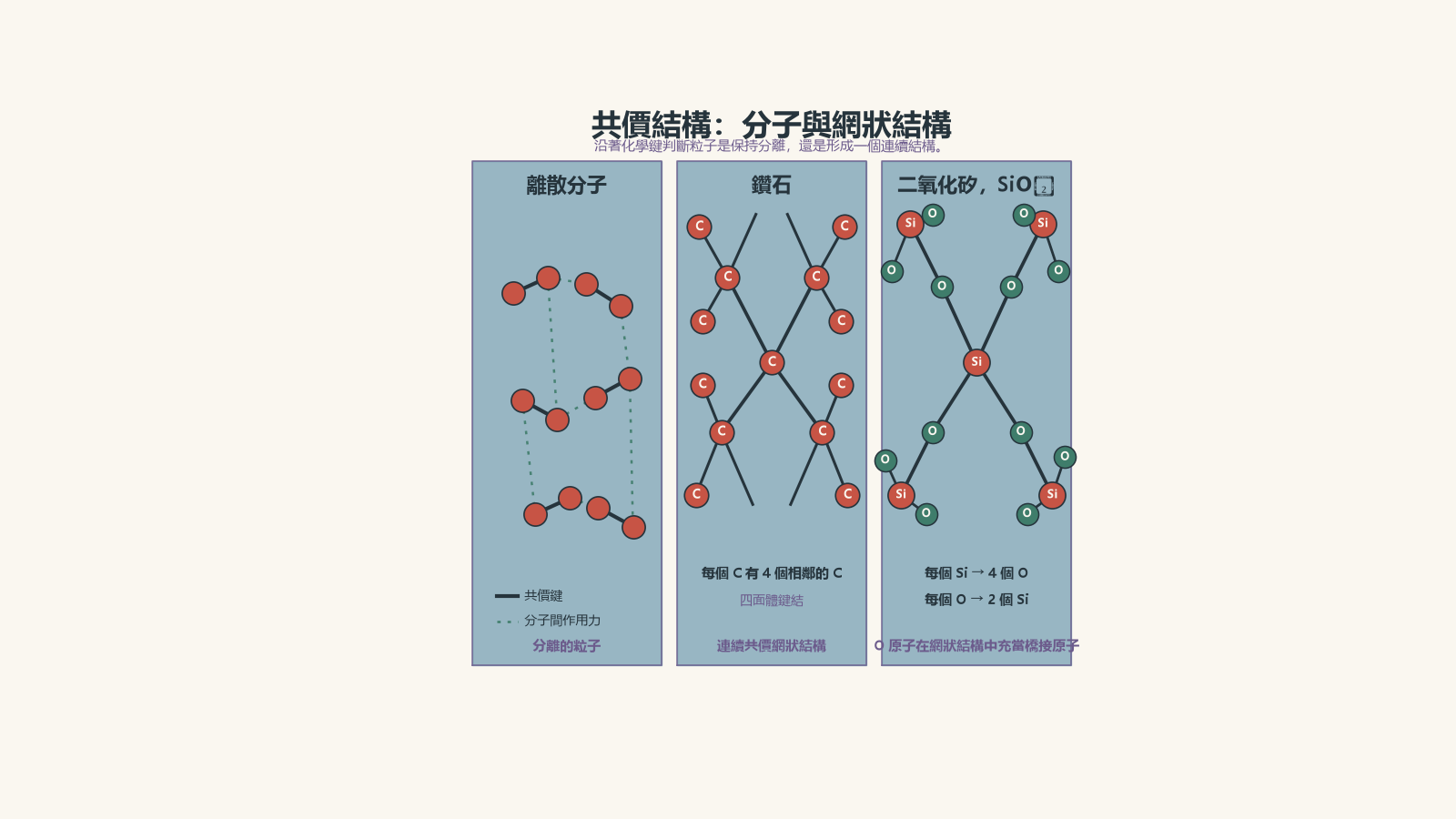
In a molecular covalent substance, people arrive as couples. Each couple holds on tightly, representing the strong covalent bonds within a molecule. Different couples interact much more loosely, representing the intermolecular forces between molecules.
If everyone gets enough energy to move around more freely, you don’t need to split up every couple. You mainly need to overcome the weaker attractions between different couples.
A covalent network is different. Imagine everyone in the room linked to several other people, forming one enormous connected structure. There aren’t separate little groups that can simply move away from one another. To pull the structure apart, you have to disrupt strong links throughout the network.
The analogy has limits. Chemical bonds aren’t literal mechanical links, and intermolecular forces are real electrostatic interactions rather than vague social awkwardness. But the distinction it highlights is exact and important:
- molecular covalent substances contain discrete molecules
- covalent network substances contain an extended network of covalently bonded atoms
You may also see a covalent network described as a giant covalent structure.
02Molecular covalent substances have two levels of attraction
Consider carbon dioxide, \(\ce{CO2}\).
Inside each carbon dioxide molecule, the carbon and oxygen atoms are joined by strong covalent bonds:
\[ \ce{O=C=O} \]
But one \(\ce{CO2}\) molecule is not covalently bonded to the next \(\ce{CO2}\) molecule. There are intermolecular forces between the molecules instead.
This gives us two different things to keep track of:
| Location | Attraction | Relative role |
|---|---|---|
| Within a molecule | Covalent bonds | Hold the atoms of that molecule together |
| Between molecules | Intermolecular forces | Hold separate molecules near one another |
This distinction matters enormously during a change of state.
When a molecular substance melts or boils without decomposing, its molecules separate or move more freely. The covalent bonds inside the molecules generally remain intact. It is the intermolecular attractions that are being overcome.
That is why saying “covalent substances have low melting points because covalent bonds are weak” is wrong.
The covalent bonds are not weak. In a molecular substance, you usually don’t need to break them to melt or boil the substance.
03A covalent network has no separate molecules to pull apart
Now consider diamond.
A diamond does not contain little \(\ce{C4}\), \(\ce{C20}\), or other carbon molecules packed together. Each carbon atom is covalently bonded to four other carbon atoms in a three-dimensional arrangement.
Those neighbouring carbon atoms are bonded to more carbon atoms, which are bonded to more again. The pattern continues throughout the crystal.
There is therefore no useful boundary where one “diamond molecule” ends and the next begins.
Why diamond is so hard
Suppose you try to push one layer of atoms past another.
In a molecular solid, molecules may be able to move relative to one another once the intermolecular attractions are overcome.
Diamond has no weakly attached layers of separate molecules. Its carbon atoms are held in a rigid three-dimensional network of strong covalent bonds.
Deforming the structure therefore means resisting or disrupting strong bonds. This gives diamond its very high hardness.
Hardness does not mean the same thing as toughness. A material can resist scratching strongly but still fracture under the right force. In chemistry questions, be precise about the property being discussed.
Why diamond requires extreme temperatures to disrupt
There are no weak intermolecular attractions holding separate diamond molecules together, because there are no separate diamond molecules.
Separating atoms from the structure requires the disruption of covalent bonding throughout the network. That requires far more energy than overcoming the intermolecular forces in a typical molecular substance.
This is why giant covalent structures generally have very high temperatures associated with melting, decomposition, or vaporisation.
Why diamond does not conduct electricity
A material conducts electricity only if it contains charged particles that can move through the material.
In diamond, the valence electrons are localised in covalent bonds. There are no mobile ions and no freely moving delocalised electrons.
So diamond is an electrical insulator.
Notice the reasoning. We did not say, “It is covalent, so it cannot conduct.” The better rule is:
Look for mobile charge carriers.
That rule will survive far more chemistry than a memorised structure-property list.
04Silicon dioxide is also a covalent network
Silicon dioxide, \(\ce{SiO2}\), gives students a particularly annoying trap.
You might see its formula and picture a molecule like carbon dioxide:
\[ \ce{O=Si=O} \]
For ordinary solid silicon dioxide such as quartz, that picture is wrong.
Silicon dioxide forms an extended three-dimensional network. Each silicon atom is covalently bonded to four oxygen atoms. Each oxygen atom acts as a bridge between two silicon atoms.
So there are no separate \(\ce{SiO2}\) molecules sitting beside one another.
Then why is the formula \(\ce{SiO2}\)?
The formula tells you the overall ratio of atoms, not necessarily the contents of one molecule.
For silicon dioxide:
- each silicon is connected to four oxygen atoms
- each oxygen is shared between two silicon atoms
So those four oxygen neighbours contribute an average of
\[ \frac{4}{2}=2 \]
oxygen atoms per silicon atom.
The overall ratio is therefore \(1:2\), giving \(\ce{SiO2}\).
This is an important distinction. A chemical formula does not automatically tell you that a substance consists of molecules with that exact collection of atoms.
05Diamond and silicon dioxide compared
Diamond and silicon dioxide are both three-dimensional covalent networks, but their networks are not identical.
| Feature | Diamond | Silicon dioxide |
|---|---|---|
| Main atoms present | Carbon | Silicon and oxygen |
| Bonding pattern | Each C bonded to 4 C atoms | Each Si bonded to 4 O atoms, each O bonded to 2 Si atoms |
| Separate molecules? | No | No |
| Main bonding throughout solid | Covalent | Covalent |
| Hardness | Extremely hard | Hard and brittle |
| Energy needed to disrupt structure | Very high | Very high |
| Electrical conductivity | Very poor | Very poor |
| Solubility in water | Insoluble | Essentially insoluble |
Their properties follow from the extended bonding, rather than simply from the word “covalent”.
06Worked example: Why does carbon dioxide leave the solid state much more easily than silicon dioxide?
Solid carbon dioxide, \(\ce{CO2(s)}\), and silicon dioxide, \(\ce{SiO2(s)}\), both contain covalent bonds. Explain why solid carbon dioxide can leave the solid state far more readily than silicon dioxide.
步驟 1
Carbon dioxide is molecular. It contains separate \(\ce{CO2}\) molecules.
Silicon dioxide is a covalent network. Its silicon and oxygen atoms are connected through an extended three-dimensional structure.
步驟 2
For solid carbon dioxide to separate into gaseous molecules, the intermolecular forces between its \(\ce{CO2}\) molecules must be overcome. The strong covalent \(\ce{C=O}\) bonds within each molecule remain.
For silicon dioxide to lose its network structure, strong Si-O covalent bonds throughout the network must be disrupted.
步驟 3
Overcoming the intermolecular attractions between carbon dioxide molecules requires much less energy than disrupting an extended network of strong covalent bonds.
So solid \(\ce{CO2}\) leaves the solid state much more readily than \(\ce{SiO2}\).
The key comparison is not “weak covalent bonds versus strong covalent bonds”. It is intermolecular forces versus an extended covalent network.
07Worked example: Why is silicon dioxide not \(\ce{SiO4}\)?
In the silicon dioxide network, each silicon atom has four oxygen neighbours. Explain why the formula is \(\ce{SiO2}\), not \(\ce{SiO4}\).
步驟 1
Suppose there are \(N\) silicon atoms.
Each silicon is bonded to four oxygen atoms, so there are \(4N\) Si-O bond connections from the silicon atoms.
步驟 2
Each oxygen is bonded to two silicon atoms. One oxygen therefore accounts for two of those Si-O connections.
The number of oxygen atoms is consequently
\[ \frac{4N}{2}=2N \]
步驟 3
There are \(N\) silicon atoms for every \(2N\) oxygen atoms:
\[ \text{Si:O}=N:2N=1:2 \]
So the formula is \(\ce{SiO2}\).
The formula represents the simplest whole-number ratio across the network. It does not represent an isolated \(\ce{SiO2}\) molecule.
08How structure controls the main physical properties
Instead of memorising separate facts for every substance, ask what must physically happen to produce the property.
Melting and boiling
For a molecular covalent substance, changing state usually requires the molecules to move further apart or more freely.
That means overcoming intermolecular forces.
For a covalent network, there are no separate molecules to release. Disrupting the structure requires breaking or rearranging strong covalent bonds throughout the network.
So covalent network substances generally require far more energy to disrupt.
Be careful with the phrase “high boiling point”. Some giant covalent substances may decompose, change structure, or sublime under particular conditions rather than displaying a neat liquid-to-gas transition. The useful principle is that separating the atoms of the network requires very large amounts of energy.
Hardness
Molecular solids often have relatively low hardness because the molecules are held together by intermolecular forces rather than by covalent bonds extending through the entire solid.
Diamond is extremely hard because strong covalent bonds extend in three dimensions.
Silicon dioxide is also hard because deformation must disturb its extended Si-O network.
This is a trend, not a licence to say every covalent network must have identical mechanical properties. The detailed arrangement of the network matters too.
Electrical conductivity
Do not decide this from bond type alone.
Ask:
Are there charged particles that can move?
For diamond and silicon dioxide, the answer is no. Their electrons are localised in bonds, and there are no mobile ions.
They therefore conduct electricity very poorly.
This also explains why “all covalent networks are non-conductors” is too broad. Some covalent networks can contain delocalised electrons. Graphite is the familiar example. Its different arrangement of carbon atoms gives it different electrical and mechanical properties from diamond.
Solubility
To dissolve a substance, the solvent must be able to separate its particles and stabilise them.
Water can sometimes separate molecules from one another because doing so only requires intermolecular attractions to be replaced by new solute-water attractions.
A three-dimensional covalent network is much harder to pull apart. Water cannot simply peel out individual molecules because there are no individual molecules to remove.
Diamond and silicon dioxide are therefore insoluble in water under ordinary conditions.
Do not turn that into the rule “covalent means insoluble”. Many molecular covalent substances dissolve readily in suitable solvents. Molecular polarity and intermolecular forces matter.
09The comparison worth remembering
| Question | Molecular covalent substance | Covalent network substance |
|---|---|---|
| What structural units exist? | Separate molecules | One extended network |
| Where are the covalent bonds? | Mainly within each molecule | Throughout the network |
| What lies between separate units? | Intermolecular forces between molecules | No separate molecular units |
| What is mainly overcome during ordinary melting? | Intermolecular forces | Extensive network bonding must be disrupted |
| Typical energy needed to change state | Lower than a giant covalent network | Very high |
| Typical solid hardness | Often relatively low | Often high for 3D networks |
| Electrical conductivity | Usually poor unless mobile charged species are present | Depends on whether mobile charge carriers exist |
| Does the formula necessarily describe one molecule? | Usually, for simple molecular substances | No, it may describe an atom ratio |
The fastest HSC decision rule is therefore:
- Decide whether the substance contains discrete molecules or an extended network.
- Identify what attraction would have to be overcome for the property being discussed.
- For electrical conductivity, separately check for mobile charge carriers.
- Use the structure to justify the property rather than quoting the property from memory.
10The most tempting misconception: “covalent substances have low melting points”
This statement mixes up two very different structures.
A student might reason:
“Covalent substances contain covalent bonds. Molecular substances melt easily. Therefore covalent bonds must be easy to break.”
The mistake is in the second step.
When a molecular substance melts, its covalent bonds usually do not break. The molecules remain intact while intermolecular forces are overcome.
When a giant covalent structure is disrupted, covalent bonds in the extended network really do have to be disturbed.
So a better comparison is:
- molecular covalent: strong bonds inside molecules, weaker attractions between molecules
- covalent network: strong covalent bonds extending throughout the structure
That distinction explains why two substances can both be described as covalent yet have completely different physical properties.
11Questions and solutions
Question 1
Solid chlorine consists of discrete \(\ce{Cl2}\) molecules. When solid chlorine melts, are the Cl-Cl covalent bonds broken? Explain.
Solution 1
No. The Cl-Cl covalent bonds remain intact during melting.
Solid chlorine is a molecular covalent substance. Each molecule contains a strong Cl-Cl covalent bond, while separate \(\ce{Cl2}\) molecules attract one another through intermolecular forces.
During melting, enough intermolecular attraction is overcome for the molecules to move past one another. Breaking the Cl-Cl bonds would produce chlorine atoms and would involve a chemical change rather than the ordinary physical process of melting.
The common trap is to say that “bonds are broken during melting” without specifying which attractions are involved. For a molecular substance, ordinary melting mainly overcomes intermolecular forces, not the covalent bonds within each molecule.
Question 2
A hypothetical giant covalent structure contains atoms X and Y. Each X atom is covalently bonded to three Y atoms, and each Y atom is shared between two X atoms. Determine the simplest formula of the structure.
Solution 2
The simplest formula is \(\ce{X2Y3}\).
Suppose there are \(N\) X atoms. Each X has three X-Y connections, giving
\[ 3N \]
X-Y connections.
Each Y atom is connected to two X atoms, so each Y accounts for two connections. The number of Y atoms is therefore
\[ \frac{3N}{2} \]
The ratio is
\[ \text{X:Y}=N:\frac{3N}{2} \]
Multiplying both parts by 2 gives
\[ \text{X:Y}=2:3 \]
so the simplest formula is
\[ \ce{X2Y3} \]
The important idea is that neighbouring atoms in a network are shared. Counting three Y neighbours around one X does not mean the formula must be \(\ce{XY3}\).
Question 3
Two covalent solids are examined.
Substance A consists of discrete molecules and melts when moderately heated. Substance B is a three-dimensional network in which every atom is joined to neighbouring atoms by covalent bonds.
A student says, “B has a higher melting point because its individual covalent bonds must be stronger than the covalent bonds in A.”
Evaluate the student’s explanation.
Solution 3
The conclusion about the melting behaviour may be reasonable, but the student’s explanation is not. We do not need to assume that B has stronger individual covalent bonds.
In substance A, the covalent bonds hold atoms together within each molecule. Melting mainly requires the intermolecular forces between separate molecules to be overcome.
In substance B, there are no separate molecules. Strong covalent bonds extend throughout the three-dimensional network. Destroying the ordered solid structure therefore requires extensive disruption of covalent bonding.
The difference in melting behaviour can consequently be explained by which interactions must be overcome, not by claiming that every individual covalent bond in B is stronger than every covalent bond in A.
That is the trap: comparing bond strengths before deciding which bonds are actually involved in the physical change.
Question 4
An unknown solid is hard, has a very high melting point, does not conduct electricity as a solid, and is insoluble in water.
Can you conclude from these observations alone that it must be a covalent network solid? Explain.
Solution 4
No. Those observations are consistent with a covalent network, but they do not uniquely prove that structure.
A three-dimensional covalent network such as diamond or silicon dioxide can be hard, have a very high melting point, be insoluble in water, and fail to conduct electricity.
However, some ionic solids can also be hard, high-melting, insoluble or only slightly soluble, and electrically non-conducting in the solid state. In an ionic solid, the ions are charged but fixed in position, so they cannot carry current while the lattice remains solid.
Further evidence would therefore be needed. For example, conductivity after melting can help distinguish structures because a molten ionic substance contains mobile ions, whereas a typical covalent network such as silicon dioxide does not suddenly become a liquid of freely moving ions.
The hidden assumption is that one set of macroscopic properties must correspond to exactly one bonding type. In practice, structural identification should use several pieces of evidence.
Question 5
A newly discovered form of an element contains strong covalent bonds extending across flat sheets. There are only weak attractions between neighbouring sheets. Some electrons are delocalised and can move along each sheet.
A student argues, “It is a giant covalent structure, so it must be extremely hard in every direction and unable to conduct electricity.”
Predict whether the student’s two claims must be correct.
Solution 5
Neither claim must be correct. The material could be relatively easy to shear between its sheets and could conduct electricity along them.
Within each sheet, the strong covalent bonds would strongly resist pulling bonded atoms apart.
Between sheets, however, there are only weak attractions. One sheet could therefore slide across another much more easily than atoms could move through the three-dimensional network of diamond. A giant covalent structure does not automatically have the same hardness in every direction.
The delocalised electrons provide mobile charge carriers. They can move through the sheets, so electrical conduction is possible despite the substance being covalently bonded.
The mistake is using the label giant covalent as though it determines every property by itself. You still need to examine the geometry of the network and the behaviour of the electrons.
Question 6
A quartz crystal made of \(\ce{SiO2}\) is crushed into an extremely fine powder.
A student claims that the crushing must have converted the giant covalent network into separate \(\ce{SiO2}\) molecules because the pieces are now much smaller.
Explain why this conclusion is incorrect.
Solution 6
Crushing the quartz produces smaller pieces of the covalent network, not a collection of separate \(\ce{SiO2}\) molecules.
Breaking the crystal creates new surfaces and necessarily disrupts some Si-O bonds where fractures occur. However, inside each tiny grain, silicon and oxygen atoms remain connected through the extended covalent structure.
Making a crystal smaller does not automatically change its bonding model. Even a microscopic grain can contain an enormous number of atoms joined as a network.
The formula \(\ce{SiO2}\) still describes the overall \(1:2\) ratio of silicon to oxygen. It does not suddenly become the molecular formula of a discrete particle.
This distinction becomes useful when you move on to ionic networks and metallic structures. For any solid, the productive first question is not simply “What type of bond does it contain?” It is: what particles or structural units are actually present, what holds them together, and which of those particles can move?