
Carboxylic Acids vs Esters: Structure, Properties and Reactions
Why do carboxylic acids and esters with the same molecular formula have different properties? Learn how functional groups affect intermolecular forces, boiling points, water solubility, and characteristic reactions, with worked examples and challenging HSC Chemistry questions.
Propanoic acid and methyl ethanoate have the same molecular formula, \(\ce{C3H6O2}\). Yet propanoic acid boils at about \(141^\circ\text{C}\), while methyl ethanoate boils at about \(57^\circ\text{C}\). That’s a difference of roughly \(84^\circ\text{C}\), despite both molecules containing exactly the same numbers of carbon, hydrogen, and oxygen atoms.
Before reading on, predict which compound forms stronger attractions between its own molecules, which mixes completely with water, and which reacts with sodium carbonate to release a gas.
The answer is propanoic acid in all three cases. The key is not how many atoms each molecule contains, but how those atoms are connected. That arrangement determines both the intermolecular forces between molecules and the reactions they can undergo.
Same molecular formula, different functional groups
| Propanoic acid | CH₃CH₂COOH Molecular formula: C₃H₆O₂ Carboxyl group: –COOH; contains an O–H bond |
|---|---|
| Methyl ethanoate | CH₃COOCH₃ Molecular formula: C₃H₆O₂ Ester linkage: –COO–; no O–H bond |
01Start with the functional groups
A molecular formula tells you which atoms are present and how many of each there are. It doesn’t tell you how the atoms are connected.
Compare these two compounds.
| Feature | Propanoic acid | Methyl ethanoate |
|---|---|---|
| Condensed structural formula | \(\ce{CH3CH2COOH}\) | \(\ce{CH3COOCH3}\) |
| Molecular formula | \(\ce{C3H6O2}\) | \(\ce{C3H6O2}\) |
| Functional group | Carboxyl group, -COOH | Ester group, -COO- |
| Molar mass | \(74.08\ \text{g mol}^{-1}\) | \(74.08\ \text{g mol}^{-1}\) |
These are called functional-group isomers. They have the same molecular formula but different functional groups, so they have different chemical properties.
What actually changes in the structures?
In propanoic acid, the carboxyl group contains both a carbonyl bond, \(\ce{C=O}\), and a hydroxyl bond, \(\ce{O-H}\). Both are attached to the same carbon atom.
In methyl ethanoate, the structure contains a carbonyl bond and a single-bonded oxygen connected to another carbon group. It has no \(\ce{O-H}\) bond.
That small structural change has two major consequences:
- It changes the types of intermolecular attractions the molecules can form.
- It changes how the molecules react with other substances.
Keep those two consequences separate. Boiling point and water solubility depend heavily on intermolecular interactions. Characteristic chemical reactions depend on the functional group’s structure and reactivity.
02Why the boiling points are so different
Imagine heating a liquid in a saucepan. As the temperature rises, its molecules move more energetically. Eventually, the liquid can boil as molecules escape into the gas phase.
What must happen for a molecule to escape?
It must overcome the attractions holding it near neighbouring molecules. These attractions are called intermolecular forces.
Boiling does not normally break the covalent bonds within each molecule. The molecules remain chemically intact; they simply move far enough apart to form a gas.
Compare the intermolecular forces
Both propanoic acid and methyl ethanoate experience London dispersion forces. Both are polar molecules, so they also experience permanent dipole-dipole attractions.
The important difference is hydrogen bonding.
Propanoic acid contains an \(\ce{O-H}\) bond. The hydrogen attached to oxygen can participate in hydrogen bonding with an oxygen atom on another propanoic acid molecule.
Its carbonyl oxygen can accept a hydrogen bond, too. Two carboxylic acid molecules can therefore form a pair linked by two hydrogen bonds, called a hydrogen-bonded dimer. In the liquid, molecules also participate in changing networks of hydrogen bonds.
Methyl ethanoate has polar oxygen-containing bonds, but it has no \(\ce{O-H}\) bond. It cannot donate the usual strong hydrogen bonds to other methyl ethanoate molecules.
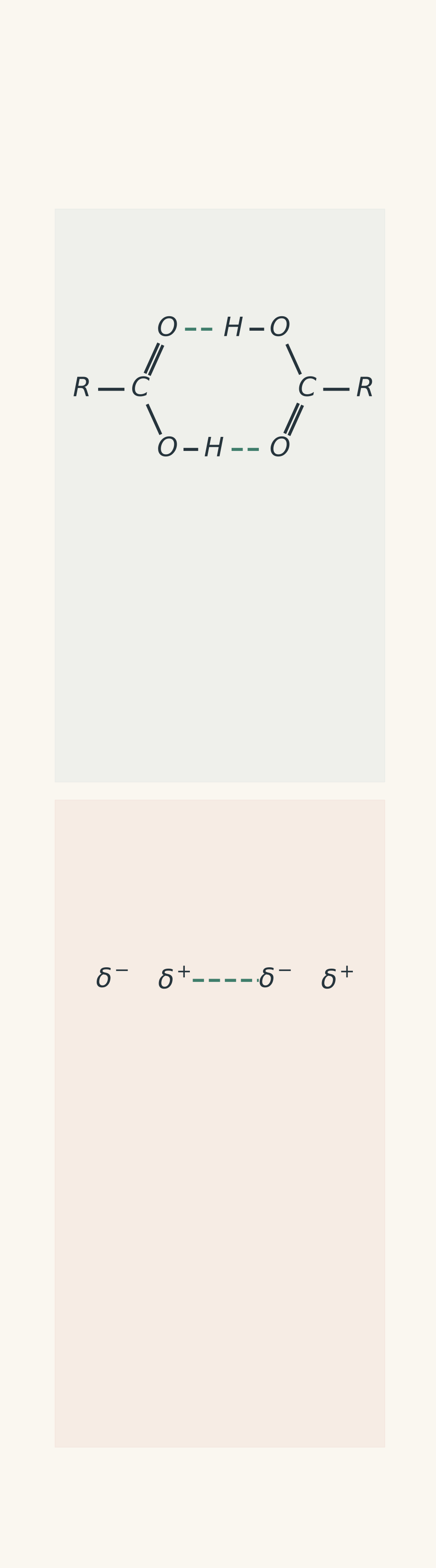
The difference is not that methyl ethanoate has no intermolecular forces. It has them. But propanoic acid molecules can form stronger hydrogen-bonding interactions with one another.
More energy is needed to separate the propanoic acid molecules sufficiently for boiling. Its boiling point is therefore higher.
The experimental values
At approximately atmospheric pressure, the boiling points are:
| Compound | Boiling point |
|---|---|
| Propanoic acid | \(141^\circ\text{C}\) |
| Methyl ethanoate | \(57^\circ\text{C}\) |
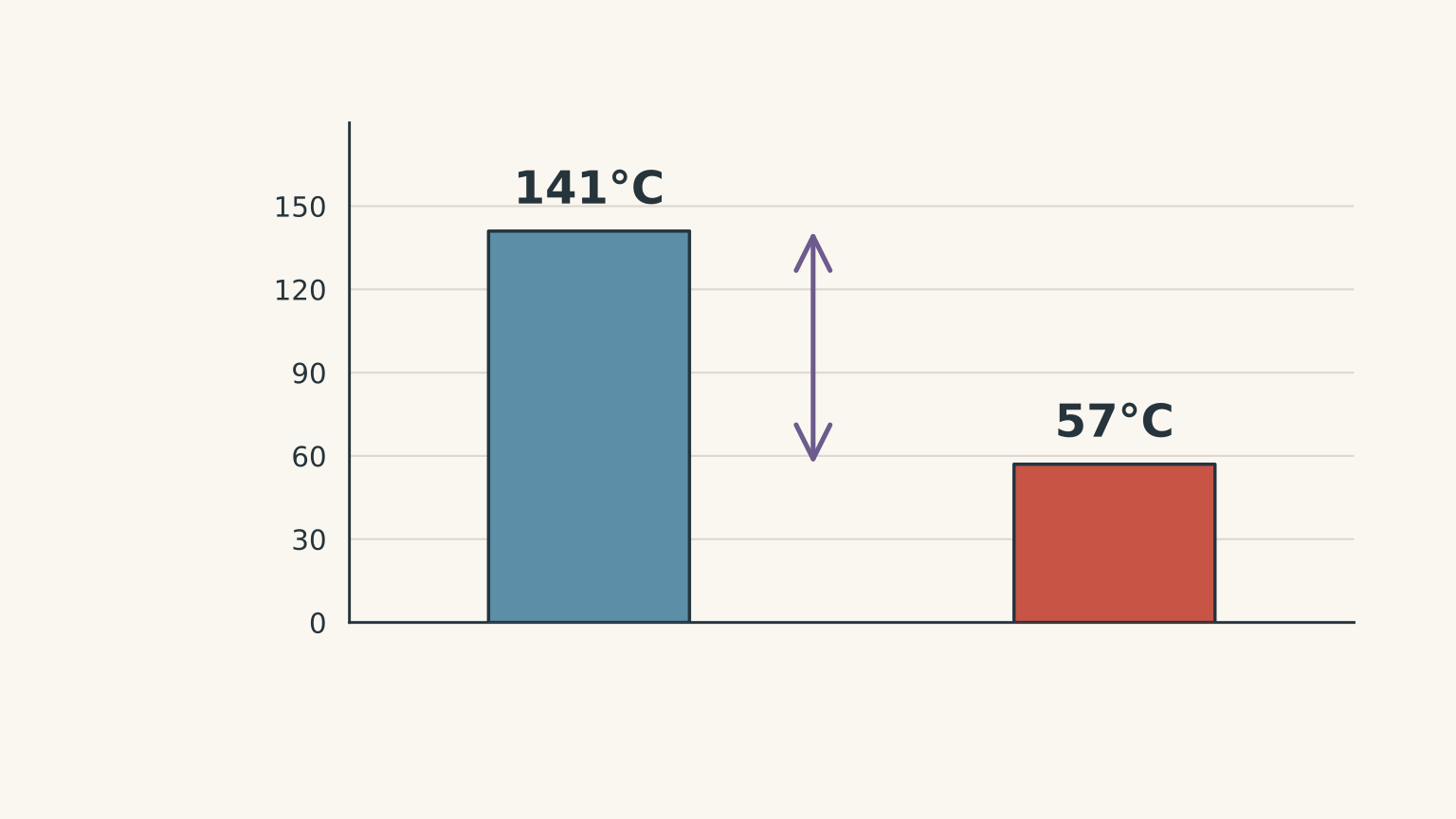
Notice that both compounds have the same molar mass. The difference in boiling point cannot be explained by one compound having heavier molecules.
Molecular size and shape can also affect boiling points, so molecular mass alone never determines the exact ranking. Here, however, the ability of carboxylic acid molecules to form strong hydrogen-bonding interactions provides the central explanation.
Worked example: Explain a boiling-point difference
Question: Propanoic acid and methyl ethanoate have the molecular formula \(\ce{C3H6O2}\). Their boiling points are approximately \(141^\circ\text{C}\) and \(57^\circ\text{C}\), respectively. Calculate the boiling-point difference and explain why the acid has the higher value.
Step 1
Using \(C = 12.0\), \(H = 1.0\), and \(O = 16.0\) as the atomic molar masses:
\[ \begin{aligned} M &= 3(12.0)+6(1.0)+2(16.0)\\ &= 74.0\ \text{g mol}^{-1} \end{aligned} \]
Both compounds have the same molecular formula, so both have a molar mass of approximately \(74.0\ \text{g mol}^{-1}\) using these rounded atomic masses.
Step 2
Propanoic acid contains a carboxyl group with an \(\ce{O-H}\) bond. Methyl ethanoate has an ester group and no \(\ce{O-H}\) bond.
Step 3
Propanoic acid molecules form hydrogen bonds with one another. Methyl ethanoate molecules experience dispersion forces and dipole-dipole attractions but cannot donate the same strong hydrogen bonds to one another.
Step 4
\[ \begin{aligned} \Delta T_b &= 141-57\\ &= 84^\circ\text{C} \end{aligned} \]
The boiling-point difference is approximately \(84^\circ\text{C}\).
Conclusion: Propanoic acid has the higher boiling point because its molecules experience stronger intermolecular attractions overall. More energy is required to separate them into the gas phase. The \(84^\circ\text{C}\) difference is an observed temperature difference, not a direct measurement of hydrogen-bond strength.
03Water solubility: why two oxygen atoms aren’t enough
Now consider a different property.
Both compounds contain two oxygen atoms, and both are polar. Does that mean they should dissolve equally well in water?
No. The number of oxygen atoms is not enough to predict solubility. You need to consider how the molecules interact with water, including whether they can donate or accept hydrogen bonds.
Water molecules form extensive hydrogen-bonding interactions with one another. For a solute to dissolve, interactions between the solute and water must make mixing favourable enough to compensate for disrupting existing interactions and accommodating the solute.
How propanoic acid interacts with water
The carboxyl group in propanoic acid can participate in hydrogen bonding with water in two ways:
- Its \(\ce{O-H}\) group can donate a hydrogen bond to a suitable oxygen atom in water.
- Its carbonyl oxygen can accept a hydrogen bond from a hydrogen atom in water.
These interactions help water accommodate propanoic acid molecules.
Propanoic acid can also ionise partially in water:
\[ \ce{CH3CH2COOH + H2O <=> CH3CH2COO^- + H3O^+} \]
The propanoate ions formed can interact strongly with polar water molecules through ion-dipole attractions. The extent of ionisation depends on conditions, particularly pH.
Together, these effects help explain why propanoic acid is miscible with water: it can mix with water in all proportions.
How methyl ethanoate interacts with water
Methyl ethanoate can also interact with water. Its oxygen atoms can accept hydrogen bonds from water molecules.
So a common claim needs correcting: an ester cannot donate the usual strong hydrogen bonds to other ester molecules, but it can accept hydrogen bonds from water.
Why, then, is its water solubility lower?
Its ester group interacts favourably with water, but the molecule also has a non-polar carbon-containing region. It cannot donate hydrogen bonds, and it does not ionise into a carboxylate ion through an ordinary carboxylic acid dissociation reaction.
These differences limit its compatibility with water compared with propanoic acid.
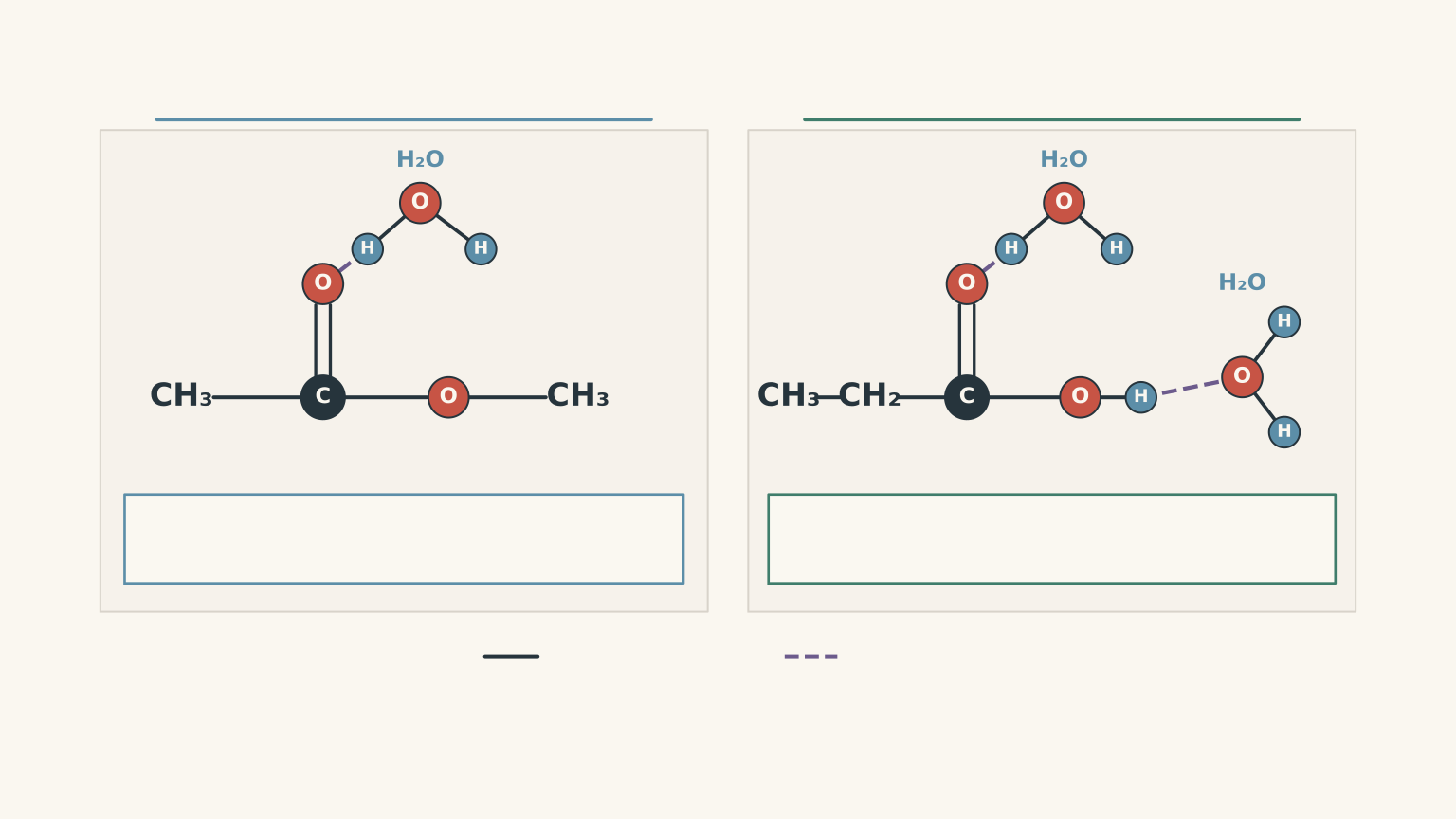
At room temperature, the practical comparison is:
- Propanoic acid: miscible with water.
- Methyl ethanoate: partially soluble in water, with a solubility of roughly \(25\ \text{g}\) per \(100\ \text{mL}\) of water under typical room-temperature conditions. It is not miscible in all proportions.
The ester is not insoluble. That distinction matters. A substance can dissolve to a significant extent without being miscible with water in every possible proportion.
A useful distinction
Polarity, hydrogen bonding, and ionisation are related, but they are not interchangeable explanations.
- Polarity describes an uneven distribution of electrical charge.
- Hydrogen bonding is a particular type of intermolecular attraction involving a suitable hydrogen-bond donor and acceptor.
- Ionisation changes the chemical species present in solution, potentially producing ions that interact strongly with water.
For a strong HSC comparison, explain which interactions are possible and how they affect the property. Avoid writing only that one compound is “more polar”.
04Characteristic reactions: what the functional group allows
Boiling point and solubility tell you how the molecules interact. Chemical reactions provide another way to distinguish the compounds: their functional groups do not respond identically to reagents.
Carboxylic acids react with carbonates
Suppose you add aqueous sodium carbonate to separate samples of propanoic acid and methyl ethanoate.
Which one should produce bubbles?
Propanoic acid reacts with sodium carbonate, releasing carbon dioxide gas. Methyl ethanoate does not produce this characteristic effervescence under ordinary aqueous test conditions.
The balanced equation is:
\[ \ce{ 2CH3CH2COOH + Na2CO3 -> 2CH3CH2COONa + H2O + CO2 } \]
The products are sodium propanoate, water, and carbon dioxide.
The acid reacts with carbonate because it can supply acidic hydrogen ions. The carbonate reacts with the acid, and carbon dioxide is released.
Carboxylic acids also react with bases such as sodium hydroxide in neutralisation reactions:
\[ \ce{ CH3CH2COOH + NaOH -> CH3CH2COONa + H2O } \]
Propanoic acid is a weak acid, meaning it ionises only partially in water. That does not mean it cannot react with a carbonate or a strong base.
Esters undergo hydrolysis
An ester has a different characteristic reaction: hydrolysis. In this reaction, water participates in breaking the ester linkage, producing an alcohol and a carboxylic acid or carboxylate, depending on the conditions.
For methyl ethanoate, acid-catalysed hydrolysis can be represented as:
\[ \ce{ CH3COOCH3 + H2O <=> CH3COOH + CH3OH } \]
The products are ethanoic acid and methanol. An acid catalyst and heating are commonly used to make the reaction proceed at a useful rate. Because the reaction is reversible, the mixture does not necessarily convert completely into products.
Under alkaline conditions, the reaction is represented by:
\[ \ce{ CH3COOCH3 + OH^- -> CH3COO^- + CH3OH } \]
Here, the products are an ethanoate ion and methanol. The carboxyl-containing product is an ion, not ethanoic acid, because the solution is alkaline. The reaction is driven towards products under these conditions.
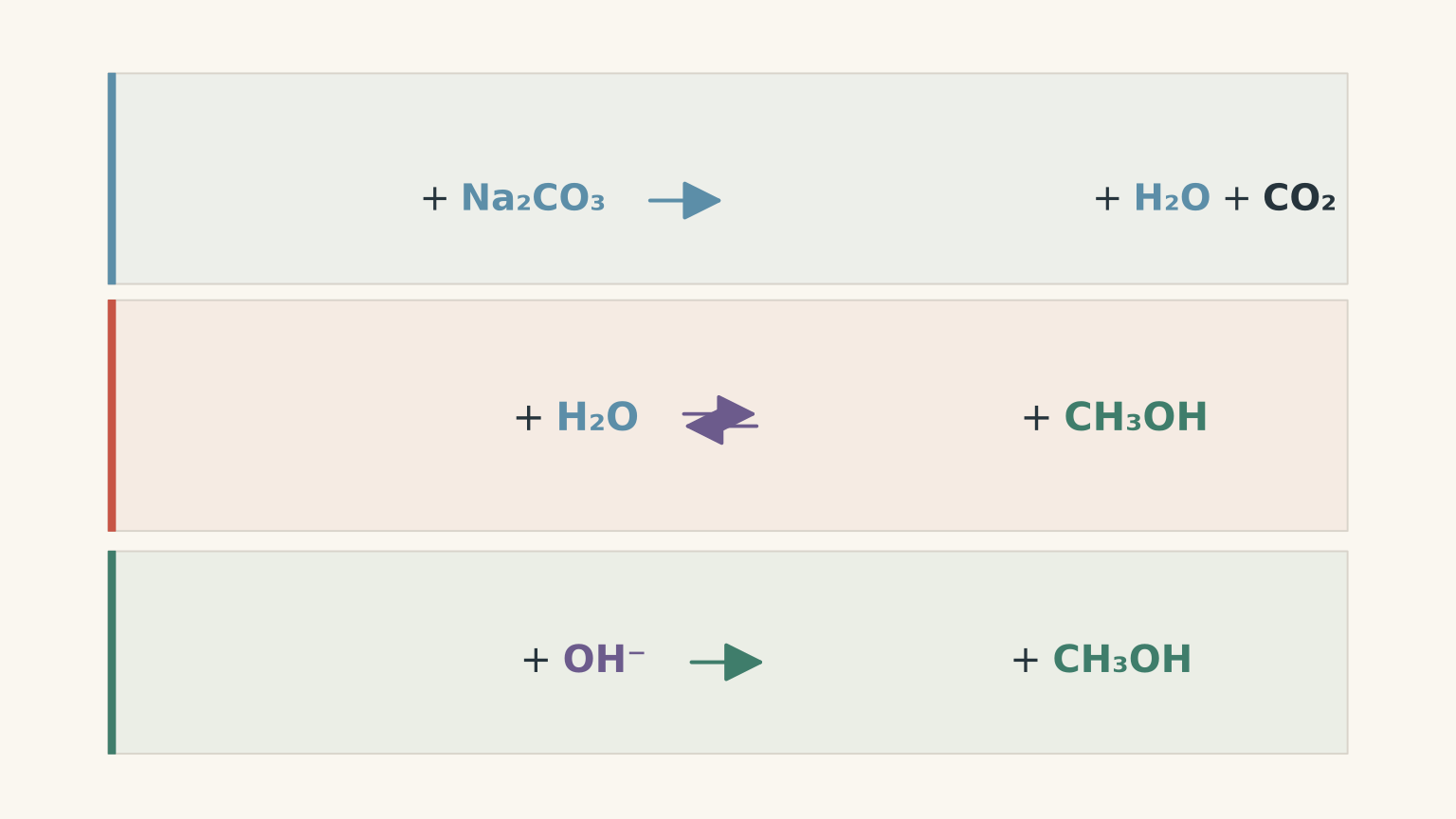
The link between the two functional groups is useful: carboxylic acids can react with alcohols to form esters and water. For example, propanoic acid reacts with methanol to form methyl propanoate under suitable acid-catalysed conditions:
\[ \ce{ CH3CH2COOH + CH3OH <=> CH3CH2COOCH3 + H2O } \]
Esterification and acid-catalysed ester hydrolysis are related reversible processes. The reaction conditions and the species present determine which direction is favoured.
Worked example: Calculate the products of ester hydrolysis
Question: A sample containing \(0.0150\ \text{mol}\) of methyl ethanoate undergoes complete alkaline hydrolysis with excess aqueous sodium hydroxide. Calculate the amounts of methanol and ethanoate ions formed. Explain why ethanoic acid is not the main carboxyl-containing product before acidification.
Step 1
\[ \ce{ CH3COOCH3 + OH^- -> CH3COO^- + CH3OH } \]
One mole of methyl ethanoate reacts with one mole of hydroxide ions to produce one mole of ethanoate ions and one mole of methanol.
Step 2
The ratio is:
\[ \begin{aligned} n(\text{ester}):n(\text{ethanoate}):n(\text{methanol})\\ =1:1:1 \end{aligned} \]
Step 3
Since the ester undergoes complete hydrolysis:
\[ \begin{aligned} n(\text{ethanoate}) &= 0.0150\ \text{mol}\\ n(\text{methanol}) &= 0.0150\ \text{mol} \end{aligned} \]
Step 4
The solution contains excess hydroxide ions, so the carboxyl-containing product is predominantly the ethanoate ion rather than neutral ethanoic acid.
If the solution is subsequently acidified, the ethanoate ions can react with hydrogen ions to form ethanoic acid.
Conclusion: Complete alkaline hydrolysis produces \(0.0150\ \text{mol}\) of methanol and \(0.0150\ \text{mol}\) of ethanoate ions. The reaction conditions determine whether the carboxyl-containing product is present mainly as an acid or as a carboxylate ion.
05A reliable method for comparing the compounds
When an exam asks you to compare a carboxylic acid and an ester, avoid treating the properties as a list of facts to memorise. Build each explanation from the structure.
| Property | Propanoic acid | Methyl ethanoate |
|---|---|---|
| Functional group | Carboxyl, -COOH | Ester, -COO- |
| Hydrogen bonding between its own molecules | Can donate and accept hydrogen bonds | Cannot donate the usual strong hydrogen bonds to other ester molecules |
| Boiling point | Higher, about \(141^\circ\text{C}\) | Lower, about \(57^\circ\text{C}\) |
| Behaviour in water | Miscible in all proportions | Partially soluble, not miscible in all proportions |
| Reaction with aqueous sodium carbonate | Releases \(\ce{CO2}\) | No characteristic effervescence under ordinary conditions |
| Characteristic reaction | Neutralisation and esterification | Hydrolysis |
These are comparisons between the specific compounds named, under the stated conditions. They are not universal rankings for every carboxylic acid and every ester.
The four-step reasoning chain
Use this sequence when writing a comparison:
- Identify the structure. State the functional group and the relevant bond or atom.
- Identify the interaction or reaction. Explain what the group allows the molecule to do.
- Connect it to the property. Explain why the interaction changes the boiling point, solubility, or reaction behaviour.
- State the consequence. Finish with the actual comparison or predicted observation.
For example:
“Propanoic acid has an \(\ce{O-H}\) bond and a carbonyl oxygen, allowing its molecules to form hydrogen bonds with one another. More energy is therefore needed to separate the molecules during boiling, giving propanoic acid a higher boiling point than methyl ethanoate.”
That explanation is stronger than simply writing “carboxylic acids have higher boiling points than esters”. It explains why the comparison holds for these compounds.
06Questions and solutions
Question 1
Two unlabelled samples are known to be propanoic acid and methyl ethanoate. One sample produces bubbles when aqueous sodium carbonate is added; the other does not.
Identify each sample, name the functional group responsible for the reaction, and write the balanced equation for the gas-producing reaction.
Solution 1
Propanoic acid produces the bubbles, while methyl ethanoate does not produce characteristic effervescence under ordinary aqueous test conditions. The reaction identifies the carboxylic acid group, -COOH.
The acid reacts with sodium carbonate to form sodium propanoate, water, and carbon dioxide:
\[ \ce{ 2CH3CH2COOH + Na2CO3 -> 2CH3CH2COONa + H2O + CO2 } \]
The bubbles are carbon dioxide gas. Propanoic acid can supply acidic hydrogen ions that react with carbonate, whereas methyl ethanoate does not have the carboxylic acid group needed for this characteristic test.
The important evidence is the reaction, not the appearance of the liquid or the fact that both compounds contain oxygen.
Question 2
Propanoic acid is miscible with water, while methyl ethanoate is only partially soluble.
A student argues that methyl ethanoate cannot form hydrogen bonds with water because it has no \(\ce{O-H}\) bond.
Explain why the student is incorrect. Then explain why propanoic acid is more compatible with water, despite both compounds containing two oxygen atoms.
Solution 2
Methyl ethanoate can accept hydrogen bonds from water, but it cannot donate the usual strong hydrogen bonds to other methyl ethanoate molecules. The absence of an \(\ce{O-H}\) bond does not prevent it from accepting hydrogen bonds.
Water contains \(\ce{O-H}\) bonds, so a water molecule can donate a hydrogen bond to a suitable oxygen atom in methyl ethanoate. The ester therefore has favourable interactions with water and is partially soluble.
Propanoic acid can both donate and accept hydrogen bonds with water. It can also ionise partially, depending on the solution’s pH, producing propanoate ions that interact strongly with water.
The tempting argument is that two oxygen atoms should give both compounds the same solubility. However, oxygen count alone does not describe the available interactions. The arrangement of the atoms, the ability to donate hydrogen bonds, the non-polar regions, and possible ionisation all affect the outcome.
Question 3
A student writes the following equation for methyl ethanoate:
\[ \ce{ CH3COOCH3 + H2O -> CH3COOH + CH3OH } \]
They claim that adding pure water to methyl ethanoate at room temperature immediately converts all the ester into ethanoic acid and methanol.
Explain two problems with this claim. Write equations for acid-catalysed and alkaline hydrolysis, and identify the carboxyl-containing species present under alkaline conditions.
Solution 3
The claim is incorrect because the equation does not specify the reaction conditions or show that hydrolysis is reversible, and because alkaline hydrolysis produces a carboxylate ion rather than predominantly the neutral carboxylic acid.
First, the equation describes the overall products of acid-catalysed hydrolysis, but it does not imply that the reaction is instantaneous or complete. An acid catalyst and suitable conditions are normally used to obtain a useful reaction rate:
\[ \ce{ CH3COOCH3 + H2O <=> CH3COOH + CH3OH } \]
The reversible arrow indicates that the reaction can proceed in both directions. The final composition depends on the equilibrium and the conditions.
Second, alkaline hydrolysis follows a different product pathway:
\[ \ce{ CH3COOCH3 + OH^- -> CH3COO^- + CH3OH } \]
The carboxyl-containing product is the ethanoate ion, \(\mathrm{CH_{3}COO}^{-}\). In alkaline solution, it is not predominantly present as ethanoic acid because hydroxide ions favour the deprotonated form.
The trap is treating an overall reaction equation as a guarantee of complete conversion under any conditions. The functional group tells you which reaction is possible, but the reaction conditions determine the rate, equilibrium, and products present.
Question 4
A mixture contains a total of \(0.0200\ \text{mol}\) of propanoic acid and methyl ethanoate. The mixture is treated with excess aqueous sodium carbonate, producing \(0.124\ \text{L}\) of carbon dioxide at \(25^\circ\text{C}\) and \(100\ \text{kPa}\).
Assume the molar volume of the gas under these conditions is \(24.8\ \text{L mol}^{-1}\), all the carbon dioxide is collected, and only the propanoic acid produces carbon dioxide in this test.
Calculate the amount, in moles, of each compound in the original mixture and the mole percentage of each.
Solution 4
The mixture contains \(0.0100\ \text{mol}\) of propanoic acid and \(0.0100\ \text{mol}\) of methyl ethanoate, so each compound represents \(50.0\%\) of the mixture by moles. The key is that two moles of propanoic acid produce one mole of carbon dioxide.
Step 1: Calculate the amount of carbon dioxide.
Using \(n=V/V_m\), where \(n\) is the amount of gas, \(V\) is its volume, and \(V_m\) is the molar volume:
\[ \begin{aligned} n(\ce{CO2}) &= \frac{0.124}{24.8}\\ &=0.00500\ \text{mol} \end{aligned} \]
Step 2: Use the balanced reaction to calculate the amount of propanoic acid.
\[ \ce{ 2CH3CH2COOH + Na2CO3 -> 2CH3CH2COONa + H2O + CO2 } \]
The mole ratio of propanoic acid to carbon dioxide is \(2:1\).
\[ \begin{aligned} n(\text{propanoic acid}) &=2n(\ce{CO2})\\ &=2(0.00500)\\ &=0.0100\ \text{mol} \end{aligned} \]
Step 3: Calculate the amount of methyl ethanoate.
The total amount of the two compounds is \(0.0200\ \text{mol}\).
\[ \begin{aligned} n(\text{methyl ethanoate}) &=0.0200-0.0100\\ &=0.0100\ \text{mol} \end{aligned} \]
Step 4: Calculate the mole percentages.
For each compound:
\[ \begin{aligned} \text{Mole percentage} &=\frac{n(\text{compound})}{n(\text{total})} \times100\%\\ &=\frac{0.0100}{0.0200}\times100\%\\ &=50.0\% \end{aligned} \]
Both compounds make up \(50.0\%\) of the mixture by moles.
The tempting mistake is to assume one mole of acid produces one mole of carbon dioxide. The balanced equation shows otherwise. Correct stoichiometry lets a chemical reaction distinguish functional groups even when the compounds have the same molecular formula.
Question 5
At \(25^\circ\text{C}\), propanoic acid has an acid dissociation constant of \(K_a=1.3\times10^{-5}\).
Consider two separate aqueous solutions containing propanoic acid and propanoate ions: one adjusted to pH \(7.00\), and the other adjusted to pH \(2.00\). Assume methyl ethanoate hydrolysis is negligible during any comparison with the ester.
A student claims:
“Lowering the pH to 2 makes propanoic acid almost completely neutral, so it must separate into an oily layer and become less soluble than methyl ethanoate. Only the ionised form of an acid can dissolve in water.”
(a) Calculate the ratio of propanoate ions to propanoic acid molecules at each pH.
(b) Calculate the percentage of the total propanoic acid species that is ionised at each pH.
(c) Evaluate the student’s claim. Explain why a change in ionisation does not automatically imply a change from complete miscibility to a separate liquid layer.
Solution 5
The student is incorrect: at pH \(2.00\), only about \(0.13\%\) of the propanoic acid species is ionised, but this does not mean the acid must separate from water or become less soluble than methyl ethanoate. Propanoic acid is miscible with water even in its neutral form.
This question requires two different ideas: acid-base equilibrium determines which chemical species are present, while solubility determines whether those species can remain mixed with the solvent.
Step 1: Write the acid dissociation expression.
For propanoic acid:
\[ \ce{ CH3CH2COOH + H2O <=> CH3CH2COO^- + H3O^+ } \]
The acid dissociation constant is:
\[ K_a= \frac{[\mathrm{CH_{3}CH_{2}COO}^{-}][\mathrm{H_{3}O}^{+}]} {[\ce{CH3CH2COOH}]} \]
Rearranging gives:
\[ \frac{[\mathrm{CH_{3}CH_{2}COO}^{-}]} {[\ce{CH3CH2COOH}]} = \frac{K_a}{[\mathrm{H_{3}O}^{+}]} \]
This ratio tells us how much propanoate ion is present relative to neutral propanoic acid.
Step 2: Calculate the ratio at pH \(7.00\).
Since \(\text{pH}=-\log_{10}[\ce{H3O+}]\):
\[ [\mathrm{H_{3}O}^{+}]=1.0\times10^{-7}\ \text{mol L}^{-1} \]
Therefore:
\[ \begin{aligned} \frac{[\mathrm{CH_{3}CH_{2}COO}^{-}]} {[\ce{CH3CH2COOH}]} &=\frac{1.3\times10^{-5}}{1.0\times10^{-7}}\\ &=130 \end{aligned} \]
The ratio is \(130:1\). There are approximately 130 propanoate ions for every neutral propanoic acid molecule.
Step 3: Calculate the ionised percentage at pH \(7.00\).
Let \(r\) be the ratio of ionised to neutral species. The ionised fraction is \(r/(1+r)\).
\[ \begin{aligned} \text{Ionised percentage} &=\frac{130}{131}\times100\%\\ &\approx99.2\% \end{aligned} \]
Approximately \(99.2\%\) of the propanoic acid species is ionised.
Step 4: Calculate the ratio at pH \(2.00\).
At pH \(2.00\):
\[ [\mathrm{H_{3}O}^{+}]=1.0\times10^{-2}\ \text{mol L}^{-1} \]
Therefore:
\[ \begin{aligned} \frac{[\mathrm{CH_{3}CH_{2}COO}^{-}]} {[\ce{CH3CH2COOH}]} &=\frac{1.3\times10^{-5}}{1.0\times10^{-2}}\\ &=1.3\times10^{-3} \end{aligned} \]
The ratio is \(0.0013:1\). Neutral propanoic acid now greatly outnumbers propanoate ions.
Step 5: Calculate the ionised percentage at pH \(2.00\).
\[ \begin{aligned} \text{Ionised percentage} &=\frac{0.0013}{1+0.0013}\times100\%\\ &\approx0.130\% \end{aligned} \]
Only approximately \(0.130\%\) of the propanoic acid species is ionised.
Step 6: Evaluate the claim about solubility.
The calculations show that pH changes the chemical form of propanoic acid dramatically. At pH \(7.00\), it is mostly present as propanoate ions. At pH \(2.00\), it is mostly present as neutral propanoic acid molecules.
But the student has made a second, incorrect assumption: that a neutral acid must be insoluble in water.
Propanoic acid can form hydrogen bonds with water through its carboxyl group. Its neutral molecules can therefore remain mixed with water, and propanoic acid is miscible with water in all proportions. A low ionised fraction does not force it to form a separate oily layer.
Methyl ethanoate, meanwhile, remains a neutral ester under these ordinary acid-base conditions. It can accept hydrogen bonds from water, but it is only partially soluble and is not miscible with water in all proportions.
The student has confused ionisation with solubility. Ionisation can strongly affect how a compound behaves in water, but it does not alone determine whether a separate liquid phase forms. Molecular interactions and the actual solubility of the neutral species matter, too.
This is the key to more advanced acid-base questions: calculate which species dominates at the given pH, then separately consider how that species interacts with its surroundings. The functional group links both decisions, but neither can replace the other.