
Does the Pomodoro Technique Work for HSC Study?
Discover how to adapt Pomodoro work-and-break cycles for different HSC subjects and study tasks. Learn what the research says, how to choose starting intervals, and how to test which approach works best for you.
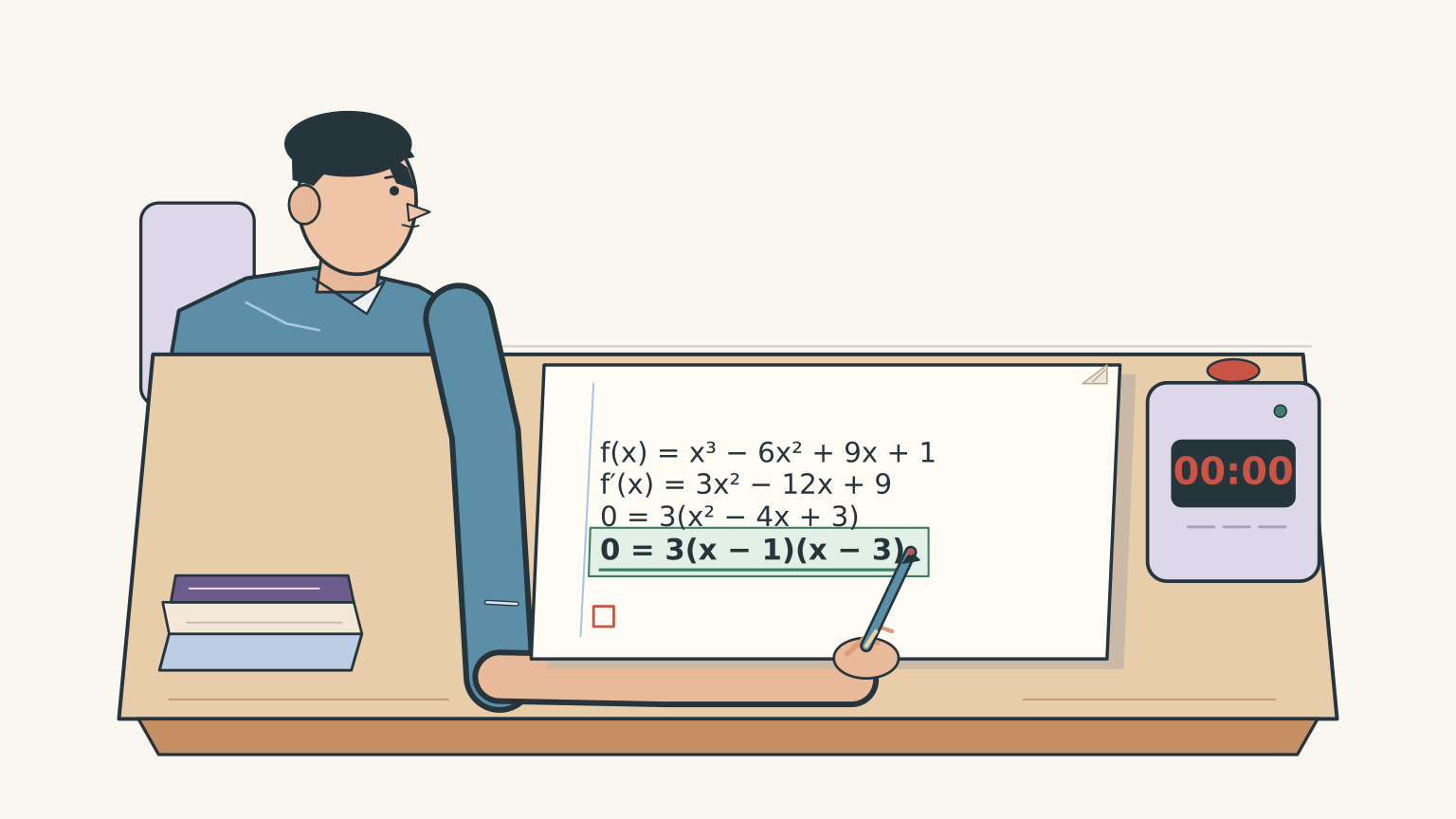
You’re halfway through a multi-step Maths Extension 1 question when your 25-minute timer rings. You’ve worked through the difficult part, but the final substitution is still unfinished. Do you stop because the Pomodoro Technique says it’s time for a break?
Probably not. Finish the current logical step, mark where you’ll resume, and then take your break. A timer should help you manage your attention, not interrupt your thinking for the sake of following a schedule.
So, does the Pomodoro Technique work for HSC study? Yes, it can. But the familiar 25-minute work and 5-minute break combination isn’t a scientifically established optimum. The real benefit comes from using planned work-and-break cycles that suit the task you’re doing. A Maths Extension 2 proof, a Chemistry recall exercise, and a Physics calculation don’t necessarily need the same timing.
01What the Pomodoro Technique actually does
The familiar Pomodoro Technique follows a simple pattern:
- Choose one task and work on it for a set period.
- Take a short, planned break.
- Return to the task or move to the next planned activity.
- After several cycles, take a longer break.
The traditional version uses 25 minutes of work followed by 5 minutes of rest. After four cycles, you take a longer break.
This is a form of time-boxing. You decide in advance how long you’ll spend concentrating on a particular task, rather than continually deciding whether to keep working.
Think of the timer as a lap marker, not a referee’s whistle. It gives you a point to check your progress, but it doesn’t mean every piece of work must stop at exactly the same moment.
The technique can help in three ways.
It makes starting easier. Committing to one defined period of work can feel more manageable than committing to an entire evening of study.
It reduces repeated decisions. You don’t need to keep wondering when you’ll finish or whether you should take a break. You’ve already made that decision.
It creates opportunities to recover. Concentrated work takes mental effort. A suitable break gives you a chance to step away before fatigue makes it harder to concentrate.
However, there’s a limitation. If you interrupt yourself halfway through a difficult question, you may lose track of the reasoning you were building. When you return, you have to reconstruct your previous steps before you can continue.
That’s why the timing needs to work around the task, rather than the other way around.
Due to technical limitations, this figure may display incorrectly or contain inaccuracies. Please check key details against your course materials.
02What does the research actually say?
It’s worth separating two claims:
- Taking breaks can help manage fatigue.
- Taking a break every 25 minutes necessarily improves learning and productivity.
The first has some research support. The second is much less certain.
A 2025 study published in Behavioral Sciences compared three approaches to taking breaks: the Pomodoro Technique, Flowtime (where students choose when to take breaks), and self-regulated breaks.
The study involved 94 university students completing a two-hour study session. The Pomodoro group used 25-minute work periods followed by 5-minute breaks.
Researchers found no significant overall differences between the groups in productivity, task completion, or flow. They did observe differences in how motivation and fatigue changed during the session, including a faster increase in fatigue in the Pomodoro group.
Importantly, these participants were university students, not NSW HSC students. The study also examined a relatively short study period, so it doesn’t establish which approach works best across an entire school term.
You can read the 2025 study comparing Pomodoro, Flowtime, and self-regulated breaks.
There is also broader research into short breaks.
A 2022 systematic review and meta-analysis examined 22 independent samples involving 2,335 participants. It found that short breaks had small positive effects on vigour and fatigue. However, the researchers did not find a statistically significant overall improvement in performance.
The review also found that longer breaks tended to be associated with greater improvements in performance. It did not establish one universally optimal break duration.
Read the 2022 meta-analysis of micro-breaks.
The practical conclusion is that breaks can help you feel less mentally depleted, but a particular timer setting doesn’t automatically make your study more effective.
For HSC students, the better question is whether your chosen intervals help you produce accurate work, maintain concentration, and remember what you’ve learned.
03Choose your work interval based on the task
A common mistake is using the same 25/5 cycle for every subject and activity.
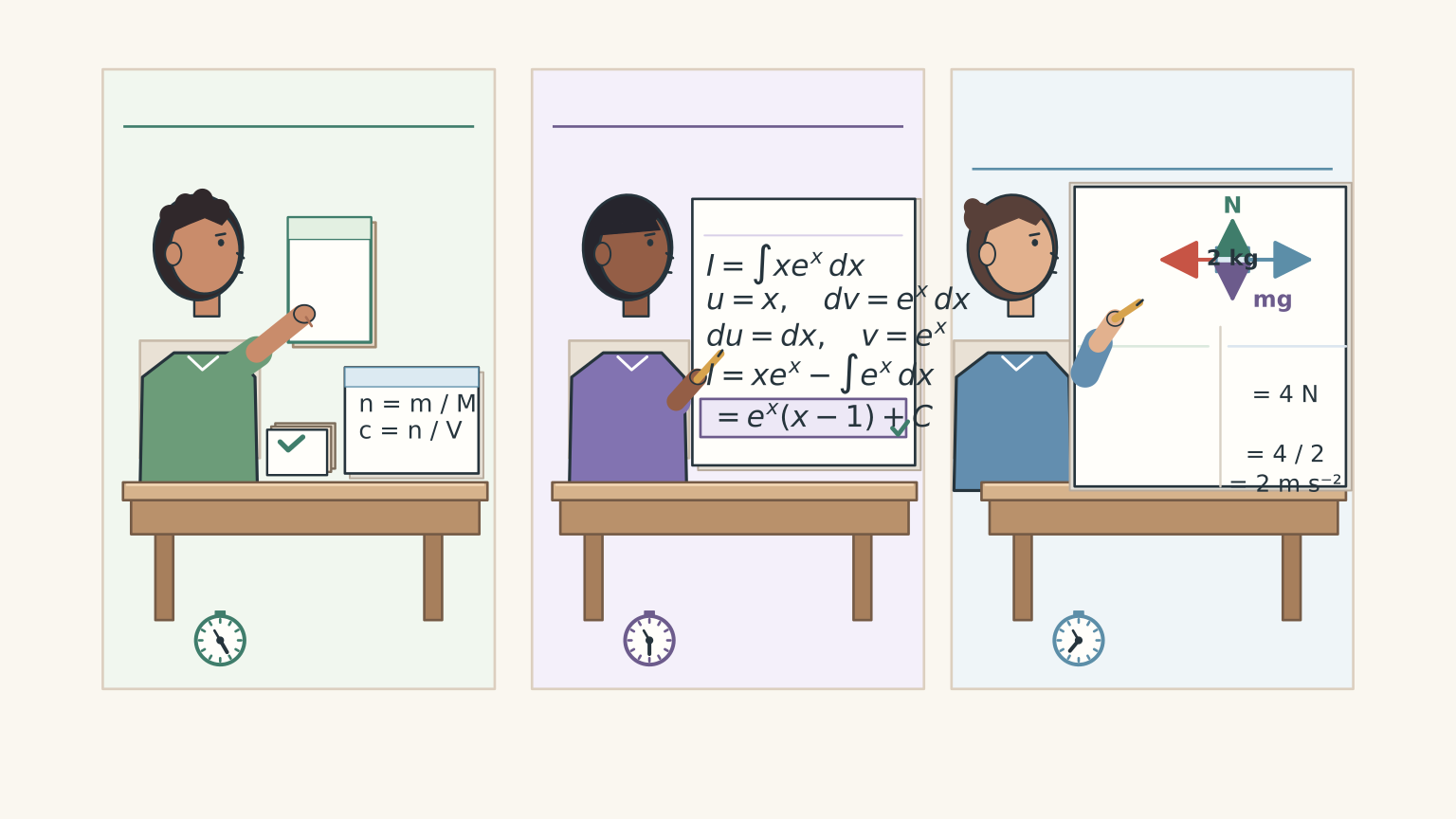
Consider the difference between memorising Chemistry definitions and solving a difficult Maths Extension 2 question.
The first involves recalling relatively discrete pieces of information. The second might require several connected steps, with each step depending on the previous one.
Interrupting these tasks in exactly the same way doesn’t necessarily make sense.
Here are some starting intervals worth trialling.
| HSC study task | Initial work interval | Suggested break |
|---|---|---|
| Flashcards, definitions, and formula recall | 20-30 minutes | 3-5 minutes |
| Chemistry reaction and evidence revision | 20-30 minutes | 5 minutes |
| Multi-step Maths Extension 1 or 2 problems | 35-50 minutes | 5-10 minutes |
| Physics calculations and extended explanations | 35-50 minutes | 5-10 minutes |
| Extended written responses or essay sections | 30-45 minutes | 5-10 minutes |
These are practical starting points, not scientifically proven ideal durations. Your concentration, familiarity with the material, and the difficulty of the task will affect what works.
The important thing is to choose a reasonable starting interval, test it, and adjust it using evidence from your own study.
Due to technical limitations, this figure may display incorrectly or contain inaccuracies. Please check key details against your course materials.
When you’re memorising or recalling information
Suppose you’re revising reaction conditions, definitions, or important Physics equations.
You could begin with a 20-minute work period. During that time, try to recall the information without looking at your notes.
For example, in Chemistry, you might write down the conditions required for several reactions from memory, then check your answers.
When the interval ends, finish checking the current set and take a short break.
This is a suitable task for relatively short work periods because you can divide it into clear sets of questions or recall prompts.
When you’re solving difficult Maths problems
Now consider a Maths Extension 2 question involving a multi-step proof.
You might spend several minutes identifying the relevant identity, manipulating an expression, and testing whether a substitution will work.
If your timer interrupts you halfway through, stopping immediately could make restarting unnecessarily difficult.
For this type of work, try a longer interval, perhaps 40 minutes initially.
If you reach the end of a question just after the timer sounds, finish that question rather than immediately starting another one. Write down the next step if you haven’t completed the problem.
The aim is to protect uninterrupted reasoning while still giving yourself a planned opportunity to rest.
When you’re learning or explaining a difficult concept
Some HSC tasks require you to connect several ideas rather than recall isolated facts.
For example, you might be explaining how a physical property determines the separation technique used for a mixture, or describing the relationship between magnetic flux and induced EMF in Physics.
A useful work period might be 30-45 minutes.
Set a clear endpoint, such as completing an explanation with supporting evidence or finishing a worked example and attempting a similar question independently.
A completed piece of reasoning is a much better stopping point than an arbitrary line on a page.
04What should you actually do during a break?
A break should give you some distance from the task.
If you spend five minutes watching short videos, checking messages, and scrolling through social media, you haven’t necessarily given yourself a useful mental rest.
Try activities that don’t require you to concentrate on another demanding task:
- Stand up and stretch.
- Refill your water bottle.
- Walk around the house.
- Look outside for a few minutes.
- Have a quick snack if you’re hungry.
You don’t need to turn your break into another productivity exercise. Its purpose is to give you a chance to recover.

Due to technical limitations, this figure may display incorrectly or contain inaccuracies. Please check key details against your course materials.
Pay attention to how you feel when you return.
If you consistently need much longer than your planned break to feel ready to work again, your previous block might have been too demanding, or your break might not have been long enough.
If you return feeling refreshed after five minutes, there’s no particular reason to extend every break to fifteen minutes.
05How to trial adjustable Pomodoro cycles
Rather than changing your entire study routine at once, test different intervals across a week.
The aim is to discover which settings work for particular tasks.
Step 1: Give each work period a specific outcome
Don’t write down:
- Study Chemistry.
- Do Maths.
- Revise Physics.
These descriptions don’t tell you what successful work looks like.
Instead, choose something you can check:
- Complete and mark four equilibrium questions.
- Recall ten reaction conditions without notes.
- Solve three Maths Extension 1 questions involving a particular technique.
- Write a complete explanation of electromagnetic induction.
A clear outcome makes it easier to judge whether your work interval was appropriate.
Step 2: Choose a starting interval
Match the interval to the task.
If you’re completing a set of recall questions, try 20-25 minutes.
If you’re solving multi-step Maths problems, try 40 minutes.
If you’re writing an extended explanation, try 35 minutes.
You don’t need to use the same settings for the whole evening.
Step 3: Work until the interval ends or you reach a sensible stopping point
When the timer sounds, check where you are.
If you’re halfway through a calculation, finish the immediate step and write down where to resume.
If you’ve completed the task, take your break.
If you’re consistently reaching the end of your interval with plenty of concentration left, consider increasing the next interval.
Step 4: Record what happened
After each work period, make a quick note of three things:
| What to record | What it tells you |
|---|---|
| Work completed | Whether the interval allowed enough time |
| Accuracy and quality | Whether you were concentrating effectively |
| Fatigue and ease of restarting | Whether the work-and-break pattern was sustainable |
You could rate fatigue from 1 to 5, where 1 means very fresh and 5 means extremely tired.
Don’t worry about making this a complicated spreadsheet. A few notes are enough to identify patterns.
Step 5: Adjust one thing at a time
Use your observations to decide what to change.
| What you’re noticing | What to try next |
|---|---|
| The timer repeatedly interrupts your reasoning | Extend the work interval by 5-10 minutes |
| You’re losing concentration well before the timer | Shorten the interval or make the task more specific |
| You struggle to return after breaks | Change the break activity or shorten its duration |
| You finish more questions but make more errors | Allow time for checking or reduce the work interval |
| You finish feeling fresh and could continue comfortably | Gradually extend the next interval |
Avoid changing the work interval, break length, task difficulty, and study environment all at once. Otherwise, you won’t know which change made the difference.
06Worked scenario: choosing cycles for one HSC study evening
Suppose you’ve planned three tasks for an evening of HSC revision.
Each task requires a different kind of thinking.
Task 1: Maths Extension 1
You want to complete four multi-step questions.
Start with a 40-minute work period and a 7-minute break.
If you finish three questions and are halfway through the fourth when the timer rings, finish the current logical step and mark where you’ll resume.
If you repeatedly find that 40 minutes interrupts your progress, trial 45 minutes next time.
Task 2: Chemistry
You want to revise separation techniques.
Start with 25 minutes of active recall. Write down which physical properties different separation methods rely on, then check your explanations against your notes.
For the content itself, you could use tutorgum’s guides to choosing separation techniques in HSC Chemistry and understanding how chromatography and mass spectrometry work together.
The aim is to retrieve and apply the ideas, rather than simply reread both resources.
Task 3: Physics
You want to complete a multi-step question involving electromagnetic induction.
Start with a 40-minute work period and a 7-minute break.
Give yourself enough time to establish the relevant physical principles, work through the calculation, and check your units.
If you finish the question early, use the remaining time to check your reasoning rather than automatically starting another demanding problem.
Notice that the three tasks have different work intervals. That’s intentional.
You aren’t trying to fit your entire HSC workload into identical 25-minute blocks. You’re choosing a structure that supports the work you’re actually doing.
07Questions and solutions
Question 1
You’re halfway through a difficult Maths Extension 2 question when your 25-minute timer rings. You’ve made good progress and understand the steps you’ve taken so far.
Should you stop immediately and take your break?
Solution 1
No. Finish the current logical step, record where you need to resume, and then take your break.
The purpose of the timer is to help manage your concentration. It isn’t a rule that requires you to abandon a coherent piece of reasoning.
If this happens regularly, your work interval is probably too short for that particular type of task. Trial a longer interval rather than repeatedly interrupting yourself.
Question 2
You find that 25-minute work periods are effective when recalling Chemistry reaction conditions. However, the same intervals repeatedly interrupt your progress when solving Maths Extension 2 problems.
Should you use 25-minute intervals for both subjects to keep your timetable consistent?
Solution 2
No. Use different intervals for different types of work.
Chemistry recall involves retrieving relatively discrete pieces of information. You can often complete a defined set of recall questions within a shorter period.
A difficult Maths problem may involve several connected steps. Interrupting that reasoning can create unnecessary restart time.
Keep the shorter interval for Chemistry recall and trial a longer interval for Maths. Consistency in your study process is useful, but identical timing isn’t necessary.
Question 3
You complete four Pomodoro cycles of Chemistry revision in one evening. You spend most of the time rereading your notes, and you feel as though you’ve covered a lot of content.
The following day, however, you struggle to explain the reactions without looking at your notes.
Does this mean you need more Pomodoro cycles?
Solution 3
No. The problem is more likely to be how you’re using your study time, rather than the number of cycles.
The Pomodoro Technique helps organise your time, but it doesn’t automatically improve memory.
Rereading information can make it feel familiar without proving that you can recall or apply it independently.
A better approach is to use retrieval practice. Close your notes, attempt to recall the reactions, explain the conditions, and answer questions without looking at the material.
Then check your answers and correct any gaps.
You should also revisit the material on another day. This is spaced practice, which is different from taking a five-minute break between two work periods.
The Australian Education Research Organisation explains how spacing and retrieval practice support long-term retention in its Spacing and Retrieval Practice Guide.
Four Pomodoro cycles in one evening aren’t a substitute for revisiting and retrieving information across several days.
08The verdict: should you use Pomodoro for HSC study?
The Pomodoro Technique is worth trialling if you struggle to start tasks, lose track of time, or work for so long that fatigue affects your concentration.
But don’t treat 25/5 as a rule.
Use shorter intervals for tasks with clear, discrete outcomes. Allow longer periods for connected problem-solving and extended explanations. Take breaks at sensible stopping points, and adjust the timing when your observations suggest something isn’t working.
Most importantly, judge your study by what you can actually do afterwards:
- Can you solve the question independently?
- Can you explain the concept without your notes?
- Can you identify and correct your mistakes?
- Can you remember and apply the material several days later?
A well-timed study block is useful, but the quality of the learning inside it matters more.
Once you’ve found work-and-break intervals that suit your concentration, the next step is to improve what happens during each block: combining active recall, worked examples, independent practice, and spaced revision. That’s how a time-management technique becomes part of an effective HSC study system.