
How a Mass Spectrometer Separates Ions by Mass-to-Charge Ratio
Learn how a magnetic-sector mass spectrometer uses accelerating voltage and magnetic deflection to separate ions by mass-to-charge ratio. Follow the key equations, compare equal-speed and equal-voltage conditions, and practise with worked examples and challenging HSC-style questions.
Two ions enter the same magnetic field. One has twice the mass of the other. Which ion bends less?
If both ions have the same charge and enter the field at the same speed, the heavier ion follows a circle with twice the radius. But a mass spectrometer usually accelerates its ions through a known voltage before they reach the magnet. That changes their speeds, so you need to consider both the energy they gain and the magnetic force acting on them.
This is the key to understanding how a magnetic-sector mass spectrometer separates ions by their mass-to-charge ratio.
01The measurement problem: turning mass into a position
Atoms of the same element can have different masses. These versions are called isotopes. They have the same number of protons but different numbers of neutrons, so their chemical properties are similar even though their masses differ.
How could you distinguish two isotopes if you couldn’t place individual atoms on a set of scales?
A mass spectrometer takes a different approach. It turns atoms into charged particles called ions, sends them through electric and magnetic fields, and measures where they arrive. The position of each detected ion can then be used to infer its mass-to-charge ratio.
Historically, J. J. Thomson’s positive-ray experiments demonstrated how charged particles could be separated by their deflection. Francis Aston’s later mass spectrograph developed this approach into a more precise method of distinguishing isotopes.
The important experimental idea is simple: use a tiny difference in particle properties to produce a measurable difference in detector position.
Following the instrument from source to detector
Read the instrument in order, from left to right.
Instrument map:
Ion source → narrow slits → accelerating gap (\(V_a\)) → magnetic sector (\(B\)) → position-sensitive detector
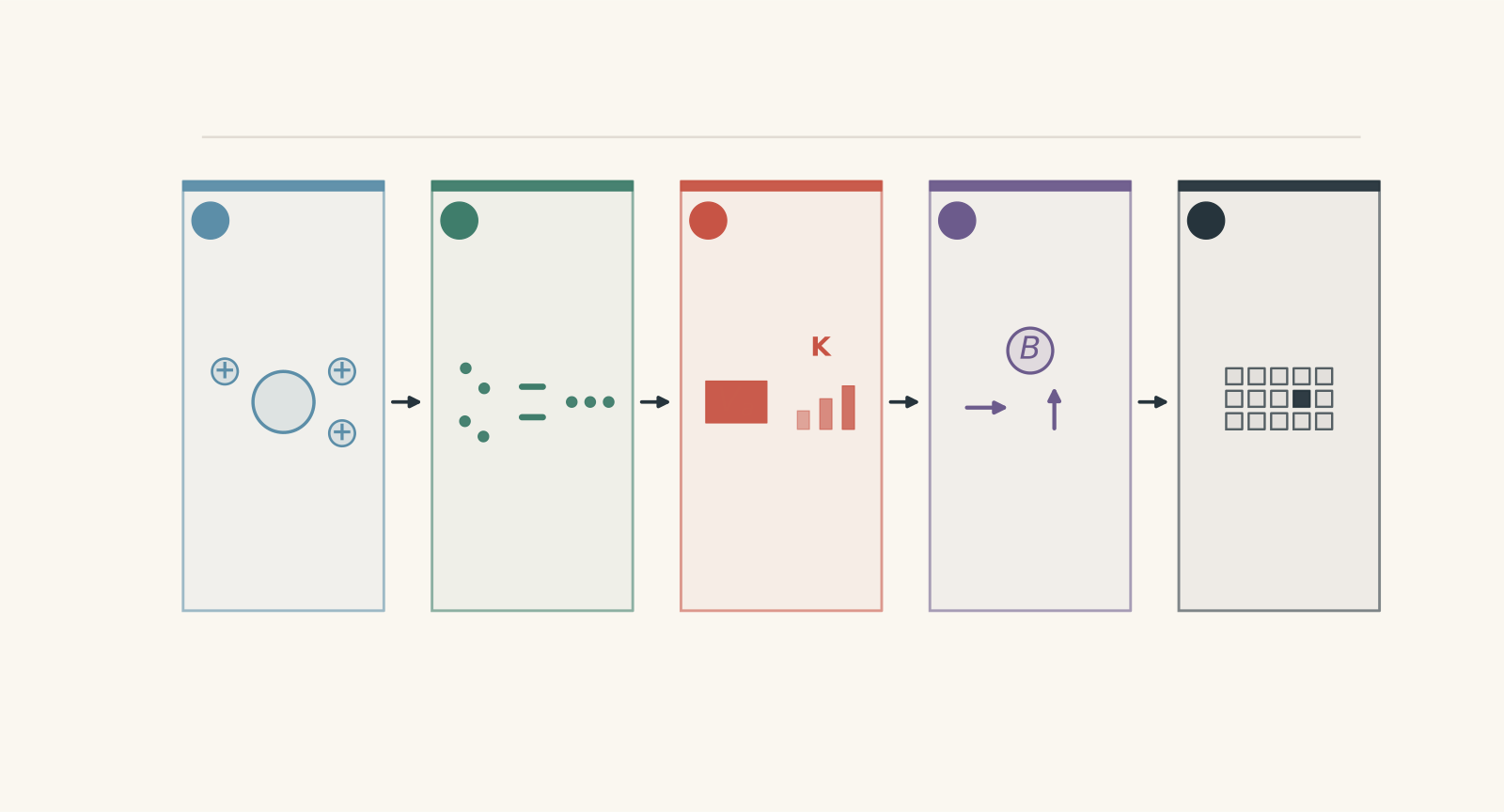
Each stage has a specific job.
| Stage | What happens | Why it matters |
|---|---|---|
| Ion source | Atoms or molecules are ionised. | Produces particles that respond to electric and magnetic fields. |
| Narrow slits | The ions pass through small openings. | Forms a narrow beam with a well-defined direction. |
| Accelerating gap | A potential difference accelerates the ions. | Establishes a known energy gain per unit charge. |
| Magnetic sector | A magnetic field bends the moving ions. | Converts differences in mass-to-charge ratio into differences in curvature. |
| Detector | The instrument records where ions arrive. | Provides the measurement used to infer mass-to-charge ratio. |
The instrument operates under a vacuum so that collisions with air molecules do not scatter the ions and disrupt their paths.
Now make a prediction. If two ions have different mass-to-charge ratios, but pass through the same accelerating voltage and magnetic field under the same starting conditions, should they arrive at the same position?
Generally, no. Their circular-path radii will differ. The equations below show exactly why.
02Step 1: the accelerating voltage determines the energy gained
Imagine an ion starting nearly at rest. It passes through a potential difference \(V_a\), measured in volts.
The electric field transfers energy to the ion. The amount of energy gained depends on both the voltage and the magnitude of the ion’s charge.
For an ion starting from rest, the gain in kinetic energy is
\[ |q|V_a=\frac12 mv^2 \]
where:
- \(m\) is the ion’s mass, in kilograms (\(\mathrm{kg}\)).
- \(|q|\) is the magnitude of its charge, in coulombs (\(\mathrm{C}\)).
- \(V_a\) is the accelerating potential difference, in volts (\(\mathrm{V}\)).
- \(v\) is the ion’s speed after acceleration, in metres per second (\(\mathrm{m\,s^{-1}}\)).
Rearranging gives
\[ v=\sqrt{\frac{2|q|V_a}{m}} \]
This equation is worth understanding before memorising it.
At the same accelerating voltage, ions with the same charge magnitude gain the same kinetic energy. The heavier ion must therefore travel more slowly.
For example, if one ion has four times the mass of another and both have the same charge, the heavier ion travels at half the speed after acceleration through the same voltage.
There is an important qualification: equal voltage does not necessarily mean equal kinetic energy. If one ion has twice the charge magnitude, it gains twice as much energy from the same voltage.
The same energy-transfer principle appears in an electron gun. See How an Electron Gun Uses Voltage to Produce a Beam for a related application.
03Step 2: the magnetic field bends the moving ions
The accelerated ions now enter a magnetic field.
The field is arranged so that the ions’ velocity is perpendicular to the magnetic field. This gives the magnetic force its maximum magnitude:
\[ F_B=|q|vB \]
Here, \(B\) is the magnetic field strength, measured in tesla (\(\mathrm{T}\)).
The magnetic force acts perpendicular to the ion’s velocity. It changes the direction of motion, not the speed. Because the force does no work on the ion, its kinetic energy remains constant while it travels through the magnetic field.
Think of the ion as constantly turning rather than speeding up or slowing down.
A force is needed to keep an object moving in a circle. This is the centripetal force, with magnitude
\[ F_c=\frac{mv^2}{r} \]
where \(r\) is the radius of the circular path, measured in metres.
The magnetic force supplies this centripetal force, so
\[ |q|vB=\frac{mv^2}{r} \]
Cancel one factor of \(v\) and rearrange:
\[ \boxed{r=\frac{mv}{|q|B}} \]
This is the magnetic circular-motion equation for an ion entering the field perpendicularly.
Notice what it tells you: at the same speed and magnetic field, a larger mass-to-charge ratio produces a larger radius. The ion bends less sharply.
But there is still a problem. The radius depends on speed as well as mass and charge. We need to combine this equation with the energy gained from the accelerating voltage.
04Step 3: combine the two equations
From the accelerating stage,
\[ v=\sqrt{\frac{2|q|V_a}{m}} \]
From the magnetic stage,
\[ r=\frac{mv}{|q|B} \]
Substitute the expression for \(v\) into the radius equation:
\[ r=\frac{m}{|q|B} \sqrt{\frac{2|q|V_a}{m}} \]
After simplifying,
\[ \boxed{r=\frac{1}{B} \sqrt{\frac{2mV_a}{|q|}}} \]
Squaring both sides gives an especially useful form:
\[ \boxed{r^2=\frac{2V_a}{B^2}\frac{m}{|q|}} \]
Rearranging to make the mass-to-charge ratio the subject,
\[ \boxed{\frac{m}{|q|}=\frac{B^2r^2}{2V_a}} \]
These are the central equations for a simplified magnetic-sector mass spectrometer.
For the ideal model, they assume that:
- The ions start with negligible kinetic energy.
- All ions pass through the same accelerating potential difference.
- The magnetic field is uniform and perpendicular to the ion velocity.
- Collisions and relativistic effects are negligible.
The last equation shows how the instrument works as a measuring device. If you know the accelerating voltage and magnetic field, and measure the radius, you can calculate the ion’s mass-to-charge ratio.
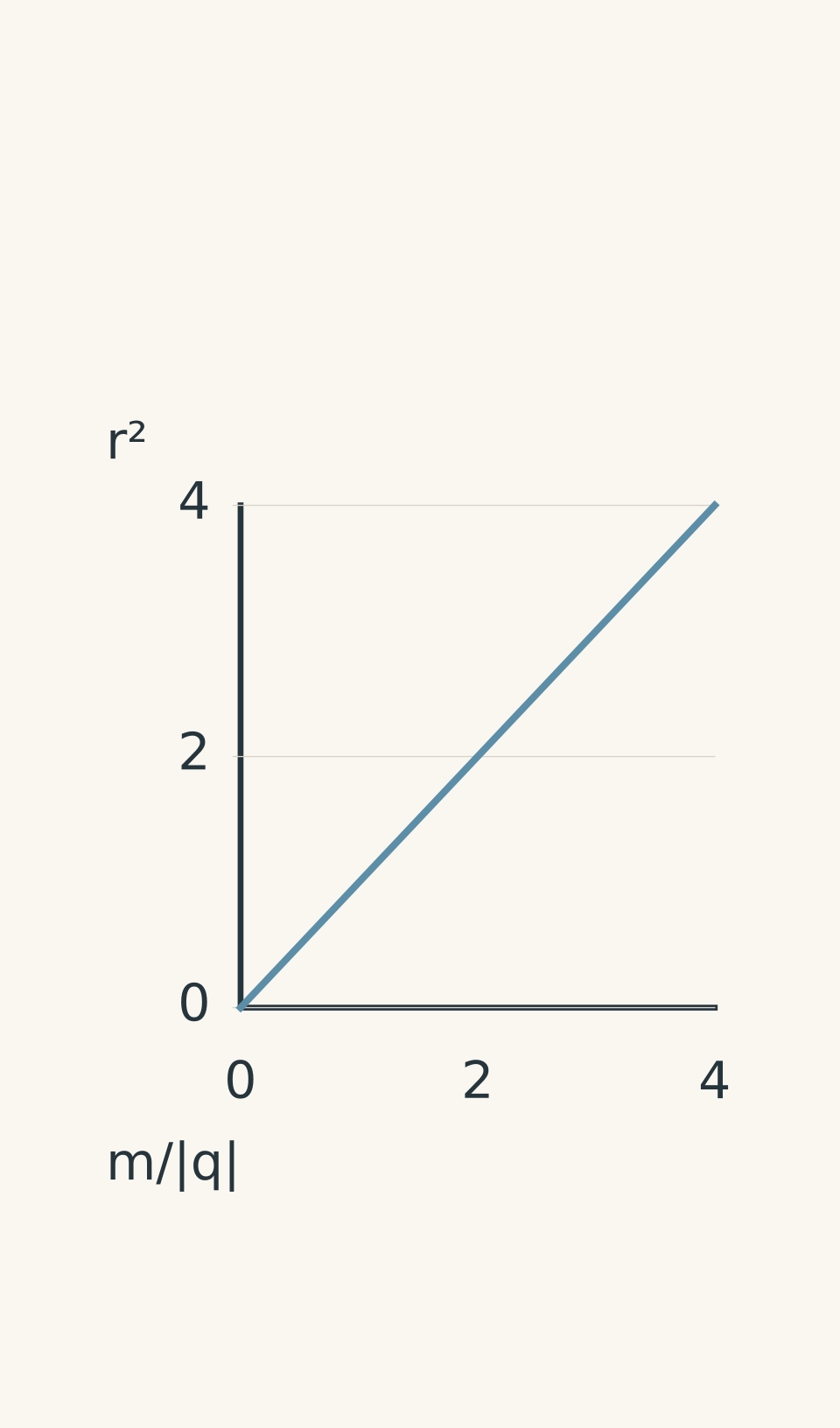
- Schematic line — gradient = 2Va/B²
At fixed \(V_a\) and \(B\), the squared radius is directly proportional to the mass-to-charge ratio.
That means:
- If \(m/|q|\) doubles, \(r^2\) doubles.
- If \(m/|q|\) quadruples, \(r^2\) quadruples, so \(r\) doubles.
- If two ions have the same \(m/|q|\), they have the same radius under these conditions.
The last point is important. The instrument measures mass-to-charge ratio, not mass alone.
05Equal speed versus equal accelerating voltage
There are two common ways to compare the paths of ions. They sound similar, but they lead to different equations.
| Condition | Radius equation | How the radius depends on \(m/|q|\) |
|---|---|---|
| Equal speed | \(r=\dfrac{mv}{|q|B}\) | \(r\propto m/|q|\) |
| Equal accelerating voltage, starting from rest | \(r=\dfrac{1}{B}\sqrt{\dfrac{2mV_a}{|q|}}\) | \(r\propto\sqrt{m/|q|}\) |
The controlled condition changes the radius relationship
| Equal speed | Same entry speed v and magnetic field B \(r=\dfrac{mv}{|q|B}\) \(r\propto\dfrac{m}{|q|}\) Radius increases directly with mass-to-charge ratio. |
|---|---|
| Equal accelerating voltage | Same \(V_a\) and B; ions start from rest \(r=\dfrac{1}{B}\sqrt{\dfrac{2mV_a}{|q|}}\) \(r\propto\sqrt{\dfrac{m}{|q|}}\) Heavier ions with the same charge are slower. |
Let’s see why the difference matters.
Suppose two singly charged ions have masses \(m\) and \(4m\).
If they enter the magnetic field at equal speeds, the heavier ion has four times the radius. This follows directly from \(r=mv/(|q|B)\).
Now suppose both ions start from rest and are accelerated through the same voltage. The heavier ion travels at half the speed. Substituting into the magnetic equation gives a radius only twice as large.
Both predictions are correct. They describe different experimental conditions.
How an experiment can control the speed
A known accelerating voltage provides one way to predict the ion speed, provided the initial kinetic energy is negligible.
Another approach is to use a velocity selector. This device uses electric and magnetic fields arranged so that their forces oppose one another.
For an ion to pass straight through the selector, the electric and magnetic force magnitudes must balance:
\[ |q|E_s=|q|vB_s \]
Cancelling \(|q|\) gives
\[ v=\frac{E_s}{B_s} \]
Here, \(E_s\) is the selector’s electric field strength and \(B_s\) is its magnetic field strength.
Only ions with the selected speed pass straight through. They then enter a separate analysing magnetic field, where
\[ r=\frac{mv}{|q|B_a} \]
In this arrangement, the speed is controlled directly, so the radius is proportional to \(m/|q|\), not its square root.
This is an important experimental lesson: before using a formula, identify what the apparatus actually holds constant.
06Worked example: calculate an ion’s speed and radius
A singly charged positive ion has a mass of \(4.0\times10^{-26}\,\mathrm{kg}\). It starts nearly from rest and is accelerated through a potential difference of \(2.0\,\mathrm{kV}\). It then enters a uniform magnetic field of \(0.20\,\mathrm{T}\) at right angles. Calculate its speed and circular-path radius.
Take the elementary charge as \(e=1.60\times10^{-19}\,\mathrm{C}\).
Step 1
The ion is singly charged, so
\[ |q|=1.60\times10^{-19}\,\mathrm{C} \]
Convert the accelerating voltage:
\[ V_a=2.0\times10^3\,\mathrm{V} \]
The mass and magnetic field are
\[ m=4.0\times10^{-26}\,\mathrm{kg} \]
\[ B=0.20\,\mathrm{T} \]
Step 2
\[ v=\sqrt{\frac{2|q|V_a}{m}} \]
Substitute the values:
\[ v=\sqrt{ \frac{2(1.60\times10^{-19})(2.0\times10^3)} {4.0\times10^{-26}} } \]
The quantity inside the square root is \(1.6\times10^{10}\,\mathrm{m^2\,s^{-2}}\), giving
\[ v=1.26\times10^5\,\mathrm{m\,s^{-1}} \]
Step 3
\[ r=\frac{mv}{|q|B} \]
Substitute the values:
\[ r=\frac{ (4.0\times10^{-26})(1.26\times10^5) }{ (1.60\times10^{-19})(0.20) } \]
Therefore,
\[ r=0.158\,\mathrm{m} \]
The ion’s speed is approximately \(1.26\times10^5\,\mathrm{m\,s^{-1}}\), and its radius is \(0.16\,\mathrm{m}\). The detector’s position depends on this radius and the geometry of the instrument.
07Worked example: distinguish two isotopes
A beam contains singly charged neon-20 and neon-22 ions. Both start nearly from rest and pass through an accelerating voltage of \(2.0\,\mathrm{kV}\), followed by a magnetic field of \(0.20\,\mathrm{T}\).
Calculate their radii and estimate the difference between them.
Use \(1\,\mathrm{u}=1.66\times10^{-27}\,\mathrm{kg}\) and \(e=1.60\times10^{-19}\,\mathrm{C}\).
Step 1
Both ions have the same charge magnitude and pass through the same voltage and magnetic field. Therefore,
\[ r\propto\sqrt{m} \]
The ratio of their radii is
\[ \frac{r_{22}}{r_{20}}=\sqrt{\frac{22}{20}} \]
\[ \frac{r_{22}}{r_{20}}=1.049 \]
The neon-22 ion has a radius about \(4.9\%\) larger than the neon-20 ion.
Step 2
Convert its mass into kilograms:
\[ m_{20}=20(1.66\times10^{-27}) \]
\[ m_{20}=3.32\times10^{-26}\,\mathrm{kg} \]
Use the radius equation:
\[ r_{20}=\frac{1}{B} \sqrt{\frac{2m_{20}V_a}{e}} \]
Substituting the values gives
\[ r_{20}\approx0.144\,\mathrm{m} \]
Step 3
Using the radius ratio,
\[ r_{22}=r_{20}\sqrt{\frac{22}{20}} \]
\[ r_{22}=0.144\sqrt{\frac{22}{20}} \]
\[ r_{22}\approx0.151\,\mathrm{m} \]
The difference between the radii is
\[ \Delta r=0.151-0.144 \]
\[ \Delta r\approx0.007\,\mathrm{m} \]
The radii are approximately \(0.144\,\mathrm{m}\) and \(0.151\,\mathrm{m}\), a difference of about \(7\,\mathrm{mm}\). This illustrates how a small difference in isotope mass can produce a measurable difference in ion curvature. The actual separation at the detector depends on the instrument’s geometry and resolution.
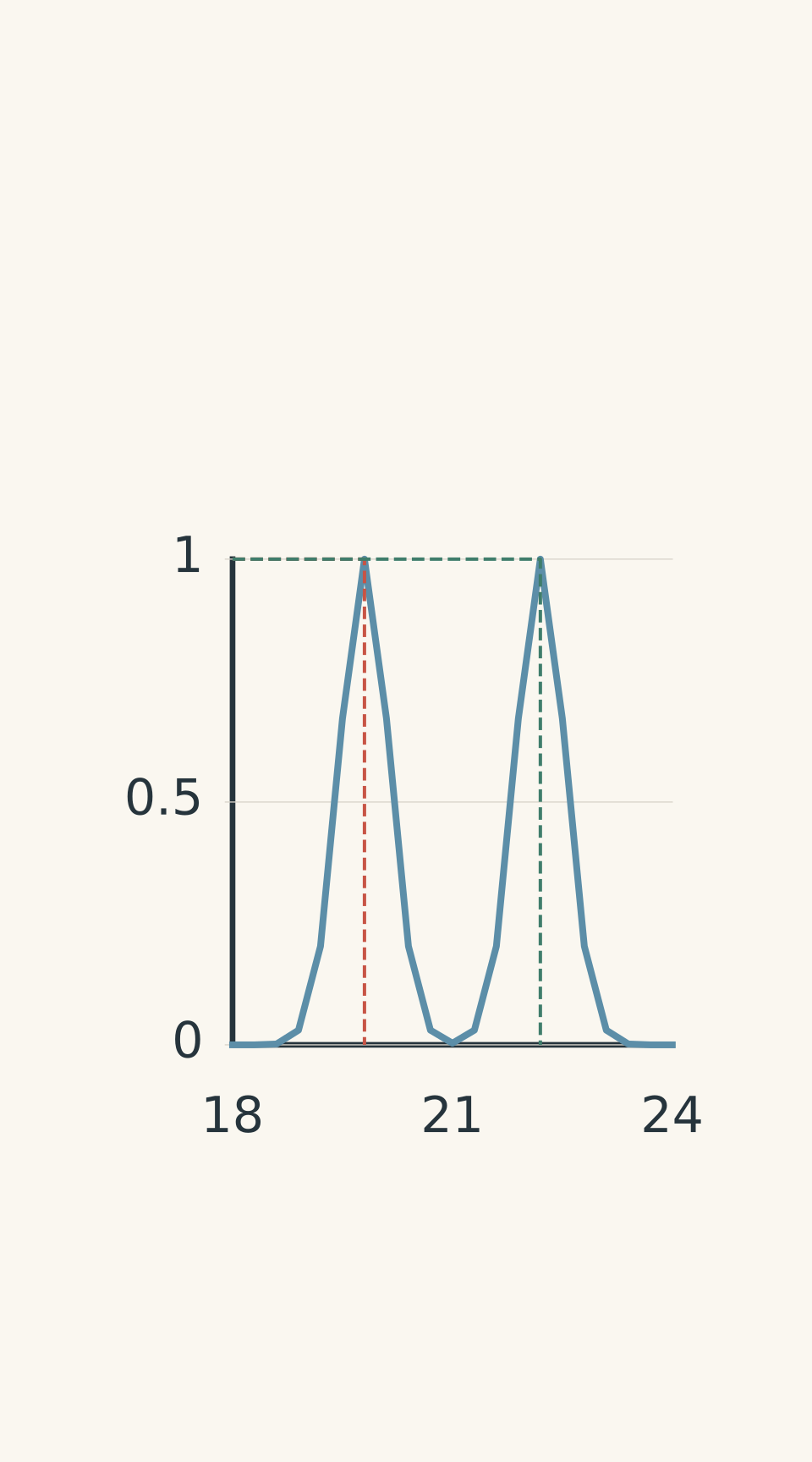
- Combined illustrative signal
- Neon-20 · ²⁰Ne⁺ · 20 u/e
- Neon-22 · ²²Ne⁺ · 22 u/e
08What the simple model leaves out
So far, we’ve assumed that the ions start nearly from rest. This is useful for HSC problems, but it is still an assumption.
Suppose an ion already has some kinetic energy \(K_0\) before entering the accelerating gap. The accelerating voltage adds energy rather than supplying all of it.
The final kinetic energy is
\[ K_f=K_0+|q|V_a \]
Therefore,
\[ \frac12 mv^2=K_0+|q|V_a \]
Combining this with the magnetic circular-motion equation gives
\[ r^2=\frac{2m(K_0+|q|V_a)}{|q|^2B^2} \]
Expanding,
\[ r^2= \frac{2mK_0}{|q|^2B^2} +\frac{2V_a}{B^2}\frac{m}{|q|} \]
There are two terms here. The first accounts for the ion’s initial kinetic energy. The second accounts for the energy gained from the accelerating voltage.
If \(K_0\) is negligible, the first term can be ignored, recovering the simpler equation:
\[ r^2=\frac{2V_a}{B^2}\frac{m}{|q|} \]
But if \(K_0\) is significant, you cannot automatically use the simple equation to infer \(m/|q|\) from a single measured radius.
Notice something useful about the expanded equation: if the initial kinetic energy remains constant while the accelerating voltage changes, \(r^2\) varies linearly with \(V_a\). The gradient depends on \(m/|q|\), even though the initial kinetic energy is not zero.
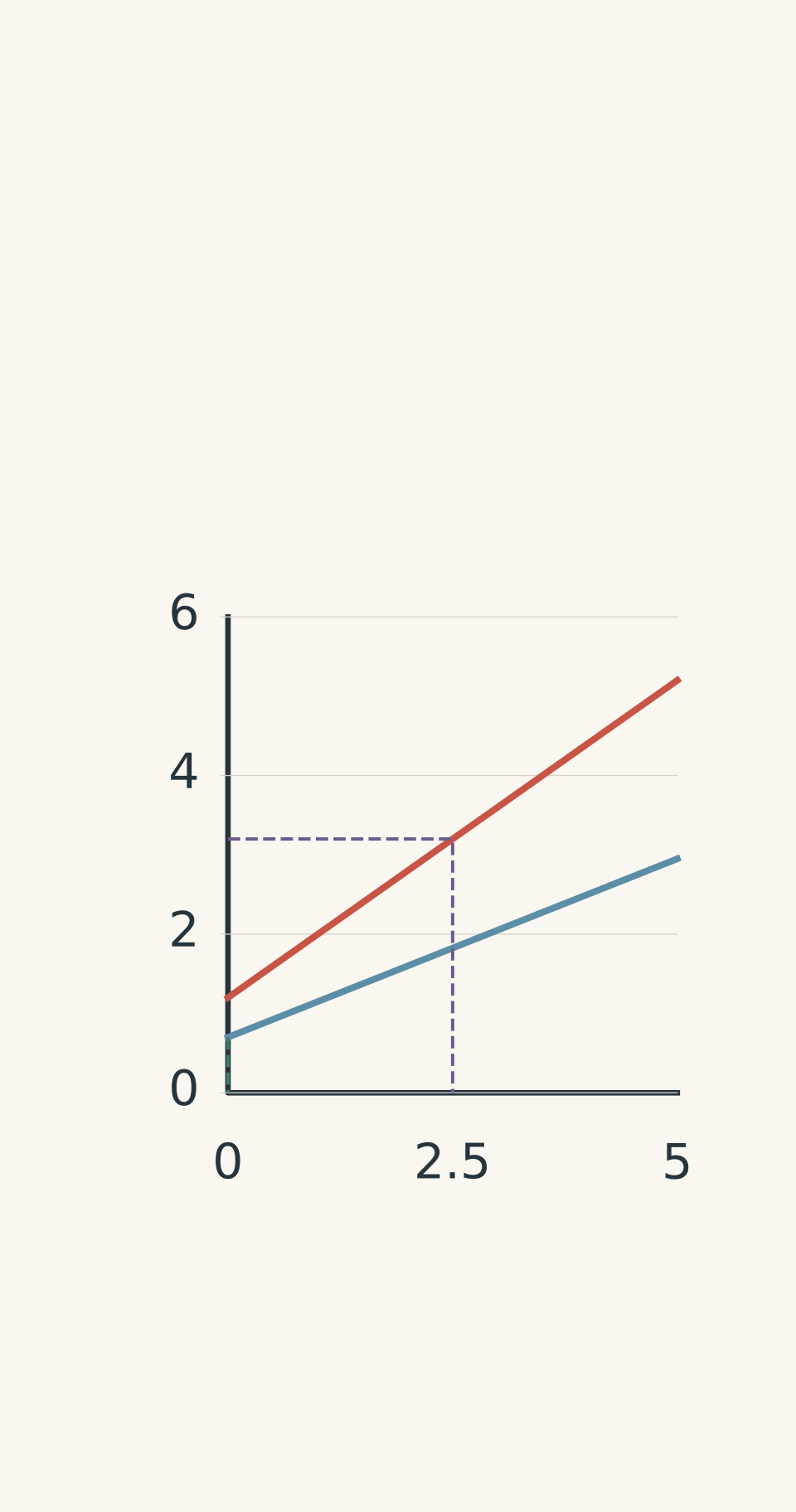
- Ion population A
- Ion population B
- Intercepts affected by initial K₀
- Gradient ∝ m/|q|
In a real instrument, field calibration, focusing, detector resolution, and the spread of ion energies also matter. The equations describe an idealised model that isolates the central physics.
09What the detector can and cannot tell you
The detector records where ions arrive. The model converts those positions into mass-to-charge ratios.
That does not mean every ion with a different mass will appear at a different position.
Consider a singly charged ion with mass \(20\,\mathrm{u}\) and a doubly charged ion with mass \(40\,\mathrm{u}\). Their mass-to-charge ratios are equal:
\[ \frac{20\,\mathrm{u}}{e} = \frac{40\,\mathrm{u}}{2e} \]
If both start nearly from rest and pass through the same accelerating voltage, they gain different amounts of kinetic energy, but their speeds are equal because their \(m/|q|\) values are equal.
Their magnetic radii are also equal. The two species therefore follow the same path in the simplified instrument.
This is why a mass spectrometer measures \(m/|q|\), rather than mass alone. To determine the mass of an ion unambiguously, you may also need to know its charge state.
For HSC questions, use this decision rule:
- If the question states that ions have equal speeds, use \(r=mv/(|q|B)\).
- If ions start from rest and pass through the same accelerating voltage, combine energy conservation with magnetic circular motion.
- If initial kinetic energy is significant, include it rather than assuming it is zero.
- If two ions have the same \(m/|q|\), don’t assume a magnetic-sector instrument can distinguish them just because their masses differ.
10Questions and solutions
Question 1
A singly charged positive ion of mass \(3.2\times10^{-26}\,\mathrm{kg}\) starts nearly from rest and is accelerated through \(1.5\,\mathrm{kV}\). It enters a magnetic field of \(0.25\,\mathrm{T}\) at right angles.
Calculate its speed and the radius of its circular path. Use \(e=1.60\times10^{-19}\,\mathrm{C}\).
Solution 1
The ion travels at approximately \(1.22\times10^5\,\mathrm{m\,s^{-1}}\), and its circular-path radius is \(9.8\times10^{-2}\,\mathrm{m}\), or \(9.8\,\mathrm{cm}\).
First, use conservation of energy:
\[ v=\sqrt{\frac{2|q|V_a}{m}} \]
Substitute the values:
\[ v=\sqrt{ \frac{2(1.60\times10^{-19})(1.5\times10^3)} {3.2\times10^{-26}} } \]
\[ v=1.22\times10^5\,\mathrm{m\,s^{-1}} \]
Next, use the magnetic circular-motion equation:
\[ r=\frac{mv}{|q|B} \]
\[ r=\frac{ (3.2\times10^{-26})(1.22\times10^5) }{ (1.60\times10^{-19})(0.25) } \]
\[ r=0.098\,\mathrm{m} \]
The radius is less than \(10\,\mathrm{cm}\). This is the radius of the ion’s circular arc, not necessarily the distance between the ion’s entry point and its detector position.
Question 2
Two ions enter the same magnetic-sector instrument. Ion A has mass \(24\,\mathrm{u}\) and charge \(+e\). Ion B has mass \(40\,\mathrm{u}\) and charge \(+2e\).
Both start nearly from rest and are accelerated through the same voltage before entering the same magnetic field.
Calculate:
- The ratio of their speeds, \(v_B/v_A\).
- The ratio of their radii, \(r_B/r_A\).
Which ion bends more sharply? Explain why the mass alone is not enough to predict the result.
Solution 2
Ion B travels approximately \(1.095\) times as fast as ion A, but its radius is only \(0.913\) times as large. Ion B therefore bends more sharply, despite having the greater mass.
At equal accelerating voltage,
\[ v\propto\sqrt{\frac{|q|}{m}} \]
Therefore,
\[ \frac{v_B}{v_A} = \sqrt{\frac{2e/40}{e/24}} \]
\[ \frac{v_B}{v_A} = \sqrt{\frac{48}{40}} \]
\[ \boxed{\frac{v_B}{v_A}=1.095} \]
For the radii, use
\[ r\propto\sqrt{\frac{m}{|q|}} \]
Hence,
\[ \frac{r_B}{r_A} = \sqrt{\frac{40/(2e)}{24/e}} \]
\[ \frac{r_B}{r_A} = \sqrt{\frac{20}{24}} \]
\[ \boxed{\frac{r_B}{r_A}=0.913} \]
The important comparison is not \(40/24\), which compares the masses alone. It is the ratio of the mass-to-charge ratios. Ion B has twice the charge but only \(40/24\) times the mass, so its mass-to-charge ratio is smaller.
A larger charge increases the energy gained from the accelerating voltage and strengthens the magnetic force. Both effects matter.
Question 3
Two singly charged ions have masses \(m\) and \(4m\).
In Run A, a velocity selector ensures that both ions enter the analysing magnetic field at the same speed.
In Run B, both ions start nearly from rest and are accelerated through the same voltage before entering the same magnetic field.
For each run, calculate the ratio \(r_{4m}/r_m\). Explain why the two answers differ, even though the ions are the same in both runs.
Solution 3
The radius ratio is \(4\) in Run A and \(2\) in Run B. The difference arises because the velocity selector fixes the speed in Run A, whereas equal accelerating voltage gives the heavier ion a lower speed in Run B.
Run A: equal speed
The magnetic circular-motion equation gives
\[ r=\frac{mv}{|q|B} \]
Since the speed, charge magnitude, and magnetic field are equal,
\[ \frac{r_{4m}}{r_m}=\frac{4m}{m} \]
\[ \boxed{\frac{r_{4m}}{r_m}=4} \]
Run B: equal accelerating voltage
The ions start nearly from rest, so
\[ r\propto\sqrt{\frac{m}{|q|}} \]
Their charge magnitudes are equal, giving
\[ \frac{r_{4m}}{r_m} = \sqrt{\frac{4m}{m}} \]
\[ \boxed{\frac{r_{4m}}{r_m}=2} \]
In Run B, the heavier ion travels at half the speed of the lighter ion. That reduces the difference in their radii compared with Run A.
The tempting mistake is to use \(r\propto m/|q|\) in both runs. That proportionality assumes equal speeds, which equal accelerating voltage does not generally provide.
Question 4
An ion enters an accelerating gap with initial kinetic energy \(K_0\). It is then accelerated through a potential difference \(V_a\) before entering a fixed magnetic field.
Assume its initial kinetic energy is equal to the energy it gains from the original accelerating voltage:
\[ K_0=|q|V_a \]
The accelerating voltage is now doubled, while \(K_0\) and the magnetic field remain unchanged.
Find the ratio of the new radius to the original radius. Explain why the answer differs from the prediction obtained by assuming the ion starts from rest.
Solution 4
The new radius is \(\sqrt{3/2}\), or approximately \(1.225\), times the original radius. The radius does not increase by \(\sqrt{2}\) because the ion already had significant kinetic energy before entering the accelerating gap.
The final kinetic energy at the original voltage is
\[ K_1=K_0+|q|V_a \]
Using \(K_0=|q|V_a\),
\[ K_1=2|q|V_a \]
After doubling the voltage,
\[ K_2=K_0+2|q|V_a \]
\[ K_2=3|q|V_a \]
For the same ion in the same magnetic field,
\[ r\propto v \]
Since kinetic energy is proportional to \(v^2\),
\[ \frac{r_2}{r_1}=\sqrt{\frac{K_2}{K_1}} \]
Substitute the kinetic energies:
\[ \frac{r_2}{r_1} = \sqrt{\frac{3|q|V_a}{2|q|V_a}} \]
Therefore,
\[ \boxed{\frac{r_2}{r_1}=\sqrt{\frac32}\approx1.225} \]
If the ion started from rest, doubling the accelerating voltage would double its kinetic energy and increase its radius by \(\sqrt{2}\). Here, the initial kinetic energy remains unchanged, so doubling the voltage does not double the total kinetic energy.
Question 5
Two ion populations, A and B, enter the same magnetic-sector instrument. Their initial kinetic energies are significant and unknown, but each population’s initial kinetic energy remains constant when the accelerating voltage changes. Their charge states also remain unchanged.
The magnetic field is held constant throughout the experiment.
At an accelerating voltage of \(1.0\,\mathrm{kV}\), both populations have the same measured radius, \(r\).
When the accelerating voltage is increased to \(2.0\,\mathrm{kV}\), the measured radii become
\[ r_A=\sqrt{1.60}\,r \]
and
\[ r_B=\sqrt{1.40}\,r \]
Determine the ratio
\[ \frac{m_A/|q_A|}{m_B/|q_B|} \]
Does the equal radius in the first run prove that the populations have the same mass-to-charge ratio? Explain why or why not.
Solution 5
The mass-to-charge ratio of population A is \(1.5\) times that of population B:
\[ \boxed{ \frac{m_A/|q_A|}{m_B/|q_B|}=1.5 } \]
The equal radii in the first run do not prove equal mass-to-charge ratios. Because the ions have non-negligible initial kinetic energies, their radii also depend on their initial energies. A single measurement cannot separate these effects.
The key is to examine how the squared radius changes with accelerating voltage.
From the energy and magnetic-motion equations,
\[ r^2= \frac{2mK_0}{|q|^2B^2} + \frac{2V_a}{B^2}\frac{m}{|q|} \]
For each population, the first term is constant as the accelerating voltage changes. The gradient of \(r^2\) against \(V_a\) is therefore
\[ S=\frac{\Delta r^2}{\Delta V_a} =\frac{2}{B^2}\frac{m}{|q|} \]
Because both populations pass through the same magnetic field, the factor \(2/B^2\) is identical for both. Their mass-to-charge ratio is therefore proportional to the gradient.
Step 1: Calculate the change in squared radius for population A.
The first radius is \(r\), and the second is \(\sqrt{1.60}\,r\). Thus,
\[ \Delta r_A^2=1.60r^2-r^2 \]
\[ \Delta r_A^2=0.60r^2 \]
Step 2: Calculate the change in squared radius for population B.
\[ \Delta r_B^2=1.40r^2-r^2 \]
\[ \Delta r_B^2=0.40r^2 \]
Step 3: Compare the gradients.
Both voltage changes are \(1.0\,\mathrm{kV}\), so
\[ \frac{S_A}{S_B} = \frac{0.60r^2/(1.0\,\mathrm{kV})} {0.40r^2/(1.0\,\mathrm{kV})} \]
The common factors cancel:
\[ \frac{S_A}{S_B}=\frac{0.60}{0.40}=1.5 \]
Since the gradients are proportional to the mass-to-charge ratios,
\[ \boxed{ \frac{m_A/|q_A|}{m_B/|q_B|}=1.5 } \]
The tempting approach is to substitute the equal radius from the first run into the formula derived for ions starting from rest. That would silently assume \(K_0=0\), contradicting the information in the question.
The deeper point is that a measurement only reveals what the model allows you to infer. Here, changing the voltage and comparing the gradients isolates the mass-to-charge ratio, even though the initial kinetic energies are unknown.
The next useful concept is resolving power: once a mass spectrometer maps mass-to-charge ratios to detector positions, how close can two values be before their signals become impossible to distinguish?