
How an Electron Gun Uses Voltage to Produce a Beam
Learn how an electron gun releases electrons, accelerates them using voltage, and focuses them into a beam. Explore why electrons accelerate opposite to the electric field, how voltage determines kinetic energy, and how electric and magnetic fields deflect the beam.
Put a heated cathode on the left of a vacuum tube and a positively charged anode on the right. A stream of electrons travels towards the anode, forming a narrow beam. But there’s an apparent contradiction: the electrons accelerate in the opposite direction to the electric field.
Before reading on, predict which way the electric field points. Does it point towards the anode, in the direction the electrons travel, or away from it?
It points away from the anode, towards the cathode. The key is that an electron has negative charge, so the electric force on it acts opposite to the electric-field direction. Once you understand that, the rest of the electron gun becomes much easier to follow.
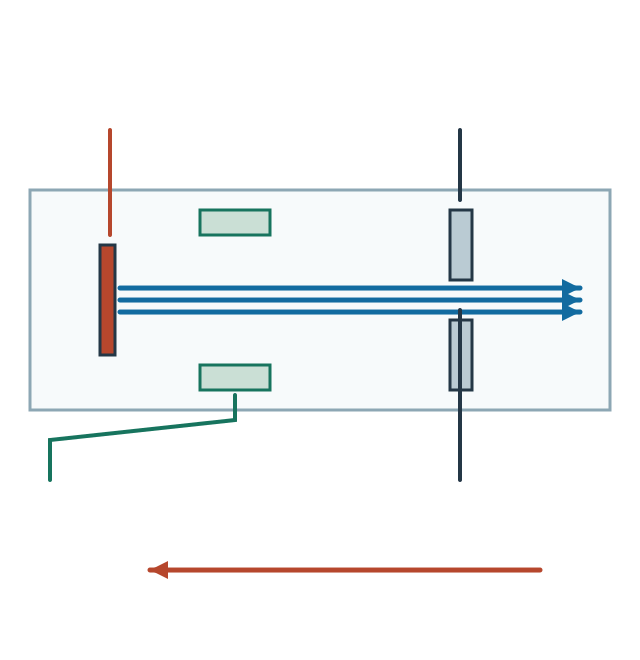
01The three stages of an electron gun
An electron gun performs three jobs in sequence.
| Stage | What happens | Main purpose |
|---|---|---|
| Electron emission | The cathode is heated, releasing electrons. | Supplies electrons. |
| Acceleration | A potential difference creates an electric field that accelerates the electrons. | Increases their kinetic energy. |
| Beam formation | Electrodes shape the electron trajectories, and an aperture limits which electrons pass through. | Produces a narrow, directed beam. |
Keep these jobs separate in your mind. Heating releases the electrons, voltage accelerates them, and electrode geometry helps form the beam.
01Electron emission: getting electrons out of the cathode
A metal contains electrons that can move through its structure, but they cannot all escape freely into the surrounding space. An electron needs enough energy to overcome the attraction holding it within the metal.
An electron gun uses a heater to raise the temperature of its cathode. This gives the electrons more thermal energy, allowing some to escape from the metal’s surface. This process is called thermionic emission.
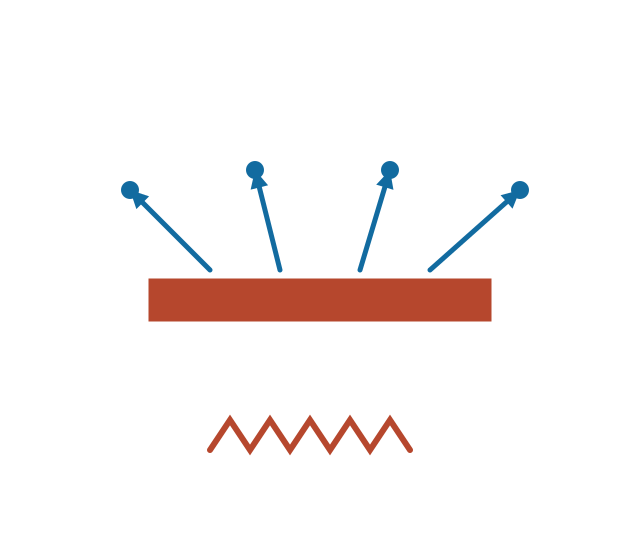
Heating the cathode does not, by itself, create a narrow beam. The emitted electrons initially travel in a range of directions, and their velocities are not all identical.
The surrounding vacuum is important, too. It contains very few gas particles, so the electrons can travel towards the anode without frequent collisions that would scatter them away from their intended paths.
Think of emission as releasing a crowd through an open doorway. The crowd is now outside, but that doesn’t mean everyone is moving in the same direction. The gun still needs to accelerate and organise the electrons.
02Acceleration: why electrons move towards the anode
Suppose the anode is at a higher electric potential than the cathode. The potential difference between them establishes an electric field in the gap.
The electric field points from higher electric potential towards lower electric potential. Therefore, in the accelerating gap, its direction is from the anode towards the cathode.
An electron, however, accelerates towards the anode.
Why?
The sign of the charge changes the force
The electric force on a charged particle is
\[ \vec F=q\vec E \]
where:
- \(\vec F\) is the electric force, measured in newtons (N).
- \(q\) is the particle’s electric charge, measured in coulombs (C).
- \(\vec E\) is the electric field, measured in newtons per coulomb (N/C).
An electron has charge
\[ q=-e=-1.602\times10^{-19}\ \mathrm C \]
Here, \(e\) is the positive magnitude of the elementary charge.
Because the electron’s charge is negative, its electric force acts opposite to the electric field. Newton’s second law tells us that its acceleration is in the direction of the net force.
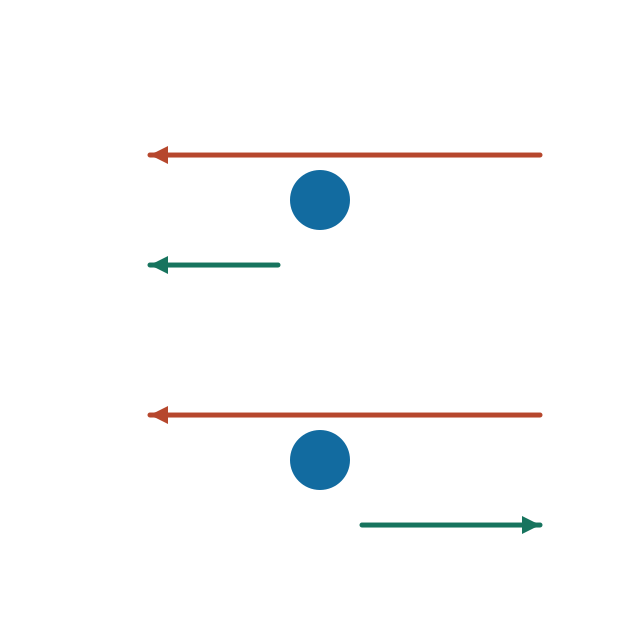
For an electron gun, this gives us the following directions:
- Electric field: from the anode towards the cathode.
- Electric force on an electron: from the cathode towards the anode.
- Electron acceleration: towards the anode.
The electrons gain speed as the electric field does work on them. The field direction hasn’t reversed; the negative charge changes the direction of the force.
This is a useful distinction for HSC Physics. Never assume a charged particle accelerates in the direction of the electric field without checking the sign of its charge.
03How accelerating voltage determines kinetic energy
Knowing which way the electron accelerates tells us about its motion. The potential difference also tells us how much kinetic energy it gains.
Start with a familiar idea: when an object loses potential energy, that energy can become kinetic energy. An electron behaves similarly, but electric potential introduces an important sign difference.
Electric potential energy is given by
\[ U=qV \]
where \(U\) is electric potential energy in joules (J), \(q\) is charge in coulombs, and \(V\) is electric potential in volts (V).
For an electron, \(q=-e\). As the electron moves towards a higher electric potential, its electric potential energy decreases.
That energy is transferred into kinetic energy, provided no other forces or energy transfers change the result.
Deriving the energy equation
Let the electron move from an initial position to a final position. Define the potential difference as
\[ \Delta V=V_f-V_i \]
where \(V_i\) and \(V_f\) are the initial and final electric potentials.
Conservation of energy gives
\[ \Delta K=-\Delta U \]
Since \(\Delta U=q\Delta V\),
\[ \Delta K=-q\Delta V \]
For an electron, \(q=-e\), so
\[ \boxed{\Delta K=e\Delta V} \]
This is the key relationship for an accelerating electron.
If the electron moves through a positive potential difference, it gains kinetic energy. If it moves through a negative potential difference, it loses kinetic energy.
For an electron starting from rest and accelerating through a potential difference of \(300\ \mathrm V\), its kinetic energy increases by \(300\ \mathrm{eV}\).
Notice the units: a volt is a unit of electric potential difference, whereas an electronvolt (eV) is a unit of energy.
One electronvolt is the energy gained by an electron moving through a potential difference of one volt:
\[ 1\ \mathrm{eV}=1.602\times10^{-19}\ \mathrm J \]
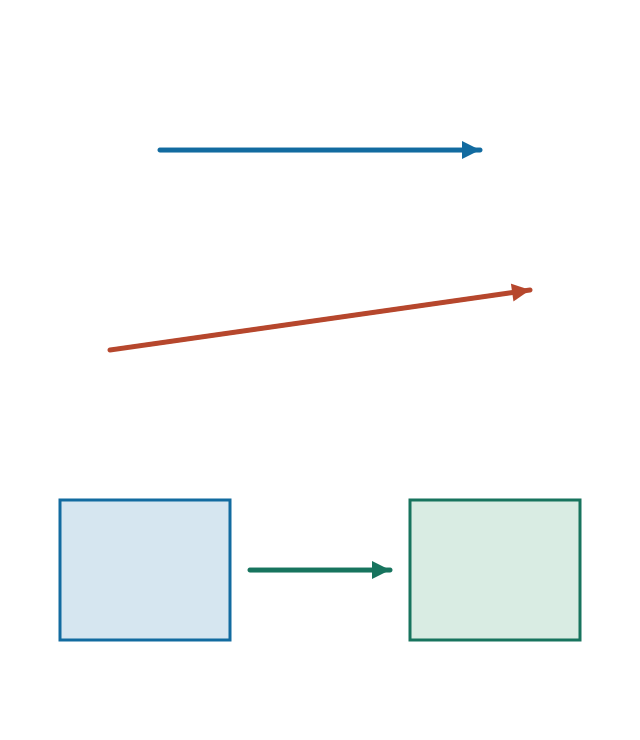
A useful mental picture is a ramp. For a positive charge, increasing electric potential increases electric potential energy. For an electron, the energy landscape is flipped: moving towards higher electric potential is like moving downhill in its own potential-energy landscape.
The analogy helps with energy bookkeeping, but it is not a literal gravitational ramp. The electric field supplies the force, and the charge’s sign determines its direction.
Worked example: kinetic energy gained through 300 V
An electron starts from rest and accelerates through a potential difference of \(300\ \mathrm V\). Calculate its final kinetic energy in electronvolts and joules.
Step 1: Identify the energy gained.
The electron starts from rest, so its initial kinetic energy is zero. Its final kinetic energy equals the energy gained from the electric field.
\[ \Delta K=e\Delta V \]
In electronvolts, the numerical value of the energy gain equals the potential difference in volts:
\[ K_f=300\ \mathrm{eV} \]
Step 2: Convert the energy into joules.
Use \(1\ \mathrm{eV}=1.602\times10^{-19}\ \mathrm J\).
\[ \begin{aligned} K_f&=300\times1.602\times10^{-19}\\\ &=4.806\times10^{-17}\ \mathrm J \end{aligned} \]
Step 3: Interpret the result.
The electron leaves the accelerating region with \(300\ \mathrm{eV}\) of kinetic energy, equivalent to approximately \(4.81\times10^{-17}\ \mathrm J\). A larger accelerating potential difference gives the electron a greater kinetic-energy gain.
From kinetic energy to speed
If you know an electron’s kinetic energy, you can calculate its speed using the non-relativistic kinetic-energy equation:
\[ K=\frac12 m_ev^2 \]
where \(m_e=9.11\times10^{-31}\ \mathrm{kg}\) is the electron’s mass and \(v\) is its speed.
Rearranging,
\[ v=\sqrt{\frac{2K}{m_e}} \]
For an electron starting from rest, this means
\[ v\propto\sqrt{\Delta V} \]
provided the electron remains in the non-relativistic regime.
This gives us an important prediction: doubling the accelerating voltage doubles the kinetic energy, but increases the speed by a factor of \(\sqrt{2}\), not by a factor of two.
Worked example: finding the speed of an accelerated electron
An electron leaves a cathode at \(-100\ \mathrm V\) with an initial kinetic energy of \(12\ \mathrm{eV}\). It reaches an anode at \(+400\ \mathrm V\). Assuming no collisions or other energy changes, calculate its final kinetic energy and speed.
Step 1: Calculate the potential difference.
Subtract the initial potential from the final potential. Be careful with the negative sign.
\[ \begin{aligned} \Delta V&=V_f-V_i\\\ &=400-(-100)\\\ &=500\ \mathrm V \end{aligned} \]
The electron moves to a potential that is \(500\ \mathrm V\) higher than its starting potential.
Step 2: Calculate the final kinetic energy.
The electron gains \(500\ \mathrm{eV}\) of kinetic energy.
\[ \begin{aligned} K_f&=K_i+\Delta K\\\ &=12+500\\\ &=512\ \mathrm{eV} \end{aligned} \]
Step 3: Convert to joules.
\[ \begin{aligned} K_f&=512\times1.602\times10^{-19}\\\ &=8.20\times10^{-17}\ \mathrm J \end{aligned} \]
Step 4: Calculate the speed.
Substitute the kinetic energy in joules and the electron’s mass into the kinetic-energy equation.
\[ \begin{aligned} v&=\sqrt{\frac{2K_f}{m_e}}\\\\[4pt] &=\sqrt{\frac{2(8.20\times10^{-17})} {9.11\times10^{-31}}}\\\\[4pt] &\approx1.34\times10^7\ \mathrm{m\\,s^{-1}} \end{aligned} \]
Step 5: Interpret the result.
The electron reaches the anode with \(512\ \mathrm{eV}\) of kinetic energy and a speed of approximately \(1.34\times10^7\ \mathrm{m\\,s^{-1}}\).
The absolute potentials, \(-100\ \mathrm V\) and \(+400\ \mathrm V\), are not individually responsible for the energy gain. What matters is their difference: \(500\ \mathrm V\).
04Beam formation: making the electrons travel together
So far, we’ve established that heating releases electrons and voltage accelerates them. But acceleration alone does not guarantee a narrow beam.
Electrons leave the cathode with a spread of initial directions. The electric field accelerates them, while the arrangement of the electrodes helps control their trajectories.
A simple electron gun uses two important features.
- Focusing electrode: Shapes the electric field so that electron trajectories are directed towards the central axis. It acts like an electrostatic lens.
- Anode aperture: A small opening that allows the central bundle of electrons to pass while blocking many off-axis electrons.
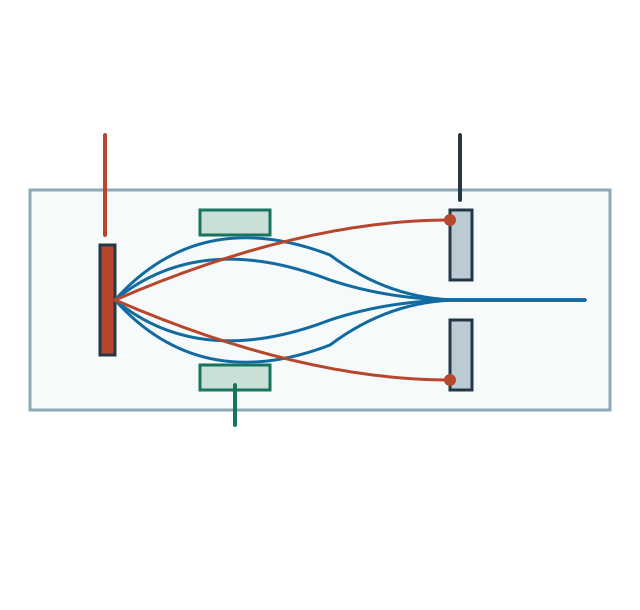
The aperture and focusing electrode have related but different jobs. The aperture restricts which trajectories pass through. The focusing electrode changes the trajectories themselves.
A narrow beam is therefore not simply a group of electrons travelling very quickly. It is a group of electrons whose trajectories have been controlled sufficiently to keep the beam concentrated.
Some electron guns also use a control grid near the cathode to regulate how many electrons enter the beam. This affects the beam current, which measures how much charge passes a point per second.
That gives us another important distinction: increasing the accelerating voltage increases the kinetic-energy gain, but it does not necessarily increase the beam current by the same proportion. The number of electrons emitted, transmitted, and collected also matters.
05The electron gun creates the beam; deflection steers it
An electron gun and a deflection system perform different jobs.
The gun produces a directed beam with a particular kinetic energy. Once the beam has formed, electric or magnetic fields can steer it towards a chosen position.
This is useful in devices such as cathode-ray tubes, where the beam must be directed towards different parts of a screen.
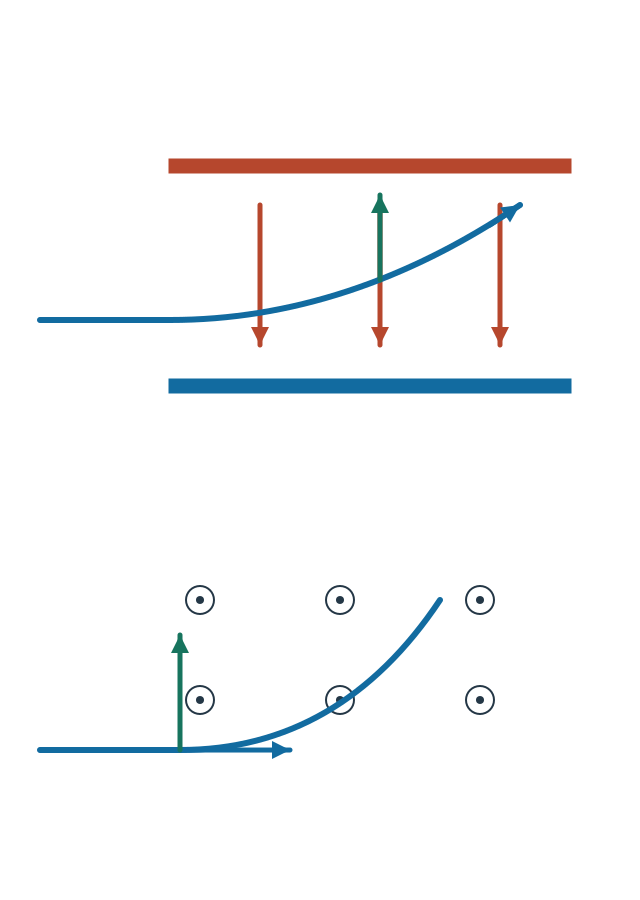
Electric deflection
An electric field exerts a force on an electron according to \(\vec F=q\vec E\). The force is opposite to the field direction, so an electron between deflection plates accelerates towards the higher-potential plate.
An electric field can change both the direction and the speed of the electron. The overall change in kinetic energy depends on the potential difference between the actual entry and exit points:
\[ \Delta K=e\Delta V \]
If an electron exits the deflection region at a potential \(25\ \mathrm V\) higher than its entry potential, it gains \(25\ \mathrm{eV}\) of kinetic energy. If the entry and exit points are at the same potential, its net kinetic-energy change is zero.
The important point is that an electric field does not necessarily change kinetic energy by a particular amount just because it bends a path. You must consider the potential difference between the endpoints.
Magnetic deflection
A magnetic field can also bend an electron beam, but its effect on kinetic energy is different.
The magnetic force is always perpendicular to the electron’s instantaneous velocity. A force perpendicular to the motion does no work, so an ideal magnetic field changes the direction of the velocity without changing its magnitude.
The electron’s speed and kinetic energy therefore remain constant in a magnetic field alone.
This gives you a useful comparison:
| Feature | Electric field | Magnetic field |
|---|---|---|
| Can change the beam’s direction? | Yes | Yes |
| Can change the electron’s speed? | Yes | No, for a magnetic field alone |
| Can change kinetic energy? | Yes, depending on the potential difference | No |
| Main effect in a deflection system | Steers the beam and may change its energy | Steers the beam without changing its kinetic energy |
Remember the distinction: the accelerating voltage establishes the electron’s energy gain in the gun, while downstream fields determine how the beam travels. Electric deflection can add to or subtract from the kinetic energy, depending on the potential change. Magnetic deflection does not change the kinetic energy.
07Questions and solutions
Question 1
An electron gun has a cathode on the left and an anode at a higher electric potential on the right.
State the directions of the electric field, the electric force on an electron, and the electron’s acceleration in the gap. Explain why the electron moves opposite to the electric field.
Solution 1
The electric field points towards the cathode, while the electric force and acceleration of the electron point towards the anode.
The electric field points from higher electric potential to lower electric potential. Because the anode is at a higher potential, the field points from right to left.
The electric force is
\[ \vec F=q\vec E \]
An electron has negative charge, so its force acts opposite to \(\vec E\). Its acceleration is in the direction of that force, according to Newton’s second law.
Therefore, the electron accelerates from left to right, towards the anode. The field direction does not change; the negative sign of the electron’s charge explains the opposite motion.
Question 2
An electron has a kinetic energy of \(180\ \mathrm{eV}\) at a point where the electric potential is \(0\ \mathrm V\). It moves towards a region where the potential is \(250\ \mathrm V\) lower.
Assume the potential decreases smoothly along its path and no other forces act.
(a) Can the electron reach the region at the lower potential?
(b) If not, at what electric potential does it momentarily stop?
Solution 2
The electron cannot reach the region where the potential is \(250\ \mathrm V\) lower. It momentarily stops when the potential has fallen by \(180\ \mathrm V\), at \(-180\ \mathrm V\).
Part (a): Can it reach the region?
For an electron,
\[ \Delta K=e\Delta V \]
The potential difference to the proposed destination is
\[ \Delta V=-250\ \mathrm V \]
Therefore, the predicted kinetic-energy change would be
\[ \Delta K=-250\ \mathrm{eV} \]
The resulting kinetic energy would be
\[ K_f=180-250=-70\ \mathrm{eV} \]
This is physically impossible: kinetic energy cannot be negative. The calculation tells us that the electron cannot reach the proposed destination under the stated assumptions. It must stop and turn around before getting there.
Part (b): Where does it stop?
At the turning point, the electron’s kinetic energy is momentarily zero.
\[ \begin{aligned} 0&=K_i+e\Delta V\\\ 0&=180\ \mathrm{eV}+e\Delta V \end{aligned} \]
When the potential difference is expressed in volts, the energy change in electronvolts has the same numerical value. Thus,
\[ \Delta V=-180\ \mathrm V \]
Since the initial potential is \(0\ \mathrm V\), the turning-point potential is
\[ V_f=0-180=-180\ \mathrm V \]
The tempting mistake is to assume the electron can always travel through any potential difference. Its initial kinetic energy places a limit on how far it can move against the electric force.
Question 3
Two electron guns have the same cathode temperature and electrode geometry. Assume their initial electron kinetic energies are negligible and their accelerating voltages are \(400\ \mathrm V\) and \(900\ \mathrm V\), respectively.
(a) Compare the kinetic-energy gains of the electrons.
(b) Calculate the ratio of their final speeds, \(v_{900}/v_{400}\).
(c) Can you conclude that the \(900\ \mathrm V\) gun produces \(2.25\) times the beam current? Explain.
Solution 3
The \(900\ \mathrm V\) gun gives the electrons \(2.25\) times the kinetic-energy gain and \(1.5\) times the final speed. You cannot conclude that its beam current is \(2.25\) times greater.
Part (a): Compare kinetic-energy gains.
For an electron starting from rest,
\[ \Delta K=e\Delta V \]
The two energy gains are
\[ K_{400}=400\ \mathrm{eV} \]
and
\[ K_{900}=900\ \mathrm{eV} \]
Their ratio is
\[ \frac{K_{900}}{K_{400}} =\frac{900}{400} =2.25 \]
The higher-voltage gun gives each electron \(2.25\) times as much kinetic energy.
Part (b): Compare speeds.
Using \(K=\frac12m_ev^2\), speed is proportional to the square root of kinetic energy.
\[ \begin{aligned} \frac{v_{900}}{v_{400}} &=\sqrt{\frac{K_{900}}{K_{400}}}\\\\[4pt] &=\sqrt{\frac{900}{400}}\\\\[4pt] &=\sqrt{2.25}\\\ &=1.5 \end{aligned} \]
The electrons in the \(900\ \mathrm V\) gun travel \(1.5\) times as fast, under the stated assumptions.
Part (c): Compare beam currents.
No. Beam current measures the amount of charge passing a point per second, not the kinetic energy carried by each electron.
The current depends on how many electrons the cathode emits and how many reach the beam. Emission, control-grid settings, space-charge effects, and electrode geometry can all affect the result.
A higher accelerating voltage does not, by itself, establish a fixed ratio between the two beam currents.
Question 4
An electron gun produces a broad beam spot on a distant screen, but the electrons already have the intended kinetic energy.
A technician suggests two changes:
- Double the accelerating voltage.
- Enlarge the anode aperture.
Explain why neither change is guaranteed to narrow the beam. Identify the component that should be adjusted to control the focusing, and state one likely trade-off of enlarging the aperture.
Solution 4
The focusing electrode is the component to adjust when the aim is to control the beam’s convergence and spread. Doubling the accelerating voltage or enlarging the aperture is not a reliable substitute for correcting the focusing.
Doubling the accelerating voltage increases the kinetic-energy gain. If the initial kinetic energy is negligible, the electrons gain twice as much kinetic energy, and their speed increases by a factor of \(\sqrt{2}\).
However, greater speed does not automatically mean a narrower beam. The beam’s width depends on the trajectories of the electrons, which are influenced by the electrode geometry and electric fields. Changing the voltage may also alter those fields, so the effect on focusing must be assessed rather than assumed.
Enlarging the aperture allows a wider range of trajectories to pass through. This may increase the transmitted current, but it can also allow more off-axis electrons through, producing a wider or less well-defined beam.
The distinction is between energy and geometry. Accelerating voltage controls the energy gain, while the focusing electrode shapes the trajectories. An aperture selects which electrons pass, but it does not necessarily make their trajectories parallel.
Question 5
An electron gun accelerates electrons from rest through a potential difference of \(600\ \mathrm V\). The electrons then pass between electric deflection plates.
At the entrance to the plates, an electron is at an electric potential of \(0\ \mathrm V\). At its exit point, the potential is \(25\ \mathrm V\) higher than at the entrance. The electron then enters a magnetic field perpendicular to its velocity.
A student makes four claims:
- Claim A: Immediately after the gun, the electron has \(600\ \mathrm{eV}\) of kinetic energy.
- Claim B: The electric deflection plates only change the direction of motion, so the electron still has \(600\ \mathrm{eV}\) of kinetic energy after leaving them.
- Claim C: The magnetic field keeps bending the electron’s path, so its kinetic energy increases.
- Claim D: Reversing the polarity of the deflection plates must reverse the sign of the electron’s kinetic-energy change.
Evaluate all four claims.
Calculate the electron’s final kinetic energy in electronvolts and joules, and its speed after passing through both the electric and magnetic fields.
For the reversed-polarity case in Claim D, assume ideal symmetric plates. The electron’s path is mirrored, and its exit point is again at a potential \(25\ \mathrm V\) higher than its entry point.
Solution 5
Only Claim A is correct. The electron leaves the gun with \(600\ \mathrm{eV}\), gains a further \(25\ \mathrm{eV}\) in the electric deflection region, and leaves the magnetic field with its kinetic energy unchanged. Its final kinetic energy is \(625\ \mathrm{eV}\), or approximately \(1.00\times10^{-16}\ \mathrm J\).
Claim A: Correct.
The electron starts from rest and accelerates through \(600\ \mathrm V\).
\[ \Delta K=e\Delta V \]
Therefore, its kinetic-energy gain is
\[ K_{\text{gun}}=600\ \mathrm{eV} \]
Since its initial kinetic energy is negligible, it has \(600\ \mathrm{eV}\) immediately after the gun.
Claim B: Incorrect.
The electric field does not necessarily just change the direction of motion. Its work depends on the potential difference between the electron’s entry and exit points.
Here, the exit potential is \(25\ \mathrm V\) higher than the entry potential, so
\[ \Delta K=e\Delta V=25\ \mathrm{eV} \]
The electron gains kinetic energy while being deflected.
Its kinetic energy after the plates is
\[ \begin{aligned} K_{\text{plates}}&=600+25\\\ &=625\ \mathrm{eV} \end{aligned} \]
The trap is assuming that a transverse electric field can only steer a beam. As the electron bends, its velocity develops a component in the direction of the electric force, allowing the field to do work.
Claim C: Incorrect.
A magnetic field changes the direction of the electron’s velocity but does not change its speed.
The magnetic force is always perpendicular to the instantaneous velocity. Since the force has no component along the motion, it does no work on the electron.
The electron therefore leaves the magnetic field with the same kinetic energy it had when entering it:
\[ K_f=625\ \mathrm{eV} \]
Claim D: Incorrect under the stated conditions.
Reversing the plate polarity reverses the electric field and the direction of the electron’s deflection. However, the electron’s path is also mirrored, and the problem specifies that its exit potential remains \(25\ \mathrm V\) higher than its entry potential.
The energy change depends on the potential difference along the actual path, not simply on which way the field points.
In both runs,
\[ \Delta K=e(+25\ \mathrm V)=+25\ \mathrm{eV} \]
Thus, the electron gains the same kinetic energy in either run. The direction of deflection reverses, but the sign of the kinetic-energy change does not.
Calculate the final kinetic energy in joules.
Convert the final energy of \(625\ \mathrm{eV}\) into joules:
\[ \begin{aligned} K_f&=625\times1.602\times10^{-19}\\\ &=1.00125\times10^{-16}\ \mathrm J \end{aligned} \]
Therefore,
\[ K_f\approx1.00\times10^{-16}\ \mathrm J \]
Calculate the final speed.
Use the non-relativistic kinetic-energy equation:
\[ v=\sqrt{\frac{2K_f}{m_e}} \]
Substituting the kinetic energy in joules and the electron mass,
\[ \begin{aligned} v&=\sqrt{\frac{2(1.00125\times10^{-16})} {9.11\times10^{-31}}}\\\\[4pt] &\approx1.48\times10^7\ \mathrm{m\\,s^{-1}} \end{aligned} \]
The electron leaves the magnetic field at approximately \(1.48\times10^7\ \mathrm{m\\,s^{-1}}\), assuming no other energy transfers occur.
The central lesson is that a curved trajectory does not tell you, by itself, whether a particle has gained or lost kinetic energy. You must identify the force acting on the particle and determine whether that force does work.
This is the starting point for analysing charged-particle motion in electric and magnetic fields: use \(q\vec E\) to determine the electric force, calculate energy changes from potential differences, and remember that a magnetic force can change the direction of motion without changing the particle’s speed.