
How Long Should HSC Study Breaks Be? A Practical Guide
Find a practical starting point for HSC study breaks, then test whether five-, ten-, or fifteen-minute breaks work best by measuring accurate task completion and restart time.
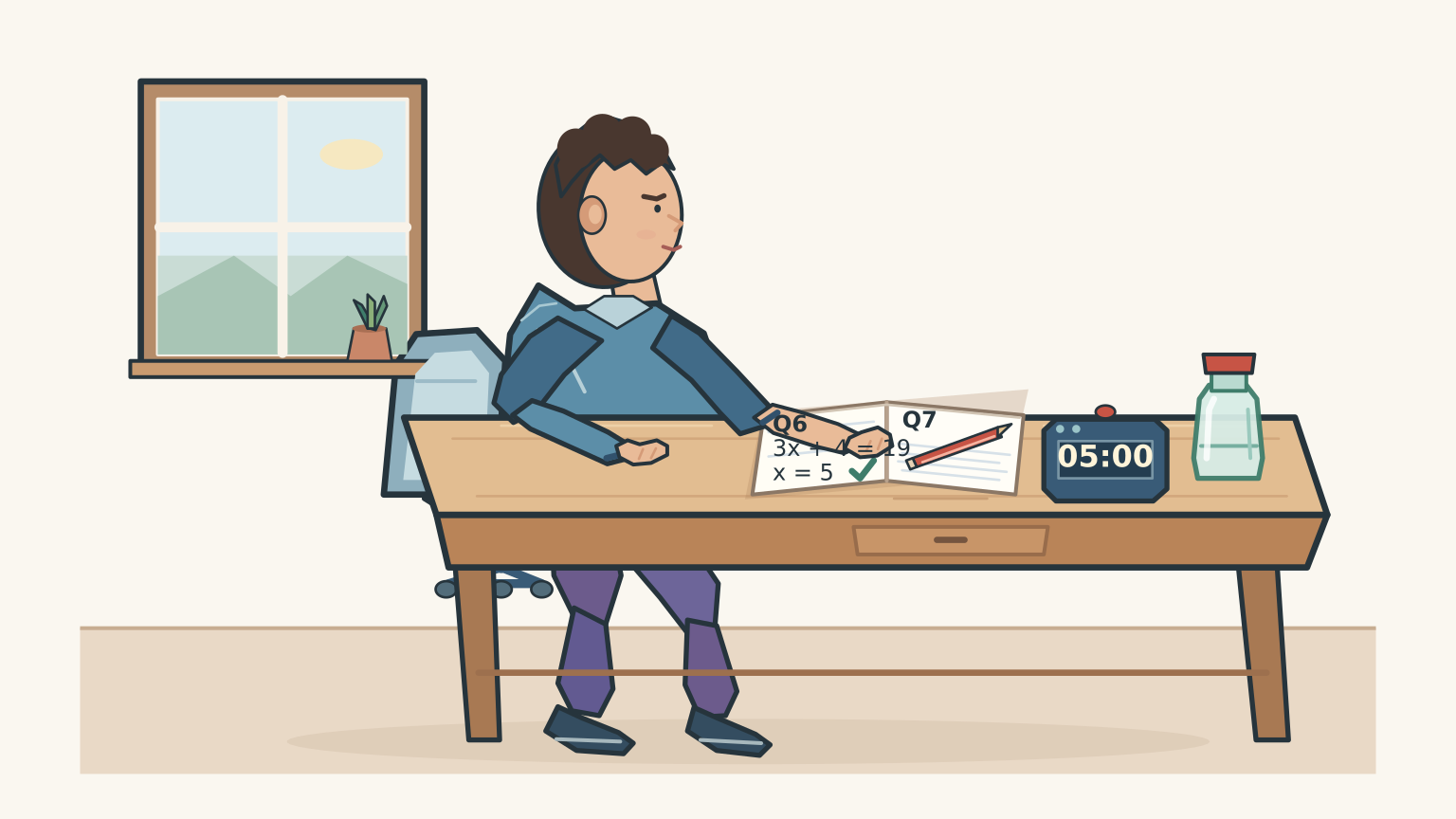
You finish a 45-minute HSC study session, stand up for a five-minute break, and return twelve minutes later. The timer says five minutes, but you spend another seven minutes remembering where you were, reopening your notes, and working out what to do next.
So how long should an HSC study break actually be?
A sensible starting point is 5-10 minutes after 40-60 minutes of focused study. If you’ve completed a longer block of around 75-90 minutes, try a break of 15-20 minutes. These are starting points, not rules. The best duration depends on how much accurate work you complete and how easily you return to studying.
There’s one detail students often overlook: the time spent getting back into a task is part of the cost of taking a break. A ten-minute break that takes another five minutes to recover from is really a fifteen-minute interruption.
Due to technical limitations, this figure may display incorrectly or contain inaccuracies. Please check key details against your course materials.
01Why the length of your break isn’t the whole story
Imagine you’re halfway through a challenging Mathematics Extension 1 question.
You’ve expanded an expression, established an equation, and identified the substitution you need next. You then take a ten-minute break.
When you return, you remember the question, but not quite why you chose that substitution. You reread your working, check the previous line, and spend another three minutes reconstructing your approach.
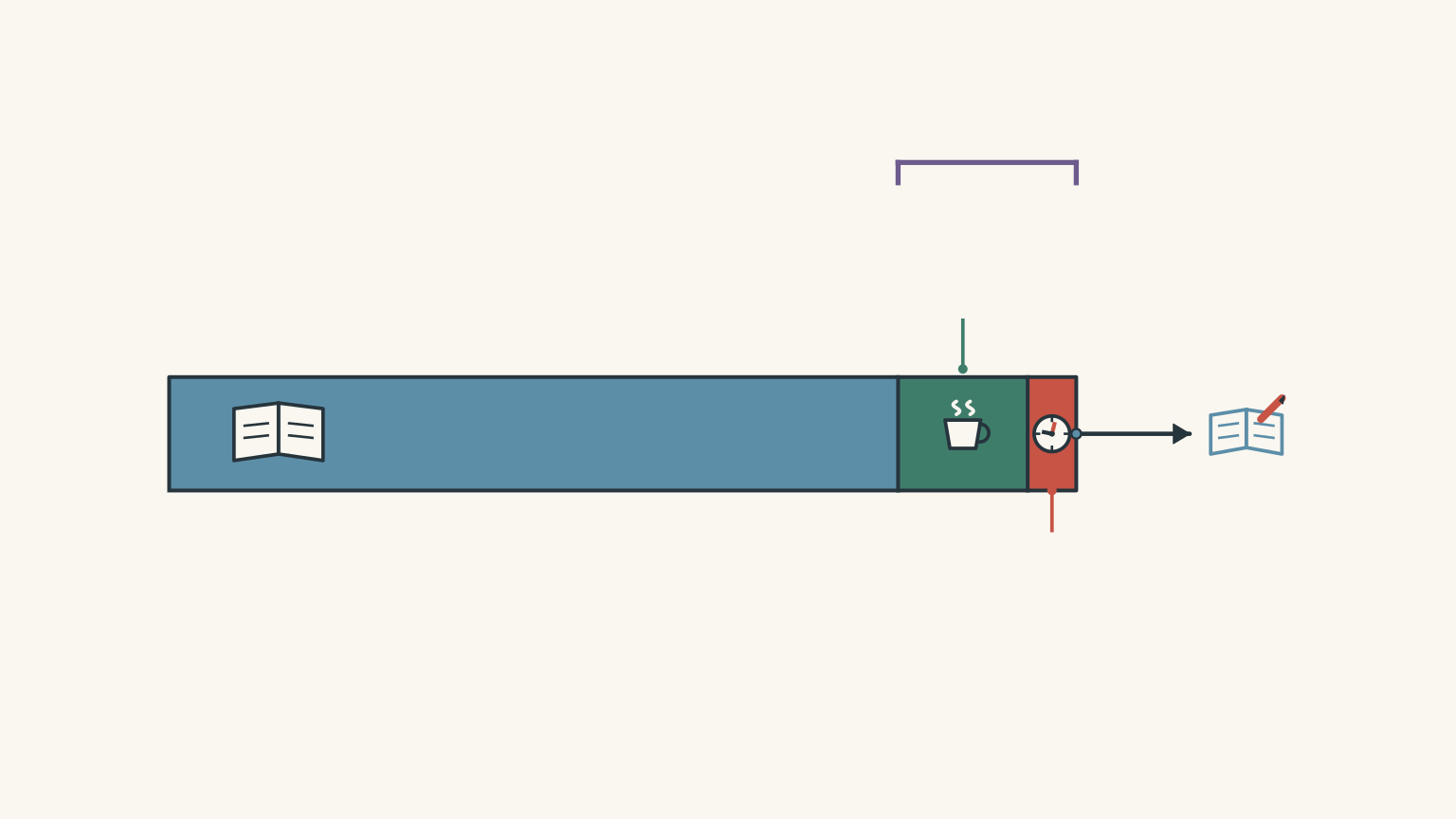
Your actual interruption has two parts:
- The time you spend away from studying.
- The time it takes to resume productive work.
The second part is called the restart delay.
We can represent the total interruption as:
\[ T_{\text{interruption}} = T_{\text{break}} + T_{\text{restart}} \]
Here:
- \(T_{\text{interruption}}\) is the total time lost between productive study periods.
- \(T_{\text{break}}\) is the actual time spent away from studying.
- \(T_{\text{restart}}\) is the time between the end of your break and your first useful study action.
For example, an eight-minute break followed by a three-minute restart delay creates an eleven-minute interruption.
Due to technical limitations, this figure may display incorrectly or contain inaccuracies. Please check key details against your course materials.
This explains why two students can take identical breaks but get different results. One returns and immediately starts solving the next question. The other spends several minutes trying to remember their previous reasoning.
It’s a little like closing a book without a bookmark. You might remember the chapter, but finding the exact place you stopped takes extra effort.
The analogy has a limit, though. A bookmark tells you where you were, while a good study note also needs to preserve what you were thinking and what you planned to do next.
02Make restarting easier before you take the break
One of the simplest ways to reduce restart delay is to leave yourself a short instruction before walking away.
Don’t just write down the question number. Record the exact next action.
For example:
| Subject | Useful restart note |
|---|---|
| Mathematics | Q6: Factorised the numerator. Next, check the excluded values before simplifying. |
| Physics | Found acceleration using \(F_{\text{net}}=ma\). Next, substitute into \(v=u+at\). |
| Chemistry | Balanced the reaction equation. Next, calculate the limiting reagent. |
| English | Finished the evidence paragraph. Next, explain how the technique supports the thesis. |
This gives you a clear starting point when you return.
Due to technical limitations, this figure may display incorrectly or contain inaccuracies. Please check key details against your course materials.
Try this three-line routine before every break:
- Where am I? Record the question, paragraph, or calculation you’re working on.
- What have I established? Note the important result or conclusion.
- What’s my first action when I return? Write a specific instruction.
Compare these two notes:
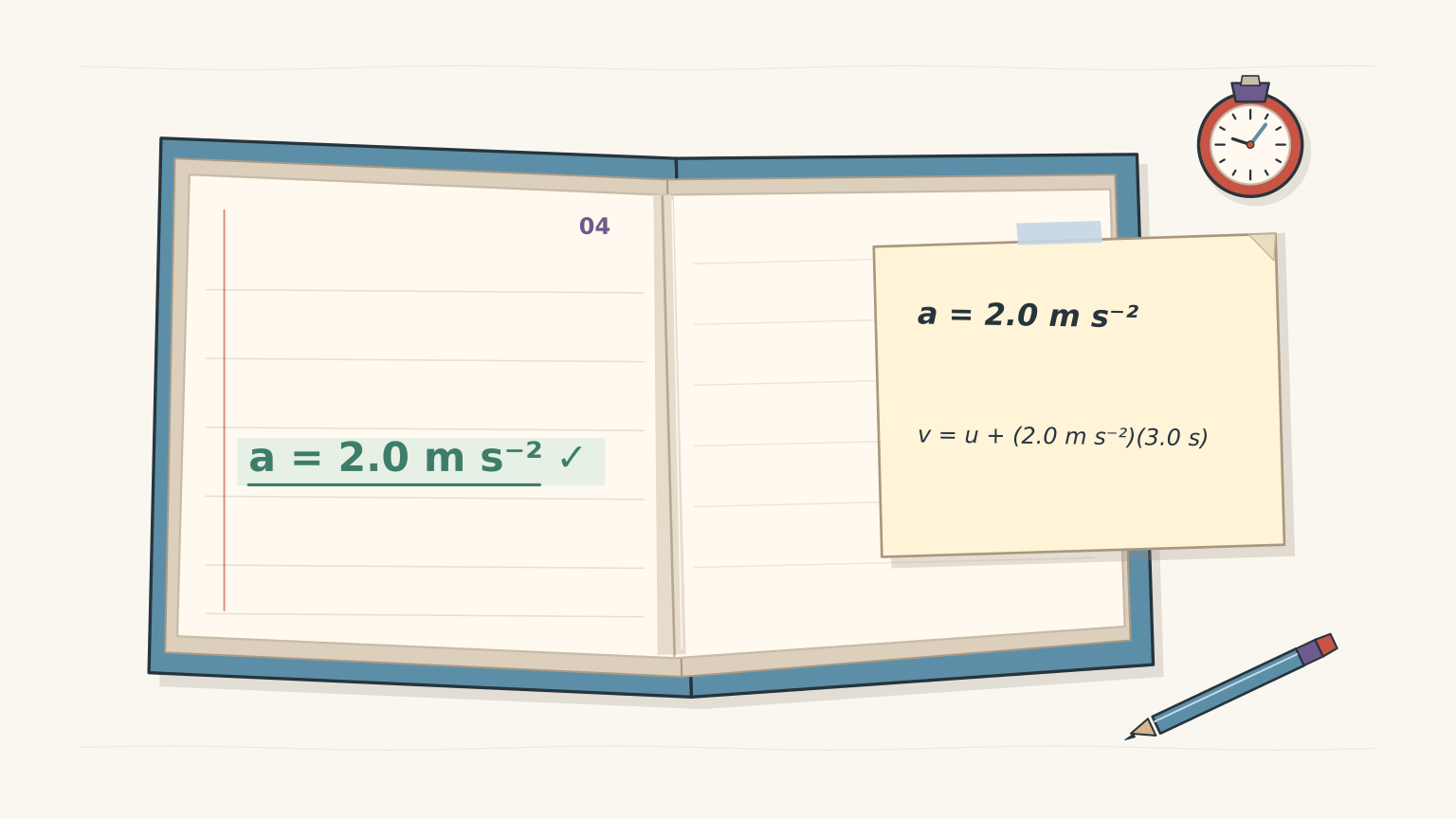
Poor: Continue physics question 4.
Better: Q4: Resolved acceleration as \(2.0\ \text{m s}^{-2}\). Next, use the initial velocity and acceleration to calculate the speed after three seconds.
The second note removes a decision from your return to work. You don’t need to work out where to begin because you’ve already decided.
03How to find your ideal break length
Rather than automatically adopting a fixed study schedule, run a small experiment.
You want to answer a specific question:
Does taking a longer break help me complete enough additional accurate work to justify the extra time?
You might predict that a 15-minute break will leave you feeling more refreshed than a five-minute break. That may be true, but it doesn’t automatically make the longer break more productive.
A longer break uses more time. It may also increase the restart delay.
You need to measure both sides.
Set up a fair experiment
You’ll need:
- A timer.
- A set of reasonably similar study tasks.
- A notebook or spreadsheet to record your results.
- A consistent place to study.
Choose one type of task to test. For example, you might use Mathematics Extension 1 practice questions of similar difficulty.
Keep your study block the same length each time. A 40-minute work block followed by a 20-minute return-to-work block is a practical starting setup.
Now compare three break lengths:
| Trial | Break duration |
|---|---|
| A | 5 minutes |
| B | 10 minutes |
| C | 15 minutes |
Try each duration at least twice, preferably across several days. Rotate the order rather than always testing the shortest break first.
Keep the following conditions as similar as possible:
- Subject and question difficulty.
- Length of the initial study block.
- Length of the return-to-work block.
- Time of day.
- Type of break activity.
For example, don’t compare a five-minute break spent stretching with a fifteen-minute break spent scrolling through social media. That introduces another variable.
Record what actually happens
After each session, record five things.
| Measurement | What to record |
|---|---|
| Actual break | How long you were away from studying |
| Restart delay | Time until your first useful study action |
| Task completion | Number of questions or tasks completed |
| Accuracy | How many were completed correctly |
| Total elapsed time | Time from the beginning of the session to the end |
Pay particular attention to accuracy.
Completing ten questions isn’t necessarily better than completing seven. If three of the ten are incorrect because you rushed, the seven accurate solutions may represent more useful work.
For written responses, use a consistent quality check rather than simply counting words. For example, compare whether each paragraph contains a clear argument, relevant evidence, and an explanation of how that evidence supports the argument.
A first attempt at this experiment can easily produce misleading results. Suppose you test a five-minute break after an easy Maths session on Monday, then a fifteen-minute break after a difficult Physics session on Friday.
If you complete more work on Friday, you cannot confidently attribute the difference to the break. The subject, difficulty, and time of day have all changed.
That’s why repeating comparable tasks and rotating the order of your trials matters.
04Worked comparison: Is a longer break worth it?
Imagine you’ve completed three comparable study sessions.
Each session contains:
- A 40-minute initial study block.
- A break of either 5, 10, or 15 minutes.
- A 20-minute return-to-work block.
You complete ten accurate questions in the initial block every time.
The return-to-work results are:
| Break | Restart delay | Accurate questions in return block |
|---|---|---|
| 5 minutes | 2 minutes | 6 |
| 10 minutes | 2 minutes | 8 |
| 15 minutes | 6 minutes | 8 |
The restart delay is included within the 20-minute return block.
Which break is most productive?
We can compare the number of accurate questions completed per elapsed hour.
The calculation is:
\[ R = \frac{N}{T}\times 60 \]
Where:
- \(R\) is accurate questions completed per hour.
- \(N\) is the total number of accurate questions.
- \(T\) is total elapsed time in minutes.
For the five-minute break:
\[ R_5 = \frac{16}{65}\times60 \]
\[ R_5 \approx 14.8 \]
For the ten-minute break:
\[ R_{10} = \frac{18}{70}\times60 \]
\[ R_{10} \approx 15.4 \]
For the fifteen-minute break:
\[ R_{15} = \frac{18}{75}\times60 \]
\[ R_{15} = 14.4 \]
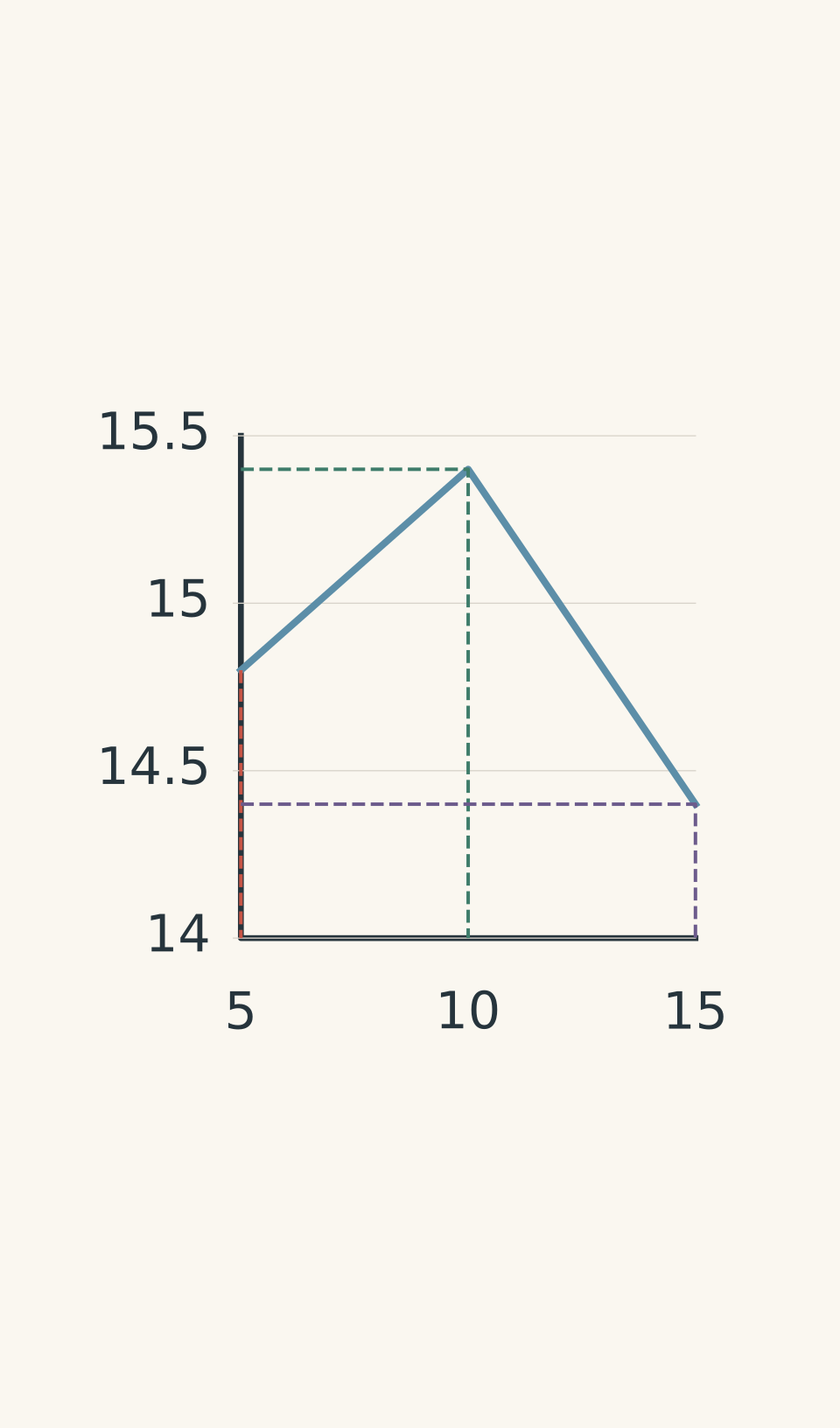
- Accurate questions per hour
- 14.8
- 15.4 · 18 correct in 70 min
- 14.4 · same 18 correct in 75 min
Due to technical limitations, this figure may display incorrectly or contain inaccuracies. Please check key details against your course materials.
In this example, the ten-minute break produces the best result.
The five-minute break saves time but produces fewer accurate answers. The fifteen-minute break produces the same total number of accurate answers as the ten-minute break, but takes longer and has a greater restart delay.
The ten-minute break therefore gives the best balance in this particular experiment.
Your results might be different. The point isn’t to discover a universal winning number. It’s to find out which duration works best for your actual study tasks.
05What should you do during a study break?
The activity matters because some breaks are much easier to end than others.
A useful break should give you a clear opportunity to step away from the task without creating another difficult task to stop.
Good options include:
- Getting a glass of water.
- Walking around the house or outside.
- Having a snack.
- Stretching or standing away from your desk.
- Looking outside for a few minutes.
Be careful with activities that have no natural endpoint.
Scrolling through social media or watching short videos can turn a planned ten-minute break into twenty minutes without you noticing.
The problem isn’t that using your phone is automatically a bad break. It’s that an open-ended activity makes the return time harder to control.
If you want to use your phone, set a separate timer and decide what you’ll do when it goes off.
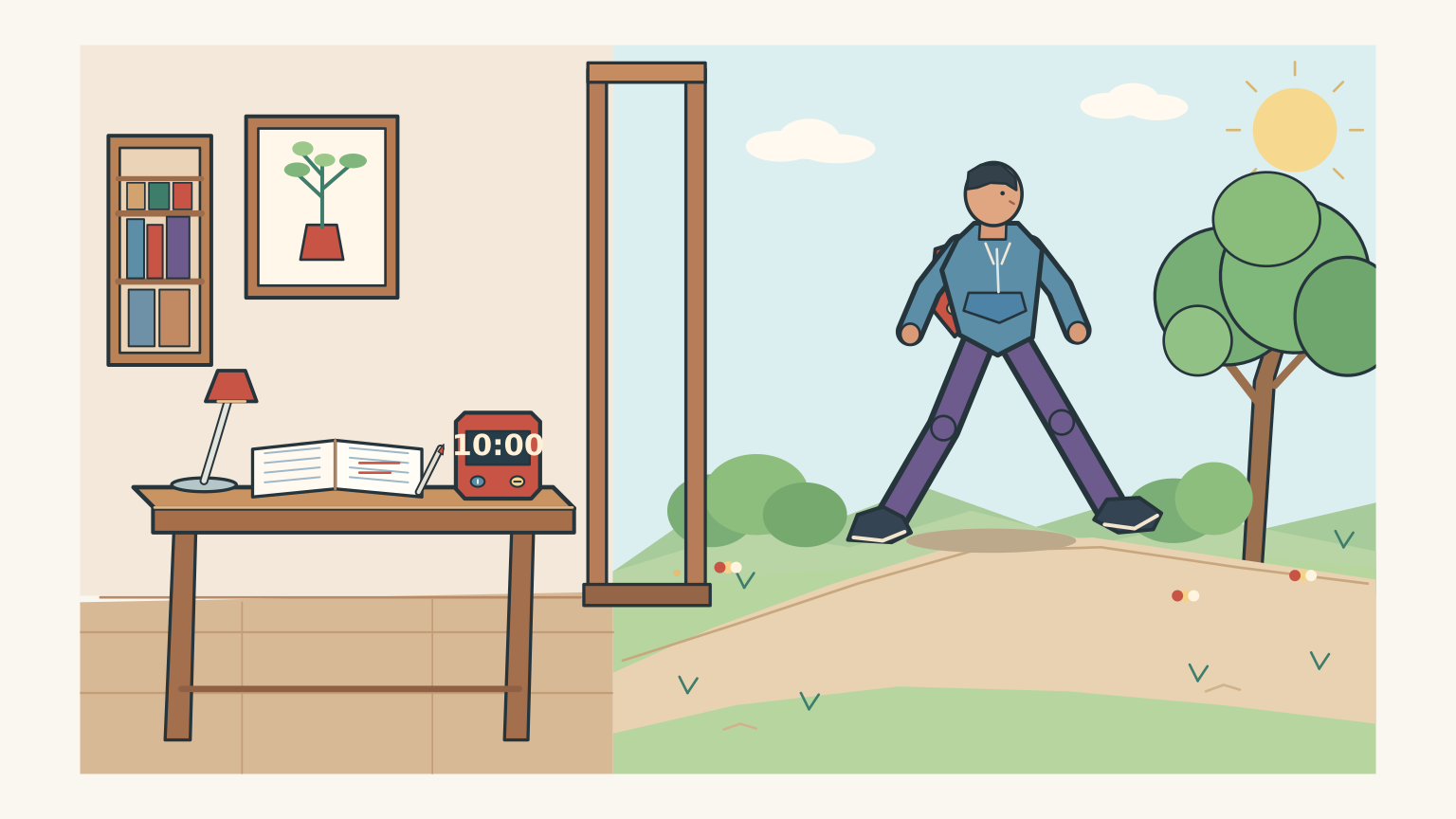
Due to technical limitations, this figure may display incorrectly or contain inaccuracies. Please check key details against your course materials.
06A practical break-length decision guide
Use these starting points, then adjust according to your experiment.
| Study situation | Break to try |
|---|---|
| Short transition between small tasks | 2-5 minutes |
| 40-60 minutes of focused study | 5-10 minutes |
| A longer 75-90-minute study block | 15-20 minutes |
| A break followed by a consistently difficult restart | Improve your restart note and retest |
There are also a few useful rules for adjusting your routine.
If you return quickly and your accuracy stays high: Your current break length is probably working. There’s no need to make it longer just because someone recommends a different schedule.
If you return quickly but make more mistakes: Try a slightly longer break and compare the accuracy of your next study block.
If your break is short but your restart delay is long: Don’t immediately assume you need a shorter break. First, improve your restart note and make your break activity easier to finish.
If a longer break produces no improvement: Try the shorter duration. You’re spending more time away without getting additional useful work in return.
One important distinction: this isn’t about choosing a Pomodoro method. A Pomodoro-style approach uses a predetermined work-and-break cycle. The experiment here has a different purpose. You’re measuring how long you need away from a particular task, and how much useful work you complete when you return.
You can use a fixed study schedule if it suits you, but there’s no need to force every subject, task, or study session into identical intervals.
07Questions and solutions
Question 1
You finish 50 minutes of Chemistry study and take an eight-minute break. When you return, you spend three minutes rereading your notes before making your next useful calculation.
What is your total interruption time? Explain why recording only the eight-minute break would give an incomplete picture.
Solution 1
The total interruption time is 11 minutes.
The calculation is:
\[ T_{\text{interruption}}=8+3 \]
\[ T_{\text{interruption}}=11\text{ minutes} \]
The eight minutes represent the actual break, while the additional three minutes represent the restart delay.
Recording only the break duration would hide the time needed to reconstruct your previous reasoning.
A useful improvement would be to write down the last completed calculation and the next step before leaving your desk. You could then repeat the experiment and see whether your restart delay decreases.
Question 2
A student compares two similar study sessions. Both contain a 40-minute initial study block and a 20-minute return-to-work block.
The student completes ten accurate questions in the initial block in both sessions.
The results are:
- Session A: A five-minute break, a two-minute restart delay, and six accurate questions in the return block.
- Session B: A ten-minute break, a one-minute restart delay, and eight accurate questions in the return block.
The restart delay is included within the return-to-work block.
Which session produces more accurate questions per elapsed hour?
Solution 2
Session B produces more accurate questions per elapsed hour.
For Session A, the student completes:
\[ N_A=10+6=16 \]
Total elapsed time:
\[ T_A=40+5+20=65\text{ minutes} \]
Therefore:
\[ R_A=\frac{16}{65}\times60 \]
\[ R_A\approx14.8 \]
For Session B:
\[ N_B=10+8=18 \]
Total elapsed time:
\[ T_B=40+10+20=70\text{ minutes} \]
Therefore:
\[ R_B=\frac{18}{70}\times60 \]
\[ R_B\approx15.4 \]
Session B produces approximately 15.4 accurate questions per hour, compared with 14.8 for Session A.
Notice that the longer break is more productive here, despite using an additional five minutes.
This is why choosing the shortest possible break isn’t necessarily the right strategy. You need to consider the extra accurate work it might allow you to complete.
Question 3
A student tests two break lengths.
On Monday, they take a five-minute break after 40 minutes of Mathematics study. On Tuesday, they take a fifteen-minute break after 40 minutes of Physics study.
They complete more work after the fifteen-minute break and conclude that longer breaks are better.
Is this a valid conclusion? Explain how the student could improve the experiment.
Solution 3
No. The student hasn’t isolated the effect of break duration.
The two sessions involve different subjects and potentially different levels of difficulty.
Mathematics and Physics questions can require different amounts of working and reasoning. The time of day, task familiarity, and difficulty could also affect how much work the student completes.
The student needs a fairer comparison.
A better experiment would:
- Use the same subject and similar levels of question difficulty.
- Keep the initial study block and return-to-work block the same length.
- Compare five-, ten-, and fifteen-minute breaks.
- Keep the break activity reasonably consistent.
- Repeat each trial and rotate the order.
- Record accurate task completion and restart delay.
This gives the student a much better basis for deciding which break length works.
08The next step: make returning to study easier
Start with five to ten minutes after a focused 40-60-minute study block. Leave yourself a clear restart note, choose a break activity with a natural endpoint, and record how much accurate work you complete afterwards.
After several comparable sessions, you’ll have a much better idea of whether a shorter or longer break suits your study.
And if your main difficulty isn’t returning after a ten-minute break, but getting back into HSC study after several days or weeks away, that’s a different problem. Read How Do You Return to HSC Study After a Long Absence? for a practical approach to rebuilding your study routine.