
How to Check an HSC Exam Paper in the Final Ten Minutes
Ten minutes left in your HSC exam? Follow this practical checking strategy to catch unanswered questions, missing answer transfers, unit errors, and mistakes in your working before you hand in your paper.
Ten minutes remain in your HSC exam. You’ve answered most of the paper, your calculator is still working, and you’re reasonably happy with your responses. But there’s a problem: you could spend those ten minutes checking every calculation and still miss a question you haven’t answered, a multiple-choice response you forgot to transfer, or a final answer with the wrong units.
The solution isn’t to reread the entire paper. It’s to check it in the right order.
Your priorities should be:
- Find unanswered questions and missing parts.
- Check that every answer is in the correct place.
- Check units, conversions, and final numerical answers.
- Revisit calculations where one small error could affect several marks.
- Make sure every booklet and answer sheet is ready to be handed in.
Here’s how to use those final ten minutes.
01The ten-minute checking strategy
A useful starting point is to divide your remaining time into five short checks.
| Time remaining | Priority | What you’re checking |
|---|---|---|
| 10-8 minutes | Omissions | Missing questions, parts, and unfinished responses |
| 8-6 minutes | Answer transfer | Multiple-choice sheets, writing booklets, and continued answers |
| 6-3 minutes | Units and final answers | Units, conversions, signs, rounding, and numerical results |
| 3-1 minutes | High-risk working | Multi-step calculations and important reasoning |
| 1-0 minutes | Final checks | Booklet labels, identification details, and hand-in requirements |
This is a suggested allocation, not a rigid rule. If you discover an unanswered question, deal with it before spending time polishing completed answers.
Due to technical limitations, this figure may display incorrectly or contain inaccuracies. Please check key details against your course materials.
01Find unanswered questions before checking calculations
Start at Question 1 and work through the paper in numerical order.
Don’t rely on your memory of what you’ve answered. Follow the actual question numbers and check every subpart.
For example, imagine a Mathematics paper containing:
- Question 8(a)
- Question 8(b)(i)
- Question 8(b)(ii)
- Question 8(c)
You might remember completing Question 8, but that doesn’t mean you’ve answered all four parts.
A quick scan should establish whether:
- Every question has a corresponding response.
- Every subpart has been attempted.
- You’ve answered all required questions in sections with question choices.
- Any answer continued on another page or booklet can be located.
- You haven’t accidentally skipped the back of a page.
What if you find a blank question?
Prioritise it.
If you can make a relevant attempt, do so before returning to completed questions.
For a Mathematics question, this might mean writing the correct initial equation or showing the first useful step. For Physics, it could be identifying the relevant physical relationship and substituting the supplied values. For Chemistry, it might be setting up the mole calculation using the balanced equation.
The aim is to provide a genuine attempt, not fill the space with unrelated working.
NESA’s 2027 HSC Rules and Procedures guide explicitly requires students to attempt all exam questions rather than submit blank or token responses.
A useful way to think about this is that an unanswered part is a known gap. A calculation that you’ve already completed is only a possible source of error. Deal with the known gap first.
02Check that your answers are in the correct place
This is one of the most important checks, and it’s easy to overlook.
Completing a question and submitting your answer in the correct place are two different things.
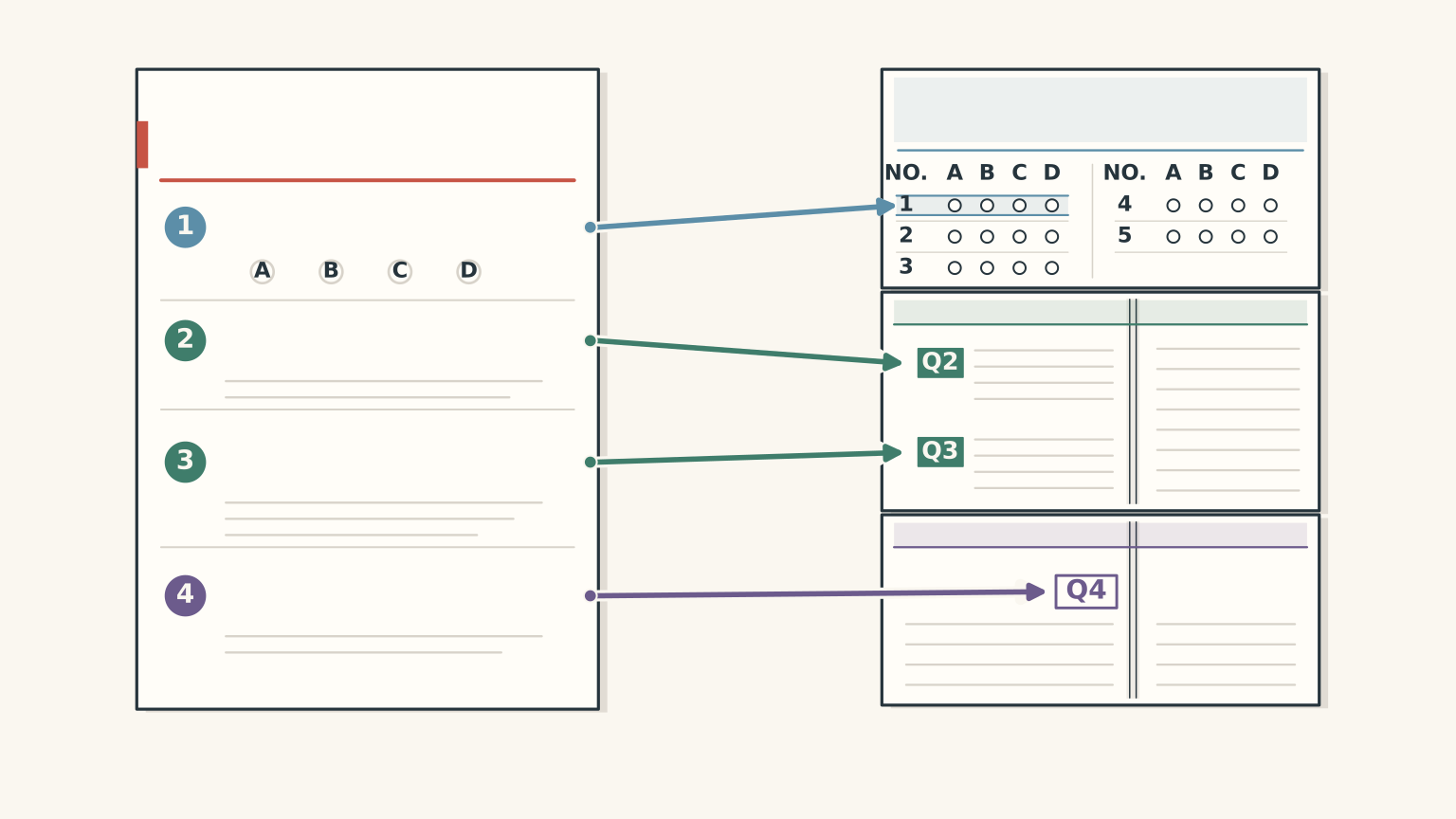
HSC exams can use several types of answer material:
- Personalised multiple-choice answer sheets.
- Question-and-answer booklets.
- Personalised writing booklets.
- Generic additional writing booklets.
The instructions depend on the examination. Your job is to make sure your responses have reached the correct destination.
Due to technical limitations, this figure may display incorrectly or contain inaccuracies. Please check key details against your course materials.
Multiple-choice answers
If your exam uses a separate multiple-choice answer sheet, check that your selected answers have actually been recorded on it.
A common mistake is to circle an answer on the question paper and forget to transfer it.
Work through the answer sheet by question number.
Check:
- Every attempted question has a corresponding response.
- You haven’t skipped a row when transferring answers.
- Each question has the intended single selection, where the instructions require one.
- Any changed answers have been recorded according to the answer sheet instructions.
Don’t assume that circling an answer in the question paper means it has been submitted.
Writing booklets
Check that each written response is in the correct booklet.
This is particularly important when personalised writing booklets are labelled with specific question numbers.
For example, if you have a booklet labelled Question 12, don’t assume it’s suitable for continuing Question 11.
If you’ve used an additional writing booklet, check that:
- The question being answered is clearly identified.
- The continuation is indicated in the original booklet.
- All booklets are labelled according to the instructions.
- The marker can follow the response without having to guess where it continues.
NESA provides specific guidance about writing in designated spaces and labelling additional booklets in its HSC examination preparation advice.
What if you’ve written an answer in the wrong booklet?
Don’t panic and start copying the entire response.
NESA’s 2027 rules instruct students to tell the supervisor if they have used the wrong booklet. Students must write a note on the front of the booklet explaining the error, must not rewrite the answers, and must label and hand in all parts of their responses.
Follow the supervisor’s instructions.
This is important because rewriting an entire response at the end of an exam can introduce new mistakes and create confusion about which version should be assessed.
03Check units and final numerical answers
Now move to your calculations.
You don’t have time to redo every mathematical step. Instead, read the final answer of each numerical question and check whether it makes sense.
Ask four things:
- Have I calculated the quantity the question actually requested?
- Have I included the correct unit?
- Have I converted all quantities into compatible units?
- Is the numerical result sensible given the information in the question?
This catches several common HSC mistakes.
Check unit conversions
Unit conversions deserve particular attention because they can introduce errors by factors of 10, 100, or 1,000.
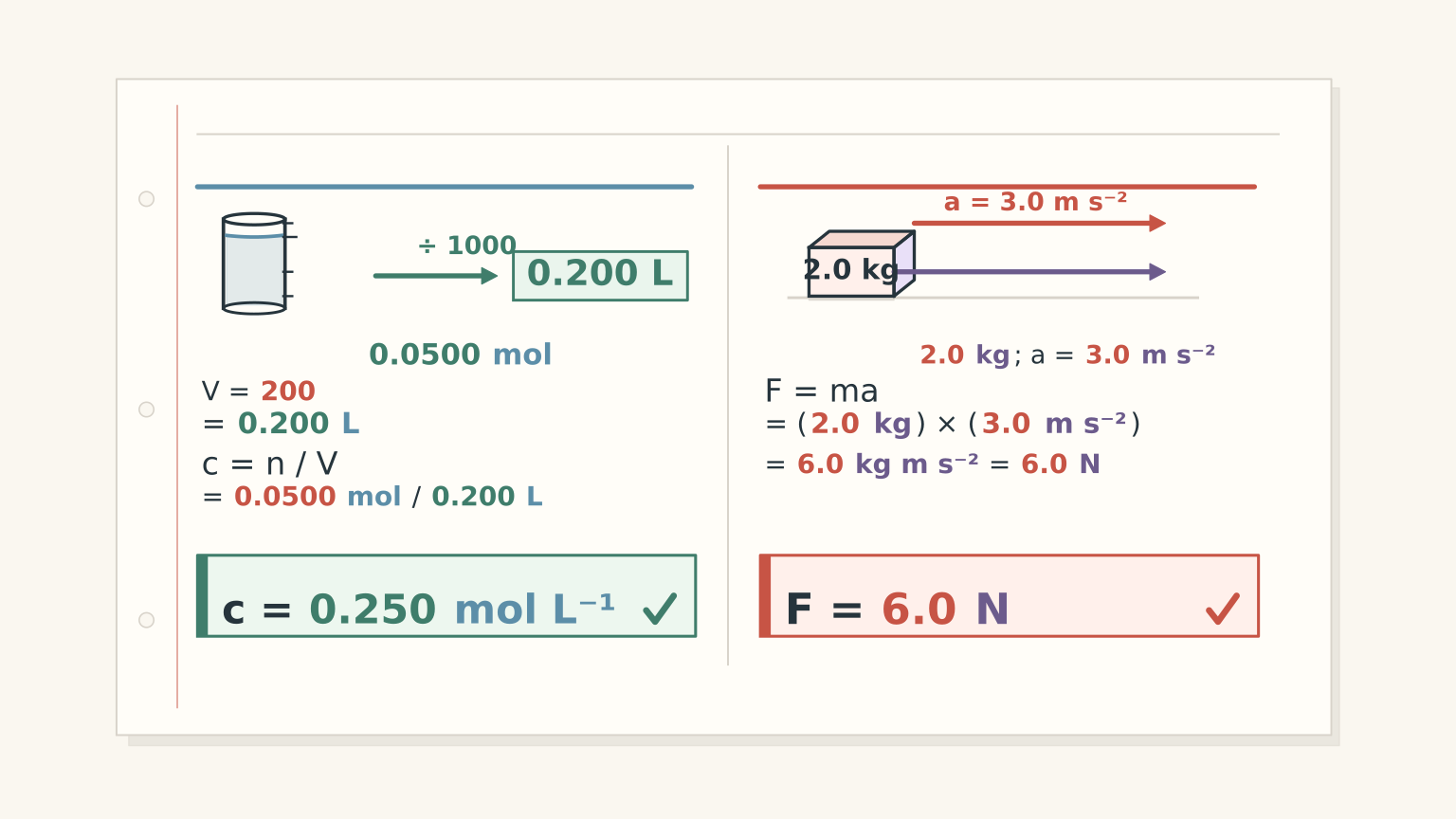
Consider a Chemistry question asking for the concentration of a solution containing 0.020 mol of solute in 200 mL of solution.
The concentration relationship is:
\[ c=\frac{n}{V} \]
where \(c\) is concentration in mol L\(^{-1}\), \(n\) is amount of substance in moles, and \(V\) is volume in litres.
Before checking the final result, confirm that the volume has been converted:
\[ 200\text{ mL}=0.200\text{ L} \]
Therefore:
\[ c=\frac{0.020}{0.200} \]
\[ \boxed{c=0.10\text{ mol L}^{-1}} \]
If you accidentally used 200 as the volume in litres, you’d obtain a result 1,000 times smaller than the correct concentration.
That’s exactly the sort of mistake worth catching in your final minutes.
Check that the units match the physical quantity
In Physics, the units can reveal whether you’ve calculated the right thing.
Suppose a question asks you to calculate the net force acting on a 0.40 kg object accelerating at 2.5 m s\(^{-2}\).
Using Newton’s second law:
\[ F=ma \]
\[ F=0.40\times2.5 \]
\[ \boxed{F=1.0\text{ N}} \]
The unit is newtons because:
\[ 1\text{ N}=1\text{ kg m s}^{-2} \]
If you’ve written 1.0 without a unit, add the appropriate unit. If the question asks for the direction of the net force, include that too.
Other units worth checking
| Subject | Common final-check errors |
|---|---|
| Physics | N versus kg, J versus W, m s\(^{-1}\) versus m s\(^{-2}\) |
| Chemistry | mL versus L, mol versus g, mol L\(^{-1}\) versus mol |
| Mathematics | Length versus area units, squared versus cubed units, degrees versus radians |
Also check significant figures and decimal places where relevant.
Don’t round intermediate values unnecessarily. Check the precision of your final answer against the information supplied and the question’s instructions.
Due to technical limitations, this figure may display incorrectly or contain inaccuracies. Please check key details against your course materials.
04Recheck the working most likely to contain an important error
You should now have a paper where every question has been attempted, answers are in the correct locations, and final values have been checked.
You can use your remaining time to revisit the calculations most likely to contain consequential mistakes.
Don’t restart every calculation. Look for places where one small error could affect several subsequent steps.
These are your highest-priority targets.
Multi-step calculations
Look at calculations involving several stages.
Examples include:
- A Physics problem involving multiple equations to find an unknown quantity.
- A Chemistry stoichiometry question involving mass, moles, and concentration.
- A Mathematics question involving several algebraic substitutions.
Check the critical transitions rather than repeating the entire calculation.
For example, in a Chemistry stoichiometry question, check that you used the mole ratio from the balanced chemical equation correctly. A mistake at that stage can affect every subsequent answer.
Signs and directions
Negative signs deserve a second look.
In Physics, a negative velocity doesn’t automatically mean your answer is wrong. It can indicate motion in the direction opposite to your chosen positive direction.
However, if the question asks for speed, the final answer should be a non-negative magnitude.
In Mathematics, check signs introduced when expanding brackets, rearranging equations, or applying differentiation and integration.
Don’t change a negative answer simply because it looks unusual. First check what the sign represents.
Powers of ten and calculator entries
Look closely at scientific notation and calculations involving very large or very small quantities.
For example, check whether you have correctly entered:
\[ 3.0\times10^{-4} \]
rather than:
\[ 3.0\times10^{4} \]
A single incorrect exponent can make an otherwise correct solution completely wrong.
Also check that the number displayed on your calculator is the number you’ve actually copied into your answer booklet.
Written responses
Not every final check needs to involve a calculation.
For longer responses, look at the wording of the question and check that your answer addresses what was requested.
| Question instruction | What your answer should contain |
|---|---|
| Identify | The specific item or quantity requested |
| Describe | Relevant characteristics or features |
| Explain | A clear relationship between cause and effect |
| Compare | Relevant similarities and differences |
| Evaluate | A supported judgement based on evidence |
For example, if a Physics question asks you to explain how changing a variable affects an experimental result, simply stating that the result increases isn’t enough.
Check that you’ve explained why it increases and connected your reasoning to the relevant physical principle.
If you’ve included a diagram, check that its labels, arrows, and quantities agree with your written explanation.
For more on this, see How to Use Diagrams in HSC Physics Written Answers.
Don’t change answers without a reason
There’s an important difference between checking an answer and doubting an answer.
If you have a result that looks unusual, test it against something specific:
- Does the unit make sense?
- Does the magnitude seem reasonable?
- Does substituting the result back into the original equation work?
- Is the sign consistent with your chosen direction?
- Does the result agree with the conditions in the question?
If you can’t identify a genuine error, be cautious about replacing your original answer.
Random last-minute changes can damage correct working.
05Your final 60-second checklist
With approximately one minute remaining, stop making broad changes to your paper.
Concentrate on the things that could prevent your completed work from being properly submitted.
Use this checklist:
- [ ] Every question and subpart has been attempted.
- [ ] No answers are missing from a separate multiple-choice answer sheet.
- [ ] Every written response is in the correct booklet or designated space.
- [ ] Additional booklets and continued answers are clearly identified.
- [ ] Numerical answers have appropriate units and sensible precision.
- [ ] Important calculations and written responses have been checked.
- [ ] All required student and exam centre details are present where they are not already printed.
- [ ] Every booklet and answer sheet is ready to be handed in.
- [ ] The Student Completion Record is completed as instructed.
One important rule: do not write your name, your school’s name, or other identifying marks on writing or answer booklets. NESA requires the relevant student and exam centre numbers where these details aren’t already printed.
The current NESA 2027 HSC Rules and Procedures guide also requires students to stop writing immediately when instructed, return all examination materials, and complete the Student Completion Record.
You cannot leave the examination in the final 15 minutes under these rules, so use the remaining time to finish your checks and follow the supervisor’s directions.
07Questions and solutions
The following situations test whether you can prioritise the right checks when time is limited.
Question 1
You have ten minutes remaining. You’ve completed Questions 1-10, but you notice that Question 7(c) is blank. Your other calculations appear correct.
Should you spend the next few minutes checking your completed calculations or attempt Question 7(c)?
Solution 1
Attempt Question 7(c) first.
An unanswered question is a definite omission, whereas your completed calculations are only possible sources of error.
Read the part again and identify what you can reasonably establish. If you know the relevant formula or principle, write down the appropriate working and explain the steps you can justify.
Once you’ve made a genuine attempt, return to the rest of your checking.
The important distinction is between improving an existing answer and providing an answer that doesn’t exist yet. With limited time, the second should take priority.
Question 2
A Chemistry question gives you 0.020 mol of solute in 200 mL of solution.
You’ve calculated the concentration as:
\[ 0.00010\text{ mol L}^{-1} \]
During your final check, what should you investigate, and what is the correct answer?
Solution 2
The correct concentration is \(0.10\text{ mol L}^{-1}\).
The likely mistake is that you used 200 as the volume without converting the millilitres into litres.
Start with:
\[ c=\frac{n}{V} \]
Convert the volume:
\[ V=200\text{ mL}=0.200\text{ L} \]
Substitute:
\[ c=\frac{0.020}{0.200} \]
Therefore:
\[ \boxed{c=0.10\text{ mol L}^{-1}} \]
Your original answer was 1,000 times too small.
This is why checking units is so valuable. You don’t necessarily need to redo an entire question to discover a major error. Sometimes checking one conversion reveals the problem.
Question 3
You’ve completed Question 9 in a writing booklet labelled Question 10.
You notice the mistake with three minutes remaining.
Should you copy your response into the Question 9 booklet?
Solution 3
No. Tell the examination supervisor and follow the NESA procedure for writing in the wrong booklet.
The current NESA rules instruct you to:
- Tell the supervisor that you’ve used the wrong booklet.
- Write a note on the front of the booklet explaining the mistake.
- Avoid rewriting your answers.
- Clearly label and hand in all parts of your response.
Copying the answer into another booklet could create confusion about which response should be assessed.
The priority is to make sure the supervisor knows where your answer is and that all parts are correctly identified.
08What happens after you hand in your final HSC paper?
Once the supervisor has collected your examination materials, your job is finished.
It’s tempting to immediately start analysing every answer with friends, searching for solutions, or worrying about questions you might have got wrong.
But the decisions that matter after your final exam are different from the decisions you make during those final ten minutes.
We’ve covered those next steps in What to Do in the Weeks After Your Final HSC Exam.
For now, remember the order: omissions first, answer transfer second, units third, high-risk working fourth, and submission checks last.
Ten minutes isn’t enough to perfect an entire examination. It is enough to catch several preventable mistakes, provided you know exactly where to look.