
How to Study an HSC Subject You Don’t Enjoy
You don't need to enjoy every HSC subject to study it effectively. Learn how to build a manageable routine using two short weekly sessions, targeted practice, and a simple error log.
At 7:30 pm, you have 25 minutes available to study. The subject you enjoy least is also the one you’ve been putting off all week. You could promise yourself an hour of revision, open your notes, and hope you feel like working. Or you could attempt two questions, check your answers, and finish with one specific thing to fix.
Which approach is more likely to happen again next week?
The second. It gives you a clear starting point, a manageable commitment, and a way to tell whether the session was useful.
If you don’t enjoy an HSC subject, you don’t need to find a way to love it. You need a routine that doesn’t depend on enjoying it.
Here’s a practical way to build one without letting the subject take over your week.
01Start with two short study sessions a week
When you dislike a subject, a large study commitment creates another reason to avoid it. An hour of revision feels like a chore before you’ve even opened your book.
Start smaller.
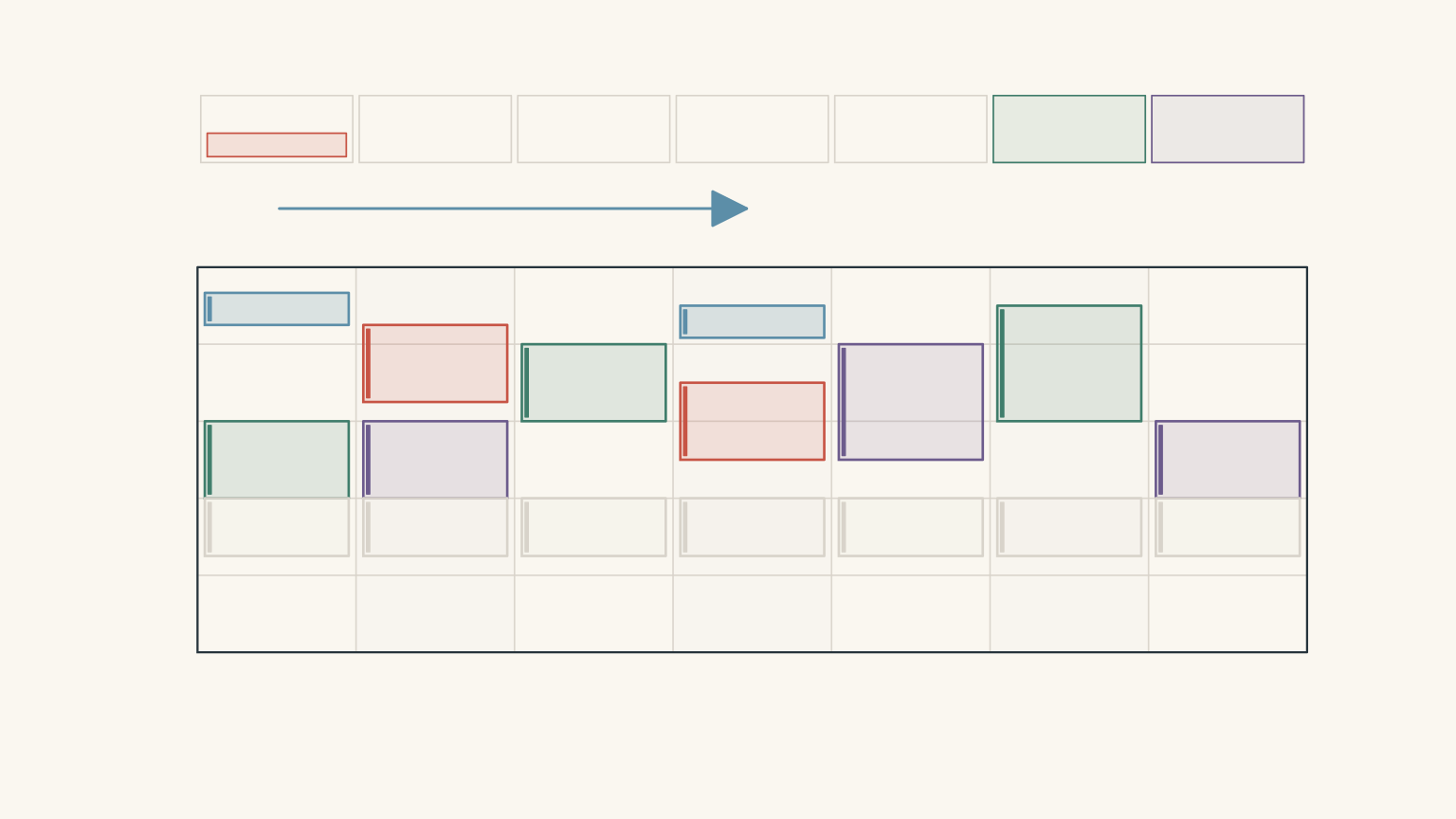
Set aside two 25-minute sessions each week for that subject. Put them in your calendar rather than relying on finding spare time.
Ideally, schedule:
- Your first session within 24 hours of a lesson.
- Your second session two or three days later.
The gap is useful. You get another chance to recall the material after you’ve had some time away from it.
Give each session a specific job.
| Session | What to do | What you should finish with |
|---|---|---|
| First 25 minutes | Recall recent content, attempt two or three questions, and check your answers. | A record of what you understand and one mistake to fix. |
| Second 25 minutes | Redo the previous mistake, then attempt new questions or an older question from the same subject. | Evidence that you’ve corrected something and a clear next task. |
For a subject with longer written responses, one substantial question can replace two or three shorter ones.
Due to technical limitations, this figure may display incorrectly or contain inaccuracies. Please check key details against your course materials.
Twenty-five minutes is a starting point, not a claim that every HSC subject only needs 50 minutes of weekly study. You’ll need more time as assessments approach and as the course becomes more demanding.
The purpose is to establish a minimum commitment that you can maintain even during an ordinary, busy school week.
02Give every session a finish line
There’s a difference between spending 25 minutes with your textbook open and actually studying.
Consider two possible tasks:
- Revise chemical equilibrium.
- Write the equilibrium expression for a reaction from memory, answer two questions about changes in concentration, and check your explanations.
The first task has no clear endpoint. You could spend the entire session highlighting notes without discovering whether you can answer an exam question.
The second gives you something to attempt and something to check.
This is particularly important when you dislike a subject because you find it difficult. If you don’t understand the material, spending longer looking at it doesn’t automatically make it clearer.
Use this simple structure for each session.
The 25-minute structure
First 3-5 minutes: Recall
Close your notes.
Write down the main ideas, formulas, reaction patterns, or steps from the previous lesson. Don’t worry if you can’t remember everything.
The gaps are useful information. They tell you where to focus.
Next 15-17 minutes: Attempt questions
Choose two or three questions from your current topic.
Try them without immediately looking at worked solutions. If you get stuck, identify the step where you became unsure.
Final 5 minutes: Check and correct
Compare your work with a worked solution, marking guide, or teacher feedback.
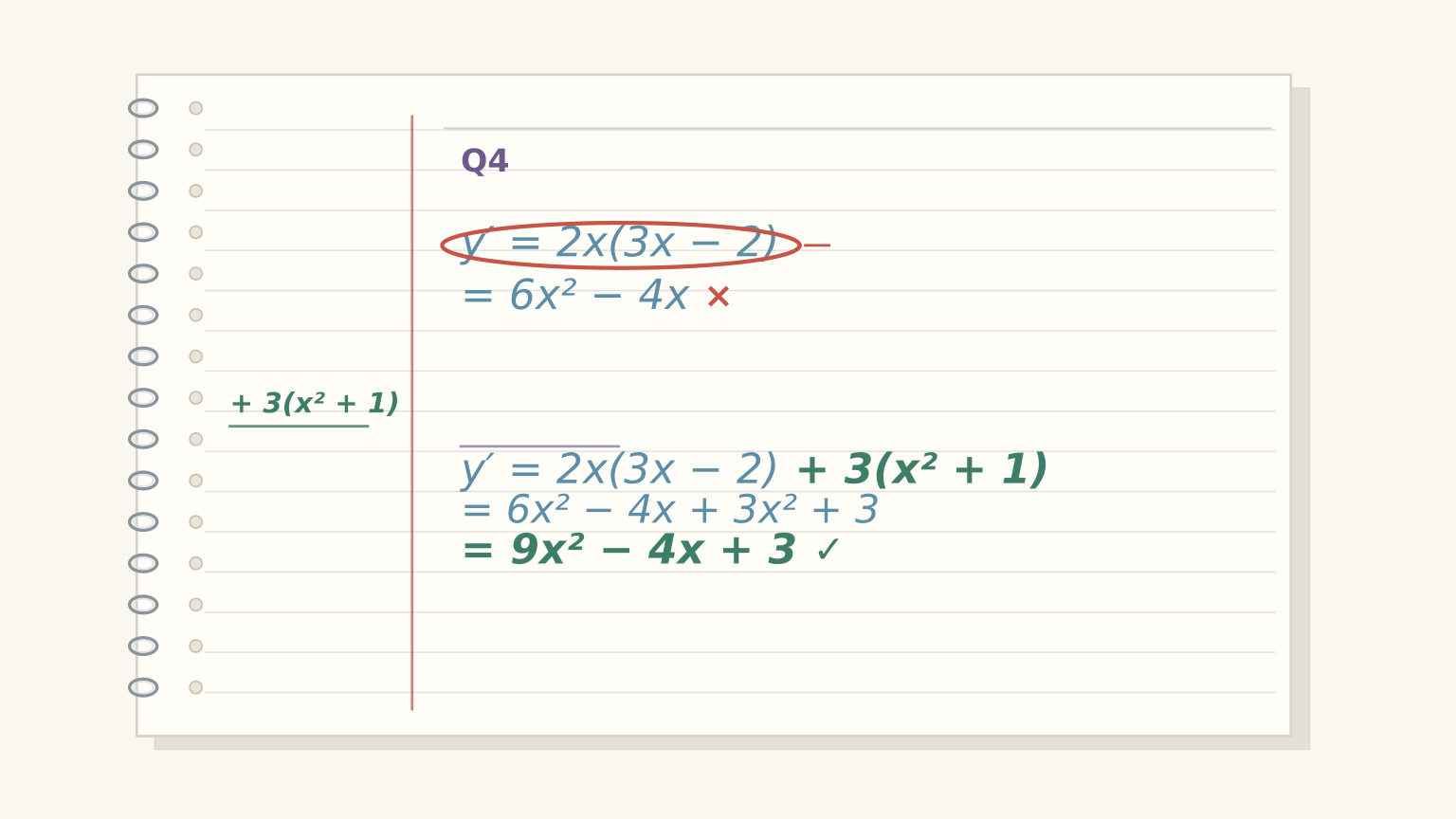
Write down one specific mistake or gap. Choose a question or task that will help you address it in your next session.
Due to technical limitations, this figure may display incorrectly or contain inaccuracies. Please check key details against your course materials.
This last part is easy to skip. Don’t.
Without checking your work, you can repeat the same mistake for weeks and still feel as though you’ve been studying consistently.
03Why attempting questions works better than just rereading notes
When you dislike a subject, rereading notes can seem like the easiest option.
You recognise the definitions. The worked examples look familiar. You might even feel as though you understand the topic.
But recognition isn’t the same as being able to produce an answer independently.
Imagine watching someone else solve a difficult Maths Extension 1 question. Their method makes sense as they explain each step. Now close the solution and try a similar question yourself.
You might discover that you don’t know how to choose the first step.
That’s the difference between recognising a solution and being able to construct one.
Trying to retrieve information from memory is called retrieval practice. It makes you identify what you can actually recall without relying on your notes.
Checking your attempt then provides feedback. You can see whether the problem was:
- Forgetting a formula or definition.
- Misunderstanding a concept.
- Choosing the wrong method.
- Making an algebraic or calculation error.
- Knowing the method but not explaining your reasoning clearly.
These are different problems. They need different solutions.
For example, if you repeatedly forget which equation to use in a Physics question, doing another ten calculations without addressing that decision won’t necessarily help.
You need to practise recognising which physical principle applies before you start calculating.
The goal isn’t to complete as many questions as possible. It’s to make each attempt teach you something.
04Turn an unpleasant subject into specific tasks
A useful way to reduce avoidance is to stop writing broad subject names on your study list.
Instead, choose a task that is small enough to start immediately.
Here are some examples for common HSC subjects.
Physics: Replace reading with prediction
Suppose you’re studying projectile motion.
Instead of writing “revise projectile motion”, give yourself this task:
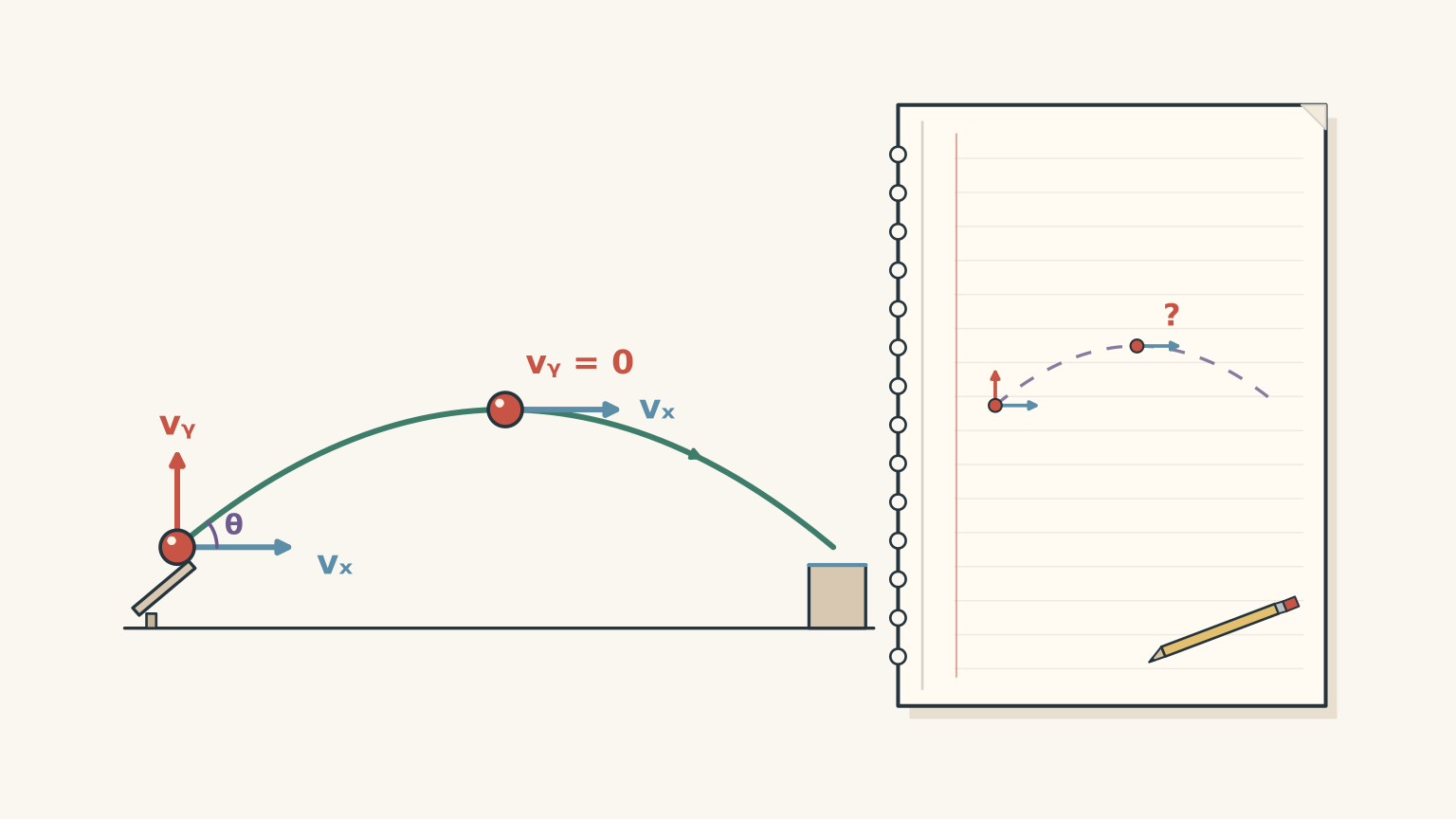
- Draw the horizontal and vertical velocity components for a projectile at launch and at its highest point.
- Attempt one projectile motion question without notes.
- Check whether you’ve used the correct equations and directions.
- Write down one step you need to practise again.
Due to technical limitations, this figure may display incorrectly or contain inaccuracies. Please check key details against your course materials.
If you struggle to explain why the horizontal velocity remains constant while the vertical velocity changes, that’s a much more useful discovery than simply knowing you’ve spent 20 minutes reading your Physics notes.
You can then make your next session about that specific idea.
Chemistry: Replace rewriting notes with testing reactions and explanations
Suppose your class has covered chemical equilibrium.
Rather than rewriting an entire set of notes, try this:
- Write an equilibrium expression for a reaction from memory.
- Predict what happens when the concentration of a reactant increases.
- Explain your prediction using Le Chatelier’s principle.
- Check your answer and identify any missing reasoning.
For example, consider:
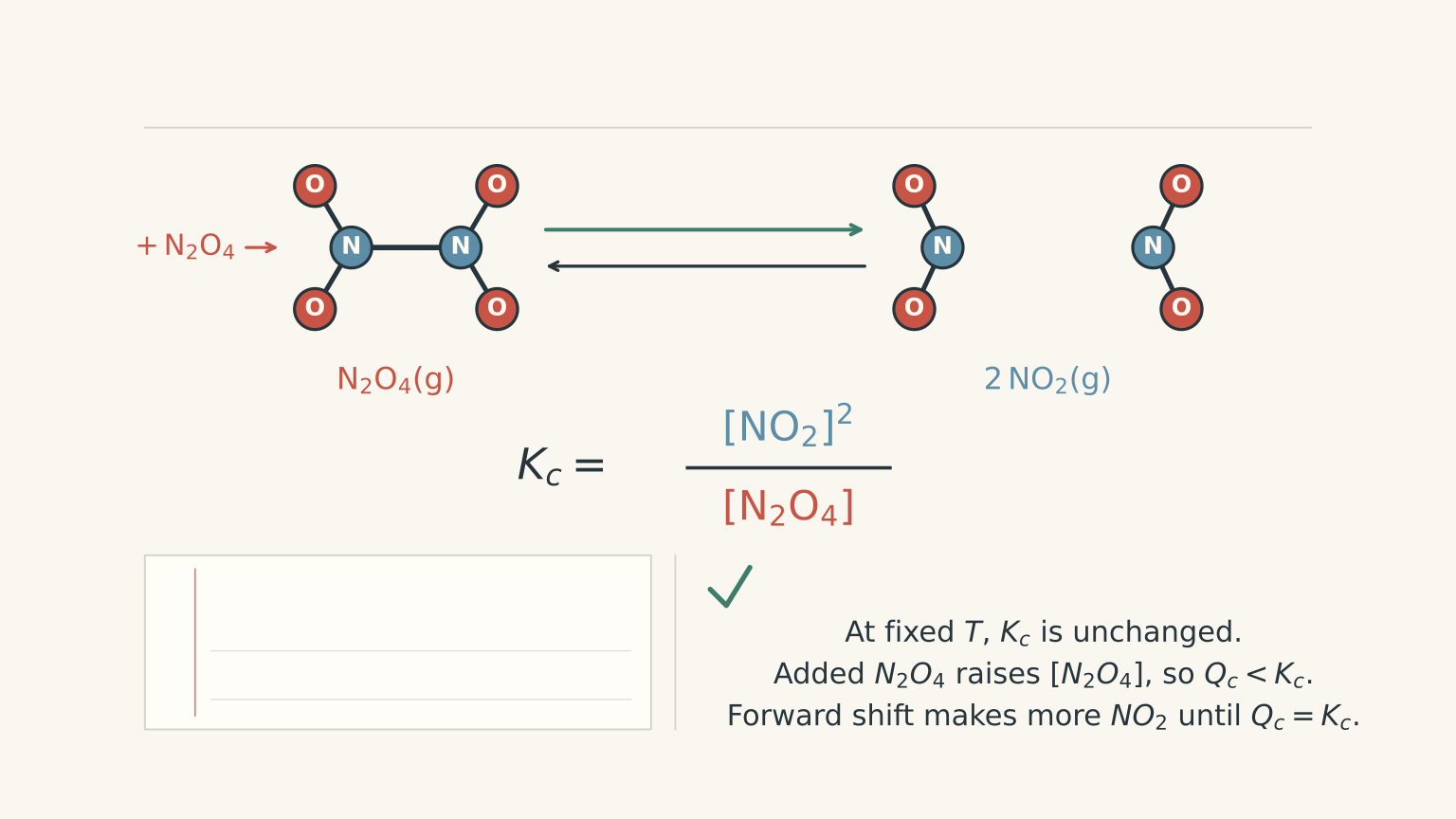
\[ \ce{N2O4(g) <=> 2NO2(g)} \]
The equilibrium expression is:
\[ K_c=\frac{[\ce{NO2}]^2}{[\ce{N2O4}]} \]
Now consider what happens when more \(\ce{N2O4}\) is added at constant temperature.
You should be able to explain why the equilibrium position shifts towards producing more \(\ce{NO2}\), rather than simply memorising the direction of the shift.
Due to technical limitations, this figure may display incorrectly or contain inaccuracies. Please check key details against your course materials.
This type of practice makes your revision more active. It also reveals whether you understand the chemistry or have only memorised a few rules.
Mathematics: Practise the step where you get stuck
Suppose you’re studying integration by substitution in Maths Extension 1.
You don’t need to spend the entire session copying out integration rules.
Instead:
- Attempt two or three questions without looking at worked solutions.
- Identify where you struggle to choose a substitution.
- Check whether you’ve transformed the entire integral correctly.
- Redo one incorrect question from the beginning.
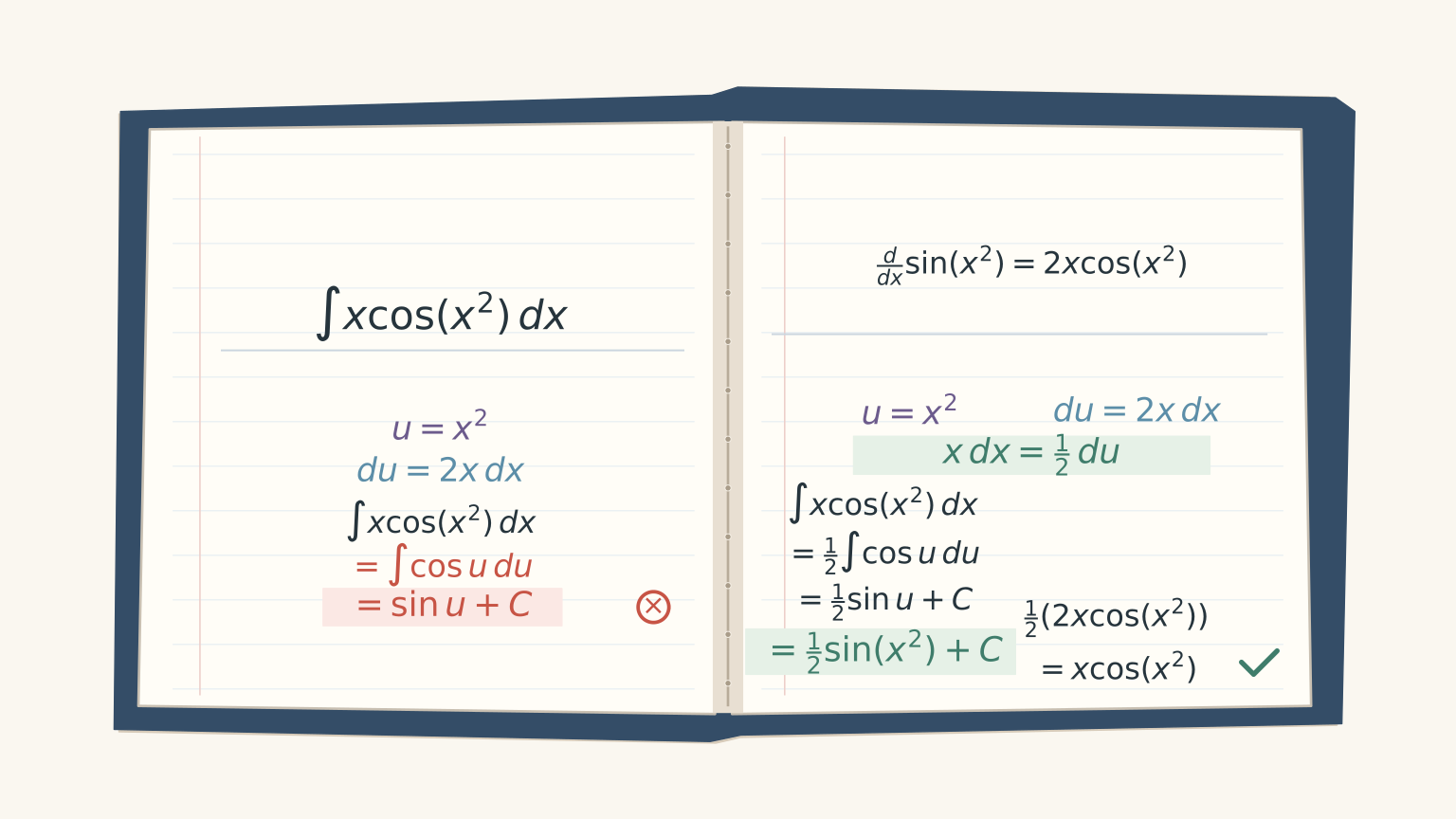
Due to technical limitations, this figure may display incorrectly or contain inaccuracies. Please check key details against your course materials.
If you repeatedly make small algebraic mistakes rather than struggling with the integration method itself, your next session should address those errors.
For more help distinguishing calculation slips from other mistakes, see How to Catch Careless Mistakes in HSC Maths Exams.
05Keep a small record of what goes wrong
You don’t need another elaborate set of revision notes.
You need a record that helps you decide what to do next.
After each study session, write down:
| What to record | Example |
|---|---|
| Topic | Projectile motion |
| What went wrong | I used the wrong sign for vertical displacement. |
| Why it happened | I didn’t define my positive direction before substituting. |
| Next action | Redo one question, defining the positive direction first. |
Keep it short.
Avoid entries such as “I don’t understand Physics” or “I need to revise everything”.
They don’t tell you what to do.
A useful entry identifies the exact point where your reasoning broke down.
After a few weeks, you’ll have a much clearer picture of the subject. You might discover that you understand most of the content but repeatedly lose marks through particular calculation errors. Or you might notice that your biggest difficulty is explaining concepts in written responses.
That information helps you choose more effective revision tasks.
It also makes asking for help much easier. Instead of telling your teacher that you don’t understand an entire topic, you can show them a question, your attempt, and the exact step where you became stuck.
06What if you miss a study session?
You will probably miss one eventually.
An assessment will take longer than expected. You’ll have other homework. You might get home exhausted and decide that tonight isn’t happening.
Don’t respond by doubling your next session.
If you miss a 25-minute block, you don’t need to punish yourself with a two-hour catch-up session on Sunday.
Instead, use a 10-minute reset at your next available opportunity:
- Open the most recent topic.
- Attempt one question.
- Check your answer.
- Write down the next task.
Then return to your normal schedule.
If you repeatedly miss the same study block, change the time or reduce the starting commitment to 15 minutes.
A routine that only works during quiet weeks isn’t particularly useful for an HSC student.
The aim is consistency, not a perfect record.
07What if you still don’t understand the subject?
There is an important difference between disliking a subject and not having the knowledge needed to study it independently.
If you’re consistently getting stuck, you may need more explanation before independent practice becomes productive.
For example, you might:
- Ask your teacher to explain one particular step again.
- Compare your working with a fully explained example.
- Work through a difficult concept with a classmate.
- Ask a tutor to identify the missing prerequisite or misconception.
Don’t spend every study session repeatedly attempting questions that rely on something you haven’t understood.
Get the missing explanation, then return to independent questions to check whether it has made a difference.
If you need more structured feedback in HSC Physics, Chemistry, or Mathematics Extension 1 or 2, tutorgum offers online tutoring in these subjects. Bringing an attempted question and a specific point of confusion makes it easier to focus the session on what you actually need.
08Questions and solutions
These situations test whether you can turn the routine into something practical.
Question 1
You’ve written “Study Chemistry” in your calendar for Wednesday evening.
Rewrite this as a specific 25-minute study session.
Solution 1
A better task would be: “Spend five minutes recalling the key ideas from today’s equilibrium lesson, attempt two equilibrium questions without notes, and use the final five minutes to check my answers and record one mistake.”
This is more useful because it defines three things: what you’ll do, how long you’ll spend, and what you’ll produce.
You also have a clear finish line. You don’t need to decide what to study after opening your textbook.
Question 2
You can follow every step of a worked Mathematics Extension 1 solution while looking at it. However, when you close the book, you cannot solve a similar question independently.
Does this mean you’ve mastered the method?
Solution 2
No. You’ve recognised the method, but you haven’t demonstrated that you can apply it independently.
The worked solution supplies the decisions and intermediate steps for you. When you attempt a new question, you must recall the method, recognise which steps are appropriate, and carry them out yourself.
Close the worked solution and attempt a similar question from a blank page.
If you get stuck, identify the first step you cannot justify. That’s the part to revisit.
Question 3
You’ve checked a Physics question and discovered that your final answer is incorrect.
You write “Revise forces” in your error log.
Why isn’t this a particularly useful entry?
Solution 3
It doesn’t identify what caused the incorrect answer.
Perhaps you drew the wrong free-body diagram. Perhaps you confused the direction of acceleration with the direction of velocity. Perhaps your force calculations were correct, but you made an arithmetic error.
Each problem needs a different response.
A better entry might be: “I included velocity as a force in my free-body diagram. Redraw the diagram for a similar question, including only forces acting on the object.”
This gives you a specific task for your next session.
Question 4
You’ve followed the two-session routine for three weeks. You’ve completed your questions, checked your answers, and recorded your mistakes.
However, your results aren’t improving much.
Should you simply increase your study time?
Solution 4
Not necessarily. First, examine the quality of your feedback and whether you’re correcting the problems you identify.
There are several possibilities.
You might be recording mistakes without actually reattempting the questions. You might be practising questions that are too easy. Or you might have a gap in your understanding that independent practice cannot resolve.
Look at your error log and identify the most common problem.
If you repeatedly make the same mistake, get an explanation of the underlying idea and then attempt a similar question without assistance. If you’re making different mistakes, check whether your practice covers enough of the topic.
More study time is useful when it addresses a genuine need. Simply repeating an ineffective routine for longer isn’t the answer.
09Your first week: Keep it simple
You don’t need to reorganise your entire HSC timetable to get started.
For the next seven days, make just three commitments:
- Choose two study times. Put two 25-minute sessions for your least enjoyable subject in your calendar.
- Prepare one task for each session. Choose questions or content from your most recent lessons.
- Record one thing after each session. Write down what went wrong, what you corrected, or what you need explained.
At the end of the week, judge the routine by two things.
First, did you actually complete the sessions?
Second, can you now answer something that you struggled with before?
You don’t need to enjoy the subject for either outcome to happen.
Once the routine becomes consistent, you can gradually increase the time you spend on difficult topics and use your error record to guide assessment preparation.
The important next step is to stop treating the subject as one enormous task called “study”. Break it into specific questions, manageable attempts, and corrections you can carry into the next lesson.