
How to Use NESA HSC Standards Packages to Improve Your Answers
Learn how to analyse NESA HSC standards packages by connecting marking guidelines, sample responses, and marker comments. Turn what you learn into two or three specific improvements for your next practice response.
Two HSC responses can sound equally convincing, yet one may satisfy the marking criteria more completely than the other. The difference might be a single missing link between evidence and a conclusion, an unjustified assumption in a calculation, or an explanation that never quite answers the question.
So, when you open a NESA HSC standards package, what should you actually learn from it? Before reading a sample response, predict what a marker would need to see for the answer to satisfy the question. Then use the marking guidelines, the student’s work, and the marker’s comments to test that prediction.
The goal is not to reproduce somebody else’s answer. It’s to understand what makes an answer effective, then apply that reasoning to a different question.
From NESA Sample Responses to Better Answers
- Read the question
Identify the command verb, content, and conditions.
- Identify the criteria
Determine what evidence and reasoning the answer needs.
- Inspect the sample
Find where the response demonstrates each criterion.
- Interpret feedback
Identify what works, what is missing, and why.
- Choose improvements
Set two or three specific changes for your next practice response.
01The quick decision rule
Use this sequence whenever you study an official NESA standards package or HSC standards material.
- Read the question first. Identify the command verb, the content being tested, and any conditions or restrictions.
- Translate the marking guidelines. Work out what evidence a response needs to contain to satisfy each criterion.
- Inspect the sample response. Find the exact working, evidence, explanation, or judgement that demonstrates those qualities.
- Read the marker’s comments. Identify what worked, what was missing, and why that difference matters.
- Choose two or three changes to test. Turn your observations into actions you can apply to your next practice response.
Keep one rule in mind throughout: the marking criteria explain what matters; the sample response shows how a student can demonstrate it.
02First, make sure you’re using the right resource
NESA provides examples of student responses to help students and teachers understand the standards demonstrated at different performance-band levels. Older resources are often called HSC Standards Packages, while many newer resources appear under HSC standards materials.
You can start with NESA’s HSC standards materials and select your subject.
An important warning: NESA’s HSC standards materials archive states that archived resources were developed for previous or discontinued syllabuses. They may contain content that differs from the current syllabus, and NESA advises against using them for current assessment.
That doesn’t make the archived responses useless. It changes how you should use them.
Use the current syllabus, relevant HSC examination papers, and current marking guidelines to establish what you need to know and demonstrate. Use older samples to study transferable features of effective reasoning, such as explaining a relationship, selecting relevant evidence, or justifying a conclusion.
Two Ways to Learn from HSC Resources
| Current syllabus pathway | Start with the current syllabus. Check the relevant HSC examination paper and current marking guidelines. Use these materials to establish current content and assessment requirements. |
|---|---|
| Archived standards pathway | Inspect sample responses and marker comments. Learn transferable reasoning, evidence selection, and justification. Warning: do not treat outdated content as a current syllabus checklist. |
Before you start analysing a package, check four things:
- Subject and course: Is it the correct course, including the appropriate level or extension course?
- Year and syllabus: Does the material match the syllabus you’re studying, or is it archived?
- Question and section: Are you examining the response to the exact question you want to understand?
- Sample label: Is the response an example from a particular performance-band level, a response near a band boundary, or an explicitly identified exemplar?
That last distinction is easy to miss. In many older packages, a label such as Band 5/6 indicates a response illustrating the boundary between those bands. It does not automatically mean the response is a perfect answer or a universal model for that question type. Package formats vary, so read the accompanying introduction to understand the labels.
Some packages also include exemplary responses, marking guidelines, band descriptions, and syllabus information. The available material varies by subject and year.
03Step 1: Read the question before the sample response
It’s tempting to open the highest-labelled response first. Resist that temptation for a moment.
Read the original question and identify exactly what it asks you to do. Otherwise, you risk admiring a well-written answer without understanding why it works for that particular task.
Start by identifying three things.
The command verb
The command verb tells you what kind of thinking the response must demonstrate.
| If the question asks you to… | Your response needs to… | Look for evidence of… |
|---|---|---|
| Explain | Show how or why something happens | A clear link between a principle, cause, or piece of evidence and the result |
| Compare | Establish similarities and differences | Direct comparisons supported by relevant evidence from both items |
| Evaluate | Make a reasoned judgement | A judgement supported by evidence and a clear basis for deciding |
| Calculate | Obtain a result using a valid method | Appropriate setup, working, and a correctly expressed answer |
| Justify | Give reasons that support a decision or conclusion | A defensible claim connected to relevant evidence or mathematical reasoning |
These are practical guides, not replacements for the precise wording of the question or your course’s requirements.
The subject matter and conditions
Next, identify what the question is actually testing and any conditions that restrict your answer.
For example, a Physics question might ask you to explain a change in acceleration when the resultant force increases and the mass remains constant. Ignoring the constant-mass condition could lead you to give a broader explanation that doesn’t address the situation described.
Similarly, a Mathematics question might ask you to determine and classify stationary points, not merely find the values of \(x\) where the derivative is zero.
The mark allocation
The number of marks gives you useful information about the expected scope of the response, although it doesn’t prescribe an exact number of sentences or working lines.
A one-mark question may require a single precise result. A question worth several marks may require multiple connected steps, evidence, or explanations.
Use the mark allocation to check whether your proposed answer is complete, not to decide that every mark must correspond to one sentence.
How to Decode an HSC Question
| Fictional Physics question | Explain how acceleration changes when the resultant force increases while mass remains constant. Command verb: Explain Key condition: Mass remains constant Mark allocation: 4 marks |
|---|---|
| Three planning prompts | What must I do? What information must I use? What must I demonstrate? |
Once you’ve identified these features, make a prediction: what would a successful response have to show?
Write down your prediction before opening the sample. This gives you something specific to test against the marking guidelines and response, rather than simply accepting whatever the sample happens to do.
04Step 2: Turn the marking guidelines into observable evidence
Marking guidelines are more useful than a list of words to memorise. They describe the qualities that earn credit for a particular question.
Suppose a guideline says that a response must use evidence to support a conclusion. Merely including a quotation, numerical value, or example may not be enough. The response needs to explain how that evidence supports the conclusion.
Translate each criterion into something you can point to in an answer.
| If the guideline rewards… | Look for… | What is not enough by itself? |
|---|---|---|
| Relevant evidence | A specific value, quotation, example, or observation | Dropping in a number or quotation without explaining its relevance |
| Explanation of a relationship | A clear link between the relevant ideas | Listing two facts without connecting them |
| Mathematical working | A valid method with the necessary steps | Giving a correct final answer without demonstrating the required method |
| Analysis of a technique | An explanation of how the technique creates meaning or an effect | Naming the technique and stopping there |
| Evaluation | A judgement supported by a reasoned basis | Giving an opinion without establishing why it is justified |
The important distinction is between mentioning something and demonstrating it.
For example, a Chemistry response might state that a catalyst increases the rate of a reaction. That statement alone may not satisfy a question asking why a catalyst changes the time taken to reach equilibrium but not the equilibrium composition.
To answer that question, the student needs to connect the increased rates of both the forward and reverse reactions to the unchanged equilibrium composition.
The extra reasoning is what makes the answer complete.
From Marking Criterion to Justified Evidence
- Marking criterion
Support a claim using relevant numerical evidence.
- Evidence in the response
Claim: Plants in higher light grew more.
Mean growth: 8.2 cm in high light versus 4.1 cm in low light.
- Why it satisfies the criterion
Mean growth was twice as high in the high-light group.
With other relevant conditions controlled, the results support the claim under the tested conditions.
A useful way to annotate a guideline is to rewrite each criterion as a question:
- What must I state?
- What evidence must I use?
- What connection must I explain?
- What conclusion or judgement must I reach?
- Are there conditions, assumptions, or limitations I must address?
You won’t need every question for every response. Choose the ones that match the actual marking criteria.
Also, don’t assume that a marking guideline requires the exact wording used in a sample. Two students may express the same valid reasoning differently. Your job is to understand the required quality, not memorise a sentence that happens to demonstrate it.
05Step 3: Read the sample response with the marker’s comments
Now you’re ready to examine the student’s work.
Read the response once without trying to imitate it. Then read it again alongside the marking guidelines and any accompanying marker comments.
For each criterion, identify the part of the response that demonstrates it. If you can’t point to the relevant evidence, you may not yet understand how the response satisfies the criterion.
A practical annotation system is:
- C – Criterion: What quality does the guideline reward?
- E – Evidence: Where does the student demonstrate that quality?
- L – Link: How does that evidence answer the question or support the conclusion?
The labels are just a convenient note-taking method. They aren’t an official NESA marking system.
Consider a hypothetical Physics response that concludes that the resultant force on an object is zero.
The student states the conclusion, refers to the object’s constant velocity, and explains that constant velocity means zero acceleration. They then connect zero acceleration to zero resultant force using Newton’s second law.
The valuable feature isn’t simply that the student names a physics law. It’s that the student makes the reasoning explicit:
Motion described in the question → acceleration inferred from the motion → resultant force determined using the law.
That sequence gives the marker evidence of understanding.
How to interpret marker comments
Marker comments can help you distinguish a correct idea from a fully developed answer.
Imagine a comment says:
Relevant evidence is provided, but the link between the evidence and the conclusion is underdeveloped.
Don’t interpret this as a request to add more evidence automatically. The comment identifies a missing connection.
Your next question should be: What sentence would make that connection explicit?
You might already have the correct numerical result or quotation. The improvement is to explain what it demonstrates and why that matters to the question.
Likewise, if a comment praises a response for a clear justification, find the actual justification. Identify the evidence used, the reasoning connecting it to the decision, and the conclusion that follows.
Claim, Evidence, and Reasoning
| Weaker response | CLAIM: Higher light increases plant growth. EVIDENCE: Mean growth is 8.2 cm versus 4.1 cm. REASONING: Missing; the evidence is not linked to the claim. |
|---|---|
| Stronger response | CLAIM: The high-light group grew more. EVIDENCE: Mean growth is 8.2 cm versus 4.1 cm. REASONING: Mean growth was twice as high; controlled conditions support the claim for this investigation. |
Keep the question and marking guidelines beside the sample while you do this. A response can contain accurate information that is irrelevant to the question, and a marker’s comment may identify precisely that problem.
06Step 4: Compare responses without assuming one template is correct
If a package includes multiple responses to the same question, comparing them can reveal more than studying one answer alone.
Look for differences in how the students demonstrate the criteria.
One response might state a claim and support it with evidence. Another might begin with a relevant equation, establish the relationship mathematically, and then interpret the result. Both could be valid if they satisfy the question and its marking criteria.
The comparison becomes particularly useful when you examine the marker’s comments alongside the responses.
Ask:
- Which criterion does each response satisfy well?
- Where does one response make its reasoning clearer?
- Does either response contain a correct statement that is insufficiently explained?
- Are the responses genuinely different in quality, or do they simply use different valid approaches?
- What can I learn from each response without copying its wording?
Why band labels matter
A response near the boundary between two bands can be useful because it shows the quality of work associated with that boundary. It can also expose the difference between a response that demonstrates some relevant qualities and one that demonstrates them more completely.
However, a boundary sample should not automatically become your model answer. Its purpose depends on the package, the question, and the label attached to it.
Similarly, a full-mark exemplar demonstrates characteristics of a response that received full marks for that question. It doesn’t establish that every other valid approach is inferior or that its structure will suit a different question.
This is why the original question and marking guidelines must remain your reference points.
Compare the Reasoning, Not the Word Count
| Response A — Longer | CLAIM: Higher light increases plant growth. EVIDENCE: Mean growth was 8.2 cm versus 4.1 cm. REASONING / CRITERION: Extended discussion, but the evidence-to-claim link is unclear. |
|---|---|
| Response B — Shorter | CLAIM: The high-light group grew more. EVIDENCE: Mean growth was 8.2 cm versus 4.1 cm. REASONING / CRITERION: Growth was twice as high on average, supporting the claim under the tested conditions. |
07Worked example: Extracting a lesson from a science response
A hypothetical HSC-style question asks:
“A student investigates how light intensity affects plant growth. After 14 days, plants in high light grew 8.2 cm on average, while plants in low light grew 4.1 cm. Water, temperature, plant species, and starting height were controlled. Explain what the results suggest about light intensity and plant growth, and comment on how strongly the data supports that conclusion. (4 marks)”
The hypothetical marking guidelines reward identifying the relationship, using numerical evidence, explaining what the comparison supports, and acknowledging a limitation in the conclusion.
A sample response reads:
“Plants in high light grew more than plants in low light: 8.2 cm compared with 4.1 cm, so the high-light group had twice the mean growth. Because the other listed conditions were controlled, the results support a link between light intensity and growth. However, the averages alone do not show how variable individual plants were, so the strength of the conclusion depends partly on the sample size and spread.”
How should you learn from this response?
Step 1
The question asks you to explain what the results suggest and comment on the strength of the evidence. Simply stating that the high-light group grew more would describe the trend, but it would not complete the task.
Step 2
You should be able to point to the statement identifying the trend, the comparison of 8.2 cm with 4.1 cm, the explanation involving controlled conditions, and the qualification concerning sample size and spread.
Step 3
The numerical comparison supports the claim that the high-light group grew more under the tested conditions. Controlling other listed variables makes light intensity a more plausible explanation for the difference.
However, the averages alone don’t tell you how much the individual results varied. The response therefore avoids claiming more than the available information establishes.
Step 4
The useful lesson is to connect a trend to numerical evidence, explain what the comparison supports, and qualify the conclusion when the evidence has limitations.
You can use that reasoning in another investigation without copying a single sentence from this response.
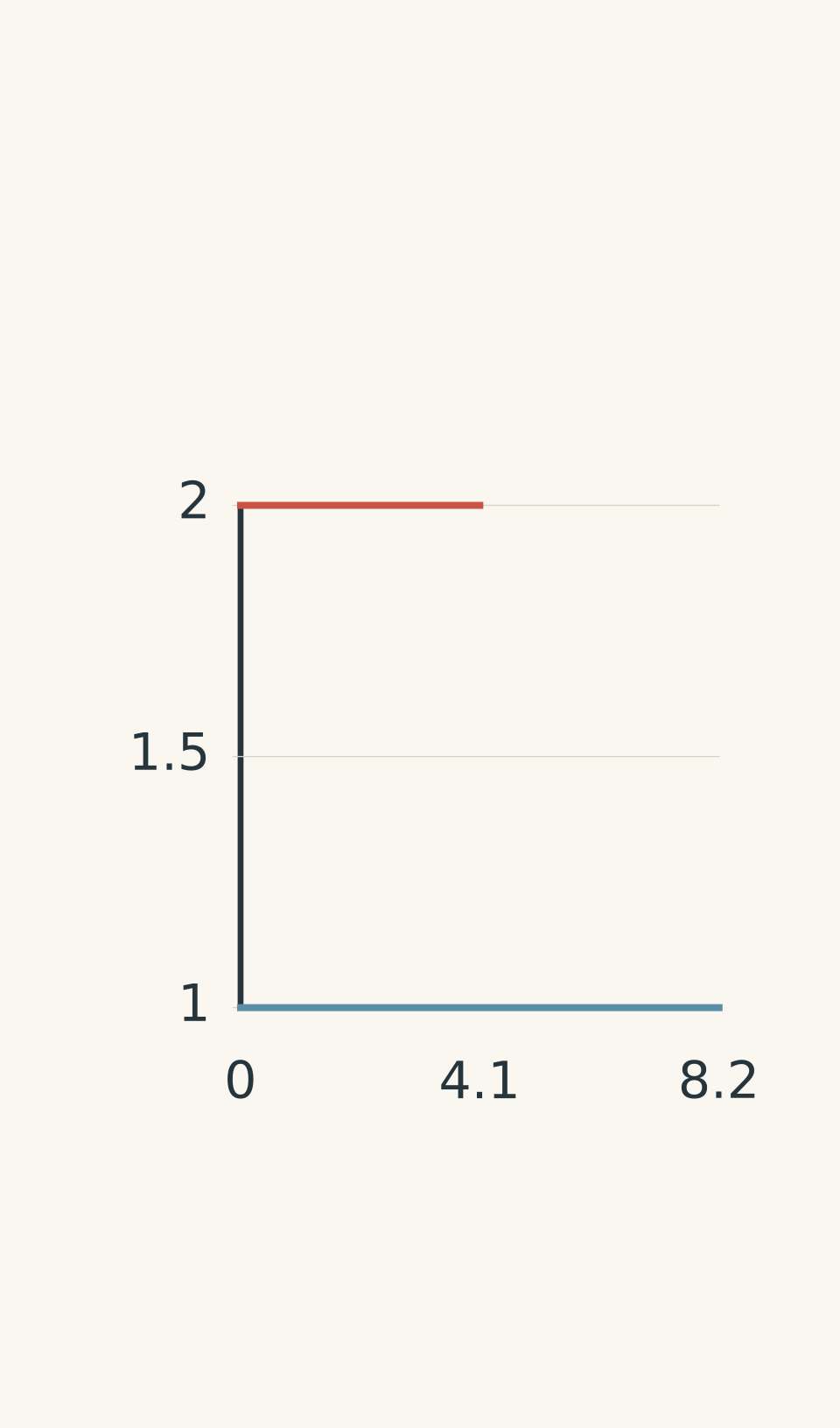
- High light: 8.2 cm mean growth
- Low light: 4.1 cm mean growth
08Worked example: Improving an analytical comparison
A hypothetical HSC English question asks:
“Compare how two texts present pressure to conform. Use one technique from each text and explain its effect. (6 marks)”
Suppose the two fictional texts use these features:
- Text A describes a corridor filled with identical doors, with one red door standing out.
- Text B repeatedly uses the line “That’s how we do it” whenever someone proposes a change.
The hypothetical marking guidelines reward a clear comparison, relevant evidence from both texts, and an explanation of how each technique contributes to the representation.
A sample response reads:
“Text A uses imagery of identical doors. Text B uses repetition of ‘That’s how we do it’. Both show pressure to conform.”
The accompanying hypothetical marker comment says:
“Relevant techniques are identified, but the effects and comparison are underdeveloped.”
How should you use this information to improve the response?
Step 1
The question asks you to compare. Identifying a technique in each text is only part of the task. You must also explain what each technique communicates and establish a meaningful relationship between the two texts.
Step 2
The sample identifies relevant techniques and provides a quotation from Text B. However, it doesn’t explain the effect of either technique, and its final sentence makes only a broad comparison.
Step 3
The response needs to move beyond naming techniques. It should explain how the imagery or repetition presents conformity, then use that explanation to establish a similarity or difference.
Step 4
A stronger version could read:
“The identical doors in Text A make conformity seem built into the environment, while the repeated line ‘That’s how we do it’ in Text B shows a group enforcing conformity through speech. Both suggest that fitting in restricts individual choice, but Text A presents the pressure as structural, whereas Text B presents it as social.”
This version identifies evidence, explains the effects, and develops a direct comparison. The structure follows the demands of the question rather than imitating a particular student’s phrasing.
The same approach works across HSC subjects. In English, the evidence might be a quotation and its effect. In Physics, it might be an equation and the reasoning that connects it to the motion. In Mathematics, it might be a valid method, intermediate steps, and a justified classification.
The details change, but the central task remains the same: identify the required quality, locate the evidence that demonstrates it, and understand why the evidence satisfies the question.
Two Techniques, One Shared Idea
| Text A: Visual imagery | Evidence: Identical doors. Effect: Conformity built into the environment. |
|---|---|
| Text B: Repetition | Evidence: Repeated group dialogue. Effect: Social pressure to conform. |
| Comparison | Shared conclusion: Conformity can restrict individual choice. Key difference: Environmental structure versus social pressure. |
09Common mistakes when using standards packages
Copying the response before understanding the criteria
A sample may contain a useful sentence or a familiar structure, but copying it doesn’t tell you why it works. Start with the question and marking guidelines, then examine how the response satisfies them.
Treating marking guidelines as keyword lists
Including the right terminology doesn’t guarantee a complete explanation. If a criterion requires you to explain a relationship, you must make the connection explicit.
Assuming longer answers are better
Extra sentences can introduce relevant detail, but they can also leave the central argument unclear. Judge a response by the quality and relevance of its evidence and reasoning, not its word count.
Treating one exemplar as the only valid approach
A sample shows one way to meet a question’s requirements. Unless the question or marking guidelines specify a particular method, don’t assume every valid answer must follow the same sequence.
Using archived content as a current syllabus checklist
An older package may be valuable for studying how a response develops an argument or justifies a result. It cannot, by itself, establish what content or assessment requirements apply to your current course.
10Questions and solutions
Question 1
A hypothetical Chemistry question asks:
“Explain why adding a catalyst changes the time taken to reach equilibrium but does not change the equilibrium composition. (3 marks)”
The marking guidelines reward explaining that a catalyst increases the rates of both forward and reverse reactions, that equilibrium is reached sooner, and that the equilibrium composition remains unchanged.
A sample response states only, “A catalyst makes the reaction faster.”
What is missing from the response, and why isn’t the statement about faster reaction rates sufficient?
Solution 1
The response is missing the link between the increased forward and reverse reaction rates and the unchanged equilibrium composition. Saying that a catalyst makes a reaction faster does not, by itself, explain why the equilibrium composition remains the same.
A complete explanation needs to establish that a catalyst speeds up both directions of the reversible reaction. Equilibrium is reached sooner because the forward and reverse rates become equal sooner, but the catalyst does not change the equilibrium composition.
When studying the standards package, you should identify the exact reasoning that connects these points. The transferable lesson is to explain the mechanism behind a result, not simply state the result.
Question 2
Two sample responses answer the same six-mark comparison question.
- Sample A is 250 words long and includes six quotations. The marker’s comments say that most of the response discusses each text separately, with comparison appearing mainly in the conclusion.
- Sample B is 120 words long and uses two pieces of evidence. It makes direct comparisons throughout, but develops only one similarity and one difference.
The marking guidelines reward sustained comparison, relevant evidence, and analysis.
Which response better demonstrates the specific criterion of sustained comparison? Why should you not automatically copy that response’s entire structure for every six-mark comparison question?
Solution 2
Sample B better demonstrates sustained comparison because it connects the texts directly throughout the response rather than treating them as separate topics.
However, that doesn’t automatically make Sample B a complete model for every six-mark question. It may not develop enough evidence or analysis to satisfy every criterion fully, and a different question may require a different emphasis.
The correct approach is to use Sample B to study how direct comparison works, then check whether your own response also provides sufficient evidence and analysis for the actual question.
The trap is confusing a strength in one criterion with proof that the entire response is ideal. A useful sample can teach one important feature without being a universal template.
Question 3
A Mathematics Extension 1 question asks you to determine and classify the stationary points of
\[ f(x)=x^3-3x^2-9x+5. \]
The marking guidelines reward a correct derivative, solving \(f'(x)=0\), finding the coordinates, and justifying the classification.
The full-mark exemplar uses the second derivative test. You prefer to use a sign chart for \(f'(x)\).
Must you change your method to match the exemplar? Determine the stationary points and explain what your response must demonstrate.
Solution 3
No, you do not need to copy the second derivative test if your sign-chart method is valid and satisfies the marking criteria. Your response must still establish the stationary points and justify whether each is a maximum or minimum.
Step 1: Differentiate the function.
\[ f'(x)=3x^2-6x-9 \]
Factorise:
\[ f'(x)=3(x-3)(x+1). \]
Step 2: Find the stationary values of \(x\).
Set \(f'(x)=0\):
\[ 3(x-3)(x+1)=0. \]
Therefore,
\[ x=3 \quad \text{or} \quad x=-1. \]
Step 3: Find the coordinates.
At \(x=-1\),
\[ f(-1)=-1-3+9+5=10. \]
At \(x=3\),
\[ f(3)=27-27-27+5=-22. \]
The stationary points are \((-1,10)\) and \((3,-22)\).
Step 4: Classify the points using the sign of \(f'(x)\).
The derivative is positive for \(x<-1\), negative for \(-13\).
The function therefore changes from increasing to decreasing at \((-1,10)\), giving a local maximum. It changes from decreasing to increasing at \((3,-22)\), giving a local minimum.
Your sign chart demonstrates the required classification. The exemplar’s second derivative test is another valid route, not a compulsory template unless the question or marking guidelines specifically require that method.
When comparing your work with the sample, check that you have demonstrated every required step and justified the conclusion. Don’t change a valid method simply because the exemplar uses a different one.
Question 4
You open an archived NESA standards package containing a question about a topic that no longer appears in your current syllabus.
The marker’s comments praise the student’s reasoning because it follows this sequence:
- state a claim;
- select relevant evidence;
- explain how the evidence supports the claim;
- qualify the conclusion where necessary.
Your current practice question tests a different concept and its marking guidelines require a calculation and an explanation of the assumptions used.
What can you transfer from the archived sample, and what must you establish independently from your current course materials?
Solution 4
You can transfer the habit of making reasoning explicit, but you must establish the required content, method, and assessment criteria from your current course materials.
The archived response demonstrates a general principle: evidence should support a claim through a clear explanation. That principle remains useful when applied to a different subject or question.
However, you cannot assume that the old topic, terminology, formula, or marking requirements apply to your current course. Nor should you force the claim-evidence-conclusion sequence onto a calculation question without adapting it to the task.
For the current question, check the syllabus and marking guidelines, identify the required calculation, state the relevant assumptions, and explain how the result answers the question.
The important distinction is between a transferable reasoning habit and a content-specific requirement. The former can inform your practice; the latter must be checked against the current course.
Question 5
A current science question asks you to compare the accuracy and precision of two measurement methods.
The accepted value is 5.0 units. For this question, accuracy is assessed by how close the mean measurement is to the accepted value, while precision is assessed by the spread of repeated measurements.
The results are:
| Method | Measurements | Mean | Range |
|---|---|---|---|
| A | 4.8, 5.0, 5.2 | 5.0 | 0.4 |
| B | 4.0, 5.0, 6.0 | 5.0 | 2.0 |
The current marking guidelines require you to distinguish accuracy from precision and support your judgement using the data.
You consult two official NESA samples:
- An archived response labelled Band 5/6 says, “Method A is more accurate because its readings are more consistent.” Its marker’s comment explicitly identifies confusion between accuracy and precision.
- A full-mark exemplar for a different question calculates the mean and spread separately before reaching its conclusion.
A student argues that the Band 5/6 response must be a good model because it comes from an official standards package, while the exemplar’s different question makes it irrelevant.
Using the data and the information about both samples, explain what conclusion the student should reach and which features of each sample are worth transferring.
Solution 5
Method A is more precise, but under the stated definition it is not more accurate than Method B: both methods have a mean of 5.0 units, exactly matching the accepted value.
The student should use the current marking guidelines and the actual data to reach that conclusion, rather than treating either sample’s label as proof that its reasoning is correct for the present question.
Step 1: Separate accuracy from precision.
The mean for Method A is
\[ \frac{4.8+5.0+5.2}{3}=5.0. \]
The mean for Method B is
\[ \frac{4.0+5.0+6.0}{3}=5.0. \]
Both means match the accepted value. Therefore, using the definition specified in the question, both methods have equally accurate mean results.
Step 2: Compare the spread of the measurements.
For Method A,
\[ \text{Range}=5.2-4.8=0.4. \]
For Method B,
\[ \text{Range}=6.0-4.0=2.0. \]
Method A has the smaller range, so its repeated measurements are more closely grouped. It is more precise.
The tempting conclusion is that Method A must also be more accurate because its readings are more consistent. The problem is that consistency and closeness of the mean to the accepted value are different properties. The data show that the two means are equally close to the accepted value, despite the different spreads.
Step 3: Interpret the archived sample correctly.
The Band 5/6 label does not turn the response into a perfect model. In this case, the marker’s comment identifies a specific weakness: the student has confused precision with accuracy.
That response is useful as a diagnostic example. It shows you what a plausible but incorrect inference looks like and what distinction your own answer must preserve.
Step 4: Transfer the reasoning from the exemplar without copying it blindly.
The full-mark exemplar is useful because it separates the analysis of the mean from the analysis of spread. Even though it answers a different question, that reasoning can be adapted to the current task.
The student should transfer the method of evaluating each property separately, not the exemplar’s exact wording or conclusion. The current marking guidelines determine what must be demonstrated, and the current data determine the answer.
This is the key lesson: official samples are evidence of how particular responses were assessed, not instructions to accept every statement in a sample as correct for every future question. Their value lies in the criteria, reasoning, and marker feedback you can extract from them.
11Turn your observations into two or three changes
After analysing a package, don’t finish with a page of notes saying that the exemplar was clear, detailed, or well structured. Those observations are too vague to guide your next practice response.
Convert what you noticed into two or three specific actions.
First, identify the weakness or effective feature. Tie it to a criterion or marker comment rather than a personal preference.
Second, turn it into an action. Write what you will do differently in your next response.
Third, decide how you will check it. Your change should be something you can actually observe in your work.
For example:
| What you noticed | Change to make in your next response | How to check it |
|---|---|---|
| The response includes data but doesn’t explain its significance | After using a value, explain what it demonstrates and how it supports the conclusion | Can the reader follow the link from evidence to conclusion? |
| The mathematical result is correct, but the method is difficult to follow | Show the relevant equation, intermediate steps, and reasoning needed to justify the result | Can the marker follow the method without guessing what you did? |
| The comparison discusses each text separately | Make direct comparisons supported by evidence from both texts | Does the response establish similarities or differences throughout, rather than only in the conclusion? |
Turn Feedback into a Better Response
- Observation from the sample
The response gives 8.2 cm versus 4.1 cm but does not explain the comparison.
- Specific change for the next response
State that mean growth was twice as high in high light and explain what this supports.
- Check against the marking criteria
Is the numerical evidence linked to the conclusion, with limitations acknowledged?
Choose changes that address the most important weaknesses in your own work. You don’t need to fix every feature at once. Two changes that directly improve how you meet the marking criteria are more useful than ten vague goals.
Then test those changes on a fresh question. A strategy that worked for one sample should help you answer a new question without relying on the same wording or structure.
This is also where standards packages connect to a broader HSC study habit: reviewing your own practice papers. Once you can identify which criterion your response missed and why, use that diagnosis when reviewing a trial HSC paper without wasting time. The point is to carry a specific improvement from one response into the next, then check whether your work actually demonstrates it.