
Click Chemistry
Imagine you want to attach a fluorescent dye to one particular protein on the surface of a living cell. There is a problem: the cell contains thousands of other molecules, including proteins, sugars, and lipids, with plenty of different functional groups.
Imagine you want to attach a fluorescent dye to one particular protein on the surface of a living cell. There is a problem: the cell contains thousands of other molecules, including proteins, sugars, and lipids, with plenty of different functional groups. How do you make the dye attach to the protein you actually want, rather than reacting with something else?
One solution is to give the protein and the dye a pair of chemical groups that react selectively with each other. The reaction joins them together while leaving most of the surrounding chemistry untouched.
This strategy is called click chemistry. It goes beyond the required NSW HSC Chemistry syllabus. Year 12 Organic Chemistry provides the starting point for understanding it, but click chemistry itself is an extension topic, not an HSC assessment requirement.
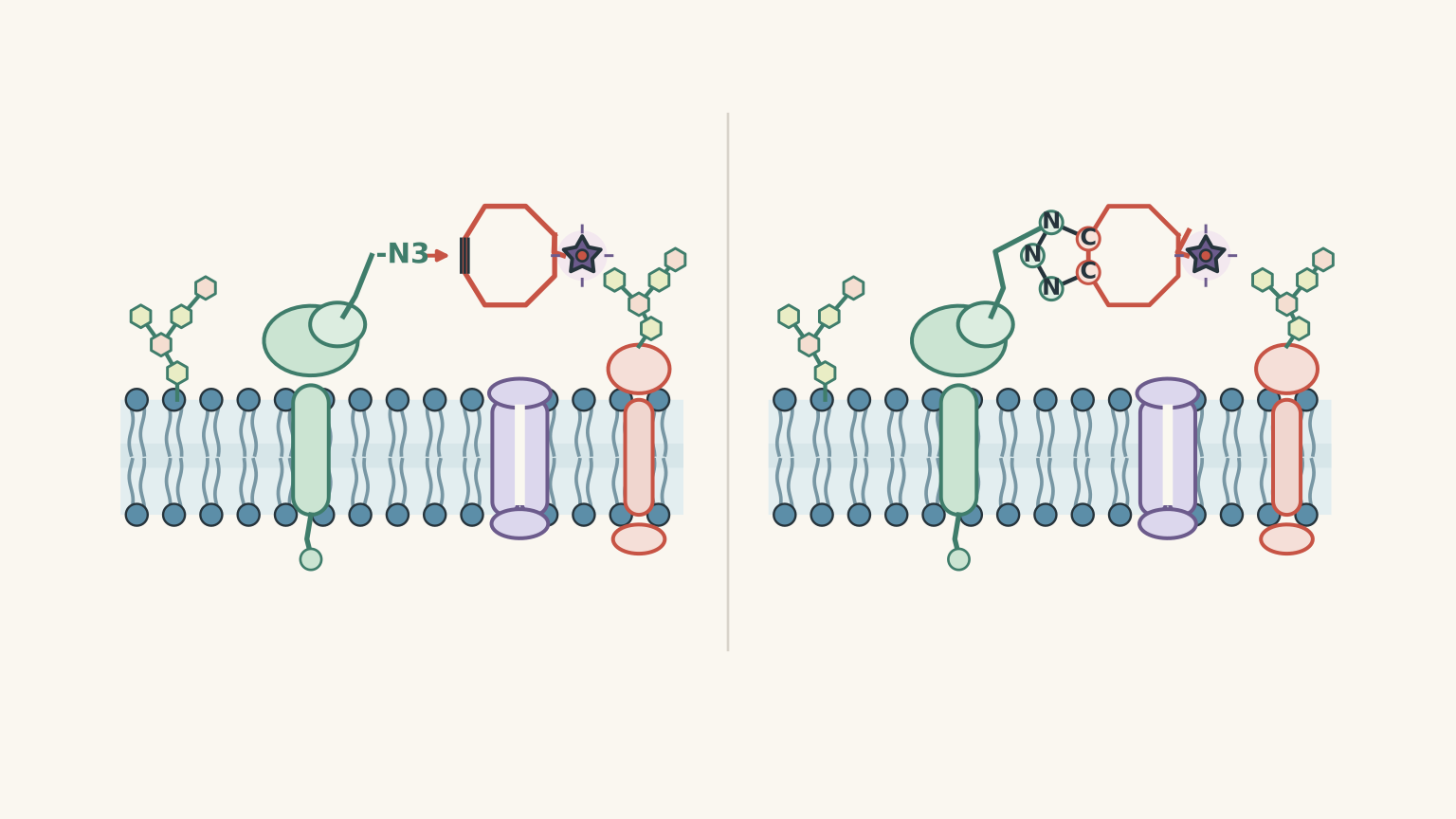
Due to technical limitations, this figure may display incorrectly or contain inaccuracies. Please check key details against your course materials.
01The chemistry you already know: making carboxylic acids
Before looking at click chemistry, recall how a primary alcohol can be converted into a carboxylic acid.
A primary alcohol contains the functional group \(\mathrm{-CH_2OH}\). When oxidised, it first forms an aldehyde, which can then undergo further oxidation to produce a carboxylic acid.
For example, ethanol can be oxidised to ethanoic acid:
\[ \ce{CH3CH2OH + 2[O] -> CH3COOH + H2O} \]
Here, \([O]\) is shorthand for the oxidising agent. It does not mean that free oxygen atoms are simply added to the molecule.
The reaction occurs in two stages:
\[ \ce{CH3CH2OH + [O] -> CH3CHO + H2O} \]
\[ \ce{CH3CHO + [O] -> CH3COOH} \]
The first reaction produces ethanal. The second converts ethanal into ethanoic acid.
Why do the reaction conditions matter?
A common oxidising agent is acidified potassium dichromate(VI), \(\ce{K2Cr2O7}\).
If the aim is to produce a carboxylic acid, the primary alcohol is heated under reflux with an excess of oxidising agent.
Reflux means that vapour rises through a condenser, cools, and returns to the reaction vessel. This prevents the volatile aldehyde intermediate from escaping, allowing it to remain in contact with the oxidising agent and undergo further oxidation.
If the aim were to collect the aldehyde instead, it would be distilled off as it forms.
The important idea is that oxidation changes the functional group of an existing molecule.
Click chemistry does something different: it joins two separate molecular building blocks together.
If you need to revisit how alcohols can be produced from haloalkanes, see Alcohol Production from Haloalkanes: HSC Chemistry Guide.
02What is click chemistry?
Imagine having two pieces of a molecular construction set. Each piece has a particular connector. When the matching connectors meet, the pieces join to form a larger structure.
Click chemistry applies a similar idea to molecules.
Chemists deliberately introduce complementary reactive groups, called chemical handles, onto two different molecules. They then select a reaction that joins those handles efficiently and selectively.
The result is a larger molecule containing both original building blocks.
This approach was formally developed by K. Barry Sharpless, M. G. Finn, and Hartmuth Kolb, who described click chemistry as a strategy for constructing useful molecules through a small collection of highly reliable reactions.
Their original 2001 paper established several important design criteria.
A good click reaction should aim to:
| Design goal | Why it matters |
|---|---|
| Be selective | The intended chemical groups react without widespread unwanted reactions. |
| Give high yields | Most of the starting material becomes the desired product. |
| Be modular | Different molecular building blocks can be connected using the same reaction. |
| Produce minimal, harmless byproducts | Less unwanted material needs to be separated from the product. |
| Work under mild conditions | Heat, pressure, and harsh chemicals can often be avoided. |
| Tolerate water and oxygen | The reaction can operate in environments where many other reactions become difficult. |
| Allow simple purification | The product can be isolated without complicated separation procedures. |
These are design goals, rather than a guarantee that every reaction described as click chemistry will satisfy every criterion under every condition.
The central attraction is selectivity. Chemists want a reaction that does one particular job extremely well.
Why use specially selected chemical handles?
Consider a protein containing several different functional groups.
It might contain:
- Amino groups.
- Carboxyl groups.
- Hydroxyl groups.
- Thiol groups.
If a reagent reacts readily with several of these groups, it may attach to the wrong locations.
Instead, chemists can introduce a functional group that is uncommon in the surrounding environment. They then choose a complementary reaction partner that reacts particularly well with that group.
This creates a selective connection.
One of the most important examples is the reaction between an organic azide and an alkyne.
03The azide-alkyne cycloaddition
This is one of the best-known click reactions.
It combines two functional groups:
- An organic azide, containing three connected nitrogen atoms.
- An alkyne, containing a carbon-carbon triple bond.
An organic azide can be represented as:
\[ \mathrm{R{-}N_3} \]
A terminal alkyne can be represented as:
\[ \mathrm{R'{-}C{\equiv}CH} \]
Here, \(R\) and \(R'\) represent the remaining parts of the two molecules. They could be large polymers, fluorescent dyes, or parts of biological molecules.
The alkyne is called terminal because the triple bond occurs at the end of the carbon chain, leaving a hydrogen attached to one of its carbon atoms.
When these two groups react, they form a five-membered nitrogen-containing ring called a 1,2,3-triazole.
Why is this called a [3 + 2] cycloaddition?
The name describes how the atoms combine to form a ring.
- The azide contributes three connected nitrogen atoms.
- The alkyne contributes two carbon atoms.
Together, these five atoms form a five-membered ring.
This is called a \([3+2]\) cycloaddition.
The product is a 1,2,3-triazole, a stable nitrogen-containing ring.
Notice something useful: the atoms from both starting materials are retained in the product. The reaction does not need to remove a small molecule such as water or hydrogen chloride to complete the connection.
This contributes to its excellent atom economy.
The role of copper(I)
The reaction can occur without a catalyst under suitable thermal conditions. However, the uncatalysed reaction is generally slower and can produce a mixture of two different arrangements of the product.
These arrangements are called regioisomers.
A regioisomer has the same atoms and molecular formula as another compound, but the positions of particular groups differ.
The copper(I)-catalysed version solves much of this problem.
It is called the copper(I)-catalysed azide-alkyne cycloaddition, or CuAAC.
Copper(I), written as \(\mathrm{Cu}^{+}\), helps activate the alkyne and guide the reaction towards a particular arrangement.
The major product is the 1,4-disubstituted 1,2,3-triazole.
The copper catalyst is not simply another reactant that gets used up. It participates in the reaction pathway and is regenerated.
A simplified way to picture its role is:
- Copper(I) interacts with the terminal alkyne, helping activate it.
- The azide coordinates to the copper-containing reaction system.
- New carbon-nitrogen bonds form in successive steps, closing the five-membered ring.
- A proton transfer releases the triazole product and regenerates the catalyst.
The precise mechanism is more complicated than this outline. Many mechanistic models involve two copper(I) centres working together, and the exact catalyst species depends on the reaction conditions.
For our purposes, the important point is that copper changes both the reaction rate and the preferred product arrangement.
This is why CuAAC is particularly useful when a chemist wants to connect two molecular building blocks and obtain a predictable product.
The original 2002 study by Rostovtsev and colleagues demonstrated the highly regioselective formation of 1,4-disubstituted triazoles using copper(I) catalysis, including under aqueous conditions.
Worked example: Predict the product of a click reaction
Benzyl azide, \(\ce{C6H5CH2N3}\), reacts with 1-butyne, \(\ce{CH3CH2C\bond{#}CH}\), under copper(I) catalysis. Predict the product and identify the positions of the two substituents.
Step 1
Benzyl azide contains the azide group. Its remaining molecular fragment is benzyl:
\[ \mathrm{C_6H_5CH_2{-}} \]
1-Butyne contains a terminal alkyne. Its remaining molecular fragment is ethyl:
\[ \mathrm{CH_3CH_2{-}} \]
Step 2
Copper(I)-catalysed azide-alkyne cycloaddition produces a 1,4-disubstituted 1,2,3-triazole.
The benzyl group from the azide attaches to nitrogen position 1.
The ethyl group from the alkyne attaches to carbon position 4.
Step 3
The product is:
\[ \boxed{\text{1-benzyl-4-ethyl-1,2,3-triazole}} \]
The key is to track where each starting molecule contributes its substituent. The azide supplies the three nitrogen atoms, while the alkyne supplies the two carbon atoms of the ring.
04What happens when copper is unsuitable?
CuAAC is extremely useful, but it has a limitation.
Copper ions can be toxic to living cells. Copper can also promote unwanted oxidative damage to proteins and other biological molecules.
That creates a problem if the goal is to label a molecule inside a living cell.
You might predict that the solution is simply to use less copper. However, reducing the catalyst concentration does not automatically solve the problem. The reaction may become slower, while copper-related damage can still be an issue.
Chemists needed a way to perform the same general type of selective bond formation without adding a copper catalyst.
This led to another important reaction: strain-promoted azide-alkyne cycloaddition, usually abbreviated to SPAAC.
Using molecular strain to drive a reaction
The key is a different type of alkyne.
In CuAAC, the alkyne is usually a terminal alkyne.
In SPAAC, the alkyne is built into a ring, commonly an eight-membered carbon ring called a cyclooctyne.
The triple bond in this ring is forced away from its preferred geometry.
A normal carbon-carbon triple bond favours a linear arrangement. Constraining it inside a ring bends that arrangement and creates molecular strain.
Think of a bent spring. It contains stored energy because it has been forced away from its preferred shape.
A strained cyclooctyne behaves in a related way. Its distorted geometry makes it more reactive towards an azide.
When the azide and cyclooctyne react, they form the same general type of five-membered triazole ring.
The reaction releases some of the stored ring strain, helping drive the reaction forward.
Unlike CuAAC, SPAAC does not require a copper catalyst.
This approach was demonstrated in a 2004 study by Nicholas Agard, Jennifer Prescher, and Carolyn Bertozzi.
They showed that strained cyclooctynes could react with azides under physiological conditions without requiring a copper catalyst. Their work demonstrated selective modification of biomolecules in vitro and on living cells.
CuAAC versus SPAAC
Both reactions use an azide, but they use different types of alkyne.
| Feature | CuAAC | SPAAC |
|---|---|---|
| Azide partner | Organic azide | Organic azide |
| Alkyne partner | Usually a terminal alkyne | Strained cyclooctyne |
| Copper catalyst | Required | Not required |
| Main driving advantage | Copper-assisted activation and selectivity | Release of ring strain |
| Product | Triazole | Triazole |
| Common application | Molecular synthesis and materials chemistry | Biological labelling and bioorthogonal chemistry |
| Main limitation | Copper can damage biological systems | Cyclooctyne design, size, solubility, and reaction rate require consideration |
SPAAC is particularly useful in biological systems because it avoids the need for a potentially harmful metal catalyst.
However, copper-free does not mean that every SPAAC reagent is automatically harmless or ideal. The size, solubility, stability, and reaction rate of the cyclooctyne still matter.
What does bioorthogonal mean?
This brings us to another important term: bioorthogonal chemistry.
A bioorthogonal reaction is a chemical reaction that can occur within a biological environment without significantly interfering with the natural biochemical processes taking place there.
Think back to the fluorescent dye problem.
A cell contains many naturally occurring chemical groups. A useful bioorthogonal reaction must selectively connect the introduced chemical handle to its intended partner without disrupting the surrounding biological molecules.
Azides are particularly useful because they are not common functional groups in naturally occurring biological molecules.
Researchers can introduce an azide handle onto a selected biological target. They can then add a complementary cyclooctyne-containing probe.
The probe reacts with the azide and becomes covalently attached to the target.
The surrounding proteins, carbohydrates, and lipids are largely left alone.
This is useful for:
- Tracking proteins inside cells.
- Labelling cell-surface carbohydrates.
- Studying how biological molecules move through a cell.
- Attaching fluorescent probes to specific biological structures.
- Developing targeted molecular delivery systems.
The wider importance of click chemistry and bioorthogonal chemistry was recognised in the 2022 Nobel Prize in Chemistry, awarded to Carolyn Bertozzi, Morten Meldal, and K. Barry Sharpless.
Official Nobel Prize announcement.
Worked example: Choosing a click reaction for a polymer coating
A researcher is developing a fluorescent coating for a non-living material.
The coating contains azide groups. The available fluorescent dye contains a terminal alkyne.
The reaction must work in an aqueous environment, produce a predictable product, and be completed efficiently. Copper residues can be removed during the material’s subsequent processing.
Should the researcher choose CuAAC or SPAAC?
Step 1
The coating contains organic azides.
The fluorescent dye contains terminal alkynes.
This is the exact combination used in CuAAC.
Step 2
The coating is not a living biological system. Therefore, copper toxicity to living cells is not the deciding limitation.
CuAAC can operate under mild, aqueous conditions and strongly favours the 1,4-disubstituted triazole product.
Step 3
CuAAC is the appropriate choice.
The copper(I) catalyst promotes efficient bond formation between the azide groups and terminal alkynes, allowing the fluorescent dye to become covalently attached to the coating.
The catalyst and any remaining reagents must be managed during purification.
The important lesson is that the best click reaction depends on the application. A reaction that is excellent for a polymer coating might be unsuitable for a living cell.
05The practical challenge: selectivity is not the only consideration
So far, we have focused on finding two matching chemical handles.
In practice, chemists must consider several other factors.
A reaction might be selective but too slow. It might give a high yield but require conditions that damage the molecule being labelled.
A successful click chemistry design balances several requirements.
Chemoselectivity
Chemoselectivity describes the preference of a reaction for one functional group over other functional groups present in the same environment.
For example, a bioorthogonal azide-cyclooctyne reaction can selectively label an azide-containing molecule even when many other functional groups are present.
Regioselectivity
Regioselectivity describes which arrangement of substituents is favoured when different structural arrangements of a product are possible.
CuAAC is particularly useful because it strongly favours the 1,4-disubstituted triazole.
Reaction rate
The reaction must occur quickly enough for the intended application.
This is especially important in living systems, where the target molecule may move, change location, or undergo degradation.
A reaction that takes hours to label a target may be unsuitable if the biological experiment only allows a short observation period.
Compatibility
The reaction conditions must not destroy the molecule being modified.
For example:
- A metal catalyst may damage a biological sample.
- A highly reactive reagent may react with unwanted functional groups.
- Poor water solubility may make a reagent unsuitable for biological applications.
- A bulky chemical handle may interfere with the function of a protein.
This means the most reactive reaction is not necessarily the best reaction.
The aim is to find a reaction that is sufficiently fast, selective, and compatible with its environment.
One final distinction is particularly important: conversion and isolated yield are not the same thing.
Conversion tells you how much starting material has reacted.
Isolated yield tells you how much desired product was actually recovered after purification.
A reaction can have excellent conversion but a lower isolated yield because some product is lost during separation.
That distinction becomes useful when evaluating whether a click reaction is genuinely efficient.
06Questions and solutions
The following questions move from predicting a simple click reaction to evaluating selectivity, interpreting reaction data, and designing a more complicated molecular labelling strategy.
Question 1
An organic azide, represented by \(\mathrm{R{-}N_3}\), reacts with propyne, \(\mathrm{CH_3C{\equiv}CH}\), under copper(I) catalysis.
Identify:
(a) The type of reaction occurring.
(b) The product formed.
(c) The positions of the two molecular substituents on the triazole ring.
(d) The atoms that contribute to the five-membered ring.
Solution 1
The reaction produces a 1-R-4-methyl-1,2,3-triazole through a copper(I)-catalysed azide-alkyne cycloaddition.
(a) The reaction is a \([3+2]\) cycloaddition, specifically CuAAC.
(b) The product is a five-membered 1,2,3-triazole ring.
(c) The substituents occupy:
- Position 1: the R group from the organic azide.
- Position 4: the methyl group from propyne.
(d) The ring contains:
- Three nitrogen atoms contributed by the azide.
- Two carbon atoms contributed by the alkyne.
The copper(I) catalyst directs the reaction towards the 1,4-disubstituted product.
The important point is that the product’s structure is determined by tracking the atoms and substituents from each starting molecule, rather than simply joining the two functional groups without considering their positions.
Question 2
An organic azide reacts with a terminal alkyne under two different sets of conditions.
- Experiment A: The reaction is conducted without a catalyst under thermal conditions.
- Experiment B: The reaction uses a copper(I) catalyst.
Experiment A produces a mixture of 1,4- and 1,5-disubstituted triazoles.
Experiment B produces predominantly the 1,4-disubstituted triazole.
A student argues:
“The copper catalyst only increases the reaction rate. It cannot explain why a different distribution of products is obtained.”
Evaluate this statement. Explain the role of copper(I) in determining the product distribution, and distinguish reaction rate from regioselectivity.
Solution 2
The student’s statement is incorrect because copper(I) influences both the reaction rate and the regioselectivity of the reaction.
Reaction rate describes how quickly reactants are converted into products.
Regioselectivity describes which structural arrangement of the product is favoured.
These are different properties.
In the uncatalysed thermal reaction, the azide and alkyne can approach each other in different orientations. This allows both 1,4- and 1,5-disubstituted triazoles to form.
The copper(I)-catalysed reaction follows a different reaction pathway.
Copper(I) interacts with the terminal alkyne, helping activate it and organise the reacting molecules. The subsequent bond-forming steps strongly favour the arrangement that produces the 1,4-disubstituted triazole.
Therefore, copper does more than accelerate the original reaction.
It changes the pathway available to the reacting molecules and favours a particular product arrangement.
A catalyst can influence product selectivity when it provides a different reaction pathway with different activation barriers for competing products.
The misconception is to assume that every catalyst simply makes the same reaction happen faster. Catalysts can also influence which products are formed.
Question 3
A polymer sample contains 0.450 mmol of polymer chains, with exactly one azide group per chain.
The polymer is reacted with 0.600 mmol of a terminal-alkyne fluorescent dye using CuAAC.
After the reaction, an independent analysis shows that 95.0% of the azide groups have reacted.
Following purification, 0.360 mmol of labelled polymer is recovered.
Assume:
- The reaction has a 1:1 azide-to-alkyne stoichiometric ratio.
- No unwanted side reactions occur.
- Each product molecule contains one polymer chain and one dye molecule.
Calculate:
(a) The limiting reagent and theoretical maximum amount of product.
(b) The amount of unreacted azide groups.
(c) The amount of unreacted alkyne dye immediately after the reaction.
(d) The isolated percentage yield.
(e) The percentage of the product formed during the reaction that was successfully recovered during purification.
Solution 3
The azide-functionalised polymer is the limiting reagent, the theoretical product amount is 0.450 mmol, and the isolated yield is 80.0%.
Let’s work through each part.
(a) Identify the limiting reagent.
The reaction has a 1:1 stoichiometric ratio.
The starting quantities are:
\[ n(\text{azide})=0.450\text{ mmol} \]
\[ n(\text{alkyne})=0.600\text{ mmol} \]
Since fewer moles of azide groups are available, the azide is the limiting reagent.
The maximum possible amount of product is therefore:
\[ n(\text{product})=0.450\text{ mmol} \]
(b) Calculate the unreacted azide groups.
The reaction consumes 95.0% of the starting azide groups.
The amount that reacts is:
\[ 0.950\times0.450 =0.4275\text{ mmol} \]
Therefore, the remaining azide groups are:
\[ 0.450-0.4275 =0.0225\text{ mmol} \]
(c) Calculate the remaining alkyne dye.
The reaction consumes equal amounts of azide and alkyne.
Therefore, 0.4275 mmol of alkyne dye reacts.
The remaining amount is:
\[ 0.600-0.4275 =0.1725\text{ mmol} \]
There are 0.1725 mmol of unreacted alkyne dye remaining.
(d) Calculate the isolated percentage yield.
The isolated yield compares the amount of product recovered with the theoretical maximum.
\[ \text{Yield} = \frac{\text{Actual product}}{\text{Theoretical product}} \times100 \]
Substituting:
\[ \text{Yield} = \frac{0.360}{0.450}\times100 \]
\[ \boxed{\text{Yield}=80.0\%} \]
(e) Calculate the product recovery during purification.
The reaction actually formed 0.4275 mmol of product because 0.4275 mmol of azide reacted.
However, only 0.360 mmol was recovered.
Therefore:
\[ \text{Recovery} = \frac{0.360}{0.4275}\times100 \]
\[ \boxed{\text{Recovery}=84.2\%} \]
The reaction converted 95.0% of the azide groups, but the purification recovered only 84.2% of the product that had formed.
This demonstrates why conversion and isolated yield must not be treated as interchangeable measurements.
The difference could result from product loss during purification rather than incomplete chemical reaction.
Question 4
A researcher wants to attach a fluorescent probe to a specific protein on the surface of living cells.
The protein has been modified to contain an organic azide handle.
Two fluorescent probes are available:
- Probe A contains a terminal alkyne and requires a copper(I) catalyst.
- Probe B contains a strained cyclooctyne and reacts with azides without a copper catalyst.
The surrounding cell membrane contains many naturally occurring proteins, carbohydrates, and lipids.
(a) Which probe should the researcher choose?
(b) Explain how the selected reaction achieves chemical selectivity.
(c) Explain why the alternative reaction may be unsuitable for this application.
(d) Identify one limitation that must still be considered when using the selected probe.
Solution 4
Probe B is the better choice because it can undergo strain-promoted azide-alkyne cycloaddition without requiring copper(I).
(a) The researcher should select Probe B, which contains a strained cyclooctyne.
This allows SPAAC to occur between the cyclooctyne and the azide attached to the target protein.
(b) The reaction is selective because the introduced azide handle has a complementary reaction partner in the cyclooctyne probe.
The azide-cyclooctyne reaction is relatively unreactive towards the common functional groups found in the surrounding biological environment.
Consequently, the probe can selectively form a covalent triazole connection with the modified protein.
This is an example of bioorthogonal chemistry.
(c) Probe A uses CuAAC, which requires a copper(I) catalyst.
Copper can cause unwanted oxidative damage to biological molecules and can be toxic to living cells.
Using this reaction on intact living cells therefore introduces a compatibility problem.
SPAAC avoids that particular limitation because it does not require copper.
(d) One limitation is the reaction rate.
Although SPAAC can occur under physiological conditions, its rate depends on the structure of the cyclooctyne. The size, solubility, and stability of the probe also need to be considered.
A poorly designed probe might react too slowly or interfere with the biological molecule being studied.
The important distinction is that chemical selectivity alone is insufficient. A reaction must also be compatible with the environment in which it is being used.
Question 5
A researcher wants to attach two different fluorescent labels to opposite ends of the same synthetic polymer chain.
The polymer contains exactly two reactive handles:
- One organic azide group at its left end.
- One terminal alkyne group at its right end.
Two fluorescent dyes are available:
- Dye A is red and contains a strained cyclooctyne group.
- Dye B is green and contains an organic azide group.
The researcher wants each polymer chain to receive exactly one red label and one green label.
The polymer is purified and does not contain other reactive functional groups. Both dyes are monofunctional, meaning that each dye contains only one relevant reactive handle.
The following assumptions apply:
- SPAAC reacts rapidly between an azide and a strained cyclooctyne.
- The unstrained terminal alkyne does not react appreciably during the short copper-free SPAAC stage.
- CuAAC selectively couples the remaining terminal alkyne with the azide-containing Dye B.
- The polymer can tolerate the copper(I) catalyst used in the second stage.
A student suggests mixing the polymer, both dyes, and copper(I) catalyst together in one reaction vessel.
(a) Explain why this one-pot approach could produce an unwanted reaction.
(b) Design a two-stage reaction sequence that attaches both dyes selectively.
(c) Explain why the removal of excess Dye A between the two stages is important.
(d) Explain what would happen if the first reaction were performed incompletely and some free azide groups remained on the polymer.
Solution 5
The correct strategy is to carry out SPAAC first, remove the excess cyclooctyne-containing Dye A, and then perform CuAAC using the azide-containing Dye B.
The important issue is that the two dyes can react with each other, not just with the polymer.
This makes the one-pot approach less selective than it first appears.
(a) Why can the one-pot reaction fail?
The student’s idea initially seems sensible.
The polymer has two different handles, and each dye appears to have a matching reaction partner.
However, look carefully at the two dyes.
Dye A contains a strained cyclooctyne.
Dye B contains an organic azide.
These are complementary functional groups.
They can undergo SPAAC directly with each other, even without the polymer being involved.
Therefore, mixing both dyes together creates an unwanted competing reaction.
Some of the red and green dyes could react with each other in solution rather than attaching to the polymer.
The problem is that the intended reactions are not fully orthogonal when all four components are present together.
(b) Design the two-stage reaction.
A selective sequence is:
Step 1: Attach the red dye using SPAAC.
Add Dye A, containing the strained cyclooctyne, to the polymer.
The cyclooctyne reacts with the organic azide at the left end of the polymer.
This produces a triazole connection containing the red fluorescent label.
The terminal alkyne at the other end remains available for the second reaction.
Step 2: Remove excess Dye A.
Separate the labelled polymer from any remaining free red dye.
This prevents unreacted cyclooctyne-containing Dye A from competing with the next reagent.
Step 3: Attach the green dye using CuAAC.
Now introduce Dye B, containing an organic azide, together with the copper(I) catalyst.
The azide group on Dye B reacts with the remaining terminal alkyne on the polymer.
This produces a second triazole connection containing the green fluorescent label.
The polymer now carries both fluorescent labels.
(c) Why must excess Dye A be removed?
This is the crucial purification step.
Any free Dye A still present contains an unreacted cyclooctyne group.
When Dye B is introduced, its azide group can react with this remaining cyclooctyne.
That would consume some of the green dye before it has an opportunity to label the polymer.
Removing excess Dye A reduces this competing reaction and makes the second stage more selective.
(d) What if the first reaction is incomplete?
If some azide groups remain on the polymer, they will remain available after the first stage.
However, Dye B also contains an azide group.
Two azide groups do not form the intended azide-alkyne cycloaddition with each other.
Therefore, the remaining polymer azides do not directly compete for Dye B during the second CuAAC reaction.
The terminal alkyne remains the intended reaction partner.
Nevertheless, the first stage would have failed to attach red dye to every polymer chain.
The final sample could therefore contain a mixture of polymer chains with different labelling patterns.
To obtain a uniform product, the researcher should establish that the first reaction is sufficiently complete before proceeding.
This question highlights a subtle but important feature of click chemistry: having two individually selective reactions does not automatically mean that both reactions can be performed together in the same mixture.
The entire collection of reactants must be considered, including possible reactions between the labelling reagents themselves.
The next useful idea is orthogonal chemistry: designing two or more reactions that can be performed in the same complex environment without interfering with one another.
Click chemistry provides the individual reactions. Orthogonal reaction design determines how several of them can be combined to build increasingly complicated molecules with precise control over where each new bond forms.