
Conformational Isomerism: Understanding Molecular Shape
Explore how rotation around carbon-carbon single bonds produces different conformations without changing molecular connectivity or stereochemical configuration. Learn to use Newman projections, compare conformational energies, and distinguish conformers from configurational and position isomers. An extension beyond the required Year 12 Chemistry syllabus.
Draw propan-1-ol as CH3CH2CH2OH. Now imagine rotating one of its carbon-carbon single bonds. The atoms change their positions in space, but the oxygen atom remains attached to the same carbon.
Now compare propan-2-ol, CH3CH(OH)CH3. Its OH group is attached to a different carbon. No amount of rotation around a single bond can turn propan-1-ol into propan-2-ol.
This difference leads to an interesting question: When does changing a molecule’s three-dimensional shape create a new isomer, and when does it simply produce another arrangement of the same molecule?
The answer involves conformational isomerism. This is an extension beyond the required Year 12 Chemistry syllabus content. Your knowledge of alcohol nomenclature and position isomers provides the foundation, but conformational isomerism itself is additional stereochemical chemistry, not an HSC assessment requirement.
01From position isomers to conformers
Before looking at three-dimensional structures, recall what you already know about alcohols.
An alcohol contains a hydroxyl functional group, \(\mathrm{-OH}\), bonded to a carbon atom. When naming an alcohol, you identify the longest carbon chain containing the carbon attached to the OH group, then number the chain to give that group the lowest possible position.
For example:
| Alcohol | Condensed structural formula | Molecular formula |
|---|---|---|
| Propan-1-ol | CH3CH2CH2OH | C3H8O |
| Propan-2-ol | CH3CH(OH)CH3 | C3H8O |
These compounds have the same molecular formula but different connectivity. The OH group is attached to carbon 1 in propan-1-ol and carbon 2 in propan-2-ol.
They are position isomers, a type of structural isomer.
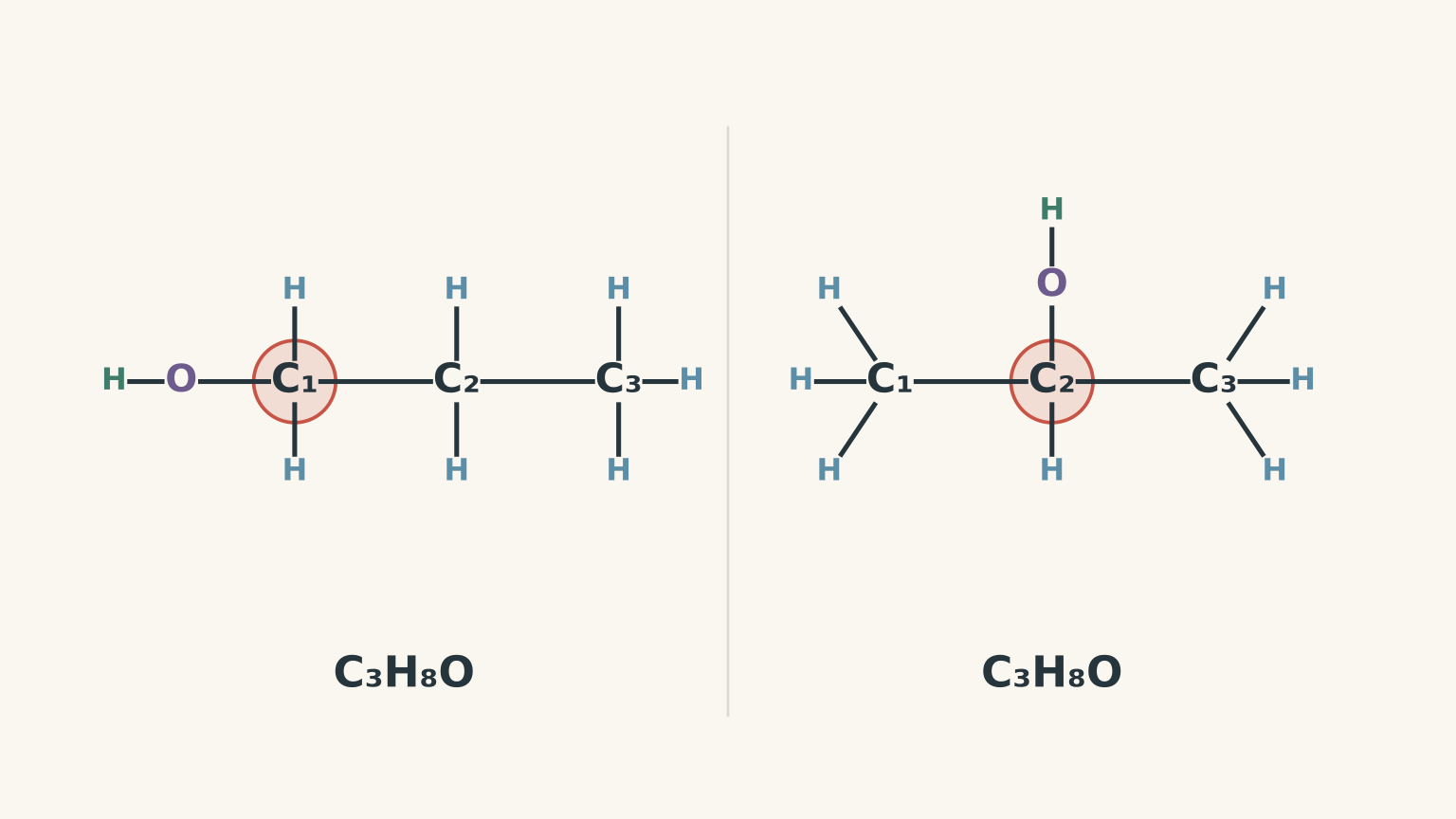
Due to technical limitations, this figure may display incorrectly or contain inaccuracies. Please check key details against your course materials.
Now consider a different situation.
You have a single molecule of propan-1-ol. You rotate around one of its C-C single bonds. The carbon chain bends into a different three-dimensional arrangement, but every atom remains connected to exactly the same neighbours.
You have not made propan-2-ol. You have changed the molecule’s conformation.
Conformational isomerism describes the existence of different spatial arrangements of a molecule that can interconvert through rotation around formally single bonds.
The different arrangements are called conformations, and individual arrangements corresponding to distinct potential-energy minima are called conformers. This terminology follows the IUPAC Gold Book definition of conformation.
The key distinction is:
- Position isomers have different connectivity.
- Conformers have the same connectivity but different spatial arrangements.
- Configurational isomers have the same connectivity but differ in stereochemical configuration, rather than simply in conformation.
Let’s work out why a single bond can produce so many different arrangements.
02Why single bonds can rotate
A carbon-carbon single bond is a sigma (\(\sigma\)) bond. Its bonding electron density is distributed around the axis joining the two carbon nuclei.
This cylindrical symmetry allows the atoms or groups attached to either carbon to rotate relative to one another without breaking the bond.
Think of the bond as a swivel joint. The two connected sections can turn relative to each other while remaining attached.
There is an important limitation to this analogy: a chemical bond is not a frictionless mechanical hinge. Electron interactions and the positions of nearby atoms affect how much energy is required for rotation.
Newman projections: looking straight down a bond
How do chemists represent these arrangements without drawing an entire three-dimensional molecule every time?
One useful method is a Newman projection.
Imagine looking directly down the axis of a carbon-carbon bond. The carbon closest to your eye is the front carbon, represented by a central point. The carbon behind it is represented by a circle.
Each carbon has three attached groups, which are drawn as three lines extending from the relevant carbon position.
This representation makes it much easier to see how the groups on adjacent carbon atoms are arranged relative to one another.
Two important arrangements appear when we examine rotation around a carbon-carbon single bond.
Staggered conformation
The bonds attached to the rear carbon sit between the bonds attached to the front carbon. Viewed along the bond axis, the groups are offset by 60°.
Eclipsed conformation
The bonds attached to the rear carbon line up with those attached to the front carbon. The groups overlap when viewed along the bond axis.
These are different conformations of the same molecule. Rotating the rear carbon by 60° converts one arrangement into the other.
But there is a catch: they do not have the same energy.
Why some conformations are more stable
You might predict that rotation around a single bond is completely unrestricted because no bond needs to break.
That prediction is reasonable, but it is not quite correct.
Rotation is possible, but different arrangements have different potential energies. The eclipsed conformation of ethane is less stable than the staggered conformation.
The reason involves unfavourable interactions between the bonding electron distributions of adjacent groups. When larger groups approach one another, additional crowding can also increase the energy. This crowding is called steric strain.
The energy difference between arrangements caused by torsional interactions is commonly discussed in terms of torsional strain.
For ethane, the energy barrier between staggered and eclipsed arrangements is approximately \(12\ \mathrm{kJ\,mol^{-1}}\). This is an energy difference for ethane, not a universal value for all carbon-carbon single bonds.
The important point is that the molecule can rotate between conformations while passing through arrangements of higher energy.
This also explains why a molecule does not remain locked in its lowest-energy conformation.
At ordinary temperatures, rotation can occur rapidly. The molecule moves between conformations, spending a greater proportion of its time in lower-energy arrangements.
The staggered arrangement is favoured, but that does not mean every molecule exists exclusively in that arrangement.
The OpenStax explanation of ethane conformations provides further detail about the energy barrier and the interactions responsible for the different energies.
Anti and gauche: when the attached groups are different
Ethane is a useful starting point because all six attached atoms are hydrogen. Larger molecules introduce another factor: the sizes of the groups attached to each carbon.
Consider butane, CH3CH2CH2CH3.
Look directly down the bond between carbon 2 and carbon 3. Each of these carbons has a methyl group or hydrogen atoms attached.
The two most important staggered arrangements are:
- Anti: The two terminal methyl groups are 180° apart.
- Gauche: The two terminal methyl groups are 60° apart.
Both arrangements are staggered. However, anti is more stable because the two larger methyl groups are further apart.
The gauche arrangement has greater steric strain because the methyl groups are closer together.
The approximate relative energies for butane illustrate the difference:
| Conformation | Dihedral angle between methyl groups | Relative energy |
|---|---|---|
| Anti | 180° | 0 kJ mol⁻¹ |
| Gauche | 60° or 300° | 3.8 kJ mol⁻¹ |
| Eclipsed, methyl-hydrogen | 120° or 240° | 16 kJ mol⁻¹ |
| Eclipsed, methyl-methyl | 0° or 360° | 19 kJ mol⁻¹ |
These are approximate values for butane, not measured energy values for every alcohol. They illustrate how both torsional and steric interactions influence conformational stability.
A useful new term is the dihedral angle. It describes the angle between a bond attached to the front carbon and a bond attached to the rear carbon when viewed along the central bond.
For butane, we commonly use the dihedral angle between the two terminal methyl groups to describe the anti and gauche arrangements.
There is one more limitation to remember when applying this model to alcohols. An OH group is polar and can participate in hydrogen bonding. These interactions can affect the relative energies of alcohol conformers, so you cannot automatically assume that every alcohol has the same conformational energy ranking as butane.
The butane model teaches you how to recognise rotation and steric effects. It is not a universal energy-prediction rule for all organic molecules.
03Conformers versus configurational isomers
This is the most important distinction in the topic.
Imagine rotating a carbon-carbon single bond in butan-2-ol, CH3CH(OH)CH2CH3.
The OH group and the carbon chain can change their relative positions in space. However, the molecule’s atoms remain connected in exactly the same way.
Now imagine changing the arrangement around the carbon attached to the OH group so that its stereochemical configuration changes from \(R\) to \(S\).
That is a different situation. You have changed the configuration of a stereogenic centre, not simply rotated a neighbouring single bond.
A stereogenic centre is an atom at which exchanging two attached groups produces a stereoisomer. In butan-2-ol, carbon 2 is attached to four different groups:
- OH
- H
- CH3
- CH2CH3
It is therefore a chiral centre, and butan-2-ol exists as two enantiomers, designated \(R\) and \(S\).
The \(R\) and \(S\) forms are configurational isomers. Rotating the C2-C3 single bond cannot convert one into the other.
If you need a refresher on assigning stereochemical configurations, see tutorgum’s guide to Chirality: Chiral Centres, Enantiomers and Optical Activity.
A second example involves a carbon-carbon double bond.
A double bond contains a sigma bond and a pi (\(\pi\)) bond. The pi bond restricts rotation because rotating one carbon relative to the other would disrupt the sideways overlap of the orbitals that form it.
This is why alkenes can have \(E\) and \(Z\) configurational isomers.
For example, an alkene with different groups attached to each carbon of the double bond can have:
- \(E\) configuration, where the higher-priority groups are on opposite sides.
- \(Z\) configuration, where the higher-priority groups are on the same side.
Rotating an ordinary C-C single bond next to the double bond does not change its \(E/Z\) configuration. The entire alkene-containing section can turn in space while the relative arrangement around the double bond remains unchanged.
This gives us three distinct types of change:
| Change | What happens? | New connectivity? | New configuration? |
|---|---|---|---|
| Rotation around a C-C single bond | Spatial arrangement changes | No | No |
| Inversion at a chiral carbon | Stereochemical arrangement changes | Usually unchanged | Yes |
| Change from E to Z around a double bond | Relative arrangement across the double bond changes | No | Yes |
For ordinary open-chain alcohols, rotation around single bonds produces conformational changes. More restricted systems can behave differently, particularly when steric crowding creates unusually high rotational barriers. Those special cases require more advanced treatment.
04Worked examples
Worked example: Are propan-1-ol and propan-2-ol conformers?
Two compounds have the molecular formula C3H8O. Their condensed structural formulae are:
- Compound A: CH3CH2CH2OH
- Compound B: CH3CH(OH)CH3
Determine whether they are conformers or position isomers.
Step 1
Compound A has the OH group attached to the first carbon. Compound B has the OH group attached to the second carbon.
Step 2
Rotation around a C-C single bond changes the spatial orientation of attached groups. It cannot change which carbon is directly bonded to oxygen.
Step 3
The compounds have the same molecular formula but different connectivity. They are position isomers, not conformers.
The distinction is important: a different-looking structural formula does not automatically indicate a conformational change. You must check which atoms are actually bonded to one another.
Worked example: Rotating a chiral alcohol without changing its configuration
A molecule of \((R)\)-butan-2-ol is viewed down its C2-C3 bond using a Newman projection.
Initially, the OH group attached to carbon 2 and the terminal CH3 group attached to carbon 3 are 180° apart. The carbon 3 end is then rotated by 120°.
Determine the new relationship between these groups and whether the molecule has changed from \(R\) to \(S\).
Step 1
The rotation occurs around the C2-C3 single bond. No bonds are broken, and the OH group remains attached to carbon 2.
Step 2
Initially, the OH and terminal CH3 groups are 180° apart, so their relationship is anti.
After the 120° rotation, they are 60° apart. Their relationship is now gauche.
Both arrangements are staggered.
Step 3
Carbon 2 remains bonded to OH, H, CH3 and CH2CH3. The spatial arrangement of these four groups at carbon 2 has not been inverted.
Therefore, the stereochemical configuration remains \(R\).
Step 4
They are two conformers of the same \((R)\)-butan-2-ol molecule.
The important lesson is that changing the relative positions of groups around a single bond does not automatically change the configuration of a nearby chiral centre.
05Common misconceptions
| Tempting assumption | What is actually correct |
|---|---|
| Every single bond rotates without an energy barrier. | Rotation is possible, but different arrangements have different energies. |
| A different three-dimensional drawing represents a different compound. | It may simply show another conformation of the same molecule. |
| The lowest-energy conformer is the only arrangement present. | Molecules can interconvert between conformations and exist as an equilibrium distribution. |
| Rotating a bond next to a chiral centre changes its R/S configuration. | Rotation around that neighbouring bond does not invert the stereogenic centre. |
| Every alcohol has the same anti and gauche energy preferences as butane. | The OH group’s polarity and possible hydrogen bonding can change relative conformational energies. |
| Rotating a single bond can change an alkene from E to Z. | Rotation around an adjacent single bond preserves the geometry of the double bond. |
06Questions and solutions
Question 1
Ethane is viewed along its central C-C bond in an eclipsed conformation. The rear carbon is rotated through 60°.
Describe the resulting conformation and explain why it is more stable than the original arrangement.
Solution 1
The resulting arrangement is staggered, and it is more stable than the original eclipsed conformation.
Step 1: Consider the initial arrangement.
In the eclipsed conformation, the C-H bonds on the front and rear carbons line up when viewed along the central C-C bond.
This creates unfavourable torsional interactions.
Step 2: Rotate the rear carbon.
A 60° rotation moves each rear C-H bond into the space between two front C-H bonds.
The result is a staggered conformation.
Step 3: Compare the energies.
The staggered arrangement has a lower potential energy because the unfavourable eclipsing interactions are reduced.
For ethane, the energy difference between these arrangements is approximately \(12\ \mathrm{kJ\,mol^{-1}}\).
No bonds have been broken, and the molecular formula remains C2H6. This is a conformational change, not the formation of a new compound.
Question 2
Two alcohols have the molecular formula C4H10O.
- Alcohol A: CH3CH2CH2CH2OH
- Alcohol B: CH3CH(OH)CH2CH3
A student claims that alcohol B can be produced from alcohol A simply by rotating around the carbon-carbon single bonds.
Evaluate this claim. Identify both alcohols by their IUPAC names and explain their relationship.
Solution 2
The claim is incorrect. Butan-1-ol and butan-2-ol are position isomers, not conformers.
Step 1: Name the compounds.
Alcohol A has a four-carbon chain with the OH group attached to carbon 1. Its name is butan-1-ol.
Alcohol B has a four-carbon chain with the OH group attached to carbon 2. Its name is butan-2-ol.
Step 2: Compare their connectivity.
In butan-1-ol, the oxygen atom is bonded to carbon 1.
In butan-2-ol, the oxygen atom is bonded to carbon 2.
This is a difference in connectivity, not simply a change in spatial arrangement.
Step 3: Consider what rotation can achieve.
Rotation around a C-C single bond changes the relative orientation of groups attached to the bond.
It cannot transfer the OH group from one carbon atom to another.
Therefore, the compounds are structural isomers, specifically position isomers. They cannot be interconverted by ordinary rotation around a carbon-carbon single bond.
Question 3
A pure sample of \((R)\)-butan-2-ol is represented using a Newman projection viewed along the C2-C3 bond.
Initially, the OH group on carbon 2 is anti to the terminal CH3 group on carbon 3. A student rotates the carbon 3 end by 120° and claims that the resulting molecule must have the \(S\) configuration because the relative positions of the groups have changed.
Explain why the student’s conclusion is incorrect.
Solution 3
The resulting molecule still has the \(R\) configuration. The student has confused a conformational change with inversion at a stereogenic centre.
Step 1: Identify what has rotated.
Only the carbon 3 end has rotated around the C2-C3 single bond.
The C2-OH, C2-H and C2-CH3 bonds have not been exchanged or broken.
Step 2: Identify what has changed.
The relative position of the OH group and the terminal CH3 group changes from anti to gauche.
This is a change in conformation.
Step 3: Examine the stereogenic centre.
Carbon 2 remains attached to four different groups in the same stereochemical arrangement.
Its absolute configuration therefore remains \(R\).
A change in the viewing angle or the orientation of a Newman projection does not automatically mean that the molecule has undergone stereochemical inversion.
Step 4: State the relationship.
The initial and final structures are conformers of the same enantiomer, \((R)\)-butan-2-ol.
To obtain the \(S\) enantiomer, the configuration at carbon 2 would have to be inverted. Rotating the C2-C3 bond cannot accomplish this.
Question 4
The following approximate relative energies describe rotation around the central C2-C3 bond of butane.
| Dihedral angle between terminal methyl groups | Relative energy |
|---|---|
| 0° | 19 kJ mol⁻¹ |
| 60° | 3.8 kJ mol⁻¹ |
| 120° | 16 kJ mol⁻¹ |
| 180° | 0 kJ mol⁻¹ |
| 240° | 16 kJ mol⁻¹ |
| 300° | 3.8 kJ mol⁻¹ |
| 360° | 19 kJ mol⁻¹ |
(a) Identify the most stable and least stable arrangements.
(b) Explain why the gauche conformation is less stable than the anti conformation, even though both are staggered.
(c) A student concludes that a sample of butane must consist entirely of anti conformers because this arrangement has the lowest energy. Explain why this conclusion is incorrect.
(d) Explain the difference between the energy difference separating two conformational minima and the energy barrier between a minimum and a maximum.
Solution 4
The anti conformation is the most stable, while the fully eclipsed arrangement at 0° and 360° is the least stable.
(a) Identify the arrangements.
At 180°, the terminal methyl groups are opposite one another. This is the anti conformation, with a relative energy of \(0\ \mathrm{kJ\,mol^{-1}}\).
At 60° and 300°, the groups are 60° apart. These are the gauche conformations, with relative energies of \(3.8\ \mathrm{kJ\,mol^{-1}}\).
At 0° and 360°, the methyl groups eclipse one another, producing the highest-energy arrangements at \(19\ \mathrm{kJ\,mol^{-1}}\).
(b) Explain the difference between anti and gauche.
Both arrangements are staggered, so neither has the eclipsing interactions associated with torsional strain.
However, the methyl groups are closer together in the gauche arrangement.
This increases steric strain, making gauche less stable than anti.
The absence of eclipsing interactions does not guarantee that a conformation has the lowest possible energy.
(c) Explain why only anti conformers are not present.
The lowest-energy arrangement is favoured, but the molecule has enough thermal energy to move between different conformations.
Consequently, gauche conformers also exist.
The anti arrangement is more heavily populated at equilibrium, but the molecule does not remain permanently locked in that one arrangement.
(d) Distinguish energy differences and rotational barriers.
The energy difference between anti and gauche is:
\[ \Delta E = 3.8-0 \]
\[ \boxed{\Delta E=3.8\ \mathrm{kJ\,mol^{-1}}} \]
This describes the relative energies of two conformational minima.
The rotational barrier is different. It describes the energy required to move from a minimum to an adjacent maximum along the rotational pathway.
For example, moving from anti at 180° towards the eclipsed arrangement at 120° requires reaching an energy of approximately \(16\ \mathrm{kJ\,mol^{-1}}\) above the anti minimum.
The energy difference between two stable arrangements therefore does not tell you the height of the barrier separating them.
Question 5
Consider the alcohol pent-3-en-2-ol, with the condensed structural formula:
\[ \mathrm{CH_3CH(OH)CH=CHCH_3} \]
This molecule contains two different stereochemical features:
- A chiral centre at carbon 2, which can have \(R\) or \(S\) configuration.
- A carbon-carbon double bond between carbons 3 and 4, which can have \(E\) or \(Z\) configuration.
Assume the molecule starts as pure \((2R,3E)\)-pent-3-en-2-ol.
Consider three separate operations:
- Operation A: Rotate the C2-C3 single bond through 180°, without breaking any bonds.
- Operation B: Change the C3=C4 double-bond geometry from \(E\) to \(Z\), without changing the configuration at carbon 2.
- Operation C: Invert the stereogenic centre at carbon 2 from \(R\) to \(S\), without changing the geometry of the double bond.
Answer the following:
(a) Which operation produces only a conformational change?
(b) Give the stereochemical designation after each individual operation.
(c) What designation results if both operations B and C occur?
(d) How many distinct configurational stereoisomers are possible for this molecule?
(e) Identify the enantiomer of the starting molecule and explain why the molecule produced by operation B is instead a diastereomer.
(f) A student argues that operation A must change the \(E/Z\) configuration because the alkene-containing section rotates through space. Explain precisely why this reasoning fails.
Solution 5
The molecule has four possible configurational stereoisomers. Rotating C2-C3 produces a conformational change only, while changing either the chiral centre or the alkene geometry produces a different configurational stereoisomer.
(a) Identify the conformational change.
Operation A is the only operation that produces a conformational change without altering configuration.
The C2-C3 bond is a single bond, so the alkene-containing section can rotate relative to the stereogenic carbon.
No atoms change their connectivity, and neither stereochemical feature is inverted.
(b) Determine the designation after each operation.
The starting molecule is:
\[ (2R,3E) \]
After operation A, the designation remains:
\[ \boxed{(2R,3E)} \]
The spatial arrangement changes, but the configuration remains unchanged.
After operation B, the alkene geometry changes from \(E\) to \(Z\):
\[ \boxed{(2R,3Z)} \]
After operation C, the chiral centre changes from \(R\) to \(S\):
\[ \boxed{(2S,3E)} \]
Each operation changes a different structural feature.
(c) Determine the result of both B and C.
Operation B changes the alkene geometry to \(Z\), while operation C changes the chiral centre to \(S\).
Therefore, the resulting molecule is:
\[ \boxed{(2S,3Z)} \]
The two changes are independent. Changing one stereochemical feature does not automatically change the other.
(d) Count the configurational stereoisomers.
There are two possible configurations at carbon 2:
\[ R,\ S \]
There are also two possible configurations at the double bond:
\[ E,\ Z \]
Combining these gives:
| Chiral centre | Alkene geometry | Stereoisomer |
|---|---|---|
| R | E | (2R,3E) |
| R | Z | (2R,3Z) |
| S | E | (2S,3E) |
| S | Z | (2S,3Z) |
The total number is:
\[ 2\times2=\boxed{4} \]
This count assumes that both stereochemical features are independent and that there are no additional stereogenic elements.
(e) Identify the enantiomer and diastereomer.
The enantiomer of the starting molecule, \((2R,3E)\), is:
\[ \boxed{(2S,3E)} \]
The chiral centre is inverted, while the alkene geometry remains \(E\).
These two structures are non-superimposable mirror images.
The product of operation B, \((2R,3Z)\), is a diastereomer of the starting molecule.
It has the same configuration at carbon 2 but a different arrangement around the double bond. It is not the mirror image of the starting molecule.
This is a useful distinction: changing one stereochemical feature can produce a diastereomer without changing every other stereochemical feature.
(f) Explain why rotating C2-C3 does not change E/Z.
The student’s mistake is confusing the orientation of an entire molecular section with the geometry within that section.
Operation A rotates around the single C2-C3 bond. The C3=C4 double bond remains intact.
The two groups attached to the double-bond carbons maintain their relative positions. The alkene-containing section may point in a different direction in three-dimensional space, but its internal geometry has not changed.
To change \(E\) into \(Z\), the arrangement around the double bond itself must change. Ordinary rotation around the adjacent C2-C3 single bond cannot achieve this.
The molecule therefore retains its \(E\) configuration during operation A, even though its overall three-dimensional shape changes.
This is the central idea of conformational isomerism: a molecule can change shape without changing its connectivity or stereochemical configuration.
07Where this idea becomes useful next
Conformational analysis gives you a way to understand why the three-dimensional arrangement of atoms matters even when the molecular formula and connectivity stay exactly the same.
It also becomes useful when studying reaction mechanisms.
For example, an E2 elimination reaction often requires a hydrogen atom and a leaving group to adopt an anti-periplanar arrangement. Rotation around a single bond can bring these groups into the required geometry without first changing the molecule’s configuration.
That is a direct application of conformational reasoning to chemical reactivity.
You can explore this connection in tutorgum’s guide to E1 and E2 Reactions: Mechanisms, Conditions and Products.
For now, remember the decision that separates the three ideas:
- Different connectivity means structural isomers.
- Same connectivity with different arrangements accessible through single-bond rotation means conformers.
- Different stereochemical configurations that cannot be interconverted by ordinary single-bond rotation mean configurational isomers.
Once you can make that distinction, three-dimensional organic structures become much easier to interpret.