
Coordination Compounds: Ligands, Charge and Coordination Number
Learn how ligands bond to metal ions, how to calculate complex ion charges and coordination numbers, and why ligand arrangement matters. Includes worked examples and challenging extension questions with detailed solutions.
Write \(\ce{Co^2+(aq)}\) for a cobalt ion dissolved in water, and you might picture a positively charged ion floating among water molecules. But some of those water molecules aren’t just floating nearby. They bind directly to the cobalt.
Suppose six neutral water molecules attach to one \(\mathrm{Co}^{2+}\) ion. Predict the charge of the whole structure. Is it \(2+\), \(8+\), or zero?
It remains \(2+\). Six new bonds have formed, but the water molecules haven’t changed the overall charge. This is our starting puzzle: how can a metal ion form several bonds without changing its oxidation state?
This is extension chemistry, beyond the required NSW Year 11 Chemistry syllabus. It builds on electron configurations, ionic charge, and bonding from Properties and structure of matter in NESA’s Chemistry 11-12 Syllabus (2025), which is scheduled for Year 11 implementation from 2028. Coordination compounds are an extra application of those ideas, not an additional HSC assessment requirement.
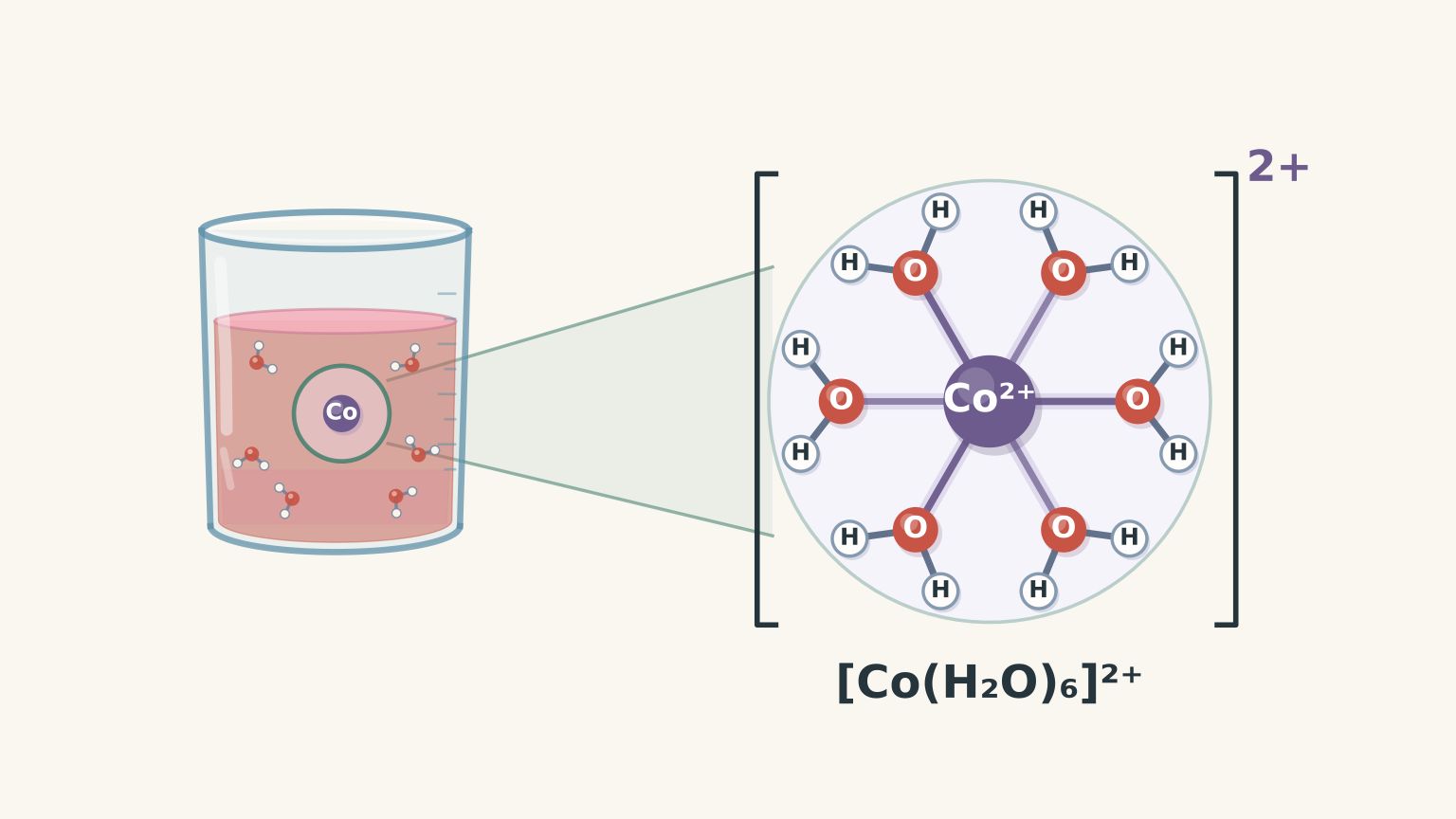
Due to technical limitations, this figure may display incorrectly or contain inaccuracies. Please check key details against your course materials.
01Start with the charge of the metal ion
Before considering the new bonds, we need to know the charge on the metal.
From atomic structure, you know that:
- Every proton has a relative charge of \(+1\).
- Every electron has a relative charge of \(-1\).
- The atomic number tells you how many protons an atom contains.
If an ion has more protons than electrons, it is positive. If it has more electrons than protons, it is negative.
We can calculate its net charge using:
\[ q=Z-N_e \]
where:
- \(q\) is the ionic charge, expressed in units of the elementary positive charge.
- \(Z\) is the atomic number, or number of protons.
- \(N_e\) is the number of electrons in the ion.
For example, cobalt has atomic number \(27\), so every cobalt atom or ion has 27 protons.
A neutral cobalt atom has the electron configuration:
\[ [\mathrm{Ar}]\,3d^7\,4s^2 \]
Here, \([\mathrm{Ar}]\) represents the first 18 electrons, \(3d^7\) means seven electrons in the \(3d\) sublevel, and \(4s^2\) means two electrons in the \(4s\) sublevel.
When cobalt forms \(\mathrm{Co}^{2+}\), it loses the two \(4s\) electrons:
\[ \mathrm{Co}^{2+}:\ [\mathrm{Ar}]\,3d^7 \]
This ion has \(18+7=25\) electrons.
\[ q=27-25=+2 \]
The cobalt ion therefore has a charge of \(2+\).
This gives us the metal’s charge before coordination. In a complex, we’ll use an oxidation state to keep track of the metal’s formal charge.
One distinction is worth keeping clear: net ionic charge is not the same as effective nuclear charge, which describes how strongly an electron experiences the nucleus after allowing for shielding by other electrons.
02Why can a neutral molecule bond to a positive metal ion?
Consider a water molecule, \(\ce{H2O}\).
Oxygen forms two bonds with hydrogen and also has two lone pairs of electrons. A lone pair is a pair of valence electrons that isn’t used in an existing covalent bond.
Because oxygen is more electronegative than hydrogen, the oxygen end of water carries a partial negative charge. It is attracted to a positive metal ion.
But attraction alone isn’t the whole explanation. One of oxygen’s lone pairs can participate in a new bond to the metal.
That creates a coordinate covalent bond: a covalent bond formed when one bonding partner initially supplies both electrons in the shared pair.
The water molecule is acting as a ligand: a molecule or ion that bonds to a central atom, usually a metal, through a donor atom.
In this example:
- The oxygen atom is the electron-pair donor.
- The cobalt ion is the electron-pair acceptor.
- Water is the ligand.
You may also meet two useful terms from acid-base chemistry. An electron-pair donor is called a Lewis base, while an electron-pair acceptor is called a Lewis acid.
For simple coordination compounds, these descriptions give us a useful model of bonding.
However, the coordinate arrow sometimes used in diagrams only tells us where the bonding electron pair came from. Once the bond has formed, its electrons are shared. It isn’t a permanently one-way transfer of two electrons, and coordinate covalent bonds aren’t automatically weaker than ordinary covalent bonds.
Real metal-ligand bonds also involve different degrees of covalent and electrostatic interaction. The electron-pair model is a starting point, not a complete description of the electron density.
03What makes a coordination compound?
When a central metal atom or ion is surrounded by directly bonded ligands, the assembly is called a coordination complex.
If the complete assembly carries a net electric charge, it is a complex ion.
For our hydrated cobalt example:
\[ \ce{[Co(H2O)6]^2+} \]
The square brackets identify the coordination sphere: the central metal and the ligands directly attached to it.
Reading the formula:
- \(\ce{Co}\) is the central cobalt atom.
- \(\ce{(H2O)6}\) means six water ligands.
- The superscript \(2+\) is the charge on the entire complex ion.
The six water molecules are electrically neutral, so their total formal charge is zero.
\[ \begin{aligned} Q&=+2+6(0)\\ &=+2 \end{aligned} \]
Here, \(Q\) represents the net charge on the complex ion.
What about ions outside the brackets?
Suppose the compound has the formula:
\[ \ce{[Co(H2O)6]Cl2} \]
This formula contains a complex ion with charge \(2+\) and two chloride ions with charge \(1-\) each.
The chloride ions are counterions. They balance the positive charge, but they are not directly bonded to the cobalt in the coordination sphere.
This difference between inside and outside the brackets matters.
In \(\ce{[Co(H2O)6]Cl2}\):
- Six oxygen atoms are directly bonded to cobalt.
- Two chloride ions balance the charge.
- The chloride ions outside the brackets do not count as coordinated ligands.
In water, the compound can be represented as producing \(\ce{[Co(H2O)6]^2+}\) and two \(\mathrm{Cl}^{-}\) counterions. This is a simplified speciation picture; real aqueous solutions can also contain equilibria between different complexes.
Calculating the charge of a complex ion
For the simple ligands in this article, use:
\[ Q=x+\sum q_L \]
where:
- \(Q\) is the net charge on the complex.
- \(x\) is the oxidation state of the central metal, written as a signed number.
- \(q_L\) is the formal charge on each coordinated ligand.
- \(\sum\) means add the charges of all the coordinated ligands, including repeated ligands.
For example, neutral water and ammonia ligands contribute zero, while each coordinated chloride ion contributes \(-1\).
The calculation is formal bookkeeping. It doesn’t claim that the real electron density is divided perfectly into isolated ions.
Worked example: Finding the charge and coordination number
A compound has the formula \(\ce{[Co(NH3)6]Cl3}\). Cobalt has atomic number 27. Determine the charge on its complex ion, the oxidation state and electron count of cobalt, and the number of atoms directly bonded to cobalt.
Step 1
There are three chloride counterions, each with charge \(-1\). The bracketed complex must therefore have charge \(+3\) to make the compound electrically neutral.
Step 2
Each ammonia molecule, \(\ce{NH3}\), is neutral.
\[ \begin{aligned} +3&=x+6(0)\\ x&=+3 \end{aligned} \]
The cobalt has oxidation state \(+3\), described as cobalt(III).
Step 3
Cobalt has 27 protons. In the formal cobalt(III) ionic model, three electrons have been removed from a neutral cobalt atom.
\[ N_e=27-3=24 \]
The corresponding ionic electron configuration is \([\mathrm{Ar}]\,3d^6\).
Step 4
Each ammonia ligand bonds through its nitrogen atom. Six ammonia molecules therefore provide six directly bonded nitrogen atoms.
The cobalt has six coordinated donor atoms. The three chloride counterions are not among them.
The key result is that cobalt’s oxidation state is \(+3\), while six ligand atoms are bonded to it. Those two numbers describe different things.
04Coordination number: count the donor atoms
The number of atoms directly bonded to the central metal through ligand donor bonds is called the coordination number, abbreviated CN.
For the simple complexes here, count the donor atoms connected directly to the metal. Do not count all the atoms in the ligands, or the ions outside the brackets.
For \(\ce{[Co(NH3)6]^3+}\), the coordination number is six.
For \(\ce{[Ag(NH3)2]+}\), it is two.
A ligand that attaches through only one donor atom is called monodentate. Water, ammonia, and chloride are monodentate in the examples we’re studying.
What shapes do different coordination numbers produce?
Different numbers of donor atoms can produce different three-dimensional arrangements.
| Example complex | Coordination number | Common geometry |
|---|---|---|
| \(\ce{[Ag(NH3)2]+}\) | 2 | Linear |
| \(\ce{[ZnCl4]^2-}\) | 4 | Tetrahedral |
| \(\ce{[Co(NH3)6]^3+}\) | 6 | Octahedral |
A linear arrangement places two donor atoms on opposite sides of the metal.
A tetrahedral arrangement places four donor atoms towards the corners of a tetrahedron, rather than in one flat plane.
An octahedral arrangement places six donor atoms along three perpendicular axes: four around the middle, one above, and one below. Each donor atom has another directly opposite it.
There is a limit to this pattern.
A coordination number of four doesn’t always mean tetrahedral geometry. Some four-coordinate metal complexes are square planar, with all four donor atoms arranged around the metal in one plane.
And six-coordinate complexes can be distorted rather than perfectly octahedral.
You cannot reliably predict geometry from coordination number alone. The metal’s electronic structure, the ligands, and the bonding conditions also matter.
05One ligand can occupy more than one coordination position
So far, each ligand has supplied one donor atom. That makes the number of ligands equal to the coordination number.
But some molecules can attach through two or more donor atoms.
Consider ethane-1,2-diamine, commonly called ethylenediamine and abbreviated en:
\[ \ce{H2NCH2CH2NH2} \]
This neutral molecule has two nitrogen atoms. Each nitrogen has a lone pair that can bond to a metal ion.
If both nitrogen atoms bond to the same metal centre, en is acting as a bidentate ligand.
The prefix bi- means two, and dentate refers to the number of donor atoms through which one ligand attaches. This number is called the ligand’s denticity.
Think of the coordination number as counting hands holding a railing, rather than people standing beside it. A person using two hands counts twice.
Likewise, one bidentate ligand makes two metal-donor connections.
The analogy works for counting, but not for predicting real structures. Atoms don’t have fixed hands or freely adjustable arms; bond lengths, bond angles, and the shape of the ligand restrict which positions it can reach.
For example:
\[ \ce{[Co(en)3]^3+} \]
This complex has three en ligands, but each contributes two nitrogen donor atoms.
\[ \mathrm{CN}=3(2)=6 \]
The coordination number is six, not three.
This type of bonding is called chelation. The ligand forms a ring-like structure by attaching to the same metal through multiple donor atoms.
In a normal six-coordinate octahedral complex, the two nitrogens of en occupy neighbouring positions, rather than positions opposite one another. The chain between the nitrogen atoms is too short to span opposite ends of that octahedral arrangement.
Worked example: A complex with two kinds of ligands
Consider the coordination compound:
\[ \ce{[Co(en)2(H2O)Cl]Cl2} \]
Assume each en ligand uses both nitrogen donor atoms. Determine the complex charge, cobalt oxidation state, cobalt electron count, coordination number, total number of coordinated ligands, and the number of chloride counterions.
Cobalt has atomic number 27.
Step 1
There are two chloride counterions outside the brackets.
Their combined charge is \(-2\), so the complex must have charge \(+2\).
Step 2
Both en and water are neutral, but the chloride ligand inside the brackets has charge \(-1\).
\[ \begin{aligned} +2&=x+2(0)+0-1\\ x&=+3 \end{aligned} \]
Cobalt is in oxidation state \(+3\).
Step 3
The cobalt(III) ionic model gives:
\[ N_e=27-3=24 \]
Its ionic electron configuration is \([\mathrm{Ar}]\,3d^6\).
Step 4
The two en ligands contribute four nitrogen donor atoms. The water contributes one oxygen, and the coordinated chloride contributes one chlorine donor atom.
\[ \begin{aligned} \mathrm{CN}&=2(2)+1+1\\ &=6 \end{aligned} \]
There are only four coordinated ligand entities: two en molecules, one water molecule, and one chloride ion. Together they make six metal-donor connections.
Step 5
One chloride is inside the brackets, directly bonded to cobalt. Two more are outside the brackets as counterions.
The compound therefore contains three chloride ions in its formula unit, but only one is a coordinated ligand.
06Changing ligands doesn’t necessarily change the metal’s oxidation state
Here’s a useful consequence of this model.
A metal can retain the same oxidation state while its surrounding ligands change. This is called ligand substitution or ligand exchange.
If a neutral water ligand is replaced by a negatively charged chloride ligand, the overall complex charge can change even though the metal hasn’t gained or lost electrons in the formal oxidation-state model.
The number of donor atoms can change too. Exchanging ligands doesn’t require the coordination number to stay constant.
This helps explain why changing the chemical environment of a metal ion can change its properties. Different ligands alter the electronic environment around the metal, sometimes affecting which wavelengths of light a complex absorbs.
That doesn’t mean colour reveals the exact structure by itself. Several factors can affect a complex’s colour, and predicting its absorption behaviour accurately requires a more detailed electronic model.
The practical decision rule for simple complex ions is:
- Identify everything inside the square brackets.
- Use the ligand charges and overall charge to find the metal oxidation state.
- Count donor atoms, allowing for ligands that bind through more than one atom.
- Treat counterions outside the brackets separately.
- Use structural information, not just the coordination number, to infer geometry.
These rules follow the distinction between coordination entities and coordination numbers made by the International Union of Pure and Applied Chemistry (IUPAC). They are reliable for the straightforward metal-ligand examples here, but do not cover every unusual type of bonding in advanced coordination chemistry.
07Questions and solutions
Question 1
A hydrated cobalt(II) ion has the formula \(\ce{[Co(H2O)6]^2+}\).
Cobalt has atomic number 27, and the cobalt(II) ion has electron configuration \([\mathrm{Ar}]\,3d^7\).
Determine:
a) The number of electrons associated with the cobalt(II) ion in the ionic model.
b) The net charge on the complex.
c) The coordination number of cobalt.
Explain why the six water molecules don’t make the complex charge \(8+\).
Solution 1
The cobalt(II) ion has 25 electrons, the complete complex has a charge of \(2+\), and its coordination number is six.
a) The argon core contains 18 electrons, and \(3d^7\) adds seven:
\[ N_e=18+7=25 \]
With 27 protons, the ionic charge is:
\[ q=27-25=+2 \]
b) Each water ligand is neutral, so:
\[ Q=+2+6(0)=+2 \]
The whole complex remains positively charged.
c) Each water molecule attaches through one oxygen atom. Six attached water molecules therefore give a coordination number of six.
The tempting mistake is to treat every new metal-ligand bond as adding one positive charge. Coordination number counts bonds to donor atoms; it doesn’t measure electric charge.
Question 2
In different chemical environments, cobalt(II) can occur as either \(\ce{[Co(H2O)6]^2+}\) or \(\ce{[CoCl4]^2-}\).
Assume water and chloride each bind through one donor atom.
a) Write a balanced reversible equation for converting the hydrated cobalt(II) complex into the chloride complex using chloride ions.
b) Determine the coordination numbers and overall charges of the two complexes.
c) Explain why the conversion is not an oxidation-reduction reaction, even though the complex changes from positively charged to negatively charged.
A student claims that ligand substitution must preserve the number of attached ligands. Assess that claim.
Solution 2
The conversion replaces six water ligands with four chloride ligands. The coordination number falls from six to four, while cobalt remains in oxidation state \(+2\). It is ligand exchange, not a redox reaction.
a) The balanced reversible equation is:
\[ \begin{aligned} &\ce{[Co(H2O)6]^2+ + 4Cl^-}\\ &\quad\ce{<=> [CoCl4]^2- + 6H2O} \end{aligned} \]
It is balanced for cobalt, chlorine, oxygen, hydrogen, and charge.
The net charge on the left is:
\[ +2+4(-1)=-2 \]
The net charge on the right is also \(-2\).
b) For the hydrated complex, six water molecules provide six donor oxygen atoms. Its coordination number is six, and its charge is \(2+\).
For the chloride complex, four chloride ions provide four donor chlorine atoms. Its coordination number is four.
Its charge can be calculated using cobalt’s \(+2\) oxidation state:
\[ \begin{aligned} Q&=+2+4(-1)\\ &=-2 \end{aligned} \]
c) Cobalt remains cobalt(II) on both sides. Its formal oxidation state hasn’t changed, so the ligand exchange is not a redox reaction.
The overall complex charge changes because the original water ligands are neutral while the incoming chloride ligands each contribute \(-1\).
The student’s claim is incorrect. Ligand exchange doesn’t have to preserve the number of ligands or the coordination number. In this case, the usual geometries also differ: the six-coordinate aqua complex is approximately octahedral, while the four-coordinate chloride complex is tetrahedral.
Question 3
A hypothetical coordination compound contains, per cobalt atom:
- Four ammonia molecules, all known to be coordinated.
- Two water molecules.
- Three chloride ions.
Cobalt is in oxidation state \(+3\), and its coordination number is six.
An idealised rapid test after dissolution detects two chloride counterions per cobalt without breaking any metal-ligand bonds. Assume all ammonia, water, and chloride ligands are monodentate. Any water not coordinated to cobalt is present in the solid as water of crystallisation, written after a centred dot in the formula.
Determine:
a) How many chloride ions and water molecules are directly bonded to cobalt.
b) The full coordination compound formula, distinguishing coordinated ligands, counterions, and water of crystallisation.
c) The charge of the complex ion.
Explain why placing both water molecules inside the coordination sphere would contradict the evidence.
Solution 3
One chloride ion and one water molecule are coordinated to cobalt. Two chloride ions are counterions, and the remaining water molecule is water of crystallisation.
The full formula is:
\[ \ce{[Co(NH3)4(H2O)Cl]Cl2}\cdot\ce{H2O} \]
a) The compound contains three chloride ions in total, but the test identifies two as counterions.
Therefore:
\[ 3-2=1 \]
One chloride ion must be coordinated.
The four ammonia molecules contribute four donor atoms, and the coordinated chloride contributes one more.
That gives five directly bonded donor atoms. Since cobalt has coordination number six, one additional water molecule must provide the sixth donor atom.
b) Inside the coordination sphere are four ammonia ligands, one water ligand, and one chloride ligand.
Outside the brackets are two chloride counterions. The second water molecule is not directly coordinated, so it appears after the dot.
c) With cobalt in oxidation state \(+3\), neutral ammonia and water, and one coordinated chloride:
\[ \begin{aligned} Q&=+3+4(0)+0-1\\ &=+2 \end{aligned} \]
Two external chloride ions balance the \(2+\) charge.
The tempting alternative is to place both waters around cobalt because water is capable of coordinating.
But then the donor count would be four ammonia nitrogens, one chloride, and two water oxygens: seven donor atoms, contradicting the specified coordination number of six.
The free-chloride observation and the coordination number must both be satisfied. Neither can be ignored.
Question 4
Consider a hypothetical sequence beginning with the six-coordinate ion \(\ce{[Co(H2O)6]^3+}\).
First, two neutral en ligands attach. Each en ligand uses both nitrogen donor atoms and displaces two water molecules.
Next, one of the remaining coordinated water molecules is replaced by a chloride ion.
Assume cobalt remains in oxidation state \(+3\), and the coordination number stays six throughout.
a) Write balanced equations for both substitution stages.
b) Give the final complex ion formula, its overall charge, its coordination number, and its number of coordinated ligand entities.
c) Write the formula of the final compound if chloride ions are its only counterions.
A student predicts that adding two en ligands to the starting complex should replace only two water molecules, since two ligands have been added. Explain the error.
Solution 4
The final complex is \(\ce{[Co(en)2(H2O)Cl]^2+}\). It has six donor atoms but only four coordinated ligand entities. Its chloride salt is \(\ce{[Co(en)2(H2O)Cl]Cl2}\).
a) In the first stage, two bidentate en ligands replace four water molecules.
\[ \begin{aligned} &\ce{[Co(H2O)6]^3+}+2\,\mathrm{en}\\ &\quad\rightarrow \ce{[Co(en)2(H2O)2]^3+}\\ &\qquad+4\,\ce{H2O} \end{aligned} \]
Both en ligands are neutral, so the complex remains \(3+\).
The second stage replaces one neutral water ligand with a chloride ion:
\[ \begin{aligned} &\ce{[Co(en)2(H2O)2]^3+}\\ &\quad+\mathrm{Cl}^{-}\\ &\quad\rightarrow \ce{[Co(en)2(H2O)Cl]^2+}\\ &\qquad+\ce{H2O} \end{aligned} \]
The equation also conserves charge: the reactants have a combined charge of \(+2\), matching the product complex.
b) The final donor count is:
\[ \begin{aligned} \mathrm{CN}&=2(2)+1+1\\ &=6 \end{aligned} \]
The two en molecules supply four nitrogen donors, water supplies one oxygen donor, and chloride supplies one chlorine donor.
There are four coordinated ligand entities: two en, one water, and one chloride.
The complex charge is:
\[ \begin{aligned} Q&=+3+2(0)+0-1\\ &=+2 \end{aligned} \]
c) Two chloride counterions are required to balance the \(2+\) complex charge.
The complete salt formula is:
\[ \ce{[Co(en)2(H2O)Cl]Cl2} \]
There are three chloride ions represented altogether: one coordinated and two outside the brackets.
The student’s mistake is treating the number of ligands as the number of available metal-donor connections.
Two en molecules contribute four donor atoms, so they replace four monodentate water ligands, not two. Retaining four water molecules as well as two fully bound en ligands would give eight donor atoms, contradicting the specified six-coordinate model.
Question 5
Two samples, A and B, contain coordination compounds with the same formula:
\[ \ce{[Co(en)2Cl2]Cl} \]
In both samples, cobalt is in oxidation state \(+3\), the geometry is octahedral, both en ligands bind through two nitrogen atoms, and both chlorides inside the brackets are directly coordinated.
However, the two samples have different arrangements.
- In sample A, the two coordinated chloride ions occupy neighbouring octahedral positions, separated by an angle of approximately \(90^\circ\) at cobalt.
- In sample B, the two coordinated chloride ions occupy opposite octahedral positions, separated by approximately \(180^\circ\).
An incoming en ligand could, in principle, replace both coordinated chloride ions, producing \(\ce{[Co(en)3]^3+}\).
We are interested specifically in a direct, geometry-preserving substitution under these idealised constraints:
- The four existing cobalt-nitrogen bonds remain intact.
- The six octahedral coordination directions remain fixed.
- The new en ligand must bind through both nitrogen atoms to neighbouring positions.
- No other ligands may detach or rearrange during the direct substitution.
- The metal’s oxidation state remains unchanged.
a) Which sample, A or B, permits this direct substitution? Explain using the positions of the donor atoms, not just the number of ligands.
b) For the permitted substitution, write a balanced equation using the complete neutral salt formulas.
c) Determine the number of chloride counterions before and after the substitution, the coordination numbers, and cobalt’s oxidation state.
d) A student argues that sample B must also permit the direct substitution because it has the same formula, oxidation state, and coordination number as A. Identify precisely why this reasoning fails.
e) Would your conclusion mean that sample B could never form \(\ce{[Co(en)3]^3+}\) through any reaction pathway? Explain the limitation of the model.
Solution 5
Only sample A permits the specified direct, geometry-preserving substitution. The decisive constraint is not charge or coordination number, but whether the two available positions can be reached simultaneously by the donor atoms of one en ligand.
a) In sample A, the coordinated chloride ions occupy neighbouring positions.
If both chlorides leave, the vacant positions are also neighbouring positions.
An incoming en ligand can attach through its two nitrogen atoms, one at each vacated position, while forming its usual chelate ring.
In sample B, the two coordinated chloride ions are opposite one another.
Removing them creates two vacant positions on opposite ends of the octahedron. The two nitrogen donor atoms of one en ligand cannot span those positions while preserving the specified geometry and keeping the existing bonds unchanged.
Therefore, the direct substitution is permitted for A, not B.
b) For sample A, the complete salt equation is:
\[ \begin{aligned} &\ce{[Co(en)2Cl2]Cl}+\mathrm{en}\\ &\quad\rightarrow\ce{[Co(en)3]Cl3} \end{aligned} \]
This schematic equation is balanced for cobalt, en ligands, and chloride ions.
There are three chloride ions on each side, even though their roles change.
c) Initially, each complex contains two coordinated chloride ligands and one chloride counterion.
The complex charge is:
\[ \begin{aligned} Q&=+3+2(0)+2(-1)\\ &=+1 \end{aligned} \]
That explains the one chloride counterion outside the brackets.
After substitution, the product contains three neutral en ligands.
\[ Q=+3+3(0)=+3 \]
Three chloride counterions are now required to balance the charge.
The coordination number before substitution is:
\[ \mathrm{CN}=2(2)+2=6 \]
The coordination number afterwards is:
\[ \mathrm{CN}=3(2)=6 \]
The cobalt oxidation state is \(+3\) throughout.
So the transformation changes the coordination-sphere charge from \(+1\) to \(+3\), increases the number of chloride counterions from one to three, and preserves coordination number six.
d) The student’s conclusion fails because coordination number tells us how many donor atoms are attached, but not their relative positions.
Both starting structures have six donor atoms. Both contain two en ligands and two coordinated chloride ions. Both have the same formal charge.
Yet their spatial arrangements are different.
In A, the vacant positions created by removing the chlorides are adjacent and can be filled by one bidentate en ligand.
In B, the vacant positions would be opposite. Filling them with one en ligand would violate the given requirement that en’s two nitrogen atoms bind at neighbouring sites.
An identical ligand count and oxidation state do not guarantee an identical substitution pathway.
e) No. The restriction only rules out the specified direct substitution without rearrangement.
If other bonds can break and reform, or the coordination arrangement can reorganise through intermediate species, sample B might also eventually form \(\ce{[Co(en)3]^3+}\).
Whether that actually occurs, and how quickly, cannot be determined from the static coordination-number model alone. Reaction mechanisms, energetics, and kinetics would also matter.
08What this model lets you understand next
The important distinction is between a metal’s charge, the number of donor atoms bonded to it, and the three-dimensional positions those atoms occupy.
A metal can keep the same oxidation state while its ligands change. Two complexes can have the same coordination number but different shapes. And two complexes with exactly the same formula can behave differently because their ligands occupy different positions.
Coordination number tells you how many connections exist. Coordination geometry tells you where those connections point.
The next question is why some metal-ligand arrangements are more stable than others, and why changing ligands can change a complex’s colour or magnetic behaviour. Answering that needs a better description of how electrons occupy and interact through orbitals. The same broader electronic ideas are explored in Molecular Orbital Theory: Bonding and Oxygen’s Magnetism, although a full treatment of transition-metal complexes requires additional models.
For now, the strongest habit is simple: when you see a complex ion, don’t stop at its overall charge. Identify the actual donor atoms, count their connections, and work out how they are arranged. Those three decisions tell you much more about the compound than its metal ion alone.