
Grignard Reagents: How They Form Carbon-Carbon Bonds
Learn how Grignard reagents create new carbon-carbon bonds and convert aldehydes and ketones into alcohols. This extension guide explains the reaction mechanism, synthesis planning, ester reactions, and why water destroys Grignard reagents.
Suppose you want to make an alcohol whose central carbon is attached to three other carbon groups. The familiar haloalkane substitution reaction can replace a halogen with an OH group, but it doesn’t build a new carbon-carbon bond. How do you make two carbon-containing molecules join together instead?
Grignard reagents provide one answer. They allow chemists to transfer a carbon group to an electron-poor carbon atom, creating a new carbon-carbon bond. That makes them particularly useful for constructing larger organic molecules and producing alcohols that are difficult to obtain through ordinary substitution reactions.
Before we get into the chemistry, make a prediction. If a carbon atom is bonded to magnesium, which atom in a carbonyl group (\(\ce{C=O}\)) is it most likely to attack: carbon or oxygen?
The answer is carbon. Understanding why is the key to understanding the entire Grignard reaction.
A syllabus note: Grignard chemistry is extension material, not a required HSC assessment topic. The assumed starting point is Year 12 organic chemistry, particularly haloalkane substitution and alcohol formation. NESA’s Chemistry 11-12 Syllabus (2025) is scheduled for implementation from 2028, with the first HSC examination under the new syllabus in 2029. In 2026, Year 12 students are still following the 2017 syllabus. The Year 12 knowledge is a starting point for this article, not an additional assessment requirement. NESA syllabus implementation information.
01Start with the reaction you already know
In Year 12 organic chemistry, you study how haloalkanes can be converted into alcohols through substitution reactions.
A haloalkane contains a carbon-halogen bond. When it reacts with hydroxide ions, the halogen can be replaced by an OH group.
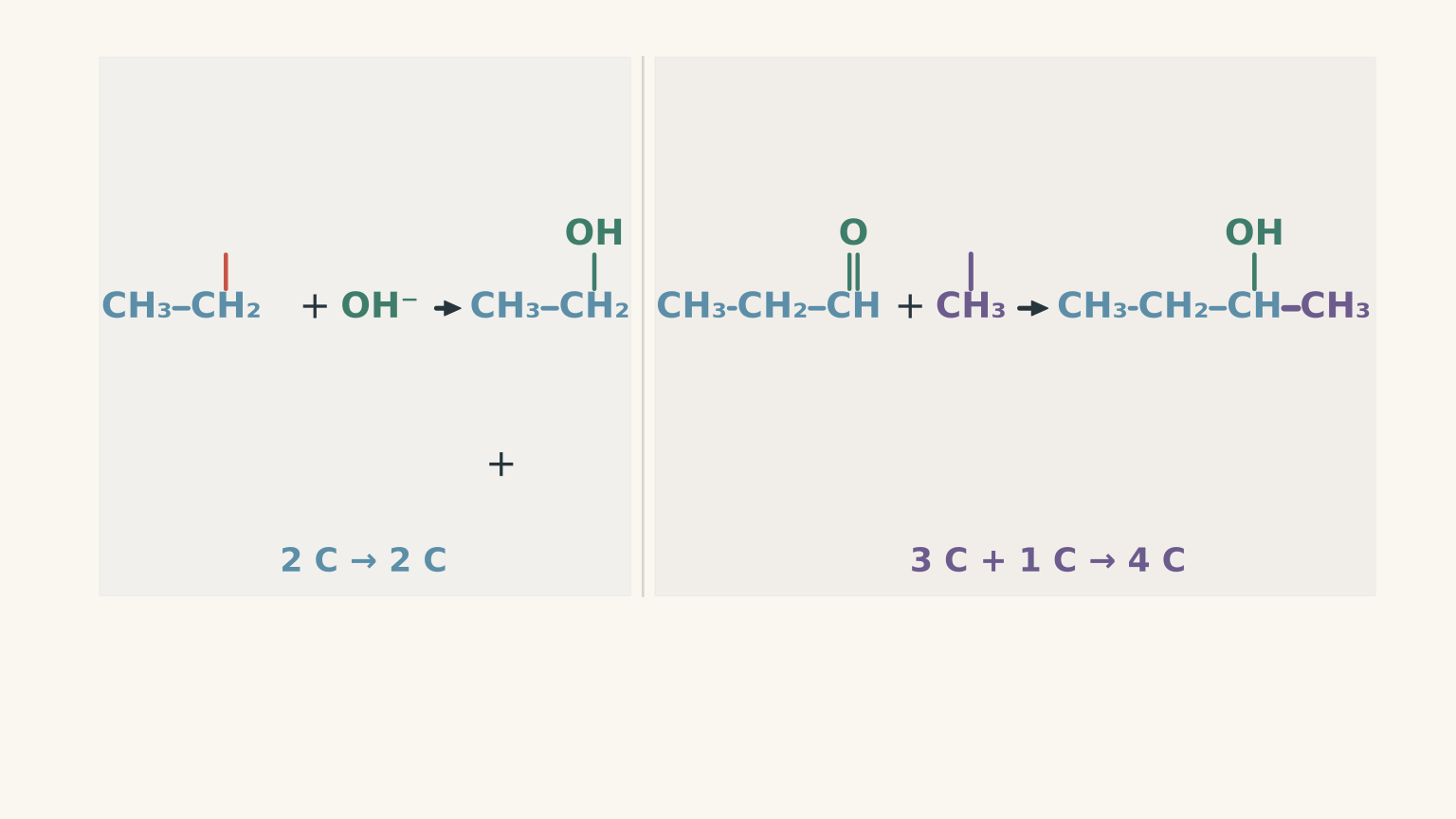
For example, bromoethane reacts with hydroxide ions to produce ethanol:
\[ \ce{CH3CH2Br + OH^- -> CH3CH2OH + Br^-} \]
Here:
- \(\ce{CH3CH2Br}\) is bromoethane, the haloalkane.
- \(\mathrm{OH}^{-}\) is the hydroxide ion, acting as a nucleophile.
- \(\ce{CH3CH2OH}\) is ethanol, the alcohol.
- \(\mathrm{Br}^{-}\) is the bromide ion, which leaves the molecule.
The important feature is that the carbon skeleton stays the same.
Bromoethane contains two carbon atoms, and ethanol still contains two carbon atoms. The reaction changes the functional group, but it doesn’t add another carbon atom.
Due to technical limitations, this figure may display incorrectly or contain inaccuracies. Please check key details against your course materials.
Now consider a different target.
You want to produce an alcohol with four carbon atoms, starting from a carbonyl compound with only three carbon atoms. Simply replacing a halogen with OH won’t solve this problem.
You need a reaction that actually joins carbon atoms together.
That’s where Grignard reagents come in.
02What is a Grignard reagent?
A Grignard reagent is an organomagnesium compound with the general formula:
\[ \ce{R-MgX} \]
Each symbol has a specific meaning:
- \(R\) represents an organic group, such as an alkyl group or an aromatic group.
- \(Mg\) represents magnesium.
- \(X\) represents a halogen, usually chlorine, bromine, or iodine.
For example, ethylmagnesium bromide has the formula:
\[ \ce{CH3CH2MgBr} \]
It contains an ethyl group, \(\ce{CH3CH2-}\), bonded to magnesium, which is also bonded to bromine.
How is a Grignard reagent formed?
Grignard reagents are formed by reacting an organic halide with magnesium metal.
The general reaction is:
\[ \ce{R-X + Mg ->[dry\ ether] R-MgX} \]
For example:
\[ \ce{CH3CH2Br + Mg ->[dry\ ether] CH3CH2MgBr} \]
Magnesium inserts into the carbon-bromine bond, producing an organomagnesium compound.
The reaction requires an anhydrous environment. Anhydrous simply means water-free.
An ether solvent, such as diethyl ether or tetrahydrofuran (THF), is commonly used. Its oxygen atoms can coordinate with magnesium, helping to stabilise the organomagnesium species in solution.
Why is the carbon-magnesium bond important?
This is the most important idea in the topic.
Magnesium is less electronegative than carbon. Consequently, the bonding electrons in the carbon-magnesium bond are drawn towards carbon.
This creates a polarised bond:
\[ \ce{C^{\delta-}-Mg^{\delta+}} \]
The carbon has a partial negative charge, while magnesium has a partial positive charge.
That gives the carbon atom an unusual property: it behaves as though it has some of the characteristics of a negatively charged carbon species.
In organic chemistry, a negatively charged carbon species is called a carbanion.
A carbanion is strongly nucleophilic because its electron-rich carbon can form a new bond with an electron-poor atom.
The Grignard reagent therefore behaves as a carbon nucleophile.
Think of it as a carbon-fragment delivery system. The organic group attached to magnesium is the group that will be transferred to another molecule.
There is an important limitation to this model: the reagent is not simply a free \(\mathrm{R}^{-}\) ion floating around in solution. Real Grignard reagents can form aggregated, solvent-coordinated structures, and their detailed reaction pathways can be more complicated than the simplified model used here.
For predicting the products, however, treating the carbon as a nucleophilic carbon equivalent is extremely useful. More detailed mechanistic studies also show that the precise pathway can depend on the Grignard reagent and its reaction partner (Yamazaki and Yamabe, Journal of Organic Chemistry, 2002).
03How Grignard reagents form carbon-carbon bonds
Now we can return to the prediction from the beginning.
A Grignard reagent reacts particularly well with aldehydes and ketones.
Both contain a carbonyl group:
\[ \ce{C=O} \]
The carbonyl bond is polar because oxygen is more electronegative than carbon.
This means:
- Oxygen carries a partial negative charge.
- Carbon carries a partial positive charge.
The carbonyl carbon is therefore an electrophilic centre. An electrophile is an electron-poor atom that can accept an electron pair to form a new bond.
The carbon in the Grignard reagent is nucleophilic, while the carbonyl carbon is electrophilic.
They are an excellent reaction pair.
The reaction mechanism
Consider a general Grignard reagent, \(\ce{R-MgX}\), reacting with a ketone.
There are three important stages.
Stage 1: Nucleophilic attack
The carbon in the Grignard reagent attacks the electrophilic carbonyl carbon.
A new carbon-carbon bond forms.
At the same time, the electrons in the carbonyl double bond move onto oxygen.
The carbonyl carbon is no longer double-bonded to oxygen.
Stage 2: Formation of an alkoxide
The oxygen now carries a negative charge and associates with the magnesium-containing species.
This intermediate is called an alkoxide.
It can be represented as:
\[ \ce{R'COR'' + R-MgX} \]
\[ \ce{-> R'C(OMgX)(R)R''} \]
The crucial point is that the carbon skeleton has increased by the number of carbon atoms in the Grignard reagent’s \(R\) group.
Stage 3: Acidic work-up
The alkoxide is not yet the final alcohol.
It needs to receive a hydrogen ion. This happens during a separate acidic work-up, commonly represented using hydronium ions, \(\ce{H3O+}\).
\[ \ce{R'C(OMgX)(R)R'' ->[H3O+] R'C(OH)(R)R''} \]
The oxygen becomes part of an OH group.
The new carbon-carbon bond remains intact.
Notice something important about the sequence.
The carbon-carbon bond forms before the alcohol appears. The acidic work-up does not create the new carbon-carbon bond. It simply protonates the oxygen-containing intermediate.
This is why the order of the two stages matters.
Predicting the alcohol from the carbonyl compound
The type of carbonyl compound determines the class of alcohol produced.
| Starting carbonyl compound | Alcohol produced | Example |
|---|---|---|
| Methanal (formaldehyde) | Primary alcohol | Methanal + methylmagnesium bromide gives ethanol |
| Other aldehydes | Secondary alcohol | Ethanal + methylmagnesium bromide gives propan-2-ol |
| Ketones | Tertiary alcohol | Propanone + methylmagnesium bromide gives 2-methylpropan-2-ol |
Why does this pattern occur?
Look at the carbon that originally formed the carbonyl group.
- Methanal originally has two hydrogen atoms attached to its carbonyl carbon. Adding one carbon group produces a primary alcohol.
- An ordinary aldehyde has one hydrogen and one carbon-containing group. Adding another carbon group produces a secondary alcohol.
- A ketone already has two carbon-containing groups. Adding another produces a tertiary alcohol.
The carbonyl carbon becomes the carbon attached to OH in the final alcohol.
The carbon group from the Grignard reagent becomes an additional carbon-containing substituent on that same carbon.
This is the central reaction map to remember.
04Worked example: Producing a secondary alcohol
Question: Ethylmagnesium bromide reacts with ethanal, followed by an acidic work-up. Determine the organic product and classify the alcohol.
Step 1
Ethanal has the structure:
\[ \ce{CH3CHO} \]
Its carbonyl carbon is attached to:
- One hydrogen atom.
- One methyl group, \(\ce{CH3}\).
Step 2
Ethylmagnesium bromide contains an ethyl group:
\[ \ce{CH3CH2-} \]
This is the carbon-containing group transferred during the reaction.
It forms a new bond with the carbonyl carbon of ethanal.
Step 3
The carbonyl carbon now has three attachments other than oxygen’s double bond: its original hydrogen, its original methyl group, and the newly added ethyl group.
The intermediate is:
\[ \ce{CH3CH(OMgBr)CH2CH3} \]
Step 4
The oxygen is protonated, producing:
\[ \ce{CH3CH(OH)CH2CH3} \]
The product is butan-2-ol.
Step 5
The carbon attached to OH is bonded to two other carbon atoms.
Therefore, the product is a secondary alcohol.
Notice that ethanal originally had two carbon atoms, while butan-2-ol has four. The Grignard reagent contributed the additional two-carbon ethyl group.
05Planning an alcohol synthesis backwards
So far, we’ve started with a carbonyl compound and predicted the alcohol.
But chemists often face the opposite problem: they know the molecule they want to produce and need to work backwards to choose the starting materials.
This is called retrosynthetic planning.
The most useful question is:
Which carbon-carbon bond in the target alcohol could have been formed by a Grignard reaction?
Follow this reasoning:
- Find the carbon attached to the OH group in the target alcohol.
- Identify its carbon-containing substituents.
- Choose one substituent to be supplied by the Grignard reagent.
- Replace that substituent with a double-bonded oxygen to reconstruct the carbonyl precursor.
- Choose a suitable haloalkane that can provide the required Grignard group.
This gives you a systematic way to plan the reaction instead of guessing combinations of organic compounds.
06Worked example: Designing a route to a tertiary alcohol
Question: Design a Grignard synthesis of 3-methylhexan-3-ol using 2-butanone as the carbonyl starting material. Identify the required Grignard reagent and its haloalkane precursor.
Step 1
The target has the structure:
\[ \ce{CH3CH2C(OH)(CH3)CH2CH2CH3} \]
The carbon attached to OH is bonded to three carbon-containing groups:
- A methyl group.
- An ethyl group.
- A propyl group.
This is a tertiary alcohol.
Step 2
The starting ketone is 2-butanone:
\[ \ce{CH3COCH2CH3} \]
Its carbonyl carbon already has a methyl group and an ethyl group attached.
Compare these groups with the target. The only additional carbon-containing group required is propyl.
Therefore, the Grignard reagent must supply a propyl group.
Step 3
The required reagent is propylmagnesium bromide:
\[ \ce{CH3CH2CH2MgBr} \]
It can be represented as being formed from 1-bromopropane and magnesium:
\[ \ce{CH3CH2CH2Br + Mg ->[dry\ ether] CH3CH2CH2MgBr} \]
Step 4
The propyl group forms a new carbon-carbon bond with the carbonyl carbon.
The resulting intermediate is:
\[ \ce{CH3CH2C(OMgBr)(CH3)CH2CH2CH3} \]
Step 5
Protonation of the alkoxide produces:
\[ \ce{CH3CH2C(OH)(CH3)CH2CH2CH3} \]
The final product is 3-methylhexan-3-ol.
This example illustrates a useful planning technique: the carbonyl compound supplies two of the carbon groups attached to the alcohol carbon, while the Grignard reagent supplies the third.
07A useful extension: What happens with esters?
Aldehydes and ketones generally require one equivalent of Grignard reagent for each carbonyl group undergoing addition.
Esters behave differently.
An ester has the general structure:
\[ \ce{RCOOR'} \]
It contains a carbonyl group and an additional oxygen-containing group attached to the carbonyl carbon.
When an ester reacts with a Grignard reagent, two equivalents are generally required to produce a tertiary alcohol.
Why two?
The first Grignard addition produces a tetrahedral intermediate. This intermediate then collapses, expelling the ester’s alkoxy group and forming a ketone.
The ketone reacts with a second equivalent of Grignard reagent.
After acidic work-up, a tertiary alcohol is produced.
For example, methyl propanoate reacts with two equivalents of ethylmagnesium bromide.
The first addition produces 3-pentanone:
\[ \ce{CH3CH2COOCH3} \]
\[ \ce{-> CH3CH2COCH2CH3} \]
The second equivalent adds another ethyl group to the ketone.
After acidic work-up, the product is 3-ethylpentan-3-ol.
The important point is that the ketone formed during the first stage is not normally the final product. It reacts further with the second equivalent of Grignard reagent.
This two-addition behaviour is a useful extension of the basic carbonyl reaction model. See OpenStax: Chemistry of Esters for further detail.
08Why water destroys Grignard reagents
There is one major condition that you must understand before predicting Grignard reactions confidently.
Grignard reagents are extremely sensitive to water.
Remember the polarity of the carbon-magnesium bond:
\[ \ce{C^{\delta-}-Mg^{\delta+}} \]
The carbon behaves as a strong base as well as a nucleophile.
Water contains hydrogen atoms that can be transferred to this carbon. When a Grignard reagent encounters water, it reacts to form an alkane instead of adding to the intended carbonyl compound.
The general reaction is:
\[ \ce{R-MgX + H2O -> R-H + Mg(OH)X} \]
For example:
\[ \ce{CH3CH2MgBr + H2O -> CH3CH3 + Mg(OH)Br} \]
Ethylmagnesium bromide becomes ethane.
The carbon group that was supposed to form a new carbon-carbon bond has instead received a hydrogen atom.
This is why Grignard reactions require dry conditions.
Why can water be added at the end?
This can seem contradictory.
If water destroys Grignard reagents, why is an aqueous work-up necessary?
The answer is timing.
Before the carbon-carbon bond forms, the Grignard reagent must remain intact. Water would consume it.
After the carbon-carbon bond has formed, the reactive intermediate is an alkoxide. Water or dilute aqueous acid can now protonate the oxygen to produce the alcohol.
The two stages have different jobs:
| Stage | What happens |
|---|---|
| Before carbonyl addition | Water destroys the Grignard reagent. |
| During carbonyl addition | The Grignard carbon forms a new C-C bond. |
| After carbonyl addition | Water or acid protonates the alkoxide to form the alcohol. |
Other functional groups that cause problems
Water is not the only substance that reacts with Grignard reagents.
Other compounds containing sufficiently acidic hydrogen atoms can also consume the reagent.
Examples include:
- Alcohols, containing O-H bonds.
- Carboxylic acids, containing O-H bonds.
- Thiols, containing S-H bonds.
- Primary and secondary amines, containing N-H bonds.
- Terminal alkynes, containing an acidic C-H bond.
In these cases, the Grignard reagent can act as a base and remove the acidic hydrogen instead of performing the desired carbon-carbon bond formation.
This limitation is particularly important when planning a synthesis involving molecules with more than one functional group.
Sometimes chemists temporarily protect a reactive functional group so that another part of the molecule can undergo the desired reaction. The protecting group is removed later.
A useful university-level discussion of these limitations is available through Chemistry LibreTexts.
Grignard reagents and the ether solvents used with them are reactive, volatile, and potentially hazardous. Their preparation and use belong in appropriately equipped, supervised laboratories, not unsupervised experiments.
09Common misconceptions
| Misconception | What actually happens |
|---|---|
| A Grignard reaction simply replaces a halogen with OH. | It creates a new carbon-carbon bond through nucleophilic addition. |
| The carbon in a Grignard reagent is a free \(\mathrm{R}^{-}\) ion. | The carbon-magnesium bond is polarised, giving carbon carbanion-like behaviour. |
| Water is always an appropriate reaction medium. | Water destroys the Grignard reagent before carbonyl addition. |
| The acidic work-up creates the carbon-carbon bond. | The bond forms during nucleophilic addition, before the work-up. |
| All aldehydes produce primary alcohols. | Only methanal produces a primary alcohol; other aldehydes produce secondary alcohols. |
| An ester reacts just like a ketone. | Esters generally require two equivalents of Grignard reagent to produce tertiary alcohols. |
One final refinement: the reaction maps in this article predict connectivity and alcohol classification. They do not automatically predict stereochemistry. If the new OH-bearing carbon has four different attached groups, it is a stereogenic centre. With achiral starting materials and conditions, attack from either face of a planar carbonyl can produce a racemic mixture.
10Questions and solutions
The following questions move from straightforward product prediction to reaction planning, stoichiometry, and more demanding mechanistic reasoning.
Question 1
A chemist reacts butylmagnesium bromide, \(\ce{CH3CH2CH2CH2MgBr}\), with methanal, \(\ce{HCHO}\), followed by an acidic work-up.
Determine:
a) The structural formula of the alcohol produced.
b) The IUPAC name of the alcohol.
c) Whether the alcohol is primary, secondary, or tertiary.
d) The number of carbon atoms contributed by the Grignard reagent.
Solution 1
The product is pentan-1-ol, a primary alcohol containing five carbon atoms. The Grignard reagent contributes four of those carbon atoms.
Step 1: Identify the carbonyl compound.
Methanal has the structure:
\[ \ce{H2C=O} \]
Its carbonyl carbon is attached to two hydrogen atoms.
Step 2: Identify the group supplied by the Grignard reagent.
Butylmagnesium bromide supplies a four-carbon butyl group:
\[ \ce{CH3CH2CH2CH2-} \]
This group forms a new carbon-carbon bond with the carbonyl carbon of methanal.
Step 3: Form the alkoxide intermediate.
\[ \ce{HCHO + C4H9MgBr} \]
\[ \ce{-> C4H9CH2OMgBr} \]
The former carbonyl carbon is now bonded to the butyl group and two hydrogen atoms.
Step 4: Perform the acidic work-up.
\[ \ce{C4H9CH2OMgBr ->[H3O+] C4H9CH2OH} \]
The final product is:
\[ \ce{CH3CH2CH2CH2CH2OH} \]
Its IUPAC name is pentan-1-ol.
Step 5: Classify the alcohol.
The carbon attached to OH is bonded to only one other carbon atom.
Therefore, it is a primary alcohol.
The Grignard reagent contributed four carbons, and methanal contributed the fifth.
Question 2
A chemist wants to synthesise 2-methylbutan-2-ol using a Grignard reaction.
The target molecule has the structure:
\[ \ce{CH3C(OH)(CH3)CH2CH3} \]
Two possible starting carbonyl compounds are available:
- Propanone.
- Butan-2-one.
For each starting carbonyl compound:
a) Identify the Grignard reagent required.
b) Identify a suitable haloalkane that could be used to form that Grignard reagent.
c) Write the overall reaction, including the acidic work-up.
d) Explain why both pathways produce the same alcohol.
Solution 2
Both routes can produce 2-methylbutan-2-ol. They differ only in which carbon groups are already present in the starting ketone and which group is supplied by the Grignard reagent.
Route A: Starting with propanone
Step 1: Examine the starting ketone.
Propanone has the structure:
\[ \ce{CH3COCH3} \]
It already contains two methyl groups attached to the carbonyl carbon.
The target alcohol contains two methyl groups and one ethyl group attached to its OH-bearing carbon.
Therefore, the Grignard reagent must supply an ethyl group.
Step 2: Identify the Grignard reagent.
The required reagent is ethylmagnesium bromide:
\[ \ce{CH3CH2MgBr} \]
It can be formed from bromoethane:
\[ \ce{CH3CH2Br + Mg ->[dry\ ether] CH3CH2MgBr} \]
Step 3: Complete the reaction.
\[ \ce{CH3COCH3 + CH3CH2MgBr} \]
\[ \ce{-> (CH3)2C(OMgBr)CH2CH3} \]
After acidic work-up:
\[ \ce{-> (CH3)2C(OH)CH2CH3} \]
The product is 2-methylbutan-2-ol.
Route B: Starting with butan-2-one
Step 1: Examine the starting ketone.
Butan-2-one has the structure:
\[ \ce{CH3COCH2CH3} \]
It already contains a methyl group and an ethyl group attached to its carbonyl carbon.
The target requires two methyl groups and one ethyl group.
Therefore, the Grignard reagent must supply a methyl group.
Step 2: Identify the Grignard reagent.
The required reagent is methylmagnesium bromide:
\[ \ce{CH3MgBr} \]
A suitable haloalkane precursor is bromomethane:
\[ \ce{CH3Br + Mg ->[dry\ ether] CH3MgBr} \]
Step 3: Complete the reaction.
\[ \ce{CH3COCH2CH3 + CH3MgBr} \]
\[ \ce{-> CH3C(OMgBr)(CH3)CH2CH3} \]
After acidic work-up:
\[ \ce{-> CH3C(OH)(CH3)CH2CH3} \]
Again, the product is 2-methylbutan-2-ol.
The two pathways work because the same final carbon skeleton can be assembled by breaking a different carbon-carbon bond in the retrosynthetic analysis.
This is an important feature of organic synthesis: there may be multiple valid routes to the same target molecule.
Question 3
A reaction mixture contains:
- \(0.018\) mol of butan-2-one.
- \(0.025\) mol of ethylmagnesium bromide.
Before the ketone is introduced, \(0.008\) mol of water accidentally enters the mixture.
Assume that each mole of water destroys one mole of Grignard reagent, and that no other side reactions occur.
Calculate:
a) The number of moles of Grignard reagent remaining after the water contamination.
b) The limiting reagent when the ketone is introduced.
c) The maximum number of moles of alcohol that can be produced.
d) The amount of unreacted ketone remaining after the reaction.
Solution 3
The maximum amount of alcohol is \(0.017\) mol, and ethylmagnesium bromide is the limiting reagent after the water contamination.
Step 1: Calculate how much Grignard reagent is destroyed.
Water reacts with ethylmagnesium bromide:
\[ \ce{CH3CH2MgBr + H2O -> CH3CH3 + Mg(OH)Br} \]
The mole ratio is \(1:1\).
Therefore, \(0.008\) mol of water consumes \(0.008\) mol of Grignard reagent.
Step 2: Calculate the remaining Grignard reagent.
\[ n_{\text{remaining}} = 0.025-0.008 \]
\[ =0.017\text{ mol} \]
Only \(0.017\) mol of ethylmagnesium bromide remains available for the desired reaction.
Step 3: Determine the reaction stoichiometry.
Butan-2-one reacts with one equivalent of Grignard reagent:
\[ \ce{CH3COCH2CH3 + CH3CH2MgBr} \]
\[ \ce{-> CH3C(OMgBr)(CH2CH3)CH2CH3} \]
After acidic work-up, the product is 3-methylpentan-3-ol.
The mole ratio between ketone and Grignard reagent is \(1:1\).
Step 4: Identify the limiting reagent.
There are:
- \(0.018\) mol of ketone.
- \(0.017\) mol of available Grignard reagent.
The Grignard reagent is limiting.
Step 5: Calculate the maximum alcohol yield in moles.
Since the reaction has a \(1:1\) mole ratio:
\[ n_{\text{alcohol}}=0.017\text{ mol} \]
Step 6: Calculate the amount of ketone remaining.
\[ n_{\text{ketone remaining}} = 0.018-0.017 \]
\[ =0.001\text{ mol} \]
Therefore, the final theoretical amounts are:
| Substance | Amount |
|---|---|
| Alcohol produced | \(0.017\) mol |
| Ketone remaining | \(0.001\) mol |
| Grignard reagent remaining | \(0\) mol |
The important lesson is that the original amount of Grignard reagent cannot be used directly in a limiting-reagent calculation if some of it has already reacted with water.
If you need to refresh the calculation method, see Limiting Reagent Reactions: HSC Chemistry Explained.
Question 4
Methyl propanoate, \(\ce{CH3CH2COOCH3}\), reacts with two equivalents of ethylmagnesium bromide, followed by an acidic work-up.
A student predicts that the final product will be 3-pentanone because the first Grignard addition replaces the methoxy group of the ester.
Evaluate this prediction.
Your response should:
a) Identify the ketone intermediate.
b) Explain why the reaction does not stop at this intermediate.
c) Determine the final alcohol product and its IUPAC name.
d) Identify the origin of each of the three carbon-containing groups attached to the OH-bearing carbon.
Solution 4
The student’s prediction identifies the correct intermediate but not the final product. The final product is 3-ethylpentan-3-ol, a tertiary alcohol.
Step 1: Understand the first addition.
Methyl propanoate contains an ester carbonyl group:
\[ \ce{CH3CH2COOCH3} \]
The first equivalent of ethylmagnesium bromide attacks the carbonyl carbon.
A tetrahedral intermediate forms, which then collapses and expels the methoxy-containing leaving group.
This produces 3-pentanone:
\[ \ce{CH3CH2COCH2CH3} \]
The student’s proposed intermediate is therefore correct.
Step 2: Consider the second equivalent.
The reaction does not stop at 3-pentanone.
Ketones are more reactive towards Grignard reagents than esters, so the newly formed ketone reacts with the second equivalent of ethylmagnesium bromide.
A second ethyl group is added to the carbonyl carbon.
The resulting alkoxide has three ethyl groups attached to the carbon that originally formed the carbonyl.
Step 3: Complete the acidic work-up.
The alkoxide receives a hydrogen ion, forming the alcohol:
\[ \ce{(CH3CH2)3C(OMgBr)} \]
\[ \ce{->[H3O+] (CH3CH2)3COH} \]
The final product is 3-ethylpentan-3-ol.
Step 4: Identify the origin of the three groups.
The final alcohol carbon is bonded to three ethyl groups.
Their origins are:
| Final substituent | Origin |
|---|---|
| First ethyl group | Original propanoate carbon chain |
| Second ethyl group | First equivalent of ethylmagnesium bromide |
| Third ethyl group | Second equivalent of ethylmagnesium bromide |
The methoxy group from the original ester is expelled during the first stage. It does not become one of the three carbon groups attached to the final alcohol carbon.
The key distinction is that an ester undergoes an initial nucleophilic acyl substitution, followed by another nucleophilic addition. Treating the entire process as a single carbonyl addition misses the second reaction.
Question 5
An advanced chemistry investigation is designed to determine where the oxygen atom in a Grignard-produced alcohol originates.
Three experiments use propanone and ethylmagnesium bromide.
Assume that isotope exchange does not occur during the brief work-up, and that the labelled oxygen atoms remain in their original chemical positions unless a reaction explicitly changes their bonding.
Experiment A
The oxygen atom in propanone is labelled with oxygen-18, written as \(\ce{^{18}O}\). Ordinary water, containing oxygen-16, is used for the final work-up.
Experiment B
Ordinary propanone, containing oxygen-16, is used. The final work-up uses water labelled with oxygen-18.
Experiment C
Ordinary propanone is used, but \(0.003\) mol of oxygen-18-labelled water accidentally contaminates the Grignard reagent before the ketone is introduced.
The initial quantities in Experiment C are:
- \(0.010\) mol of propanone.
- \(0.012\) mol of ethylmagnesium bromide.
- \(0.003\) mol of oxygen-18-labelled water.
Assume one mole of Grignard reagent is destroyed per mole of contaminating water. After the carbonyl reaction, ordinary water is used for the final work-up.
Answer the following:
a) Determine the structural formula and IUPAC name of the alcohol that would form in a successful Grignard addition.
b) Identify whether the oxygen-18 label appears in the alcohol in Experiment A.
c) Identify whether the oxygen-18 label appears in the alcohol in Experiment B.
d) In Experiment C, calculate the maximum amount of alcohol produced and the amount of unreacted propanone remaining.
e) Explain where the oxygen-18 label ends up in Experiment C.
Solution 5
The alcohol is 2-methylbutan-2-ol. Its oxygen atom comes from the original carbonyl compound, not from the water used during the final work-up.
In Experiment A, the alcohol contains oxygen-18. In Experiment B, the alcohol contains oxygen-16. In Experiment C, the maximum alcohol production is \(0.009\) mol, with \(0.001\) mol of propanone remaining. The oxygen-18 from the contaminating water does not enter the alcohol.
The reasoning requires tracking both the carbon atoms and the oxygen atom through the reaction.
Step 1: Determine the organic product.
Propanone has the structure:
\[ \ce{CH3COCH3} \]
Ethylmagnesium bromide supplies an ethyl group:
\[ \ce{CH3CH2MgBr} \]
The ethyl group forms a new carbon-carbon bond with the carbonyl carbon.
The resulting alcohol is:
\[ \ce{CH3C(OH)(CH3)CH2CH3} \]
Its IUPAC name is 2-methylbutan-2-ol.
The carbonyl carbon becomes the carbon attached to OH, and the two original methyl groups remain attached to it.
Step 2: Analyse Experiment A.
The starting propanone contains an oxygen-18-labelled carbonyl group.
During nucleophilic addition, the carbonyl double bond becomes a single bond, and its oxygen becomes part of the alkoxide intermediate.
The oxygen atom does not leave the molecule.
The final acidic work-up adds a hydrogen to that oxygen.
Therefore, the alcohol contains oxygen-18:
\[ \ce{CH3C(^{18}OH)(CH3)CH2CH3} \]
The labelled oxygen came from the original propanone.
Step 3: Analyse Experiment B.
This time, the starting propanone contains oxygen-16.
The Grignard addition converts that oxygen into the alkoxide oxygen.
During the final work-up, oxygen-18-labelled water protonates the alkoxide.
However, the water supplies a hydrogen ion, not a replacement oxygen atom.
The final alcohol therefore retains oxygen-16:
\[ \ce{CH3C(^{16}OH)(CH3)CH2CH3} \]
The oxygen-18 remains outside the alcohol molecule.
This is a subtle but important distinction: protonation of an alkoxide does not require replacing its oxygen atom.
Step 4: Calculate the effect of water contamination in Experiment C.
The oxygen-18-labelled water reacts with ethylmagnesium bromide before the ketone is introduced.
The reaction is:
\[ \ce{CH3CH2MgBr + H2^{18}O} \]
\[ \ce{-> CH3CH3 + MgBr^{18}OH} \]
Each mole of water consumes one mole of Grignard reagent under the stated assumption.
The initial Grignard amount is \(0.012\) mol.
The amount destroyed is \(0.003\) mol.
Therefore:
\[ n_{\text{remaining}} = 0.012-0.003 \]
\[ =0.009\text{ mol} \]
Only \(0.009\) mol of ethylmagnesium bromide remains available for the desired reaction.
Step 5: Determine the limiting reagent.
The remaining reactants are:
- \(0.010\) mol of propanone.
- \(0.009\) mol of ethylmagnesium bromide.
Their reaction ratio is \(1:1\).
Ethylmagnesium bromide is therefore the limiting reagent.
The maximum amount of alcohol is:
\[ n_{\text{alcohol}}=0.009\text{ mol} \]
Step 6: Calculate the unreacted propanone.
\[ n_{\text{propanone remaining}} = 0.010-0.009 \]
\[ =0.001\text{ mol} \]
Therefore, Experiment C produces a maximum of \(0.009\) mol of alcohol, leaving \(0.001\) mol of propanone unreacted.
Step 7: Track the oxygen-18 label.
This is the most important conceptual part of the question.
The oxygen-18-labelled water reacts with the Grignard reagent before the carbonyl compound is introduced.
It destroys some of the Grignard reagent, producing ethane and a magnesium-containing hydroxide species.
The oxygen-18 therefore enters the inorganic by-product, not the alcohol.
The remaining Grignard reagent reacts with ordinary propanone. Its carbonyl oxygen is oxygen-16, and that oxygen remains in the final alcohol.
The tempting prediction is that the water used in the work-up supplies the oxygen atom in the alcohol. It doesn’t. The carbonyl oxygen is retained throughout the addition and protonation sequence.
The timing of water exposure also changes the amount of product because water introduced before carbonyl addition destroys the Grignard reagent.
This question brings together three ideas:
- Carbon-carbon bond formation.
- The role of the carbonyl oxygen in alcohol production.
- The difference between a reagent being consumed before a reaction and being used during the final work-up.
11What to understand next
Grignard reagents introduce a new way to think about organic synthesis.
Instead of asking only which functional group can replace another, you can now ask which carbon-carbon bond needs to form to build a target molecule.
The most useful next step is to combine this reaction with other organic transformations. For example, once you can plan a Grignard addition, you can consider how to prepare its haloalkane precursor, how to select a suitable carbonyl compound, and how to protect functional groups that might interfere.
That is the beginning of multi-step organic synthesis: choosing reactions based not just on the functional groups present, but on the carbon skeleton you need to construct.