
How to Identify Monoprotic, Diprotic and Triprotic Acids
Learn how to identify monoprotic, diprotic and triprotic acids from their molecular structures. Includes worked examples, conjugate acid-base reactions, titration calculations, and common HSC Chemistry misconceptions.
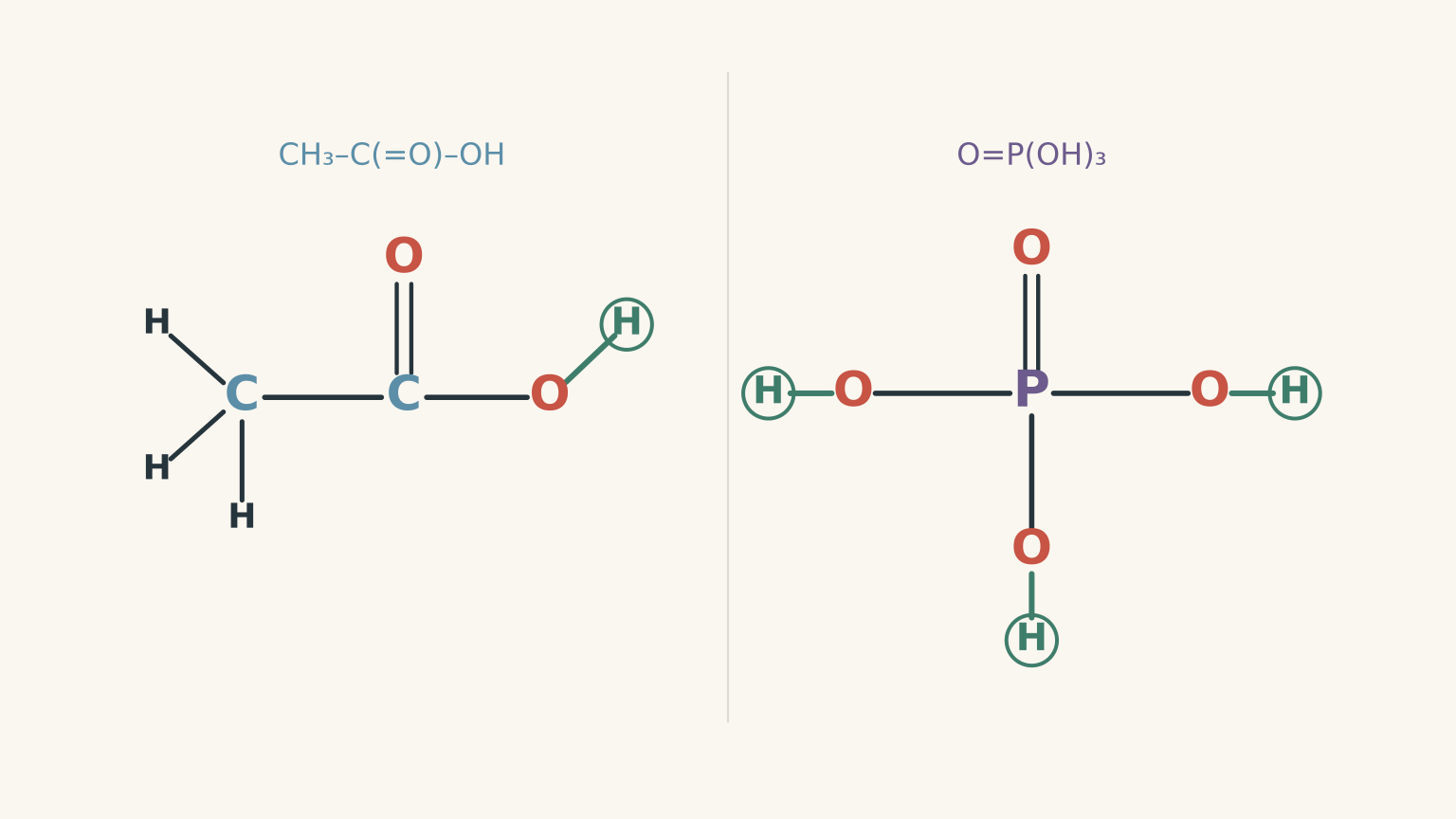
Ethanoic acid, \(\ce{CH3COOH}\), contains four hydrogen atoms, but it is monoprotic. Phosphoric acid, \(\ce{H3PO4}\), contains only three hydrogen atoms, yet it is triprotic. So counting every hydrogen in a chemical formula won’t give you the correct answer.
The trick is to count how many hydrogen ions, \(\mathrm{H}^{+}\), an acid molecule can donate. One transferable proton makes an acid monoprotic, two make it diprotic, and three make it triprotic.
The difference becomes clear when you look at where the hydrogen atoms are attached in the structure.
Due to technical limitations, this figure may display incorrectly or contain inaccuracies. Please check key details against your course materials.
01The rule: count transferable protons, not total hydrogen atoms
In Brønsted-Lowry theory, an acid is a proton donor and a base is a proton acceptor.
A proton is a hydrogen ion, \(\mathrm{H}^{+}\). When an acid transfers a proton to water, the water molecule accepts it and becomes hydronium, \(\ce{H3O+}\).
The number of protons an acid can donate per molecule is called its proticity.
There are three common classifications:
| Acid classification | Number of transferable protons | Example |
|---|---|---|
| Monoprotic | 1 | \(\ce{HCl}\) |
| Diprotic | 2 | \(\ce{H2SO4}\) |
| Triprotic | 3 | \(\ce{H3PO4}\) |
You may also encounter the terms ionisable hydrogen and replaceable hydrogen. They refer to the same idea in this context.
Notice that these definitions describe the maximum number of protons an acid molecule can donate. They don’t tell you how readily it donates them.
How to identify the acidic hydrogens in a structure
For common acids in HSC Chemistry, use this method.
Step 1: Find the hydrogen atoms.
Start with the structural formula, not just the molecular formula.
If you are given a condensed formula, expand it enough to see which atoms are bonded to hydrogen.
Step 2: Look for potential acid sites.
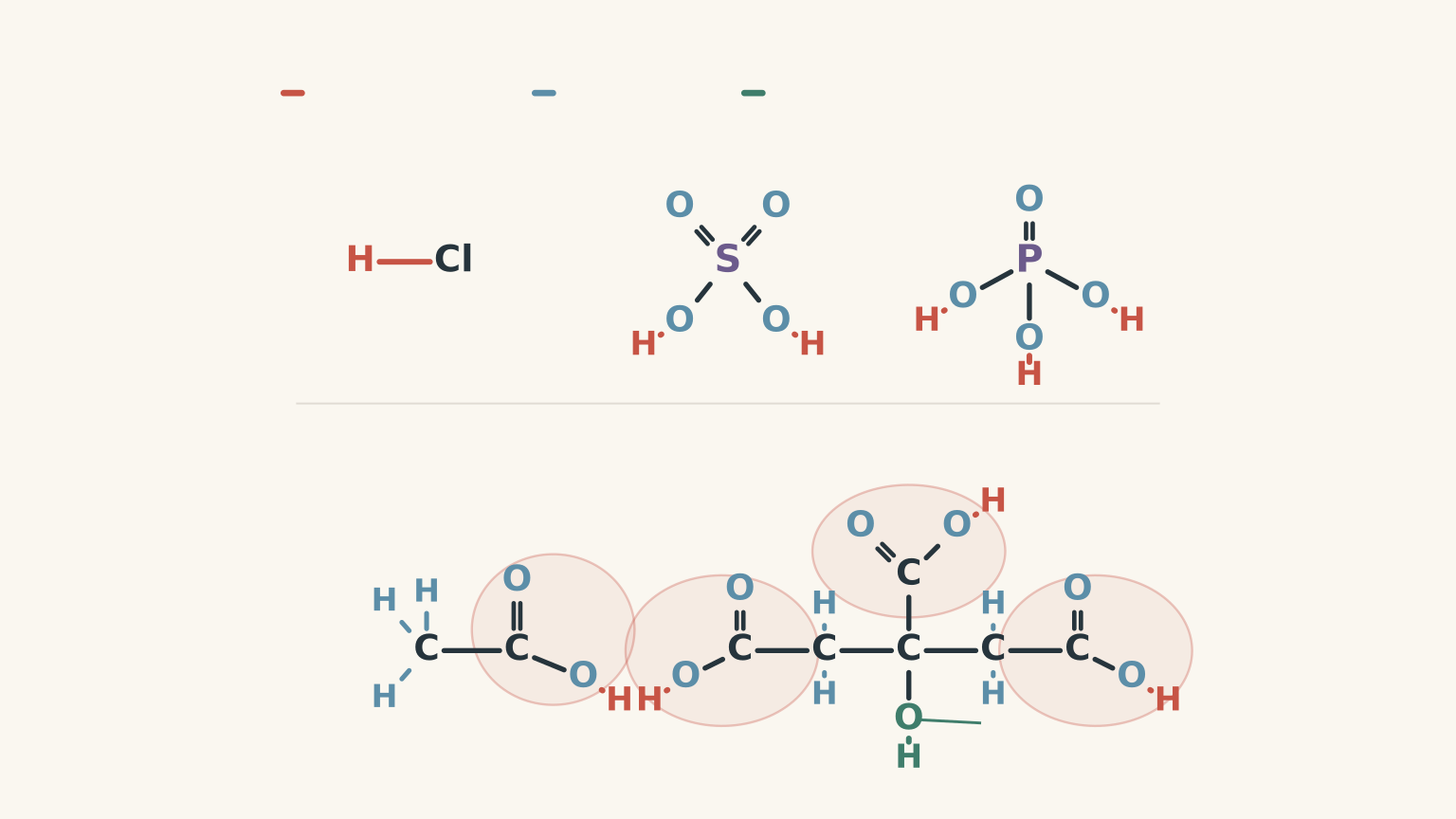
In common inorganic oxoacids, such as sulfuric acid and phosphoric acid, the acidic hydrogens are attached to oxygen atoms.
In organic carboxylic acids, look for the carboxyl group:
\[ \ce{-COOH} \]
Each carboxyl group contributes one acidic hydrogen: the hydrogen attached to its oxygen.
For simple binary acids such as hydrochloric acid, the hydrogen attached to the halogen is the transferable proton.
Step 3: Ignore hydrogens that aren’t normally acidic in the given context.
This is where students often make mistakes.
Hydrogens attached to carbon in ordinary organic molecules are generally not donated as \(\mathrm{H}^{+}\) in standard aqueous HSC acid-base reactions.
Also, don’t automatically count every O-H bond. An alcohol group, \(\ce{-OH}\), is not normally treated as an additional readily ionisable acid site in ordinary aqueous HSC questions.
Step 4: Count the transferable protons.
Count the acid sites, then check that removing each proton produces a chemically reasonable conjugate base.
Each proton donation removes one positive charge from the acid particle, making its charge one unit more negative.
Due to technical limitations, this figure may display incorrectly or contain inaccuracies. Please check key details against your course materials.
A quick structural comparison
| Acid | Important structural feature | Transferable protons | Classification |
|---|---|---|---|
| Hydrochloric acid, \(\ce{HCl}\) | One H-Cl bond | 1 | Monoprotic |
| Ethanoic acid, \(\ce{CH3COOH}\) | One \(\ce{-COOH}\) group | 1 | Monoprotic |
| Sulfuric acid, \(\ce{H2SO4}\) | Two O-H groups | 2 | Diprotic |
| Carbonic acid, \(\ce{H2CO3}\) | Two O-H groups | 2 | Diprotic |
| Phosphoric acid, \(\ce{H3PO4}\) | Three O-H groups | 3 | Triprotic |
| Citric acid | Three \(\ce{-COOH}\) groups and one alcohol O-H | 3 | Triprotic |
The final row is worth remembering. Citric acid contains four O-H bonds, but only three are counted as readily ionisable acid protons in ordinary aqueous acid-base chemistry.
For a closer explanation of why carboxyl groups behave as acids, see Organic Acids and Bases: HSC Chemistry Structures and Reactions.
02Worked example: classify oxalic acid from its structure
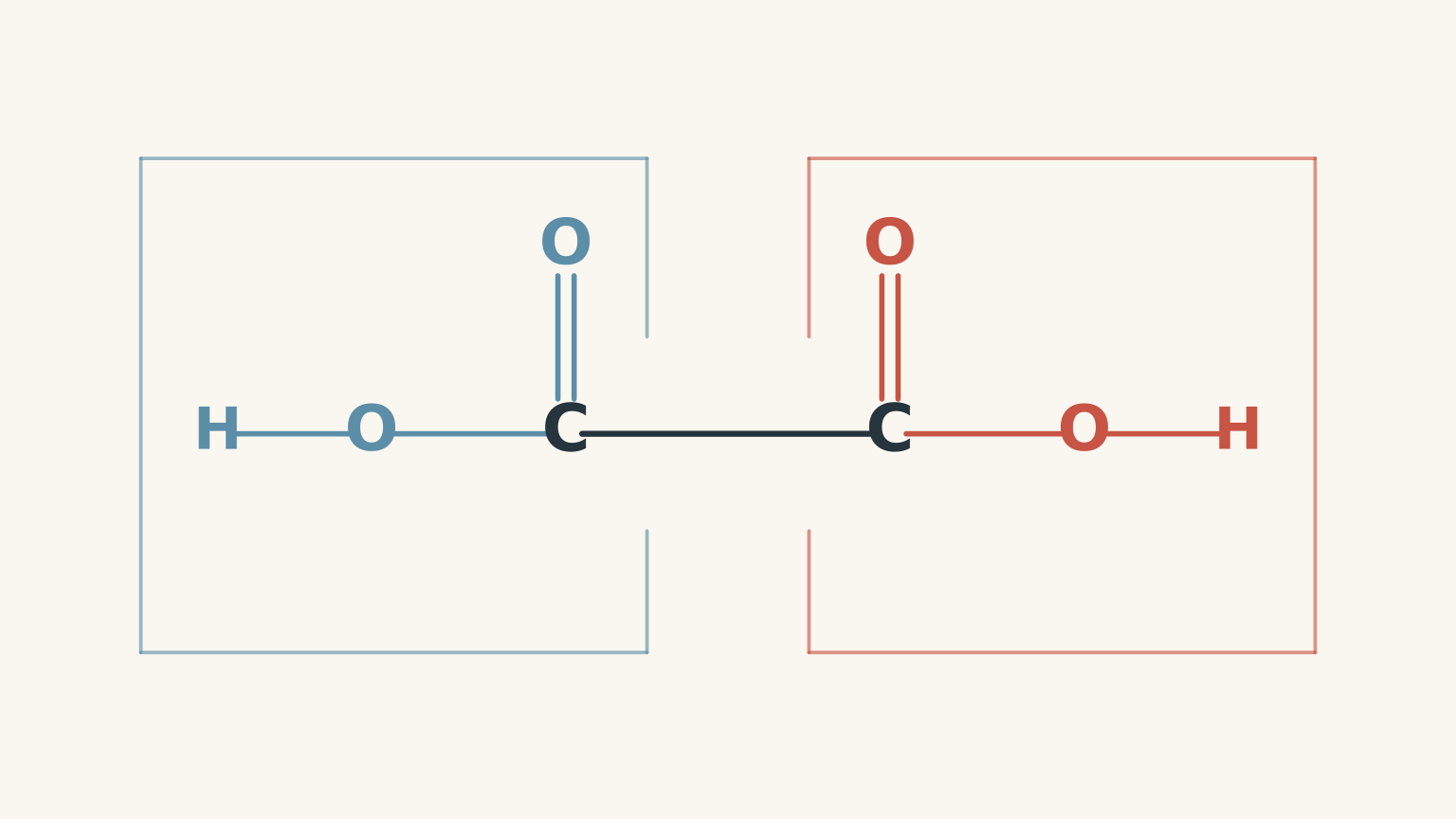
Question: Oxalic acid has the structural formula \(\ce{HOOC-COOH}\).
Determine whether oxalic acid is monoprotic, diprotic or triprotic. Show the conjugate base formed after each proton donation.
Step 1
The structure contains two carboxyl groups:
\[ \ce{-COOH} \]
Each group contains one O-H hydrogen that can be donated as a proton.
Step 2
There are two carboxyl groups, each contributing one acidic proton.
Therefore, oxalic acid can donate two protons per molecule.
It is diprotic.
Step 3
Oxalic acid donates one proton to water:
\[ \ce{H2C2O4 + H2O <=> H3O+ + HC2O4^-} \]
The hydrogen oxalate ion, \(\mathrm{HC_{2}O_{4}}^{-}\), is formed.
Step 4
The hydrogen oxalate ion can donate its remaining acidic proton:
\[ \ce{HC2O4^- + H2O <=> H3O+ + C2O4^2-} \]
The final product is the oxalate ion, \(\mathrm{C_{2}O_{4}}^{2-}\).
Oxalic acid is therefore diprotic, even though you could initially identify its classification simply by counting the two carboxyl groups.
Due to technical limitations, this figure may display incorrectly or contain inaccuracies. Please check key details against your course materials.
03Each proton donation creates a conjugate acid-base pair
There is another reason to understand the structure rather than simply memorise the classification.
When an acid donates a proton, it becomes its conjugate base.
A conjugate acid-base pair consists of two species that differ by exactly one proton.
Consider phosphoric acid, \(\ce{H3PO4}\).
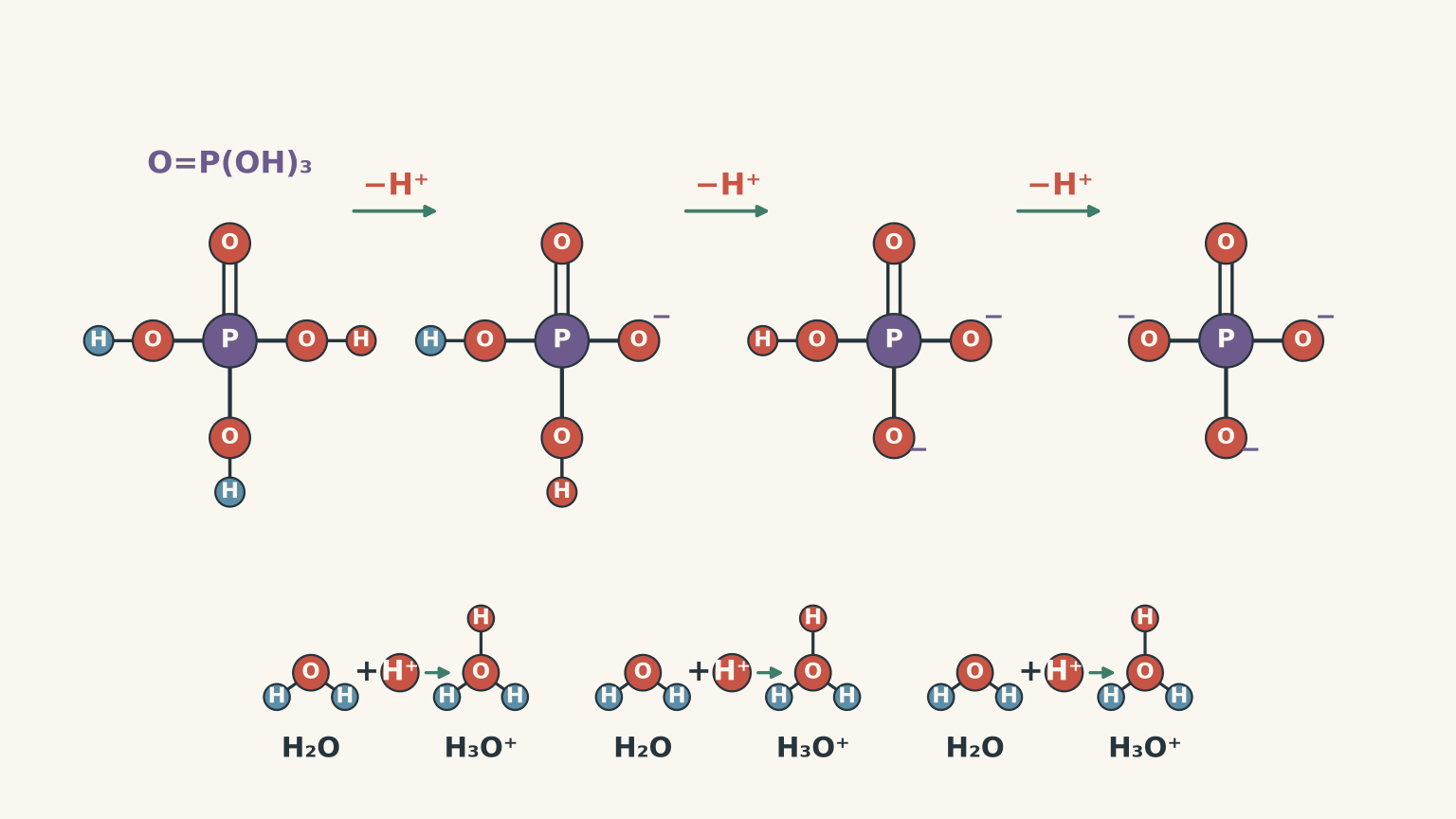
It can donate three protons, but these donations happen in separate stages.
Due to technical limitations, this figure may display incorrectly or contain inaccuracies. Please check key details against your course materials.
The first proton donation
Phosphoric acid transfers one proton to water:
\[ \ce{H3PO4 + H2O <=> H3O+ + H2PO4^-} \]
Two conjugate acid-base pairs are formed:
- \(\ce{H3PO4 / H2PO4^-}\)
- \(\ce{H2O / H3O+}\)
Phosphoric acid is the acid because it donates a proton. Water is the base because it accepts one.
The second proton donation
The dihydrogen phosphate ion can donate another proton:
\[ \ce{H2PO4^- + H2O <=> H3O+ + HPO4^2-} \]
The new conjugate acid-base pairs are:
- \(\ce{H2PO4^- / HPO4^2-}\)
- \(\ce{H2O / H3O+}\)
The third proton donation
The hydrogen phosphate ion can donate its final acidic proton:
\[ \ce{HPO4^2- + H2O <=> H3O+ + PO4^3-} \]
The conjugate acid-base pairs are:
- \(\ce{HPO4^2- / PO4^3-}\)
- \(\ce{H2O / H3O+}\)
The complete sequence is:
\[ \ce{H3PO4 -> H2PO4^- -> HPO4^2- -> PO4^3-} \]
Each step removes exactly one proton and makes the remaining species one unit more negative.
This gives you a useful way to check your classification. A triprotic acid should have a sequence of three possible proton donations, producing three successive conjugate bases.
Does each proton leave equally easily?
No. This is an important distinction between proticity and acid strength.
For most common polyprotic acids, successive proton donations become less favourable.
Why?
After the first proton leaves, the remaining species has a negative charge. Removing another positive proton from an already negatively charged particle is generally less favourable.
For phosphoric acid, the three dissociation constants are approximately:
| Dissociation step | Approximate \(K_a\) at 25°C |
|---|---|
| First, \(K_{a1}\) | \(7.5 \times 10^{-3}\) |
| Second, \(K_{a2}\) | \(6.2 \times 10^{-8}\) |
| Third, \(K_{a3}\) | \(4.2 \times 10^{-13}\) |
The first proton is donated much more readily than the second, and the second much more readily than the third.
Phosphoric acid is still triprotic. Its classification doesn’t change just because the third proton is difficult to remove.
These approximate values are consistent with the treatment of polyprotic acids in OpenStax Chemistry.
04How a titration can test the number of transferable protons
Structural reasoning gives you the predicted number of acidic protons. A titration can provide experimental evidence about the acid’s total neutralising capacity.
Imagine you have an unknown acid and want to determine whether it is monoprotic or diprotic.
You prepare a known volume of the acid solution in a conical flask. A burette containing a standard sodium hydroxide solution is positioned above the flask.
As sodium hydroxide enters the flask, hydroxide ions react with the acid by accepting protons.
A pH probe immersed in the flask measures the pH after each addition. The probe connects to a meter, allowing you to record pH against the volume of sodium hydroxide added.
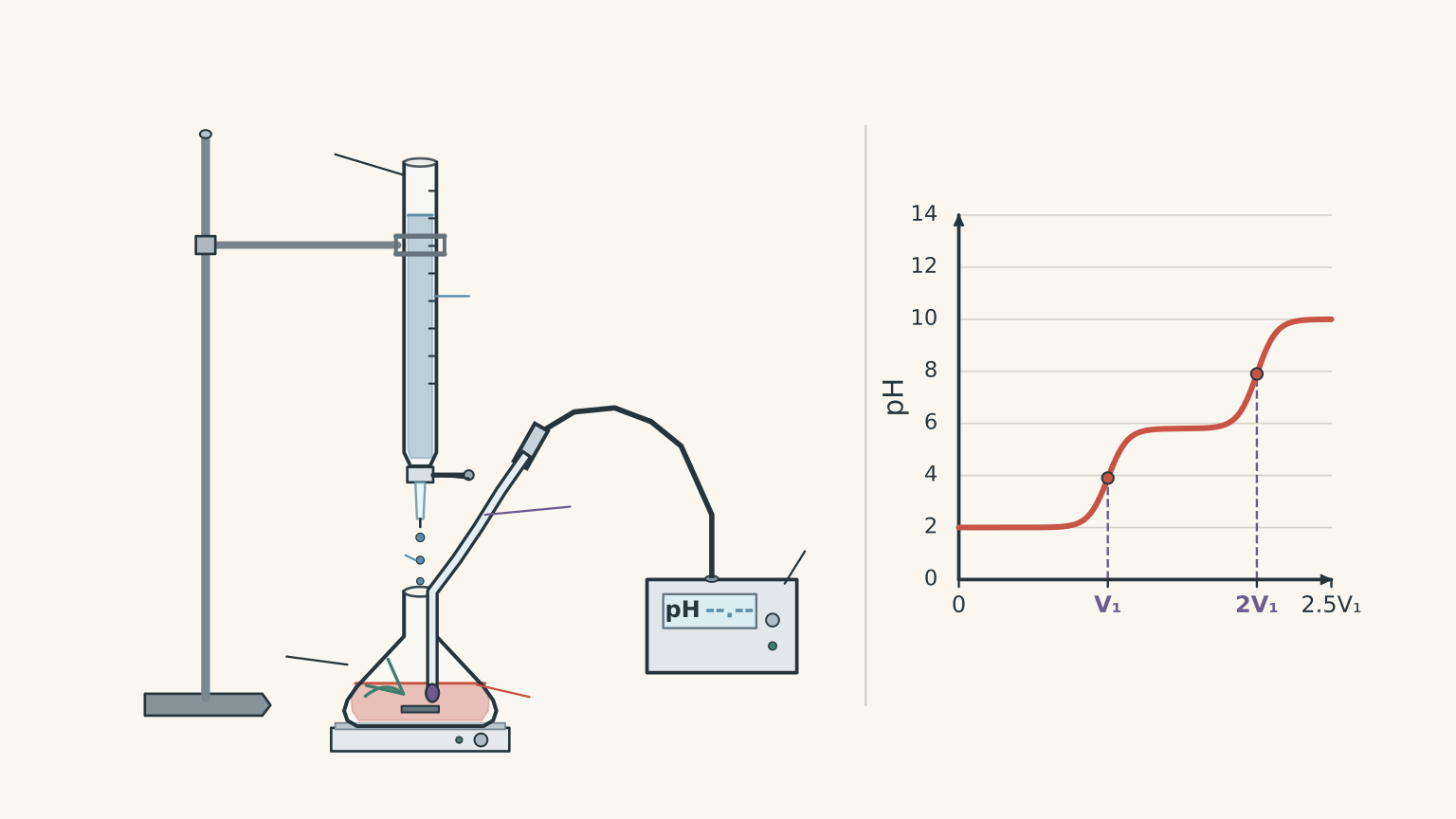
Due to technical limitations, this figure may display incorrectly or contain inaccuracies. Please check key details against your course materials.
What should the experiment show?
Consider a generic diprotic acid, \(\ce{H2A}\).
It can donate two protons through two separate neutralisation reactions.
First:
\[ \ce{H2A + OH^- -> HA^- + H2O} \]
Then:
\[ \ce{HA^- + OH^- -> A^2- + H2O} \]
Each acid molecule requires two hydroxide ions for complete neutralisation.
If the two stages are sufficiently separated in their equilibrium behaviour, the titration curve should show two distinct equivalence points.
The second equivalence point occurs at twice the volume of sodium hydroxide required for the first.
For a triprotic acid, three distinct equivalence points may be observed if all three stages can be resolved.
Why the original measurement can be misleading
Suppose you use an indicator and notice only one clear colour change.
You might conclude that the acid is monoprotic.
But an indicator only changes colour over a particular pH range. It doesn’t necessarily reveal every proton-transfer stage.
A better investigation uses a calibrated pH probe to record the pH at many small volume increments. The temperature and solution concentrations should also be controlled.
Even then, some equivalence points may be difficult to resolve. Phosphoric acid is a particularly useful example: its third dissociation is so weak that its third equivalence point is not well defined when using 0.100 mol L\(^{-1}\) sodium hydroxide.
The important conclusion is that a visible pH jump is evidence of a neutralisation stage, not a perfect count of every transferable proton.
This is why structural reasoning and experimental evidence should be considered together.
Worked example: calculate the neutralisation volumes of a diprotic acid
Question: A 25.00 mL sample of an unknown diprotic acid solution is titrated with 0.1000 mol L\(^{-1}\) sodium hydroxide.
The first equivalence point occurs after 18.40 mL of sodium hydroxide has been added.
Calculate:
- The amount of acid in the original sample.
- The concentration of the acid solution.
- The expected volume of sodium hydroxide at the second equivalence point.
Assume both equivalence points can be resolved and no side reactions occur.
Step 1
Use:
\[ n=cV \]
where \(n\) is amount in mol, \(c\) is concentration in mol L\(^{-1}\), and \(V\) is volume in litres.
Convert the volume:
\[ 18.40\text{ mL}=0.01840\text{ L} \]
Therefore:
\[ \begin{aligned} n(\ce{NaOH})&=0.1000\times0.01840\\ &=0.001840\text{ mol} \end{aligned} \]
Step 2
At the first equivalence point, one mole of hydroxide ions has reacted with each mole of acid molecules.
Therefore:
\[ n(\text{acid})=0.001840\text{ mol} \]
Step 3
The original acid volume was 25.00 mL, or 0.02500 L.
\[ \begin{aligned} c&=\frac{n}{V}\\ &=\frac{0.001840}{0.02500}\\ &=0.07360\text{ mol L}^{-1} \end{aligned} \]
Step 4
A diprotic acid requires two moles of hydroxide ions per mole of acid.
Therefore:
\[ n(\ce{NaOH})=2(0.001840) \]
\[ =0.003680\text{ mol} \]
Now calculate the volume of sodium hydroxide:
\[ \begin{aligned} V&=\frac{n}{c}\\ &=\frac{0.003680}{0.1000}\\ &=0.03680\text{ L}\\ &=36.80\text{ mL} \end{aligned} \]
The second equivalence point is therefore at 36.80 mL.
The original acid concentration is \(0.07360\ \mathrm{mol\,L^{-1}}\), and the second equivalence point occurs at twice the first volume.
This is consistent with a diprotic acid.
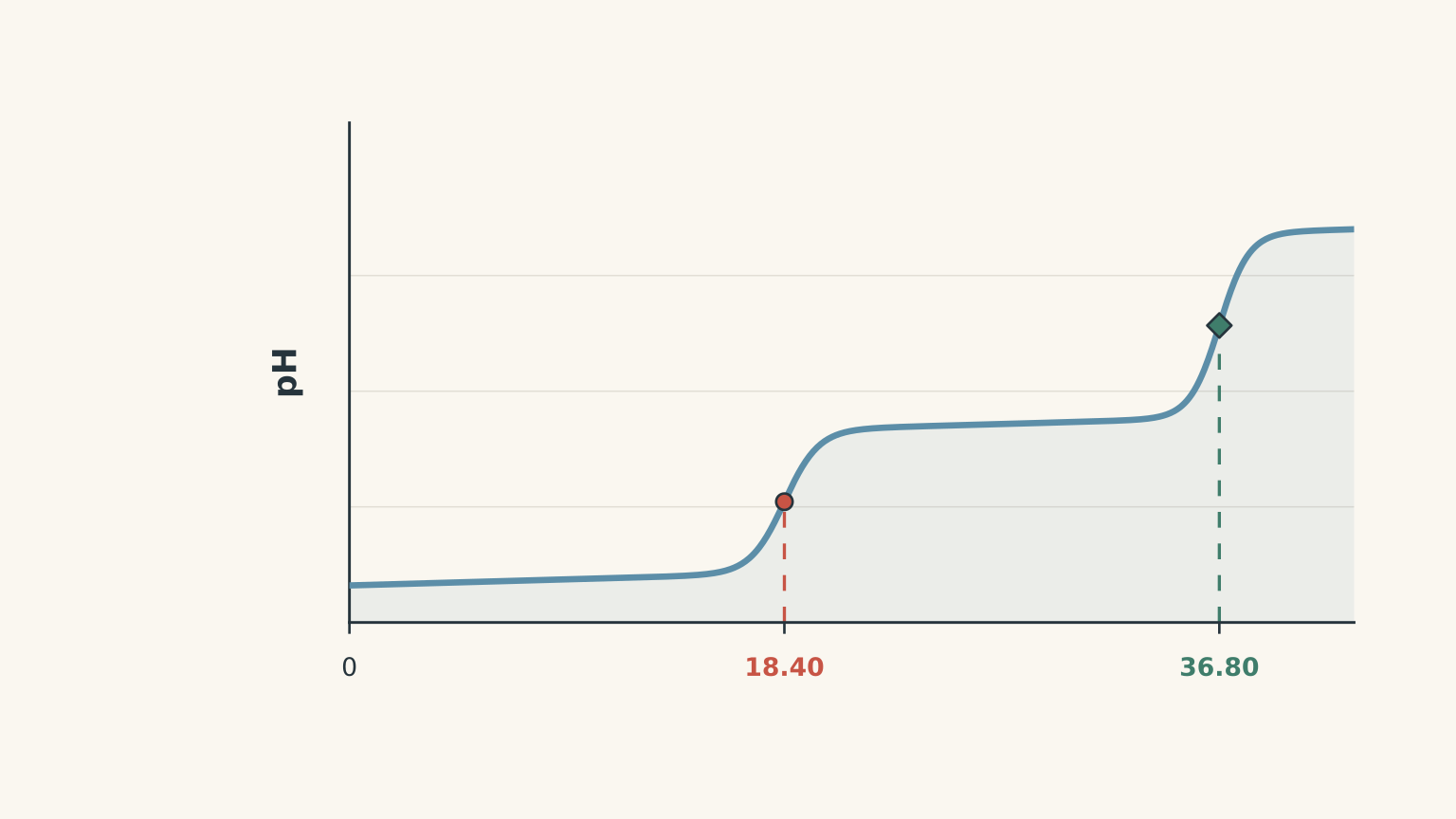
Due to technical limitations, this figure may display incorrectly or contain inaccuracies. Please check key details against your course materials.
05Don’t confuse proticity, strength, amount and concentration
These four ideas are related, but they describe different properties.
| Term | What it describes | How to determine it |
|---|---|---|
| Proticity | Maximum number of protons donated per acid molecule | Structural formula and proton-transfer reactions |
| Acid strength | How readily each proton is donated | \(K_a\) and equilibrium position |
| Amount | Total quantity of acid present | \(n=cV\) |
| Concentration | Amount of acid per unit volume | \(c=n/V\) |
Proticity is not acid strength
Consider hydrochloric acid and phosphoric acid.
Hydrochloric acid is monoprotic but strong. It ionises essentially completely in water.
Phosphoric acid is triprotic but weak. Its successive proton donations are equilibrium processes, and the later stages are much less favourable.
Therefore, having more transferable protons does not automatically make an acid stronger.
Proticity is not concentration
Concentration tells you how many moles of acid are present per litre of solution.
For example, a 0.100 mol L\(^{-1}\) solution of hydrochloric acid contains 0.100 mol of acid per litre.
A 0.100 mol L\(^{-1}\) solution of phosphoric acid also contains 0.100 mol of acid per litre.
However, one mole of hydrochloric acid has a maximum neutralising capacity of one mole of hydroxide ions, whereas one mole of phosphoric acid has a maximum capacity of three moles of hydroxide ions.
Proticity is not the amount of hydronium already present
This distinction is particularly important when discussing pH.
A triprotic acid does not automatically release all three protons into water.
For a weak polyprotic acid, only a proportion of its molecules may have donated their first proton, and even fewer may have donated their second or third.
The hydronium concentration depends on the equilibrium position of the individual proton-transfer reactions.
If you need to compare \(K_a\), pH, acid strength and concentration in more detail, see How to Explain Acid Strength Using Equilibrium Rather Than pH Alone.
A useful calculation: maximum neutralising capacity
If an acid has \(z\) transferable protons per molecule and contains \(n\) moles of acid, its maximum proton capacity is:
\[ n(\mathrm{H}^{+})=zn(\text{acid}) \]
This assumes complete neutralisation of all acidic protons by a suitable strong base, with no competing reactions.
For example, 0.0200 mol of a diprotic acid has a maximum capacity of:
\[ n(\mathrm{H}^{+})=2(0.0200) \]
\[ =0.0400\text{ mol} \]
The same amount of a triprotic acid would have a maximum capacity of:
\[ n(\mathrm{H}^{+})=3(0.0200) \]
\[ =0.0600\text{ mol} \]
This is the theoretical amount of proton equivalents available for neutralisation. It is not a prediction of the initial hydronium concentration.
06Questions and solutions
Question 1
Sulfuric acid has the structural formula:
\[ \ce{HO-S(=O)2-OH} \]
Identify whether sulfuric acid is monoprotic, diprotic or triprotic.
Write the two possible proton-transfer reactions with water and identify the conjugate acid-base pairs.
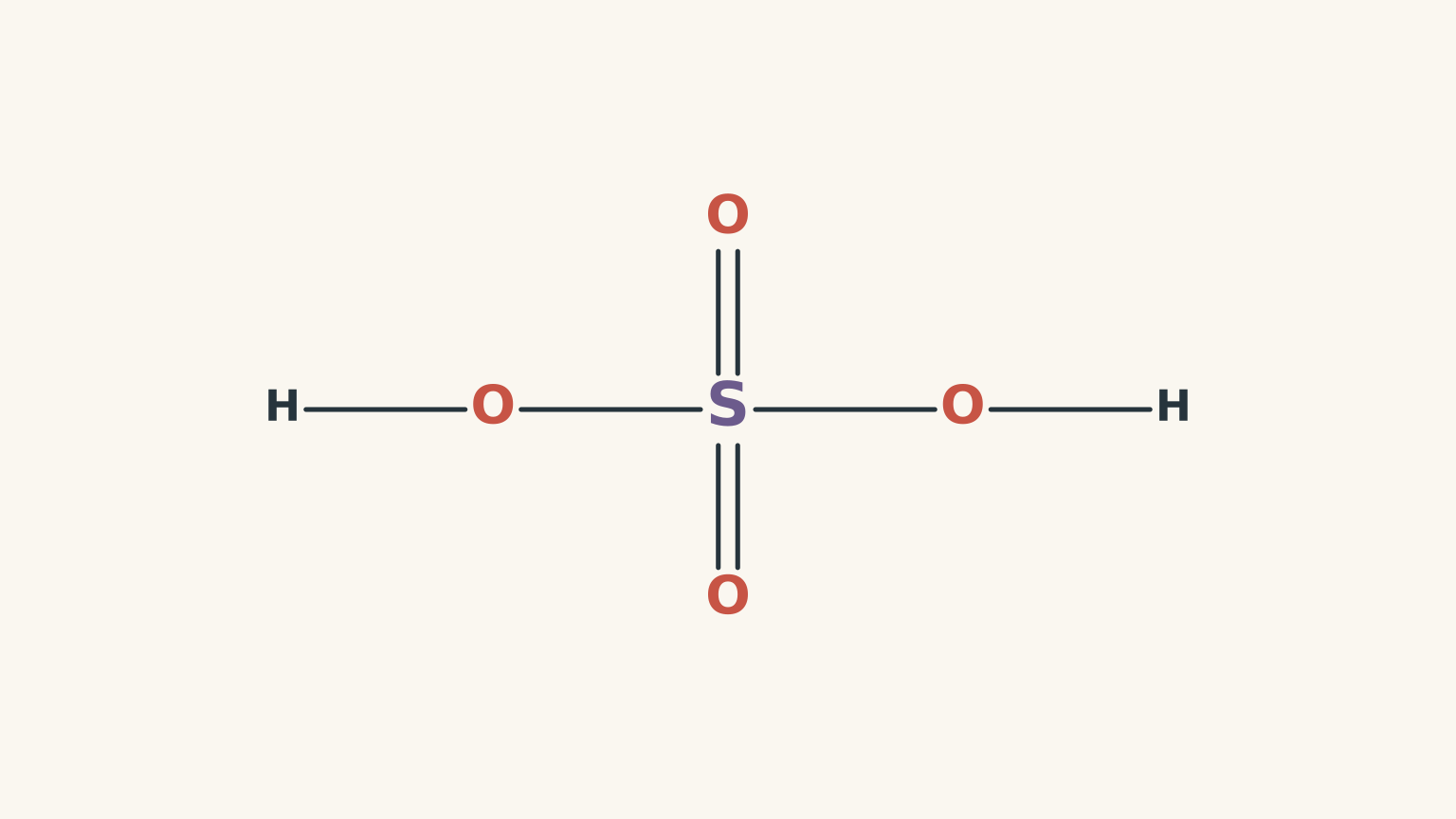
Due to technical limitations, this figure may display incorrectly or contain inaccuracies. Please check key details against your course materials.
Solution 1
Sulfuric acid is diprotic because it contains two transferable O-H hydrogens.
Each hydrogen can be donated separately.
The first proton-transfer reaction is:
\[ \ce{H2SO4 + H2O -> H3O+ + HSO4^-} \]
The conjugate acid-base pairs are:
- \(\ce{H2SO4 / HSO4^-}\)
- \(\ce{H2O / H3O+}\)
The second proton-transfer reaction is:
\[ \ce{HSO4^- + H2O <=> H3O+ + SO4^2-} \]
The conjugate acid-base pairs are:
- \(\ce{HSO4^- / SO4^2-}\)
- \(\ce{H2O / H3O+}\)
The important point is that the hydrogen sulfate ion still has one transferable proton after the first donation.
Therefore, sulfuric acid can donate two protons per molecule.
Question 2
Citric acid has the following structural formula:
\[ \ce{HOOC-CH2-C(OH)(COOH)-CH2-COOH} \]
A student identifies four O-H bonds and concludes that citric acid is tetraprotic.
Explain why this classification is incorrect and determine the correct classification.
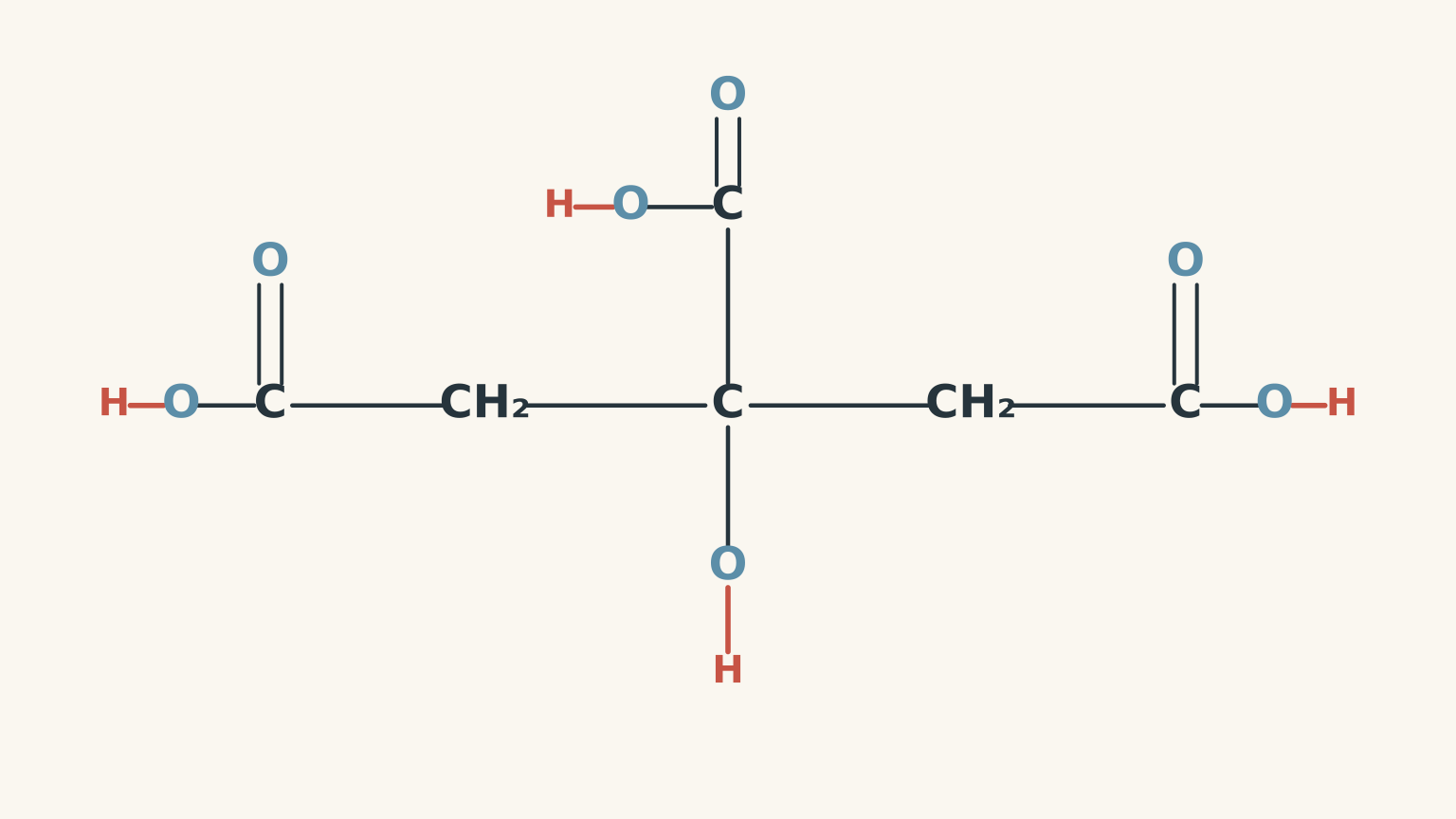
Due to technical limitations, this figure may display incorrectly or contain inaccuracies. Please check key details against your course materials.
Solution 2
Citric acid is triprotic, not tetraprotic.
The student has counted every O-H bond without considering the type of functional group involved.
There are three carboxyl groups in the structure:
\[ \ce{-COOH} \]
Each carboxyl group contains one acidic O-H hydrogen that can be donated to a base.
The fourth O-H bond belongs to an alcohol group. In ordinary aqueous HSC acid-base chemistry, this alcohol hydrogen is not counted as an additional readily ionisable acid proton.
Therefore:
- Three carboxyl groups contribute three transferable protons.
- The alcohol O-H group does not provide a fourth readily transferable proton under the conditions considered.
Citric acid is triprotic.
This example shows why simply counting O-H bonds can also produce an incorrect answer. You need to identify the chemical environment of each hydrogen.
Question 3
An unknown weak acid, \(\ce{H2A}\), undergoes two successive ionisation reactions in water.
At 25°C, its acid dissociation constants are:
\[ K_{a1}=1.0\times10^{-3} \]
\[ K_{a2}=1.0\times10^{-7} \]
Determine whether the acid is monoprotic or diprotic.
Write both ionisation equations, identify the conjugate acid-base pairs, and explain why the two protons are not donated to the same extent.
Solution 3
The acid is diprotic because it can donate two protons, even though the second donation is much less favourable than the first.
The first ionisation reaction is:
\[ \ce{H2A + H2O <=> H3O+ + HA^-} \]
The conjugate acid-base pairs are:
- \(\ce{H2A / HA^-}\)
- \(\ce{H2O / H3O+}\)
The second ionisation reaction is:
\[ \ce{HA^- + H2O <=> H3O+ + A^2-} \]
The conjugate acid-base pairs are:
- \(\ce{HA^- / A^2-}\)
- \(\ce{H2O / H3O+}\)
Now compare the two dissociation constants.
\[ \frac{K_{a1}}{K_{a2}} = \frac{1.0\times10^{-3}}{1.0\times10^{-7}} \]
\[ =10^4 \]
The first dissociation constant is 10,000 times larger than the second.
This means the first proton is donated much more readily than the second.
After the first proton leaves, the acid becomes negatively charged. Removing another positive proton from this negatively charged species is less favourable.
The tempting mistake is to assume that a weak second ionisation means the acid only has one acidic proton.
That confuses acid strength with proticity.
The second proton can still be donated, so the acid remains diprotic.
Question 4
Two separate acid solutions are prepared at 25°C.
Both have a volume of 25.00 mL and an initial concentration of 0.0500 mol L\(^{-1}\).
The following illustrative measurements are obtained:
| Property | Solution X | Solution Y |
|---|---|---|
| Acid | \(\ce{HCl}\) | \(\ce{H3PO4}\) |
| Concentration | 0.0500 mol L\(^{-1}\) | 0.0500 mol L\(^{-1}\) |
| Volume | 25.00 mL | 25.00 mL |
| Measured pH | 1.30 | 1.80 |
Answer the following:
(a) Calculate the amount of acid in each solution.
(b) Calculate the maximum amount of hydroxide ions required to completely neutralise each sample.
(c) Which solution has the greater initial hydronium ion concentration?
(d) Explain why the solution with the greater neutralising capacity does not have the greater initial hydronium concentration.
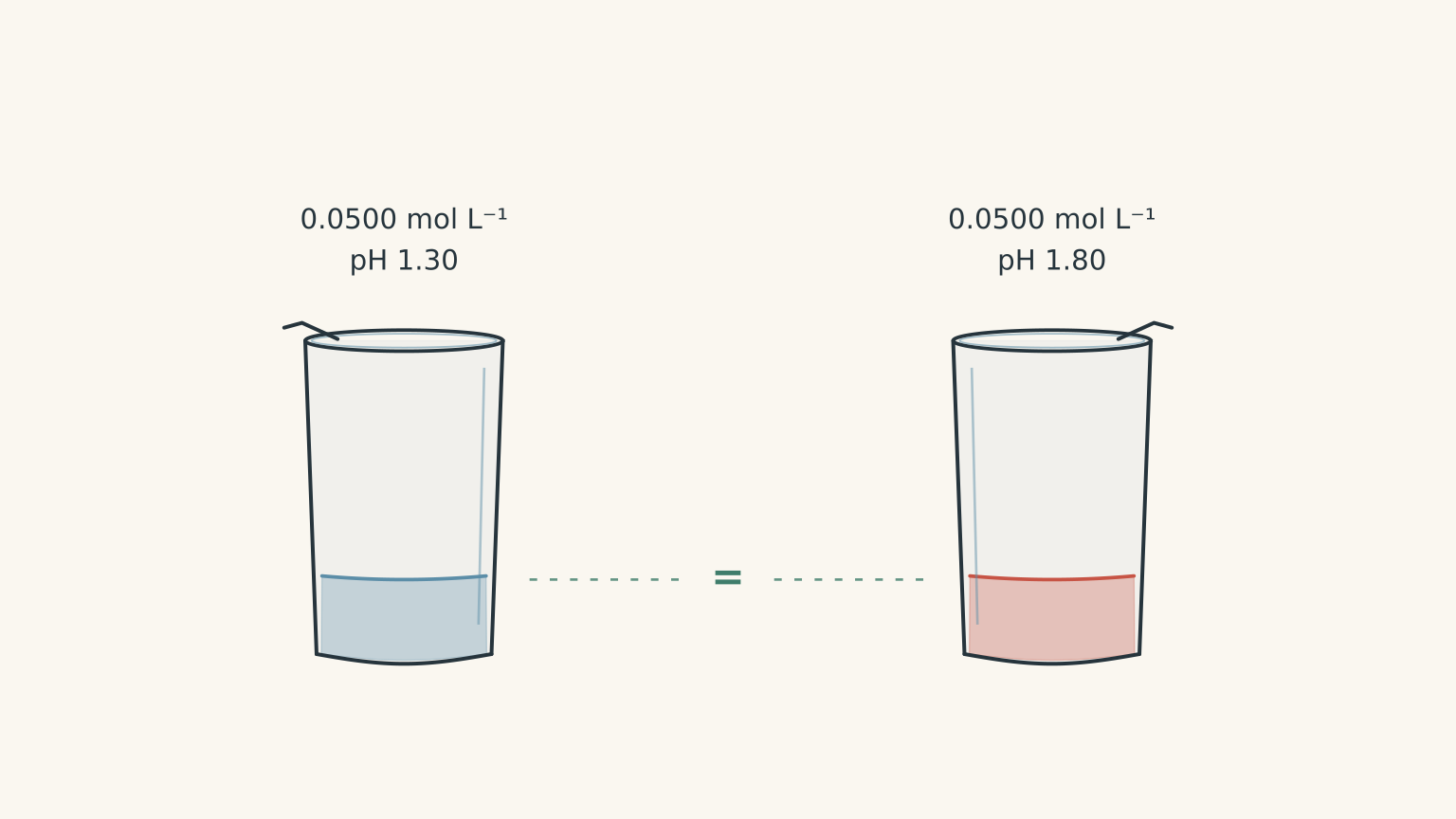
Due to technical limitations, this figure may display incorrectly or contain inaccuracies. Please check key details against your course materials.
Solution 4
Solution X has the greater initial hydronium concentration, but solution Y has the greater maximum neutralising capacity.
The difference comes from acid strength and proticity describing separate properties.
(a) Calculate the amount of acid in each solution.
Use:
\[ n=cV \]
Convert the volume:
\[ 25.00\text{ mL}=0.02500\text{ L} \]
For solution X:
\[ \begin{aligned} n(\ce{HCl})&=0.0500\times0.02500\\ &=0.00125\text{ mol} \end{aligned} \]
For solution Y:
\[ \begin{aligned} n(\ce{H3PO4})&=0.0500\times0.02500\\ &=0.00125\text{ mol} \end{aligned} \]
Both solutions contain the same amount of acid.
(b) Calculate the maximum neutralising capacity.
Hydrochloric acid is monoprotic, so one mole of \(\ce{HCl}\) requires one mole of hydroxide ions.
\[ n(\mathrm{OH}^{-})=1(0.00125) \]
\[ =0.00125\text{ mol} \]
Phosphoric acid is triprotic, so complete neutralisation requires three moles of hydroxide ions per mole of acid.
\[ n(\mathrm{OH}^{-})=3(0.00125) \]
\[ =0.00375\text{ mol} \]
Therefore:
| Solution | Maximum amount of \(\mathrm{OH}^{-}\) required |
|---|---|
| X: HCl | 0.00125 mol |
| Y: H3PO4 | 0.00375 mol |
Solution Y has three times the maximum neutralising capacity.
(c) Determine the hydronium ion concentrations.
Use the HSC pH relationship:
\[ [\ce{H3O+}]=10^{-\mathrm{pH}} \]
For solution X:
\[ [\ce{H3O+}]=10^{-1.30} \]
\[ =0.0501\text{ mol L}^{-1} \]
For solution Y:
\[ [\ce{H3O+}]=10^{-1.80} \]
\[ =0.0158\text{ mol L}^{-1} \]
Solution X has the greater initial hydronium concentration.
(d) Explain the difference.
Hydrochloric acid is a strong monoprotic acid. It ionises essentially completely in water, releasing its available proton.
Phosphoric acid is a weak triprotic acid. Its three proton donations occur through separate equilibria, and the second and third donations are much less favourable.
Consequently, phosphoric acid has a greater theoretical neutralising capacity, but it does not release all three protons into water immediately.
This is why solution X has the lower pH, even though solution Y can eventually neutralise more hydroxide ions per mole of acid.
Question 5
Extension challenge.
Two phosphorus-containing acids have the following structural formulas:
\[ \text{Acid X: }\ce{O=P(OH)3} \]
\[ \text{Acid Y: }\ce{H-P(=O)(OH)2} \]
Both have three hydrogen atoms in their molecular formulas.
When titrated with 0.1000 mol L\(^{-1}\) sodium hydroxide, both acids produce two clearly visible pH jumps.
The following additional information is available:
- For acid X, the approximate dissociation values at 25°C are \(pK_{a1}=2.15\), \(pK_{a2}=7.20\), and \(pK_{a3}=12.35\).
- For acid Y, the P-H hydrogen does not ionise as \(\mathrm{H}^{+}\) in ordinary aqueous acid-base conditions. Only the two O-H hydrogens are transferable.
- Each acid sample has a volume of 25.00 mL and a concentration of 0.1000 mol L\(^{-1}\).
- Assume complete neutralisation of all transferable protons by excess sodium hydroxide, with no competing reactions.
Answer the following:
(a) Classify both acids as monoprotic, diprotic or triprotic.
(b) Calculate the volume of 0.1000 mol L\(^{-1}\) sodium hydroxide required for complete neutralisation of each sample.
(c) Explain why both titration curves can show two clear pH jumps even though the acids have different proticities.
(d) Write the complete sequence of conjugate bases for each acid.
(e) Explain why neither the number of hydrogen atoms in the molecular formula nor the number of visible pH jumps is sufficient by itself to identify the acid’s proticity.
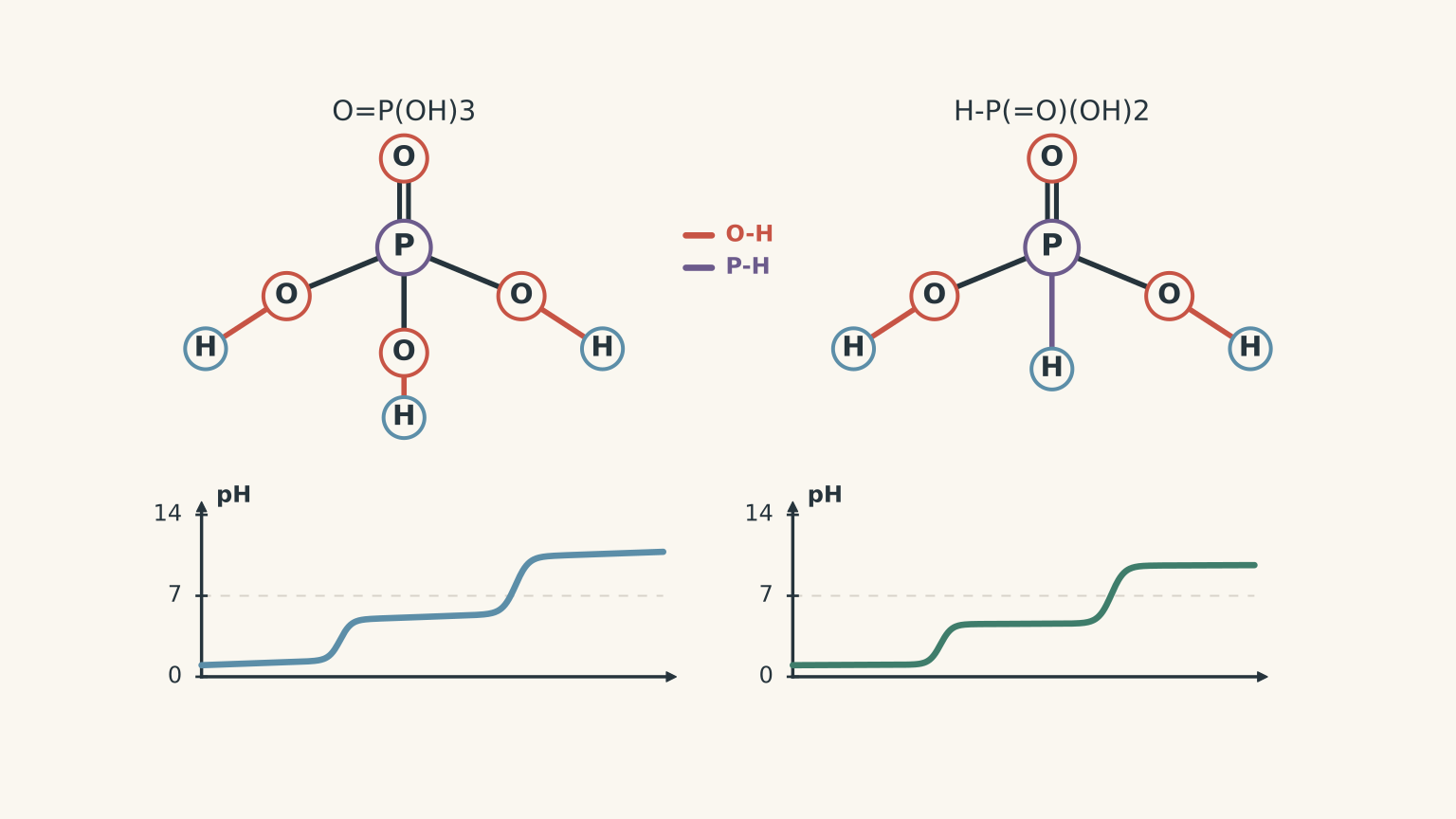
Due to technical limitations, this figure may display incorrectly or contain inaccuracies. Please check key details against your course materials.
Solution 5
Acid X is triprotic, whereas acid Y is diprotic.
The two acids produce similar-looking titration curves for different chemical reasons. This is the key distinction in the problem.
(a) Classify both acids.
Acid X is phosphoric acid:
\[ \ce{O=P(OH)3} \]
It contains three O-H groups, each capable of donating a proton.
Therefore, acid X is triprotic.
Acid Y is phosphorous acid:
\[ \ce{H-P(=O)(OH)2} \]
It contains two O-H groups and one P-H bond.
Under the stated aqueous conditions, the two O-H hydrogens are transferable, but the P-H hydrogen is not readily ionised as \(\mathrm{H}^{+}\).
Therefore, acid Y is diprotic.
Both molecular formulas contain three hydrogen atoms, but the bonding arrangements are different.
(b) Calculate the neutralisation volumes.
Start by calculating the amount of each acid.
\[ \begin{aligned} n&=cV\\ &=0.1000\times0.02500\\ &=0.002500\text{ mol} \end{aligned} \]
Each sample contains 0.002500 mol of acid.
For acid X, three moles of hydroxide ions are required per mole of acid:
\[ n(\mathrm{OH}^{-})=3(0.002500) \]
\[ =0.007500\text{ mol} \]
Calculate the volume of sodium hydroxide:
\[ \begin{aligned} V&=\frac{n}{c}\\ &=\frac{0.007500}{0.1000}\\ &=0.07500\text{ L}\\ &=75.00\text{ mL} \end{aligned} \]
For acid Y, only two moles of hydroxide ions are required per mole of acid:
\[ n(\mathrm{OH}^{-})=2(0.002500) \]
\[ =0.005000\text{ mol} \]
Therefore:
\[ \begin{aligned} V&=\frac{0.005000}{0.1000}\\ &=0.05000\text{ L}\\ &=50.00\text{ mL} \end{aligned} \]
The results are:
| Acid | Classification | NaOH volume for complete neutralisation |
|---|---|---|
| X: \(\ce{H3PO4}\) | Triprotic | 75.00 mL |
| Y: \(\ce{H3PO3}\) | Diprotic | 50.00 mL |
(c) Explain why both curves show two clear pH jumps.
This is where the two acids behave differently.
For acid Y, there are only two transferable protons. Its two O-H hydrogens are donated in successive stages.
The P-H hydrogen remains attached to phosphorus. There is no third acid dissociation stage under the stated conditions.
For acid X, all three O-H hydrogens are transferable. However, its third dissociation is extremely weak.
Its third dissociation constant is approximately:
\[ K_{a3}=10^{-12.35} \]
\[ \approx4.5\times10^{-13} \]
This means the third proton is donated very reluctantly to water.
With 0.1000 mol L\(^{-1}\) sodium hydroxide, the third equivalence point is not well resolved because the third dissociation occurs at a very high pH.
The third proton is still available for neutralisation by a sufficiently strong base. It simply doesn’t produce a clear third pH jump under these titration conditions.
This is a documented limitation of phosphoric acid titration curves. See the discussion of polyprotic acid titrations in Chemistry LibreTexts.
(d) Write the conjugate base sequences.
For acid X, phosphoric acid:
\[ \ce{H3PO4 -> H2PO4^- -> HPO4^2- -> PO4^3-} \]
Its three proton-transfer reactions are:
\[ \ce{H3PO4 + H2O <=> H3O+ + H2PO4^-} \]
\[ \ce{H2PO4^- + H2O <=> H3O+ + HPO4^2-} \]
\[ \ce{HPO4^2- + H2O <=> H3O+ + PO4^3-} \]
For acid Y, phosphorous acid:
\[ \ce{H3PO3 -> H2PO3^- -> HPO3^2-} \]
Its two proton-transfer reactions are:
\[ \ce{H3PO3 + H2O <=> H3O+ + H2PO3^-} \]
\[ \ce{H2PO3^- + H2O <=> H3O+ + HPO3^2-} \]
The P-H hydrogen remains in the final phosphite species.
This structural distinction is confirmed in OpenStax Chemistry’s discussion of phosphorous acid.
(e) Explain why hydrogen counts and visible pH jumps are insufficient.
The molecular formula tells you the total number of hydrogen atoms, but not which of those hydrogens can be transferred as protons.
Acid Y demonstrates this: it contains three hydrogen atoms, but only two are ionisable.
The titration curve also has a limitation. A weak proton-transfer stage may not produce a clearly identifiable equivalence point, even when the proton can still be neutralised by a sufficiently strong base.
Acid X demonstrates this: it is triprotic despite producing only two clearly visible pH jumps.
The correct method is therefore to examine the molecular structure, identify the transferable hydrogens, and use proton-transfer reactions to confirm the classification. Experimental titration data can support that conclusion, but the number of visible jumps is not always the complete answer.
07The method to remember
When an HSC Chemistry question asks you to identify a monoprotic, diprotic or triprotic acid from its structure, follow this sequence:
- Find the hydrogen atoms and identify which atoms they are bonded to.
- Identify the potential acidic groups, such as O-H groups in common oxoacids and carboxyl groups in organic acids.
- Exclude ordinary C-H bonds and O-H bonds that are not readily ionisable under the stated conditions.
- Count the transferable protons per acid molecule.
- Check the sequence of conjugate bases to confirm the number of possible proton donations.
- Keep proticity separate from acid strength, amount, concentration and pH.
The most important distinction is simple: proticity tells you how many protons an acid can donate; acid strength tells you how readily it donates them.
Once you can separate those two ideas, questions involving polyprotic acids, conjugate pairs and acid-base titrations become much easier to reason through.