
Ionic Strength Effects on pKa
Imagine measuring the same weak acid in two beakers at 25 °C. Both contain the same acid, at the same analytical concentration.
Imagine measuring the same weak acid in two beakers at 25 °C. Both contain the same acid, at the same analytical concentration. You add sodium chloride to one beaker, increasing its ionic strength.
Now calculate its pKa using the equilibrium concentrations. The two beakers can give different answers.
Has the acid actually become stronger, or has something changed about how its ions behave in solution?
The answer is the second one. This is the distinction between a thermodynamic dissociation constant and an apparent, concentration-based dissociation constant.
This article is an extension beyond the required NSW Year 12 Chemistry 2025 syllabus. It assumes you already understand acid dissociation, Ka, and pKa from the Acid-base reactions content. Year 12 Chemistry is the prerequisite starting point, not an assessment requirement for this extension.
01Start with the familiar acid-base model
For a weak monoprotic acid, HA, the dissociation reaction in water is:
\[ \ce{HA(aq) + H2O(l) <=> H3O+(aq) + A-(aq)} \]
The acid donates a proton to water, producing hydronium ions and its conjugate base.
At the HSC level, you calculate the acid dissociation constant using:
\[ K_a \approx \frac{[\ce{H3O+}][\mathrm{A}^{-}]} {[\ce{HA}]} \]
The square brackets represent equilibrium concentrations.
You then use:
\[ pK_a=-\log_{10}K_a \]
A larger Ka means a stronger acid, while a smaller pKa means a stronger acid.
If you need to refresh this comparison, see How to Compare Acid Strength Using pKa Values.
The concentration-based expression works well as an approximation in sufficiently dilute solutions. It assumes that concentration is a good measure of how effectively each species participates in the equilibrium.
That assumption is where things get interesting.
02Why does adding salt change anything?
Suppose you add sodium chloride to a solution containing a weak acid.
The salt dissociates:
\[ \ce{NaCl(aq) -> Na+(aq) + Cl-(aq)} \]
Neither ion needs to react with the weak acid for the solution’s chemistry to change.
The additional ions interact electrostatically with the existing ions.
Positive ions attract negative ions, while ions of the same charge repel one another. Consequently, each ion experiences an environment containing many other charged particles.
This surrounding distribution of ions is sometimes called an ionic atmosphere.
Concentration is not the same as activity
Imagine two rooms containing the same number of people.
In one room, everyone has plenty of space. In the other, the room is crowded, and people are constantly interacting.
The headcount is identical, but the conditions are different.
Concentration is like the headcount. Activity is a measure of the effective chemical behaviour after accounting for interactions between particles.
This analogy is not exact: activity is not a literal count of free ions. It is a thermodynamic quantity that accounts for non-ideal behaviour.
Chemists express the relationship using an activity coefficient:
\[ a_i=\gamma_i\frac{[i]}{c^\circ} \]
Where:
- \(a_i\) is the activity of species \(i\), a dimensionless quantity.
- \(\gamma_i\) is its dimensionless activity coefficient.
- \([i]\) is its concentration in mol L\(^{-1}\).
- \(c^\circ\) is the standard concentration, equal to 1 mol L\(^{-1}\).
The activity coefficient corrects the concentration to account for interactions in solution.
For an ideal solution, or in the infinite-dilution limit, \(\gamma_i\) approaches 1. Activity and concentration then become numerically equivalent when expressed using the same standard concentration.
For ions in ordinary dilute electrolyte solutions, activity coefficients are commonly less than 1.
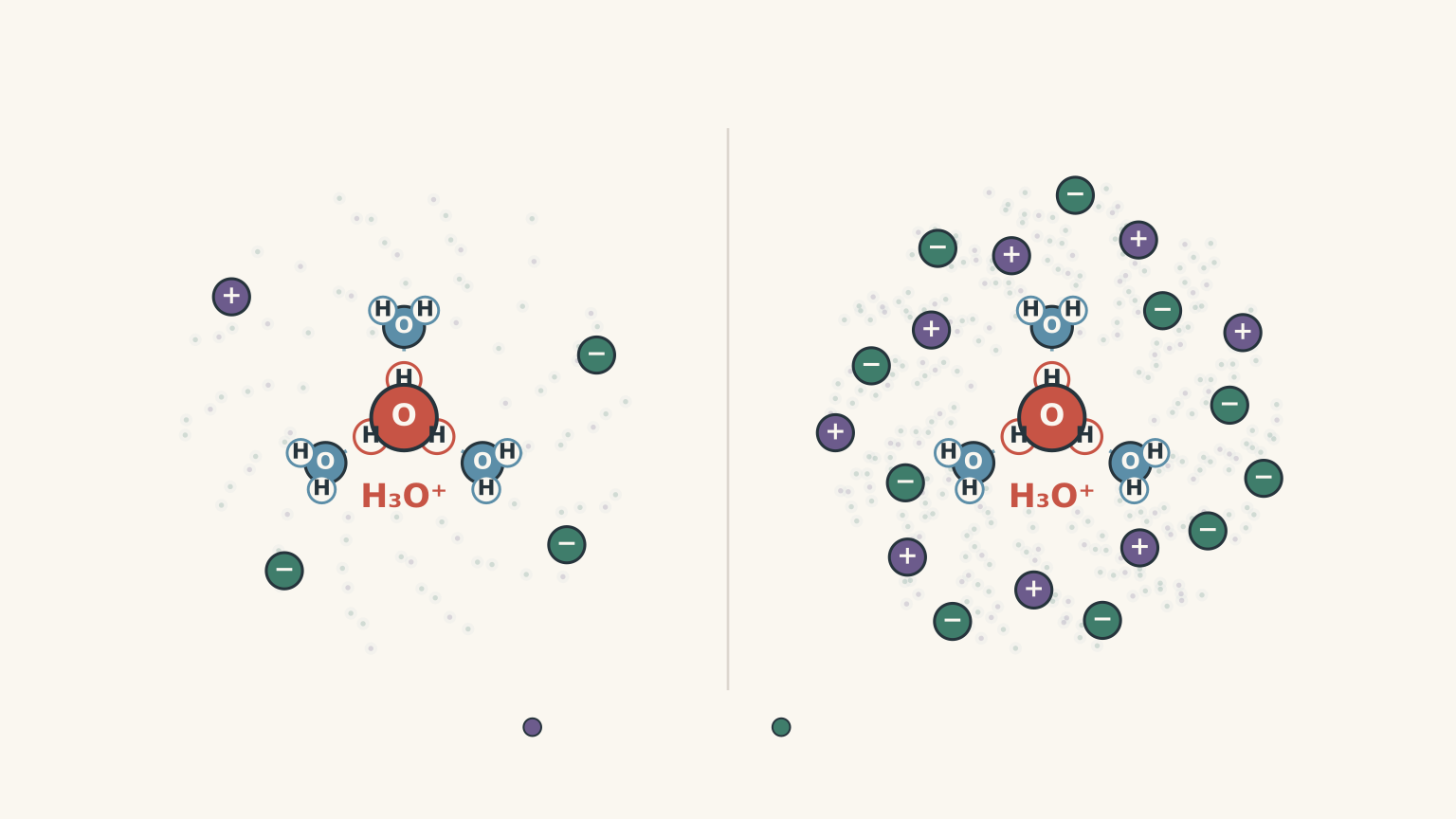
Due to technical limitations, this figure may display incorrectly or contain inaccuracies. Please check key details against your course materials.
What determines the ionic atmosphere?
The important quantity is called the ionic strength, represented by \(I\).
Ionic strength accounts for both:
- The concentration of each ion.
- The magnitude of its electrical charge.
Its mathematical expression is:
\[ I=\frac{1}{2}\sum_i c_i z_i^2 \]
Where:
- \(I\) is the ionic strength.
- \(c_i\) is the concentration of ion \(i\), in mol L\(^{-1}\).
- \(z_i\) is the charge number of that ion.
- The summation includes every significant ionic species in the solution.
Notice that the charge is squared.
This means a divalent ion contributes four times as much ionic strength per mole as a monovalent ion.
Consider two solutions.
| Solution | Ion concentrations | Ionic strength |
|---|---|---|
| 0.10 M NaCl | 0.10 M Na+, 0.10 M Cl− | 0.10 M |
| 0.10 M Na2SO4 | 0.20 M Na+, 0.10 M SO4²− | 0.30 M |
For sodium chloride:
\[ I=\frac12[(0.10)(1)^2+(0.10)(1)^2] \]
\[ I=0.10\ \mathrm{mol\,L^{-1}} \]
For sodium sulfate:
\[ I=\frac12[(0.20)(1)^2+(0.10)(2)^2] \]
\[ I=0.30\ \mathrm{mol\,L^{-1}} \]
Both solutions contain 0.10 M salt, but the sodium sulfate solution has three times the ionic strength.
This is why salt concentration alone is not enough to describe the ionic environment.
03The difference between thermodynamic Ka and apparent Ka
We can now return to the weak acid.
The thermodynamic dissociation constant uses activities rather than concentrations:
\[ K_a^\circ= \frac{a_{\ce{H3O+}}a_{\mathrm{A}^{-}}} {a_{\ce{HA}}} \]
The superscript circle indicates a thermodynamic standard-state equilibrium constant.
Substitute the activity expressions:
\[ K_a^\circ= \frac{ \gamma_{\ce{H3O+}}\gamma_{\mathrm{A}^{-}} }{ \gamma_{\ce{HA}} } \frac{ [\ce{H3O+}][\mathrm{A}^{-}] }{ [\ce{HA}]c^\circ } \]
Now define the concentration-based equilibrium constant:
\[ K_{a,c}(I)= \frac{ [\ce{H3O+}][\mathrm{A}^{-}] }{ [\ce{HA}]c^\circ } \]
The subscript \(c\) indicates that this value is calculated using concentrations. Its value is conditional on the ionic environment.
We can therefore write:
\[ \boxed{ K_a^\circ= K_{a,c}(I) \frac{ \gamma_{\ce{H3O+}}\gamma_{\mathrm{A}^{-}} }{ \gamma_{\ce{HA}} } } \]
This is the central relationship.
The thermodynamic constant accounts for non-ideal behaviour through activities. The concentration-based constant does not.
For dilute aqueous solutions, we can often approximate the activity coefficient of the neutral acid as:
\[ \gamma_{\ce{HA}}\approx1 \]
The relationship then simplifies to:
\[ K_a^\circ\approx K_{a,c}(I) \gamma_{\ce{H3O+}}\gamma_{\mathrm{A}^{-}} \]
Rearranging:
\[ K_{a,c}(I)\approx \frac{K_a^\circ} {\gamma_{\ce{H3O+}}\gamma_{\mathrm{A}^{-}}} \]
Since the activity coefficients of the two monovalent ions are generally below 1 in this model, their product is also below 1.
Dividing by this product makes the concentration-based Ka larger than the thermodynamic Ka.
Taking negative logarithms gives:
\[ \boxed{ pK_{a,c}=pK_a^\circ+ \log_{10} \left( \frac{ \gamma_{\ce{H3O+}}\gamma_{\mathrm{A}^{-}} }{ \gamma_{\ce{HA}} } \right) } \]
For the neutral weak acid considered here:
\[ pK_{a,c}<pK_a^\circ \]
This is the important prediction.
As ionic strength increases, the apparent concentration-based pKa of a neutral monoprotic acid generally decreases in the simple dilute-solution model.
The acid has not acquired a different thermodynamic dissociation constant. The activity coefficients have changed, altering the relationship between its equilibrium concentrations and its thermodynamic equilibrium constant.
A subtle point: pH-based pKa values
There is another distinction worth understanding before doing calculations.
pH is defined using hydrogen-ion activity:
\[ \mathrm{pH}=-\log_{10}a_{\ce{H3O+}} \]
It is not strictly equal to \(-\log_{10}[\ce{H3O+}]\).
This matters when an experimental pKa is calculated using the Henderson-Hasselbalch equation.
Starting from the thermodynamic equilibrium expression:
\[ \mathrm{pH} = pK_a^\circ+ \log_{10} \left( \frac{a_{\mathrm{A}^{-}}}{a_{\ce{HA}}} \right) \]
Expanding the activities gives:
\[ \mathrm{pH} = pK_a^\circ+ \log_{10} \left( \frac{[\mathrm{A}^{-}]}{[\ce{HA}]} \right) + \log_{10} \left( \frac{\gamma_{\mathrm{A}^{-}}}{\gamma_{\ce{HA}}} \right) \]
Therefore, if an experiment fits pH against the concentration ratio, its conditional pKa intercept is:
\[ pK_{a,\mathrm{pH}}= pK_a^\circ+ \log_{10} \left( \frac{\gamma_{\mathrm{A}^{-}}}{\gamma_{\ce{HA}}} \right) \]
This is not necessarily identical to \(pK_{a,c}\), which is defined as the negative logarithm of the concentration quotient.
Both types of values may be described as apparent or conditional pKa values in experimental literature.
Always check how an author has defined the reported value before comparing measurements.
The IUPAC Gold Book explicitly distinguishes concentration-based dissociation constants at a specified ionic strength from thermodynamic constants obtained by extrapolation to zero ionic strength.
04Worked example: calculate the ionic strength
A solution contains 0.020 mol L\(^{-1}\) NaCl and 0.010 mol L\(^{-1}\) CaCl2. Assume both salts dissociate completely, no ion pairing occurs, and the weak acid contributes negligibly to the ionic strength.
Calculate the ionic strength.
Step 1
NaCl produces one Na+ and one Cl− per formula unit.
CaCl2 produces one Ca2+ and two Cl− ions per formula unit.
Therefore:
- \([\mathrm{Na}^{+}]=0.020\ \mathrm{mol\,L^{-1}}\)
- \([\mathrm{Ca}^{2+}]=0.010\ \mathrm{mol\,L^{-1}}\)
- \([\mathrm{Cl}^{-}]=0.020+2(0.010)=0.040\ \mathrm{mol\,L^{-1}}\)
Step 2
\[ I=\frac12\sum_i c_i z_i^2 \]
Substitute the three ion concentrations:
\[ \begin{aligned} I=\frac12[& (0.020)(1)^2\\ &+(0.010)(2)^2\\ &+(0.040)(1)^2] \end{aligned} \]
Step 3
\[ \begin{aligned} I&=\frac12(0.020+0.040+0.040)\\ &=\frac12(0.100)\\ &=0.050\ \mathrm{mol\,L^{-1}} \end{aligned} \]
The ionic strength is:
\[ \boxed{I=0.050\ \mathrm{mol\,L^{-1}}} \]
Notice how the calcium ions contribute 0.040 mol L\(^{-1}\) to the sum before multiplication by one-half, despite their actual concentration being only 0.010 mol L\(^{-1}\).
Their double charge matters.
05Estimating the size of the pKa shift
So far, we have established the direction of the effect.
Can we estimate its size?
One useful approximation is the Davies equation, which estimates activity coefficients for ions in aqueous solutions.
At 25 °C:
\[ \log_{10}\gamma_i= -0.509z_i^2 \left[ \frac{\sqrt I}{1+\sqrt I} -0.3I \right] \]
Here:
- \(\gamma_i\) is the activity coefficient of ion \(i\).
- \(z_i\) is its charge number.
- \(I\) is the ionic strength, expressed on a molarity basis for this dilute-solution estimate.
- 0.509 is an approximate constant for water at 25 °C.
This is an empirical approximation, not an exact law.
For the simple model, it predicts the activity coefficient using ionic strength and ionic charge. It does not fully account for differences in ion size or specific interactions between particular ions.
Worked example: estimate an apparent pKa
A hypothetical neutral monoprotic acid has a thermodynamic pKa of 4.80 at 25 °C.
It is dissolved in a solution with an ionic strength of 0.050 mol L\(^{-1}\).
Assume:
- \(\gamma_{\ce{H3O+}}=\gamma_{\mathrm{A}^{-}}=\gamma\)
- \(\gamma_{\ce{HA}}=1\)
Estimate the concentration-based pKa.
Step 1
Using the Davies equation:
\[ \log_{10}\gamma= -0.509 \left[ \frac{\sqrt{0.050}}{1+\sqrt{0.050}} -0.3(0.050) \right] \]
Since:
\[ \sqrt{0.050}\approx0.224 \]
We obtain:
\[ \log_{10}\gamma\approx-0.0855 \]
Therefore:
\[ \gamma=10^{-0.0855}\approx0.82 \]
Step 2
\[ \frac{\gamma_{\ce{H3O+}}\gamma_{\mathrm{A}^{-}}} {\gamma_{\ce{HA}}} = \frac{(0.82)(0.82)}{1} \]
\[ \approx0.67 \]
Step 3
We are given:
\[ pK_a^\circ=4.80 \]
Therefore:
\[ K_a^\circ=10^{-4.80} \]
\[ K_a^\circ=1.58\times10^{-5} \]
Step 4
Recall:
\[ K_a^\circ=K_{a,c}(I)(0.67) \]
Rearranging:
\[ K_{a,c}(I)= \frac{1.58\times10^{-5}}{0.67} \]
\[ K_{a,c}(I)\approx2.35\times10^{-5} \]
Step 5
\[ pK_{a,c}=-\log_{10}(2.35\times10^{-5}) \]
\[ \boxed{pK_{a,c}\approx4.63} \]
The results are:
| Quantity | Value |
|---|---|
| Thermodynamic pKa | 4.80 |
| Concentration-based pKa | 4.63 |
| Difference | 0.17 |
The concentration-based pKa is approximately 0.17 units lower.
Nothing has changed about the acid’s thermodynamic dissociation constant at 25 °C. The difference arises from the non-ideal behaviour of the ions.
These values are illustrative model calculations, not experimental measurements for a particular acid.
06When does this prediction stop working?
It would be tempting to memorise one rule:
More salt means lower apparent pKa.
That is too broad.
The direction and size of the correction depend on the charges of the reacting species and the interactions occurring in solution.
Different charge patterns produce different corrections
Consider a positively charged acid:
\[ \ce{BH+(aq) + H2O(l) <=> B(aq) + H3O+(aq)} \]
This reaction differs from the neutral acid reaction.
The reactant \(\ce{BH+}\) has a +1 charge, and the hydronium product also has a +1 charge. The conjugate base B is neutral.
The activity-based equilibrium constant is:
\[ K_a^\circ= \frac{a_{\ce{H3O+}}a_{\ce{B}}} {a_{\ce{BH+}}} \]
Expanding the activities:
\[ K_a^\circ= K_{a,c} \frac{ \gamma_{\ce{H3O+}}\gamma_{\ce{B}} }{ \gamma_{\ce{BH+}} } \]
In the Debye-Hückel limiting model, activity coefficients depend on the square of the ionic charge.
Both \(\ce{H3O+}\) and \(\ce{BH+}\) have the same charge. Their activity coefficients are therefore predicted to be equal in this simplified model.
The leading ionic-strength correction approximately cancels:
\[ \frac{ \gamma_{\ce{H3O+}}\gamma_{\ce{B}} }{ \gamma_{\ce{BH+}} } \approx1 \]
This means the apparent pKa of this positively charged acid does not necessarily show the same shift as the neutral acid.
In reality, hydronium and \(\ce{BH+}\) have different sizes and may experience different short-range interactions. Their activity coefficients are not guaranteed to be identical.
The cancellation is a prediction of the simplified model, not a universal result.
The identity of the salt also matters
Two solutions can have the same ionic strength but different chemical compositions.
At very low ionic strengths, the Debye-Hückel limiting law predicts that the main electrostatic correction depends on ionic strength and charge.
At higher ionic strengths, specific interactions become increasingly important.
For example:
- Some ions can form ion pairs with the acid or its conjugate base.
- Certain ions can interact more strongly with particular molecular species.
- Changes in solvent conditions can affect activity coefficients.
- Complex formation can introduce additional equilibrium reactions.
Consequently, two different salts at the same ionic strength do not necessarily produce identical apparent pKa values.
The Davies equation is useful for simple estimates, but the OECD Nuclear Energy Agency’s thermochemical review cautions against using it generally above approximately 0.1 mol kg\(^{-1}\). More concentrated or compositionally complex solutions may require specific-ion interaction models, such as SIT or Pitzer models.
For this article, the important decision is recognising when the simple activity-coefficient approximation is appropriate.
How do chemists recover the thermodynamic pKa?
If activity coefficients approach 1 as ionic strength approaches zero, then:
\[ \lim_{I\to0}K_{a,c}(I)=K_a^\circ \]
This gives chemists a way to estimate the thermodynamic dissociation constant.
They can measure conditional concentration-based equilibrium constants at several ionic strengths and extrapolate the results towards zero ionic strength.
The zero-ionic-strength intercept provides an estimate of the thermodynamic value.
It is not necessary to prepare a literal solution containing absolutely no ions. The value is obtained by extrapolation.
This distinction is described in the IUPAC Gold Book entry on acid dissociation constants.
07Questions and solutions
Question 1
A solution contains 0.020 mol L\(^{-1}\) NaCl and 0.0050 mol L\(^{-1}\) MgCl2.
Assume complete dissociation and negligible ion pairing.
Calculate the ionic strength of the solution.
Solution 1
The ionic strength is 0.035 mol L\(^{-1}\).
Start by identifying the concentration of every ion.
From NaCl:
\[ [\mathrm{Na}^{+}]=0.020\ \mathrm{M} \]
From MgCl2:
\[ [\mathrm{Mg}^{2+}]=0.0050\ \mathrm{M} \]
The chloride concentration comes from both salts:
\[ [\mathrm{Cl}^{-}]=0.020+2(0.0050) \]
\[ [\mathrm{Cl}^{-}]=0.030\ \mathrm{M} \]
Apply:
\[ I=\frac12\sum_i c_i z_i^2 \]
Substitute:
\[ \begin{aligned} I=\frac12[& (0.020)(1)^2\\ &+(0.0050)(2)^2\\ &+(0.030)(1)^2] \end{aligned} \]
\[ I=\frac12(0.020+0.020+0.030) \]
\[ \boxed{I=0.035\ \mathrm{mol\,L^{-1}}} \]
The key is remembering that magnesium has a charge of +2, so its contribution is multiplied by four.
Question 2
A neutral weak acid is studied at 25 °C in two aqueous solutions.
Both solutions contain the same analytical concentration of acid. The added electrolyte does not react with the acid or form complexes.
The following concentration-based pKa values are obtained:
| Solution | Ionic strength | \(pK_{a,c}\) |
|---|---|---|
| A | 0.001 mol L\(^{-1}\) | 4.78 |
| B | 0.050 mol L\(^{-1}\) | 4.60 |
A student concludes that the acid in solution B is intrinsically stronger because it has a lower pKa.
Explain why this conclusion is not justified. Predict the expected direction of the change using the simple activity-coefficient model, and describe how the intrinsic acid strength could be compared.
Solution 2
The results do not establish that the acid has become intrinsically stronger. They show that its concentration-based equilibrium constant depends on the ionic environment.
For a neutral acid:
\[ \ce{HA <=> H3O+ + A-} \]
The concentration-based equilibrium constant is related to the thermodynamic constant by:
\[ K_{a,c}\approx \frac{K_a^\circ} {\gamma_{\ce{H3O+}}\gamma_{\mathrm{A}^{-}}} \]
As ionic strength increases in the simple dilute-solution model, the activity coefficients of the monovalent ions decrease.
Their product therefore becomes smaller.
Dividing the unchanged thermodynamic Ka by this smaller product increases the concentration-based Ka.
Since:
\[ pK_{a,c}=-\log_{10}K_{a,c} \]
An increase in Ka produces a decrease in pKa.
This explains the observed direction: solution B has a lower concentration-based pKa.
However, the thermodynamic pKa remains unchanged at the same temperature and in the same solvent.
To compare intrinsic acid strengths, the measurements should be corrected for activity effects or extrapolated towards zero ionic strength.
The important distinction is between a change in the thermodynamic equilibrium constant and a change in the concentration-based value used to describe that equilibrium.
Question 3
A hypothetical neutral monoprotic acid has a thermodynamic dissociation constant corresponding to:
\[ pK_a^\circ=3.90 \]
At a particular ionic strength, the activity coefficients are estimated to be:
\[ \gamma_{\ce{H3O+}}=0.90 \]
\[ \gamma_{\mathrm{A}^{-}}=0.80 \]
\[ \gamma_{\ce{HA}}=1.00 \]
Calculate:
a. The concentration-based dissociation constant, \(K_{a,c}\).
b. The concentration-based pKa.
c. The difference between the thermodynamic and concentration-based pKa values.
Solution 3
The concentration-based values are \(K_{a,c}=1.75\times10^{-4}\) and \(pK_{a,c}=3.76\).
Start by converting the thermodynamic pKa into Ka.
\[ K_a^\circ=10^{-3.90} \]
\[ K_a^\circ=1.26\times10^{-4} \]
Step 1: Calculate the activity coefficient ratio.
\[ \frac{\gamma_{\ce{H3O+}}\gamma_{\mathrm{A}^{-}}} {\gamma_{\ce{HA}}} = \frac{(0.90)(0.80)}{1.00} \]
\[ =0.72 \]
Step 2: Rearrange the thermodynamic relationship.
\[ K_a^\circ=K_{a,c}(0.72) \]
Therefore:
\[ K_{a,c}=\frac{K_a^\circ}{0.72} \]
Substituting:
\[ K_{a,c}= \frac{1.26\times10^{-4}}{0.72} \]
\[ \boxed{K_{a,c}=1.75\times10^{-4}} \]
Step 3: Calculate the concentration-based pKa.
\[ pK_{a,c}=-\log_{10}(1.75\times10^{-4}) \]
\[ \boxed{pK_{a,c}=3.76} \]
Step 4: Calculate the difference.
\[ \Delta pK_a=3.90-3.76 \]
\[ \boxed{\Delta pK_a=0.14} \]
The concentration-based pKa is 0.14 units lower than the thermodynamic pKa.
The acid has not acquired a new thermodynamic dissociation constant. The difference comes from the activity coefficients of the reacting species.
Question 4
Consider the dissociation of a positively charged acid:
\[ \ce{BH+(aq) + H2O(l) <=> B(aq) + H3O+(aq)} \]
The reactant \(\ce{BH+}\) and product \(\ce{H3O+}\) both have a charge of +1. The conjugate base B is neutral.
Using the Debye-Hückel limiting model, explain why the leading ionic-strength correction to the concentration-based dissociation constant approximately cancels.
Would this prove that the measured pKa of this acid is completely independent of the salt concentration?
Solution 4
The leading correction approximately cancels, but this does not prove that the measured pKa is completely independent of salt concentration.
For this reaction:
\[ K_a^\circ= \frac{a_{\ce{H3O+}}a_{\ce{B}}} {a_{\ce{BH+}}} \]
Expanding the activities:
\[ K_a^\circ= K_{a,c} \frac{ \gamma_{\ce{H3O+}}\gamma_{\ce{B}} }{ \gamma_{\ce{BH+}} } \]
The Debye-Hückel limiting model predicts that activity coefficients depend on the square of ionic charge.
Both \(\ce{H3O+}\) and \(\ce{BH+}\) have a charge of +1.
Therefore, in this simplified model:
\[ \gamma_{\ce{H3O+}}\approx\gamma_{\ce{BH+}} \]
For the neutral species:
\[ \gamma_{\ce{B}}\approx1 \]
Substituting:
\[ K_a^\circ\approx K_{a,c} \]
The leading correction therefore cancels.
Compare this with a neutral acid:
\[ \ce{HA <=> H3O+ + A-} \]
Here, the reactant is neutral, while both products are charged. The activity coefficients do not cancel in the same way.
However, the cancellation for \(\ce{BH+}\) is only an approximation.
Hydronium and \(\ce{BH+}\) have different hydrated sizes and may interact differently with the surrounding ions. More sophisticated models can therefore predict a residual ionic-strength effect.
The trap is assuming that equal charges guarantee identical chemical behaviour. They produce the same leading charge-dependent correction in the limiting model, but they do not necessarily have identical activity coefficients in real solutions.
Question 5
A neutral monoprotic acid HA is studied at 25 °C in an aqueous solution with:
\[ I=0.050\ \mathrm{mol\,L^{-1}} \]
Assume the following activity coefficients:
\[ \gamma_{\ce{H3O+}}=0.82 \]
\[ \gamma_{\mathrm{A}^{-}}=0.82 \]
\[ \gamma_{\ce{HA}}=1.00 \]
Two groups analyse the same equilibrium mixture.
- Group A calculates the equilibrium constant directly from measured equilibrium concentrations and obtains \(pK_{a,c}=4.63\).
- Group B uses an electrode pH measurement and fits the Henderson-Hasselbalch equation against the concentration ratio \([\mathrm{A}^{-}]/[\ce{HA}]\). It obtains an intercept of \(pK_{a,\mathrm{pH}}=4.71\).
A third student claims that one group must have made a mistake because both groups studied the same acid.
Now consider a further change. Some NaCl is replaced with the same molar amount of NaA, a soluble salt that dissociates completely.
Assume this substitution keeps the ionic strength at 0.050 mol L\(^{-1}\), and that the activity coefficients remain unchanged. No ion pairing or complex formation occurs.
Explain:
a. Why the two groups obtain different pKa values.
b. Calculate the thermodynamic pKa.
c. What happens to the extent of acid dissociation after NaA is introduced?
d. What happens to both reported conditional pKa values?
Solution 5
Both groups can be correct: 4.63 and 4.71 describe two different conditional pKa definitions. The thermodynamic pKa is 4.80. Adding NaA reduces the extent of acid dissociation, but neither conditional pKa changes under the stated assumptions.
This question combines three ideas:
- Activity-based pH measurements.
- Concentration-based equilibrium constants.
- The common-ion effect at constant ionic strength.
Step 1: Explain why the two groups obtain different values.
Group A uses the concentration-based equilibrium constant:
\[ K_{a,c}= \frac{ [\ce{H3O+}][\mathrm{A}^{-}] }{ [\ce{HA}]c^\circ } \]
Its pKa is:
\[ pK_{a,c}= pK_a^\circ+ \log_{10} \left( \frac{ \gamma_{\ce{H3O+}}\gamma_{\mathrm{A}^{-}} }{ \gamma_{\ce{HA}} } \right) \]
Group B uses an electrode measurement of pH.
Remember:
\[ \mathrm{pH}=-\log_{10}a_{\ce{H3O+}} \]
The electrode therefore measures hydrogen-ion activity, not hydrogen-ion concentration directly.
When the Henderson-Hasselbalch equation is expressed using concentrations for the acid and conjugate base, its conditional pKa intercept is:
\[ pK_{a,\mathrm{pH}}= pK_a^\circ+ \log_{10} \left( \frac{\gamma_{\mathrm{A}^{-}}}{\gamma_{\ce{HA}}} \right) \]
The two expressions contain different activity-coefficient corrections.
That is why their numerical values differ.
Step 2: Calculate the thermodynamic pKa using Group A’s result.
We know:
\[ pK_{a,c}=4.63 \]
And:
\[ \frac{ \gamma_{\ce{H3O+}}\gamma_{\mathrm{A}^{-}} }{ \gamma_{\ce{HA}} } =(0.82)(0.82)=0.6724 \]
Rearrange:
\[ pK_a^\circ= pK_{a,c}- \log_{10}(0.6724) \]
Therefore:
\[ pK_a^\circ=4.63-(-0.172) \]
\[ \boxed{pK_a^\circ\approx4.80} \]
Step 3: Check Group B’s result independently.
Using the pH-based conditional expression:
\[ pK_{a,\mathrm{pH}} = 4.80+\log_{10}(0.82) \]
\[ pK_{a,\mathrm{pH}} = 4.80-0.086 \]
\[ \boxed{pK_{a,\mathrm{pH}}\approx4.71} \]
Both groups have obtained values consistent with the same thermodynamic pKa.
The difference is not an experimental contradiction. It comes from the different definitions used in their calculations.
Step 4: Determine the effect of adding NaA.
Sodium acetate-style salts are useful examples of soluble salts that supply a conjugate-base ion. Here, NaA supplies additional \(\mathrm{A}^{-}\).
The equilibrium is:
\[ \ce{HA + H2O <=> H3O+ + A-} \]
Adding \(\mathrm{A}^{-}\) increases the concentration of a product.
By Le Chatelier’s principle, the equilibrium shifts to the left.
Consequently:
- More HA remains undissociated.
- Less additional H3O+ is produced by acid dissociation.
- The fraction of the original acid that dissociates decreases.
This is the common-ion effect.
Step 5: Determine what happens to the conditional pKa values.
Here is the important constraint: the ionic strength is held constant, and the question explicitly states that the activity coefficients do not change.
Therefore, the concentration-based equilibrium constant remains:
\[ K_{a,c}= \frac{ [\ce{H3O+}][\mathrm{A}^{-}] }{ [\ce{HA}]c^\circ } \]
at its original conditional value.
The individual equilibrium concentrations change, but their quotient still satisfies the same equilibrium constant.
Similarly, the pH-based conditional pKa remains unchanged because its activity-coefficient correction is also unchanged.
The results are therefore:
| Quantity | Before NaA | After NaA |
|---|---|---|
| Thermodynamic pKa | 4.80 | 4.80 |
| Concentration-based pKa | 4.63 | 4.63 |
| pH-based conditional pKa | 4.71 | 4.71 |
| Fraction of acid dissociated | Higher | Lower |
The tempting answer is that adding a common ion changes Ka or pKa because the equilibrium shifts.
But an equilibrium shift does not mean the equilibrium constant has changed.
A second tempting answer is that holding ionic strength constant forces the apparent pKa to become equal to the thermodynamic pKa.
That is also incorrect. Holding ionic strength constant holds the activity-coefficient corrections constant under the assumptions given. It does not make those corrections equal to one.
This is the crucial distinction: the common-ion effect changes the equilibrium composition, while ionic strength determines the relationship between concentrations and activities.
08Scientific references and model limitations
The explanations and approximations in this extension are consistent with established treatments of chemical thermodynamics and electrolyte solutions.
- IUPAC Gold Book – Acid dissociation constant. Defines acid dissociation constants and distinguishes concentration-based conditional values from thermodynamic values obtained through extrapolation to zero ionic strength.
- David Harvey, DePauw University – Activity Coefficients, LibreTexts. Develops ionic strength, activity coefficients, and the relationship between activities and concentrations.
- OECD Nuclear Energy Agency – Chemical Thermodynamics of Technetium, Appendix C. Discusses ionic-strength corrections, the Davies equation, and the need for more specific interaction models at higher ionic strengths.
The Davies equation used here is an estimate for aqueous electrolyte solutions, not a universal model. The numerical examples deliberately use simplified assumptions about neutral species and monovalent ions.
09Where this leads next
The practical value of understanding ionic strength is that you can now distinguish two questions that initially look identical:
- How strongly does an acid dissociate under a specified thermodynamic standard state?
- What concentrations of its species should you expect in a particular solution?
The first question is answered by the thermodynamic pKa. The second requires you to consider the solution conditions, including ionic strength and activity coefficients.
This distinction becomes particularly useful when studying acid-base speciation.
A speciation diagram predicts the relative proportions of different acid-base species as pH changes. Once you understand conditional pKa values, you can see why the solution environment matters when interpreting those diagrams.
The natural next step is Acid-Base Speciation Diagrams: Reading Species vs pH.