
Acid-Base Analysis in Practice: Chemistry Practice Exam
Test your understanding of acid-base analysis with this original 50-mark chemistry practice paper. Apply your skills to digital probes, household titration, industrial quality control, and respectful research practices, with complete worked solutions and a marking guide.
This is an original tutorgum practice paper covering acid-base analysis in practice, using the supplied chemistry-2017 topic scope. It assesses digital pH and conductivity measurements, household acidity analysis, industrial titration quality control, and the respectful investigation of acid-base analysis in Aboriginal and Torres Strait Islander community contexts. It is a focused topic paper, not a full-course examination or an official, endorsed, past, or predicted NESA paper.
01Exam instructions
| Condition | Details |
|---|---|
| Total marks | 50 |
| Suggested reading time | 5 minutes |
| Suggested working time | 75 minutes |
| Equipment | Scientific calculator and ruler |
| Questions | Answer all five questions |
| Working | Show calculations, substitutions, units, and appropriate rounding |
These are suggested conditions for this practice paper, not statements about official examination rules.
Assessed scope
This paper assesses only the supplied topic scope:
- Digital probes and instruments for collecting, processing, and evaluating pH and conductivity data.
- Calibration, sampling quality, repeatability, and the suitability of analytical methods.
- Household acidity analysis, including titration and communication of results.
- Industrial titration, quality control, and decisions about product specifications.
- Respectful investigation of acid-base analysis in Aboriginal and Torres Strait Islander contexts, including community authority, cultural context, and responsible reporting.
Other Chemistry modules and content outside this specified scope are excluded.
Working conventions
- Use litres when calculating amounts of substance from concentrations in mol L⁻¹.
- Include units in numerical answers, except where the quantity has no unit, such as pH.
- Give answers to an appropriate number of significant figures, consistent with the supplied data.
- Read each question carefully. State the evidence supporting your conclusions, particularly when evaluating data or the suitability of a method.
02Questions
Question 1 (8 marks)
A student intends to measure the pH of an alkaline household cleaning product using a digital pH probe.
The probe has been calibrated using pH 4.00 and pH 7.00 buffer solutions. A technician then checks its performance using fresh portions of three certified buffer solutions.
| Certified buffer pH | Probe reading |
|---|---|
| 4.00 | 4.02 |
| 7.00 | 6.99 |
| 10.00 | 9.62 |
The acceptance criterion is that each check must be within ±0.05 pH units of the certified value.
(a) Calculate the absolute deviation between the certified value and the probe reading for each buffer. (3 marks)
(b) Decide whether these results justify using the probe across the full pH range, including for the alkaline cleaning product. Justify your decision using the acceptance criterion. (2 marks)
(c) Outline a suitable corrective procedure and a verification step that should be completed before the probe is used to measure the cleaning product. (3 marks)
Question 2 (9 marks)
A field team collects three replicate pH and conductivity readings from each of three water samples. Each set of readings represents repeated measurements of the same sample.
Conductivity is reported in microsiemens per centimetre (µS cm⁻¹).
| Sample | pH readings | Conductivity readings (µS cm⁻¹) |
|---|---|---|
| A | 6.42, 6.48, 6.43 | 180, 185, 181 |
| B | 5.12, 5.18, 7.82 | 620, 625, 618 |
| C | 7.21, 7.24, 7.22 | 205, 208, 206 |
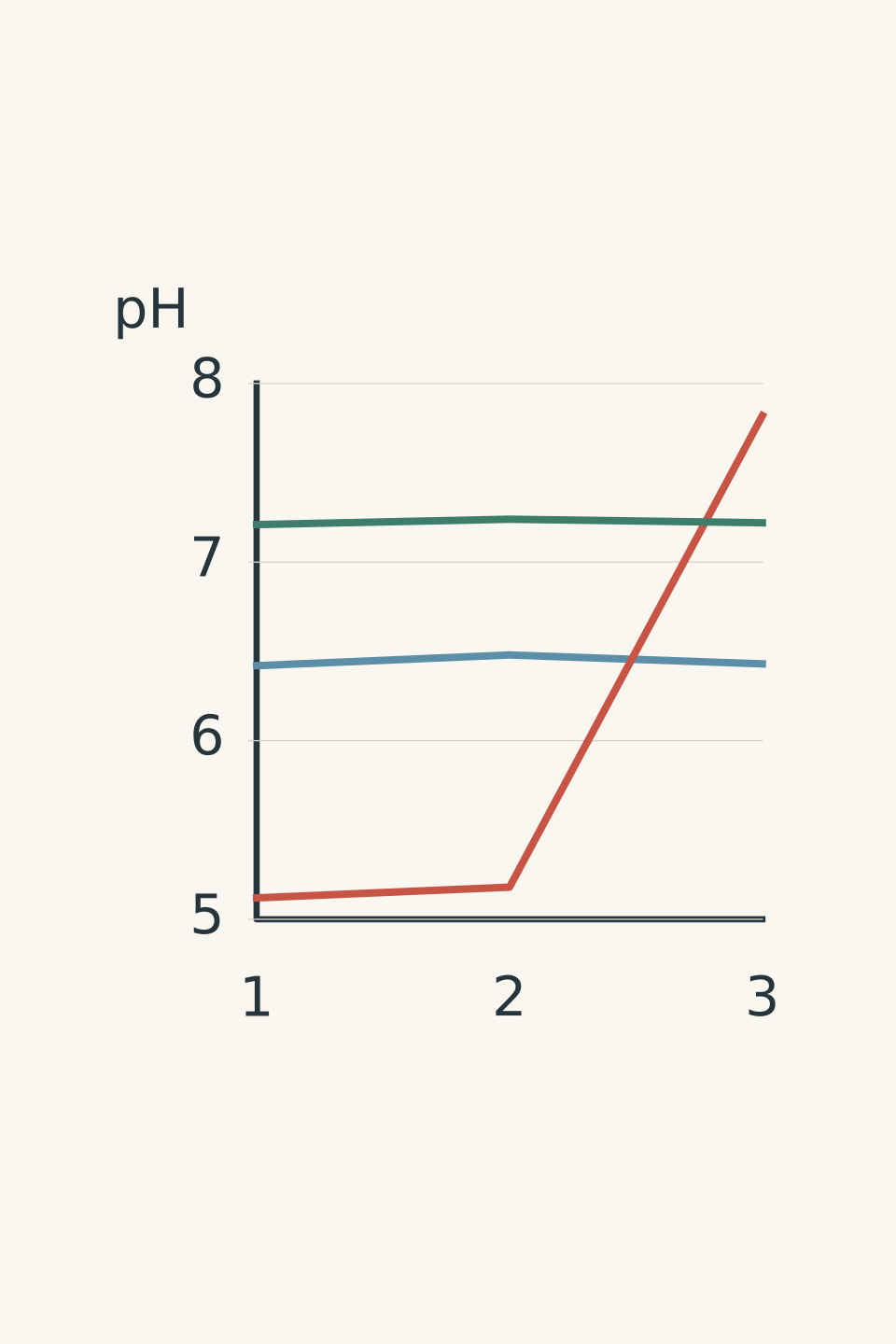
- Sample A
- Sample B
- Sample C
(a) Calculate the mean pH of samples A and C, giving each answer to two decimal places. (2 marks)
(b) Identify the sample with the poorest repeatability in its pH measurements. Calculate the range of its readings. (2 marks)
(c) Calculate the mean conductivity of sample B. Include the appropriate unit. (2 marks)
(d) State one inference supported by the conductivity data for sample B. Then state one conclusion about the sample that cannot be established from conductivity alone. (2 marks)
(e) Identify one procedural check that should be completed before accepting the pH results for sample B. (1 mark)
Question 3 (11 marks)
A student investigates the acidity of a household lemon drink using a titration.
The pH of the original drink, measured separately, is 2.84.
The student pipettes 10.00 mL of the drink into a 100.0 mL volumetric flask and dilutes it to the mark with distilled water. A 20.00 mL aliquot, meaning a measured portion, of this diluted solution is then titrated with 0.1000 mol L⁻¹ sodium hydroxide, NaOH.
A titre is the volume of titrant delivered to reach the titration endpoint.
The three titres are:
| Trial | Titre of NaOH (mL) |
|---|---|
| 1 | 12.35 |
| 2 | 12.45 |
| 3 | 12.40 |
For the calculations, assume citric acid is the only acid contributing to the titre. Use the supplied reaction equation:
\[ \ce{C6H8O7 + 3NaOH -> Na3C6H5O7 + 3H2O} \]
(a) Calculate the mean titre. (1 mark)
(b) Calculate the amount, in moles, of NaOH delivered at the mean titre. (2 marks)
(c) Calculate the concentration of citric acid in the diluted drink, in mol L⁻¹. (3 marks)
(d) Calculate the concentration of citric acid in the original drink, in mol L⁻¹. (2 marks)
(e) Explain why the measured pH and the concentration obtained from the titration describe different properties of the drink. (2 marks)
(f) State one reason why the calculated value might not equal the actual concentration of citric acid in a real drink. (1 mark)
Question 4 (12 marks)
An industrial plant manufactures a cleaning solution containing a monoprotic acid, represented by HZ. A monoprotic acid reacts with one mole of NaOH per mole of acid.
A quality-control technician titrates a 25.00 mL sample from each batch using standardised 0.1500 mol L⁻¹ NaOH.
The reaction is:
\[ \ce{HZ + NaOH -> NaZ + H2O} \]
The product specification requires an acid concentration between 0.185 and 0.195 mol L⁻¹, inclusive.
The following titres are recorded.
| Trial | Batch A (mL) | Batch B (mL) |
|---|---|---|
| 1 | 31.55 | 34.20 |
| 2 | 31.60 | 34.15 |
| 3 | 31.65 | 34.25 |
(a) Calculate the mean titre for each batch. (2 marks)
(b) Calculate the acid concentration in each batch, in mol L⁻¹. (4 marks)
(c) Determine which batch meets the product specification. Support your decision with numerical evidence. (2 marks)
(d) Explain one reason for collecting replicate titres. State one limitation of relying on replicate measurements alone. (2 marks)
(e) Recommend two appropriate quality-control actions for batch B before it is released for use. (2 marks)
Question 5 (10 marks)
A fictional contemporary environmental-monitoring project is led by an Aboriginal community’s ranger team. The team selects two monitoring sites and combines its place-based observations with measurements from digital pH probes and conductivity meters.
A research partner drafts a report describing the project as “a traditional Aboriginal method for identifying acidic water”, based only on the instrument readings. The partner also proposes publishing exact site locations and the team’s observations without further community approval.
This scenario is fictional. It does not describe a particular community, cultural practice, or knowledge system.
(a) Explain what pH and conductivity measurements can each establish about a water sample. State one limitation of each measurement. (4 marks)
(b) Identify two actions that would support respectful collaboration and community control over the knowledge and data involved in the project. (2 marks)
(c) Evaluate the proposed description of the project. Suggest a more accurate way to describe the work in a published educational resource. (2 marks)
(d) Identify two scientific checks that should be completed before reporting the field measurements. (2 marks)
03Worked solutions and marking guide
Award follow-through marks where a student applies a correct method to an earlier numerical result, even if that result contains an error. Accept mathematically equivalent methods, appropriate rounding, and valid alternative procedures where the question permits them.
Solution 1
(a) Calculate the absolute deviations. (3 marks)
The absolute deviation is the absolute difference between the probe reading and the certified pH.
For the pH 4.00 buffer:
\[ |4.02-4.00|=0.02 \]
For the pH 7.00 buffer:
\[ |6.99-7.00|=0.01 \]
For the pH 10.00 buffer:
\[ |9.62-10.00|=0.38 \]
The deviations are 0.02, 0.01, and 0.38 pH units, respectively.
Marking:
- 1 mark for the deviation of the pH 4.00 buffer.
- 1 mark for the deviation of the pH 7.00 buffer.
- 1 mark for the deviation of the pH 10.00 buffer.
(b) Evaluate the probe’s suitability. (2 marks)
The probe does not meet the acceptance criterion across the full pH range.
The pH 4.00 and pH 7.00 checks are within the permitted deviation of ±0.05. However, the pH 10.00 check has a deviation of 0.38, which exceeds the permitted limit.
The results do not justify using the probe for the alkaline cleaning product until the calibration problem has been addressed.
Marking:
- 1 mark for correctly concluding that the probe is not acceptable across the full range.
- 1 mark for identifying the failed pH 10.00 check and comparing its deviation with the tolerance.
(c) Recommend a corrective procedure. (3 marks)
A suitable procedure would be to:
- Clean and rinse the probe, inspect it for damage, and check that it has been stored correctly.
- Recalibrate using fresh, appropriate buffer solutions, including pH 7.00 and pH 10.00 to cover the expected alkaline range.
- Verify the calibration against a suitable known standard before measuring the cleaning product. The probe should not be used for reporting results until the checks meet the acceptance criterion. If it continues to fail, it should be serviced or replaced.
Marking:
- 1 mark for an appropriate cleaning, inspection, or maintenance step.
- 1 mark for recalibration using suitable fresh buffers.
- 1 mark for verification against a known standard and an appropriate response if the probe still fails.
Solution 2
(a) Calculate the mean pH of samples A and C. (2 marks)
The mean is calculated by adding the replicate readings and dividing by three.
For sample A:
\[ \begin{aligned} \text{Mean pH} &=\frac{6.42+6.48+6.43}{3}\\ &=\frac{19.33}{3}\\ &=6.44 \end{aligned} \]
For sample C:
\[ \begin{aligned} \text{Mean pH} &=\frac{7.21+7.24+7.22}{3}\\ &=\frac{21.67}{3}\\ &=7.22 \end{aligned} \]
Marking:
- 1 mark for the correct mean pH of sample A.
- 1 mark for the correct mean pH of sample C.
(b) Identify the sample with the poorest repeatability. (2 marks)
Sample B has the poorest repeatability because its readings vary much more than those of samples A and C.
The range is the highest reading minus the lowest reading:
\[ \begin{aligned} \text{Range}&=7.82-5.12\\ &=2.70\text{ pH units} \end{aligned} \]
This large range indicates that the repeated pH measurements for sample B are inconsistent.
Marking:
- 1 mark for identifying sample B.
- 1 mark for calculating the range as 2.70 pH units.
(c) Calculate the mean conductivity of sample B. (2 marks)
The mean conductivity is:
\[ \begin{aligned} \text{Mean conductivity} &=\frac{620+625+618}{3}\\ &=\frac{1863}{3}\\ &=621\text{ µS cm}^{-1} \end{aligned} \]
Marking:
- 1 mark for correctly calculating the mean.
- 1 mark for the correct answer with units.
(d) Interpret the conductivity data. (2 marks)
Sample B has a mean conductivity of 621 µS cm⁻¹, much higher than the mean conductivity of sample A (182 µS cm⁻¹) or sample C (approximately 206 µS cm⁻¹).
This supports the inference that sample B contains a greater amount of dissolved mobile ions, although conductivity alone cannot identify the ions present or establish whether the sample is acidic or alkaline.
Marking:
- 1 mark for a reasonable inference based on the higher conductivity.
- 1 mark for explaining a valid limitation, such as the inability to identify specific ions or determine acidity from conductivity alone.
pH and conductivity measure different properties
| pH scale | Acidic: below 7; neutral: 7; alkaline: above 7 (at 25 °C). Indicates acidity or basicity. |
|---|---|
| Conductivity scale | Low → high as dissolved mobile-ion concentration and mobility increase. Does not directly determine pH or identify specific ions. |
(e) Recommend one procedural check. (1 mark)
The technician could rinse the pH probe, place it in a fresh portion of sample B, allow the reading to stabilise, and repeat the measurement. Alternatively, the technician could verify the probe’s calibration against appropriate buffer solutions.
Either approach could help determine whether the inconsistent readings result from the measurement procedure or the instrument.
Marking:
- 1 mark for one valid procedural check.
Solution 3
(a) Calculate the mean titre. (1 mark)
\[ \begin{aligned} \text{Mean titre} &=\frac{12.35+12.45+12.40}{3}\\ &=12.40\text{ mL} \end{aligned} \]
Marking:
- 1 mark for the correct mean titre.
(b) Calculate the amount of NaOH. (2 marks)
First, convert the mean titre into litres:
\[ 12.40\text{ mL}=0.01240\text{ L} \]
The amount of a dissolved substance, \(n\), is calculated by multiplying its concentration, \(c\), by its volume, \(V\), in litres.
\[ \begin{aligned} n(\ce{NaOH})&=cV\\ &=0.1000\times0.01240\\ &=0.001240\text{ mol} \end{aligned} \]
Therefore, the amount of NaOH delivered is \(1.240\times10^{-3}\) mol.
Marking:
- 1 mark for converting the titre into litres and using the correct relationship.
- 1 mark for the correct amount in moles.
(c) Calculate the concentration in the diluted drink. (3 marks)
The supplied equation shows that one mole of citric acid reacts with three moles of NaOH.
Therefore:
\[ \begin{aligned} n(\text{citric acid}) &=\frac{n(\ce{NaOH})}{3}\\ &=\frac{0.001240}{3}\\ &=4.133\times10^{-4}\text{ mol} \end{aligned} \]
The titrated aliquot has a volume of 20.00 mL, or 0.02000 L.
The concentration of citric acid in the diluted drink is:
\[ \begin{aligned} c&=\frac{n}{V}\\ &=\frac{4.133\times10^{-4}}{0.02000}\\ &=0.02067\text{ mol L}^{-1} \end{aligned} \]
Marking:
- 1 mark for applying the 1:3 citric acid-to-NaOH mole ratio correctly.
- 1 mark for dividing by the correct aliquot volume in litres.
- 1 mark for the correct concentration with units.
(d) Calculate the concentration in the original drink. (2 marks)
The original 10.00 mL sample was diluted to a final volume of 100.0 mL.
The dilution factor is:
\[ \text{Dilution factor}=\frac{100.0}{10.00}=10.00 \]
The original concentration is therefore ten times the diluted concentration:
\[ \begin{aligned} c_{\text{original}} &=0.02067\times10.00\\ &=0.2067\text{ mol L}^{-1} \end{aligned} \]
The estimated citric acid concentration in the original drink is \(0.2067\text{ mol L}^{-1}\), under the stated assumption.
Marking:
- 1 mark for identifying and applying the dilution factor of 10.00.
- 1 mark for the correct original concentration with units.
From titration data to original concentration
- Prepare dilution
Dilute a measured original sample to a known final volume.
- Titrate aliquot
Titrate a measured portion with standard NaOH; record the titre.
- Calculate acid moles
Use NaOH moles and the balanced equation’s mole ratio.
- Find diluted concentration
Divide acid moles by aliquot volume in litres.
- Recover original concentration
Multiply diluted concentration by the dilution factor.
(e) Explain the difference between pH and titration results. (2 marks)
The pH value of 2.84 indicates how acidic the original drink is at the time of measurement. It is related to the hydrogen-ion activity in the solution.
The titration measures how much NaOH is needed to neutralise the acids to the chosen endpoint. Under the stated assumption, this gives an estimate of the citric acid concentration. More generally, titration can be used to determine titratable acidity, which is not the same property as pH.
The two measurements answer different questions, so the pH value cannot be substituted directly into the titration calculation.
Marking:
- 1 mark for explaining what pH indicates.
- 1 mark for explaining what the titration measures and distinguishing it from pH.
(f) State one limitation. (1 mark)
A real drink may contain other acids that also react with NaOH. If these acids are present, the titration may measure the drink’s total titratable acidity rather than the actual concentration of citric acid alone.
Marking:
- 1 mark for identifying a valid limitation, such as the presence of other acids or uncertainty in the endpoint.
Solution 4
(a) Calculate the mean titre for each batch. (2 marks)
For batch A:
\[ \begin{aligned} \text{Mean titre} &=\frac{31.55+31.60+31.65}{3}\\ &=31.60\text{ mL} \end{aligned} \]
For batch B:
\[ \begin{aligned} \text{Mean titre} &=\frac{34.20+34.15+34.25}{3}\\ &=34.20\text{ mL} \end{aligned} \]
Marking:
- 1 mark for the correct mean titre of batch A.
- 1 mark for the correct mean titre of batch B.
(b) Calculate the acid concentration in each batch. (4 marks)
The reaction between HZ and NaOH has a 1:1 mole ratio. Therefore, the amount of acid in each sample equals the amount of NaOH delivered at the mean titre.
For batch A:
\[ \begin{aligned} n(\ce{NaOH}) &=cV\\ &=0.1500\times0.03160\\ &=0.004740\text{ mol} \end{aligned} \]
The acid concentration is:
\[ \begin{aligned} c(\ce{HZ}) &=\frac{0.004740}{0.02500}\\ &=0.1896\text{ mol L}^{-1} \end{aligned} \]
For batch B:
\[ \begin{aligned} n(\ce{NaOH}) &=0.1500\times0.03420\\ &=0.005130\text{ mol} \end{aligned} \]
The acid concentration is:
\[ \begin{aligned} c(\ce{HZ}) &=\frac{0.005130}{0.02500}\\ &=0.2052\text{ mol L}^{-1} \end{aligned} \]
The calculated concentrations are 0.1896 mol L⁻¹ for batch A and 0.2052 mol L⁻¹ for batch B.
Marking:
- 1 mark for correctly calculating the amount of NaOH for batch A.
- 1 mark for correctly calculating the acid concentration in batch A.
- 1 mark for correctly calculating the amount of NaOH for batch B.
- 1 mark for correctly calculating the acid concentration in batch B.
(c) Determine which batch meets the specification. (2 marks)
Batch A meets the specification because its concentration, 0.1896 mol L⁻¹, falls within the permitted range of 0.185-0.195 mol L⁻¹.
Batch B does not meet the specification because its concentration, 0.2052 mol L⁻¹, exceeds the upper limit of 0.195 mol L⁻¹.
Marking:
- 1 mark for correctly identifying batch A as meeting the specification and batch B as failing it.
- 1 mark for supporting the decision with the calculated concentrations and specification limits.
(d) Explain the purpose and limitation of replicate titres. (2 marks)
Replicate titres help assess repeatability. Similar results provide evidence that the measurement procedure produces consistent results, while an unusual result may indicate random error or a procedural problem.
However, replicate measurements do not necessarily reveal a systematic error. For example, an incorrectly calibrated measuring instrument or an inaccurate NaOH concentration could affect every trial in a similar way.
Marking:
- 1 mark for explaining how replicate titres help assess consistency or identify anomalous results.
- 1 mark for identifying a limitation, such as the inability to detect a systematic error through repetition alone.
(e) Recommend two quality-control actions for batch B. (2 marks)
First, hold batch B and do not release it for use while the result is outside specification.
Second, collect a fresh, representative sample and repeat the titration using verified equipment and standardised NaOH. If the result is confirmed, investigate the production process and apply the plant’s approved corrective procedure before retesting the batch.
Industrial acid quality control
- Sample the batch
Collect a representative sample using a consistent procedure.
- Titrate the sample
Titrate a measured aliquot with standardised NaOH.
- Calculate concentration
Use the mean titre, NaOH concentration, and reaction mole ratio.
- Check specification
Compare the calculated acid concentration with the permitted range.
- Hold or release
Release if compliant; otherwise hold, investigate, and retest.
Marking:
- 1 mark for recommending that the batch be held pending confirmation.
- 1 mark for recommending appropriate resampling, retesting, or investigation before release.
Solution 5
(a) Explain what pH and conductivity measurements establish. (4 marks)
pH indicates how acidic or basic a water sample is. However, a pH measurement alone does not identify the substance responsible for the measured acidity or explain its source.
Conductivity indicates how readily a solution carries electrical current, which depends on the presence and behaviour of dissolved mobile ions. However, conductivity alone does not identify the particular ions present or establish whether the water is acidic or alkaline.
The measurements provide complementary information. Neither one, by itself, identifies the cause of a change in water quality.
Marking:
- 1 mark for explaining what pH indicates.
- 1 mark for stating a limitation of pH measurements.
- 1 mark for explaining what conductivity indicates.
- 1 mark for stating a limitation of conductivity measurements.
(b) Recommend two actions for respectful collaboration. (2 marks)
Two appropriate actions are:
- Obtain informed permission from the relevant community and follow its protocols before using, sharing, or publishing observations and site information.
- Agree on how the community will control, review, interpret, and approve the use of its knowledge and data, including appropriate attribution and restrictions on sharing sensitive locations.
Aboriginal and Torres Strait Islander Peoples are diverse. Researchers should not assume that one community’s protocols, knowledge, or preferences apply to another community.
Marking:
- 1 mark for an appropriate action involving permission, consultation, or community protocols.
- 1 mark for an appropriate action involving data control, publication approval, attribution, or protection of sensitive information.
(c) Evaluate the proposed description. (2 marks)
The description is not justified by the evidence provided. The use of digital probes in a contemporary community-led project does not, by itself, establish that the method is traditional. Nor does one project’s use of instruments support a general claim about all Aboriginal and Torres Strait Islander Peoples.
A more accurate description would be:
A community-led contemporary water-monitoring project combining place-based observations with pH and conductivity measurements, described and shared with the participating community’s approval.
Any specific cultural knowledge or practice should be described only with appropriate evidence, context, permission, and attribution.
Marking:
- 1 mark for identifying why the proposed description is unsupported or overgeneralised.
- 1 mark for suggesting an accurate, appropriately contextualised alternative.
(d) Identify two scientific checks. (2 marks)
Suitable checks include:
- Verify the calibration of the pH probe and conductivity meter with appropriate standards before and after fieldwork.
- Collect replicate measurements using a consistent procedure, rinse probes between samples, and record relevant sampling conditions.
These checks help establish whether the measurements are reliable and whether the results can be compared meaningfully.
Marking:
- 1 mark for one valid instrument-calibration or verification check.
- 1 mark for one valid sampling, replication, or measurement-quality check.