
Acid-Base Titration Problems: Original Chemistry Practice Exam
Practise acid-base titration problems with this original 60-mark Chemistry revision paper. Test your calculations, curve interpretation, and chemical reasoning, then check your answers against complete worked solutions and a detailed marking guide.
This original tutorgum practice paper focuses on acid-base titration problems, including standard-solution preparation, unknown concentrations, dilution, back titration, limiting reagents, titration curves, indicator selection, and conductivity graphs. It uses the supplied chemistry-2025 topic scope only. It is a focused revision paper, not a full-course Chemistry exam or an official, endorsed, past, or predicted NESA paper.
01Exam instructions
- Suggested reading time: 5 minutes.
- Working time: 75 minutes.
- Total marks: 60.
- Equipment: Scientific calculator, ruler, and writing materials. No notes.
- These are practice-paper conditions, not official examination rules.
Assessed scope
This paper assesses acid-base titration problems within the supplied chemistry-2025 revision scope. You will need to prepare a standard solution, determine an unknown concentration using stoichiometry and dilution, solve a back-titration problem, interpret acid-base titration curves, select suitable indicators, and explain conductivity changes.
No topics outside this focused scope are assessed.
Data and assumptions
Unless a question states otherwise:
- All solutions are at \(25\,^\circ\mathrm{C}\).
- Strong acids and bases dissociate completely.
- Assume solution volumes are additive.
- Use three or four significant figures, as appropriate, and include units in numerical answers.
- For a calculation, \(n\) is amount in moles, \(c\) is concentration in \(\mathrm{mol\,L^{-1}}\), \(V\) is volume in litres, \(m\) is mass in grams, and \(M\) is molar mass in \(\mathrm{g\,mol^{-1}}\).
Useful relationships:
\[ n=cV \]
\[ m=nM \]
\[ \mathrm{pH}=-\log_{10}[\ce{H3O+}] \]
\[ K_w=1.00\times10^{-14} \]
Here, \(K_w\) is the ionic product of water. \(K_a\) and \(K_b\) denote acid and base dissociation constants, respectively.
Indicator data
Use these approximate transition ranges when selecting an indicator.
| Indicator | Transition pH range |
|---|---|
| Methyl orange | 3.1-4.4 |
| Bromothymol blue | 6.0-7.6 |
| Phenolphthalein | 8.2-10.0 |
An indicator is suitable when its transition range falls within the steep pH change near the equivalence point.
02Questions
Question 1 (10 marks)
A standard solution is to be prepared using anhydrous sodium carbonate, \(\ce{Na2CO3}\). The required solution volume is \(250.0\ \mathrm{mL}\), and the target concentration is \(0.05000\ \mathrm{mol\,L^{-1}}\).
The molar mass of anhydrous \(\ce{Na2CO3}\) is \(105.99\ \mathrm{g\,mol^{-1}}\). A balance, weighing boat, beaker, funnel, wash bottle, and \(250.0\ \mathrm{mL}\) volumetric flask are available.
(a) Calculate the mass of anhydrous sodium carbonate required. (3 marks)
(b) Describe a procedure for preparing the standard solution accurately from the weighed solid. (4 marks)
(c) During preparation, a small amount of the weighed solid remains on the weighing boat and is not transferred to the solution. State and explain how this affects the actual concentration. (2 marks)
(d) The volumetric flask was rinsed with distilled water but was still wet when the dissolved solute was transferred into it. The solution was subsequently made up to the calibration mark. Would this affect the final concentration? Explain briefly. (1 mark)
Question 2 (10 marks)
An unknown sodium hydroxide solution is diluted by transferring \(10.00\ \mathrm{mL}\) of the stock solution into a \(100.0\ \mathrm{mL}\) volumetric flask and making the solution up to the calibration mark.
Three \(25.00\ \mathrm{mL}\) aliquots of the diluted solution are titrated with standard hydrochloric acid of concentration \(0.08000\ \mathrm{mol\,L^{-1}}\).
The concordant titres are:
| Trial | Titre of HCl (mL) |
|---|---|
| 1 | 18.60 |
| 2 | 18.55 |
| 3 | 18.60 |
(a) Write the net ionic equation for the neutralisation reaction. (1 mark)
(b) Calculate the mean titre of hydrochloric acid. (1 mark)
(c) Calculate the concentration of the diluted sodium hydroxide solution. (3 marks)
(d) Calculate the concentration of the original stock solution. (3 marks)
(e) Suppose the transfer pipette was rinsed with distilled water and a few drops remained inside when the stock solution was drawn up. Predict the effect on the calculated stock concentration and explain why. (2 marks)
Question 3 (12 marks)
A \(0.5000\ \mathrm{g}\) sample of powdered antacid contains calcium carbonate, \(\ce{CaCO3}\), and inert material.
The sample is treated with \(60.00\ \mathrm{mL}\) of \(0.2000\ \mathrm{mol\,L^{-1}}\) hydrochloric acid. After the reaction is complete, the excess hydrochloric acid is titrated with \(0.1000\ \mathrm{mol\,L^{-1}}\) sodium hydroxide. The mean titre is \(38.40\ \mathrm{mL}\).
Assume that only the calcium carbonate reacts with hydrochloric acid.
The relevant reactions are:
\[ \ce{CaCO3 + 2HCl -> CaCl2 + CO2 + H2O} \]
\[ \ce{HCl + NaOH -> NaCl + H2O} \]
The molar mass of \(\ce{CaCO3}\) is \(100.09\ \mathrm{g\,mol^{-1}}\).
(a) Calculate the initial amount, in moles, of hydrochloric acid added to the sample. (2 marks)
(b) Calculate the amount, in moles, of hydrochloric acid remaining after the reaction with the antacid. (2 marks)
(c) Determine the mass of calcium carbonate in the original sample. Show your stoichiometric working. (4 marks)
(d) Calculate the mass percentage of calcium carbonate in the antacid sample. (2 marks)
(e) Identify the limiting reagent in the initial reaction between calcium carbonate and hydrochloric acid. Justify your answer using the calculated amounts. (2 marks)
Question 4 (10 marks)
A \(25.00\ \mathrm{mL}\) sample of a monoprotic acid, \(\ce{HA}\), is titrated with \(0.1000\ \mathrm{mol\,L^{-1}}\) sodium hydroxide at \(25\,^\circ\mathrm{C}\).
The following approximate pH values are measured during the titration.
| Volume of NaOH added (mL) | Measured pH |
|---|---|
| 0.00 | 2.88 |
| 5.00 | 4.16 |
| 12.50 | 4.76 |
| 20.00 | 5.36 |
| 24.00 | 6.14 |
| 24.90 | 7.16 |
| 25.00 | 8.72 |
| 25.10 | 10.30 |
| 26.00 | 11.29 |
| 30.00 | 11.96 |
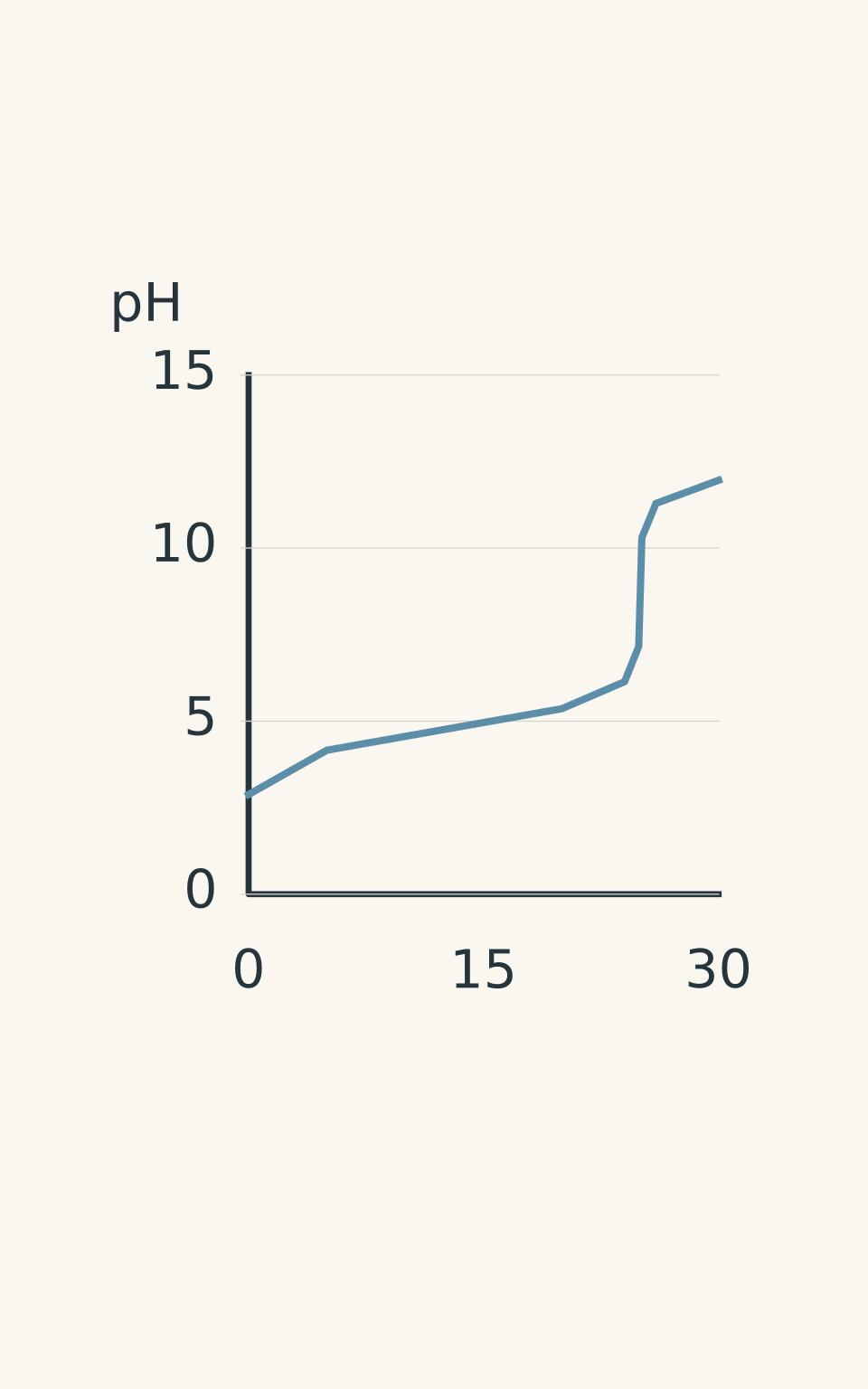
- Measured pH
(a) Use the data to estimate the equivalence volume and the pH at equivalence. Then calculate the initial concentration of the acid. (3 marks)
(b) Identify whether the acid and titrant are strong or weak. Explain why the pH at equivalence has the value observed. (3 marks)
(c) Select a suitable indicator from the table in the exam instructions. Justify your choice using its transition range. (2 marks)
(d) Use the half-equivalence data to estimate the acid’s \(pK_a\) and calculate its \(K_a\). (2 marks)
Question 5 (8 marks)
Two separate \(25.00\ \mathrm{mL}\) portions of \(0.1000\ \mathrm{mol\,L^{-1}}\) hydrochloric acid are titrated at \(25\,^\circ\mathrm{C}\).
- Titration A uses \(0.1000\ \mathrm{mol\,L^{-1}}\) sodium hydroxide.
- Titration B uses \(0.1000\ \mathrm{mol\,L^{-1}}\) aqueous ammonia, \(\ce{NH3}\).
Both titrations reach equivalence after \(25.00\ \mathrm{mL}\) of titrant has been added.
For ammonia, \(K_b=1.80\times10^{-5}\). Use \(K_w=1.00\times10^{-14}\).
(a) State the expected pH at equivalence for titration A. (1 mark)
(b) Calculate the pH at equivalence for titration B. Show your working, including the relevant equilibrium constant. (3 marks)
(c) Select a suitable indicator for each titration from the table in the exam instructions. Justify each selection. (2 marks)
(d) Compare the expected steepness of the pH change near equivalence and the pH rise after equivalence in the two titrations. (2 marks)
Question 6 (10 marks)
A \(25.00\ \mathrm{mL}\) sample of \(0.1000\ \mathrm{mol\,L^{-1}}\) hydrochloric acid is titrated with \(0.1000\ \mathrm{mol\,L^{-1}}\) sodium hydroxide.
The conductivity of the mixture is recorded as titrant is added.
| Volume of NaOH added (mL) | Conductivity (\(\mathrm{mS\,cm^{-1}}\)) |
|---|---|
| 0.00 | 42.0 |
| 5.00 | 30.5 |
| 10.00 | 21.9 |
| 15.00 | 15.4 |
| 20.00 | 10.3 |
| 24.00 | 7.0 |
| 25.00 | 6.3 |
| 26.00 | 6.7 |
| 30.00 | 8.0 |
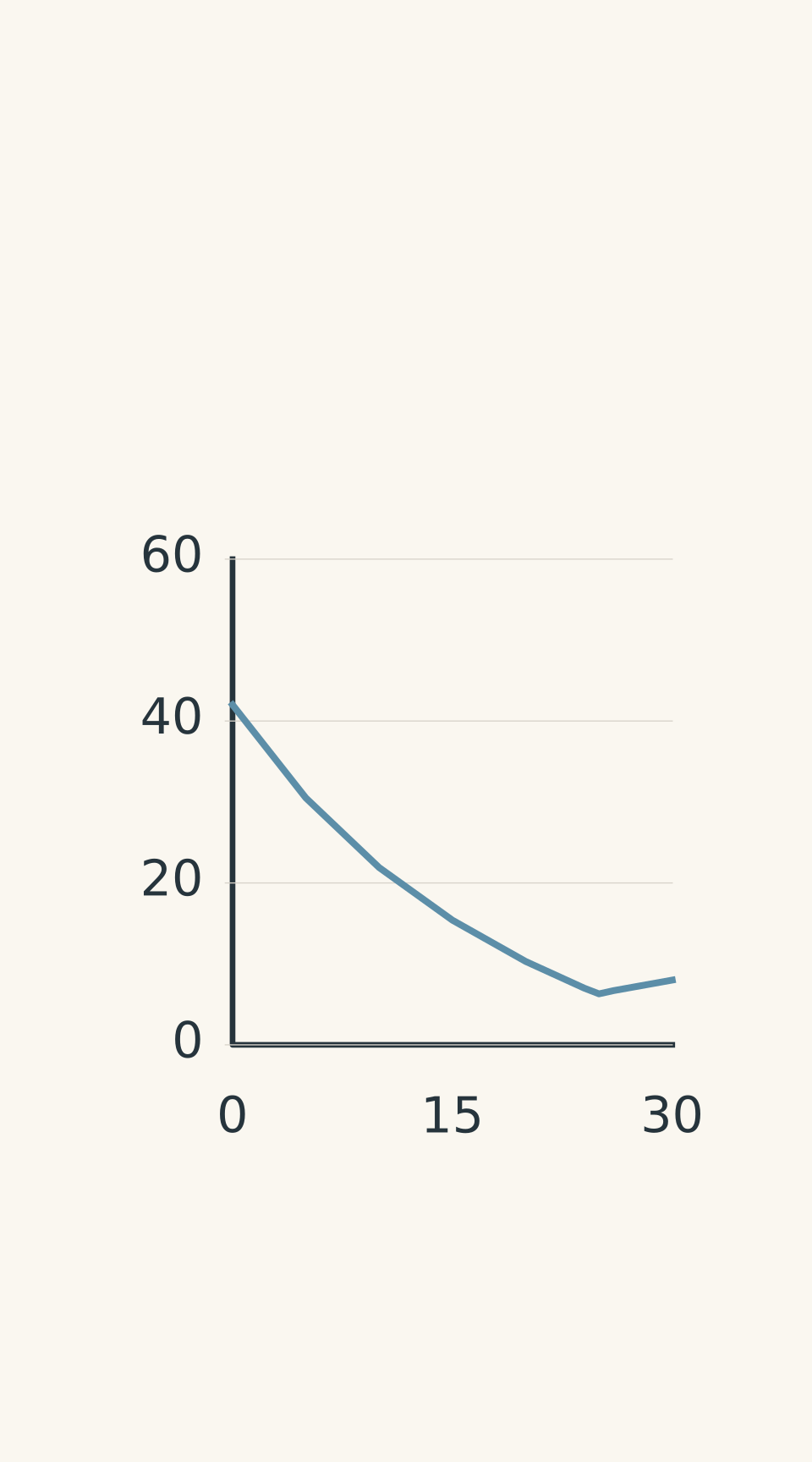
- Measured conductivity
(a) Estimate the equivalence volume from the conductivity data. (1 mark)
(b) Explain the decrease in conductivity before equivalence in terms of the ions present and their relative ionic mobilities. (3 marks)
(c) Explain why the conductivity increases after equivalence. (2 marks)
(d) Write the net ionic equation for the neutralisation reaction. (1 mark)
(e) At \(10.00\ \mathrm{mL}\) and \(30.00\ \mathrm{mL}\) of NaOH added, identify the ion in excess at each stage. Also name the two ions that are present at both stages but do not take part in the neutralisation reaction. (3 marks)
03Worked solutions and marking guide
Solution 1
(a) Calculate the required mass.
Convert the volume into litres:
\[ V=250.0\ \mathrm{mL}=0.2500\ \mathrm{L} \]
Calculate the amount of sodium carbonate required:
\[ \begin{aligned} n&=cV\\ &=0.05000\times0.2500\\ &=0.01250\ \mathrm{mol} \end{aligned} \]
Use the molar mass to calculate the mass:
\[ \begin{aligned} m&=nM\\ &=0.01250\times105.99\\ &=1.324875\ \mathrm{g} \end{aligned} \]
The required mass is \(1.325\ \mathrm{g}\).
Marking breakdown (3 marks):
- Correct amount in moles: 1 mark.
- Correct use of \(m=nM\): 1 mark.
- Correct mass with units and appropriate precision: 1 mark.
(b) Prepare the standard solution.
- Accurately weigh approximately \(1.325\ \mathrm{g}\) of anhydrous sodium carbonate and record the actual mass.
- Transfer the solid into a clean beaker. Add a small volume of distilled water and stir until all the solid dissolves.
- Transfer the solution quantitatively into the \(250.0\ \mathrm{mL}\) volumetric flask using a funnel. Rinse the beaker, stirring rod, and funnel with distilled water, adding the rinsings to the flask.
- Add distilled water until the bottom of the meniscus reaches the calibration mark at eye level. Stopper the flask and invert it several times to mix thoroughly.
Quantitative transfer matters because the calculated concentration depends on the amount of solute that actually reaches the volumetric flask.
Marking breakdown (4 marks):
- Accurate weighing and recording of mass: 1 mark.
- Complete dissolution: 1 mark.
- Quantitative transfer and rinsing: 1 mark.
- Correct final dilution, stopper, and mixing: 1 mark.
(c) Some solid is not transferred.
The actual concentration will be lower than the target concentration. Fewer moles of sodium carbonate are present, while the final solution volume remains \(250.0\ \mathrm{mL}\).
Marking breakdown (2 marks):
- States that the concentration is lower: 1 mark.
- Explains the reduction in solute amount at the same final volume: 1 mark.
(d) The volumetric flask is wet.
There is no effect on the final concentration, provided the solution is made up to the calibration mark. The residual distilled water becomes part of the solvent and is included in the final volume.
Marking breakdown (1 mark):
- Correctly explains why the final concentration is unchanged: 1 mark.
Solution 2
(a) Net ionic equation.
\[ \ce{H3O+ + OH^- -> 2H2O} \]
Marking breakdown (1 mark):
- Correctly balanced net ionic equation: 1 mark.
(b) Mean titre.
Calculate the arithmetic mean:
\[ \begin{aligned} \bar V &=\frac{18.60+18.55+18.60}{3}\\ &=18.5833\ldots\ \mathrm{mL} \end{aligned} \]
The mean titre is \(18.58\ \mathrm{mL}\) to four significant figures.
Keep the unrounded mean for intermediate calculations.
Marking breakdown (1 mark):
- Correct mean titre: 1 mark.
(c) Concentration of the diluted sodium hydroxide.
First, calculate the amount of hydrochloric acid used. Convert the mean titre to litres.
\[ \begin{aligned} n(\ce{HCl}) &=cV\\ &=0.08000\times0.0185833\ldots\\ &=0.00148667\ \mathrm{mol} \end{aligned} \]
Hydrochloric acid and sodium hydroxide react in a \(1:1\) mole ratio. Therefore, the \(25.00\ \mathrm{mL}\) aliquot contains the same amount of sodium hydroxide:
\[ n(\ce{NaOH})=0.00148667\ \mathrm{mol} \]
The concentration of the diluted solution is:
\[ \begin{aligned} c(\ce{NaOH}) &=\frac{n}{V}\\ &=\frac{0.00148667}{0.02500}\\ &=0.0594667\ \mathrm{mol\,L^{-1}} \end{aligned} \]
The diluted concentration is \(0.05947\ \mathrm{mol\,L^{-1}}\).
Marking breakdown (3 marks):
- Correct amount of HCl calculated: 1 mark.
- Correct \(1:1\) stoichiometric relationship: 1 mark.
- Correct concentration of diluted NaOH: 1 mark.
(d) Concentration of the original stock solution.
The stock solution was diluted from \(10.00\ \mathrm{mL}\) to \(100.0\ \mathrm{mL}\). The dilution factor is:
\[ \text{Dilution factor}=\frac{100.0}{10.00}=10.00 \]
Using the dilution relationship \(c_1V_1=c_2V_2\):
\[ \begin{aligned} c_{\text{stock}} &=c_{\text{diluted}}\times10.00\\ &=0.0594667\times10.00\\ &=0.594667\ \mathrm{mol\,L^{-1}} \end{aligned} \]
The original stock concentration is \(0.5947\ \mathrm{mol\,L^{-1}}\).
Marking breakdown (3 marks):
- Correct dilution factor: 1 mark.
- Correct dilution relationship: 1 mark.
- Correct stock concentration with units: 1 mark.
(e) The transfer pipette contains residual water.
The calculated stock concentration will be underestimated. Residual water dilutes the stock solution entering the pipette, so the delivered aliquot contains fewer moles of sodium hydroxide than expected. The diluted solution consequently requires less hydrochloric acid during titration, producing a lower calculated concentration.
Marking breakdown (2 marks):
- Predicts an underestimated concentration: 1 mark.
- Explains the dilution and its effect on the titration result: 1 mark.
Solution 3
(a) Initial amount of hydrochloric acid.
Convert the volume to litres:
\[ 60.00\ \mathrm{mL}=0.06000\ \mathrm{L} \]
Calculate the amount added:
\[ \begin{aligned} n(\ce{HCl}) &=cV\\ &=0.2000\times0.06000\\ &=0.01200\ \mathrm{mol} \end{aligned} \]
The initial amount of hydrochloric acid is \(0.01200\ \mathrm{mol}\).
Marking breakdown (2 marks):
- Correct conversion and use of \(n=cV\): 1 mark.
- Correct amount in moles: 1 mark.
(b) Amount of hydrochloric acid remaining.
The excess hydrochloric acid is titrated with sodium hydroxide. These substances react in a \(1:1\) mole ratio.
\[ \begin{aligned} n(\ce{NaOH}) &=0.1000\times0.03840\\ &=0.003840\ \mathrm{mol} \end{aligned} \]
Therefore, the remaining hydrochloric acid is:
\[ n(\ce{HCl})_{\text{remaining}} =0.003840\ \mathrm{mol} \]
Marking breakdown (2 marks):
- Correct amount of NaOH calculated: 1 mark.
- Correctly relates the amount of NaOH to the excess HCl: 1 mark.
(c) Mass of calcium carbonate.
The amount of hydrochloric acid that reacted with the calcium carbonate is the initial amount minus the excess amount:
\[ \begin{aligned} n(\ce{HCl})_{\text{reacted}} &=0.01200-0.003840\\ &=0.008160\ \mathrm{mol} \end{aligned} \]
From the balanced equation,
\[ \ce{CaCO3 + 2HCl -> CaCl2 + CO2 + H2O} \]
two moles of hydrochloric acid react with one mole of calcium carbonate. Hence,
\[ \begin{aligned} n(\ce{CaCO3}) &=\frac{0.008160}{2}\\ &=0.004080\ \mathrm{mol} \end{aligned} \]
Convert this amount into mass:
\[ \begin{aligned} m(\ce{CaCO3}) &=nM\\ &=0.004080\times100.09\\ &=0.4083672\ \mathrm{g} \end{aligned} \]
The sample contains \(0.4084\ \mathrm{g}\) of calcium carbonate.
Marking breakdown (4 marks):
- Correct amount of HCl consumed: 1 mark.
- Correct \(2:1\) HCl-to-\(\ce{CaCO3}\) mole ratio: 1 mark.
- Correct amount of \(\ce{CaCO3}\): 1 mark.
- Correct mass with units: 1 mark.
(d) Mass percentage of calcium carbonate.
Mass percentage is the mass of calcium carbonate divided by the total sample mass, multiplied by \(100\).
\[ \begin{aligned} \%\ce{CaCO3} &=\frac{0.4083672}{0.5000}\times100\\ &=81.6734\ldots\% \end{aligned} \]
The sample contains \(81.7\%\) calcium carbonate by mass.
Marking breakdown (2 marks):
- Correct mass-percentage calculation: 1 mark.
- Correct percentage with appropriate precision: 1 mark.
(e) Limiting reagent.
The initial amount of hydrochloric acid was \(0.01200\ \mathrm{mol}\), while the amount that reacted was \(0.008160\ \mathrm{mol}\).
The calcium carbonate consumed \(0.008160\ \mathrm{mol}\) of hydrochloric acid, leaving \(0.003840\ \mathrm{mol}\) unreacted. Hydrochloric acid was therefore in excess, and calcium carbonate was the limiting reagent.
Marking breakdown (2 marks):
- Correct comparison of the amounts: 1 mark.
- Correct identification of the limiting and excess reagents: 1 mark.
Solution 4
(a) Equivalence volume, equivalence pH, and acid concentration.
The steepest pH change occurs around \(25.00\ \mathrm{mL}\) of NaOH added. The equivalence volume is therefore approximately \(25.00\ \mathrm{mL}\), with a pH of approximately \(8.72\).
At equivalence, the acid and sodium hydroxide have reacted in a \(1:1\) mole ratio.
\[ \begin{aligned} n(\ce{NaOH}) &=0.1000\times0.02500\\ &=0.002500\ \mathrm{mol} \end{aligned} \]
The initial amount of acid was also \(0.002500\ \mathrm{mol}\). Therefore,
\[ \begin{aligned} c(\ce{HA}) &=\frac{0.002500}{0.02500}\\ &=0.1000\ \mathrm{mol\,L^{-1}} \end{aligned} \]
The initial acid concentration is \(0.1000\ \mathrm{mol\,L^{-1}}\).
Marking breakdown (3 marks):
- Correct equivalence volume: 1 mark.
- Correct equivalence pH: 1 mark.
- Correct acid concentration: 1 mark.
(b) Strength of the acid and base.
The acid is weak, and sodium hydroxide is a strong base.
The equivalence pH is above \(7\) because the conjugate base, \(\mathrm{A}^{-}\), reacts with water to produce hydroxide ions:
\[ \ce{A^- + H2O <=> HA + OH^-} \]
The production of \(\mathrm{OH}^{-}\) makes the solution basic at equivalence.
Marking breakdown (3 marks):
- Correctly identifies the weak acid: 1 mark.
- Correctly identifies the strong base: 1 mark.
- Explains the formation of \(\mathrm{OH}^{-}\) and the basic equivalence pH: 1 mark.
(c) Suitable indicator.
Phenolphthalein is suitable because its transition range is pH \(8.2\)-\(10.0\). This range falls within the steep pH change around the equivalence point, where the pH rises rapidly from approximately \(7.16\) to \(10.30\).
Marking breakdown (2 marks):
- Selects phenolphthalein: 1 mark.
- Correctly relates its transition range to the steep region: 1 mark.
(d) Calculate \(pK_a\) and \(K_a\).
Half-equivalence occurs when half the required volume of titrant has been added:
\[ V_{\text{half-equivalence}} =\frac{25.00}{2} =12.50\ \mathrm{mL} \]
At half-equivalence, the concentrations of the weak acid and its conjugate base are equal. Therefore, the Henderson-Hasselbalch relationship gives \(\mathrm{pH}=pK_a\).
From the table,
\[ pK_a=4.76 \]
Convert this into the acid dissociation constant:
\[ \begin{aligned} K_a&=10^{-pK_a}\\ &=10^{-4.76}\\ &=1.74\times10^{-5} \end{aligned} \]
The results are \(pK_a=4.76\) and \(K_a=1.74\times10^{-5}\).
Marking breakdown (2 marks):
- Correct \(pK_a\): 1 mark.
- Correct \(K_a\): 1 mark.
Solution 5
(a) Equivalence pH for titration A.
Hydrochloric acid is a strong acid, and sodium hydroxide is a strong base. At equivalence, the acid and base have reacted completely, leaving a neutral solution under the stated conditions.
The expected pH is \(7.00\).
Marking breakdown (1 mark):
- Correct equivalence pH: 1 mark.
(b) Equivalence pH for titration B.
Ammonia reacts with hydrochloric acid to form ammonium ions:
\[ \ce{NH3 + H3O+ -> NH4+ + H2O} \]
At equivalence, the amount of ammonium ions formed is:
\[ \begin{aligned} n(\ce{NH4+}) &=0.1000\times0.02500\\ &=0.002500\ \mathrm{mol} \end{aligned} \]
The total volume is \(25.00+25.00=50.00\ \mathrm{mL}\), or \(0.05000\ \mathrm{L}\). Therefore,
\[ [\ce{NH4+}] =\frac{0.002500}{0.05000} =0.05000\ \mathrm{mol\,L^{-1}} \]
Ammonium ions are weakly acidic. Their acid dissociation constant is related to the base dissociation constant of ammonia by:
\[ \begin{aligned} K_a(\ce{NH4+}) &=\frac{K_w}{K_b(\ce{NH3})}\\ &=\frac{1.00\times10^{-14}}{1.80\times10^{-5}}\\ &=5.56\times10^{-10} \end{aligned} \]
The relevant equilibrium is:
\[ \ce{NH4+ + H2O <=> NH3 + H3O+} \]
Using the weak-acid approximation, \([\ce{H3O+}]\approx\sqrt{K_a c}\):
\[ \begin{aligned} [\ce{H3O+}] &\approx\sqrt{(5.56\times10^{-10})(0.05000)}\\ &=5.27\times10^{-6}\ \mathrm{mol\,L^{-1}} \end{aligned} \]
Hence,
\[ \begin{aligned} \mathrm{pH} &=-\log_{10}(5.27\times10^{-6})\\ &=5.28 \end{aligned} \]
The expected equivalence pH for titration B is approximately \(5.28\). It is below \(7\) because the ammonium ions make the solution acidic.
Marking breakdown (3 marks):
- Correct \(K_a\) and ammonium concentration: 1 mark.
- Correct hydronium concentration calculation: 1 mark.
- Correct pH: 1 mark.
(c) Indicator selection.
- Titration A: Bromothymol blue, with a transition range of pH \(6.0\)-\(7.6\), is suitable for the steep pH change around the equivalence point of a strong acid-strong base titration.
- Titration B: Methyl orange, with a transition range of pH \(3.1\)-\(4.4\), is suitable because its transition falls within the steep region of the strong acid-weak base titration curve.
Marking breakdown (2 marks):
- Suitable indicator and justification for A: 1 mark.
- Suitable indicator and justification for B: 1 mark.
(d) Compare the titration curves.
Near equivalence, titration A has a steeper pH change, centred around pH \(7\). Titration B has an acidic equivalence point and a less pronounced pH jump because ammonia is a weak base and only partially ionises.
After equivalence, excess sodium hydroxide dissociates completely, so the pH rises rapidly. Excess ammonia ionises only partially, so the pH rises more gradually.
Marking breakdown (2 marks):
- Correct comparison near equivalence: 1 mark.
- Correct comparison after equivalence: 1 mark.
Solution 6
(a) Equivalence volume.
The conductivity reaches its minimum at approximately \(25.00\ \mathrm{mL}\) of NaOH added. This identifies the equivalence volume.
Answer: \(25.00\ \mathrm{mL}\).
Marking breakdown (1 mark):
- Correct equivalence volume: 1 mark.
(b) Why conductivity decreases before equivalence.
The net ionic reaction is:
\[ \ce{H3O+ + OH^- -> 2H2O} \]
Before equivalence, added hydroxide ions react with hydronium ions. This removes \(\ce{H3O+}\), which has a very high ionic mobility.
Sodium ions, \(\mathrm{Na}^{+}\), replace the hydronium ions in solution. Sodium ions have much lower ionic mobility, so the solution conducts electricity less effectively. Dilution also contributes to the decrease.
Marking breakdown (3 marks):
- Explains the removal of \(\ce{H3O+}\) by neutralisation: 1 mark.
- Explains its replacement by less mobile \(\mathrm{Na}^{+}\): 1 mark.
- Identifies chloride as a spectator ion or explains the contribution of dilution: 1 mark.
(c) Why conductivity increases after equivalence.
Once all the hydrochloric acid has reacted, additional sodium hydroxide remains in excess. It supplies additional \(\mathrm{OH}^{-}\) and \(\mathrm{Na}^{+}\) ions to the solution.
The increasing concentration of mobile ions causes the conductivity to rise.
Marking breakdown (2 marks):
- Identifies excess hydroxide ions after equivalence: 1 mark.
- Explains the increase in conductivity from additional mobile ions: 1 mark.
(d) Net ionic equation.
\[ \ce{H3O+ + OH^- -> 2H2O} \]
Marking breakdown (1 mark):
- Correctly balanced net ionic equation: 1 mark.
(e) Identify the ions at the two stages.
At \(10.00\ \mathrm{mL}\), the amount of NaOH added is:
\[ n(\ce{NaOH})=0.1000\times0.01000 =0.001000\ \mathrm{mol} \]
The initial hydrochloric acid amount was \(0.002500\ \mathrm{mol}\). Hydrochloric acid remains in excess, so \(\ce{H3O+}\) is the excess ion.
At \(30.00\ \mathrm{mL}\), the amount of NaOH added is:
\[ n(\ce{NaOH})=0.1000\times0.03000 =0.003000\ \mathrm{mol} \]
This exceeds the initial \(0.002500\ \mathrm{mol}\) of hydrochloric acid. Therefore, \(\mathrm{OH}^{-}\) is the excess ion.
At both specified stages, \(\mathrm{Na}^{+}\) and \(\mathrm{Cl}^{-}\) are present. These are spectator ions in the neutralisation reaction.
Marking breakdown (3 marks):
- Correctly identifies \(\ce{H3O+}\) as the excess ion at \(10.00\ \mathrm{mL}\): 1 mark.
- Correctly identifies \(\mathrm{OH}^{-}\) as the excess ion at \(30.00\ \mathrm{mL}\): 1 mark.
- Correctly identifies both spectator ions, \(\mathrm{Na}^{+}\) and \(\mathrm{Cl}^{-}\): 1 mark.
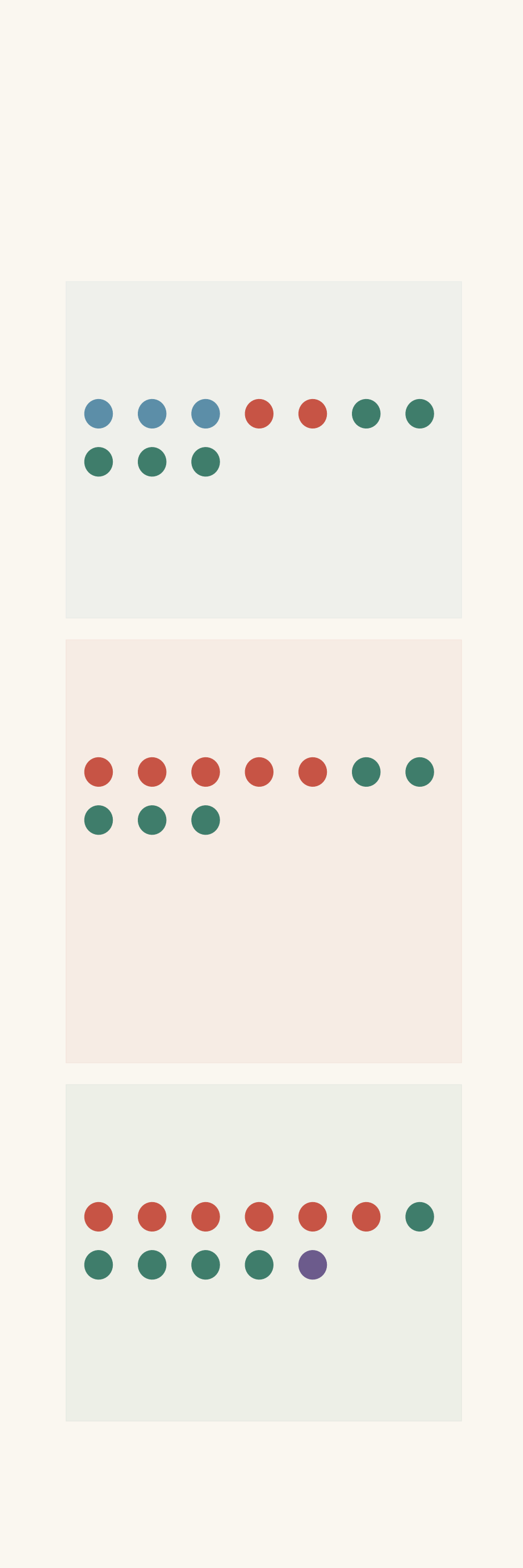
- H₃O⁺
- Na⁺
- Cl⁻
- OH⁻
For another set of focused practice questions, try tutorgum’s acid-base titration practice exam.