
Acid-Base Titration Problems: Original Chemistry Practice Exam
Test your understanding of acid-base titration problems with this original 50-mark Chemistry practice exam. Includes a 60-minute assessment covering titration calculations, curves, indicators, conductivity, and experimental errors, followed by fully worked solutions and a detailed marking guide.
This original tutorgum practice paper assesses acid-base titration problems within the supplied Chemistry 2017-edition scope. It covers unknown concentrations, titration curves, equivalence points, indicator selection, conductivity, and experimental errors. It is a focused topic assessment, not a full-course exam or an official, endorsed, past, or predicted NESA paper.
01Exam instructions
- Working time: 60 minutes.
- Reading time: 5 minutes.
- Total marks: 50.
- Equipment: Scientific calculator, ruler, and writing materials. No notes are required.
- Working: Show your calculations, include units, and give answers to a precision justified by the data.
For calculations, use \(n=cV\), where \(n\) is the amount of substance in moles, \(c\) is concentration in \(\mathrm{mol\,L^{-1}}\), and \(V\) is volume in litres. Convert volumes from millilitres to litres before using this equation.
Unless otherwise stated, assume aqueous solutions at \(25^\circ\mathrm{C}\), additive solution volumes, and complete ionisation of strong acids and bases. Use \(pH+pOH=14.00\) at this temperature.
Assessed topics
- Determining unknown acid or base concentrations using titration data and stoichiometry.
- Strong acid-strong base, weak acid-strong base, and strong acid-weak base titration curves.
- Equivalence-point behaviour and indicator selection.
- Conductivity changes and the ions present during titration.
- Endpoint, transfer, and solution-preparation errors.
Exclusions: Quantitative \(K_a\) and \(K_b\) equilibrium calculations, extended buffer calculations, and topics outside the specified acid-base titration scope are not assessed.
02Questions
Question 1 (8 marks)
A student is determining the concentration of an unknown diprotic acid, \(\ce{H2A}\).
The student transfers \(25.00\ \mathrm{mL}\) of the original acid solution into a \(250.0\ \mathrm{mL}\) volumetric flask and dilutes it to the calibration mark with distilled water.
A \(25.00\ \mathrm{mL}\) aliquot of the diluted acid is then titrated with \(0.1200\ \mathrm{mol\,L^{-1}}\) sodium hydroxide. The balanced equation for complete neutralisation is:
\[ \ce{H2A + 2OH^- -> A^2- + 2H2O} \]
The student records one rough titre of \(19.10\ \mathrm{mL}\), followed by three concordant titres of \(18.55\ \mathrm{mL}\), \(18.60\ \mathrm{mL}\), and \(18.65\ \mathrm{mL}\).
(a) Calculate the mean of the three concordant titres. (1 mark)
(b) Calculate the concentration of the diluted acid. Show your working. (4 marks)
(c) Determine the concentration of the original acid solution. (2 marks)
(d) Explain why the balanced equation must be used when converting the amount of sodium hydroxide into the amount of acid neutralised. (1 mark)
Question 2 (8 marks)
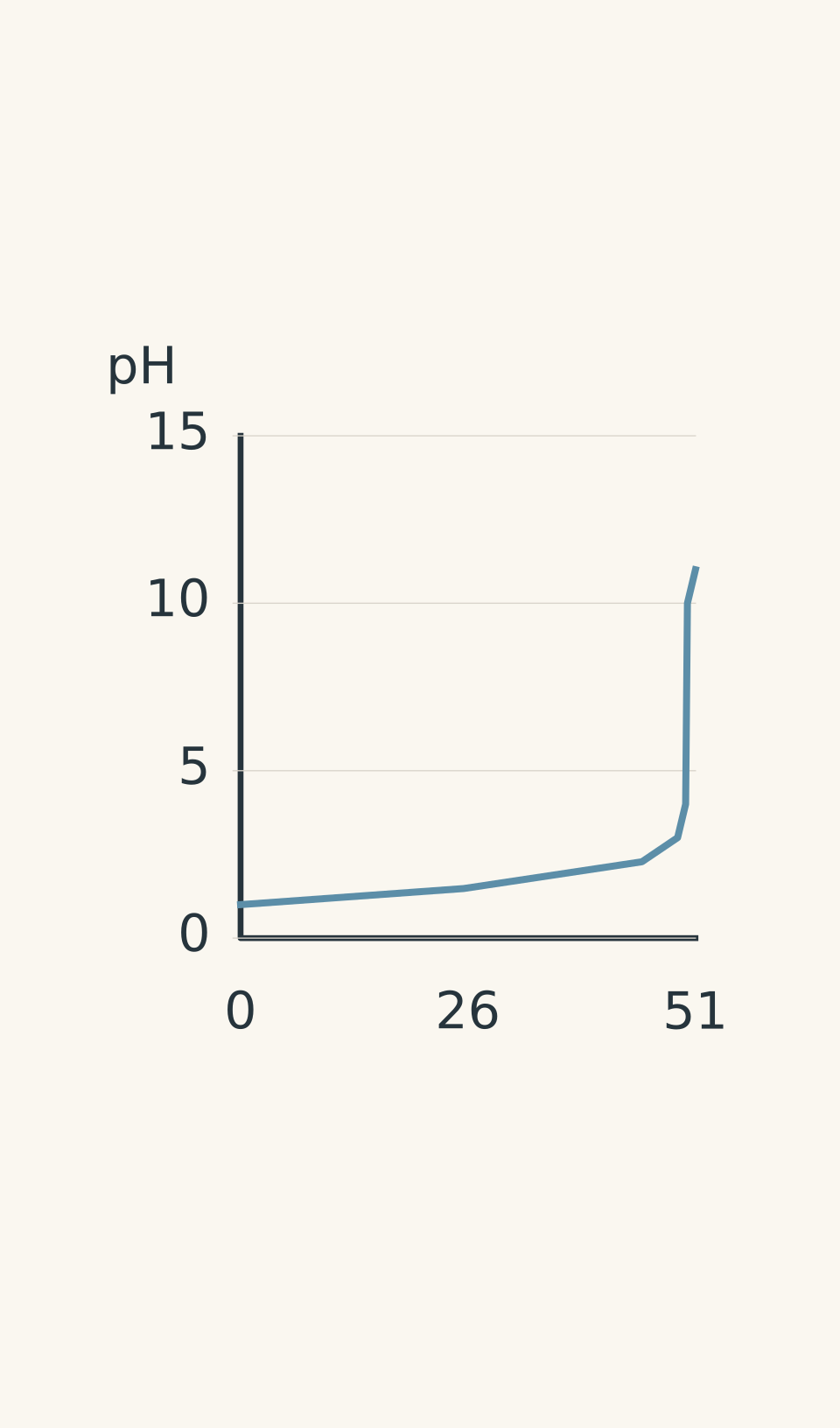
A \(50.00\ \mathrm{mL}\) sample of \(0.1000\ \mathrm{mol\,L^{-1}}\) hydrochloric acid is titrated with \(0.1000\ \mathrm{mol\,L^{-1}}\) sodium hydroxide.
The following pH readings are recorded.
| Volume of NaOH added (mL) | pH |
|---|---|
| 0.00 | 1.00 |
| 25.00 | 1.48 |
| 45.00 | 2.28 |
| 49.00 | 3.00 |
| 49.90 | 4.00 |
| 50.00 | 7.00 |
| 50.10 | 10.00 |
| 51.00 | 11.00 |
- HCl titrated with NaOH
(a) Determine the equivalence-point volume of sodium hydroxide. (1 mark)
(b) Explain why the pH at the equivalence point is approximately 7.00 at \(25^\circ\mathrm{C}\). (2 marks)
(c) Three indicators are available:
| Indicator | Transition range |
|---|---|
| Methyl orange | pH 3.1-4.4 |
| Bromothymol blue | pH 6.0-7.6 |
| Phenolphthalein | pH 8.2-10.0 |
Select the indicator whose transition range is centred closest to the equivalence-point pH. Justify your choice. (2 marks)
(d) Calculate the pH after \(55.00\ \mathrm{mL}\) of sodium hydroxide has been added. (3 marks)
Question 3 (9 marks)
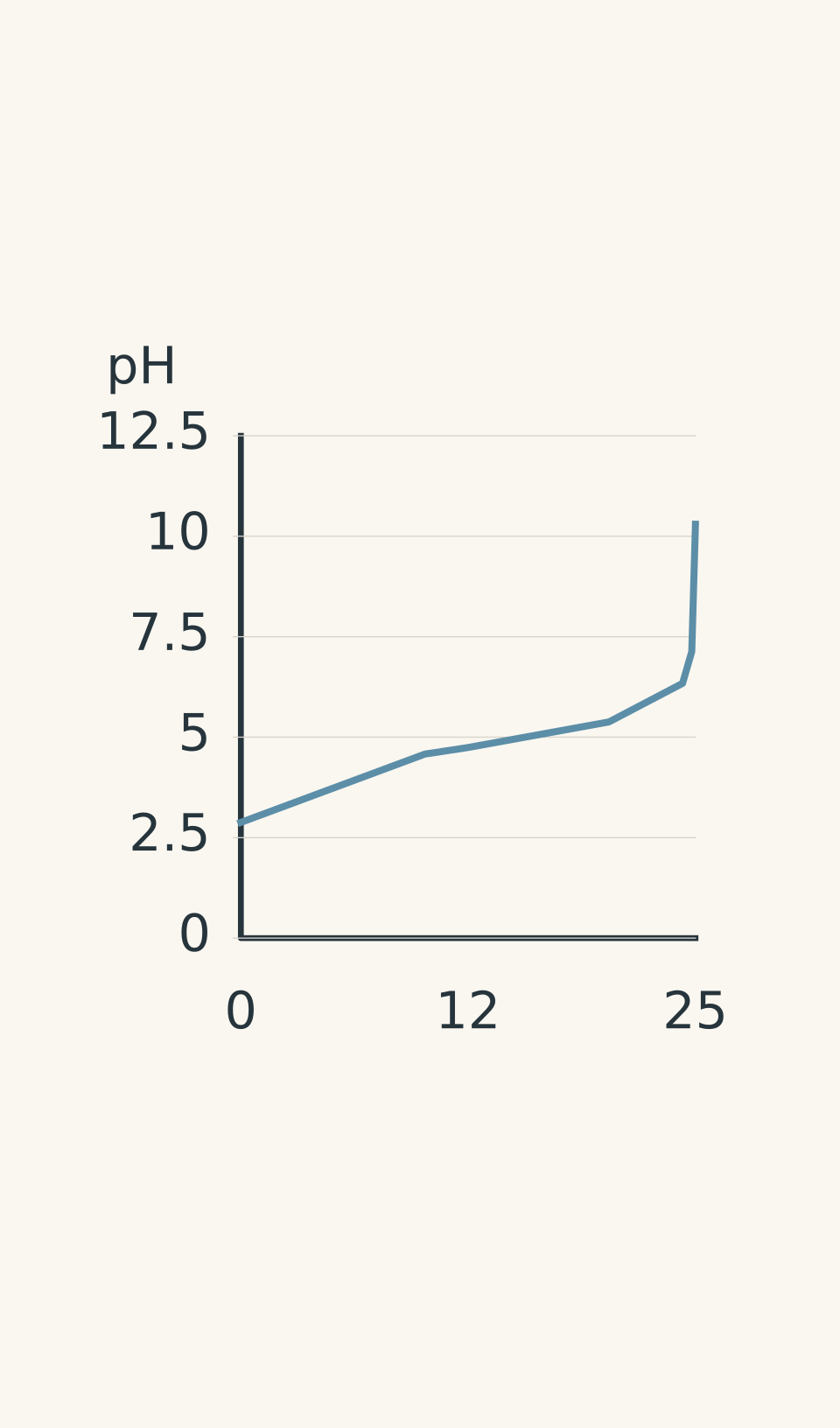
A \(25.00\ \mathrm{mL}\) sample of an unknown weak monoprotic acid, \(\ce{HA}\), is titrated with \(0.1000\ \mathrm{mol\,L^{-1}}\) sodium hydroxide.
The following pH readings are obtained.
| Volume of NaOH added (mL) | pH |
|---|---|
| 0.00 | 2.88 |
| 10.00 | 4.58 |
| 12.30 | 4.74 |
| 20.00 | 5.38 |
| 24.00 | 6.34 |
| 24.50 | 7.13 |
| 24.60 | 8.72 |
| 24.70 | 10.30 |
- Weak acid titrated with NaOH
(a) Estimate the equivalence-point volume from the data. (1 mark)
(b) Calculate the initial concentration of the weak acid. (3 marks)
(c) Explain why the pH at the equivalence point is greater than 7. Include a chemical equation for the relevant reaction with water. (3 marks)
(d) Select the most suitable indicator from the three indicators below and justify your choice using its transition range and the titration data. (2 marks)
| Indicator | Transition range |
|---|---|
| Methyl orange | pH 3.1-4.4 |
| Bromothymol blue | pH 6.0-7.6 |
| Phenolphthalein | pH 8.2-10.0 |
Question 4 (9 marks)
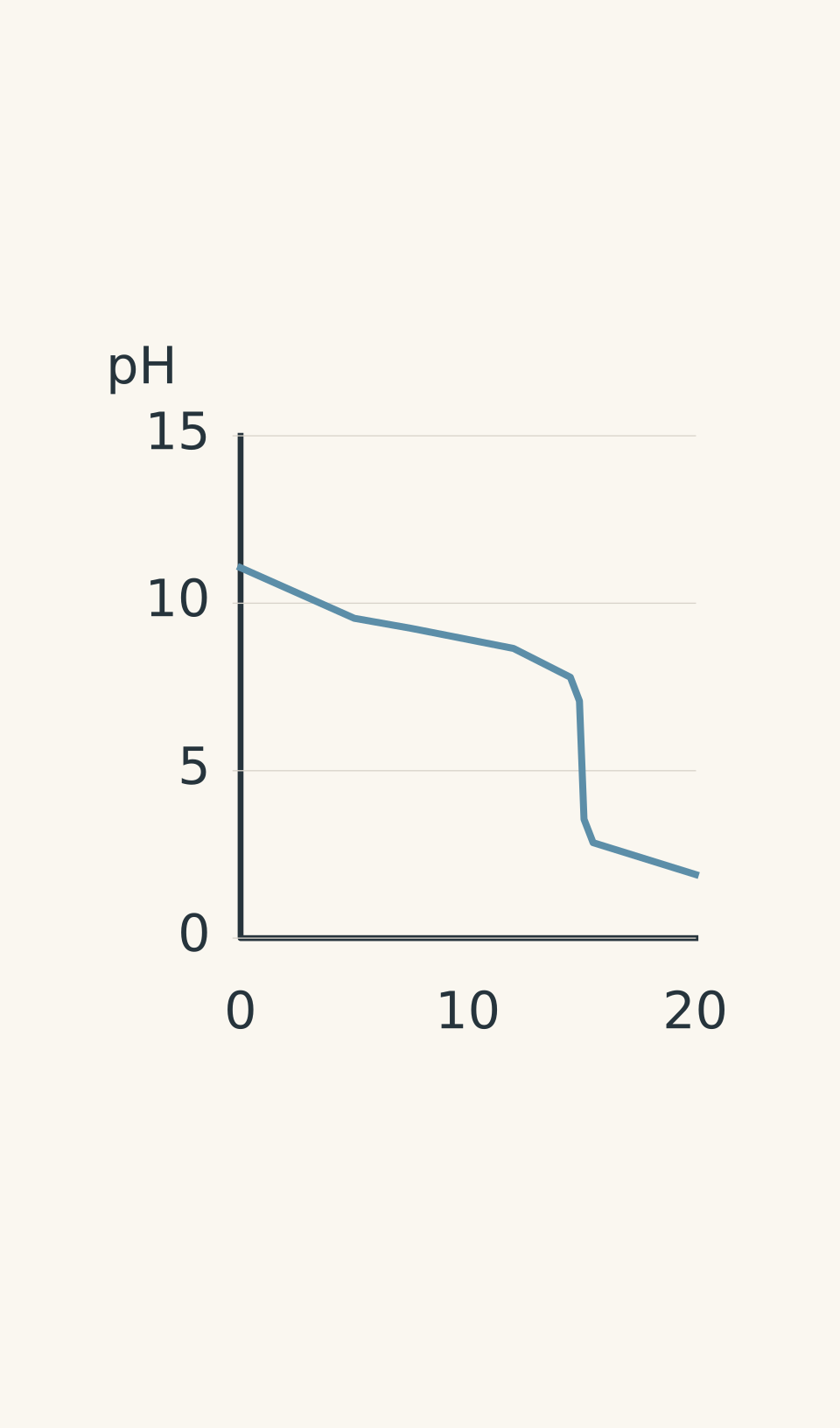
A \(20.00\ \mathrm{mL}\) sample of aqueous ammonia, \(\ce{NH3}\), of unknown concentration is titrated with \(0.1000\ \mathrm{mol\,L^{-1}}\) hydrochloric acid.
The pH is recorded as acid is added.
| Volume of HCl added (mL) | pH |
|---|---|
| 0.00 | 11.06 |
| 5.00 | 9.55 |
| 7.50 | 9.25 |
| 12.00 | 8.65 |
| 14.50 | 7.79 |
| 14.90 | 7.08 |
| 15.00 | 5.31 |
| 15.10 | 3.55 |
| 15.50 | 2.85 |
| 20.00 | 1.90 |
- NH₃ titrated with HCl
(a) Determine the equivalence-point volume. (1 mark)
(b) Calculate the initial concentration of the ammonia solution. (3 marks)
(c) Write the equation for the reaction of ammonium ions with water and explain why the pH at the equivalence point is below 7. (3 marks)
(d) Select the most suitable indicator from the table below and justify your choice. (2 marks)
| Indicator | Transition range |
|---|---|
| Methyl orange | pH 3.1-4.4 |
| Methyl red | pH 4.4-6.2 |
| Bromothymol blue | pH 6.0-7.6 |
| Phenolphthalein | pH 8.2-10.0 |
Question 5 (8 marks)
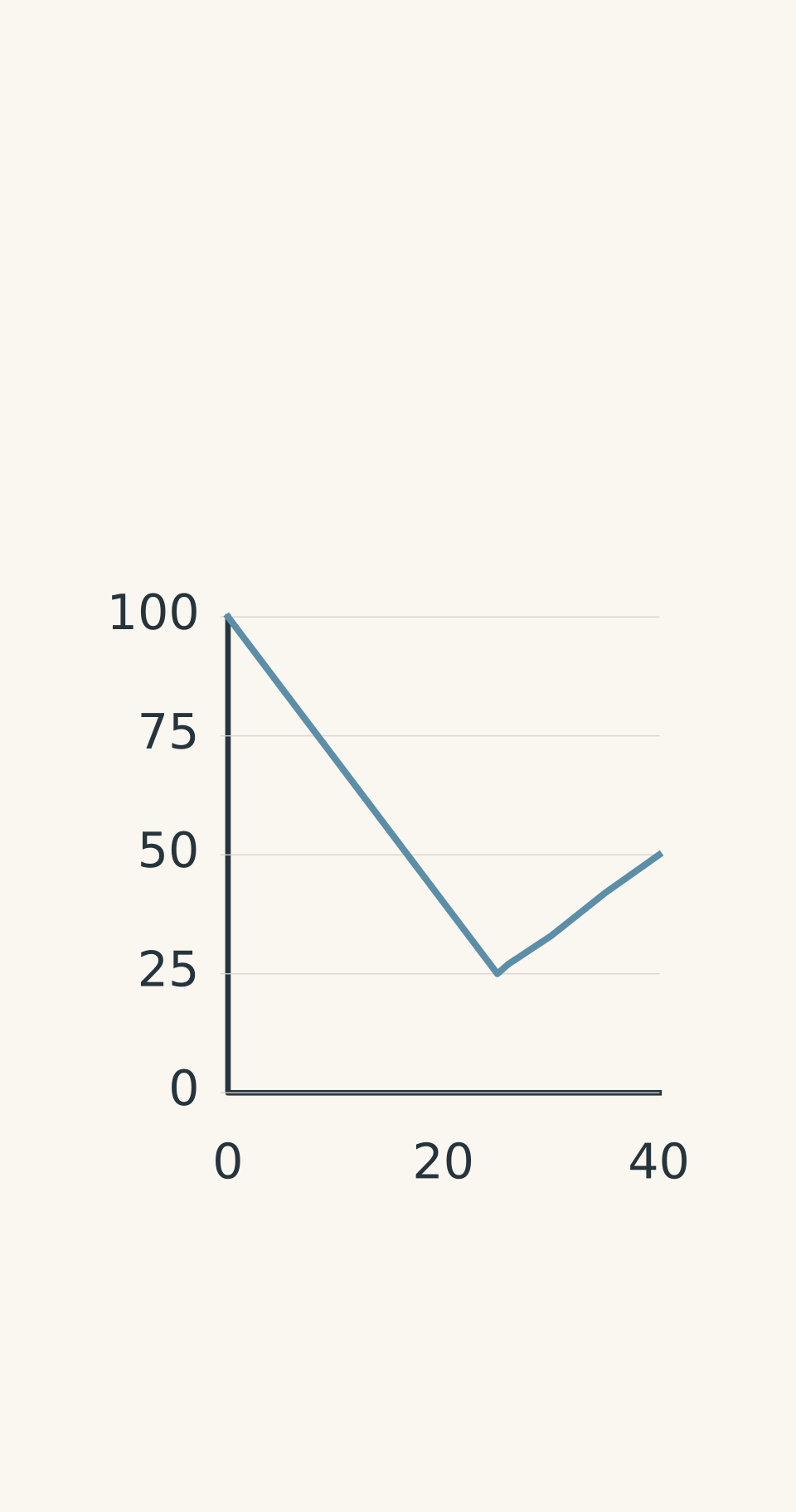
A \(25.00\ \mathrm{mL}\) sample of \(0.1000\ \mathrm{mol\,L^{-1}}\) hydrochloric acid is titrated with \(0.1000\ \mathrm{mol\,L^{-1}}\) sodium hydroxide.
The student measures the conductivity of the mixture as the titration proceeds. The readings below are relative conductivity values in arbitrary units; a larger value represents greater conductivity.
| Volume of NaOH added (mL) | Relative conductivity |
|---|---|
| 0.00 | 100 |
| 5.00 | 85 |
| 10.00 | 70 |
| 15.00 | 55 |
| 20.00 | 40 |
| 24.00 | 28 |
| 25.00 | 25 |
| 26.00 | 27 |
| 30.00 | 33 |
| 35.00 | 42 |
| 40.00 | 50 |
- HCl titrated with NaOH
(a) Estimate the equivalence-point volume from the data. (1 mark)
(b) Name the principal dissolved ions present just before equivalence, at equivalence, and just after equivalence. (3 marks)
(c) Explain why the conductivity decreases before equivalence and increases after equivalence. (2 marks)
(d) A student claims that the conductivity must be zero at equivalence because the acid and base have neutralised each other. Evaluate this claim, referring to the ions present. (2 marks)
Question 6 (8 marks)
A student determines the concentration of a sodium hydroxide solution by titrating \(25.00\ \mathrm{mL}\) aliquots with \(0.1000\ \mathrm{mol\,L^{-1}}\) hydrochloric acid.
The reaction is:
\[ \ce{HCl + NaOH -> NaCl + H2O} \]
The student calculates the sodium hydroxide concentration using:
\[ c(\ce{NaOH})= \frac{c(\ce{HCl})V(\ce{HCl})} {V(\ce{NaOH})} \]
For each independent error below, state whether the calculated concentration of sodium hydroxide or the reported concentration of the original acid would be too high, too low, or unchanged. Explain your reasoning.
(a) After the \(25.00\ \mathrm{mL}\) sodium hydroxide aliquot has been delivered into the conical flask, the student rinses the flask with distilled water before beginning the titration. (2 marks)
(b) The pipette is rinsed with distilled water but is not conditioned with sodium hydroxide solution before the aliquot is transferred. (2 marks)
(c) In a separate acid-dilution experiment, \(25.00\ \mathrm{mL}\) of stock acid is diluted in a \(250.0\ \mathrm{mL}\) volumetric flask. The student leaves the meniscus above the calibration mark but still uses a dilution factor of 10.00 to calculate the original acid concentration. (2 marks)
(d) During the sodium hydroxide titration, the student overshoots the indicator endpoint by adding excess hydrochloric acid. (2 marks)
03Worked solutions and marking guide
Award marks for the specified steps or ideas. Equivalent correct methods are acceptable. Where a later calculation correctly follows through from an earlier numerical error, award appropriate follow-through marks if the method remains valid.
Solution 1
(a) Mean titre (1 mark)
Calculate the mean using the three concordant titres, excluding the rough titre.
\[ \begin{aligned} V_{\text{mean}} &=\frac{18.55+18.60+18.65}{3}\\ &=18.60\ \mathrm{mL} \end{aligned} \]
Marking: 1 mark for the correct mean of \(18.60\ \mathrm{mL}\).
(b) Concentration of the diluted acid (4 marks)
First calculate the amount of hydroxide ions delivered.
\[ \begin{aligned} n(\mathrm{OH}^{-}) &=cV\\ &=0.1200\times0.01860\\ &=2.232\times10^{-3}\ \mathrm{mol} \end{aligned} \]
The balanced equation shows that 2 mol of \(\mathrm{OH}^{-}\) react with 1 mol of \(\ce{H2A}\).
\[ \begin{aligned} n(\ce{H2A}) &=\frac{2.232\times10^{-3}}{2}\\ &=1.116\times10^{-3}\ \mathrm{mol} \end{aligned} \]
The aliquot volume is \(25.00\ \mathrm{mL}=0.02500\ \mathrm{L}\).
\[ \begin{aligned} c_{\text{diluted}} &=\frac{n(\ce{H2A})}{V}\\ &=\frac{1.116\times10^{-3}}{0.02500}\\ &=0.04464\ \mathrm{mol\,L^{-1}} \end{aligned} \]
The concentration of the diluted acid is \(0.04464\ \mathrm{mol\,L^{-1}}\).
Marking:
- 1 mark for calculating the amount of \(\mathrm{OH}^{-}\).
- 1 mark for applying the 2:1 hydroxide-to-acid mole ratio.
- 1 mark for calculating the amount of \(\ce{H2A}\).
- 1 mark for calculating the diluted acid concentration with units.
(c) Concentration of the original acid (2 marks)
The dilution factor is:
\[ \frac{250.0}{25.00}=10.00 \]
Dilution changes the concentration but does not change the amount of acid transferred into the volumetric flask.
Therefore,
\[ \begin{aligned} c_{\text{original}} &=10.00\times0.04464\\ &=0.4464\ \mathrm{mol\,L^{-1}} \end{aligned} \]
Marking:
- 1 mark for identifying the dilution factor of 10.00.
- 1 mark for the correct original concentration, including units.
(d) Importance of the balanced equation (1 mark)
The balanced equation establishes the mole ratio. Each mole of \(\ce{H2A}\) requires 2 mol of \(\mathrm{OH}^{-}\) for complete neutralisation, so the amount of acid cannot be obtained by simply assuming a 1:1 ratio.
Marking: 1 mark for identifying the required 1:2 acid-to-hydroxide mole ratio.
Solution 2
(a) Equivalence-point volume (1 mark)
The equivalence point occurs at \(50.00\ \mathrm{mL}\) of added sodium hydroxide.
Marking: 1 mark for \(50.00\ \mathrm{mL}\).
(b) Equivalence-point pH (2 marks)
Hydrochloric acid and sodium hydroxide are both strong, so they ionise essentially completely in water. At equivalence, the hydronium and hydroxide ions have reacted in the required stoichiometric amounts.
The net ionic equation is:
\[ \ce{H3O+ + OH^- -> 2H2O} \]
The remaining dissolved ions are mainly \(\mathrm{Na}^{+}\) and \(\mathrm{Cl}^{-}\). These ions do not significantly react with water to change its pH, so the solution is approximately neutral at \(25^\circ\mathrm{C}\).
Thus, \(pH\approx7.00\).
Marking:
- 1 mark for explaining the neutralisation of hydronium and hydroxide ions.
- 1 mark for explaining that the remaining salt ions do not significantly affect pH.
(c) Indicator selection (2 marks)
Bromothymol blue is the best choice from the three options. Its transition range, pH 6.0-7.6, is centred closest to the equivalence-point pH of 7.00.
The curve also has a steep pH change around equivalence, so a small addition of titrant produces a clear indicator colour change.
Marking:
- 1 mark for selecting bromothymol blue.
- 1 mark for relating its transition range to the equivalence pH.
(d) pH after \(55.00\ \mathrm{mL}\) of sodium hydroxide (3 marks)
First calculate the amounts of acid and base.
\[ \begin{aligned} n(\ce{HCl}) &=0.1000\times0.05000\\ &=0.005000\ \mathrm{mol}\\[4pt] n(\ce{NaOH}) &=0.1000\times0.05500\\ &=0.005500\ \mathrm{mol} \end{aligned} \]
Sodium hydroxide is in excess.
\[ n_{\text{excess }\mathrm{OH}^{-}} =0.005500-0.005000 =0.000500\ \mathrm{mol} \]
The total volume is:
\[ V_{\text{total}}=0.05000+0.05500 =0.10500\ \mathrm{L} \]
Therefore,
\[ \begin{aligned} [\mathrm{OH}^{-}] &=\frac{0.000500}{0.10500}\\ &=0.004762\ \mathrm{mol\,L^{-1}} \end{aligned} \]
Calculate the pOH and then the pH.
\[ \begin{aligned} pOH&=-\log_{10}(0.004762)\\ &=2.322\\ pH&=14.00-2.322\\ &=11.68 \end{aligned} \]
The pH is \(11.68\).
Marking:
- 1 mark for calculating the excess amount of hydroxide ions.
- 1 mark for calculating the hydroxide concentration using the total volume.
- 1 mark for obtaining the correct pOH and pH.
Solution 3
(a) Equivalence-point volume (1 mark)
The sharp pH change occurs around \(24.60\ \mathrm{mL}\).
The equivalence-point volume is \(24.60\ \mathrm{mL}\).
Marking: 1 mark for the correct volume.
(b) Initial acid concentration (3 marks)
The neutralisation equation for a monoprotic acid is:
\[ \ce{HA + OH^- -> A^- + H2O} \]
The mole ratio is 1:1. At equivalence, the initial amount of acid equals the amount of sodium hydroxide added.
\[ \begin{aligned} n(\ce{NaOH}) &=cV\\ &=0.1000\times0.02460\\ &=0.002460\ \mathrm{mol} \end{aligned} \]
Hence, the initial amount of \(\ce{HA}\) was also \(0.002460\ \mathrm{mol}\).
\[ \begin{aligned} c(\ce{HA}) &=\frac{0.002460}{0.02500}\\ &=0.09840\ \mathrm{mol\,L^{-1}} \end{aligned} \]
Marking:
- 1 mark for calculating the amount of sodium hydroxide at equivalence.
- 1 mark for applying the 1:1 mole ratio.
- 1 mark for the correct acid concentration with units.
(c) Why the equivalence-point pH exceeds 7 (3 marks)
At equivalence, the original weak acid has been neutralised, leaving its conjugate base, \(\mathrm{A}^{-}\), in solution.
The conjugate base reacts with water:
\[ \ce{A^- + H2O <=> HA + OH^-} \]
This reaction produces hydroxide ions. Their presence makes the solution basic, so the equivalence-point pH is greater than 7.
Marking:
- 1 mark for identifying the conjugate base as the principal acid-derived species at equivalence.
- 1 mark for the correct equilibrium equation.
- 1 mark for linking the production of hydroxide ions to a pH above 7.
(d) Indicator selection (2 marks)
Phenolphthalein is the most suitable choice. Its transition range is pH 8.2-10.0, which lies within the steep pH change around the equivalence point.
The measured pH rises from 7.13 at \(24.50\ \mathrm{mL}\) to 10.30 at \(24.70\ \mathrm{mL}\). The indicator should therefore change colour over a small volume interval near equivalence.
Marking:
- 1 mark for selecting phenolphthalein and identifying its range.
- 1 mark for linking the range to the steep section of the curve.
Solution 4
(a) Equivalence-point volume (1 mark)
The equivalence point occurs at \(15.00\ \mathrm{mL}\) of added hydrochloric acid.
Marking: 1 mark for \(15.00\ \mathrm{mL}\).
(b) Initial ammonia concentration (3 marks)
Ammonia reacts with hydrochloric acid in a 1:1 mole ratio:
\[ \ce{NH3 + HCl -> NH4Cl} \]
At equivalence, the amount of hydrochloric acid added equals the initial amount of ammonia.
\[ \begin{aligned} n(\ce{HCl}) &=0.1000\times0.01500\\ &=0.001500\ \mathrm{mol} \end{aligned} \]
Therefore,
\[ \begin{aligned} c(\ce{NH3}) &=\frac{0.001500}{0.02000}\\ &=0.07500\ \mathrm{mol\,L^{-1}} \end{aligned} \]
Marking:
- 1 mark for calculating the amount of hydrochloric acid at equivalence.
- 1 mark for applying the 1:1 mole ratio.
- 1 mark for the correct ammonia concentration with units.
(c) Why the equivalence-point pH is below 7 (3 marks)
Ammonia is a weak base. At equivalence, it has reacted with the hydrochloric acid, leaving ammonium ions in solution.
Ammonium ions react with water according to:
\[ \ce{NH4+ + H2O <=> NH3 + H3O+} \]
This reaction produces hydronium ions, making the solution acidic. The equivalence-point pH is therefore below 7.
Marking:
- 1 mark for identifying \(\ce{NH4+}\) as the relevant species at equivalence.
- 1 mark for the correct equilibrium equation.
- 1 mark for explaining that the production of hydronium ions lowers the pH below 7.
(d) Indicator selection (2 marks)
Methyl red is the most suitable choice. Its transition range is pH 4.4-6.2, which includes the equivalence-point pH of 5.31.
The transition range also falls within the rapid pH change around equivalence, making it suitable for detecting the endpoint.
Marking:
- 1 mark for selecting methyl red and identifying its range.
- 1 mark for linking its transition range to the equivalence-point pH and steep section of the curve.
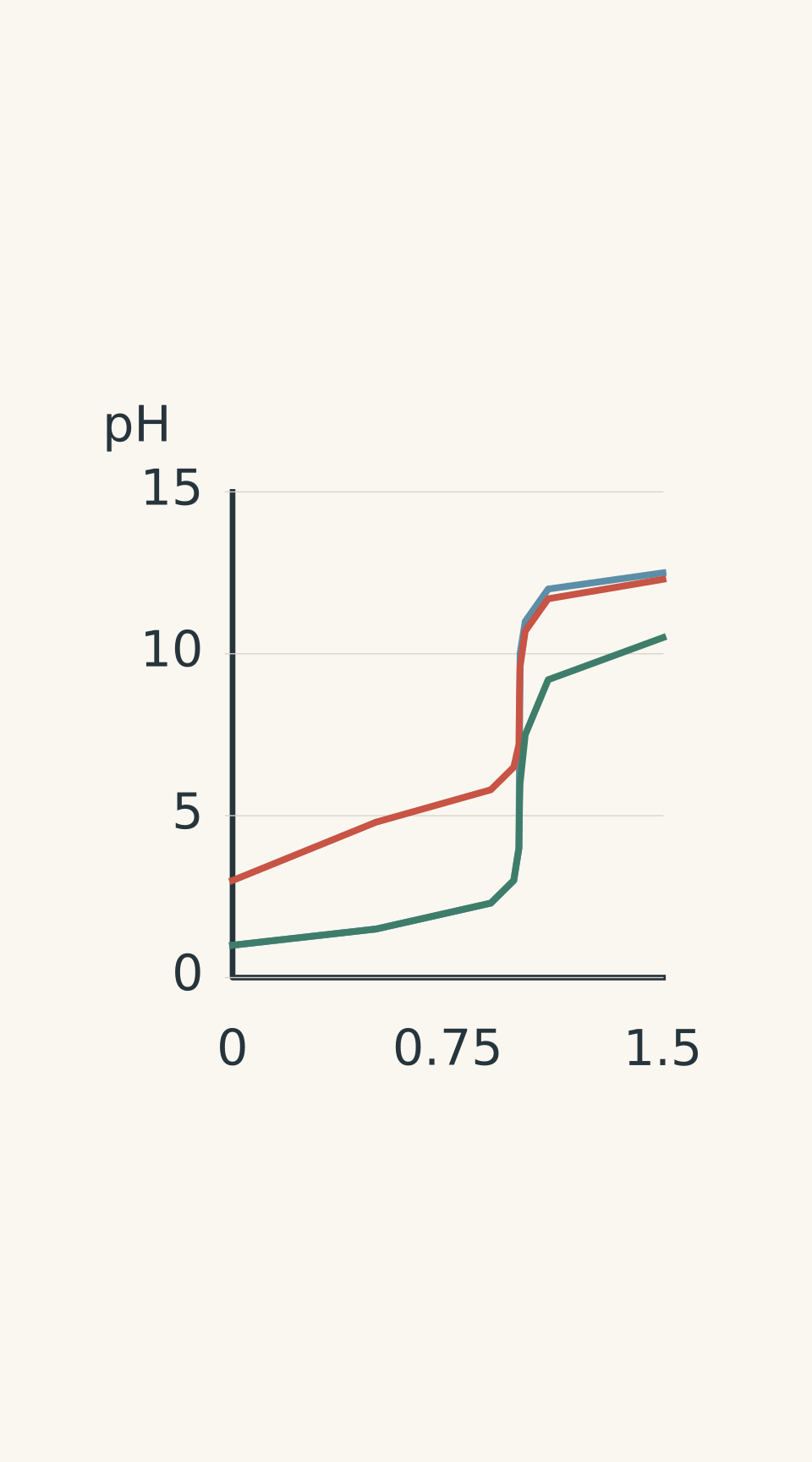
- Strong acid–strong base (pH ≈ 7)
- Weak acid–strong base (pH > 7)
- Strong acid–weak base (pH < 7)
The key comparison is that the equivalence-point pH depends on the acid and base involved. A neutralisation reaction does not automatically produce a solution with pH 7.
Solution 5
(a) Equivalence-point volume (1 mark)
The conductivity reaches its minimum at approximately \(25.00\ \mathrm{mL}\).
The equivalence-point volume is \(25.00\ \mathrm{mL}\).
Marking: 1 mark for the correct volume.
(b) Principal ions at each stage (3 marks)
- Just before equivalence: \(\ce{H3O+}\), \(\mathrm{Na}^{+}\), and \(\mathrm{Cl}^{-}\). Hydrochloric acid remains in excess.
- At equivalence: \(\mathrm{Na}^{+}\) and \(\mathrm{Cl}^{-}\). The solution contains dissolved sodium chloride.
- Just after equivalence: \(\mathrm{Na}^{+}\), \(\mathrm{Cl}^{-}\), and excess \(\mathrm{OH}^{-}\). Sodium hydroxide is now in excess.
Marking:
- 1 mark for the principal ions before equivalence.
- 1 mark for the principal ions at equivalence.
- 1 mark for the principal ions after equivalence.
(c) Why conductivity decreases and then increases (2 marks)
Before equivalence, the added hydroxide ions neutralise the highly mobile hydronium ions. These are progressively replaced by sodium ions, which have lower ionic mobility. Conductivity therefore decreases.
After equivalence, additional sodium hydroxide introduces excess hydroxide ions and more sodium ions. These mobile ions increase the conductivity.
Marking:
- 1 mark for linking the decrease to the removal of highly mobile hydronium ions.
- 1 mark for linking the increase to the presence of excess hydroxide ions and additional sodium ions.
(d) Conductivity at equivalence (2 marks)
The claim is incorrect. Neutralisation removes the excess hydronium ions and hydroxide ions, but it does not remove the sodium and chloride ions from solution.
These ions remain mobile and can carry electric charge, so the conductivity reaches a minimum rather than zero.
Marking:
- 1 mark for stating that the conductivity is not zero at equivalence.
- 1 mark for identifying the remaining mobile \(\mathrm{Na}^{+}\) and \(\mathrm{Cl}^{-}\) ions.
Solution 6
(a) Distilled water added to the conical flask (2 marks)
The calculated sodium hydroxide concentration is unchanged.
The measured aliquot already contains the same amount of sodium hydroxide. Adding distilled water increases the total volume and lowers the concentration in the flask, but it does not change the number of moles of sodium hydroxide that must react.
The equivalence-point titre is therefore unchanged.
Marking:
- 1 mark for stating that the calculated concentration is unchanged.
- 1 mark for explaining that the amount of sodium hydroxide in the aliquot remains constant.
(b) Pipette not conditioned with sodium hydroxide (2 marks)
The calculated sodium hydroxide concentration is too low.
Residual water dilutes the sodium hydroxide transferred by the pipette. The nominal aliquot therefore contains fewer moles of sodium hydroxide than expected, requiring less hydrochloric acid to reach equivalence.
Using this smaller titre in the calculation underestimates the sodium hydroxide concentration.
Marking:
- 1 mark for stating that the calculated concentration is too low.
- 1 mark for linking the residual water to fewer moles transferred and a smaller titre.
(c) Volumetric flask filled above the calibration mark (2 marks)
The reported concentration of the original stock acid is too low.
The actual final volume exceeds \(250.0\ \mathrm{mL}\), so the prepared acid is more dilute than intended. Its concentration is lower than the value expected for a tenfold dilution.
Multiplying the measured diluted concentration by the nominal dilution factor of 10.00 therefore underestimates the original concentration.
Marking:
- 1 mark for stating that the reported original concentration is too low.
- 1 mark for explaining the larger final volume and the incorrect nominal dilution factor.
(d) Endpoint overshot (2 marks)
The calculated sodium hydroxide concentration is too high.
Overshooting the endpoint means that more hydrochloric acid is recorded than is required for stoichiometric equivalence. The calculation treats this excess acid as if it had reacted with the sodium hydroxide, overestimating the amount of base in the aliquot.
Since the aliquot volume is fixed, the calculated concentration is too high.
Marking:
- 1 mark for stating that the calculated concentration is too high.
- 1 mark for explaining that the excess titre leads to an overestimate of the amount of sodium hydroxide.
End of paper
Mark summary: Question 1: 8 marks; Question 2: 8 marks; Question 3: 9 marks; Question 4: 9 marks; Question 5: 8 marks; Question 6: 8 marks. Total: 50 marks.