
Why You Shouldn’t Round Away Half-Integer Mole Ratios
Learn why a mole ratio of 1:1.5 should be multiplied rather than rounded, using worked HSC Chemistry examples. Explore how experimental uncertainty, empirical formulas, and mixtures affect the conclusions you can draw.
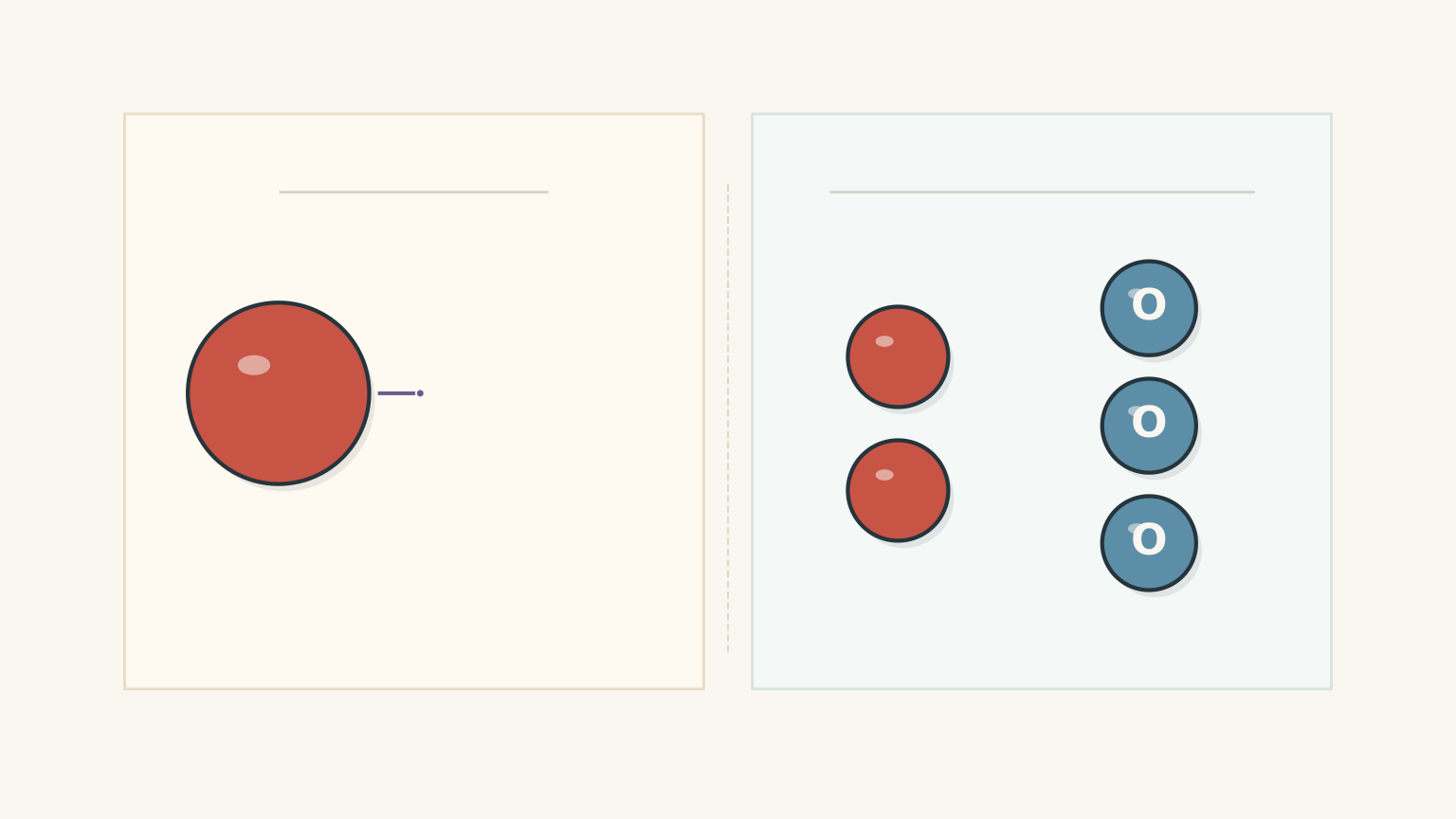
A sample of iron oxide contains 0.0200 mol of iron atoms and 0.0300 mol of oxygen atoms. Divide both amounts by 0.0200, and you get an iron-to-oxygen mole ratio of \(1:1.50\).
Should you round 1.50 up to 2 and write \(\ce{FeO2}\)?
No. That would change the composition, not just tidy up the calculation. A ratio of \(1:1.50\) means that for every two iron atoms, there are three oxygen atoms. Multiply both parts by 2, and the simplest whole-number ratio is \(2:3\), giving \(\ce{Fe2O3}\).
The important distinction is between rounding a measurement and changing a ratio. A result such as 1.49 might reasonably represent 1.50, depending on the experimental uncertainty. But 1.50 itself is not an error waiting to be rounded away. It can be the clearest evidence of a genuine \(2:3\) relationship.
There is a second question worth asking: does the measured ratio describe one pure compound, or merely the overall composition of everything in the sample? The calculation alone cannot always tell you.
Due to technical limitations, this figure may display incorrectly or contain inaccuracies. Please check key details against your course materials.
01How an experiment produces a half-integer mole ratio
Imagine trying to determine the composition of an iron oxide without simply looking up its chemical formula.
One approach is to start with a known amount of dissolved iron, convert it into a solid oxide, and measure the mass of that oxide.
We will use a constructed experimental scenario. All measurements below are illustrative, not observations from a reported laboratory experiment.
The apparatus and what moves through it
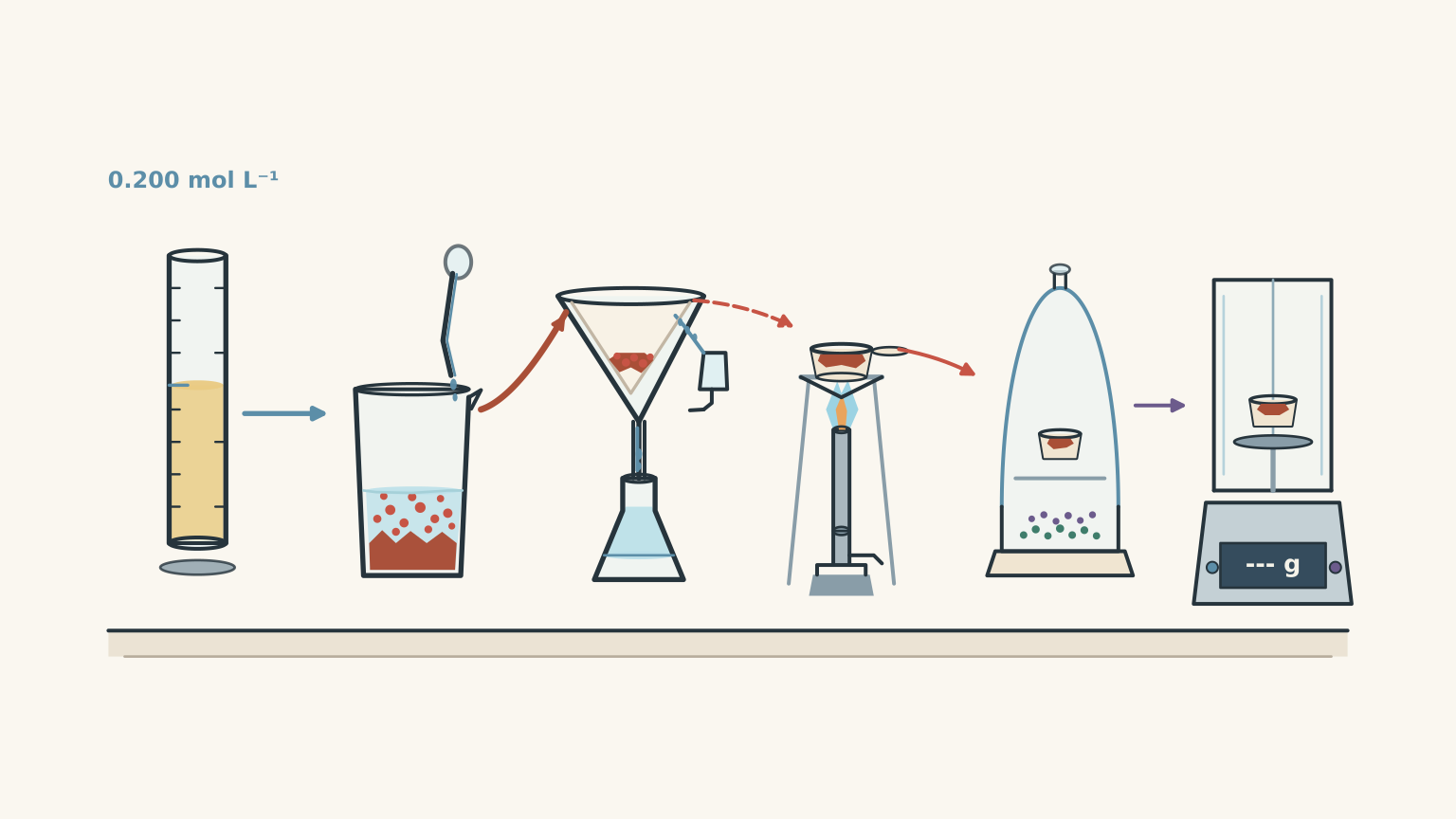
The experiment begins with 100.0 mL of \(0.200\ \mathrm{mol\,L^{-1}}\) iron(III) chloride solution, \(\ce{FeCl3}\).
The arrangement has several stages.
- The measured iron(III) chloride solution is transferred into a beaker.
- Excess sodium hydroxide solution is added. A reddish-brown iron(III) hydroxide precipitate forms.
- The mixture passes through filter paper in a funnel. The solid remains on the paper, while the solution containing dissolved sodium chloride passes into a receiving flask.
- The precipitate is washed to remove soluble impurities and transferred quantitatively into a suitable weighed crucible.
- The material is heated to convert the hydroxide into an oxide. After cooling in dry conditions, the solid is weighed.
Due to technical limitations, this figure may display incorrectly or contain inaccuracies. Please check key details against your course materials.
The precipitation reaction can be represented as
\[ \ce{FeCl3(aq) + 3NaOH(aq) -> Fe(OH)3(s) + 3NaCl(aq)} \]
The iron-containing solid is separated from the dissolved sodium chloride.
Heating can then convert iron(III) hydroxide into iron(III) oxide:
\[ \ce{2Fe(OH)3(s) -> Fe2O3(s) + 3H2O(g)} \]
The equation represents the intended chemical conversion. It does not guarantee that an actual precipitate is initially pure \(\ce{Fe(OH)3}\), or that heating has produced a completely pure oxide.
What should the experiment show?
We began with iron(III) ions, \(\mathrm{Fe}^{3+}\). If the final pure oxide contains those iron ions and oxide ions, \(\mathrm{O}^{2-}\), electrical neutrality requires two iron ions for every three oxide ions.
The predicted formula is therefore \(\ce{Fe2O3}\).
This predicts a mass that we can test.
The amount of iron initially present is
\[ \begin{aligned} n(\mathrm{Fe})&=cV\\ &=0.200\times0.1000\\ &=0.0200\ \mathrm{mol} \end{aligned} \]
Here, \(n\) is amount in moles, \(c\) is concentration in \(\mathrm{mol\,L^{-1}}\), and \(V\) is solution volume in litres.
For pure \(\ce{Fe2O3}\), 0.0200 mol of iron atoms would combine with 0.0300 mol of oxygen atoms.
Using molar masses of \(55.85\ \mathrm{g\,mol^{-1}}\) for Fe and \(16.00\ \mathrm{g\,mol^{-1}}\) for O, the predicted oxide mass is
\[ \begin{aligned} m(\mathrm{Fe})&=0.0200(55.85)\\ &=1.117\ \mathrm{g}\\ m(\mathrm{O})&=0.0300(16.00)\\ &=0.480\ \mathrm{g}\\ m(\mathrm{oxide})&=1.117+0.480\\ &=1.597\ \mathrm{g} \end{aligned} \]
The symbol \(m\) represents mass in grams.
If the experiment gives a dry oxide mass close to 1.597 g, that supports the predicted composition.
Why the first measurement might be misleading
Suppose the solid is only air-dried before weighing.
It may still contain water, and the iron-containing precipitate itself contains hydroxide groups. Treating every gram beyond the iron mass as oxygen would give an incorrect result.
Some sodium chloride could also remain if washing was incomplete.
The problem is not necessarily with the arithmetic. It is with the assumption that the remaining mass belongs entirely to oxygen.
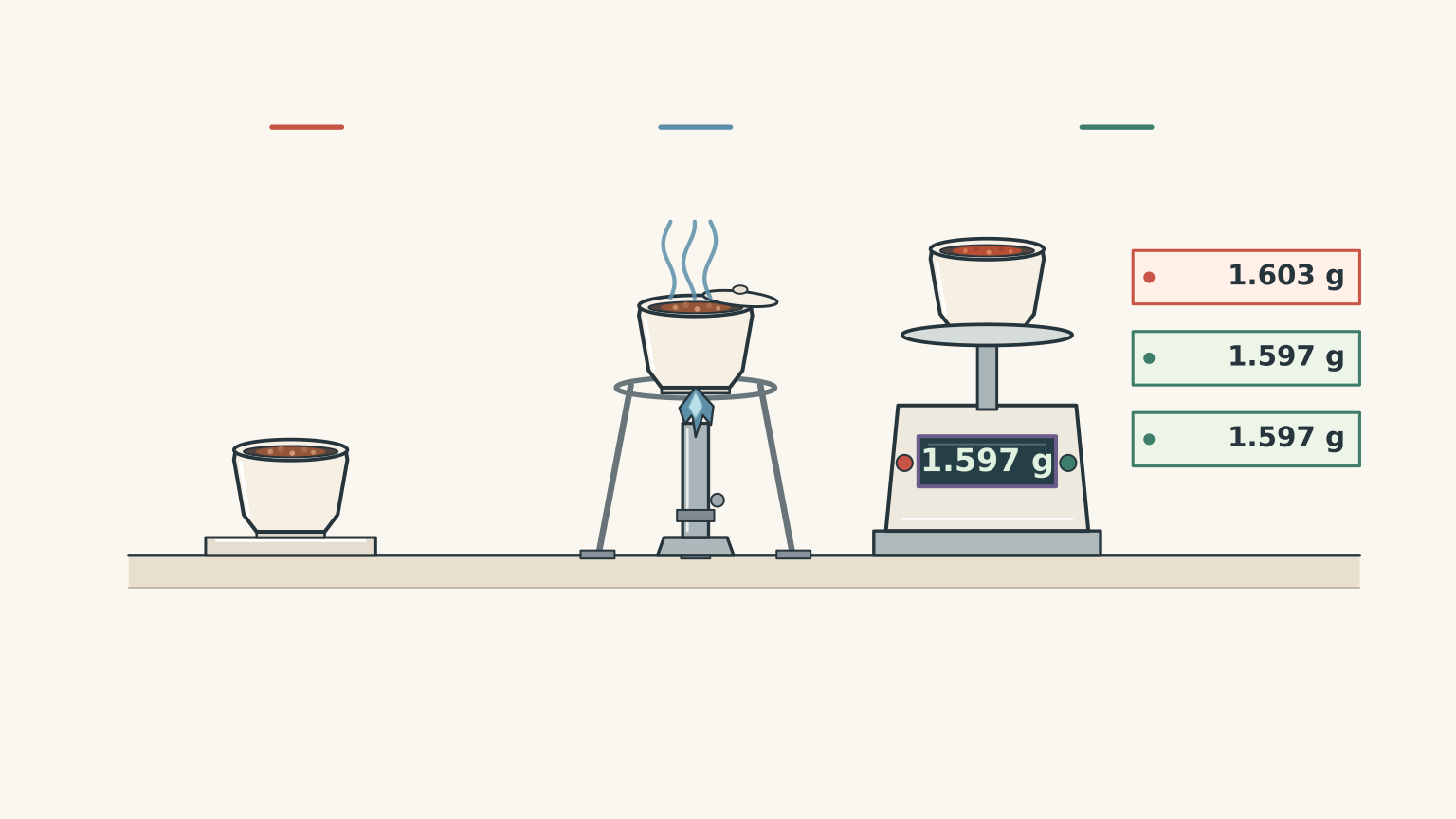
A stronger design washes the precipitate thoroughly, converts the hydroxide to oxide, and uses repeated heating, cooling, and weighing to look for a stable endpoint.
Consider these illustrative results.
| Measurement | Mass of recovered solid |
|---|---|
| After first heating and cooling | 1.603 g |
| After second heating and cooling | 1.597 g |
| After third heating and cooling | 1.597 g |
The first residue was slightly heavier. The later measurements suggest that the mass has stabilised under the heating conditions.
Due to technical limitations, this figure may display incorrectly or contain inaccuracies. Please check key details against your course materials.
Repeated heating addresses one weakness: the first weighing may have been taken before the material reached a stable composition.
It does not address everything. Constant mass does not prove that all the iron was recovered, that no other material remains, or that the residue contains only one solid phase.
Those limitations become important when interpreting a half-integer ratio.
Worked example: Does the oxide really contain 1.5 oxygen atoms per iron atom?
An illustrative experiment begins with 0.0200 mol of iron(III) ions. All the iron is assumed to be recovered as a dry solid containing only iron and oxygen. The final residue has a mass of 1.597 g.
Calculate the simplest empirical formula and explain why the oxygen ratio must not be rounded to 2.
Use \(M(\mathrm{Fe})=55.85\ \mathrm{g\,mol^{-1}}\) and \(M(\mathrm{O})=16.00\ \mathrm{g\,mol^{-1}}\).
Step 1
\[ \begin{aligned} m(\mathrm{Fe})&=nM\\ &=0.0200(55.85)\\ &=1.117\ \mathrm{g} \end{aligned} \]
Step 2
Under the stated assumptions, everything in the residue apart from iron is oxygen.
\[ \begin{aligned} m(\mathrm{O})&=1.597-1.117\\ &=0.480\ \mathrm{g} \end{aligned} \]
Convert oxygen mass into moles:
\[ \begin{aligned} n(\mathrm{O})&=\frac{m}{M}\\ &=\frac{0.480}{16.00}\\ &=0.0300\ \mathrm{mol} \end{aligned} \]
Step 3
\[ \begin{aligned} \mathrm{Fe:O}&=0.0200:0.0300\\ &=1:1.50\\ &=2:3 \end{aligned} \]
The empirical formula is \(\ce{Fe2O3}\).
Step 4
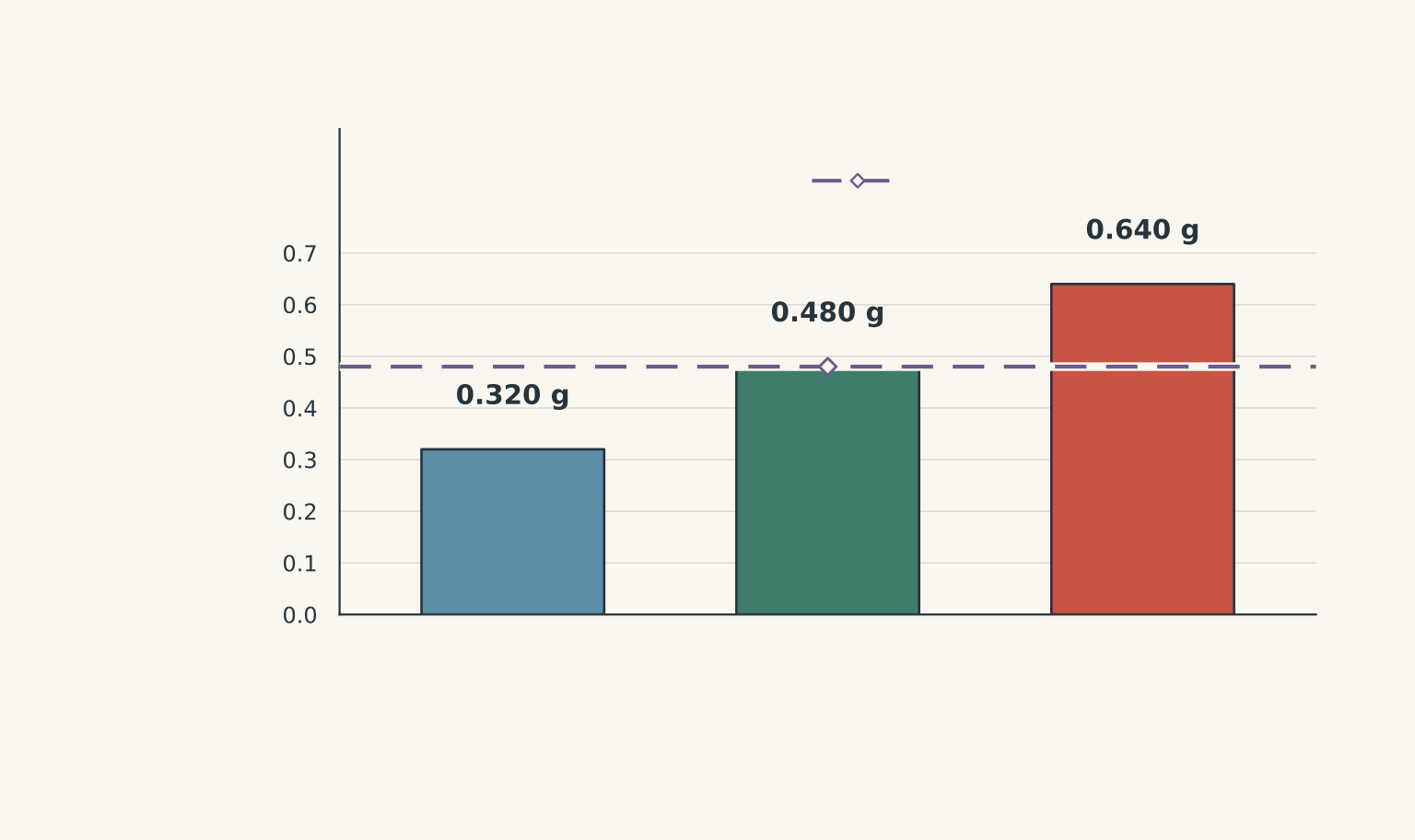
If you rounded 1.50 to 2, the proposed \(\ce{FeO2}\) ratio would require
\[ \begin{aligned} n(\mathrm{O})&=2(0.0200)\\ &=0.0400\ \mathrm{mol}\\ m(\mathrm{O})&=0.0400(16.00)\\ &=0.640\ \mathrm{g} \end{aligned} \]
But the sample contained only 0.480 g of oxygen.
That is a difference of 0.160 g, or one-third of the measured oxygen mass.
Rounding has created a substantially different composition. It has not corrected a measurement error.
Due to technical limitations, this figure may display incorrectly or contain inaccuracies. Please check key details against your course materials.
02When is rounding a mole ratio justified?
Not all non-integer results should be treated the same way.
Suppose a calculation produces \(1:1.49\). The value 1.49 may be a measured approximation to the exact ratio \(1:1.50\).
But \(1:1.50\) and \(1:2.00\) are different ratios. Rounding between them is not a small adjustment.
A helpful distinction is:
- Measurement rounding: changing 1.49 to 1.50 because the experimental precision supports that interpretation.
- Ratio scaling: multiplying \(1:1.50\) by 2 to obtain \(2:3\), without changing the proportions.
- Unjustified rounding: changing \(1:1.50\) to \(1:2\), which alters the chemical composition.
The comparison should be against the measurements
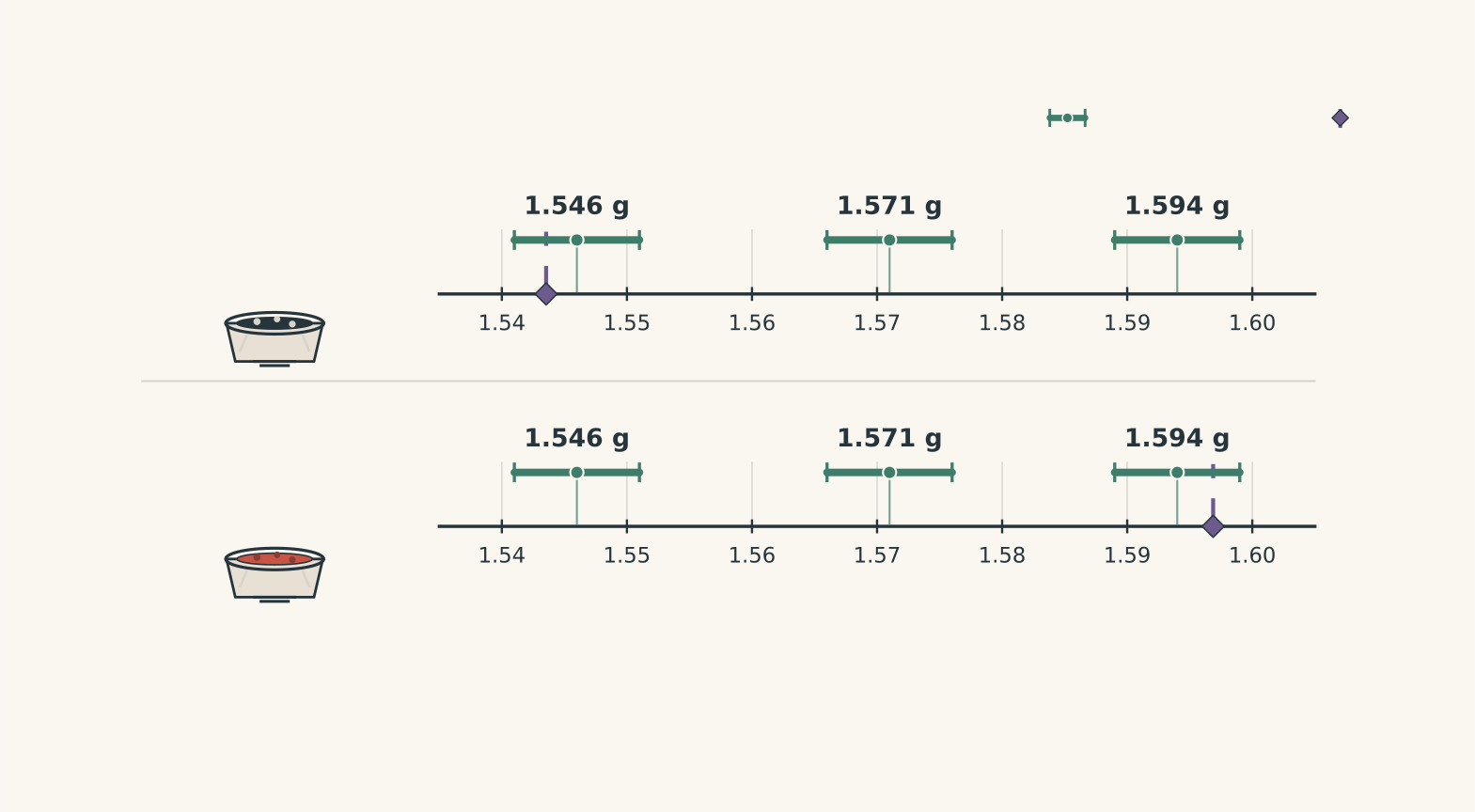
Consider three more illustrative iron oxide residues.
Each sample contains 0.0200 mol of iron atoms, corresponding to 1.117 g of iron. Assume the iron amount is sufficiently accurate that its uncertainty is negligible for this comparison, and that the uncertainty in each final mass is approximately \(\pm0.005\ \mathrm{g}\).
| Final residue mass | Calculated O:Fe ratio | Interpretation |
|---|---|---|
| 1.594 g | 1.49 | Consistent with \(3:2\) |
| 1.546 g | 1.34 | Consistent with \(4:3\) |
| 1.571 g | 1.42 | Neither simple ratio is clearly supported |
Why does the first measurement support \(3:2\)?
The predicted residue mass for \(\ce{Fe2O3}\) is 1.597 g. The observed mass is only 0.003 g lower, within the stated uncertainty.
The second measurement is much closer to the mass predicted for \(\ce{Fe3O4}\), whose oxygen-to-iron ratio is \(4:3\).
For the third measurement, 1.42 lies between approximately 1.33 and 1.50. It would be unsafe to force the result into either formula without investigating the sample.
It might represent a mixture, an incomplete conversion, an experimental error, or another composition. The numbers alone do not settle that question.
Due to technical limitations, this figure may display incorrectly or contain inaccuracies. Please check key details against your course materials.
A practical decision process
When you encounter a decimal mole ratio:
- Divide all element mole amounts by the same smallest amount.
- Look for a simple fraction: \(1.50=3/2\), \(1.33\approx4/3\), or \(1.25=5/4\).
- Multiply every part of the ratio by the denominator to obtain whole numbers.
- Simplify if the resulting whole numbers share a common factor.
- Check the proposed formula against the original measured masses, their uncertainty, and the chemical assumptions.
If the data do not support a simple ratio, do not manufacture one.
There is no universal rule that a mole ratio within some fixed decimal distance of an integer must be rounded. The acceptable difference depends on the measurements and the competing chemical explanations.
For a broader look at how experimental observations establish ratios, including reaction breakpoints, see Whole-number mole ratios from experimental data.
03An empirical formula is not necessarily a molecular identity
Return to \(\ce{Fe2O3}\).
The formula tells us the simplest iron-to-oxygen atom ratio in a pure sample of iron(III) oxide.
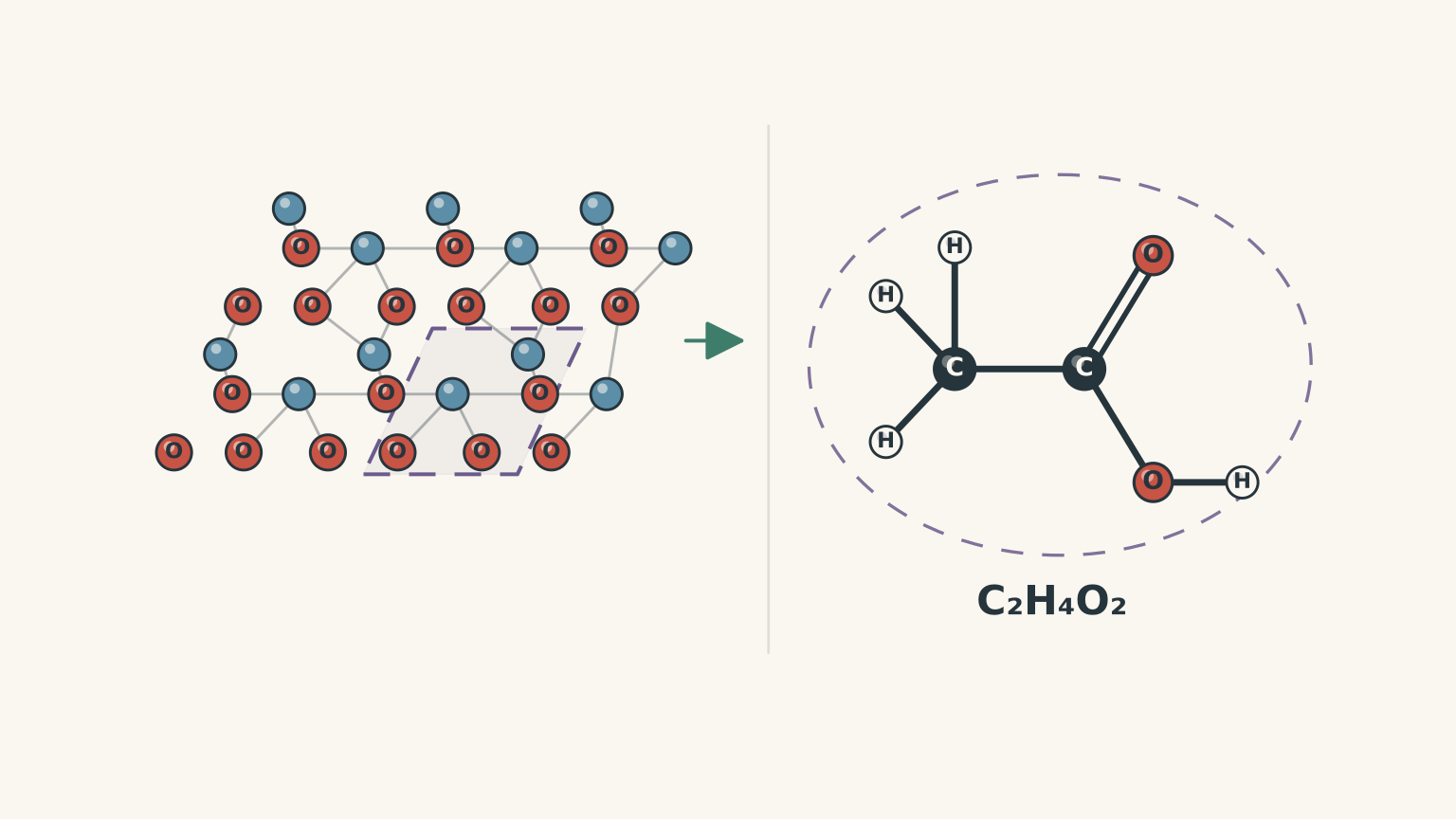
It does not mean the solid is made of separate little molecules, each containing exactly two iron atoms and three oxygen atoms. Iron(III) oxide is an extended solid with atoms arranged throughout a crystal structure.
The formula represents its composition.
For a molecular compound, an empirical formula and a molecular formula can also be different.
Imagine a molecular compound with an empirical formula of \(\ce{CH2O}\).
Its molecular formula could be \(\ce{CH2O}\), \(\ce{C2H4O2}\), or another whole-number multiple, provided independent evidence supports that molecular composition.
The empirical formula alone cannot choose between those possibilities.
Due to technical limitations, this figure may display incorrectly or contain inaccuracies. Please check key details against your course materials.
Worked example: A half-integer ratio in an organic compound
An illustrative elemental analysis of a 3.80 g sample of a pure organic compound gives the following elemental masses:
| Element | Mass |
|---|---|
| Carbon | 1.20 g |
| Hydrogen | 0.200 g |
| Oxygen | 2.40 g |
An independent measurement gives its molecular molar mass as approximately \(76.1\ \mathrm{g\,mol^{-1}}\).
Determine its empirical and molecular formulas.
Use atomic molar masses C = 12.01, H = 1.008, and O = \(16.00\ \mathrm{g\,mol^{-1}}\).
Step 1
\[ \begin{aligned} n(\mathrm{C})&=\frac{1.20}{12.01}\\ &=0.0999\ \mathrm{mol}\\ n(\mathrm{H})&=\frac{0.200}{1.008}\\ &=0.198\ \mathrm{mol}\\ n(\mathrm{O})&=\frac{2.40}{16.00}\\ &=0.150\ \mathrm{mol} \end{aligned} \]
Step 2
Dividing each amount by approximately 0.0999 mol gives
\[ \mathrm{C:H:O}\approx1.00:1.99:1.50 \]
The value 1.99 is consistent with 2.00 at the precision of the supplied data.
So the intended simple ratio is
\[ \mathrm{C:H:O}=1:2:1.5 \]
Step 3
\[ \mathrm{C:H:O}=2:4:3 \]
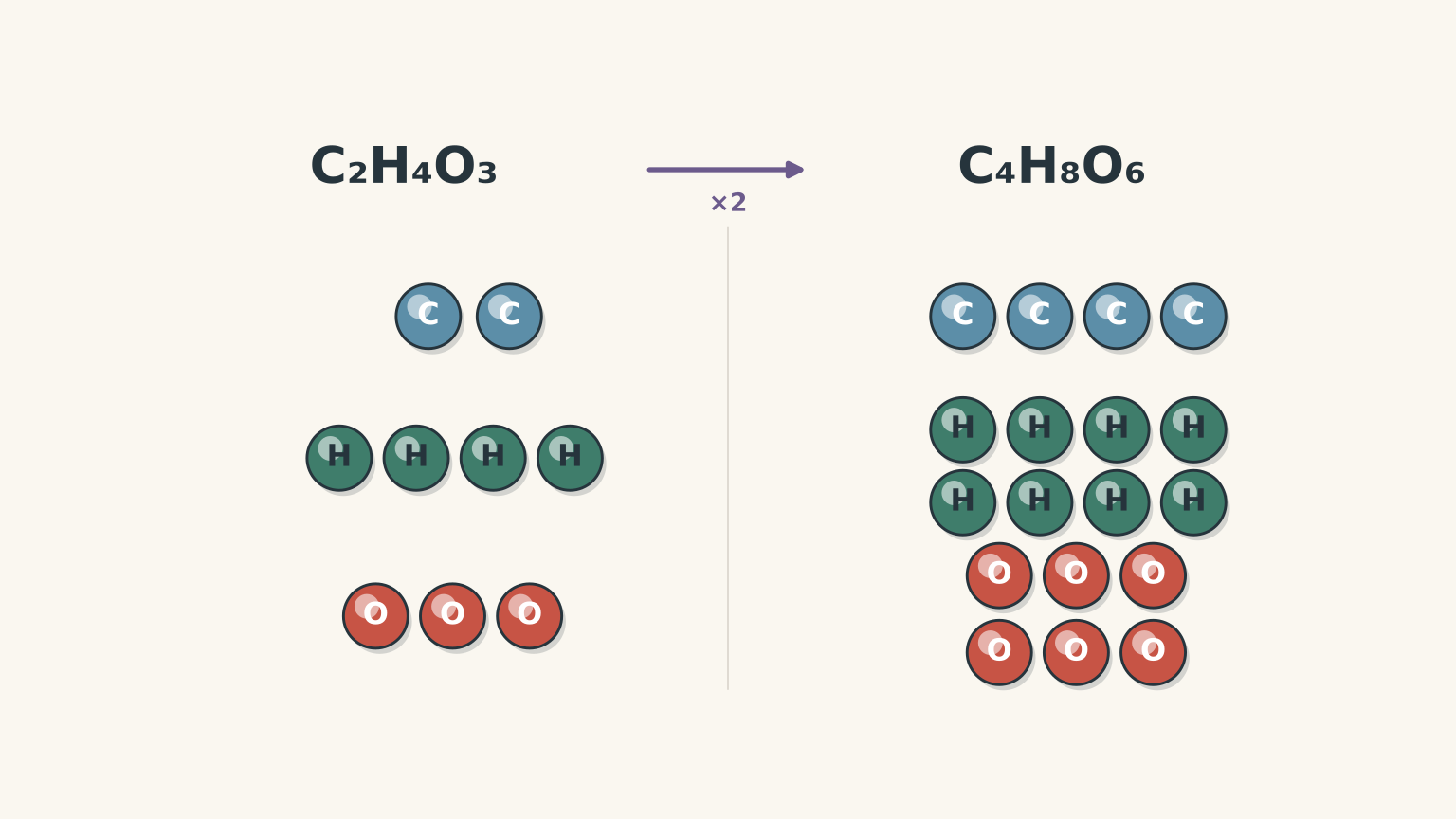
The empirical formula is \(\ce{C2H4O3}\).
Notice that we did not round the oxygen value to 2. We multiplied every element’s ratio by the same factor.
Step 4
\[ \begin{aligned} M(\ce{C2H4O3}) &=2(12.01)+4(1.008)\\ &\quad+3(16.00)\\ &=76.05\ \mathrm{g\,mol^{-1}} \end{aligned} \]
The measured molecular molar mass is approximately \(76.1\ \mathrm{g\,mol^{-1}}\), so the ratio of molecular to empirical formula mass is approximately 1.
The molecular formula is also \(\ce{C2H4O3}\).
If the independently measured molar mass had instead been \(152.1\ \mathrm{g\,mol^{-1}}\), the molecular formula would have been \(\ce{C4H8O6}\), twice the empirical formula.
Neither result, by itself, specifies which atoms are bonded to which. A molecular formula gives atom counts, not a complete structural identity.
Due to technical limitations, this figure may display incorrectly or contain inaccuracies. Please check key details against your course materials.
04Questions and solutions
The first question checks the basic ratio method. The remaining questions test experimental reliability, molecular formulas, mixtures, and whether an additional measurement really provides new information.
All numerical scenarios are original illustrative problems. Assume the molar masses stated in each question, and treat substances as pure only where the question explicitly establishes that condition.
Question 1
A pure aluminium oxide contains 0.0500 mol of aluminium atoms. Its total mass is 2.55 g.
Assume the oxide contains only aluminium and oxygen.
Use Al = \(26.98\ \mathrm{g\,mol^{-1}}\) and O = \(16.00\ \mathrm{g\,mol^{-1}}\).
Calculate:
(a) The mass of oxygen.
(b) The oxygen-to-aluminium mole ratio.
(c) The empirical formula, explaining how you handle the half-integer ratio.
Solution 1
The empirical formula is \(\ce{Al2O3}\), because the oxygen-to-aluminium mole ratio is approximately \(1.50:1\), equivalent to \(3:2\).
(a) Oxygen mass
First calculate the aluminium mass.
\[ \begin{aligned} m(\mathrm{Al})&=nM\\ &=0.0500(26.98)\\ &=1.349\ \mathrm{g} \end{aligned} \]
The oxygen mass is
\[ \begin{aligned} m(\mathrm{O})&=2.55-1.349\\ &=1.201\ \mathrm{g} \end{aligned} \]
This is approximately 1.20 g at the precision of the original mass measurement.
(b) Mole ratio
\[ \begin{aligned} n(\mathrm{O})&=\frac{1.201}{16.00}\\ &=0.0751\ \mathrm{mol} \end{aligned} \]
Therefore,
\[ \begin{aligned} \mathrm{O:Al}&=0.0751:0.0500\\ &\approx1.50:1 \end{aligned} \]
(c) Empirical formula
Multiply both parts by 2:
\[ \mathrm{Al:O}=2:3 \]
The empirical formula is \(\ce{Al2O3}\).
Rounding the 1.50 oxygen-to-aluminium ratio up to 2 would instead give \(\ce{AlO2}\), a different composition that does not fit the measured oxygen mass.
The half-integer is a useful clue to the simplest whole-number ratio.
Question 2
An experiment begins with a solution containing 0.0400 mol of iron(III) ions.
The iron is precipitated, filtered, washed, and heated to produce an oxide residue.
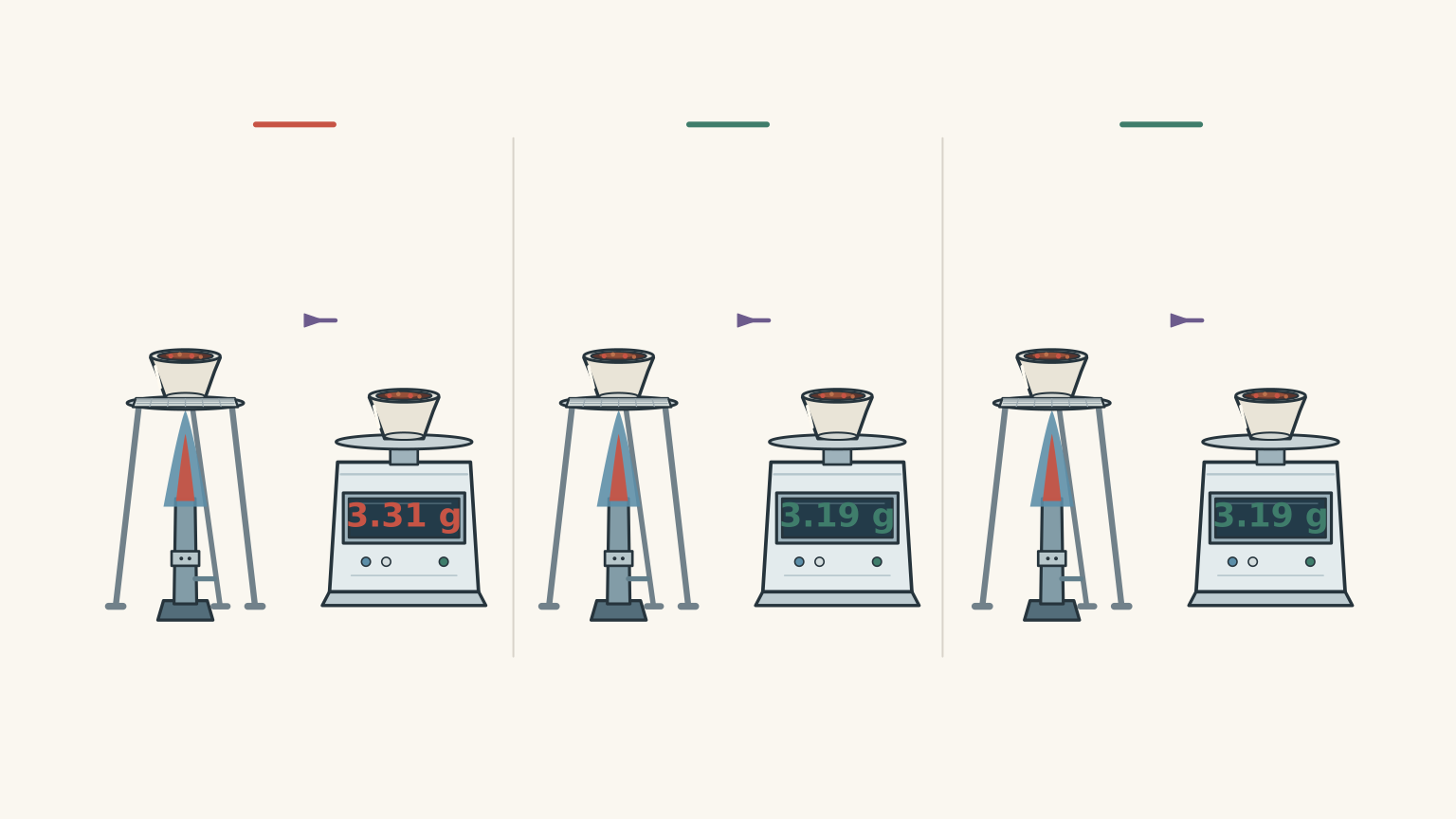
The following masses are recorded after cooling:
| Heating cycle | Residue mass |
|---|---|
| First | 3.31 g |
| Second | 3.19 g |
| Third | 3.19 g |
Assume all the original iron remains in the residue, and that the stable final residue is a pure oxide containing only iron and oxygen.
Use Fe = \(55.85\ \mathrm{g\,mol^{-1}}\) and O = \(16.00\ \mathrm{g\,mol^{-1}}\).
A student uses the first mass and obtains an oxygen-to-iron ratio near 1.68. They propose the empirical formula \(\ce{Fe3O5}\), reasoning that \(1.68\) is close to \(5/3\).
(a) Calculate the apparent oxygen-to-iron ratio using the first mass.
(b) Calculate the ratio using the final stable mass and determine the empirical formula.
(c) Explain why the first result does not justify \(\ce{Fe3O5}\), and give one remaining limitation of the improved measurement.
Due to technical limitations, this figure may display incorrectly or contain inaccuracies. Please check key details against your course materials.
Solution 2
The stable residue is consistent with \(\ce{Fe2O3}\). The initial 1.68 ratio does not establish \(\ce{Fe3O5}\), because the residue was still losing mass during repeated heating.
(a) First measurement
The mass of iron is
\[ \begin{aligned} m(\mathrm{Fe})&=0.0400(55.85)\\ &=2.234\ \mathrm{g} \end{aligned} \]
If we incorrectly assume that all remaining mass is oxygen,
\[ \begin{aligned} m(\mathrm{O})&=3.31-2.234\\ &=1.076\ \mathrm{g}\\ n(\mathrm{O})&=\frac{1.076}{16.00}\\ &=0.06725\ \mathrm{mol} \end{aligned} \]
The apparent ratio is
\[ \begin{aligned} \mathrm{O:Fe}&=\frac{0.06725}{0.0400}\\ &=1.681:1 \end{aligned} \]
The arithmetic is correct under its assumption. The assumption is the problem.
(b) Stable residue
Using the final mass of 3.19 g,
\[ \begin{aligned} m(\mathrm{O})&=3.19-2.234\\ &=0.956\ \mathrm{g}\\ n(\mathrm{O})&=\frac{0.956}{16.00}\\ &=0.05975\ \mathrm{mol} \end{aligned} \]
Therefore,
\[ \begin{aligned} \mathrm{O:Fe}&=\frac{0.05975}{0.0400}\\ &\approx1.49:1\\ &\approx3:2 \end{aligned} \]
The empirical formula is \(\ce{Fe2O3}\).
A pure \(\ce{Fe2O3}\) residue containing 0.0400 mol of iron would have a predicted mass of approximately 3.194 g, consistent with 3.19 g.
(c) Why the first proposal fails
The sample lost \(3.31-3.19=0.12\ \mathrm{g}\) between the first and second weighings.
That means the first residue had not reached the same stable condition as the later residue. Water or another removable component may have been present.
Converting 1.68 into a simple fraction before establishing what the measured mass represents gives false confidence.
The later constant mass supports the interpretation of a stable oxide, but even that does not independently prove its purity or structure. For example, retained non-volatile impurities could remain without causing further mass loss.
The lesson is that experimental consistency must come before formula assignment.
Question 3
A pure molecular compound X contains only carbon, hydrogen, and oxygen.
Elemental analysis gives the following atom mole ratio:
\[ \mathrm{C:H:O}=1.00:2.00:1.50 \]
An independent experiment reports its molecular molar mass as \(114.1\ \mathrm{g\,mol^{-1}}\).
Use C = 12.01, H = 1.008, and O = \(16.00\ \mathrm{g\,mol^{-1}}\).
(a) Determine the empirical formula and its formula mass.
(b) Explain whether the reported molecular molar mass is consistent with the elemental analysis for a pure molecular substance.
(c) A student proposes \(\ce{C3H6O5}\) by multiplying the original ratios by 3 and rounding the resulting 4.5 oxygen atoms up to 5. Test this proposal against the original ratio and measured molar mass.
(d) If the independent molar mass measurement is corrected to \(152.1\ \mathrm{g\,mol^{-1}}\), determine the molecular formula and state one thing the formula still cannot identify.
Solution 3
The empirical formula is \(\ce{C2H4O3}\), and the original reported molar mass of \(114.1\ \mathrm{g\,mol^{-1}}\) is inconsistent with a pure molecular compound having that exact composition.
The correction to \(152.1\ \mathrm{g\,mol^{-1}}\) makes \(\ce{C4H8O6}\) possible.
(a) Empirical formula
Multiply every part of the original ratio by 2:
\[ \mathrm{C:H:O}=2:4:3 \]
This gives \(\ce{C2H4O3}\).
Its formula mass is
\[ \begin{aligned} M_{\mathrm{emp}}&=2(12.01)+4(1.008)\\ &\quad+3(16.00)\\ &=76.05\ \mathrm{g\,mol^{-1}} \end{aligned} \]
(b) Testing the reported molar mass
For a pure molecular compound, the molecular formula must contain a positive integer multiple of the empirical formula.
The multiplier is
\[ \begin{aligned} k&=\frac{114.1}{76.05}\\ &\approx1.50 \end{aligned} \]
This cannot be the molecular multiplier.
A molecule containing 1.5 empirical formula units would contain
\[ \ce{C3H6O4.5} \]
which is not a valid molecular formula because an individual molecule cannot contain half an oxygen atom.
The reported molar mass and the stated elemental ratio therefore cannot both describe the same pure molecular compound accurately.
(c) Testing the rounded proposal
The proposed formula \(\ce{C3H6O5}\) has an oxygen-to-carbon ratio of
\[ \frac{5}{3}=1.667 \]
But the elemental analysis gave 1.50.
Its molar mass would also be
\[ \begin{aligned} M&=3(12.01)+6(1.008)\\ &\quad+5(16.00)\\ &=122.08\ \mathrm{g\,mol^{-1}} \end{aligned} \]
That differs from the reported \(114.1\ \mathrm{g\,mol^{-1}}\).
Rounding the oxygen count has made both constraints fail.
(d) Corrected molar mass
Using the corrected value,
\[ \begin{aligned} k&=\frac{152.1}{76.05}\\ &\approx2 \end{aligned} \]
Therefore,
\[ \ce{C2H4O3}\times2 \longrightarrow\ce{C4H8O6} \]
The molecular formula is \(\ce{C4H8O6}\).
It does not establish the exact bonding arrangement. Different structures can share the same molecular formula.
The surprising part is that 114.1 was not simply a value to round to the nearest plausible molecular mass. It created a genuine contradiction between two measurements, and that contradiction had to be investigated.
Question 4
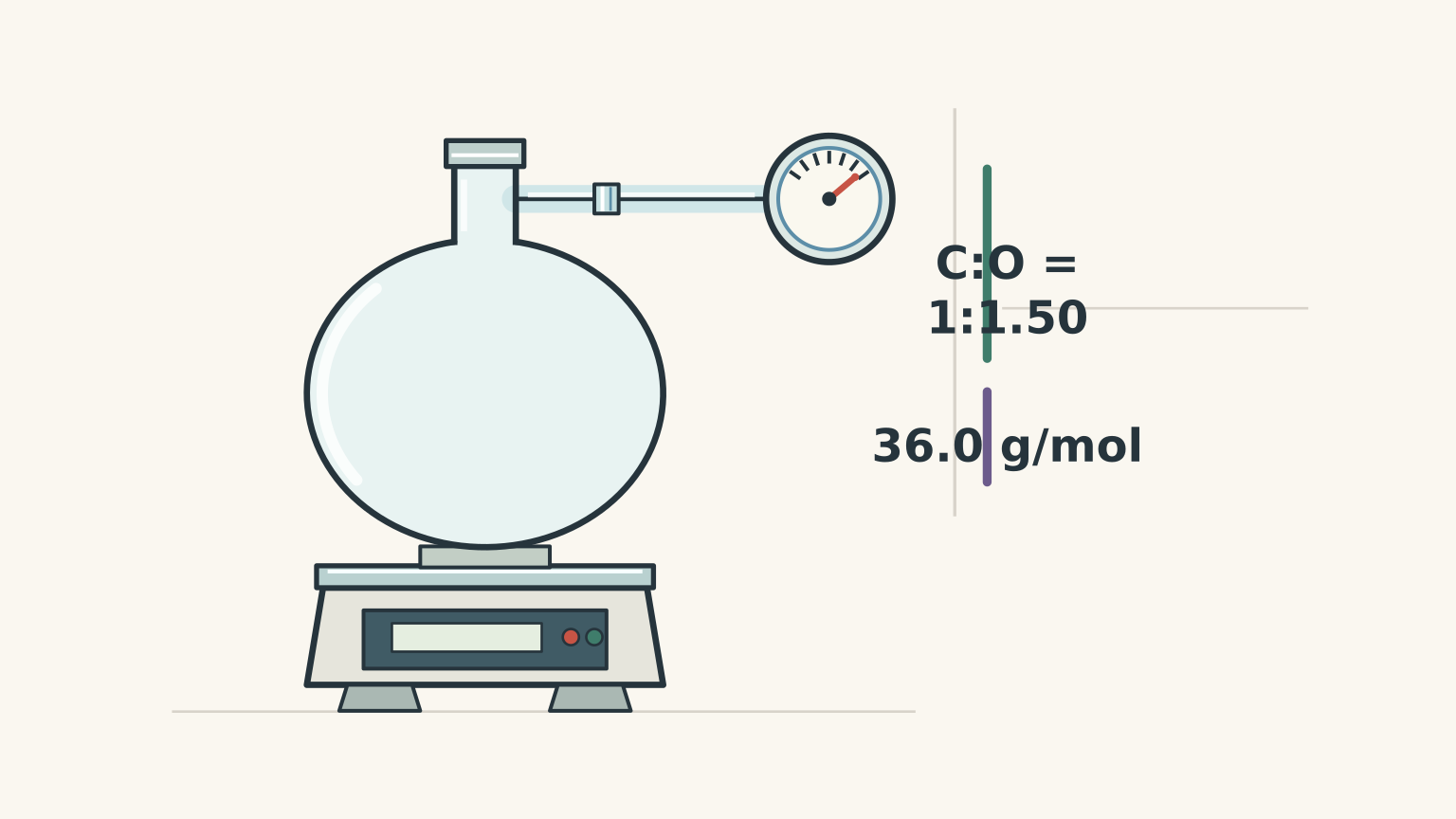
A sealed gas sample contains only carbon and oxygen.
Elemental analysis gives an overall carbon-to-oxygen atom mole ratio of
\[ \mathrm{C:O}=1:1.50 \]
An independent gas-density measurement gives a mean molar mass of approximately \(36.0\ \mathrm{g\,mol^{-1}}\).
An analyst argues that the gas must consist of \(\ce{C2O3}\) molecules because the overall atom ratio is \(2:3\).
Another analyst suggests that the sample is a mixture of \(\ce{CO}\) and \(\ce{CO2}\).
Assume the gases behave ideally, and that if the sample is a mixture, these are the only two gases present.
Use C = \(12.01\ \mathrm{g\,mol^{-1}}\) and O = \(16.00\ \mathrm{g\,mol^{-1}}\).
(a) Explain why the proposed pure \(\ce{C2O3}\) molecular composition is inconsistent with the molar mass measurement.
(b) Determine the mole fraction of each gas in the proposed mixture.
(c) Calculate the predicted mean molar mass of that mixture.
(d) Explain what the overall \(2:3\) atom ratio does and does not establish.
Due to technical limitations, this figure may display incorrectly or contain inaccuracies. Please check key details against your course materials.
Solution 4
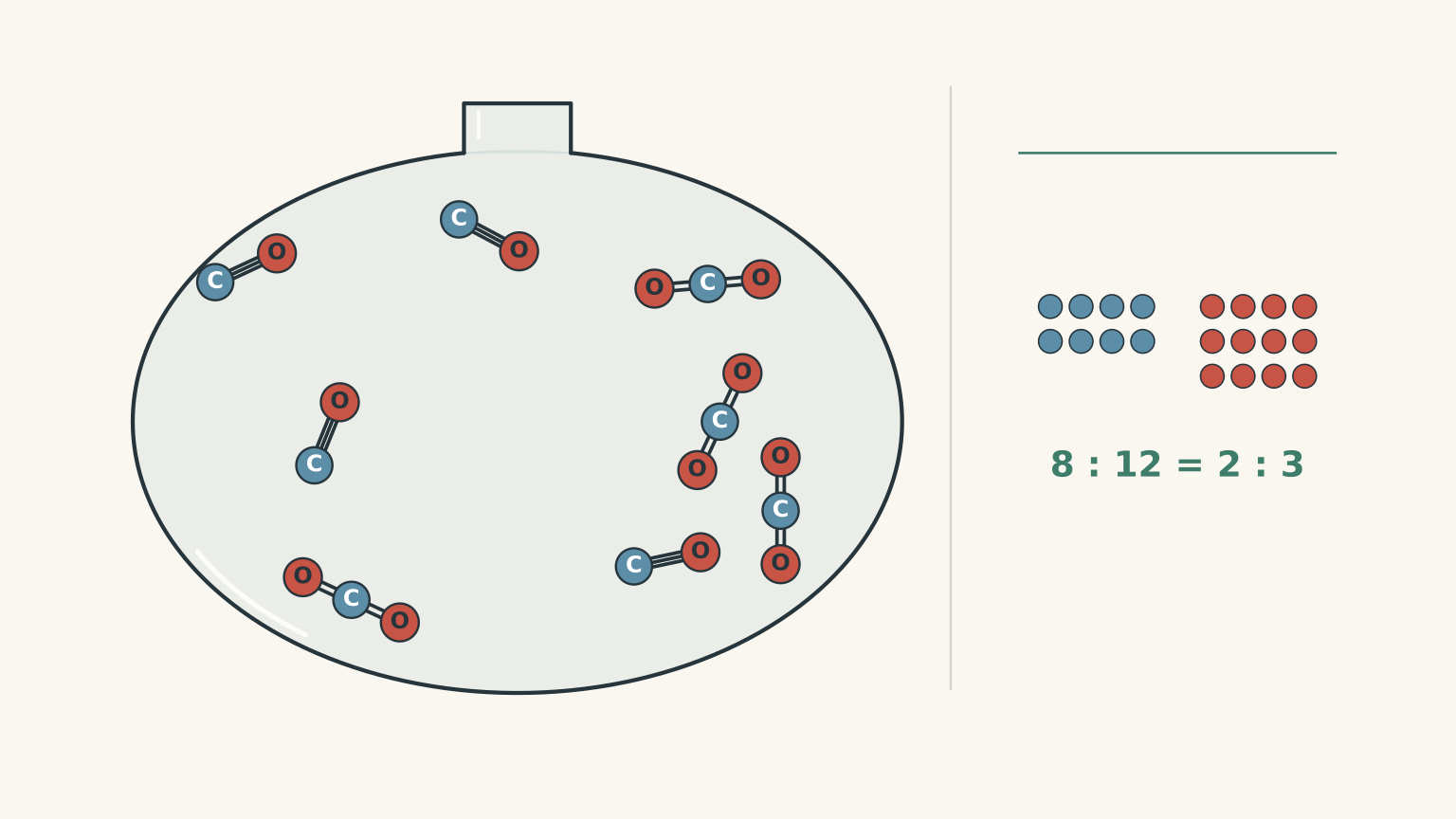
The data are consistent with a 50:50 mole mixture of \(\ce{CO}\) and \(\ce{CO2}\). They are not consistent with a pure gas of \(\ce{C2O3}\) molecules.
The important distinction is between the average elemental composition of a gas sample and the identity of its individual molecules.
(a) Pure molecular proposal
If the gas consisted of \(\ce{C2O3}\) molecules, its molecular molar mass would be
\[ \begin{aligned} M(\ce{C2O3})&=2(12.01)+3(16.00)\\ &=72.02\ \mathrm{g\,mol^{-1}} \end{aligned} \]
The measurement instead gives approximately \(36.0\ \mathrm{g\,mol^{-1}}\).
That is about half the required molar mass. A pure molecular interpretation cannot satisfy both observations.
(b) Mixture composition
Both \(\ce{CO}\) and \(\ce{CO2}\) contain one carbon atom per molecule.
Let \(x\) be the mole fraction of \(\ce{CO2}\). Then the mole fraction of \(\ce{CO}\) is \(1-x\).
Each mole of \(\ce{CO}\) contributes 1 mol of oxygen atoms, while each mole of \(\ce{CO2}\) contributes 2 mol.
The mean oxygen-to-carbon ratio is therefore
\[ \begin{aligned} 1.50&=(1-x)(1)+2x\\ 1.50&=1+x\\ x&=0.50 \end{aligned} \]
Thus,
\[ x_{\ce{CO}}=0.50 \qquad x_{\ce{CO2}}=0.50 \]
The mixture contains equal mole amounts of the two gases.
(c) Mean molar mass
The molar masses are
\[ M(\ce{CO})=28.01\ \mathrm{g\,mol^{-1}} \]
and
\[ M(\ce{CO2})=44.01\ \mathrm{g\,mol^{-1}} \]
For an ideal gas mixture, the mean molar mass is the mole-fraction-weighted average:
\[ \begin{aligned} \overline{M}&=0.50(28.01)\\ &\quad+0.50(44.01)\\ &=36.01\ \mathrm{g\,mol^{-1}} \end{aligned} \]
This agrees with the measured value of approximately \(36.0\ \mathrm{g\,mol^{-1}}\).
(d) What the ratio establishes
The gas sample has an overall carbon-to-oxygen atom ratio of \(2:3\).
That ratio describes the total numbers of carbon and oxygen atoms in the sample. It does not establish that the atoms belong to \(\ce{C2O3}\) molecules.
In this case, the known \(\ce{CO}\) and \(\ce{CO2}\) mixture explains both the elemental ratio and the mean molar mass.
The tempting mistake is to treat the overall composition of a mixture as if it were automatically the molecular formula of a pure substance.
Due to technical limitations, this figure may display incorrectly or contain inaccuracies. Please check key details against your course materials.
Question 5
A researcher analyses an unknown iron oxide solid and determines that it contains
\[ n(\mathrm{Fe})=0.150\ \mathrm{mol} \]
and
\[ n(\mathrm{O})=0.200\ \mathrm{mol} \]
The researcher concludes that the solid is pure \(\ce{Fe3O4}\).
A second researcher suggests that it could instead be a physical mixture of \(\ce{FeO}\) and \(\ce{Fe2O3}\).
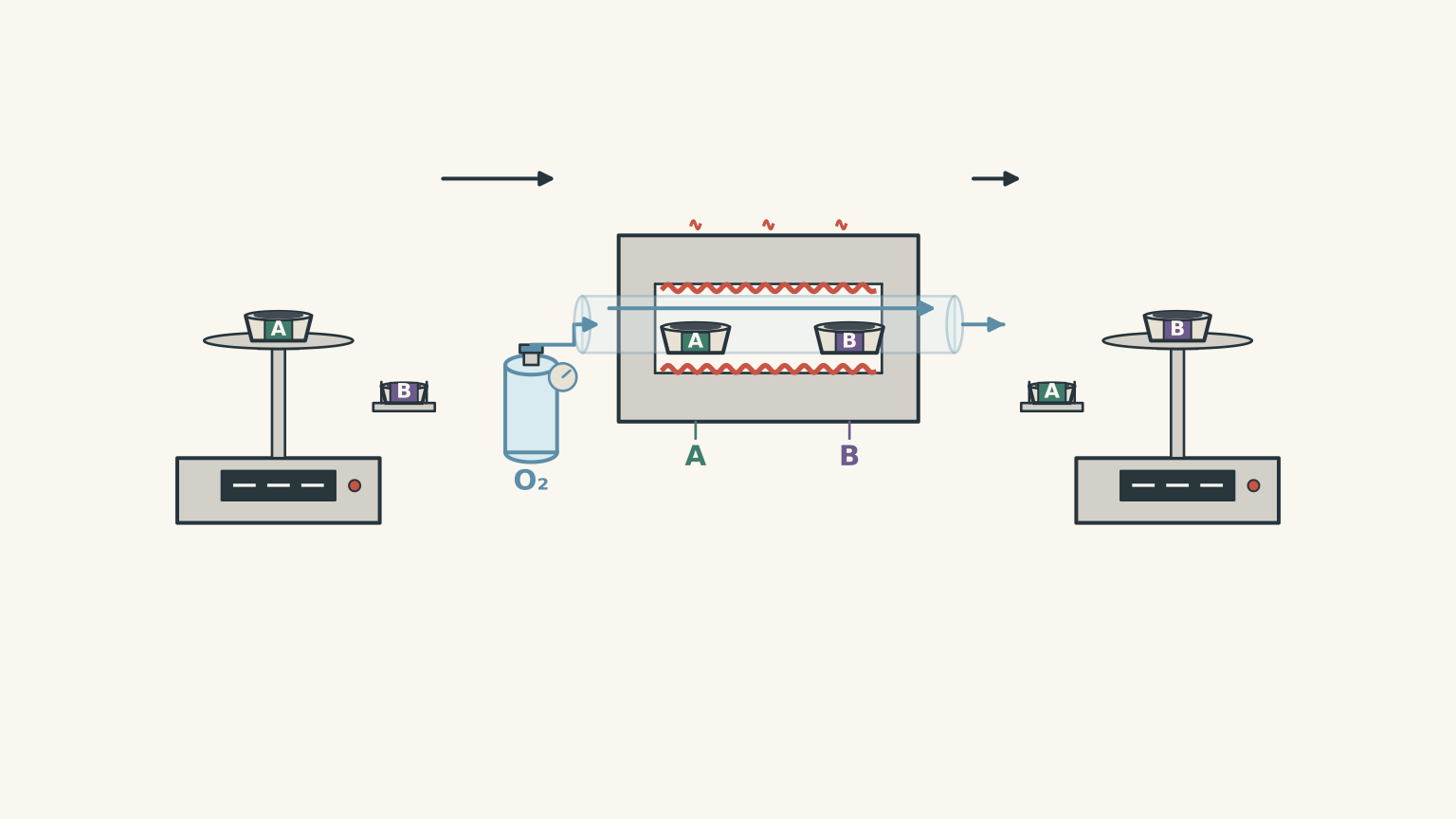
To settle the disagreement, the first researcher proposes heating the sample in excess oxygen until all iron has been converted to \(\ce{Fe2O3}\), and measuring the mass increase.
Assume:
- The only possible starting solid phases are idealised \(\ce{FeO}\), \(\ce{Fe3O4}\), and \(\ce{Fe2O3}\).
- No solid is lost, and no elements other than iron and oxygen are present.
- The oxidation produces only \(\ce{Fe2O3}\) and goes to completion.
- All measured amounts are exact for the purposes of this problem.
Use O = \(16.00\ \mathrm{g\,mol^{-1}}\).
(a) Determine the simplest overall iron-to-oxygen ratio.
(b) Show that a physical mixture containing only \(\ce{FeO}\) and \(\ce{Fe2O3}\) can produce exactly the same overall composition. Calculate the required mole amount of each oxide.
(c) Calculate the predicted mass gain when the solid is completely converted to \(\ce{Fe2O3}\). Determine whether that measurement would distinguish the two proposed starting materials.
(d) Propose a different kind of experimental evidence that could distinguish them, and explain why it succeeds where the mass measurement fails.
Due to technical limitations, this figure may display incorrectly or contain inaccuracies. Please check key details against your course materials.
Solution 5
The overall atom ratio is \(\mathrm{Fe:O}=3:4\), but neither that ratio nor the mass gain during complete oxidation can distinguish pure \(\ce{Fe3O4}\) from a particular mixture of \(\ce{FeO}\) and \(\ce{Fe2O3}\).
The proposed second experiment appears to provide independent evidence, but it depends on the same total iron and oxygen amounts already measured. That is the key limitation.
(a) Overall composition
\[ \begin{aligned} \mathrm{Fe:O}&=0.150:0.200\\ &=3:4 \end{aligned} \]
The overall composition matches the formula \(\ce{Fe3O4}\).
If the sample were known independently to be a single pure phase selected from the three stated oxides, this would identify \(\ce{Fe3O4}\). But purity has not been established.
(b) Construct a different sample with the same composition
Let:
- \(x\) be the amount of \(\ce{FeO}\) formula units, in mol.
- \(y\) be the amount of \(\ce{Fe2O3}\) formula units, in mol.
One \(\ce{FeO}\) formula unit contributes one Fe and one O atom.
One \(\ce{Fe2O3}\) formula unit contributes two Fe and three O atoms.
To match the measured composition,
\[ x+2y=0.150 \]
and
\[ x+3y=0.200 \]
Subtract the first equation from the second:
\[ \begin{aligned} y&=0.200-0.150\\ &=0.0500\ \mathrm{mol} \end{aligned} \]
Substitute into the iron equation:
\[ \begin{aligned} x+2(0.0500)&=0.150\\ x&=0.0500\ \mathrm{mol} \end{aligned} \]
Therefore, the alternative sample could contain:
\[ n(\ce{FeO})=0.0500\ \mathrm{mol} \]
and
\[ n(\ce{Fe2O3})=0.0500\ \mathrm{mol} \]
Check both totals.
Iron:
\[ \begin{aligned} n(\mathrm{Fe})&=0.0500+2(0.0500)\\ &=0.150\ \mathrm{mol} \end{aligned} \]
Oxygen:
\[ \begin{aligned} n(\mathrm{O})&=0.0500+3(0.0500)\\ &=0.200\ \mathrm{mol} \end{aligned} \]
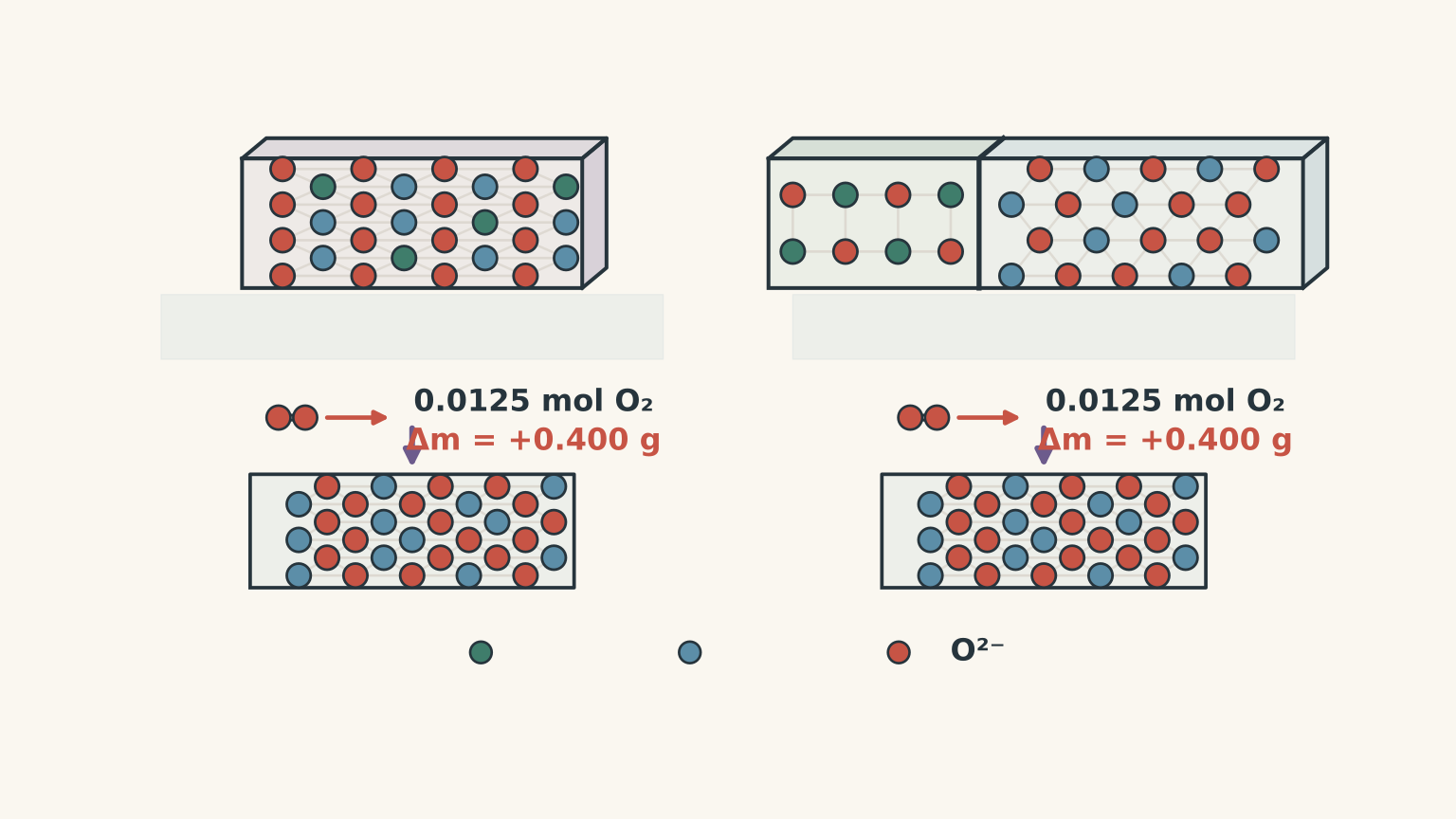
The mixture and the pure \(\ce{Fe3O4}\) sample have exactly the same bulk elemental composition.
Yet a physical mixture of two separate oxides is not the same solid phase as pure \(\ce{Fe3O4}\).
(c) Predict the oxidation mass gain
In the final product, all iron is present as \(\ce{Fe2O3}\).
Its oxygen-to-iron ratio is \(3:2\), so the final amount of oxygen atoms must be
\[ \begin{aligned} n(\mathrm{O})_{\mathrm{final}} &=\frac{3}{2}(0.150)\\ &=0.225\ \mathrm{mol} \end{aligned} \]
The initial solid contained 0.200 mol of oxygen atoms.
The additional oxygen incorporated is therefore
\[ \begin{aligned} \Delta n(\mathrm{O})&=0.225-0.200\\ &=0.0250\ \mathrm{mol} \end{aligned} \]
The positive mass gain is
\[ \begin{aligned} \Delta m&=0.0250(16.00)\\ &=0.400\ \mathrm{g} \end{aligned} \]
This is the predicted mass gain for either starting material.
Why?
Both samples begin with the same amounts of iron and oxygen. Both finish with the same amounts of iron and oxygen in \(\ce{Fe2O3}\).
Conservation of atoms forces the same oxygen uptake.
We can also see the result from the separate oxidation reactions:
\[ \ce{4Fe3O4 + O2 -> 6Fe2O3} \]
and
\[ \ce{4FeO + O2 -> 2Fe2O3} \]
The \(\ce{Fe2O3}\) already present in the physical mixture requires no further oxidation.
For the pure \(\ce{Fe3O4}\) sample, 0.0500 mol of formula units consumes \(0.0125\ \mathrm{mol}\) of \(\ce{O2}\).
For the mixture, its 0.0500 mol of \(\ce{FeO}\) formula units also consumes \(0.0125\ \mathrm{mol}\) of \(\ce{O2}\).
Both therefore gain \(0.400\ \mathrm{g}\).
Even the proposed extra measurement fails to distinguish them.
(d) What kind of evidence could succeed?
The researcher needs information about how the atoms are arranged in the solid, not just how many atoms of each element are present.
One possible technique is X-ray diffraction, which can reveal different crystalline phases. This is an extension beyond the mole-ratio calculation, but it illustrates the kind of independent evidence required.
A sample containing separate \(\ce{FeO}\) and \(\ce{Fe2O3}\) crystalline phases can give a different diffraction pattern from a single \(\ce{Fe3O4}\) phase.
The distinction is structural.
Due to technical limitations, this figure may display incorrectly or contain inaccuracies. Please check key details against your course materials.
The deeper point is that an experiment is not independent simply because it measures a different quantity.
If two proposed starting materials have the same total elemental composition and finish as the same product, measuring their total oxidation mass gain cannot distinguish them. You need an observation sensitive to the difference between their structures or phases.
05The next decision: what does your formula actually establish?
A half-integer mole ratio is often an instruction to multiply, not a reason to round.
For \(1:1.50\), multiplying both parts by 2 preserves the chemical proportions and gives \(2:3\). Rounding 1.50 to 2 changes the proportions, so it requires a justification that ordinary measurement rounding cannot provide.
Once you have found the simplest whole-number ratio, ask what you have actually established:
- If your data describe a single pure compound, you may have determined its empirical formula.
- If you have an independent molecular molar mass, you may be able to determine its molecular formula.
- If your sample could contain several substances, the ratio may describe only their combined elemental composition.
That distinction becomes especially useful when checking an empirical formula against percentage composition, molar mass, charge balance, or a second experimental measurement.
For the reverse calculation-starting with a proposed formula and predicting its elemental mass percentages-see How to Calculate Element Percentages from Chemical Formulas.
The calculation tells you what atom ratio fits the evidence. The next chemical question is whether the evidence is sufficient to identify the substance that produced it.