
Why Ionic Solids Are Brittle: The Role of Their Crystal Lattice
Discover why ionic solids fracture despite their strong electrostatic attractions. Learn how shifting ion layers creates repulsion, why metals behave differently, and how to apply the explanation in HSC Chemistry questions.
A sodium chloride crystal can have a high melting point and still split into sharp fragments when struck. That seems contradictory. If the attractions holding the crystal together are so strong, why doesn’t it bend instead of breaking?
Ionic solids are brittle because their ions form a rigid, repeating lattice. When one layer shifts relative to another, like-charged ions can become neighbours. The resulting electrostatic repulsion makes the structure unstable, causing the crystal to fracture rather than deform smoothly.
The important distinction is that strong attractions make a crystal difficult to separate, but they do not necessarily make it capable of changing shape. In fact, the way ionic particles are arranged is precisely what makes many ionic solids brittle.
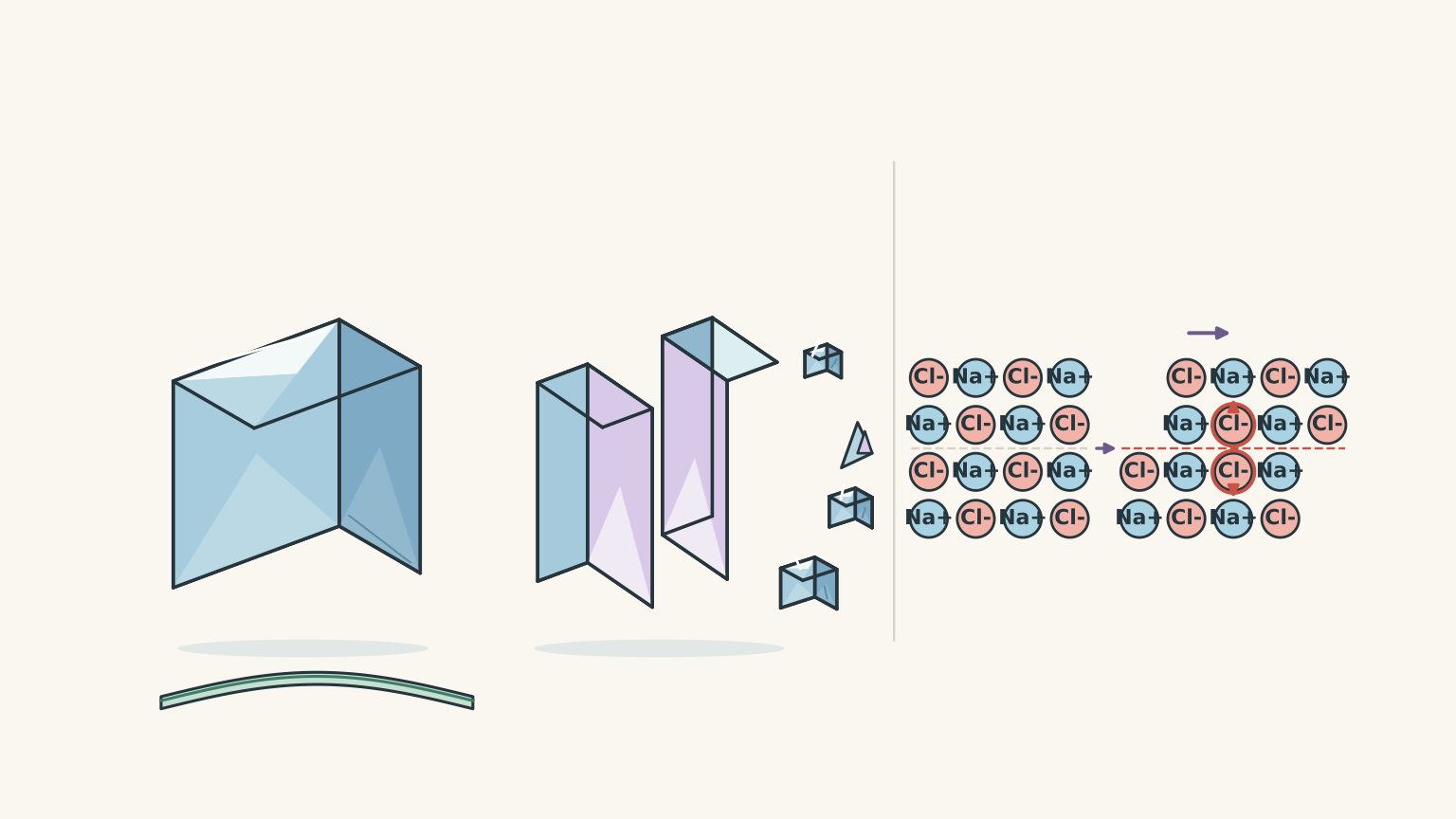
Due to technical limitations, this figure may display incorrectly or contain inaccuracies. Please check key details against your course materials.
01Strong attractions do not mean flexibility
First, separate three properties that are easy to confuse.
| Property | What it describes |
|---|---|
| Hardness | Resistance to scratching or indentation |
| Brittleness | Tendency to fracture with little permanent deformation |
| Toughness | Ability to absorb energy before fracturing |
An ionic solid can be hard and brittle at the same time.
For example, sodium chloride has a relatively high melting point because considerable energy is needed to overcome the electrostatic attractions throughout its crystal lattice. However, when a sufficiently large mechanical force is applied, the crystal can fracture rather than change shape.
This happens because hardness and brittleness describe different aspects of a material’s behaviour.
- Hardness concerns resistance to local deformation.
- Brittleness concerns what happens when the material is subjected to stress and its structure can no longer accommodate that stress without breaking.
There is another important detail. An ionic solid is not held together by a collection of separate, individual bonds acting like little connecting rods.
Instead, ionic bonding describes the electrostatic attraction throughout a giant, three-dimensional arrangement of positive and negative ions.
To understand brittleness, we need to look at how those ions are arranged.
02How valence and ionic charge determine the structure
Consider sodium chloride, \(\ce{NaCl}\).
A sodium atom has one valence electron and tends to lose it. A chlorine atom has seven valence electrons and tends to gain one.
The resulting ions are:
\[ \ce{Na -> Na+ + e-} \]
\[ \ce{Cl + e- -> Cl-} \]
Sodium becomes a positive ion, \(\mathrm{Na}^{+}\), while chlorine becomes a negative ion, \(\mathrm{Cl}^{-}\).
Opposite charges attract, while like charges repel.
This creates a repeating arrangement in which positive and negative ions alternate throughout the crystal.
The formula does not show the whole structure
The formula \(\ce{NaCl}\) tells us that sodium and chloride ions occur in a 1:1 ratio.
It does not mean that a sodium chloride crystal consists of separate \(\ce{NaCl}\) molecules.
Instead, the crystal contains an extended ionic lattice. In the familiar rock-salt structure, each sodium ion has six nearest-neighbour chloride ions, and each chloride ion has six nearest-neighbour sodium ions.
The ratio is still 1:1 because the overall numbers of positive and negative ions are equal.
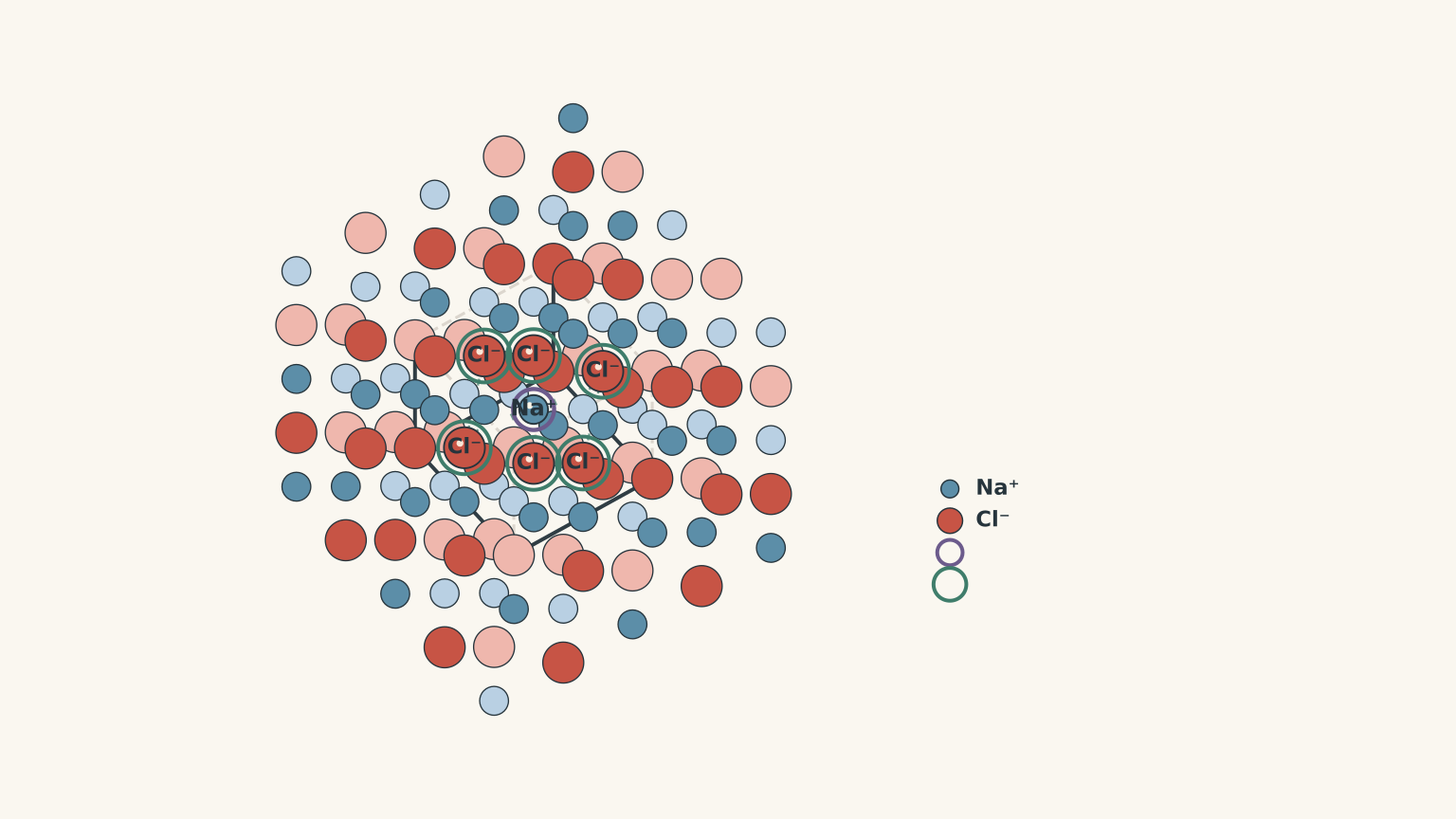
Due to technical limitations, this figure may display incorrectly or contain inaccuracies. Please check key details against your course materials.
The charges also determine the simplest formula of other ionic compounds.
| Compound | Positive ion | Negative ion | Charge balance | Formula |
|---|---|---|---|---|
| Sodium chloride | \(\mathrm{Na}^{+}\) | \(\mathrm{Cl}^{-}\) | \(+1-1=0\) | \(\ce{NaCl}\) |
| Magnesium chloride | \(\mathrm{Mg}^{2+}\) | \(\mathrm{Cl}^{-}\) | \(+2+2(-1)=0\) | \(\ce{MgCl2}\) |
| Magnesium oxide | \(\mathrm{Mg}^{2+}\) | \(\mathrm{O}^{2-}\) | \(+2-2=0\) | \(\ce{MgO}\) |
| Aluminium oxide | \(\mathrm{Al}^{3+}\) | \(\mathrm{O}^{2-}\) | \(2(+3)+3(-2)=0\) | \(\ce{Al2O3}\) |
The formula tells us the simplest whole-number ratio needed for electrical neutrality. It does not tell us the precise three-dimensional arrangement of the ions.
That distinction matters when we start thinking about how the structure responds to force.
03What happens when you push the layers?
Imagine the ionic lattice as a three-dimensional checkerboard, with positive and negative ions alternating.
A two-dimensional slice of this arrangement can be represented using two rows.
Before any movement:
- Upper row: \(\ce{Cl- Na+ Cl- Na+}\)
- Lower row: \(\ce{Na+ Cl- Na+ Cl-}\)
Notice the pattern. Each ion has oppositely charged neighbours.
Now imagine applying a sideways force to the upper layer.
What would happen if that layer shifted by one nearest-neighbour spacing?
You might initially predict that the ions would simply move into new positions while remaining attracted to the ions around them.
But look at what happens to the alignment.
After the upper row shifts by one position:
- Upper row: \(\ce{Na+ Cl- Na+ Cl-}\)
- Lower row: \(\ce{Na+ Cl- Na+ Cl-}\)
Now positive ions are aligned with positive ions, and negative ions are aligned with negative ions across the interface.
The arrangement has changed dramatically.
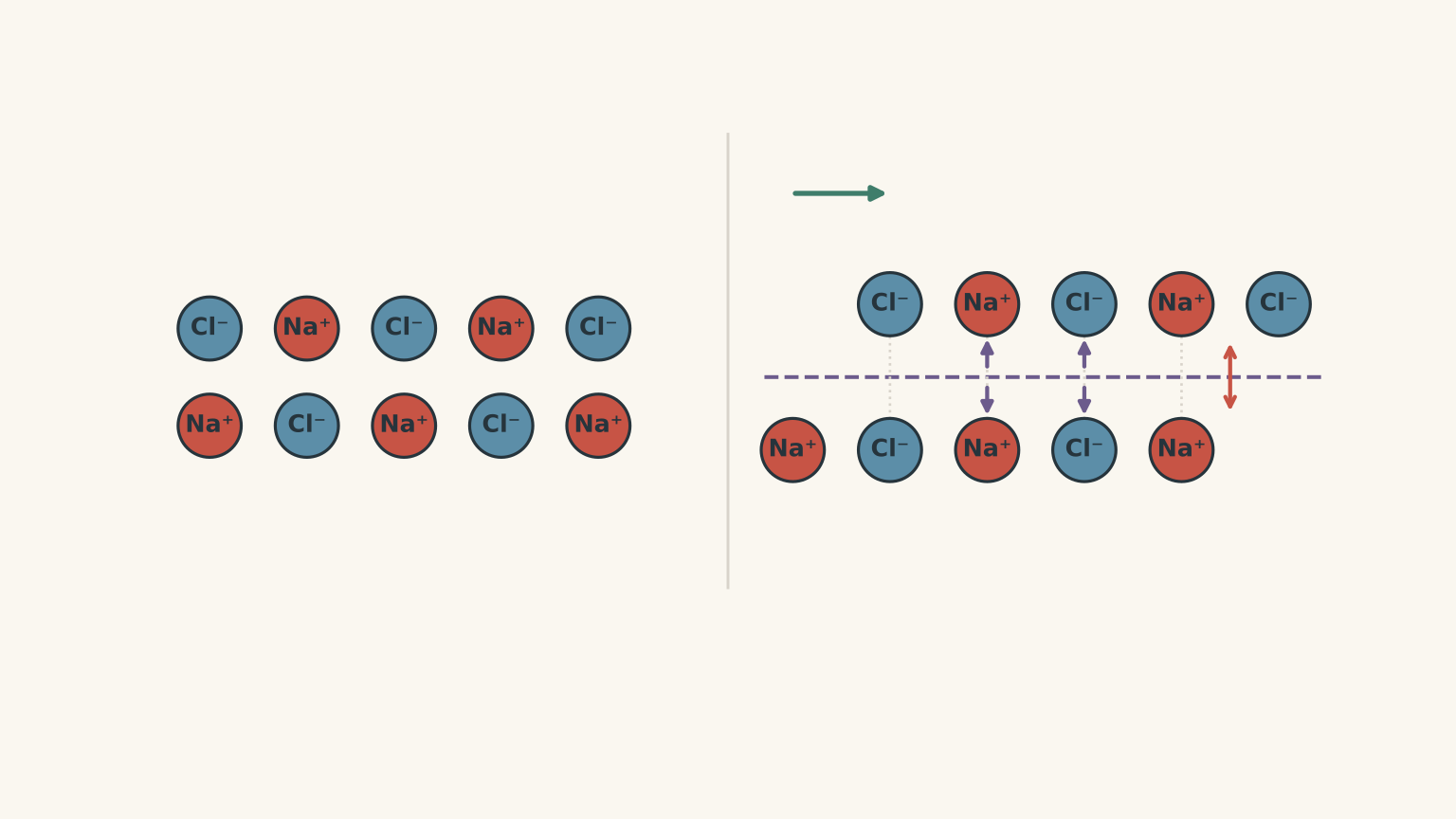
Due to technical limitations, this figure may display incorrectly or contain inaccuracies. Please check key details against your course materials.
Like charges repel
Remember the basic electrostatic rules:
- Positive and negative charges attract.
- Positive and positive charges repel.
- Negative and negative charges repel.
The shifted arrangement therefore produces strong electrostatic repulsion between like-charged ions.
The crystal cannot easily maintain this arrangement.
Instead of continuing to slide smoothly, the lattice tends to fracture along a plane. The crystal splits into separate pieces.
This is the central explanation for the brittleness of ionic solids.
The crystal does not break because its ionic attractions are weak. It breaks because shifting the lattice creates an unfavourable arrangement of like charges.
The attractions between oppositely charged ions are still present. However, the new arrangement introduces strong repulsive interactions that make continued deformation difficult.
An important limitation of the checkerboard model
The two-dimensional checkerboard is useful, but a real ionic crystal is three-dimensional.
Not every possible movement produces exactly the same arrangement of charges. The crystal’s orientation, the direction of the applied force, and defects in its structure all influence how it fractures.
The checkerboard model captures the key idea: certain layer displacements bring like charges into unfavourable positions.
It is not a literal photograph of the ions moving.
04Why metals can bend instead of shattering
Now compare an ionic solid with a metal.
Both can have strong attractions holding their structures together. Yet a piece of copper can be bent into a different shape without immediately breaking, while a sodium chloride crystal tends to fracture.
Why?
The difference is the arrangement and behaviour of the particles.
In a metal, positive ion cores are surrounded by delocalised electrons. These electrons are not restricted to individual bonds between particular pairs of atoms.
When layers of metal ion cores move relative to one another, the delocalised electrons can continue to provide attraction throughout the structure.
The metal can therefore undergo plastic deformation without necessarily losing its overall cohesion.
In an ionic crystal, however, shifting the layers can place like-charged ions next to one another. This produces strong repulsion and makes smooth deformation difficult.
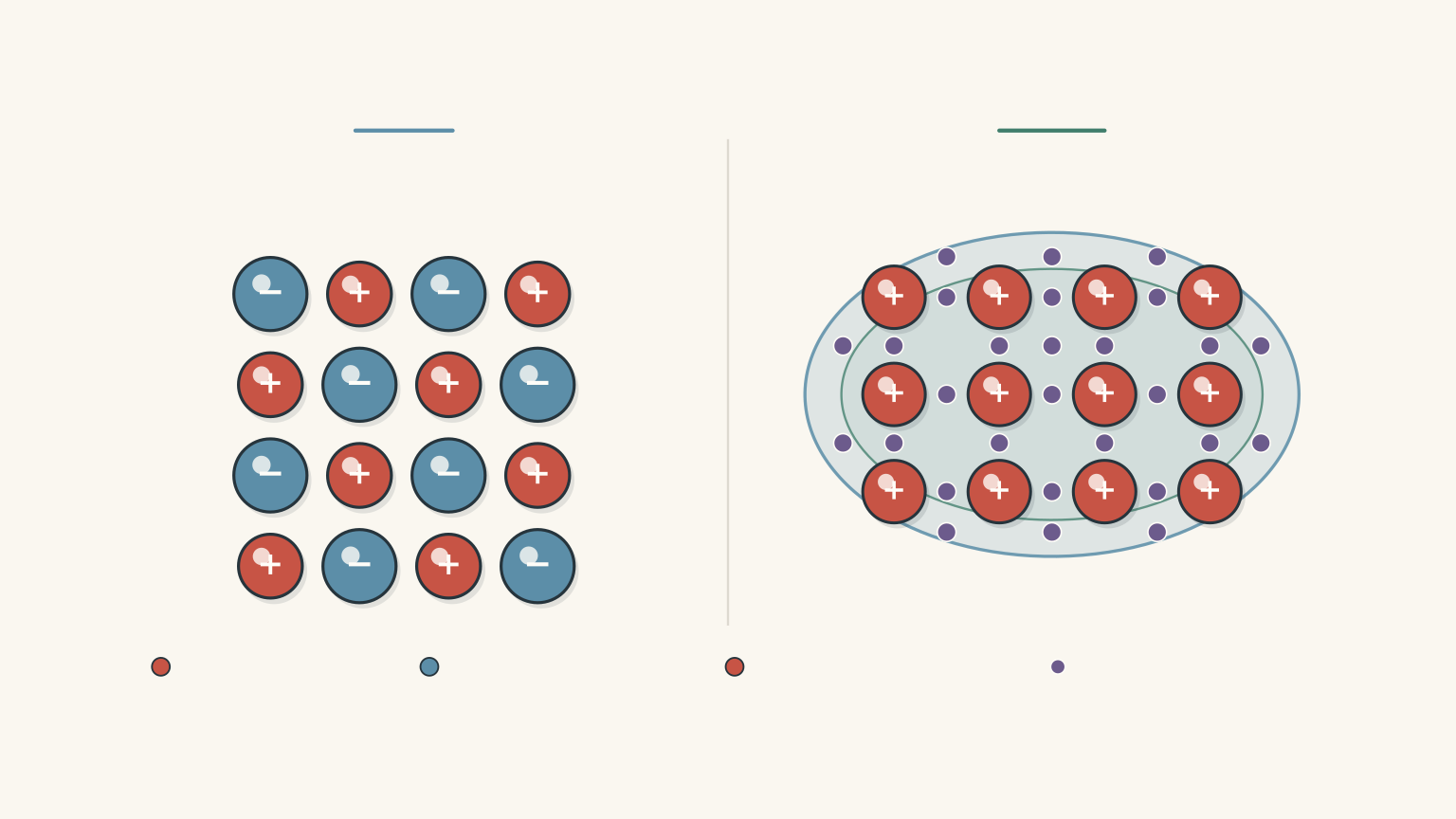
Due to technical limitations, this figure may display incorrectly or contain inaccuracies. Please check key details against your course materials.
| Feature | Ionic solid | Typical metal |
|---|---|---|
| Main particles | Positive and negative ions | Positive ion cores and delocalised electrons |
| Attraction | Electrostatic attraction between oppositely charged ions | Attraction between positive ion cores and delocalised electrons |
| Response to layer movement | Can bring like charges into close proximity | Electron cloud can maintain cohesion as layers move |
| Typical mechanical behaviour | Hard and brittle | Often malleable and ductile |
This does not mean that metallic bonding is weak or that every metal is always malleable. Metal alloys, crystal defects, and temperature can change mechanical behaviour.
The important difference is that the two structures respond differently when their layers move.
05How experiments support the explanation
There are two separate questions scientists need to answer:
- How are the ions arranged inside the crystal?
- What happens to that arrangement when the crystal is subjected to force?
A structural model needs evidence for both.
1. X-ray diffraction reveals the repeating structure
Before scientists could confidently explain the properties of crystals, they needed a way to investigate their internal arrangements.
Looking at the outside of a salt crystal was not enough. A cube-shaped crystal does not reveal exactly where its ions sit inside.
X-ray diffraction provided a way to investigate this.
The apparatus works in a specific sequence:
- An X-ray source produces a beam of X-rays.
- A collimator directs the beam towards a single crystal.
- The crystal is mounted on a rotating stage.
- X-rays are scattered by the electrons in the crystal.
- A detector records the intensity of the scattered X-rays at different angles.
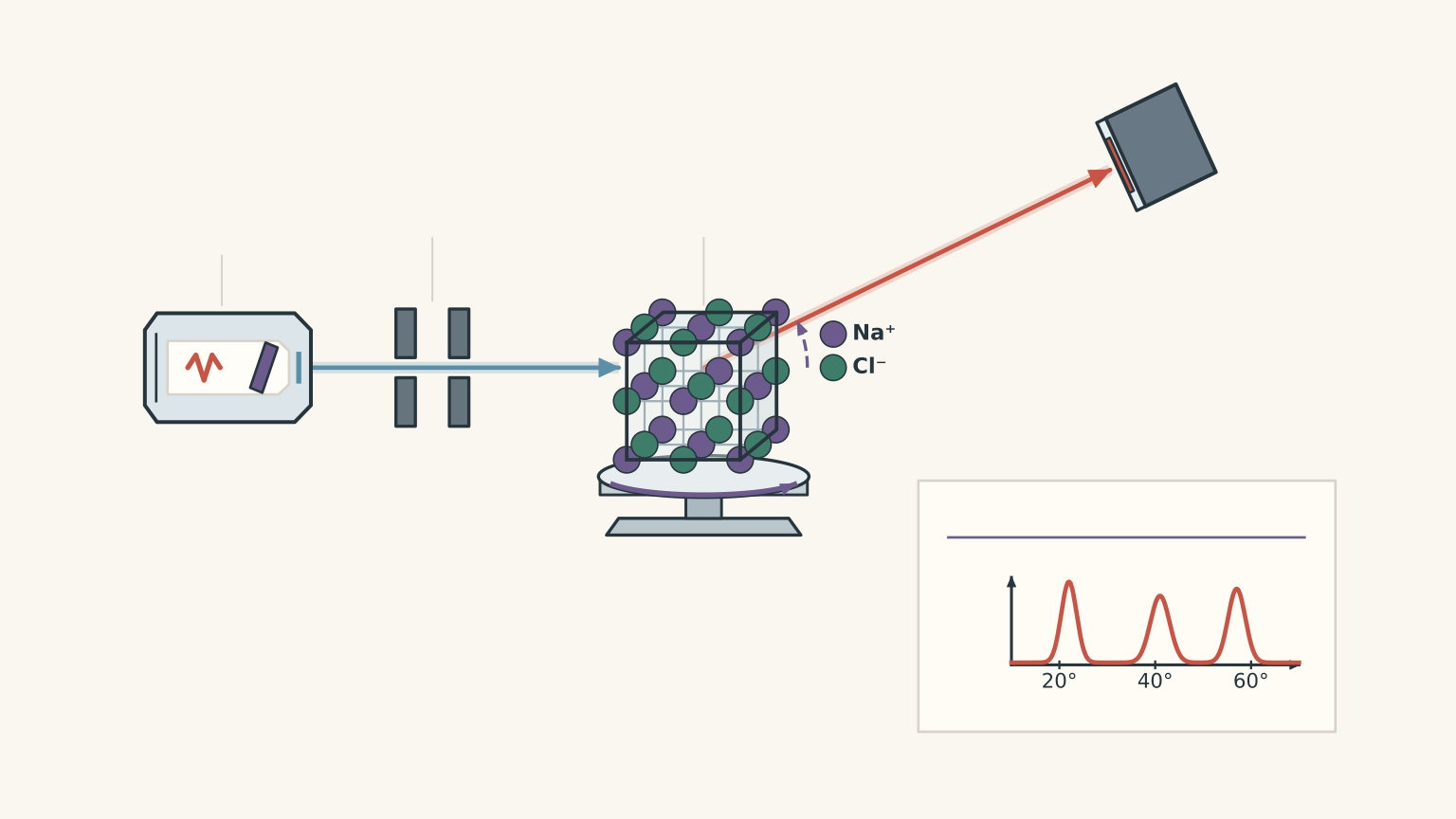
Due to technical limitations, this figure may display incorrectly or contain inaccuracies. Please check key details against your course materials.
What should the experiment show?
If the particles are arranged in a regular repeating structure, scattered X-rays can reinforce one another at particular angles.
This produces a recognisable diffraction pattern.
If the structure were completely disordered, the pattern would be different.
The measured diffraction pattern can therefore be compared with predictions from different structural models.
For sodium chloride, the results support a regular rock-salt arrangement of alternating sodium and chloride positions.
There is an important distinction here: the detector does not photograph tiny positive and negative spheres. The pattern is measured experimentally, and the arrangement is inferred by testing structural models against that evidence.
The chemical composition and charge balance help identify which positions correspond to the positive and negative ions.
At HSC level, the important point is understanding how a measured pattern supports a model of the crystal structure, rather than calculating diffraction angles.
2. Mechanical testing reveals how the crystal fractures
Knowing the internal arrangement is only half the explanation.
We also need to investigate what happens when a crystal experiences mechanical stress.
A controlled shear experiment provides a way to investigate this.
Imagine a single ionic crystal held between two supports:
- The lower support remains fixed.
- The upper support applies a sideways force.
- A force sensor measures the applied force.
- A displacement sensor measures the relative movement of the supports.
- A microscope records the development and direction of any cracks.
What should the model predict?
If the layers could slide freely while maintaining their favourable arrangement, we would expect the crystal to undergo continued deformation.
However, the ionic model predicts that certain layer movements will create unfavourable like-charge alignments.
We would therefore expect the force to rise as the crystal resists movement, followed by fracture rather than extensive smooth deformation.
Ionic crystals characteristically cleave along particular crystal planes. This is consistent with the idea that the internal arrangement determines where fracture occurs.
Why the experimental design matters
Suppose the first attempt simply involved crushing a handful of salt crystals with a hammer.
The observation would be straightforward: the salt breaks into smaller pieces.
But this experiment would not establish exactly why it broke.
The sample contains many small crystals with different orientations. Some already have cracks or imperfections. Grain boundaries and contact points between particles also influence where fracture occurs.
The experiment cannot distinguish fracture caused by the internal ionic arrangement from fracture caused by existing defects or boundaries between grains.
A better design uses a single crystal with a known orientation.
The improved investigation would:
- Determine the crystal orientation using structural information.
- Secure the crystal in a controlled mechanical testing arrangement.
- Apply a measured shear force.
- Record the displacement and the point at which a crack forms.
- Compare the fracture plane with the predicted arrangement of ions.
This gives a much stronger test of the proposed mechanism.
The structural measurement establishes the repeating arrangement. The mechanical test establishes how that arrangement responds to stress.
Together, they support the explanation of ionic brittleness.
A useful scale estimate
The movements involved occur at an extremely small scale.
A typical nearest-neighbour ion separation in an ionic crystal is on the order of \(3.0\times10^{-10}\ \text{m}\).
Suppose a visible crack extends for \(1.0\ \text{mm}\).
The approximate number of ion spacings across that length is:
\[ \begin{aligned} N&=\frac{\text{crack length}}{\text{ion spacing}}\\ &=\frac{1.0\times10^{-3}}{3.0\times10^{-10}}\\ &\approx3.3\times10^6 \end{aligned} \]
So a crack just one millimetre long spans roughly 3.3 million nearest-neighbour spacings.
This is an illustrative scale estimate, not a measurement of a particular crack.
It shows how changes occurring at the atomic scale can produce the visible fracture of an entire crystal.
06Worked examples
Worked example: Determine the formula from ionic charges
An ionic compound forms from aluminium ions, \(\mathrm{Al}^{3+}\), and oxide ions, \(\mathrm{O}^{2-}\).
Determine its simplest formula unit.
Step 1
Each aluminium ion has a charge of \(+3\), while each oxide ion has a charge of \(-2\).
Step 2
Two aluminium ions contribute:
\[ 2(+3)=+6 \]
Three oxide ions contribute:
\[ 3(-2)=-6 \]
The total charge is therefore:
\[ +6-6=0 \]
Step 3
There are two aluminium ions for every three oxide ions.
Therefore:
\[ \boxed{\ce{Al2O3}} \]
The formula represents a 2:3 ratio throughout the ionic structure.
It does not represent a separate \(\ce{Al2O3}\) molecule.
This matters because the physical behaviour comes from the extended lattice, not from the behaviour of individual formula units.
Worked example: Does a higher ionic charge mean greater brittleness?
Compare a sodium chloride ion pair, \(\mathrm{Na}^{+}\) and \(\mathrm{Cl}^{-}\), with a magnesium oxide ion pair, \(\mathrm{Mg}^{2+}\) and \(\mathrm{O}^{2-}\).
Assume both pairs have the same separation. Compare the relative magnitude of their electrostatic attractions.
Step 1
The charges have magnitudes of 1 and 1.
Their charge product is:
\[ 1\times1=1 \]
Step 2
The charges have magnitudes of 2 and 2.
Their charge product is:
\[ 2\times2=4 \]
Step 3
For a single pair of ions at the same separation, the electrostatic attraction scales with the product of the charge magnitudes.
Therefore, the idealised magnesium oxide ion pair has four times the electrostatic attraction of the sodium chloride ion pair.
Step 4
This does not mean magnesium oxide is four times as brittle as sodium chloride.
The calculation compares individual ion pairs under an assumed equal separation. Actual crystals have different interionic distances, coordination arrangements, and interactions with many surrounding ions.
More importantly, brittleness is not simply a measure of how strong an attraction is.
It describes how a material responds when subjected to stress, particularly whether it fractures before undergoing substantial permanent deformation.
Higher ionic charges can strengthen electrostatic interactions, but they do not automatically determine the degree of brittleness.
07Questions and solutions
Question 1
Calcium forms \(\mathrm{Ca}^{2+}\) ions, while fluorine forms \(\mathrm{F}^{-}\) ions.
Determine the simplest formula of the ionic compound formed. Explain how the charges determine the ratio of ions in the compound.
Solution 1
The formula is \(\ce{CaF2}\), because one calcium ion requires two fluoride ions to produce an electrically neutral compound.
The calcium ion has a charge of \(+2\).
Each fluoride ion has a charge of \(-1\).
Therefore:
\[ (+2)+2(-1)=0 \]
The simplest whole-number ratio is one calcium ion to two fluoride ions.
The formula tells us the ratio of ions throughout the ionic lattice. It does not mean that the solid consists of individual \(\ce{CaF2}\) molecules.
Question 2
A single crystal of sodium chloride is subjected to a sideways force.
In a simplified two-dimensional model, the upper layer initially contains alternating \(\mathrm{Na}^{+}\) and \(\mathrm{Cl}^{-}\) ions, with the lower layer arranged in the opposite pattern.
The upper layer is displaced by one nearest-neighbour spacing.
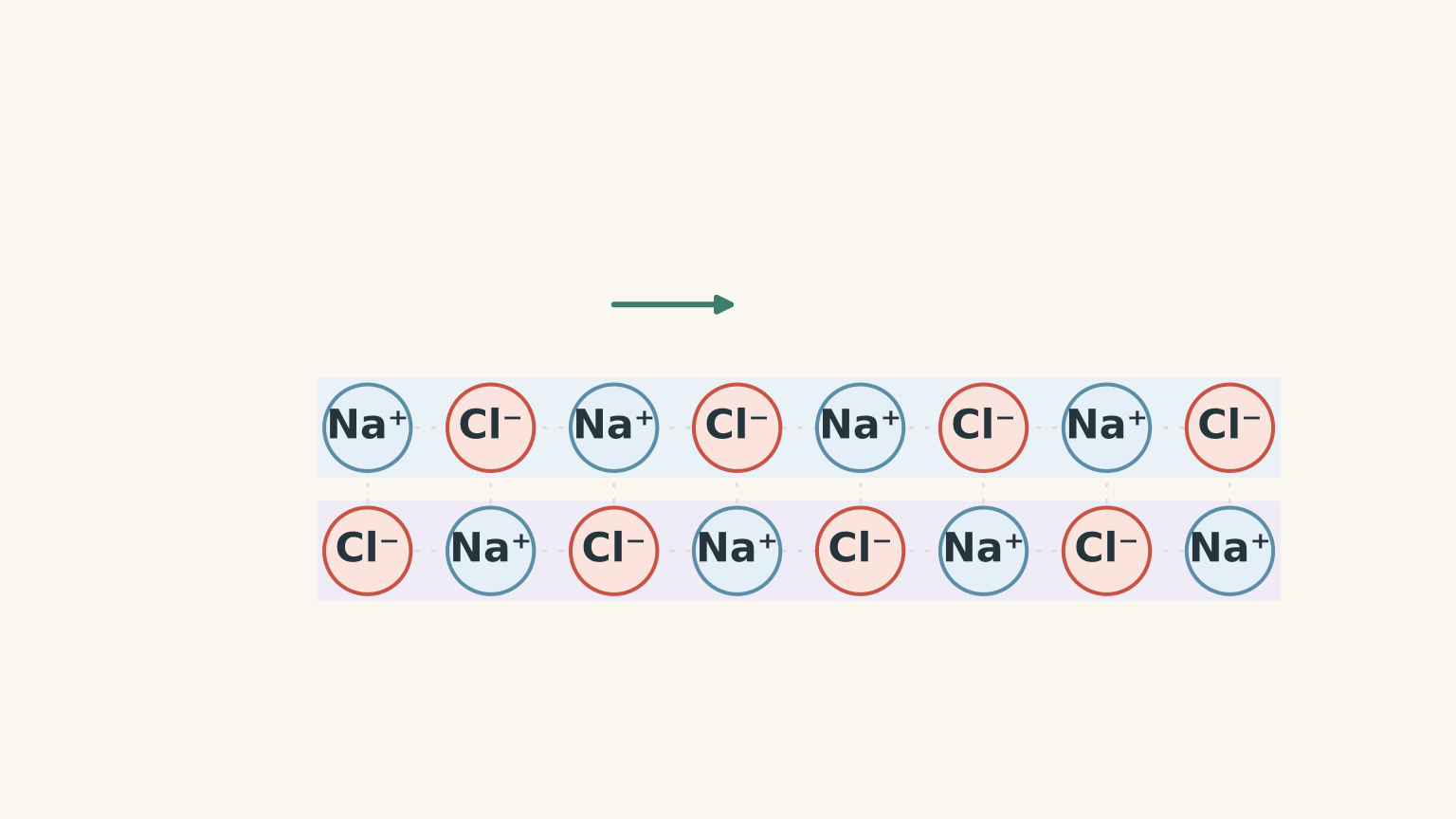
Due to technical limitations, this figure may display incorrectly or contain inaccuracies. Please check key details against your course materials.
Explain why this displacement can cause the crystal to fracture rather than remain permanently deformed.
Your answer should refer to the electrostatic interactions between the ions.
Solution 2
The displacement brings like-charged ions into alignment, producing strong electrostatic repulsion and making the shifted lattice unstable.
Initially, positive and negative ions alternate throughout the structure.
When the upper layer moves, some positive ions become aligned with other positive ions, while some negative ions become aligned with other negative ions.
Like charges repel.
The resulting repulsion makes it energetically unfavourable for the crystal to maintain the displaced arrangement.
Rather than continuing to slide smoothly, the crystal tends to split along a plane.
This explains why ionic solids are brittle despite their strong electrostatic attractions.
The mistake would be to assume that strong ionic attractions automatically allow the layers to move without difficulty. Their behaviour depends on how the arrangement of charges changes during that movement.
Question 3
A student compares a sodium chloride crystal with a piece of copper.
Both are held together by strong attractive interactions.
When subjected to mechanical force, the sodium chloride crystal fractures, while the copper can be bent into a new shape.
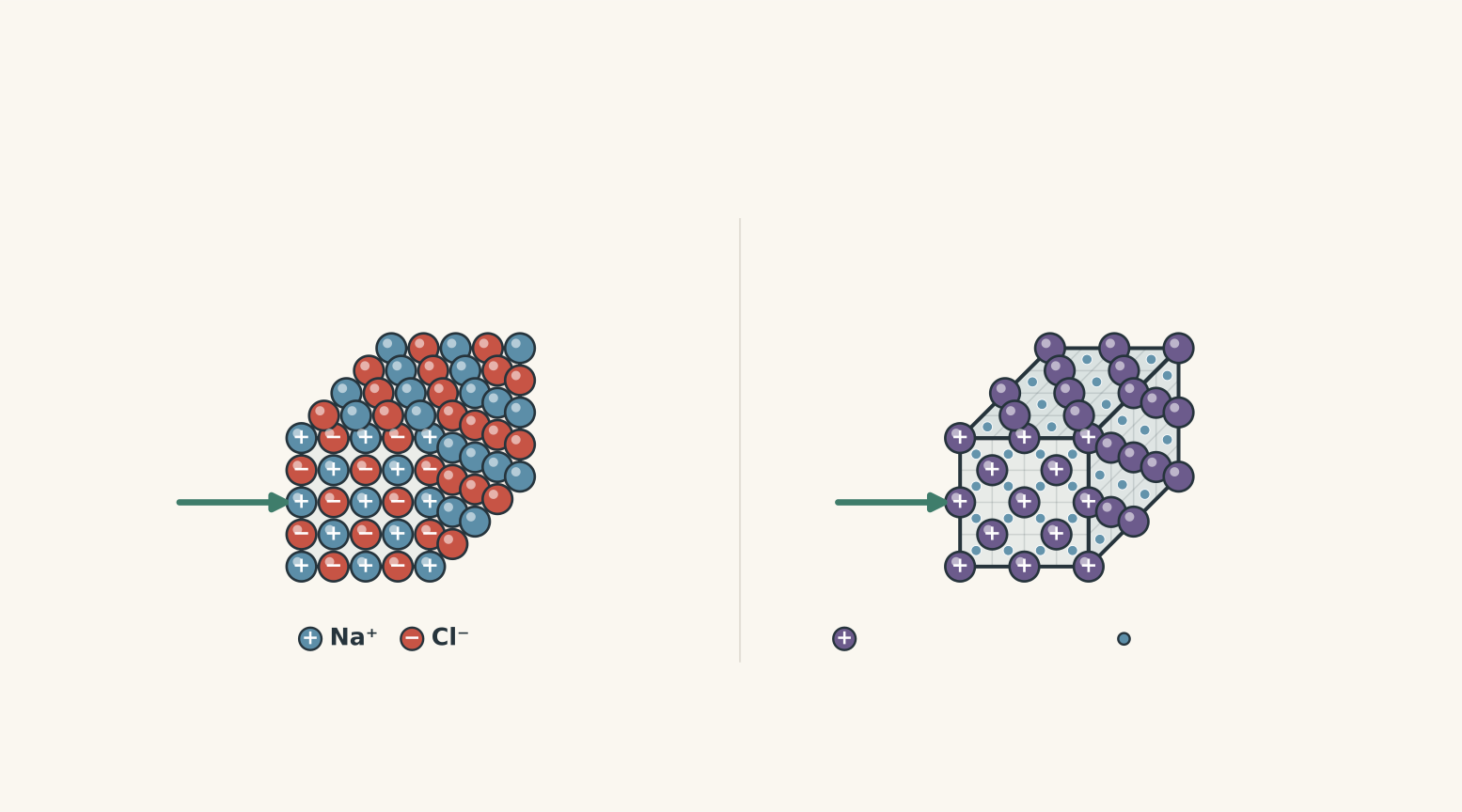
Due to technical limitations, this figure may display incorrectly or contain inaccuracies. Please check key details against your course materials.
Explain why the two materials respond differently to the applied force.
Your answer should identify the role of delocalised electrons and the arrangement of ionic charges.
Solution 3
Sodium chloride fractures because layer movement can bring like-charged ions together, whereas copper can undergo deformation while its delocalised electrons continue to maintain attraction throughout the metallic structure.
In sodium chloride, the positive and negative ions occupy a regular repeating arrangement.
When layers shift, like charges can become adjacent. The resulting electrostatic repulsion makes continued deformation difficult and encourages fracture.
Copper has a different bonding arrangement.
Its positive ion cores are surrounded by delocalised electrons. These electrons are not restricted to individual pairs of atoms.
When layers of metal ion cores move relative to one another, the delocalised electrons can continue to provide attraction throughout the structure.
This allows many metals to undergo permanent deformation without immediately fracturing.
The tempting misconception is that copper must be more malleable because its bonding is weaker.
That is not the explanation. Both materials can have strong attractions. Their different mechanical properties arise from the different ways their structures respond to movement.
Question 4
A student wants to investigate why sodium chloride crystals are brittle.
Their first experiment involves crushing a collection of small salt crystals with a hammer. They observe that the crystals break into smaller fragments.
The student concludes that this proves like-charge repulsion causes ionic solids to fracture.
Evaluate the student’s conclusion.
Describe an improved experiment that would provide stronger evidence for the proposed mechanism. Include:
- the apparatus required
- the measurements taken
- one important variable that must be controlled
- the observation expected if the model is correct.
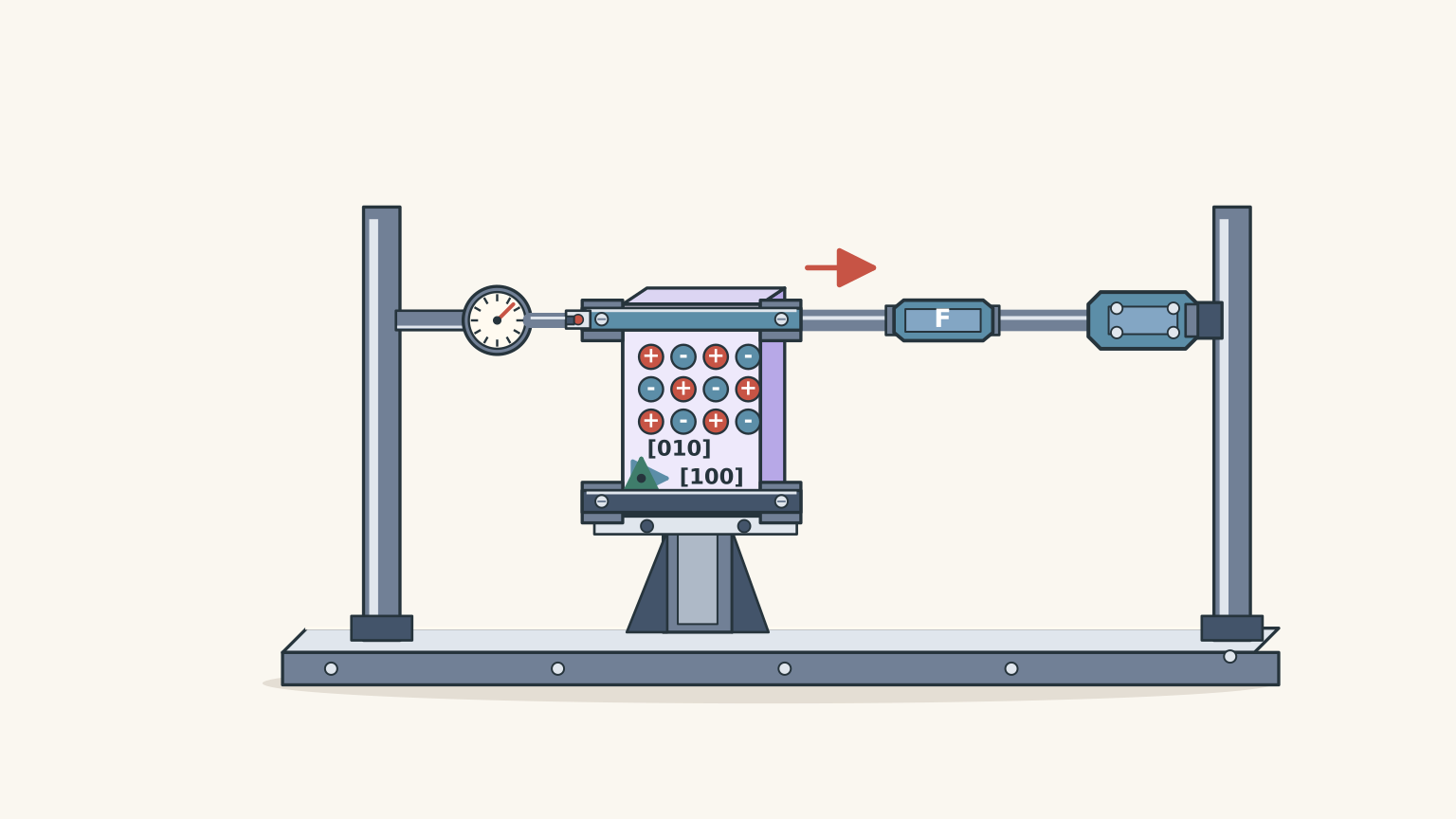
Due to technical limitations, this figure may display incorrectly or contain inaccuracies. Please check key details against your course materials.
Solution 4
The student’s experiment demonstrates that salt crystals fracture, but it does not prove that like-charge repulsion is responsible.
Crushing a collection of small crystals introduces several uncontrolled factors.
The crystals may have different orientations, existing cracks, and grain boundaries. These can all influence where the material breaks.
A better experiment would use a single crystal with a known orientation.
Apparatus
The improved setup would include:
- A single sodium chloride crystal.
- A fixed support to hold one part of the crystal.
- A movable grip to apply a controlled sideways force.
- A force sensor to measure the applied force.
- A displacement sensor to measure the relative movement.
- A microscope to observe crack formation.
Measurements
Record the applied force and corresponding displacement.
Also observe the direction and location of any fracture.
Controlled variable
The crystal orientation should be controlled because the direction of applied force relative to the lattice influences how the layers can move.
Using crystals with different orientations without accounting for this would make the results difficult to compare.
Expected observation
If the proposed model is correct, the crystal should resist certain layer displacements and then fracture rather than undergo extensive smooth deformation.
The fracture should be consistent with the orientation of the crystal lattice.
This provides stronger evidence because the experiment links the measured mechanical response to the known internal arrangement.
The key difference is that the improved experiment tests a specific prediction of the ionic lattice model, rather than merely showing that a salt crystal can break.
Question 5
Consider two idealised ionic crystals, A and B.
They have:
- Identical lattice geometries.
- Identical nearest-neighbour distances.
- Identical coordination arrangements.
- No structural defects.
- The same possible pathways for layer movement and fracture.
However, their ionic charges differ.
Crystal A contains ions with charges \(+e\) and \(-e\).
Crystal B contains corresponding ions with charges \(+2e\) and \(-2e\).
Here, \(e\) represents the magnitude of the elementary charge.
Assume that electrostatic interaction energy follows the relationship:
\[ U\propto\frac{q_1q_2}{r} \]
where \(U\) is electrostatic interaction energy, \(q_1\) and \(q_2\) are the ionic charges, and \(r\) is the separation between the ions.
For a particular layer displacement, the change in electrostatic energy for crystal A is \(+0.80\) model energy units per repeating patch.
Answer the following:
(a) Calculate the corresponding energy change for crystal B.
(b) A student concludes that crystal B must be four times as brittle because its ionic charges are twice as large. Explain why this conclusion is incorrect.
(c) Suppose both the energy required for layer movement and the energy required for cleavage are considered. Would doubling every ionic charge make cleavage four times more favourable relative to layer movement? Explain.
(d) Identify two features of real crystals that could cause their mechanical behaviour to differ from the idealised prediction.
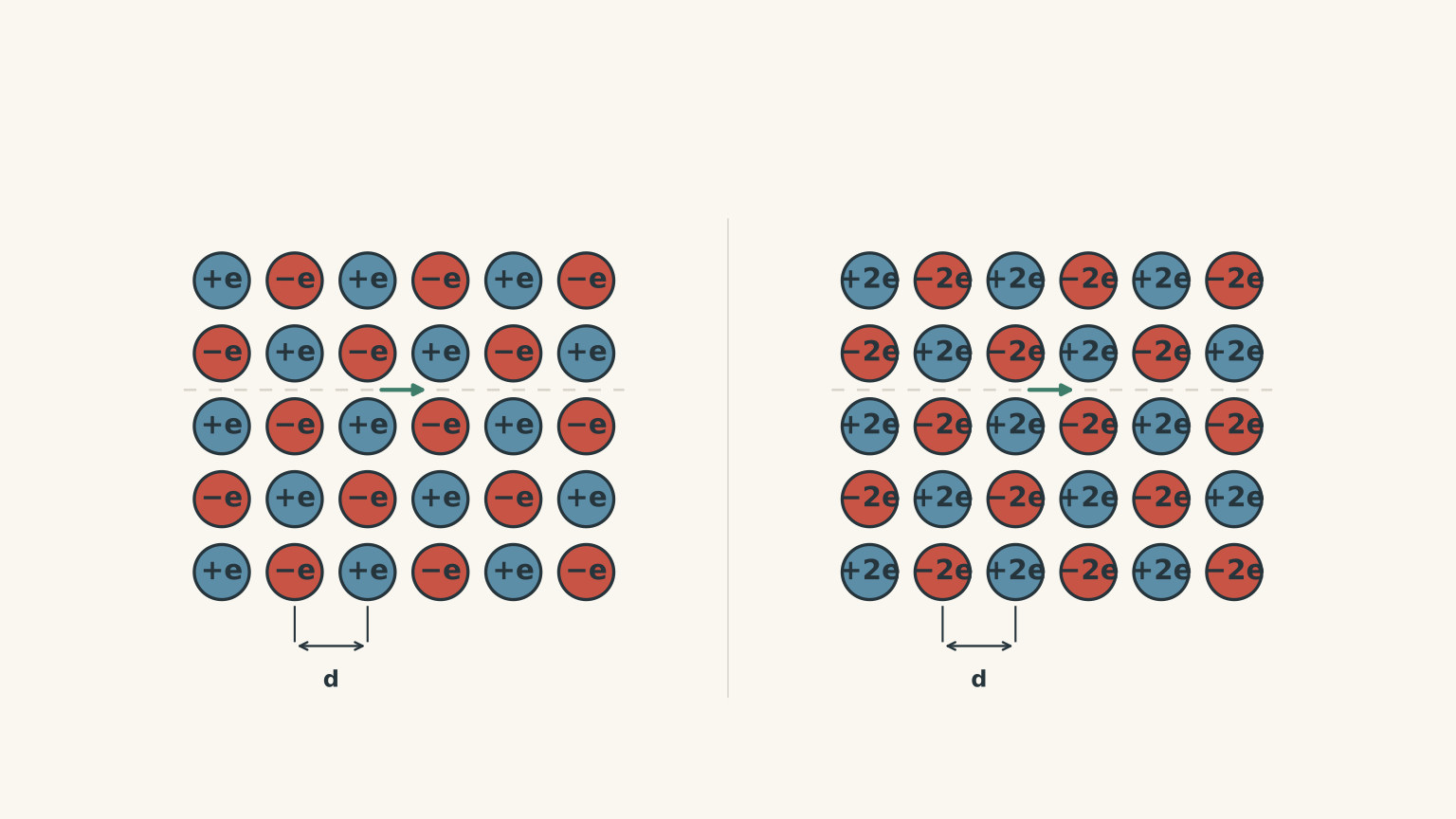
Due to technical limitations, this figure may display incorrectly or contain inaccuracies. Please check key details against your course materials.
Solution 5
(a) The energy change for crystal B is \(+3.20\) model energy units per repeating patch.
Doubling the magnitude of both ionic charges multiplies the product of the charges by four.
For crystal A, the magnitude of the charge product is:
\[ e\times e=e^2 \]
For crystal B:
\[ 2e\times2e=4e^2 \]
The charge product is therefore four times larger.
Because the crystal geometries and interionic distances are identical, every electrostatic pair interaction scales by the same factor.
The energy change for the specified displacement is:
\[ \begin{aligned} \Delta U_B&=4\Delta U_A\\ &=4(0.80)\\ &=\boxed{+3.20\text{ model energy units}} \end{aligned} \]
The positive sign indicates that the displacement increases the electrostatic energy in both crystals.
(b) Crystal B is not necessarily four times as brittle.
The calculation establishes that a particular displacement requires four times the electrostatic energy change under the stated assumptions.
It does not establish that the material is four times as brittle.
Brittleness describes the tendency to fracture before undergoing substantial plastic deformation. It is not simply a measurement of the energy required to move ions.
A material with stronger electrostatic interactions may resist deformation more strongly, but that alone does not determine how readily it fractures compared with how readily it can undergo other structural changes.
The student has confused the magnitude of an interaction with the relative mechanical behaviour of the material.
(c) No. Cleavage does not become four times more favourable relative to layer movement.
This is the important consequence of the idealised assumptions.
Doubling every ionic charge multiplies all electrostatic pair-interaction energies by four.
That includes both attractive and repulsive contributions.
Consequently, if the geometry and the two possible pathways remain identical, the energy changes associated with both layer movement and cleavage are multiplied by four.
Their relative energetic preference therefore remains unchanged.
The crystal requires more work for the same specified electrostatic rearrangement, but the balance between the two competing pathways has not changed.
This is why stronger electrostatic interactions alone cannot establish that a crystal becomes more brittle.
(d) Real crystals contain additional structural features.
Two important examples are:
- Defects and dislocations: Imperfections in a crystal can allow local rearrangements that change how easily the material deforms or fractures.
- Interionic distances and lattice geometry: Real compounds have different ion sizes, coordination arrangements, and distances. These affect the interactions throughout the lattice.
Temperature, impurities, and grain boundaries can also influence mechanical behaviour.
The idealised model isolates the effect of ionic charge. Real crystals require a more complete structural and mechanical explanation.
This question highlights an important distinction: stronger electrostatic interactions can increase resistance to rearrangement without necessarily changing the relative tendency of a material to fracture rather than deform.
08Where this connects next
You can now connect three different types of chemical evidence:
- Valence and ionic charge tell you which ions form and the ratio needed for electrical neutrality.
- Structural representations show how those ions are arranged throughout a repeating lattice.
- Physical behaviour reveals how that arrangement responds to heating, electrical conditions, and mechanical stress.
For ionic brittleness, the reasoning chain is:
\[ \boxed{ \begin{gathered} \text{Ionic lattice}\\ \downarrow\\ \text{Layers are displaced}\\ \downarrow\\ \text{Like charges become adjacent}\\ \downarrow\\ \text{Electrostatic repulsion increases}\\ \downarrow\\ \text{The crystal fractures} \end{gathered} } \]
The same structure-property reasoning is useful when identifying an unknown solid. If you combine melting point, electrical conductivity, and mechanical behaviour, you can build a much stronger case for its bonding and structure.
Continue with How to Identify an Unknown Solid from Chemistry Data to practise using multiple physical properties to identify an unknown substance.