
Formal Language of Proof for HSC Mathematics Extension 2
Learn how to use statements, implications, converses, negations, and contrapositives in rigorous mathematical proofs. Includes worked examples and challenging HSC Extension 2 practice questions with fully explained solutions.
An integer divisible by 4 is always even. Does that mean every even integer must be divisible by 4?
It sounds plausible if you read the sentence too quickly. But \(6\) is even, and \(6\) is not divisible by 4. The original statement is true; reversing its direction makes it false.
This is one of the most important habits to develop in Mathematics Extension 2: a statement, its converse, its negation, and its contrapositive are different logical objects. Knowing exactly how they relate makes your proofs more rigorous and helps you recognise when an argument has a gap.
Let’s build that language properly.
01What makes something a mathematical statement?
A mathematical statement is a declarative sentence that has a definite truth value. It must be either true or false.
For example:
- \(12\) is divisible by 3. (True.)
- \(15\) is an even number. (False.)
- Every integer is either even or odd. (True.)
Notice that the truth of a statement depends on its domain: the set of values we’re considering.
Consider the sentence:
\[ n \text{ is even}. \]
Is this true or false?
We can’t answer until we know what \(n\) represents. If \(n=8\), the statement is true. If \(n=9\), it is false.
A sentence containing an unspecified variable is often called an open sentence or predicate. It becomes a statement when we specify the variable or quantify over its possible values.
For example:
\[ \forall n\in\mathbb Z,\quad n \text{ is even} \]
is a statement. It is false because not every integer is even.
Here, \(\mathbb Z\) represents the set of integers, and \(\forall\) means “for all”.
This distinction matters throughout proof-writing. Before proving anything, identify:
- The domain of the variables.
- The condition being assumed.
- The conclusion that must follow.
A proof about integers is not automatically a proof about real or complex numbers.
02Implications: if this is true, what must follow?
Suppose we make the following claim:
“If an integer is divisible by 4, then it is even.”
We can divide this into two smaller statements:
- \(P\): The integer is divisible by 4.
- \(Q\): The integer is even.
The claim says that whenever \(P\) is true, \(Q\) must also be true.
This relationship is called an implication.
We write:
\[ P\implies Q \]
Read this as “\(P\) implies \(Q\)” or “if \(P\), then \(Q\)”.
The statement before the arrow, \(P\), is called the hypothesis or antecedent. The statement after the arrow, \(Q\), is called the conclusion or consequent.
When is an implication true?
An implication is false only when its hypothesis is true but its conclusion is false.
Consider all four possible combinations:
| \(P\) | \(Q\) | \(P\implies Q\) |
|---|---|---|
| True | True | True |
| True | False | False |
| False | True | True |
| False | False | True |
The second row is the only situation that makes an implication false.
Why?
Because the claim promises that whenever \(P\) happens, \(Q\) follows. If \(P\) happens and \(Q\) doesn’t, the promise has been broken.
If \(P\) is false, the implication has not been contradicted. It makes no claim about what happens when the hypothesis isn’t satisfied.
For example, consider the integer \(n=5\).
It is not divisible by 4, so \(P\) is false. This does not disprove the statement that every integer divisible by 4 is even.
Necessary and sufficient conditions
Implications also introduce two terms that appear frequently in rigorous mathematical arguments.
If \(P\implies Q\), then:
- \(P\) is a sufficient condition for \(Q\).
- \(Q\) is a necessary condition for \(P\).
In our example, being divisible by 4 is sufficient to guarantee that an integer is even.
Being even is necessary for an integer to be divisible by 4.
The distinction is useful:
- Sufficient means the condition guarantees the result.
- Necessary means the result cannot occur without the condition.
Neither term automatically tells you that the reverse implication is true.
03The converse: reversing the implication
Return to our original statement:
\[ P\implies Q \]
The converse is formed by swapping the hypothesis and conclusion:
\[ Q\implies P \]
In words:
Original: If an integer is divisible by 4, then it is even.
Converse: If an integer is even, then it is divisible by 4.
The converse is false.
Take \(n=6\). It is even, but it is not divisible by 4.
This example is called a counterexample: a specific case that satisfies the hypothesis but contradicts the conclusion.
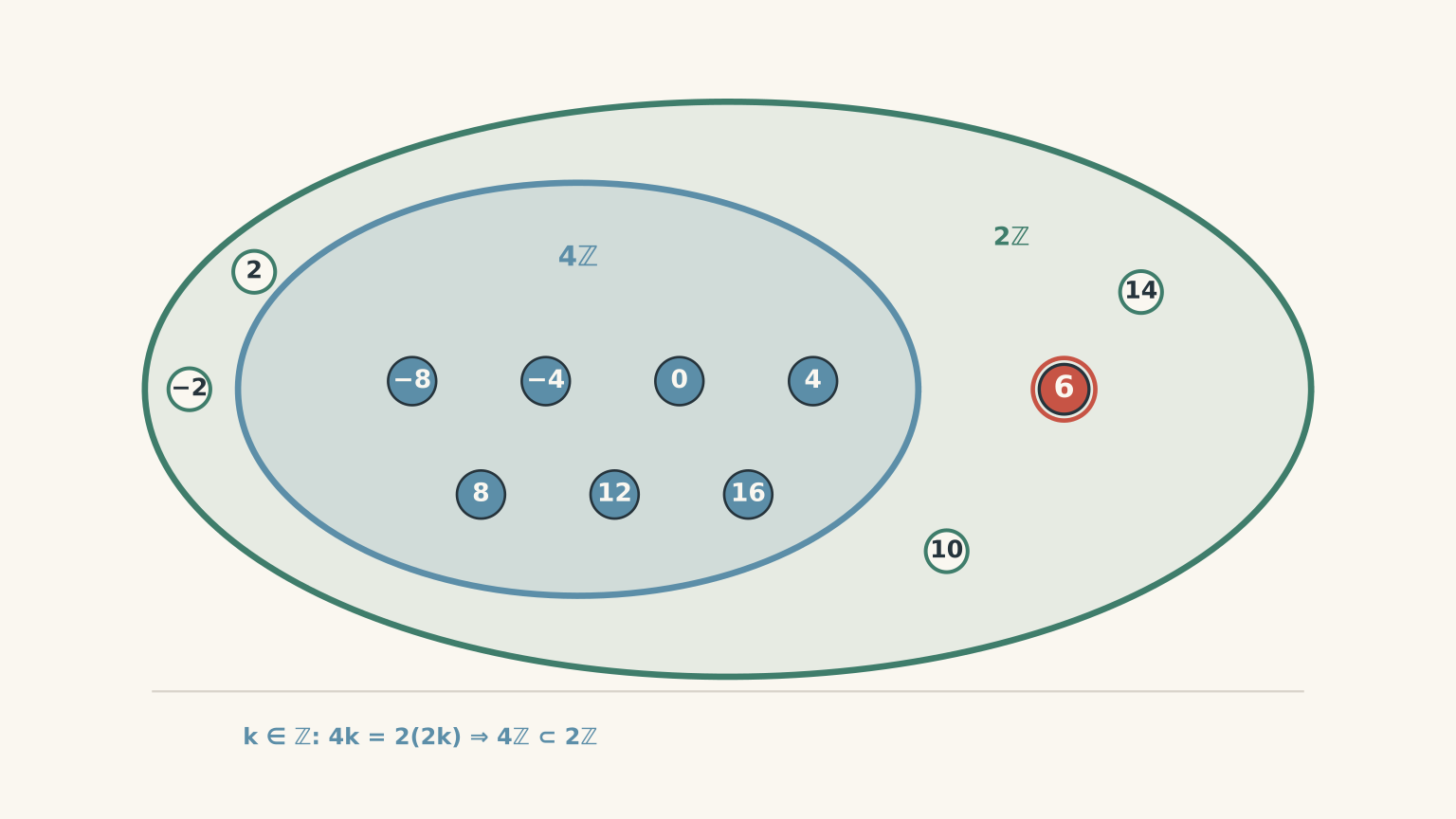
Due to technical limitations, this figure may display incorrectly or contain inaccuracies. Please check key details against your course materials.
The important point is that the original statement does not automatically establish its converse.
Even if you have proved \(P\implies Q\), you have said nothing yet about whether \(Q\implies P\).
To establish the converse, you need a separate proof. To disprove it, one counterexample is enough.
A useful comparison
| Logical form | Symbol | Meaning |
|---|---|---|
| Original implication | \(P\implies Q\) | If \(P\), then \(Q\). |
| Converse | \(Q\implies P\) | If \(Q\), then \(P\). |
| Contrapositive | \(\neg Q\implies\neg P\) | If not \(Q\), then not \(P\). |
| Negation | \(P\land\neg Q\) | \(P\) is true and \(Q\) is false. |
The last two forms deserve particular attention.
04The negation: what would make the statement false?
The negation of a statement is its logical opposite.
If \(P\) is true, its negation, written \(\neg P\), is false. If \(P\) is false, \(\neg P\) is true.
For simple statements, this is fairly straightforward.
For example:
- \(P\): \(x>3\).
- \(\neg P\): \(x\leq 3\).
Notice that the negation of \(x>3\) is not \(x<3\). The value \(x=3\) must also be included.
The more interesting case is negating an implication.
Negating an implication
Suppose the original statement is:
\[ P\implies Q \]
For this implication to be false, two things must happen:
- \(P\) must be true.
- \(Q\) must be false.
Therefore, its negation is:
\[ \boxed{\neg(P\implies Q) \equiv P\land\neg Q} \]
The symbol \(\land\) means “and”.
In plain English:
“The hypothesis is true, but the conclusion is false.”
This is exactly the situation represented by a counterexample.
Consider our original statement about divisibility by 4.
Its negation is:
“There exists an integer that is divisible by 4 but is not even.”
To prove the original statement, we need to establish that no such integer exists.
Suppose \(n\) is divisible by 4. Then:
\[ n=4k,\qquad k\in\mathbb Z \]
Rearranging:
\[ n=2(2k) \]
Since \(2k\) is an integer, \(n\) is even.
Therefore, no integer can satisfy the negation. The original implication is true.
Negating statements involving every or some
You also need to be careful when a statement contains words such as “every”, “all”, or “there exists”.
The rules are:
\[ \neg(\forall x\in D,\ P(x)) \]
\[ \equiv \exists x\in D:\neg P(x) \]
And:
\[ \neg(\exists x\in D,\ P(x)) \]
\[ \equiv \forall x\in D:\neg P(x) \]
In words:
- The negation of “every object has a property” is “there exists an object without that property”.
- The negation of “there exists an object with a property” is “every object lacks that property”.
For a universal implication, this gives an especially useful result:
\[ \boxed{ \neg\left[\forall x\in D,\ P(x)\implies Q(x)\right] } \]
\[ \boxed{ \equiv \exists x\in D: P(x)\land\neg Q(x) } \]
This is the formal definition of what you need to find when disproving a universal mathematical claim.
05The contrapositive: a different route to the same proof
Here is a useful result:
If an integer is divisible by 4, then it is even.
We know that this is true. But suppose we want to prove it using a different approach.
Instead of assuming that the integer is divisible by 4, consider what happens if it is not even.
If an integer is not even, it must be odd.
An odd integer cannot be divisible by 4.
So we can make the statement:
“If an integer is not even, then it is not divisible by 4.”
This is the contrapositive of the original implication.
In symbols:
\[ \boxed{P\implies Q \iff \neg Q\implies\neg P} \]
The contrapositive reverses the direction of the implication and negates both statements.
The crucial result is that an implication and its contrapositive are logically equivalent. They always have the same truth value.
This is different from the converse, which is not generally equivalent to the original statement.
Why is the contrapositive so useful?
Sometimes proving a statement directly is awkward.
You might assume \(P\) and struggle to reach \(Q\). However, assuming \(\neg Q\) might give you a much simpler starting point from which you can establish \(\neg P\).
Because the contrapositive is logically equivalent to the original, proving it is enough.
Worked example: Proving that an even square has an even integer root
For an integer \(n\), prove that if \(n^2\) is even, then \(n\) is even.
Step 1
Let:
- \(P\): \(n^2\) is even.
- \(Q\): \(n\) is even.
We need to prove \(P\implies Q\).
Step 2
The contrapositive is:
“If \(n\) is odd, then \(n^2\) is odd.”
We will prove this instead.
Step 3
If \(n\) is odd, then:
\[ n=2k+1,\qquad k\in\mathbb Z \]
Step 4
\[ \begin{aligned} n^2&=(2k+1)^2\\ &=4k^2+4k+1\\ &=2(2k^2+2k)+1 \end{aligned} \]
Since \(k\) is an integer, \(2k^2+2k\) is also an integer.
Therefore, \(n^2\) has the form \(2m+1\), where \(m\) is an integer.
This means \(n^2\) is odd.
Step 5
We have established that if \(n\) is odd, then \(n^2\) is odd.
Therefore, the contrapositive is true, which means the original implication is also true.
Hence:
\[ \boxed{ n^2\text{ even}\implies n\text{ even} } \]
This is a complete proof by contrapositive.
06A worked example combining all four forms
Let’s put the terminology together using an inequality.
Worked example: Analysing a statement about squares
For real numbers \(x\), consider the implication:
\[ x>2\implies x^2>4 \]
Determine whether the original statement is true. Then write its converse, contrapositive, and negation, and determine their truth values.
Step 1
If \(x>2\), then \(x\) is positive and greater than 2.
Squaring gives:
\[ x^2>4 \]
Therefore, the original implication is true.
Step 2
Swap the hypothesis and conclusion:
\[ x^2>4\implies x>2 \]
This is false.
For example, take \(x=-3\).
Then:
\[ (-3)^2=9>4 \]
However, \(-3\) is not greater than 2.
Therefore, \(x=-3\) is a counterexample.
Step 3
Negate both statements and reverse their order:
\[ x^2\leq4\implies x\leq2 \]
If \(x^2\leq4\), then:
\[ -2\leq x\leq2 \]
This certainly means \(x\leq2\).
Therefore, the contrapositive is true, as expected.
Step 4
The negation of the universal implication is:
\[ \exists x\in\mathbb R: x>2\land x^2\leq4 \]
In words:
“There exists a real number greater than 2 whose square is less than or equal to 4.”
No such number exists, so the negation is false.
Notice how the four forms give us different ways to examine the same mathematical relationship.
The original implication is true, its converse is false, its contrapositive is true, and its negation is false.
07When can you use “if and only if”?
There is one more expression worth understanding.
Suppose both of the following statements are true:
\[ P\implies Q \]
and
\[ Q\implies P \]
We can combine them into a biconditional:
\[ \boxed{P\iff Q} \]
This is read as “\(P\) if and only if \(Q\)”.
It means that each statement is both necessary and sufficient for the other.
For example, we can prove that an integer \(n\) has an even square if and only if \(n\) is even.
We already proved:
\[ n^2\text{ even}\implies n\text{ even} \]
Now consider the reverse direction.
If \(n\) is even, write:
\[ n=2k,\qquad k\in\mathbb Z \]
Squaring:
\[ n^2=4k^2=2(2k^2) \]
Therefore, \(n^2\) is even.
We have now established both directions:
\[ \boxed{ n^2\text{ is even} \iff n\text{ is even} } \]
Be careful when using this notation in an exam. Proving one implication does not establish a biconditional. You must prove both directions independently, unless one follows from an already established result.
08Questions and solutions
The following questions progress from translating logical statements to constructing proofs and testing whether a mathematical argument survives a change of domain.
Question 1
Let \(n\) be an integer. Consider the statement:
“If \(n\) is divisible by 6, then \(n\) is divisible by 3.”
(a) Write the statement using implication notation.
(b) Write its converse and determine whether it is true.
(c) Write its contrapositive and explain why it is true.
(d) Write the negation of the original universal statement.
Solution 1
The original implication and its contrapositive are true, but the converse is false.
(a) Let:
- \(P\): \(6\mid n\).
- \(Q\): \(3\mid n\).
The implication is:
\[ P\implies Q \]
or:
\[ 6\mid n\implies3\mid n \]
Here, \(a\mid n\) means that \(n\) is divisible by \(a\).
(b) The converse is:
\[ 3\mid n\implies6\mid n \]
This is false.
Take \(n=3\). It is divisible by 3, but not by 6.
Therefore, \(n=3\) is a counterexample.
(c) The contrapositive is:
\[ 3\nmid n\implies6\nmid n \]
This is true.
If an integer were divisible by 6, it would necessarily be divisible by 3. Therefore, an integer that is not divisible by 3 cannot be divisible by 6.
This establishes the contrapositive and, consequently, the original implication.
(d) The negation is:
\[ \exists n\in\mathbb Z: 6\mid n\land3\nmid n \]
In words:
“There exists an integer divisible by 6 but not divisible by 3.”
No such integer exists because every multiple of 6 is also a multiple of 3.
Therefore, the negation is false.
Question 2
Let \(x\) be a real number. Consider the statement:
“If \(x\) is rational, then \(x^2\) is rational.”
(a) Prove the original implication.
(b) Write its converse and determine whether it is true. Give a counterexample if necessary.
(c) Write its contrapositive.
(d) Write the negation of the original universal statement and explain its truth value.
Solution 2
The original implication is true, its converse is false, and its contrapositive is true.
(a) Suppose \(x\) is rational.
By definition, we can express \(x\) as:
\[ x=\frac pq \]
where \(p,q\in\mathbb Z\) and \(q\neq0\).
Squaring:
\[ x^2=\frac{p^2}{q^2} \]
Since \(p^2\) and \(q^2\) are integers, and \(q^2\neq0\), this is a rational number.
Therefore:
\[ x\in\mathbb Q\implies x^2\in\mathbb Q \]
where \(\mathbb Q\) represents the rational numbers.
(b) The converse is:
\[ x^2\in\mathbb Q\implies x\in\mathbb Q \]
This is false.
Consider:
\[ x=\sqrt2 \]
Then:
\[ x^2=2\in\mathbb Q \]
However, \(\sqrt2\) is irrational.
To see why, suppose \(\sqrt2=p/q\), where \(p\) and \(q\) are integers with no common factor.
Then:
\[ p^2=2q^2 \]
This means \(p^2\) is even, so \(p\) must be even. Write \(p=2k\).
Substituting:
\[ 4k^2=2q^2 \]
Therefore:
\[ q^2=2k^2 \]
So \(q\) must also be even.
This contradicts our assumption that \(p\) and \(q\) have no common factor.
Hence, \(\sqrt2\) is irrational, and the converse is false.
(c) The contrapositive is:
\[ x^2\notin\mathbb Q \implies x\notin\mathbb Q \]
This is true because it is logically equivalent to the original implication.
(d) The negation is:
\[ \exists x\in\mathbb R: x\in\mathbb Q\land x^2\notin\mathbb Q \]
In words:
“There exists a rational real number whose square is irrational.”
This is false because squaring a rational number always produces another rational number, as established in part (a).
Question 3
For an integer \(n\), consider the statement:
\[ 3\mid n^2\implies3\mid n \]
(a) Prove this implication using its contrapositive.
(b) Determine whether the converse is true.
(c) Hence, write a biconditional involving \(3\mid n^2\) and \(3\mid n\).
Solution 3
Both directions are true. Therefore, an integer is divisible by 3 if and only if its square is divisible by 3.
(a) The original implication is:
\[ 3\mid n^2\implies3\mid n \]
Its contrapositive is:
\[ 3\nmid n\implies3\nmid n^2 \]
We will prove this.
If \(n\) is not divisible by 3, it must have one of the following forms:
\[ n=3k+1 \]
or:
\[ n=3k+2 \]
where \(k\in\mathbb Z\).
Consider the first case.
\[ \begin{aligned} n^2&=(3k+1)^2\\ &=9k^2+6k+1\\ &=3(3k^2+2k)+1 \end{aligned} \]
The square has a remainder of 1 when divided by 3.
Now consider the second case.
\[ \begin{aligned} n^2&=(3k+2)^2\\ &=9k^2+12k+4\\ &=3(3k^2+4k+1)+1 \end{aligned} \]
Again, the square has a remainder of 1 when divided by 3.
Therefore, in both cases:
\[ 3\nmid n^2 \]
The contrapositive is true, so the original implication is true.
(b) The converse is:
\[ 3\mid n\implies3\mid n^2 \]
Suppose \(3\mid n\).
Then:
\[ n=3k \]
for some integer \(k\).
Squaring:
\[ n^2=9k^2=3(3k^2) \]
Since \(3k^2\) is an integer, \(n^2\) is divisible by 3.
Therefore, the converse is also true.
(c) Since both implications are true:
\[ \boxed{ 3\mid n^2\iff3\mid n } \]
This result is stronger than the original implication because it establishes both directions.
Question 4
Consider the following statement, where the domain is initially all real numbers:
\[ x^2>9\implies x>3 \]
(a) Determine whether the statement is true. If false, give a counterexample.
(b) Write its negation.
(c) Write its converse and contrapositive, and determine their truth values.
(d) Now restrict the domain to \(x\geq0\). Does the original implication become true? Explain which part of the reasoning changes.
Solution 4
The original implication is false over all real numbers but becomes true when the domain is restricted to non-negative real numbers.
(a) Consider:
\[ x^2>9 \]
Taking square roots correctly gives:
\[ |x|>3 \]
Therefore:
\[ x<-3\quad\text{or}\quad x>3 \]
The original statement claims that every such \(x\) must be greater than 3.
But take \(x=-4\).
Then:
\[ (-4)^2=16>9 \]
However, \(-4\) is not greater than 3.
Therefore, the original implication is false.
(b) The negation of the universal statement is:
\[ \boxed{ \exists x\in\mathbb R: x^2>9\land x\leq3 } \]
The counterexample \(x=-4\) satisfies both conditions.
Therefore, the negation is true, confirming that the original statement is false.
(c) The converse is:
\[ x>3\implies x^2>9 \]
This is true.
If \(x>3\), then \(x\) is positive and greater than 3. Squaring gives \(x^2>9\).
The contrapositive is:
\[ x\leq3\implies x^2\leq9 \]
This is false over the real numbers.
For example, \(x=-4\) satisfies \(x\leq3\), but:
\[ x^2=16>9 \]
As expected, the contrapositive has the same truth value as the original implication.
(d) Now restrict the domain to:
\[ x\in[0,\infty) \]
We know that:
\[ x^2>9 \]
implies:
\[ x<-3\quad\text{or}\quad x>3 \]
However, the restriction \(x\geq0\) eliminates the first possibility.
We are left with:
\[ x>3 \]
Therefore, the original implication is now true.
Its converse remains true, so we can establish:
\[ \boxed{ x^2>9\iff x>3 \quad\text{for }x\geq0 } \]
The important detail is the domain.
Over all real numbers, squaring loses information about the sign of a number. Restricting the domain to non-negative numbers removes that ambiguity.
This is why specifying the domain is not just a formality. It can change whether an implication is true or false.
Question 5
Consider the following statement:
“For all real numbers \(a\) and \(b\), if \(a^2+b^2=0\), then \(a=b=0\).”
(a) Prove this statement using its contrapositive.
(b) Determine whether its converse is true. Hence, state whether the original statement can be written as a biconditional over the real numbers.
(c) A student claims that the same implication must hold for all complex numbers \(a\) and \(b\). They argue:
“If \(a\neq0\) or \(b\neq0\), then \(a^2>0\) or \(b^2>0\). Therefore, \(a^2+b^2>0\).”
Determine whether the student’s claim is correct. If it is false, give a counterexample and identify the exact flaw in their reasoning.
(d) Write the negation and contrapositive of the student’s claimed implication over the complex numbers.
(e) Suggest a related statement involving complex moduli that is true for all complex numbers \(a\) and \(b\).
Solution 5
The original statement is true over the real numbers but false over the complex numbers. The difference comes from a property of real squares that does not extend to complex squares.
(a) Define:
- \(P\): \(a^2+b^2=0\).
- \(Q\): \(a=b=0\).
We want to prove:
\[ P\implies Q \]
The contrapositive is:
\[ \neg Q\implies\neg P \]
In words:
“If at least one of \(a\) or \(b\) is non-zero, then \(a^2+b^2\neq0\).”
Suppose:
\[ a\neq0\quad\text{or}\quad b\neq0 \]
Since \(a\) and \(b\) are real numbers, their squares are non-negative.
Furthermore, at least one of the squares must be strictly positive.
Therefore:
\[ a^2+b^2>0 \]
Hence:
\[ a^2+b^2\neq0 \]
We have proved the contrapositive.
Therefore, the original implication is true for all real numbers \(a\) and \(b\).
(b) The converse is:
\[ a=b=0\implies a^2+b^2=0 \]
This is clearly true because:
\[ 0^2+0^2=0 \]
Therefore, both directions are true, and we can write:
\[ \boxed{ a^2+b^2=0 \iff a=b=0 } \]
This biconditional is valid over the real numbers.
(c) The student’s claim is false over the complex numbers.
Consider:
\[ a=1,\qquad b=i \]
Recall that:
\[ i^2=-1 \]
Substituting:
\[ \begin{aligned} a^2+b^2&=1^2+i^2\\ &=1-1\\ &=0 \end{aligned} \]
Therefore:
\[ a^2+b^2=0 \]
However, neither \(a\) nor \(b\) is zero.
The original implication fails.
The student’s exact error is assuming that the square of every non-zero number must be positive.
This is true for real numbers, but not for complex numbers.
In particular:
\[ i^2=-1 \]
A complex square can be negative or non-real. The real-number argument relied on both squares being non-negative, which is not guaranteed over the complex numbers.
The domain has changed, so a property used in the original proof is no longer available.
(d) The original implication over the complex numbers is:
\[ a^2+b^2=0\implies a=b=0 \]
Its negation is:
\[ \boxed{ \exists a,b\in\mathbb C: a^2+b^2=0 \land (a\neq0\lor b\neq0) } \]
This is true, as demonstrated by \(a=1\) and \(b=i\).
Its contrapositive is:
\[ \boxed{ (a\neq0\lor b\neq0) \implies a^2+b^2\neq0 } \]
This is false for exactly the same counterexample.
Remember, an implication and its contrapositive must always have the same truth value, even when the domain changes.
(e) A related statement that is true for all complex numbers uses the modulus:
\[ \boxed{ |a|^2+|b|^2=0 \implies a=b=0 } \]
The modulus of a complex number \(z\), written \(|z|\), represents its distance from the origin in the complex plane.
Its square is always a non-negative real number:
\[ |z|^2=z\overline z\geq0 \]
where \(\overline z\) is the complex conjugate of \(z\).
Therefore, if:
\[ |a|^2+|b|^2=0 \]
both terms must individually equal zero, since neither can be negative.
Thus:
\[ |a|^2=0,\qquad |b|^2=0 \]
which gives:
\[ a=b=0 \]
The converse is also true, so this corrected statement is a biconditional.
This final example illustrates why rigorous proof-writing requires more than manipulating symbols correctly. You must know exactly what each statement claims, which properties are available in the chosen domain, and whether the conclusion genuinely follows from the hypothesis.
09Where to use this in your HSC proofs
When you encounter a statement that needs proving or disproving, use the following decisions:
- Proving an implication: Assume the hypothesis and establish the conclusion.
- Proving by contrapositive: Assume the negation of the conclusion and establish the negation of the hypothesis.
- Disproving an implication: Find one counterexample where the hypothesis is true and the conclusion is false.
- Proving a converse: Swap the hypothesis and conclusion, then prove the new implication independently.
- Negating a universal statement: Find at least one value in the stated domain that violates the original claim.
- Proving an equivalence: Establish both implications separately.
These distinctions become particularly useful when you move into proof by contradiction, mathematical induction, inequalities, and complex number arguments in Mathematics Extension 2.
The next time you write “therefore” in a proof, pause for a moment. Have you actually established the implication you need, or have you quietly assumed that its converse is true?