
Centripetal Acceleration and Net Force: HSC Physics Practice Exam
Test your understanding of centripetal acceleration and net force with this original tutorgum NSW HSC Physics practice paper. Complete 40 marks of timed questions, then check your answers against fully worked solutions and a detailed marking guide.
This original tutorgum practice paper focuses on centripetal acceleration and net force in the NSW HSC Physics 2017 syllabus edition. It is a topic-specific revision exam, not a full-course paper, and it is not an official or NESA-endorsed examination. The questions test your ability to connect changing velocity direction to inward acceleration, calculate the required resultant force, identify the real force supplying it, and predict what happens when that inward force is removed.
01Exam instructions
- Suggested reading time: 5 minutes.
- Suggested working time: 50 minutes.
- Total marks: 40.
- Permitted equipment: Scientific calculator, pen or pencil, and ruler. No notes or internet access.
- Working: Show your equations, substitutions, and units. Give final answers to 2-3 significant figures where appropriate.
- Assumptions: Assume uniform circular motion unless stated otherwise. Ignore air resistance and other resistive forces where the question specifies this.
These are the conditions for this tutorgum practice paper, not claims about official NESA examination rules.
Assessed topics
- Centripetal acceleration and why it points towards the centre of a circular path.
- Calculating centripetal acceleration and inward resultant force.
- How speed, mass, and radius affect acceleration and force.
- Distinguishing the inward resultant force from the real force that supplies it.
- Predicting motion when the inward force is removed.
Excluded topics: Gravitational orbits, banking, vertical circular motion, angular quantities, and other syllabus modules.
02Questions
Question 1 (4 marks)
A puck moves at constant speed in a horizontal circle on a smooth table. A light string connects the puck to a fixed point at the centre of the circle. Ignore air resistance.
(a) State the direction of the puck’s instantaneous velocity relative to the circle. (1 mark)
(b) State the direction of the puck’s acceleration at that instant. (1 mark)
(c) Identify the real horizontal force that provides the inward resultant force. (1 mark)
(d) Explain why the puck has acceleration even though its speed is constant. (1 mark)
Question 2 (5 marks)
A test vehicle travels at speed \(v=6.0\ \mathrm{m\,s^{-1}}\) around a circular path of radius \(r=4.0\ \mathrm{m}\). Its centripetal acceleration is denoted by \(a_c\), measured in \(\mathrm{m\,s^{-2}}\).
(a) Calculate the magnitude of the centripetal acceleration. (2 marks)
(b) The vehicle’s speed increases to \(9.0\ \mathrm{m\,s^{-1}}\), while the radius remains unchanged. Calculate its new centripetal acceleration. (2 marks)
(c) State the factor by which the centripetal acceleration changes from its initial value. (1 mark)
Question 3 (5 marks)
A car of mass \(m=1200\ \mathrm{kg}\) travels at \(15\ \mathrm{m\,s^{-1}}\) around a level circular bend of radius \(50\ \mathrm{m}\). Let \(F_c\) denote the magnitude of the net inward force, measured in newtons (N). The tyres do not skid.
(a) Calculate the magnitude of the net inward force required for the car to follow the bend. (2 marks)
(b) An \(1800\ \mathrm{kg}\) van takes the same bend at the same speed. Calculate the required net inward force and state how it compares with the car’s force. (2 marks)
(c) Identify the real horizontal force that supplies the inward resultant force on the car. (1 mark)
Question 4 (3 marks)
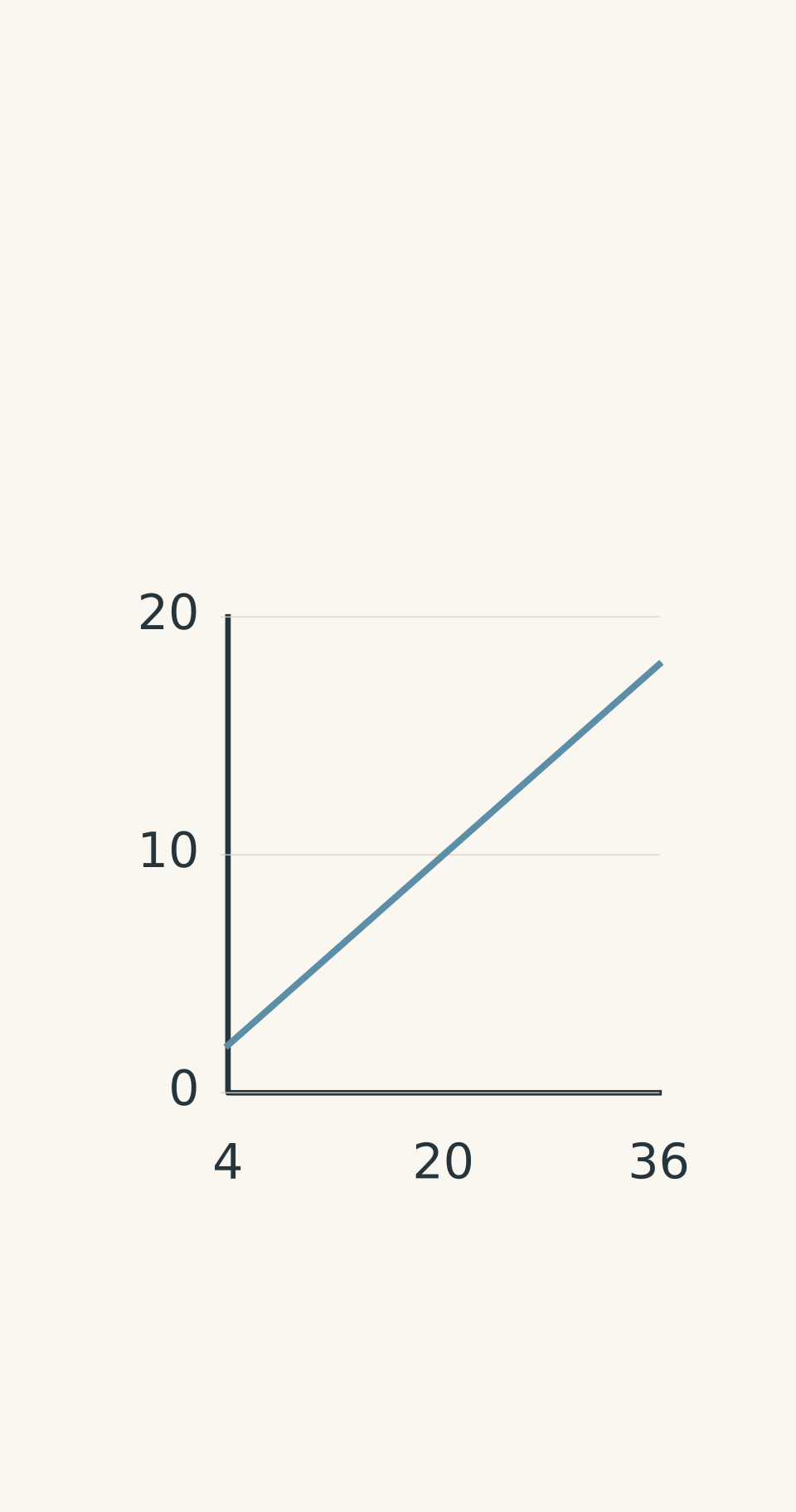
An object moves in a circle of fixed radius \(r\). Its speed \(v\) is changed, and its centripetal acceleration \(a_c\) is measured. Figure 1 plots \(a_c\), in \(\mathrm{m\,s^{-2}}\), against \(v^2\), in \(\mathrm{m^2\,s^{-2}}\).
- Centripetal acceleration
(a) Determine the gradient of the graph and state its units. (2 marks)
(b) Use the gradient to determine the radius of the circular path. (1 mark)
Question 5 (5 marks)
A motorbike and rider have a combined mass of \(250\ \mathrm{kg}\). On one bend, their speed is \(10\ \mathrm{m\,s^{-1}}\) and the radius is \(25\ \mathrm{m}\). On a second bend, their speed is \(15\ \mathrm{m\,s^{-1}}\) and the radius is \(45\ \mathrm{m}\).
Assume the combined mass is unchanged and the motorbike follows uniform circular motion on both bends.
(a) Calculate the centripetal acceleration on the first bend. (1 mark)
(b) Calculate the centripetal acceleration on the second bend. (2 marks)
(c) Calculate the magnitude of the net inward force required on the second bend. (1 mark)
(d) Calculate the percentage change in centripetal acceleration from the first bend to the second bend. State whether it is an increase or a decrease. (1 mark)
Question 6 (4 marks)
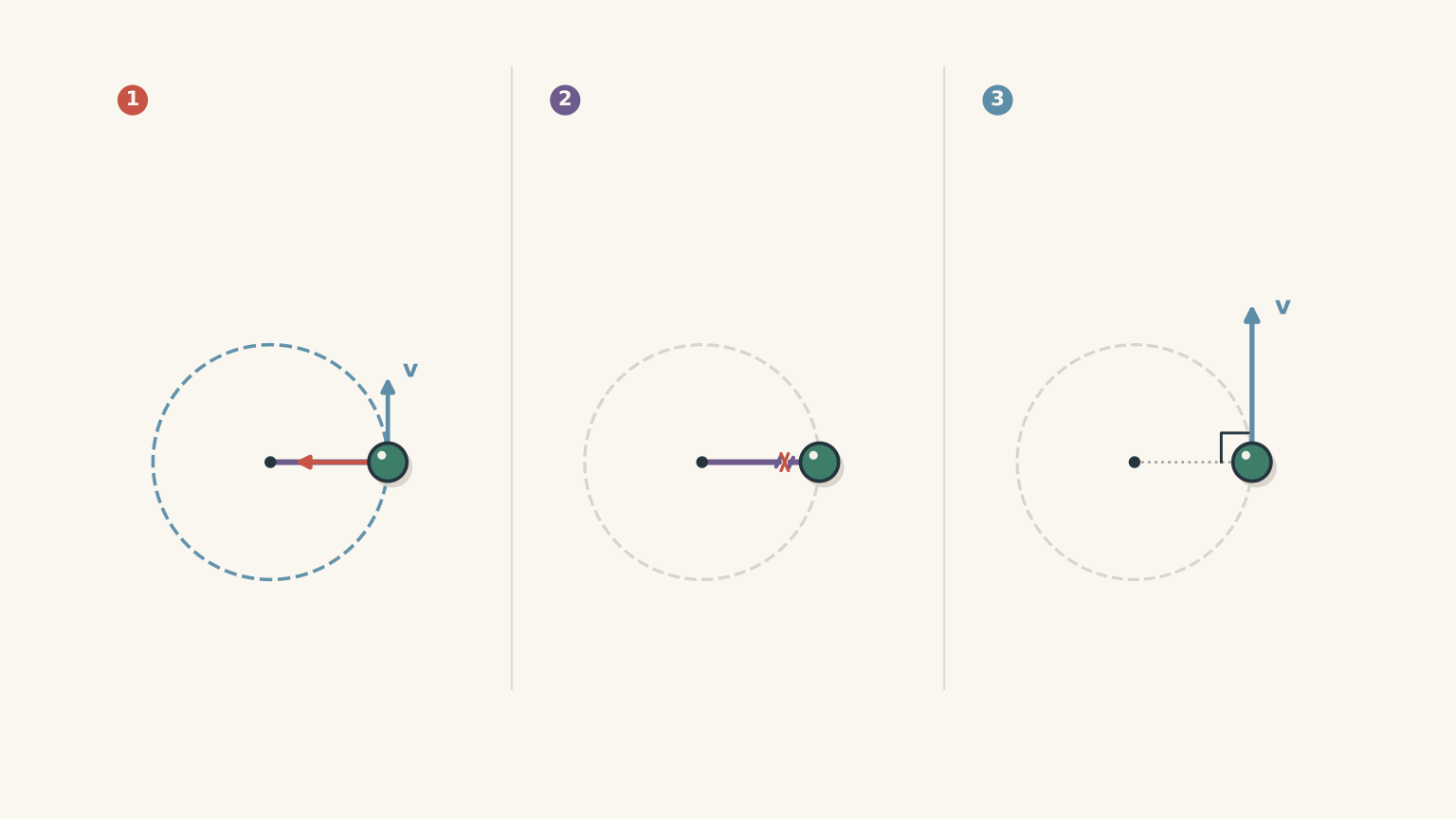
A puck moves in a circle on a smooth horizontal table while a string provides the inward force. At one instant, the string snaps. Ignore any remaining horizontal forces.
(a) Describe the puck’s motion immediately after the string snaps, including the direction in which it initially travels. (2 marks)
(b) Explain why the puck does not continue around the circle or travel directly away from the centre. (2 marks)
Question 7 (6 marks)
An object of mass \(m=0.30\ \mathrm{kg}\) moves at constant speed \(v=5.0\ \mathrm{m\,s^{-1}}\) in a horizontal circle of radius \(r=1.2\ \mathrm{m}\). The string’s tension \(T\), measured in newtons, supplies the only horizontal force.
(a) Calculate the object’s centripetal acceleration. (2 marks)
(b) Calculate the tension in the string. (2 marks)
(c) The object’s speed and mass remain unchanged, but the radius increases to \(1.8\ \mathrm{m}\). Calculate the new tension. (2 marks)
Question 8 (8 marks)
An object of mass \(m=2.0\ \mathrm{kg}\) moves in a circle of radius \(r=5.0\ \mathrm{m}\) at speed \(v=10\ \mathrm{m\,s^{-1}}\). Let \(a_c\) denote its centripetal acceleration and \(F_c\) the magnitude of its inward resultant force.
(a) Calculate the object’s initial centripetal acceleration. (2 marks)
(b) Calculate the initial magnitude of its inward resultant force. (1 mark)
(c) The mass is doubled to \(4.0\ \mathrm{kg}\), the speed is halved to \(5.0\ \mathrm{m\,s^{-1}}\), and the radius is halved to \(2.5\ \mathrm{m}\). Calculate the new centripetal acceleration and the new inward resultant force. (3 marks)
(d) A student claims that doubling the mass must double the centripetal force. Explain whether the new conditions support this claim. Use the relationships between mass, speed, and radius in your explanation. (2 marks)
03Worked solutions and marking guide
Solution 1
(a) The instantaneous velocity is directed along a tangent to the circle at the puck’s position.
Marking: 1 mark for identifying the tangential direction.
(b) The acceleration points directly towards the centre of the circle.
Marking: 1 mark for identifying the inward direction.
(c) The tension in the string supplies the inward horizontal resultant force.
Marking: 1 mark for identifying tension.
(d) Speed describes how quickly the puck moves, while velocity describes both its speed and direction. Even though the speed stays constant, the direction of the velocity changes continuously as the puck moves around the circle. A change in velocity means there is acceleration.
Marking: 1 mark for explaining that the changing direction of velocity produces acceleration despite constant speed.
Total: 4 marks.
Solution 2
(a) The centripetal acceleration is calculated using
\[ a_c=\frac{v^2}{r} \]
Substituting the initial speed and radius,
\[ \begin{aligned} a_c&=\frac{(6.0)^2}{4.0}\\ &=\frac{36}{4.0}\\ &=9.0\ \mathrm{m\,s^{-2}} \end{aligned} \]
The initial centripetal acceleration is \(9.0\ \mathrm{m\,s^{-2}}\).
Marking (2 marks):
- 1 mark for the correct relationship and substitution.
- 1 mark for the correct answer with units.
(b) The new speed is \(9.0\ \mathrm{m\,s^{-1}}\), and the radius remains \(4.0\ \mathrm{m}\).
\[ \begin{aligned} a_c&=\frac{v^2}{r}\\ &=\frac{(9.0)^2}{4.0}\\ &=\frac{81}{4.0}\\ &=20.25\ \mathrm{m\,s^{-2}} \end{aligned} \]
To three significant figures, the new acceleration is \(20.3\ \mathrm{m\,s^{-2}}\).
Marking (2 marks):
- 1 mark for the correct substitution.
- 1 mark for the correct answer with units.
(c) The factor of change is
\[ \frac{20.25}{9.0}=2.25 \]
The centripetal acceleration increases by a factor of \(2.25\).
Marking (1 mark): Correct factor of \(2.25\).
Notice that the speed increased by a factor of \(1.5\), but the acceleration increased by \(1.5^2=2.25\). The square on speed is important.
Total: 5 marks.
Solution 3
(a) The magnitude of the required inward resultant force is
\[ F_c=\frac{mv^2}{r} \]
Substituting the car’s mass, speed, and radius,
\[ \begin{aligned} F_c&=\frac{1200(15)^2}{50}\\ &=\frac{1200(225)}{50}\\ &=5400\ \mathrm{N} \end{aligned} \]
The car requires an inward resultant force of \(5400\ \mathrm{N}\).
Marking (2 marks):
- 1 mark for the correct relationship and substitution.
- 1 mark for the correct force with units.
(b) The van has a mass of \(1800\ \mathrm{kg}\). Its speed and radius are unchanged.
\[ \begin{aligned} F_c&=\frac{mv^2}{r}\\ &=\frac{1800(15)^2}{50}\\ &=8100\ \mathrm{N} \end{aligned} \]
Compare the two forces:
\[ \frac{8100}{5400}=1.5 \]
The van requires \(8100\ \mathrm{N}\), which is \(1.5\) times the force required by the car.
At the same speed and radius, the required inward force is directly proportional to mass. The van has \(1.5\) times the mass, so it needs \(1.5\) times the inward resultant force.
Marking (2 marks):
- 1 mark for the correct force of \(8100\ \mathrm{N}\).
- 1 mark for correctly comparing the forces and identifying the mass relationship.
(c) The real horizontal force is static friction between the tyres and the road, directed towards the centre of the bend.
Static friction can act without the tyres sliding across the road. Since the car does not skid, this is the appropriate force supplying the inward resultant.
Marking (1 mark): Identifies static friction between the tyres and road.
Total: 5 marks.
Solution 4
(a) The gradient is the change in vertical-axis value divided by the change in horizontal-axis value.
Using the points \((4,2)\) and \((36,18)\),
\[ \begin{aligned} \text{gradient} &=\frac{\Delta a_c}{\Delta(v^2)}\\ &=\frac{18-2}{36-4}\\ &=\frac{16}{32}\\ &=0.50 \end{aligned} \]
The vertical-axis unit is \(\mathrm{m\,s^{-2}}\), and the horizontal-axis unit is \(\mathrm{m^2\,s^{-2}}\). Therefore,
\[ \text{gradient} =\frac{\mathrm{m\,s^{-2}}} {\mathrm{m^2\,s^{-2}}} =\mathrm{m^{-1}} \]
The gradient is \(0.50\ \mathrm{m^{-1}}\).
Marking (2 marks):
- 1 mark for the correct gradient calculation.
- 1 mark for the correct units.
(b) The centripetal acceleration relationship is
\[ a_c=\frac{v^2}{r} \]
Comparing this with the graph, the gradient of \(a_c\) against \(v^2\) is \(1/r\).
Therefore,
\[ \begin{aligned} r&=\frac{1}{\text{gradient}}\\ &=\frac{1}{0.50}\\ &=2.0\ \mathrm{m} \end{aligned} \]
The radius is \(2.0\ \mathrm{m}\).
Marking (1 mark): Correctly uses the reciprocal of the gradient to obtain \(2.0\ \mathrm{m}\).
Total: 3 marks.
Solution 5
(a) On the first bend, the speed is \(10\ \mathrm{m\,s^{-1}}\) and the radius is \(25\ \mathrm{m}\).
\[ \begin{aligned} a_{c,1}&=\frac{v^2}{r}\\ &=\frac{10^2}{25}\\ &=4.0\ \mathrm{m\,s^{-2}} \end{aligned} \]
Marking (1 mark): Correct acceleration with units.
(b) On the second bend, the speed is \(15\ \mathrm{m\,s^{-1}}\) and the radius is \(45\ \mathrm{m}\).
\[ \begin{aligned} a_{c,2}&=\frac{v^2}{r}\\ &=\frac{15^2}{45}\\ &=\frac{225}{45}\\ &=5.0\ \mathrm{m\,s^{-2}} \end{aligned} \]
The centripetal acceleration on the second bend is \(5.0\ \mathrm{m\,s^{-2}}\).
Marking (2 marks):
- 1 mark for the correct relationship and substitution.
- 1 mark for the correct answer with units.
(c) The net inward force is related to mass and acceleration by \(F_c=ma_c\).
\[ \begin{aligned} F_c&=250(5.0)\\ &=1250\ \mathrm{N} \end{aligned} \]
The required inward resultant force is \(1250\ \mathrm{N}\).
Marking (1 mark): Correct force with units.
(d) The percentage change is calculated relative to the initial acceleration.
\[ \begin{aligned} \%\text{ change} &=\frac{5.0-4.0}{4.0}\times100\\ &=25\% \end{aligned} \]
The centripetal acceleration increases by \(25\%\).
Marking (1 mark): Correct percentage and direction of change.
Total: 5 marks.
Solution 6
(a) Immediately after the string snaps, the puck moves in a straight line tangent to the circle at the release point. Its initial direction is the direction of its instantaneous velocity at the moment the string breaks.
Marking (2 marks):
- 1 mark for identifying a straight-line path tangent to the circle.
- 1 mark for identifying the direction of the instantaneous velocity.
(b) Before the string snaps, its tension supplies the inward resultant force. This force continually changes the direction of the puck’s velocity, allowing it to follow a circular path.
When the string snaps, that inward force disappears. Assuming no other horizontal forces act, there is no longer a centripetal acceleration to keep changing the velocity’s direction. The puck continues in the direction it was travelling at that instant.
It does not travel directly away from the centre because no outward force suddenly appears. It also cannot continue around the circle because the inward resultant force needed to maintain circular motion has been removed.
Marking (2 marks):
- 1 mark for explaining that removing the inward resultant removes the centripetal acceleration.
- 1 mark for explaining that the puck continues in its instantaneous velocity direction, rather than moving radially outward or continuing to curve.
Total: 4 marks.
Solution 7
(a) The centripetal acceleration is
\[ \begin{aligned} a_c&=\frac{v^2}{r}\\ &=\frac{(5.0)^2}{1.2}\\ &=20.8\ \mathrm{m\,s^{-2}} \end{aligned} \]
To two significant figures, this is \(21\ \mathrm{m\,s^{-2}}\).
Marking (2 marks):
- 1 mark for the correct relationship and substitution.
- 1 mark for the correct answer with units.
(b) The string tension \(T\) supplies the inward resultant force, so its magnitude equals the required centripetal force.
\[ \begin{aligned} T&=\frac{mv^2}{r}\\ &=\frac{0.30(5.0)^2}{1.2}\\ &=6.25\ \mathrm{N} \end{aligned} \]
To two significant figures, the tension is \(6.3\ \mathrm{N}\).
Marking (2 marks):
- 1 mark for the correct relationship and substitution.
- 1 mark for the correct tension with units.
(c) The mass and speed remain unchanged, but the radius increases to \(1.8\ \mathrm{m}\).
\[ \begin{aligned} T_{\text{new}}&=\frac{mv^2}{r}\\ &=\frac{0.30(5.0)^2}{1.8}\\ &=4.17\ \mathrm{N} \end{aligned} \]
To two significant figures, the new tension is \(4.2\ \mathrm{N}\).
The tension decreases because the object needs less inward force to maintain the same speed along a larger-radius circle.
Marking (2 marks):
- 1 mark for the correct substitution.
- 1 mark for the correct new tension with units.
Total: 6 marks.
Solution 8
(a) The initial centripetal acceleration is
\[ \begin{aligned} a_c&=\frac{v^2}{r}\\ &=\frac{10^2}{5.0}\\ &=20\ \mathrm{m\,s^{-2}} \end{aligned} \]
The initial centripetal acceleration is \(20\ \mathrm{m\,s^{-2}}\).
Marking (2 marks):
- 1 mark for the correct relationship and substitution.
- 1 mark for the correct answer with units.
(b) The initial inward resultant force is
\[ \begin{aligned} F_c&=ma_c\\ &=2.0(20)\\ &=40\ \mathrm{N} \end{aligned} \]
The initial inward resultant force is \(40\ \mathrm{N}\).
Marking (1 mark): Correct force with units.
(c) The new mass is \(4.0\ \mathrm{kg}\), the new speed is \(5.0\ \mathrm{m\,s^{-1}}\), and the new radius is \(2.5\ \mathrm{m}\).
First, calculate the new centripetal acceleration:
\[ \begin{aligned} a_{c,\text{new}}&=\frac{v^2}{r}\\ &=\frac{5.0^2}{2.5}\\ &=10\ \mathrm{m\,s^{-2}} \end{aligned} \]
Next, calculate the new inward resultant force:
\[ \begin{aligned} F_{c,\text{new}}&=\frac{mv^2}{r}\\ &=\frac{4.0(5.0)^2}{2.5}\\ &=40\ \mathrm{N} \end{aligned} \]
The new centripetal acceleration is \(10\ \mathrm{m\,s^{-2}}\), and the new inward resultant force is \(40\ \mathrm{N}\).
Marking (3 marks):
- 1 mark for the correct new acceleration.
- 1 mark for the correct force relationship and substitution.
- 1 mark for the correct new force with units.
(d) The student’s claim is incorrect for these conditions. Although the mass doubles, the speed halves, so \(v^2\) becomes one-quarter of its original value. Halving the radius then doubles the factor associated with \(1/r\).
The combined effect on the inward resultant force is
\[ 2\times\frac{1}{4}\times2=1 \]
The force therefore remains unchanged at \(40\ \mathrm{N}\), rather than doubling to \(80\ \mathrm{N}\).
Marking (2 marks):
- 1 mark for correctly explaining the combined effects of mass, speed squared, and radius.
- 1 mark for concluding that the force remains \(40\ \mathrm{N}\), so the claim is not supported.
Total: 8 marks.
End of paper. Total: 40 marks.