
Centripetal Acceleration and Net Force: HSC Physics Practice Paper
Test your understanding of centripetal acceleration and net inward force with this original 40-mark tutorgum practice paper. Includes timed exam instructions, eight questions, complete worked solutions, and a marking guide.
This original tutorgum practice paper assesses a focused part of NSW HSC Physics: centripetal acceleration, the net inward force responsible for circular motion, the real force supplying that resultant, and motion after the inward force is removed. It is a topic-specific revision paper, not a full-course exam, and it is not an official, endorsed, past, or predicted NESA paper.
01Exam instructions
- Suggested reading time: 5 minutes.
- Suggested working time: 50 minutes.
- Total marks: 40.
- Permitted equipment: Pen or pencil and a scientific calculator. For a timed attempt, do not use notes or the internet.
- Answer all eight questions. Show your working, substitute values into equations, include units, and explain your reasoning where requested.
- Unless otherwise stated, give numerical answers to two significant figures.
Assessed scope
This paper covers:
- The relationship between changing velocity direction and inward acceleration.
- Calculating centripetal acceleration and net inward force.
- Comparing acceleration and force when speed, mass, or radius changes.
- Identifying the real force that supplies the inward resultant.
- Predicting motion after the inward force is removed, using the assumptions stated in each question.
Angular speed and period calculations, vertical-circle energy analysis, and broader course topics are excluded.
Formula reference and assumptions
You may use the following equations:
\[ a_c=\frac{v^2}{r} \]
\[ F_c=\frac{mv^2}{r} \]
Here, \(a_c\) is centripetal acceleration, measured in \(\text{m/s}^2\); \(F_c\) is the magnitude of the net inward force, measured in newtons (N); \(v\) is speed in metres per second (m/s); \(r\) is the radius of the circular path in metres (m); and \(m\) is mass in kilograms (kg).
Assume uniform circular motion for the acceleration and force calculations unless a question states otherwise. The radius is measured from the centre of the circle to the moving object.
For questions about a force being removed, follow the stated assumptions about any remaining forces. Your prediction must match those conditions.
02Questions
Question 1 (4 marks)
(a) A bead moves around a circular path at constant speed. Explain why its velocity is changing even though its speed remains constant. (2 marks)
(b) State the direction of the bead’s acceleration and the direction of the resultant force acting on it at any instant. (2 marks)
Question 2 (5 marks)
An object moves at \(3.0\ \text{m/s}\) around a circular path of radius \(1.5\ \text{m}\).
(a) Calculate the object’s centripetal acceleration. (2 marks)
(b) The object’s speed increases to \(6.0\ \text{m/s}\), while the radius remains unchanged. Calculate its new centripetal acceleration and state the factor by which the acceleration changes. (3 marks)
Question 3 (5 marks)
An object of mass \(0.80\ \text{kg}\) moves in uniform circular motion at \(5.0\ \text{m/s}\), with a radius of \(2.0\ \text{m}\).
(a) Calculate the magnitude of the net inward force required to maintain this motion. (3 marks)
(b) The mass is increased to \(1.2\ \text{kg}\), while the speed and radius remain unchanged. Calculate the new magnitude of the net inward force. (2 marks)
Question 4 (4 marks)
For each situation, identify the real force that supplies the inward resultant force.
(a) A car travels around a level circular bend without skidding. (1 mark)
(b) A ball moves in a horizontal circle while attached to a taut string. (1 mark)
(c) A satellite follows a circular orbit around Earth. (1 mark)
(d) Explain why the term centripetal force should not be treated as an additional force alongside the force identified in parts (a), (b), or (c). (1 mark)
Question 5 (4 marks)
A puck moves in a horizontal circle on a nearly frictionless table. At a particular instant, its velocity is directed due east. The string providing the inward force breaks.
Assume no other horizontal force acts after the string breaks, and the vertical forces remain balanced.
(a) Describe the puck’s path immediately after the string breaks, including its direction. (2 marks)
(b) State what happens to the puck’s speed after the break. (1 mark)
(c) Explain your answer to part (b) in terms of the resultant force. (1 mark)
Question 6 (6 marks)
An object of mass \(0.50\ \text{kg}\) moves at a constant speed of \(4.0\ \text{m/s}\). The following trials use the same object, with the radius changed between trials.
| Trial | Speed (m/s) | Radius (m) | Centripetal acceleration (m/s²) |
|---|---|---|---|
| A | 4.0 | 8.0 | 2.0 |
| B | 4.0 | 4.0 | – |
| C | 4.0 | 2.0 | – |
(a) Calculate the missing centripetal acceleration values for trials B and C. (2 marks)
(b) Using trials A and B, describe how the centripetal acceleration changes when the radius is halved and the speed remains constant. (2 marks)
(c) Calculate the magnitude of the net inward force in trial C. (2 marks)
Question 7 (6 marks)
A car of mass \(1.2\times10^3\ \text{kg}\) travels around a level bend of radius \(40\ \text{m}\) at \(12\ \text{m/s}\).
The maximum available static friction force towards the centre of the bend is \(5.0\ \text{kN}\). Assume friction is the only horizontal force acting on the car and the vertical forces balance.
(a) Calculate the car’s centripetal acceleration. (2 marks)
(b) Calculate the magnitude of the net inward force required and determine whether the available friction is sufficient for the car to maintain its motion at \(12\ \text{m/s}\). (2 marks)
(c) Calculate the maximum speed the car can maintain around the same bend before reaching the stated friction limit. (2 marks)
Question 8 (6 marks)
Two objects move in uniform circular motion.
| Property | Object A | Object B |
|---|---|---|
| Mass | \(0.50\ \text{kg}\) | \(1.0\ \text{kg}\) |
| Speed | \(4.0\ \text{m/s}\) | \(4.0\ \text{m/s}\) |
| Radius | \(2.0\ \text{m}\) | \(4.0\ \text{m}\) |
(a) Calculate the centripetal acceleration of each object. (2 marks)
(b) Calculate the magnitude of the net inward force acting on each object. (2 marks)
(c) A student claims, “Object B must require a greater centripetal force because it has twice the mass.”
Assess this claim using your calculations. (2 marks)
03Worked solutions and marking guide
Solution 1
(a) Why velocity changes
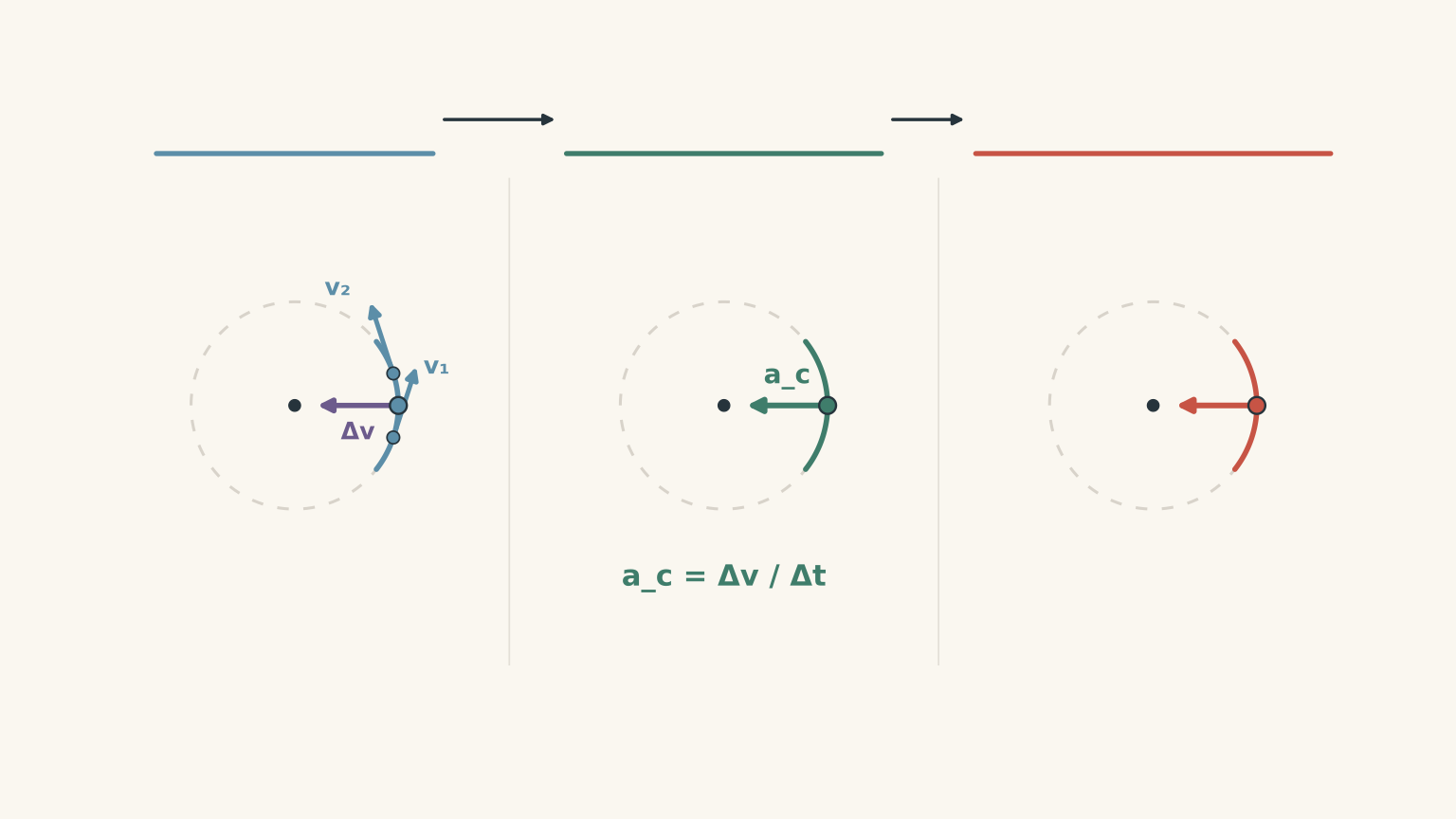
Velocity is a vector quantity. This means it describes both an object’s speed and its direction of motion.
As the bead moves around the circle, its direction changes continuously. Therefore, its velocity changes even though its speed remains constant.
(b) Directions of acceleration and resultant force
The acceleration points radially inwards, towards the centre of the circle. The resultant force also points inwards because the acceleration and net force have the same direction, as described by Newton’s second law.
Marking guide (4 marks)
- (a) 1 mark for identifying that velocity includes direction; 1 mark for stating that the direction changes.
- (b) 1 mark for identifying inward acceleration; 1 mark for identifying the inward resultant force.
Solution 2
(a) Calculate centripetal acceleration
Use
\[ a_c=\frac{v^2}{r} \]
Substitute the given values:
\[ \begin{aligned} a_c&=\frac{(3.0)^2}{1.5}\\ &=\frac{9.0}{1.5}\\ &=6.0\ \text{m/s}^2 \end{aligned} \]
The centripetal acceleration is \(6.0\ \text{m/s}^2\).
(b) Calculate the new acceleration
The speed is now \(6.0\ \text{m/s}\), with the same radius.
\[ \begin{aligned} a_c&=\frac{(6.0)^2}{1.5}\\ &=\frac{36}{1.5}\\ &=24\ \text{m/s}^2 \end{aligned} \]
Compare the new acceleration with the original:
\[ \frac{24}{6.0}=4 \]
The acceleration becomes four times as large.
This happens because centripetal acceleration is proportional to the square of speed when the radius is fixed. Doubling the speed multiplies the acceleration by \(2^2=4\), not by two.
Marking guide (5 marks)
- (a) 1 mark for the correct equation and substitution; 1 mark for \(6.0\ \text{m/s}^2\).
- (b) 1 mark for the correct substitution; 1 mark for \(24\ \text{m/s}^2\); 1 mark for identifying the factor of four and relating it to the squared speed.
Solution 3
(a) Calculate the net inward force
Use
\[ F_c=\frac{mv^2}{r} \]
Substitute the mass, speed, and radius:
\[ \begin{aligned} F_c&=\frac{0.80(5.0)^2}{2.0}\\ &=\frac{0.80\times25}{2.0}\\ &=10\ \text{N} \end{aligned} \]
The required net inward force has a magnitude of \(10\ \text{N}\).
(b) Calculate the new force
The mass increases to \(1.2\ \text{kg}\), but the speed and radius remain unchanged.
\[ \begin{aligned} F_c&=\frac{1.2(5.0)^2}{2.0}\\ &=15\ \text{N} \end{aligned} \]
The new net inward force is \(15\ \text{N}\).
At fixed speed and radius, the required force is directly proportional to mass. Increasing the mass from \(0.80\ \text{kg}\) to \(1.2\ \text{kg}\) increases the required force by a factor of \(1.5\).
Marking guide (5 marks)
- (a) 1 mark for the correct equation; 1 mark for correct substitution and calculation; 1 mark for \(10\ \text{N}\).
- (b) 1 mark for the correct calculation or proportional reasoning; 1 mark for \(15\ \text{N}\).
Solution 4
(a) Car on a level bend
Static friction between the tyres and road supplies the inward resultant force.
(b) Ball attached to a string
Tension in the string supplies the inward resultant force.
(c) Satellite in a circular orbit
Earth’s gravitational force supplies the inward resultant force.
(d) Why centripetal force is not an extra force
Centripetal force describes the net inward resultant required for circular motion. It is not a separate physical interaction that should be added to friction, tension, or gravity.
For example, if tension is the force providing the inward resultant, adding a second force called “centripetal force” would count the same effect twice.
Marking guide (4 marks)
- (a) 1 mark for static friction.
- (b) 1 mark for tension.
- (c) 1 mark for gravitational force.
- (d) 1 mark for explaining that centripetal force is the net inward resultant, not an additional force.
Solution 5
(a) Predict the path after the string breaks
The puck moves in a straight line tangent to the circular path at the point where the string breaks. Since its instantaneous velocity is directed due east, it moves in a straight line towards the east.
(b) What happens to the speed?
The puck’s speed remains constant under the stated assumptions.
(c) Explain using the resultant force
Once the string breaks, there is no horizontal resultant force. The vertical forces balance, so the total resultant force is zero.
By Newton’s first law, an object with zero resultant force maintains a constant velocity. The puck therefore continues in a straight line at constant speed.
The assumptions matter here. If another unbalanced force acted after the break, the puck would accelerate in response to that force. It does not automatically move radially outwards when the string breaks.
Marking guide (4 marks)
- (a) 1 mark for identifying a straight tangent path; 1 mark for identifying the eastward direction.
- (b) 1 mark for stating that speed remains constant.
- (c) 1 mark for explaining that the resultant force is zero and the puck consequently maintains constant velocity.
Solution 6
(a) Calculate the missing accelerations
For trial B:
\[ \begin{aligned} a_c&=\frac{v^2}{r}\\ &=\frac{(4.0)^2}{4.0}\\ &=4.0\ \text{m/s}^2 \end{aligned} \]
For trial C:
\[ \begin{aligned} a_c&=\frac{(4.0)^2}{2.0}\\ &=8.0\ \text{m/s}^2 \end{aligned} \]
The missing values are \(4.0\ \text{m/s}^2\) for trial B and \(8.0\ \text{m/s}^2\) for trial C.
(b) Describe the effect of halving the radius
Between trials A and B, the radius decreases from \(8.0\ \text{m}\) to \(4.0\ \text{m}\), while the speed remains at \(4.0\ \text{m/s}\).
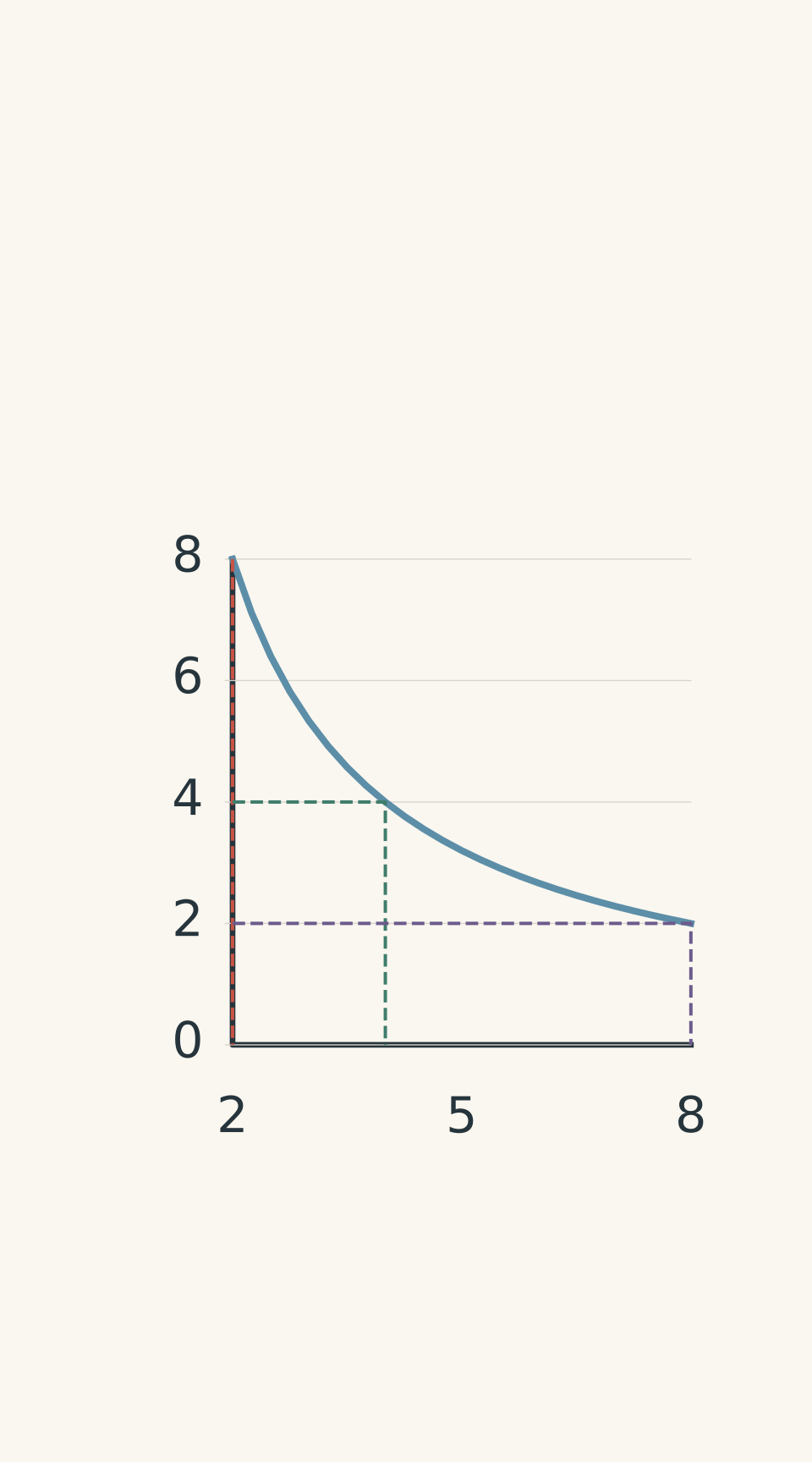
The acceleration increases from \(2.0\ \text{m/s}^2\) to \(4.0\ \text{m/s}^2\). Halving the radius therefore doubles the centripetal acceleration when speed is constant.
This follows from
\[ a_c=\frac{v^2}{r} \]
At fixed speed, centripetal acceleration is inversely proportional to radius.
- a_c = 16/r
- (2, 8)
- (4, 4)
- (8, 2)
(c) Calculate the net inward force in trial C
Use Newton’s second law:
\[ F_c=ma_c \]
The mass is \(0.50\ \text{kg}\), and the acceleration in trial C is \(8.0\ \text{m/s}^2\).
\[ \begin{aligned} F_c&=0.50\times8.0\\ &=4.0\ \text{N} \end{aligned} \]
The net inward force is \(4.0\ \text{N}\).
Marking guide (6 marks)
- (a) 1 mark for the correct acceleration in trial B; 1 mark for the correct acceleration in trial C, including units.
- (b) 1 mark for stating that acceleration doubles; 1 mark for supporting the statement with the trial values or the inverse relationship.
- (c) 1 mark for a valid force calculation; 1 mark for \(4.0\ \text{N}\).
Solution 7
(a) Calculate the centripetal acceleration
Use
\[ a_c=\frac{v^2}{r} \]
Substitute \(v=12\ \text{m/s}\) and \(r=40\ \text{m}\):
\[ \begin{aligned} a_c&=\frac{12^2}{40}\\ &=\frac{144}{40}\\ &=3.6\ \text{m/s}^2 \end{aligned} \]
The car’s centripetal acceleration is \(3.6\ \text{m/s}^2\).
(b) Calculate the required force and check the friction limit
The net inward force is
\[ F_c=ma_c \]
Substitute the values:
\[ \begin{aligned} F_c&=(1.2\times10^3)(3.6)\\ &=4.32\times10^3\ \text{N}\\ &=4.32\ \text{kN} \end{aligned} \]
To two significant figures, the required force is \(4.3\ \text{kN}\).
The maximum available friction is \(5.0\ \text{kN}\). Since \(4.3\ \text{kN}\) is less than \(5.0\ \text{kN}\), the available friction is sufficient for the car to maintain its circular motion at \(12\ \text{m/s}\), under the stated assumptions.
(c) Calculate the maximum speed
At the friction limit, the maximum available force supplies the required inward resultant:
\[ F_{\max}=\frac{mv_{\max}^2}{r} \]
Rearrange to make the maximum speed the subject:
\[ v_{\max}=\sqrt{\frac{F_{\max}r}{m}} \]
Convert \(5.0\ \text{kN}\) to newtons:
\[ 5.0\ \text{kN}=5.0\times10^3\ \text{N} \]
Substitute:
\[ \begin{aligned} v_{\max} &=\sqrt{\frac{(5.0\times10^3)(40)} {1.2\times10^3}}\\ &=\sqrt{166.7}\\ &\approx12.9\ \text{m/s} \end{aligned} \]
To two significant figures, the maximum speed is \(13\ \text{m/s}\).
This is the idealised threshold at which the required inward force reaches the stated maximum friction. Above that speed, the available friction would be insufficient under the model given.
Marking guide (6 marks)
- (a) 1 mark for the correct equation and substitution; 1 mark for \(3.6\ \text{m/s}^2\).
- (b) 1 mark for calculating the required force as approximately \(4.3\ \text{kN}\); 1 mark for comparing it with \(5.0\ \text{kN}\) and reaching the correct conclusion.
- (c) 1 mark for correctly rearranging the force equation; 1 mark for the maximum speed of approximately \(13\ \text{m/s}\), with units.
Solution 8
(a) Calculate each object’s centripetal acceleration
For object A:
\[ \begin{aligned} a_{c,A}&=\frac{v^2}{r}\\ &=\frac{(4.0)^2}{2.0}\\ &=8.0\ \text{m/s}^2 \end{aligned} \]
For object B:
\[ \begin{aligned} a_{c,B}&=\frac{(4.0)^2}{4.0}\\ &=4.0\ \text{m/s}^2 \end{aligned} \]
Object A has a centripetal acceleration of \(8.0\ \text{m/s}^2\), while object B has a centripetal acceleration of \(4.0\ \text{m/s}^2\).
(b) Calculate each object’s net inward force
For object A:
\[ \begin{aligned} F_{c,A}&=ma_{c,A}\\ &=0.50\times8.0\\ &=4.0\ \text{N} \end{aligned} \]
For object B:
\[ \begin{aligned} F_{c,B}&=ma_{c,B}\\ &=1.0\times4.0\\ &=4.0\ \text{N} \end{aligned} \]
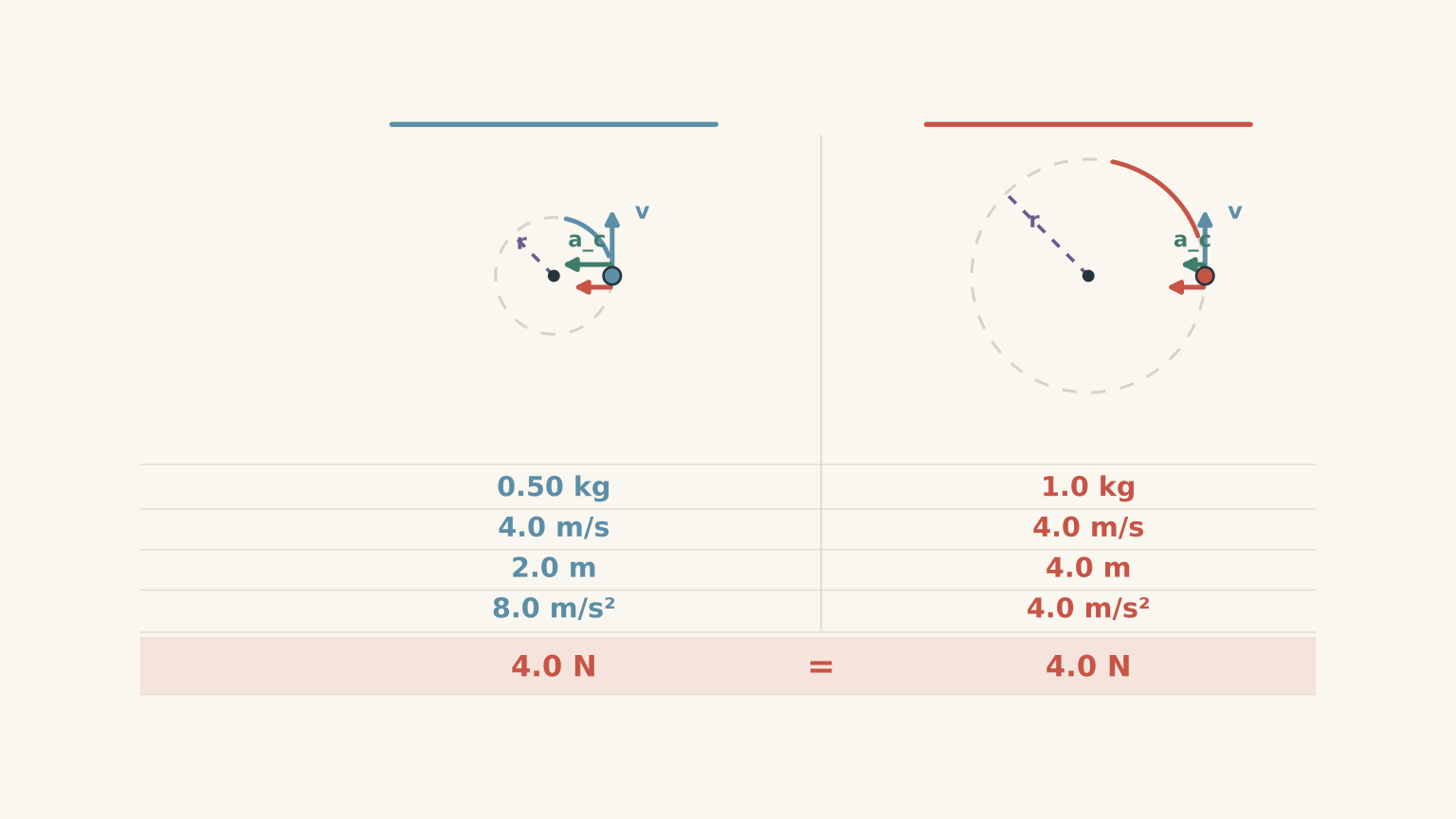
Both objects require a net inward force of \(4.0\ \text{N}\).
(c) Assess the student’s claim
The claim is incorrect. Object B does not require a greater net inward force; both objects require \(4.0\ \text{N}\).
Object B has twice the mass of object A, but it also moves in a circle with twice the radius at the same speed. Its centripetal acceleration is therefore half that of object A. These changes balance in the force relationship \(F_c=ma_c\), giving the same net inward force for both objects.
Marking guide (6 marks)
- (a) 1 mark for object A’s acceleration; 1 mark for object B’s acceleration, including units.
- (b) 1 mark for object A’s net inward force; 1 mark for object B’s net inward force, including units.
- (c) 1 mark for rejecting the claim and stating that the forces are equal; 1 mark for explaining that B’s doubled mass is balanced by its halved acceleration.
End of paper – 40 marks