
HSC Physics Practice Exam: Current, Voltage and Resistance
Test your understanding of current, voltage, and resistance with this original 40-mark NSW HSC Physics practice exam. Includes 60 minutes of exam-style questions, fully worked solutions, and a detailed marking guide.
This original tutorgum practice paper assesses the supplied Physics 2017 scope for current, voltage, and resistance foundations. It is a focused topic assessment for NSW Stage 6 Physics students, not a full-course mock exam. All questions, numerical data, and solutions are original. This is not an official, endorsed, past, or predicted NESA paper.
01Exam instructions
Suggested examination conditions
- Reading time: 5 minutes.
- Working time: 60 minutes.
- Total marks: 40.
- Questions: 5. All questions are compulsory.
Permitted equipment
- Scientific calculator.
- Ruler.
- Black or blue pen, pencil, and eraser.
No notes or formula sheet are required or permitted under these practice conditions.
Assessed topics
This paper covers the following content from the supplied Physics 2017 revision scope:
- Electric current as the rate of charge flow, using \(I=q/t\) for steady current.
- Charge carriers in metals and the difference between electron drift and conventional current.
- Potential difference as energy transferred per unit charge, using \(W=qV\).
- Qualitative changes in resistance with conductor length, cross-sectional area, and temperature.
Exclusions
This paper does not assess quantitative Ohm’s law calculations, resistivity calculations, electrical power, complex series and parallel circuit analysis, electromagnetic induction, or other Physics modules.
General instructions
- Answer every question.
- Show all working for calculations.
- Include appropriate units in numerical answers.
- Use appropriate significant figures.
- Unless otherwise stated, treat charge, potential difference, and energy values as magnitudes.
- Assume current is steady whenever the question states that it is steady.
- For comparisons between wires, assume they are made from the same material and are at the same temperature unless stated otherwise.
These are suggested practice conditions, not claims about current official NESA examination conditions.
02Questions
Question 1 (7 marks)
Electric current and charge flow
(a) Define electric current and state its SI unit. (2 marks)
(b) A steady current transfers 18 C of charge through a conductor in 6.0 s.
Calculate the current through the conductor. (2 marks)
(c) A second conductor carries a steady current of 0.40 A for 75 s.
Calculate the total charge passing through the conductor during this interval. (2 marks)
(d) A student describes electric current as “the amount of charge inside a wire”.
Identify the error in this description. (1 mark)
Question 2 (7 marks)
Electric current in metals
A metal test wire forms part of a closed circuit connected to a DC power supply. The positive supply terminal is on the left, and the negative supply terminal is on the right.
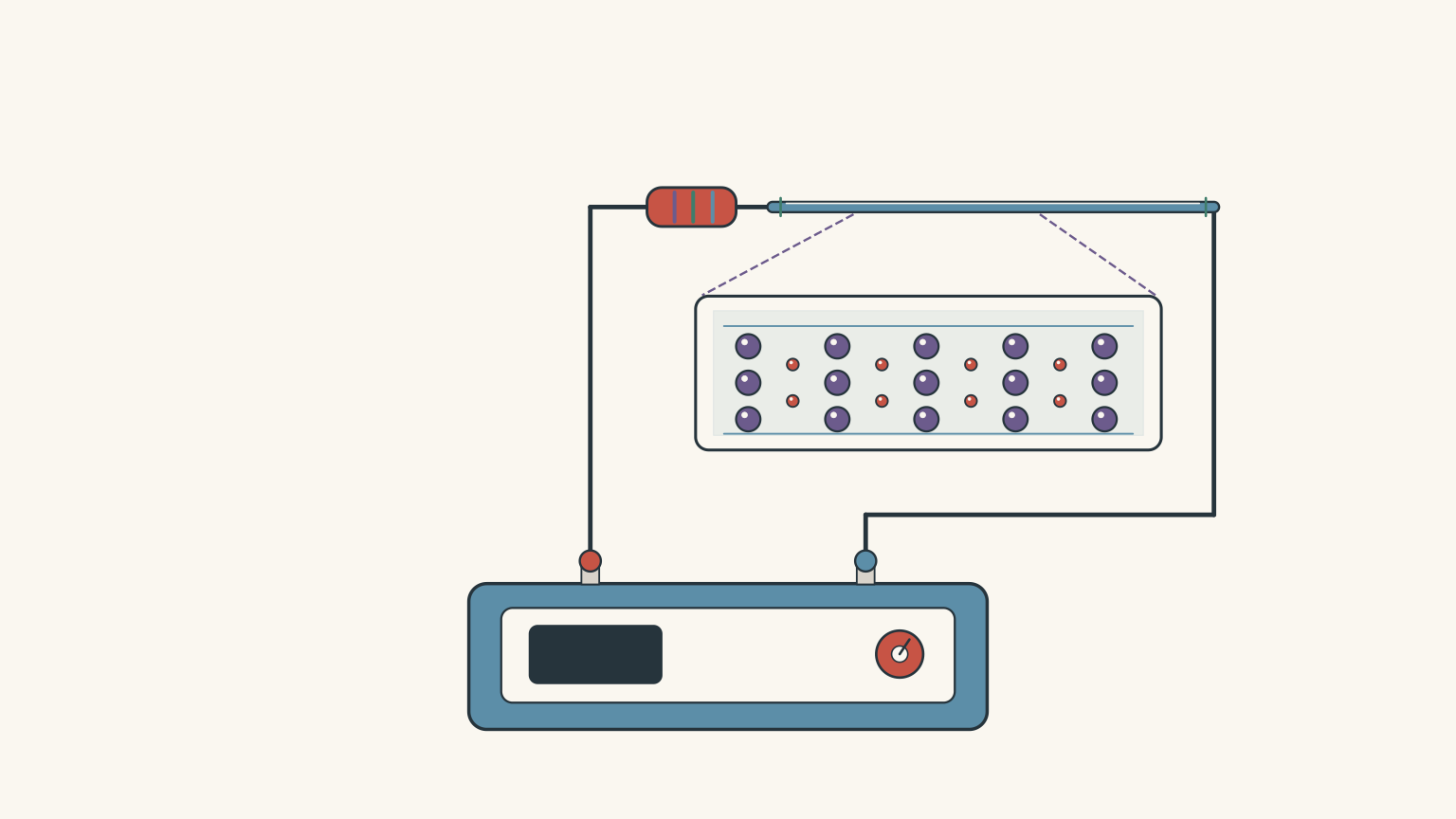
(a) Describe the charge carriers in a metal wire. Include the arrangement of the metal ions in your answer. (2 marks)
(b) On the diagram, draw two arrows:
- One showing the direction of electron drift.
- One showing the direction of conventional current.
Clearly label both arrows. (2 marks)
(c) Explain why electron drift and conventional current have opposite directions in a metal wire. (3 marks)
Question 3 (8 marks)
Potential difference and electrical work
(a) Define potential difference between two points in terms of energy transferred and electric charge. (2 marks)
(b) A charge of 3.0 C moves through a potential difference of 12 V.
Calculate the magnitude of the energy transferred. (2 marks)
(c) A total of 48 J of energy is transferred when 4.0 C of charge passes between two points.
Calculate the potential difference between the two points. (2 marks)
(d) A student makes the following statement:
“A potential difference of 12 V means that 12 J of energy is transferred in total.”
Explain why this statement is incomplete. (2 marks)
Question 4 (8 marks)
Factors affecting electrical resistance
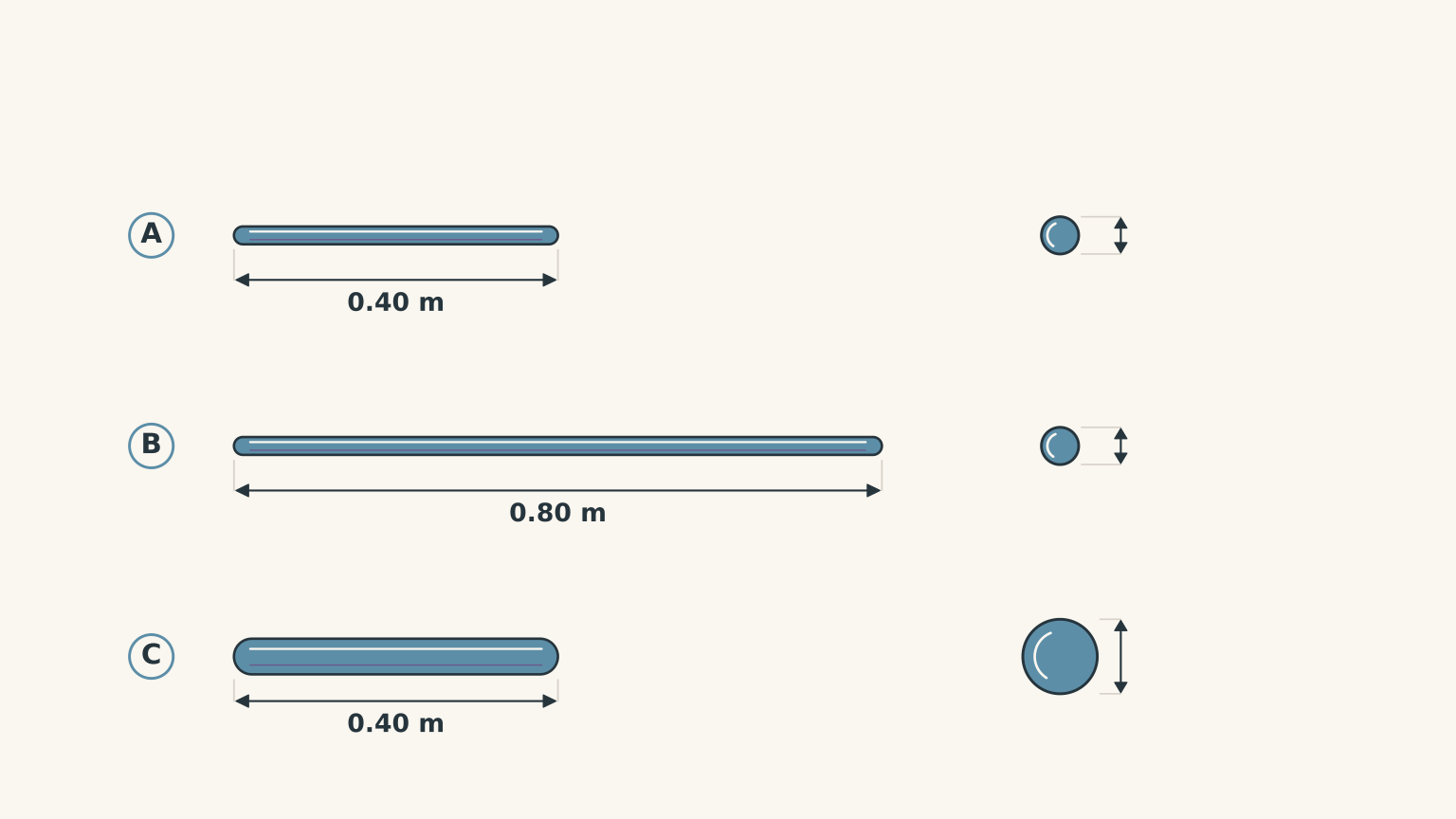
Three metal wires, A, B, and C, are shown below.
(a) State what electrical resistance describes in a conductor. (1 mark)
(b) Compare the resistance of wires A and B.
Identify which wire has the greater resistance and explain why. (2 marks)
(c) Compare the resistance of wires A and C.
Identify which wire has the lower resistance and explain why. (2 marks)
(d) A separate metal wire is heated while its length and diameter remain effectively constant.
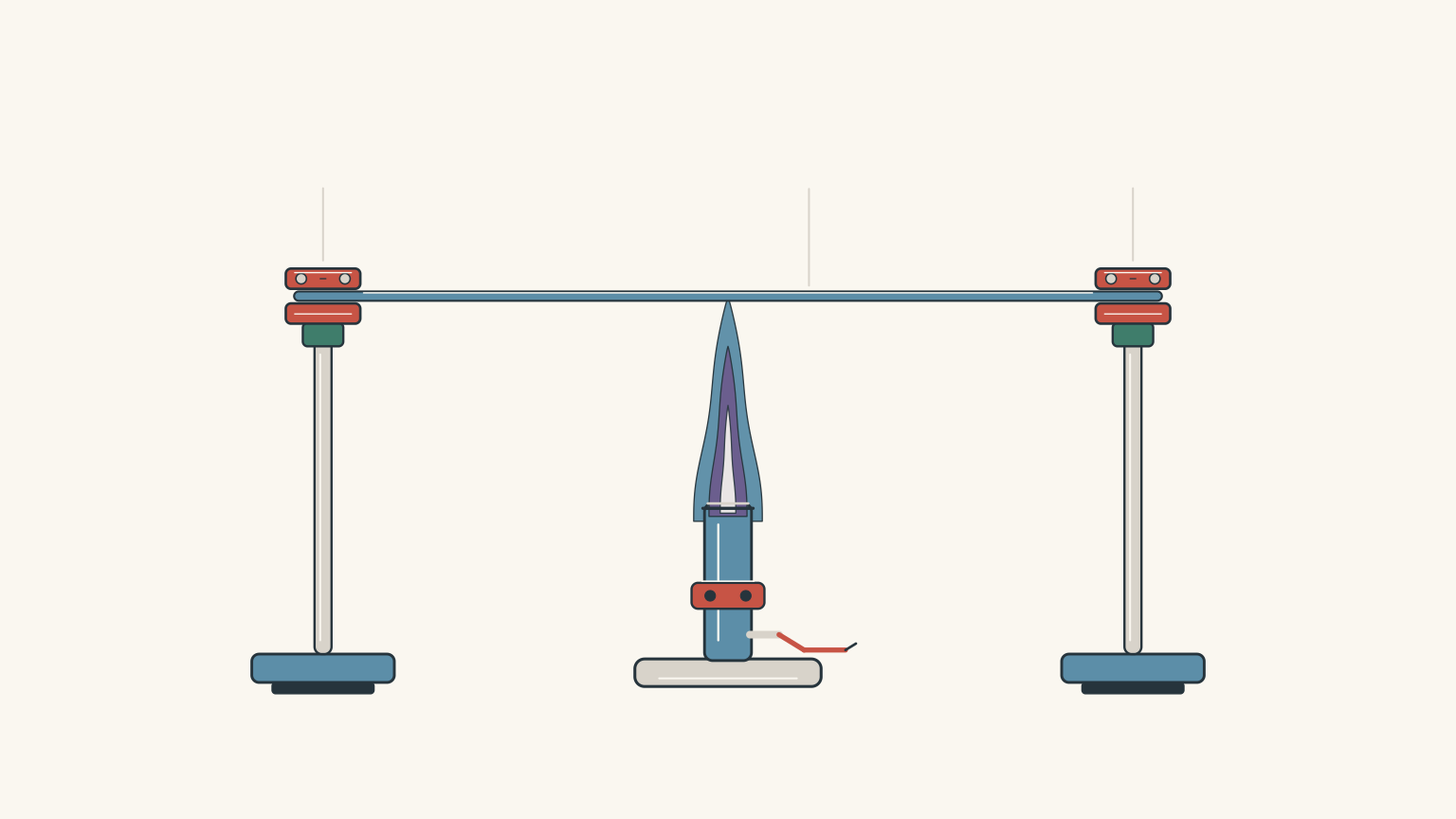
Predict the usual change in the resistance of the wire as its temperature increases. Explain this change using a particle model of the metal. (3 marks)
Question 5 (10 marks)
Combining current, charge, voltage, and energy
An electrical device operates in the simple circuit shown below.
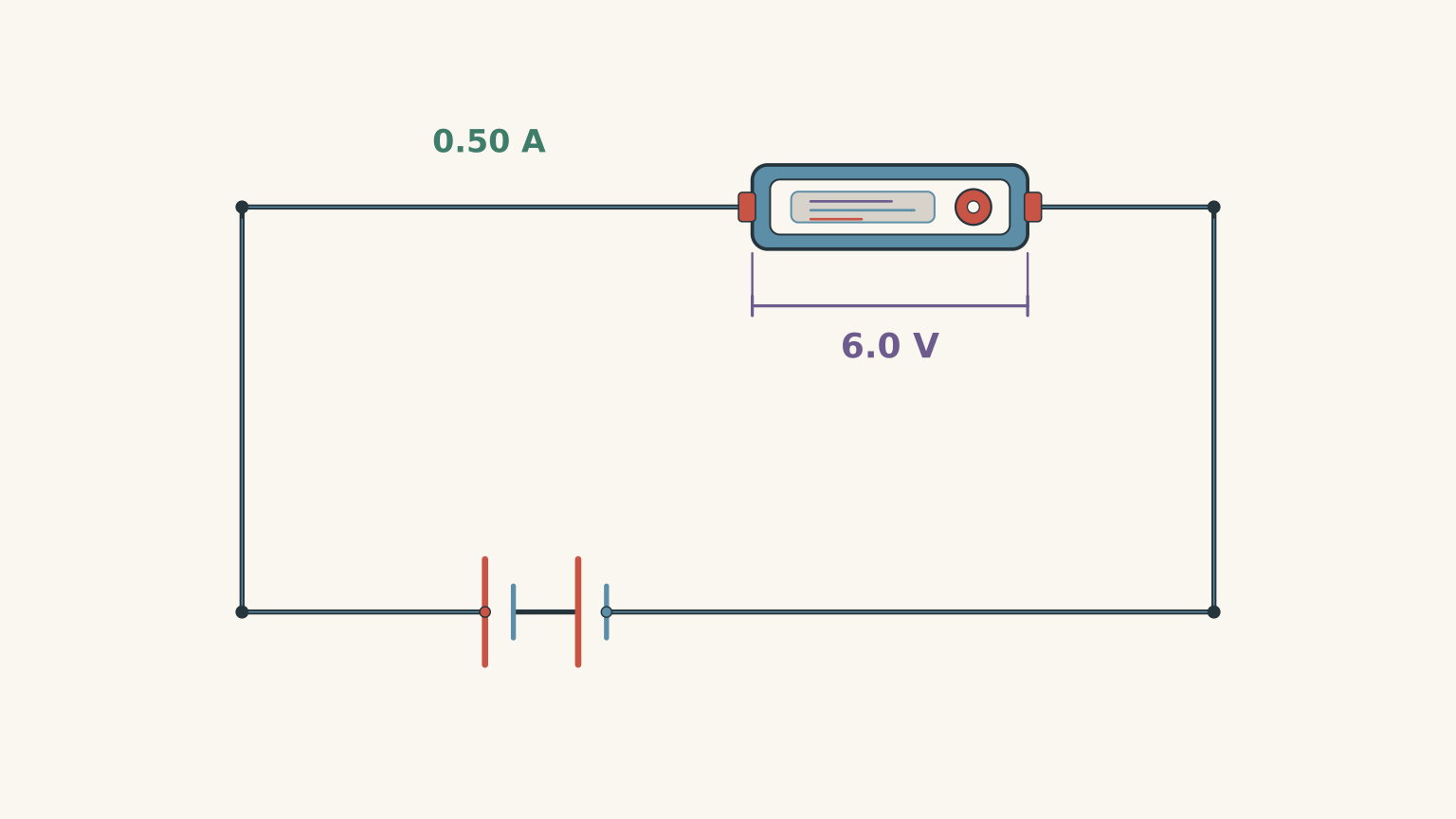
During the first operating interval, the current is steady at 0.50 A, and the potential difference across the device is 6.0 V. The device operates under these conditions for 2.0 minutes.
(a) Calculate the total charge passing through the device during this interval. (3 marks)
(b) Calculate the total energy transferred to the device during this interval. (2 marks)
(c) During a later operating interval, the same device carries the same steady current for 3.0 minutes. The potential difference remains 6.0 V.
Calculate the total energy transferred to the device during this later interval. (3 marks)
(d) Explain why more energy is transferred during the later interval, even though the current and potential difference remain unchanged. (2 marks)
03Worked solutions and marking guide
The following solutions show the expected reasoning and calculations. Marks are awarded for demonstrated understanding and correct working, not just the final numerical answer.
Accept mathematically equivalent methods and correctly rearranged equations. Where a calculation contains an arithmetic error, award available method marks if the correct physical relationship and substitution are demonstrated.
Solution 1
Electric current and charge flow
(a) Definition of electric current (2 marks)
Electric current is the rate at which electric charge passes a point in a conductor.
The relationship between current, charge, and time is:
\[ I=\frac{q}{t} \]
Where:
- \(I\) is electric current, measured in amperes (A).
- \(q\) is electric charge, measured in coulombs (C).
- \(t\) is time, measured in seconds (s).
The SI unit of current is the ampere (A).
One ampere means that one coulomb of charge passes a point every second.
Marking guide:
- 1 mark for defining current as the rate of charge flow.
- 1 mark for stating the ampere (A) as its SI unit.
(b) Calculating current (2 marks)
Given:
\[ q=18\ \mathrm{C} \]
\[ t=6.0\ \mathrm{s} \]
Using:
\[ I=\frac{q}{t} \]
Substitute the values:
\[ I=\frac{18}{6.0} \]
\[ \boxed{I=3.0\ \mathrm{A}} \]
The current is 3.0 A.
Marking guide:
- 1 mark for selecting and applying \(I=q/t\).
- 1 mark for the correct answer with units.
(c) Calculating charge (2 marks)
Given:
\[ I=0.40\ \mathrm{A} \]
\[ t=75\ \mathrm{s} \]
Rearrange the current equation to make charge the subject:
\[ q=It \]
Substitute:
\[ q=(0.40)(75) \]
\[ \boxed{q=30\ \mathrm{C}} \]
A total of 30 C of charge passes through the conductor.
Marking guide:
- 1 mark for correctly rearranging the relationship to \(q=It\) and substituting.
- 1 mark for the correct answer with units.
(d) Understanding current (1 mark)
The student’s description confuses the amount of charge with the rate of charge flow.
Current measures how much charge passes a particular point per second. It does not measure how much charge is stored inside the wire.
For example, two conductors could each have 10 C of charge pass through them, but over different time intervals. Their currents would therefore be different.
Marking guide:
- 1 mark for identifying that current is a rate of charge flow, rather than the total amount of charge.
Total: 7 marks
Solution 2
Electric current in metals
(a) Charge carriers in a metal (2 marks)
Metals contain two important types of charged particles:
- Positive metal ions occupy fixed positions in a regular lattice structure. They can vibrate around these positions but do not move freely through the metal.
- Delocalised electrons are free to move throughout the metal. These electrons act as the mobile charge carriers.
When a potential difference is applied across the wire, the mobile electrons develop a net drift in one direction.
Marking guide:
- 1 mark for identifying delocalised electrons as the mobile charge carriers.
- 1 mark for describing positive metal ions as occupying fixed lattice positions.
(b) Directions of electron drift and conventional current (2 marks)
The positive terminal is on the left, and the negative terminal is on the right.
The correct directions are:
- Electron drift: from right to left, towards the positive terminal.
- Conventional current: from left to right, towards the negative terminal.
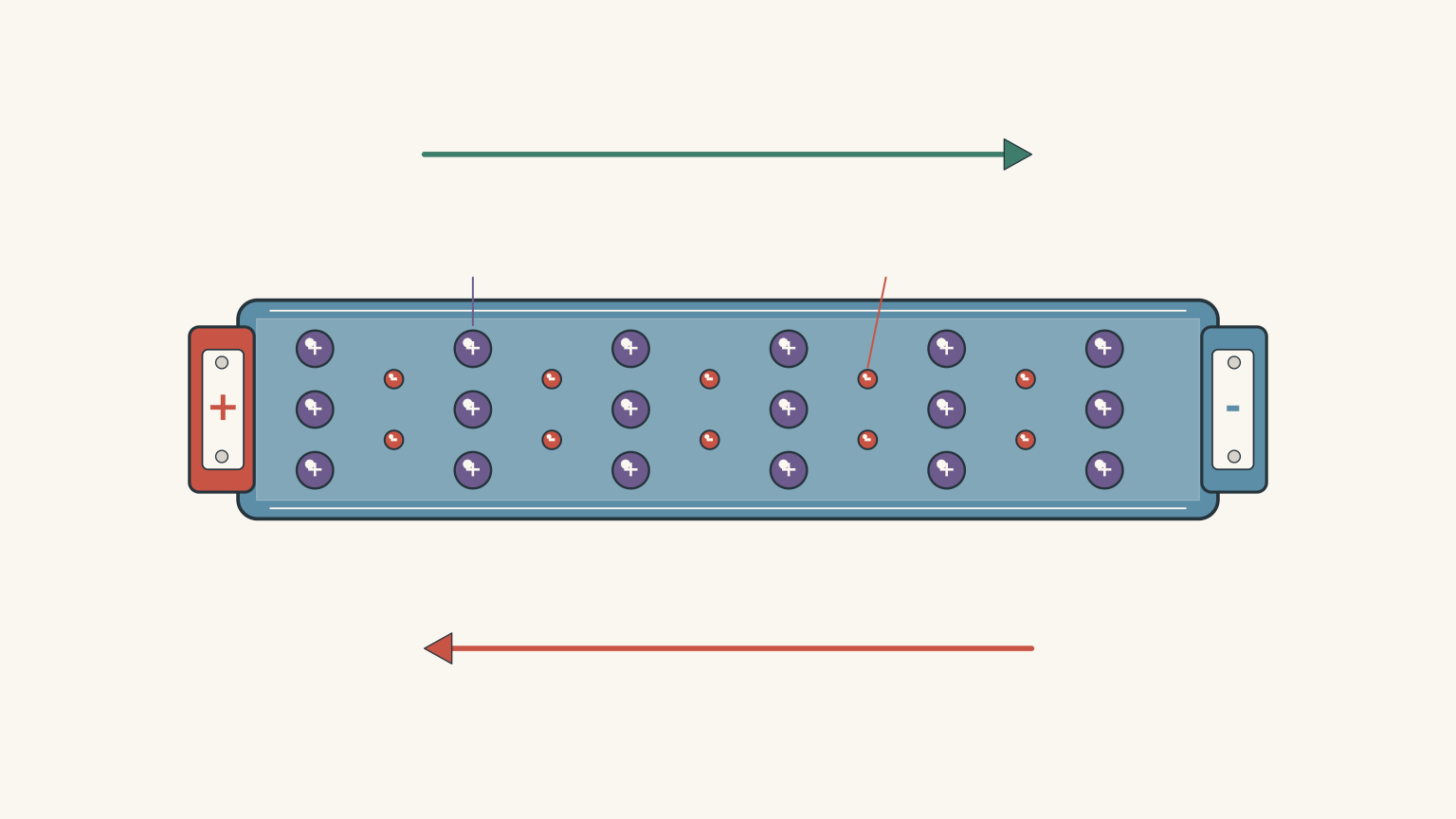
Marking guide:
- 1 mark for the correctly directed and labelled electron-drift arrow.
- 1 mark for the correctly directed and labelled conventional-current arrow.
(c) Why the directions are opposite (3 marks)
Conventional current is defined as the direction in which positive charge would flow.
However, the mobile charge carriers in a metal are negatively charged electrons.
A negative charge moves in the opposite direction to the direction defined for positive charge flow under the same electric field.
Therefore:
- Conventional current flows from the positive terminal towards the negative terminal through the external circuit.
- Electrons drift from the negative terminal towards the positive terminal.
The two directions are opposite because electrons have a negative charge.
Marking guide:
- 1 mark for explaining that conventional current is defined using the direction of positive charge flow.
- 1 mark for identifying electrons as negatively charged.
- 1 mark for linking the negative charge to the opposite direction of electron drift.
Total: 7 marks
Solution 3
Potential difference and electrical work
(a) Defining potential difference (2 marks)
Potential difference describes the energy transferred per unit charge between two points in an electrical circuit.
It tells us how much energy is transferred for each coulomb of charge that moves between those points.
The relationship is:
\[ V=\frac{W}{q} \]
Where:
- \(V\) is potential difference, measured in volts (V).
- \(W\) is energy transferred, measured in joules (J).
- \(q\) is charge, measured in coulombs (C).
One volt is equivalent to one joule per coulomb:
\[ 1\ \mathrm{V}=1\ \mathrm{J/C} \]
Marking guide:
- 1 mark for defining potential difference as energy transferred per unit charge.
- 1 mark for identifying the relationship with energy and charge, including the correct units.
(b) Calculating energy transferred (2 marks)
Given:
\[ q=3.0\ \mathrm{C} \]
\[ V=12\ \mathrm{V} \]
We use:
\[ W=qV \]
Substitute:
\[ W=(3.0)(12) \]
\[ \boxed{W=36\ \mathrm{J}} \]
The energy transferred is 36 J.
Marking guide:
- 1 mark for selecting \(W=qV\).
- 1 mark for the correct answer with units.
(c) Calculating potential difference (2 marks)
Given:
\[ W=48\ \mathrm{J} \]
\[ q=4.0\ \mathrm{C} \]
Start with:
\[ W=qV \]
Rearrange to make potential difference the subject:
\[ V=\frac{W}{q} \]
Substitute:
\[ V=\frac{48}{4.0} \]
\[ \boxed{V=12\ \mathrm{V}} \]
The potential difference is 12 V.
Marking guide:
- 1 mark for correctly rearranging the energy equation.
- 1 mark for the correct answer with units.
(d) Interpreting potential difference (2 marks)
The student’s statement is incomplete because potential difference describes energy transferred per coulomb, not the total energy transferred.
A potential difference of 12 V means that 12 J of energy is transferred for every coulomb of charge.
The total energy also depends on how much charge passes between the two points.
For example:
- 1 C of charge transfers 12 J.
- 2 C of charge transfers 24 J.
- 5 C of charge transfers 60 J.
The voltage alone does not determine the total energy without knowing the amount of charge transferred.
Marking guide:
- 1 mark for explaining that 12 V represents 12 J per coulomb.
- 1 mark for explaining that total energy depends on the total charge transferred.
Total: 8 marks
Solution 4
Factors affecting electrical resistance
(a) Definition of resistance (1 mark)
Electrical resistance describes how strongly a conductor opposes the flow of electric current.
A conductor with greater resistance provides greater opposition to charge flow.
Marking guide:
- 1 mark for identifying resistance as the opposition to electric current.
(b) Comparing wires A and B (2 marks)
Wire B has the greater resistance.
Both wires are made from the same material, have the same temperature, and have the same diameter.
However, wire B is twice as long as wire A.
A longer wire provides a longer path through the conducting material. Electrons experience more scattering interactions as they travel through this longer section.
This increases the opposition to charge flow.
Therefore:
\[ \boxed{R_B>R_A} \]
Marking guide:
- 1 mark for identifying wire B as having greater resistance.
- 1 mark for explaining that increasing wire length increases resistance when the other relevant factors remain constant.
(c) Comparing wires A and C (2 marks)
Wire C has the lower resistance.
Both wires have the same length, material, and temperature.
However, wire C has twice the diameter of wire A.
A larger diameter means a larger cross-sectional area. This provides more available pathways for charge carriers to move through the conductor.
The opposition to charge flow is therefore reduced.
Hence:
\[ \boxed{R_C<R_A} \]
Marking guide:
- 1 mark for identifying wire C as having lower resistance.
- 1 mark for explaining that a larger cross-sectional area reduces resistance when the other relevant factors remain constant.
(d) Effect of temperature on resistance (3 marks)
The resistance of a metal wire generally increases as its temperature increases.
To understand why, consider the metal’s structure.
Positive metal ions occupy fixed positions in a lattice. As the temperature increases, these ions vibrate more strongly around their equilibrium positions.
The mobile electrons travelling through the metal experience more frequent scattering from the vibrating lattice.
This makes it more difficult for the electrons to maintain their net drift through the conductor.
Consequently, the metal offers greater opposition to electric current, and its resistance increases.
The sequence is:
- Temperature increases.
- Positive metal ions vibrate more strongly.
- Mobile electrons experience more frequent scattering.
- Resistance increases.
Marking guide:
- 1 mark for predicting that resistance increases.
- 1 mark for explaining that the positive metal ions vibrate more strongly as temperature increases.
- 1 mark for linking increased scattering of electrons to greater resistance.
Total: 8 marks
Solution 5
Combining current, charge, voltage, and energy
This question combines the two main relationships assessed in this paper:
\[ I=\frac{q}{t} \]
and
\[ W=qV \]
The first relates current to charge flow over time. The second relates energy transfer to charge and potential difference.
(a) Calculating charge transferred (3 marks)
Given:
\[ I=0.50\ \mathrm{A} \]
\[ t=2.0\ \mathrm{min} \]
The first step is to convert the time into seconds because the SI unit of time in the current equation is seconds.
\[ t=2.0\times60 \]
\[ t=120\ \mathrm{s} \]
Now use:
\[ I=\frac{q}{t} \]
Rearrange:
\[ q=It \]
Substitute:
\[ q=(0.50)(120) \]
\[ \boxed{q=60\ \mathrm{C}} \]
A total of 60 C passes through the device.
Marking guide:
- 1 mark for correctly converting minutes into seconds.
- 1 mark for selecting and applying \(q=It\).
- 1 mark for the correct charge with units.
(b) Calculating energy transferred (2 marks)
From part (a):
\[ q=60\ \mathrm{C} \]
The potential difference is:
\[ V=6.0\ \mathrm{V} \]
Use:
\[ W=qV \]
Substitute:
\[ W=(60)(6.0) \]
\[ \boxed{W=360\ \mathrm{J}} \]
The device receives 360 J of energy during the first interval.
Marking guide:
- 1 mark for selecting and applying \(W=qV\).
- 1 mark for the correct answer with units.
(c) Calculating energy during the later interval (3 marks)
The later operating interval is 3.0 minutes.
The current and potential difference remain unchanged.
Given:
\[ I=0.50\ \mathrm{A} \]
\[ V=6.0\ \mathrm{V} \]
First, convert the new time into seconds:
\[ t=3.0\times60 \]
\[ t=180\ \mathrm{s} \]
Calculate the charge transferred:
\[ q=It \]
\[ q=(0.50)(180) \]
\[ q=90\ \mathrm{C} \]
Now calculate the energy transferred:
\[ W=qV \]
\[ W=(90)(6.0) \]
\[ \boxed{W=540\ \mathrm{J}} \]
The total energy transferred during the later interval is 540 J.
Marking guide:
- 1 mark for correctly converting the time and calculating the charge transferred.
- 1 mark for applying \(W=qV\).
- 1 mark for the correct energy with units.
Follow-through: If a candidate makes an arithmetic error when calculating charge but correctly applies the energy relationship using their calculated charge, award the appropriate method mark.
(d) Explaining the greater energy transfer (2 marks)
The later interval lasts longer, even though the current and potential difference remain unchanged.
Because the current is constant, the same amount of charge passes through the device every second.
A longer operating time therefore allows more total charge to pass through the device.
The potential difference is still 6.0 V, meaning that each coulomb transfers the same amount of energy.
Since more charge passes through the device, more total energy is transferred.
Marking guide:
- 1 mark for explaining that the longer time allows more total charge to pass at the same current.
- 1 mark for explaining that the same energy is transferred per coulomb, resulting in greater total energy.
Total: 10 marks
Final paper mark allocation
| Question | Topic | Marks |
|---|---|---|
| 1 | Electric current and charge flow | 7 |
| 2 | Current in metals | 7 |
| 3 | Potential difference and energy | 8 |
| 4 | Factors affecting resistance | 8 |
| 5 | Integrated current and energy calculations | 10 |
| Total | 40 |
End of paper.