
Current, Voltage and Resistance: HSC Physics Practice Exam
Test your understanding of current, voltage, electrical work, and resistance with this original 30-mark tutorgum HSC Physics practice paper. Includes timed exam conditions, six original questions, and fully worked solutions with a detailed marking guide.
This original tutorgum practice paper tests the foundations of current, potential difference, electrical work, and resistance in HSC Physics. It covers the supplied Physics 2025 syllabus scope only, with a mix of calculations, conceptual explanations, and interpretation of diagrams.
The paper is worth 30 marks and is designed to take 50 minutes, including reading time. Complete all questions before checking the worked solutions and marking guide.
01Exam instructions
Paper information
| Assessment detail | Information |
|---|---|
| Subject | HSC Physics |
| Syllabus edition | Physics 2025 |
| Assessment type | Original tutorgum practice paper |
| Total marks | 30 |
| Reading time | 5 minutes |
| Working time | 45 minutes |
| Total suggested time | 50 minutes |
This is an original tutorgum practice paper. It is not an official, endorsed, past, or predicted NESA examination paper.
Assessed topics
This paper assesses:
- AC and DC current.
- Electric current as the rate of charge flow, using steady current.
- Charge carriers in metals and the difference between electron flow and conventional current.
- Potential difference and electrical work, using \(W=qV\).
- Resistance and the effects of conductor length and cross-sectional area.
The paper does not assess Ohm’s law, resistivity calculations, electrical power, series and parallel circuit calculations, or other Physics modules.
Equipment and conventions
- A scientific calculator is permitted.
- You may use a pen, pencil, and ruler.
- No formula sheet is provided.
- Show your working for all calculations. An unsupported numerical answer may not receive full marks.
- Include appropriate units in numerical answers.
- Use sensible significant figures.
- Assume current is steady wherever a steady current is specified.
- Assume conductors are uniform. Where stated, conductors have the same material and temperature.
The following symbols and units are used throughout:
| Symbol | Physical quantity | SI unit |
|---|---|---|
| \(I\) | Electric current | Ampere (A) |
| \(q\) | Electric charge | Coulomb (C) |
| \(t\) | Time | Second (s) |
| \(V\) | Potential difference | Volt (V) |
| \(W\) | Electrical work | Joule (J) |
| \(R\) | Electrical resistance | Ohm (\(\Omega\)) |
| \(L\) | Conductor length | Metre (m) |
| \(A\) | Cross-sectional area | Square metre (\(\text{m}^2\)) |
All questions are compulsory.
02Questions
Question 1 (5 marks)
A steady electric current flows through a metal wire. A total charge of \(24.0\text{ C}\) passes a particular cross-section of the wire in \(8.0\text{ s}\).
(a) Calculate the electric current in the wire. (2 marks)
(b) Assuming the current remains unchanged, calculate the charge that passes the same cross-section in \(15.0\text{ s}\). (2 marks)
(c) State what a current of \(3.0\text{ A}\) means in terms of charge passing a cross-section of a conductor each second. (1 mark)
Question 2 (4 marks)
The following diagrams show the current in two different electrical circuits over time.
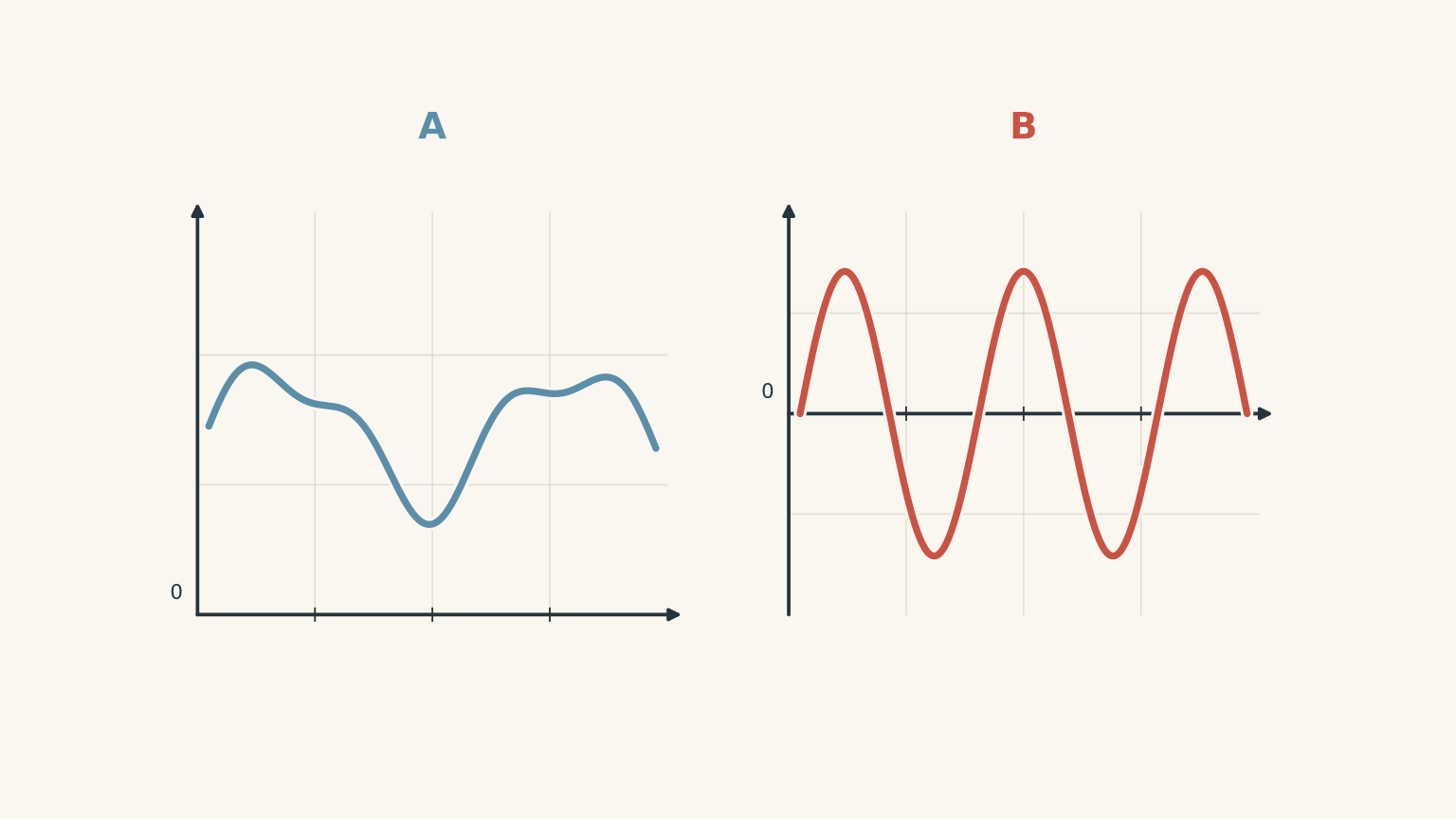
For both graphs, positive and negative current represent opposite directions of charge flow.
(a) Identify whether the current in circuit A is AC or DC. Justify your answer using the information in the graph. (2 marks)
(b) Identify whether the current in circuit B is AC or DC. Justify your answer using the information in the graph. (2 marks)
Question 3 (5 marks)
A battery is connected to a lamp using metal wires to form a complete electrical circuit.
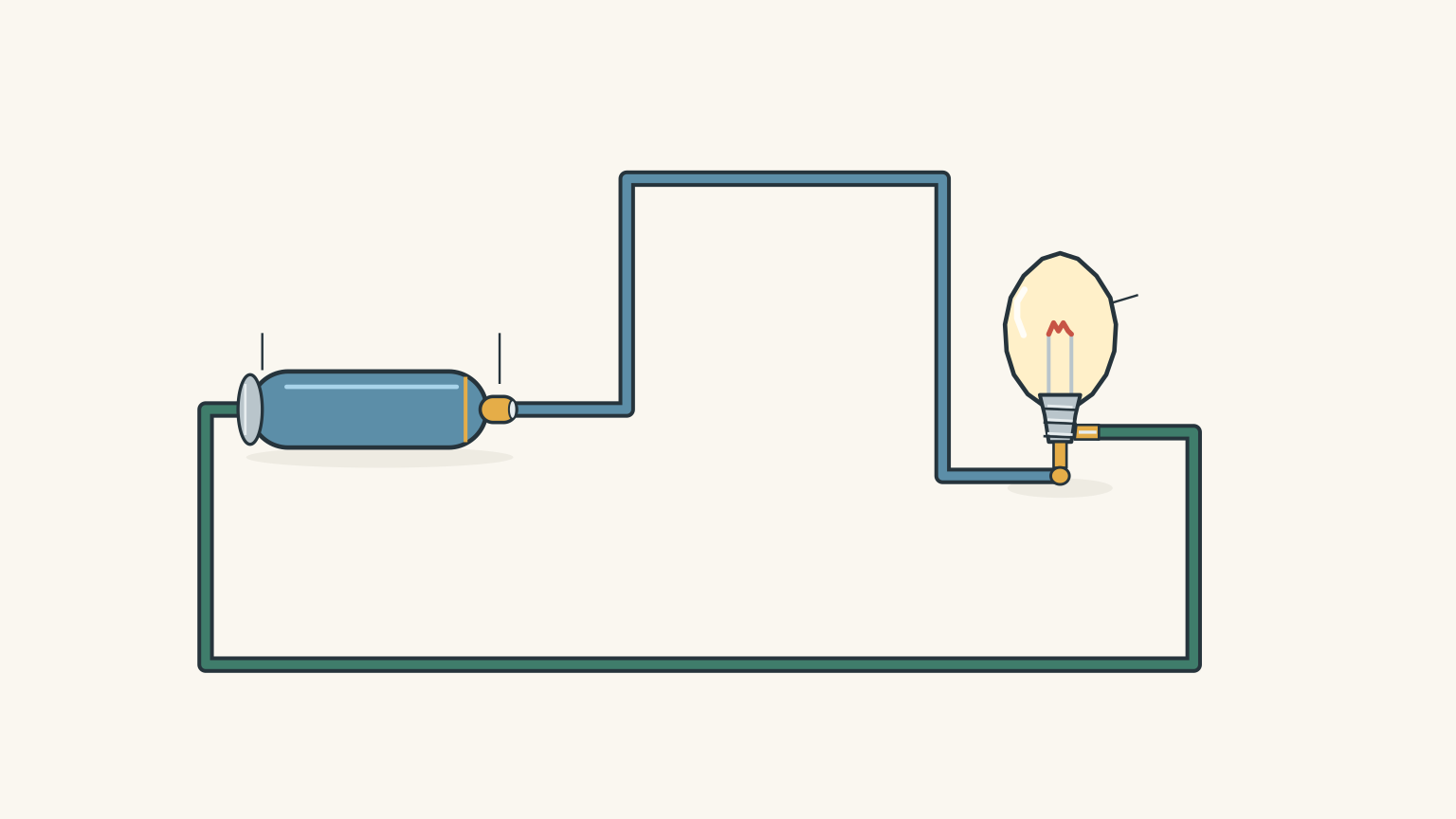
(a) Identify the mobile charge carriers responsible for electric current in the metal wires. (1 mark)
(b) State the direction of electron drift through the external metallic wires, relative to the battery terminals. (1 mark)
(c) State the direction of conventional current through the external circuit, relative to the battery terminals. (1 mark)
(d) Explain why electron flow and conventional current have opposite directions in a metallic conductor. (2 marks)
Question 4 (6 marks)
Potential difference describes the electrical energy transferred per unit charge as charge moves between two points in a circuit.
(a) A charge of \(2.5\text{ C}\) moves through a component with a potential difference of \(12\text{ V}\).
Calculate the electrical work transferred to the charge. (2 marks)
(b) A component transfers \(18\text{ J}\) of electrical work to a charge of \(3.0\text{ C}\).
Calculate the potential difference across the component. (2 marks)
(c) Explain what a potential difference of \(12\text{ V}\) means in terms of energy transferred per unit charge. (2 marks)
Question 5 (5 marks)
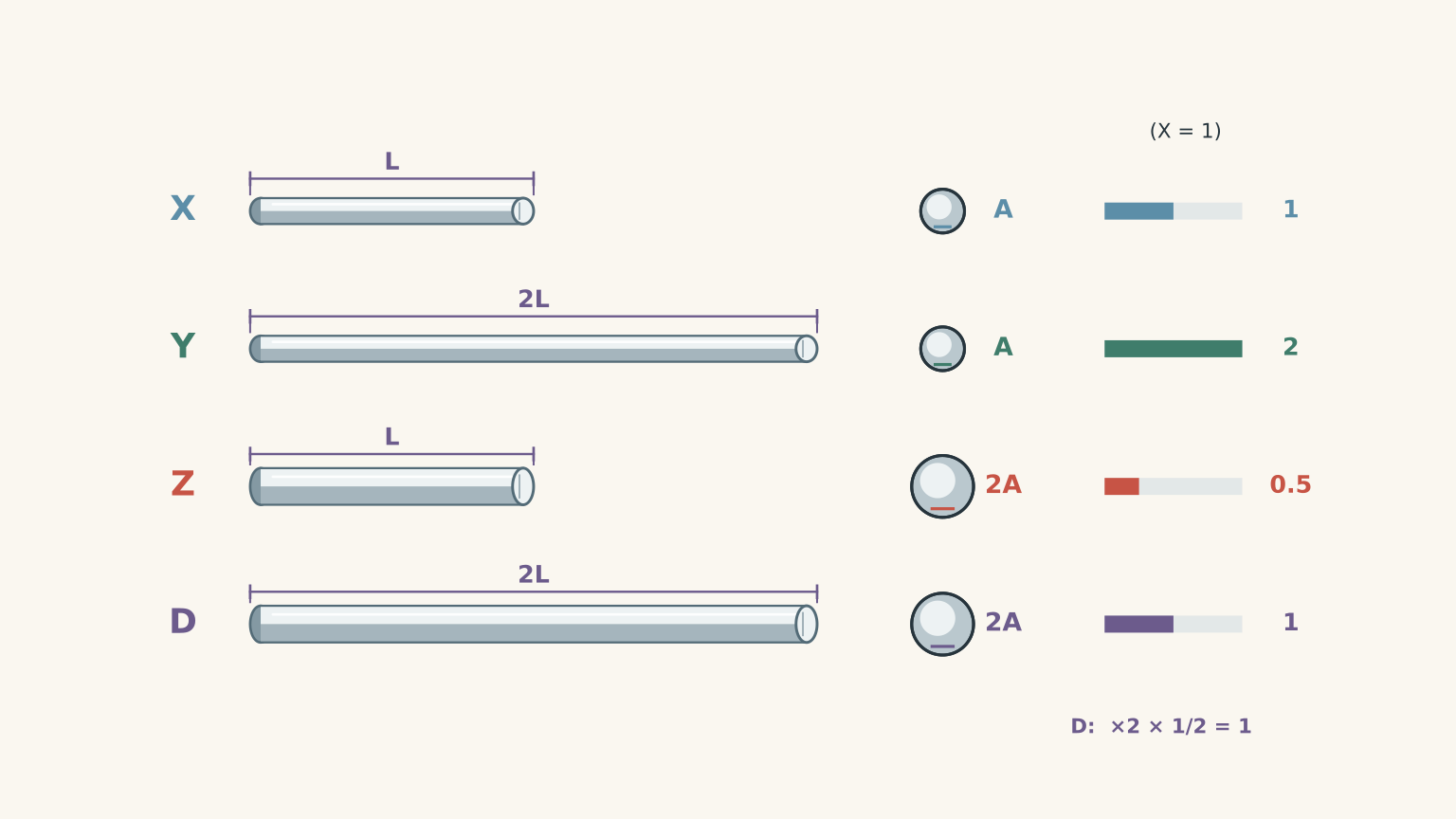
Three uniform metal wires, X, Y, and Z, are made from the same material and are maintained at the same temperature.
Their dimensions are shown below.
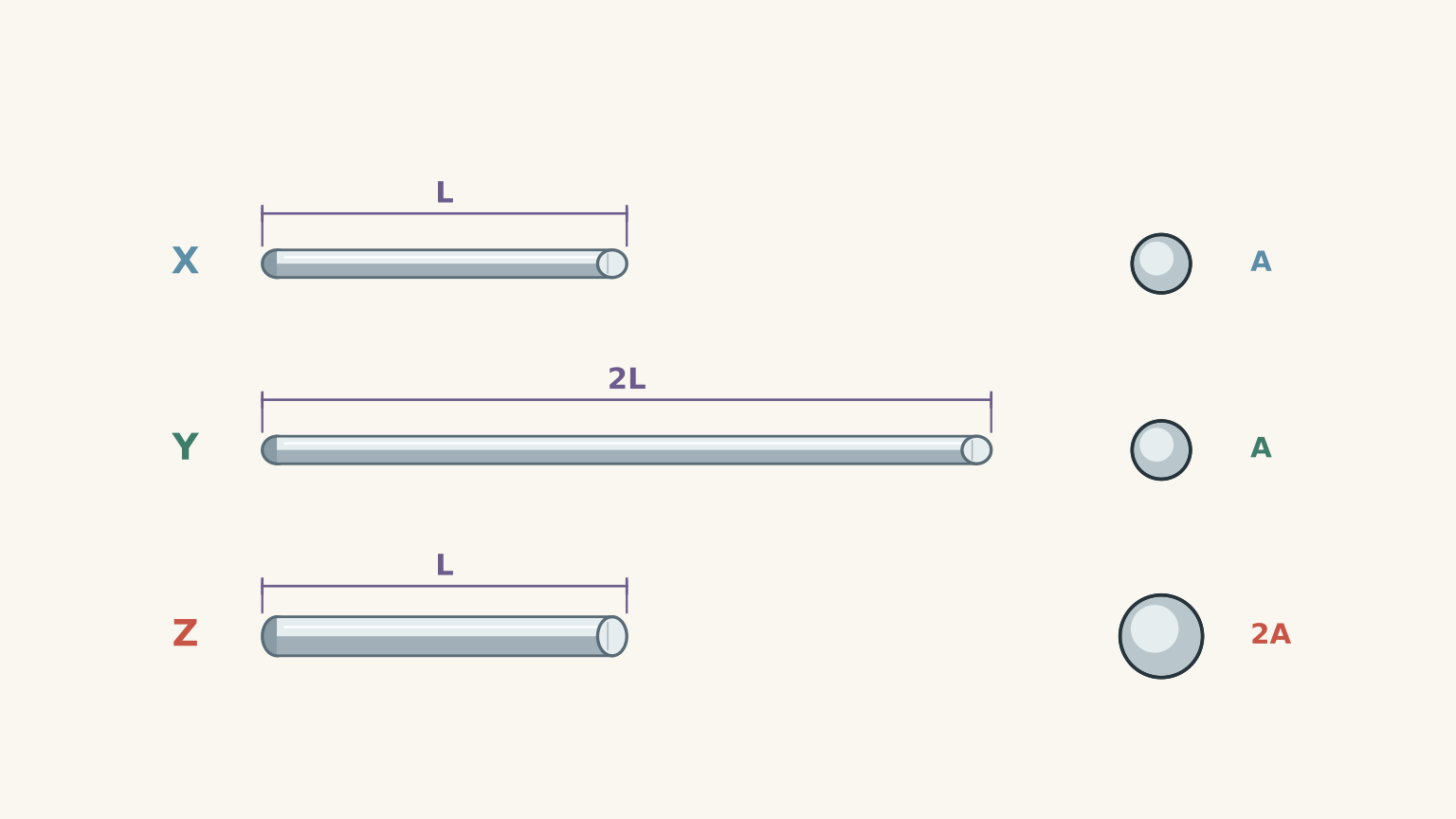
| Wire | Length | Cross-sectional area |
|---|---|---|
| X | \(L\) | \(A\) |
| Y | \(2L\) | \(A\) |
| Z | \(L\) | \(2A\) |
(a) Compare the resistance of wire Y with the resistance of wire X. (1 mark)
(b) Compare the resistance of wire Z with the resistance of wire X. (1 mark)
(c) A fourth wire, D, is made from the same material at the same temperature. It has a length of \(2L\) and a cross-sectional area of \(2A\).
Predict the resistance of wire D relative to wire X. Explain your reasoning using the effects of conductor length and cross-sectional area. (3 marks)
Question 6 (5 marks)
A component operates at a constant potential difference of \(6.0\text{ V}\). A steady current of \(0.30\text{ A}\) flows through the component for \(20.0\text{ s}\).
(a) Calculate the total charge passing through the component during this time. (2 marks)
(b) Calculate the electrical work transferred to this charge. (2 marks)
(c) If the operating time is doubled while the current and potential difference remain constant, state how the total electrical work transferred changes. (1 mark)
03Worked solutions and marking guide
The solutions below show the expected reasoning, calculations, and units. Each question includes a suggested marking breakdown.
For marking purposes, mathematically equivalent methods are acceptable. Follow-through marks should be awarded where a student correctly applies a method using an earlier incorrect numerical result.
Solution 1
(a) Calculate the electric current.
Electric current is the rate at which electric charge passes a cross-section of a conductor.
For steady current:
\[ I=\frac{q}{t} \]
Where:
- \(I\) is current in amperes (A).
- \(q\) is charge in coulombs (C).
- \(t\) is time in seconds (s).
Substitute the given values:
\[ \begin{aligned} I&=\frac{24.0}{8.0}\\ &=3.0\text{ A} \end{aligned} \]
Answer: \(3.0\text{ A}\).
Marking breakdown:
- Correct relationship, \(I=q/t\): 1 mark.
- Correct substitution and answer with unit: 1 mark.
(b) Calculate the charge passing through the wire in 15.0 seconds.
Rearrange the current equation:
\[ q=It \]
The current remains \(3.0\text{ A}\), so:
\[ \begin{aligned} q&=3.0\times15.0\\ &=45\text{ C} \end{aligned} \]
Answer: \(45\text{ C}\).
Marking breakdown:
- Correct relationship, \(q=It\): 1 mark.
- Correct substitution and answer with unit: 1 mark.
(c) Interpret a current of 3.0 A.
A current of \(3.0\text{ A}\) means that \(3.0\text{ C}\) of electric charge passes a particular cross-section of the conductor every second.
Remember that an ampere is equivalent to one coulomb per second:
\[ 1\text{ A}=1\text{ C s}^{-1} \]
Marking breakdown:
- States that \(3.0\text{ C}\) passes each second: 1 mark.
Total: 5 marks.
Solution 2
(a) Identify the current in circuit A.
Circuit A has DC (direct current).
The current remains positive throughout the time shown. Its magnitude changes, but its direction does not reverse.
This is the important distinction: DC does not have to maintain a perfectly constant magnitude. Its defining feature is that the current flows in one direction.
Marking breakdown:
- Correctly identifies DC: 1 mark.
- Explains that the current does not reverse direction: 1 mark.
(b) Identify the current in circuit B.
Circuit B has AC (alternating current).
The current repeatedly changes sign, moving between positive and negative values. This represents a repeated reversal in the direction of charge flow.
Marking breakdown:
- Correctly identifies AC: 1 mark.
- Explains that the current repeatedly reverses direction: 1 mark.
Total: 4 marks.
Solution 3
(a) Identify the mobile charge carriers in metal wires.
The mobile charge carriers in metals are electrons.
Metal atoms have electrons that are able to move through the metallic structure. These mobile electrons are responsible for electrical conduction.
Marking breakdown:
- Identifies electrons: 1 mark.
(b) State the direction of electron drift.
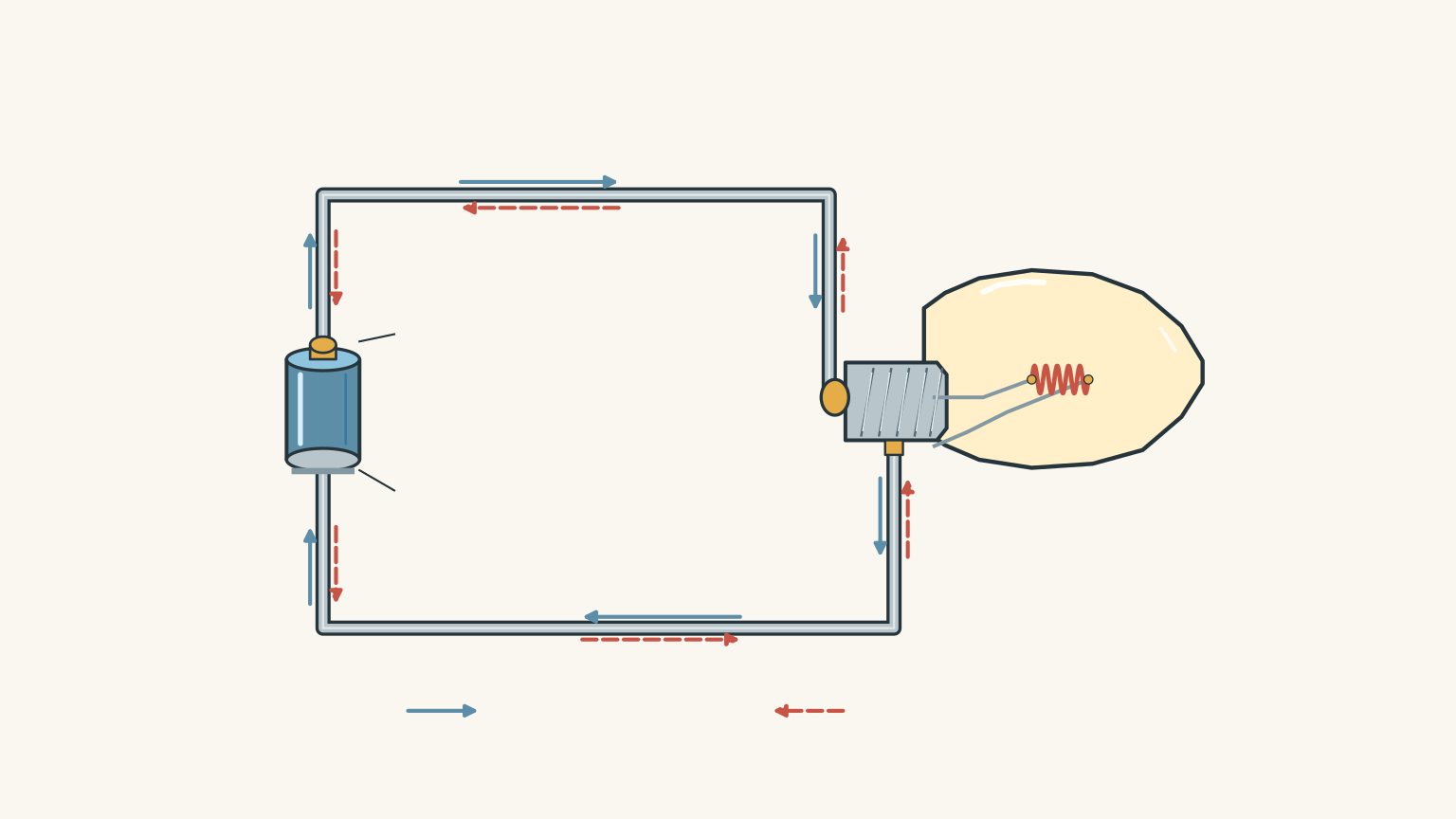
Electrons drift through the external metallic wires from the battery’s negative terminal towards its positive terminal.
Remember that electrons carry negative charge.
Marking breakdown:
- Correctly identifies the direction as negative to positive: 1 mark.
(c) State the direction of conventional current.
Conventional current flows through the external circuit from the battery’s positive terminal towards its negative terminal.
Marking breakdown:
- Correctly identifies the direction as positive to negative: 1 mark.
(d) Explain why the two directions are opposite.
Conventional current is defined as the direction in which positive charge would move.
Electrons have negative charge, so their movement is opposite to the direction that positive charges would move under the same electric field.
Therefore, conventional current and electron drift have opposite directions in a metal conductor.
Marking breakdown:
- Explains that conventional current represents the direction of positive charge movement: 1 mark.
- Explains that negatively charged electrons move in the opposite direction: 1 mark.
Total: 5 marks.
Solution 4
(a) Calculate the electrical work transferred.
The relationship between electrical work, charge, and potential difference is:
\[ W=qV \]
Where:
- \(W\) is electrical work in joules (J).
- \(q\) is charge in coulombs (C).
- \(V\) is potential difference in volts (V).
Substitute the values:
\[ \begin{aligned} W&=2.5\times12\\ &=30\text{ J} \end{aligned} \]
Answer: \(30\text{ J}\).
Marking breakdown:
- Correctly identifies \(W=qV\): 1 mark.
- Correct substitution and answer with unit: 1 mark.
(b) Calculate the potential difference.
Start with:
\[ W=qV \]
Rearrange to make potential difference the subject:
\[ V=\frac{W}{q} \]
Substitute the given values:
\[ \begin{aligned} V&=\frac{18}{3.0}\\ &=6.0\text{ V} \end{aligned} \]
Answer: \(6.0\text{ V}\).
Marking breakdown:
- Correct rearrangement, \(V=W/q\): 1 mark.
- Correct substitution and answer with unit: 1 mark.
(c) Explain the meaning of a potential difference of 12 V.
Potential difference measures the electrical energy transferred per unit charge.
One volt is equivalent to one joule per coulomb:
\[ 1\text{ V}=1\text{ J C}^{-1} \]
Therefore:
\[ 12\text{ V}=12\text{ J C}^{-1} \]
This means that each coulomb of charge passing through the component is associated with 12 joules of electrical energy transferred.
Marking breakdown:
- Identifies potential difference as energy transferred per unit charge: 1 mark.
- Correctly interprets \(12\text{ V}\) as \(12\text{ J}\) per coulomb: 1 mark.
Total: 6 marks.
Solution 5
(a) Compare the resistance of wires Y and X.
Wire Y has twice the length of wire X, while both have the same cross-sectional area.
For conductors of the same material and temperature, increasing the length increases resistance proportionally.
Therefore:
\[ R_Y=2R_X \]
Answer: Wire Y has twice the resistance of wire X.
Marking breakdown:
- Correctly identifies that \(R_Y=2R_X\): 1 mark.
(b) Compare the resistance of wires Z and X.
Wire Z has the same length as wire X, but twice the cross-sectional area.
Increasing the cross-sectional area decreases resistance.
Therefore:
\[ R_Z=\frac{1}{2}R_X \]
Answer: Wire Z has half the resistance of wire X.
Marking breakdown:
- Correctly identifies that \(R_Z=\frac{1}{2}R_X\): 1 mark.
(c) Predict the resistance of wire D relative to wire X.
Wire D has twice the length and twice the cross-sectional area of wire X.
Two effects occur:
- Doubling the length increases resistance by a factor of two.
- Doubling the cross-sectional area decreases resistance by a factor of two.
These effects cancel each other.
For the same material and temperature, the geometric relationship can be expressed as:
\[ R\propto\frac{L}{A} \]
Comparing D with X:
\[ \begin{aligned} \frac{R_D}{R_X} &=\frac{2L}{L}\times\frac{A}{2A}\\ &=2\times\frac{1}{2}\\ &=1 \end{aligned} \]
Therefore:
\[ R_D=R_X \]
Answer: Wire D has the same resistance as wire X.
Marking breakdown:
- Identifies that doubling length doubles resistance: 1 mark.
- Identifies that doubling cross-sectional area halves resistance: 1 mark.
- Combines both effects correctly and concludes \(R_D=R_X\): 1 mark.
Total: 5 marks.
Solution 6
(a) Calculate the total charge transferred.
Use the relationship between current, charge, and time:
\[ I=\frac{q}{t} \]
Rearrange:
\[ q=It \]
Substitute the given values:
\[ \begin{aligned} q&=0.30\times20.0\\ &=6.0\text{ C} \end{aligned} \]
Answer: \(6.0\text{ C}\).
Marking breakdown:
- Correct relationship, \(q=It\): 1 mark.
- Correct substitution and answer with unit: 1 mark.
(b) Calculate the electrical work transferred.
Use:
\[ W=qV \]
From part (a):
\[ q=6.0\text{ C} \]
The potential difference is:
\[ V=6.0\text{ V} \]
Substitute:
\[ \begin{aligned} W&=6.0\times6.0\\ &=36\text{ J} \end{aligned} \]
Answer: \(36\text{ J}\).
Marking breakdown:
- Correct relationship, \(W=qV\): 1 mark.
- Correct substitution and answer with unit: 1 mark.
(c) Determine how the electrical work changes when operating time doubles.
The current remains constant.
Since:
\[ q=It \]
Doubling the operating time doubles the total charge transferred.
The potential difference also remains constant, so:
\[ W=qV \]
Doubling the charge while maintaining the same potential difference doubles the electrical work.
Therefore, the electrical work transferred doubles.
Marking breakdown:
- Correctly states that the electrical work doubles: 1 mark.
Total: 5 marks.
04Final mark summary
| Question | Assessed content | Marks |
|---|---|---|
| 1 | Current as charge flow rate | 5 |
| 2 | AC and DC current | 4 |
| 3 | Charge carriers and conventional current | 5 |
| 4 | Potential difference and electrical work | 6 |
| 5 | Resistance and conductor geometry | 5 |
| 6 | Combined current, charge, and electrical work | 5 |
| Total | 30 |
05Key concepts to review after the exam
If you struggled with particular questions, use this table to identify what needs more revision.
| If you struggled with… | Revisit this concept |
|---|---|
| Question 1 | Current is the rate of charge flow. Practise rearranging \(I=q/t\). |
| Question 2 | AC reverses direction, whereas DC maintains one direction. |
| Question 3 | Electrons are negatively charged, so electron drift opposes conventional current. |
| Question 4 | Potential difference is energy transferred per unit charge. Practise rearranging \(W=qV\). |
| Question 5 | Resistance increases with conductor length and decreases with cross-sectional area. |
| Question 6 | Combine \(q=It\) and \(W=qV\) to solve multi-step electrical questions. |
A useful final check is whether you can explain each relationship in words, not just substitute numbers into an equation. HSC Physics questions often test whether you understand what a physical quantity actually represents, rather than whether you can remember a formula.