
HSC Physics Practice Exam: Electric Potential and Particle Motion
Test your understanding of electric potential and charged-particle motion with this original 50-mark tutorgum Physics practice exam. Includes timed assessment conditions, five exam-style questions, complete worked solutions, and a detailed marking guide.
This original tutorgum practice paper assesses electric potential and charged-particle motion within the supplied Physics 2025 syllabus scope. It covers uniform electric fields between parallel plates, potential difference, electric potential energy, work, and the motion of electrons and protons in electric fields.
It is a focused topic assessment, not a full-course HSC Physics mock exam. All questions and worked solutions are original. This is not an official, endorsed, past, or predicted NESA paper.
01Exam instructions
| Assessment detail | Conditions |
|---|---|
| Reading time | 5 minutes |
| Working time | 75 minutes |
| Total marks | 50 |
| Equipment | Scientific calculator, ruler, pen and pencil |
| Suggested conditions | Closed book; no notes or internet |
Assessed syllabus scope
This paper assesses:
- Electric field strength and potential difference using \(E=V/d\) for uniform fields.
- Changes in electric potential energy when charged particles move through electric fields.
- Work done by an electric field.
- Electric force and acceleration of charged particles in uniform electric fields.
- Charged-particle trajectories, including motion perpendicular to an electric field.
- Approximately uniform electric fields between parallel plates and the effects of fringing fields near plate edges.
Other syllabus modules, magnetic fields, and circuit analysis are excluded.
Constants
Use the following values throughout the paper:
| Constant | Value |
|---|---|
| Elementary charge magnitude, \(e\) | \(1.60\times10^{-19}\ \mathrm{C}\) |
| Electron mass, \(m_e\) | \(9.11\times10^{-31}\ \mathrm{kg}\) |
| Proton mass, \(m_p\) | \(1.67\times10^{-27}\ \mathrm{kg}\) |
General instructions
- Attempt every question.
- Show all working for calculations. Answers without working may not receive full marks.
- Include appropriate units and directions in numerical answers.
- Unless otherwise stated, give final answers to two significant figures.
- For potential differences, use final potential minus initial potential.
- Ignore gravitational effects and air resistance. Assume non-relativistic particle speeds.
- Treat the field between parallel plates as uniform, except when a question specifically asks about edge effects.
02Questions
Question 1 (10 marks)
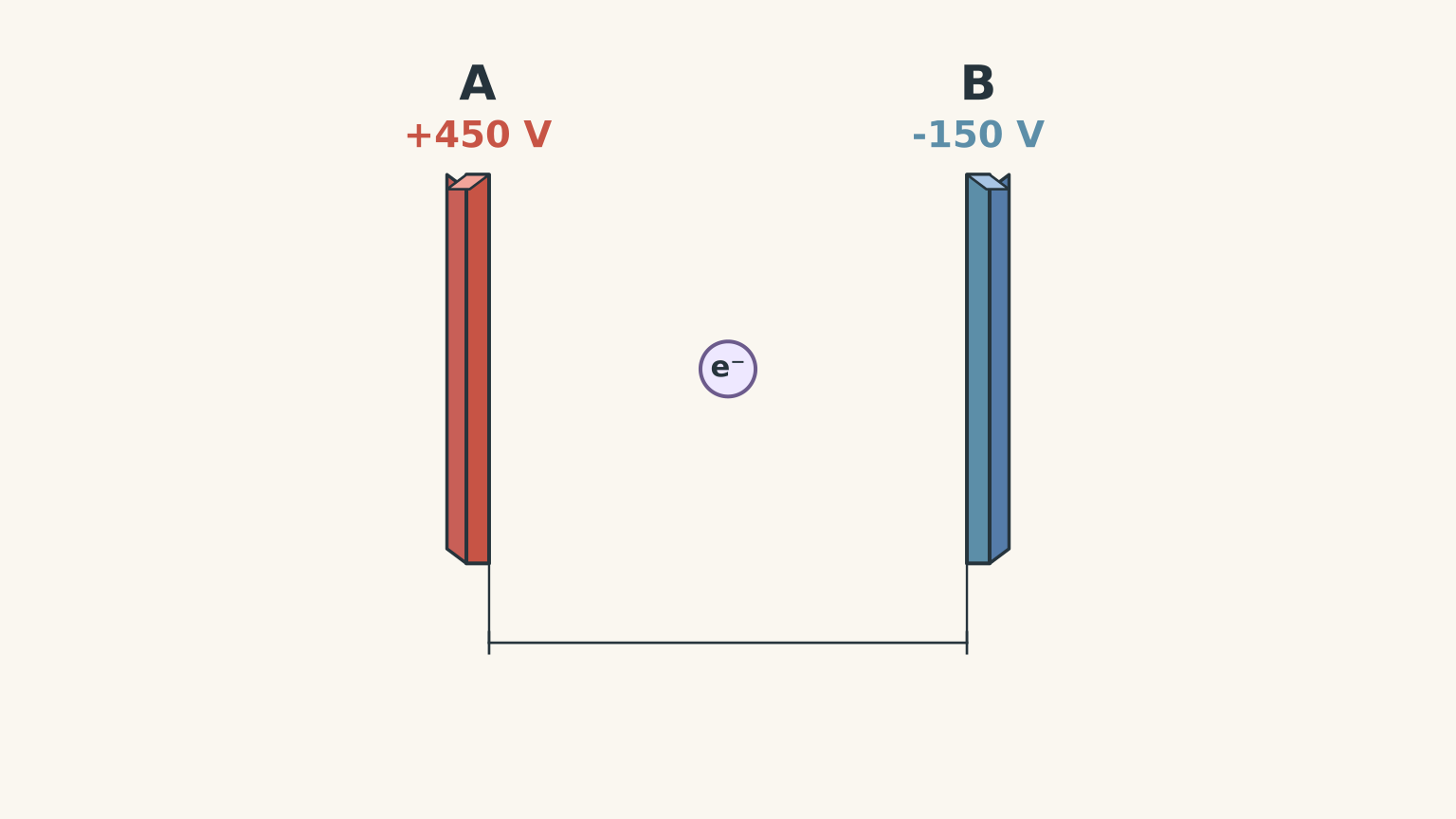
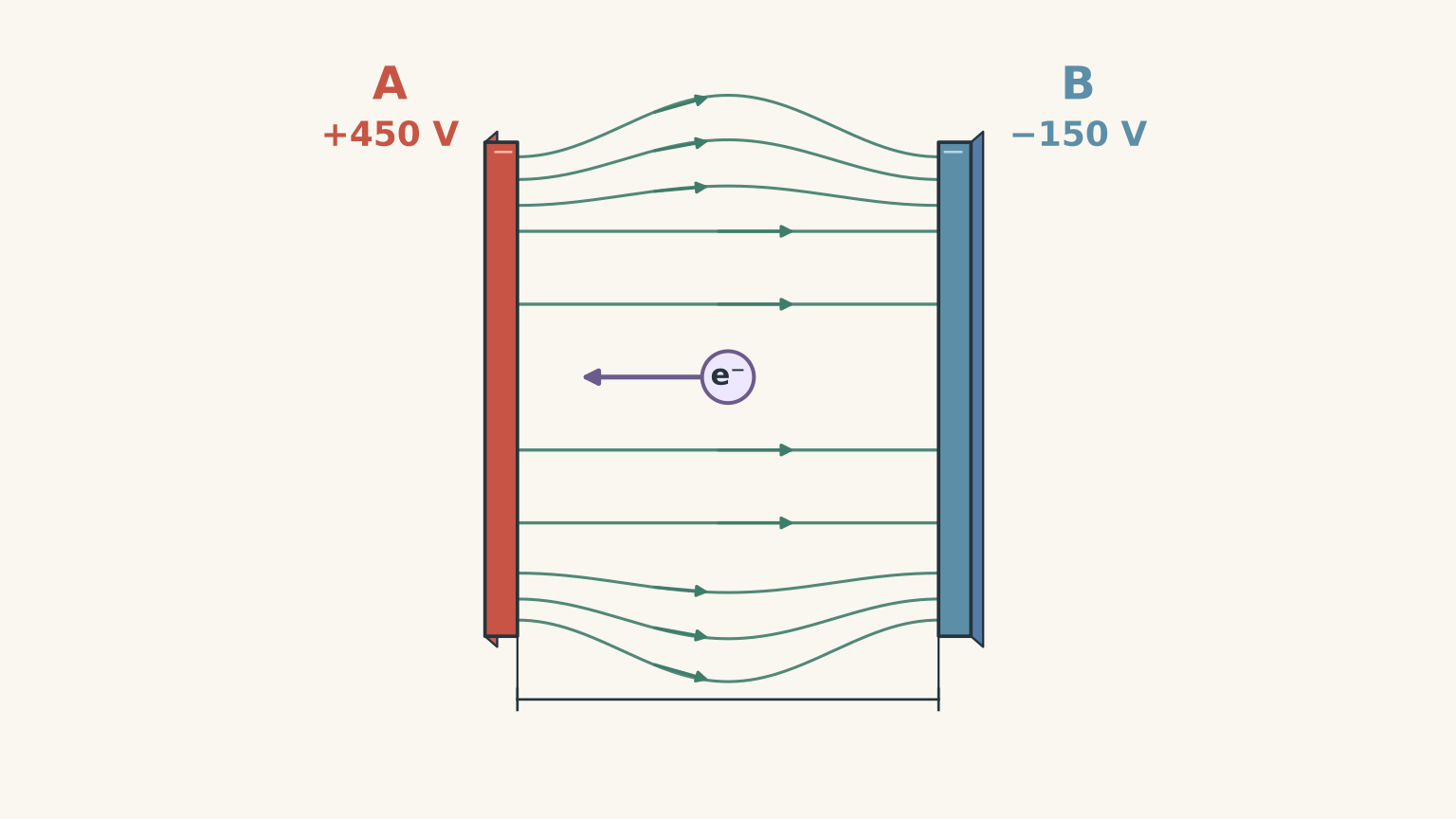
Two large, parallel metal plates are separated by a distance of \(3.0\ \mathrm{cm}\).
Plate A is maintained at an electric potential of \(+450\ \mathrm{V}\), while plate B is maintained at an electric potential of \(-150\ \mathrm{V}\). An electron is positioned halfway between the plates.
Assume the central region between the plates has a uniform electric field.
(a) Calculate the magnitude of the potential difference between the plates and the electric field strength between them. (3 marks)
(b) Determine the magnitude and direction of the electric force acting on the electron. (3 marks)
(c) Explain why the electric field is approximately uniform in the central region between the plates. Describe what happens to the electric field near the edges of the plates. (4 marks)
Question 2 (10 marks)
Two points, P and Q, are located within an electric field.
The electric potential at each point is:
- Point P: \(+320\ \mathrm{V}\)
- Point Q: \(-80\ \mathrm{V}\)
A proton is moved from point P to point Q.
(a) Calculate the potential difference experienced by the proton. (2 marks)
(b) Calculate the change in the proton’s electric potential energy. (2 marks)
(c) Calculate the work done by the electric field on the proton as it moves from P to Q. (2 marks)
(d) An electron is now moved from Q to P.
Calculate the change in the electron’s electric potential energy and the work done by the electric field. Explain why the electron’s potential energy changes in the same direction as the proton’s potential energy in the previous situation, despite the particles having opposite charges. (4 marks)
Question 3 (10 marks)
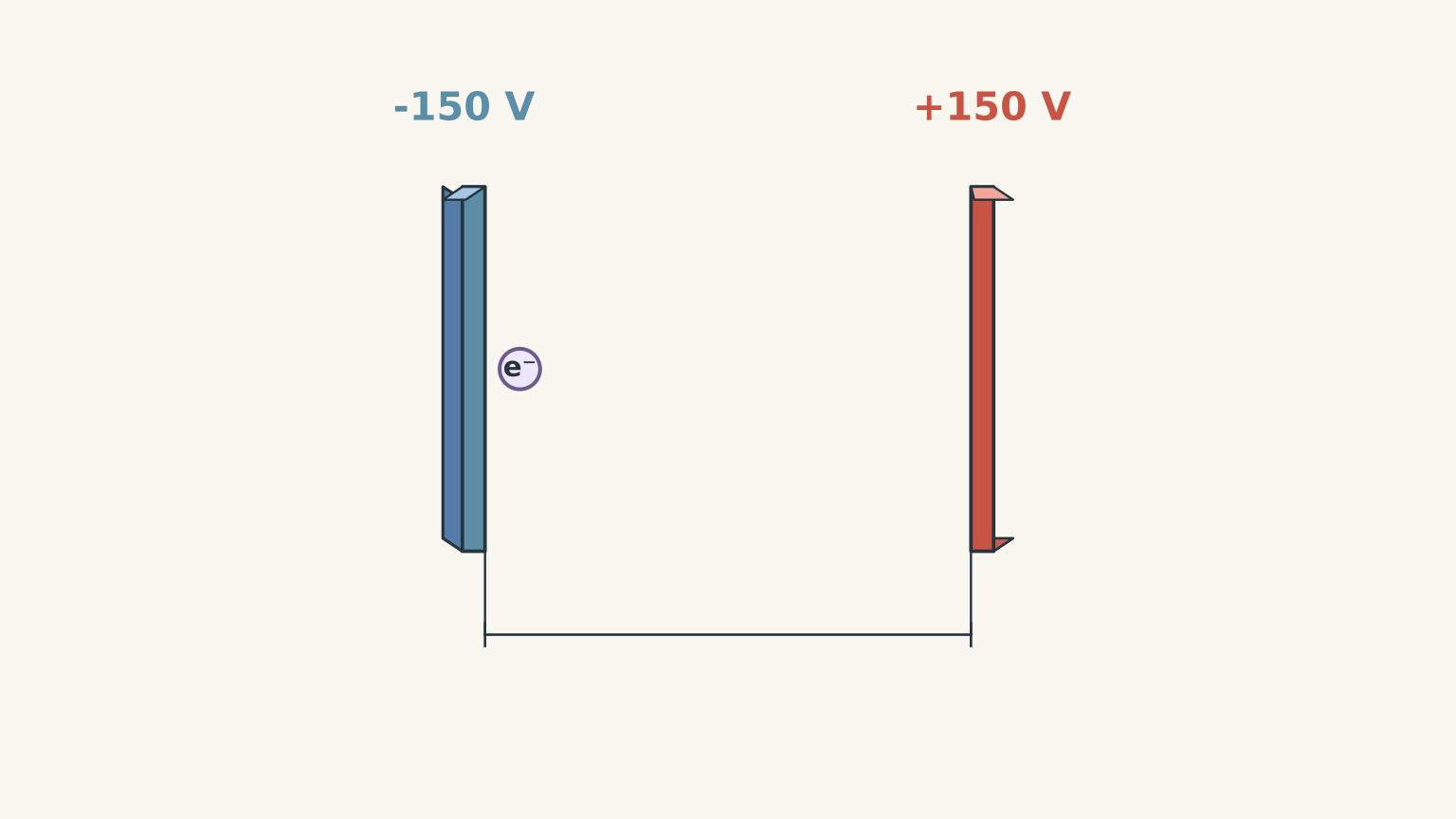
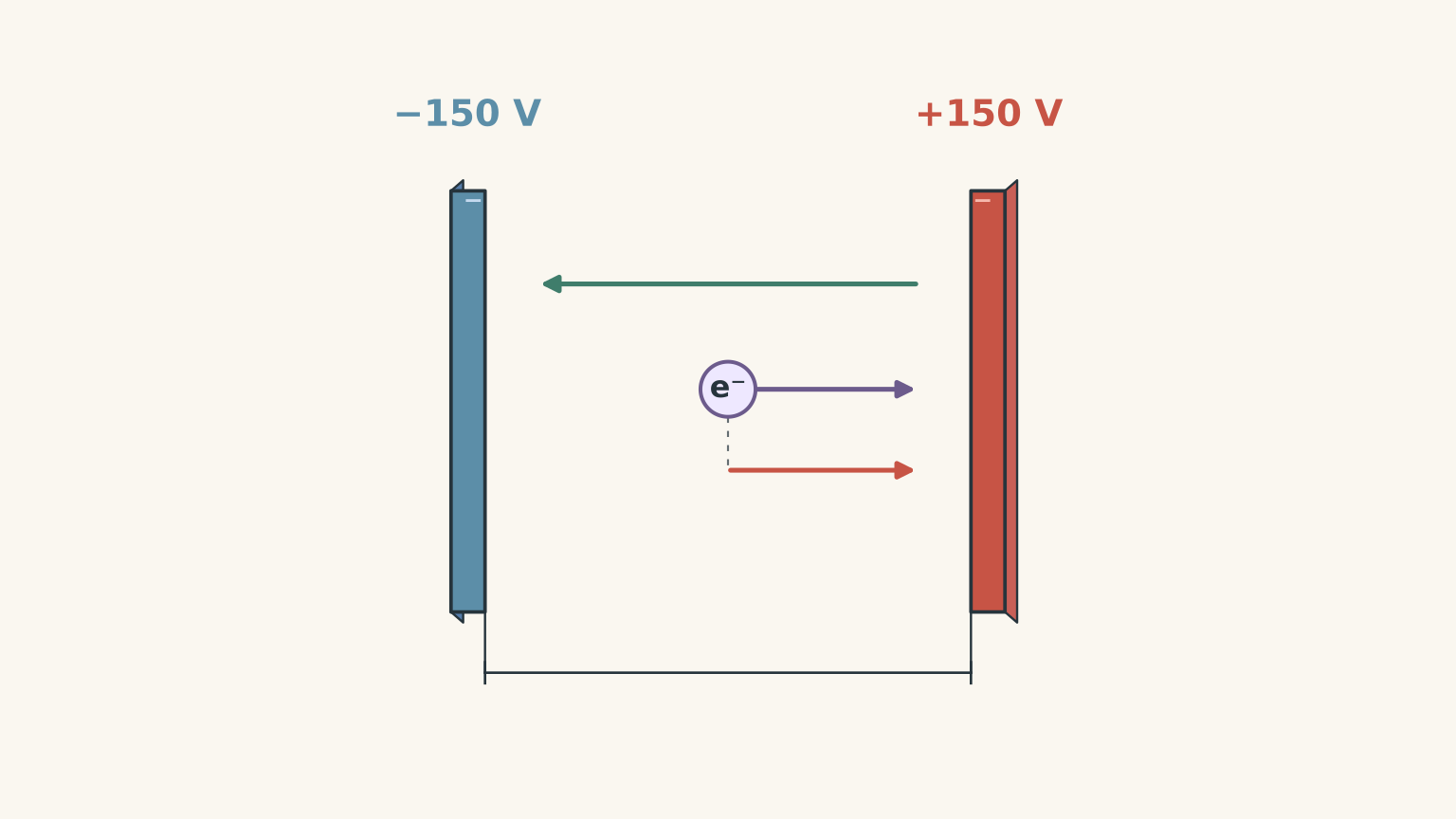
An electron is placed immediately beside the inner surface of the left plate in a parallel-plate arrangement.
The left plate is maintained at \(-150\ \mathrm{V}\), and the right plate is maintained at \(+150\ \mathrm{V}\). The plates are separated by \(2.0\ \mathrm{cm}\).
The electron is released from rest and travels across the gap towards the right plate.
Assume the electric field is uniform throughout the gap.
(a) Calculate the magnitude and direction of the electric field between the plates. (2 marks)
(b) Calculate the magnitude and direction of the electric force acting on the electron. (2 marks)
(c) Determine the magnitude and direction of the electron’s acceleration. (2 marks)
(d) Calculate the electron’s speed immediately before it reaches the right plate. (4 marks)
Question 4 (10 marks)
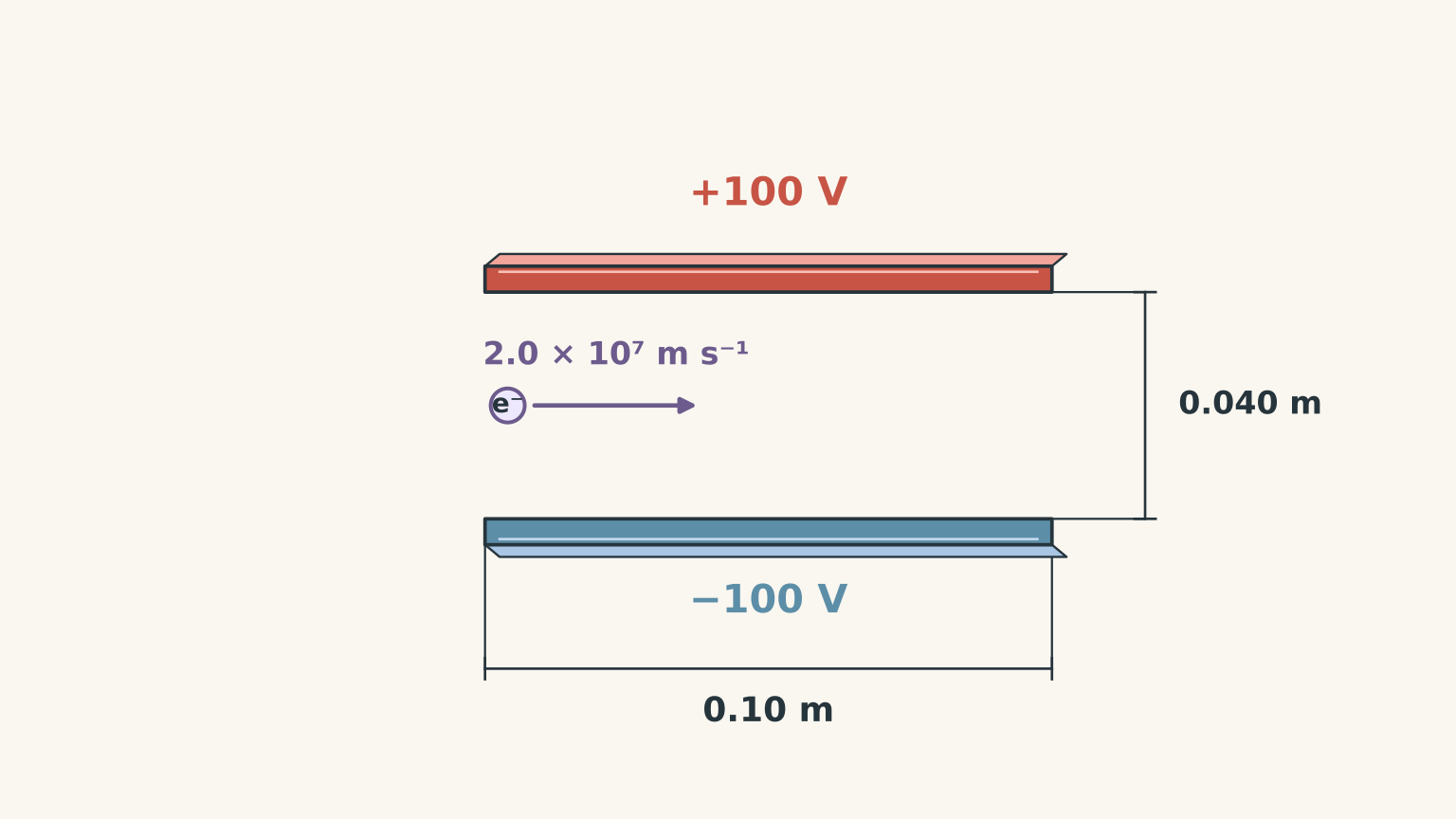
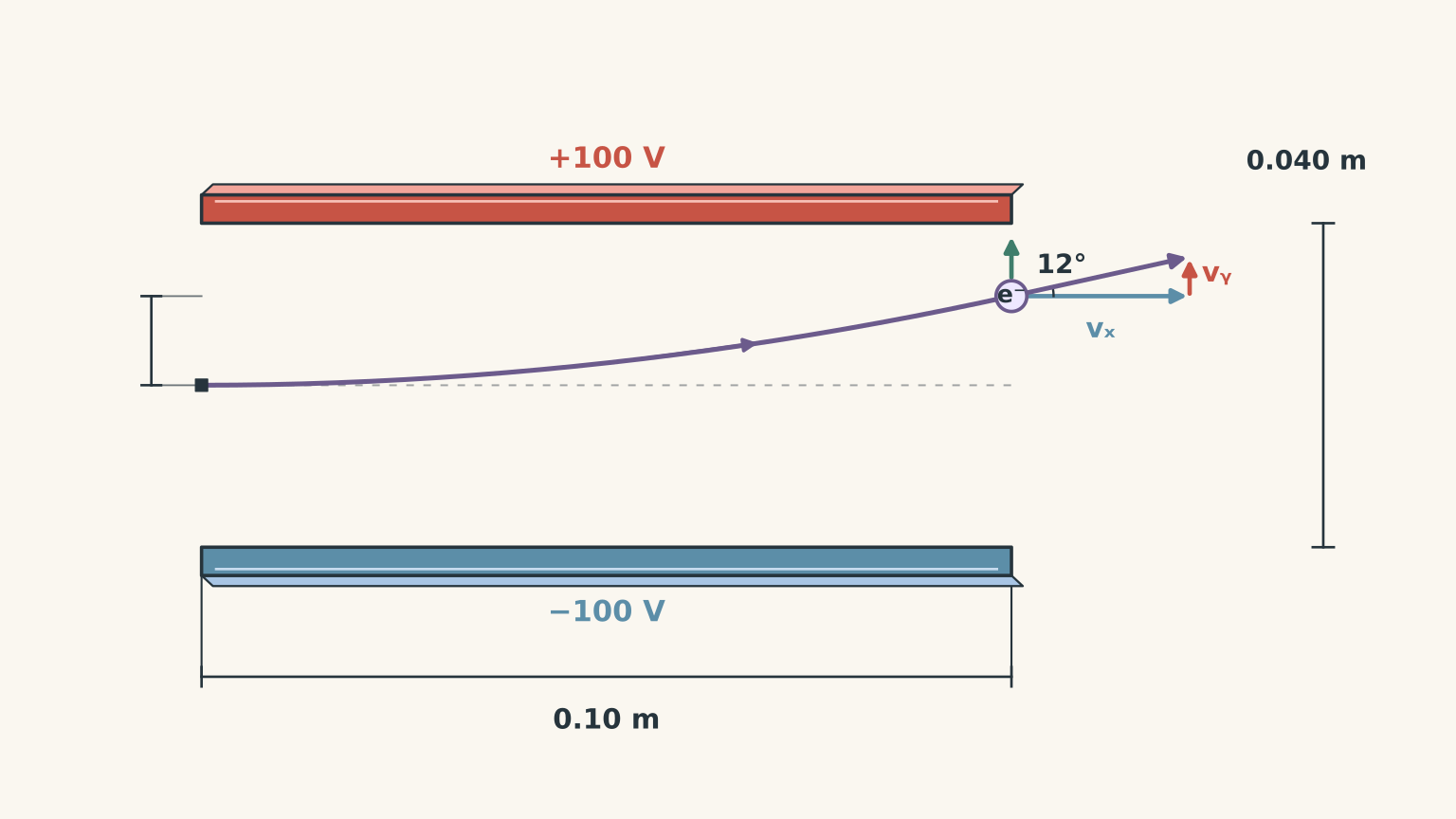
An electron enters the region between two horizontal parallel plates.
The upper plate is maintained at \(+100\ \mathrm{V}\), while the lower plate is maintained at \(-100\ \mathrm{V}\).
The plates have the following dimensions:
- Separation: \(0.040\ \mathrm{m}\)
- Length in the direction of travel: \(0.10\ \mathrm{m}\)
The electron enters halfway between the plates with a horizontal velocity of \(2.0\times10^7\ \mathrm{m\,s^{-1}}\). Its initial vertical velocity is zero.
Assume the electric field is uniform throughout the region between the plates, and ignore fringe effects.
(a) Calculate the magnitude and direction of the electric field between the plates. (2 marks)
(b) Calculate the time the electron spends travelling between the plates. (1 mark)
(c) Calculate the electron’s vertical acceleration and its vertical displacement by the time it reaches the end of the plates. (4 marks)
(d) Describe the shape and direction of the electron’s trajectory. Calculate the angle of its velocity relative to the horizontal as it exits the plates. (3 marks)
Question 5 (10 marks)
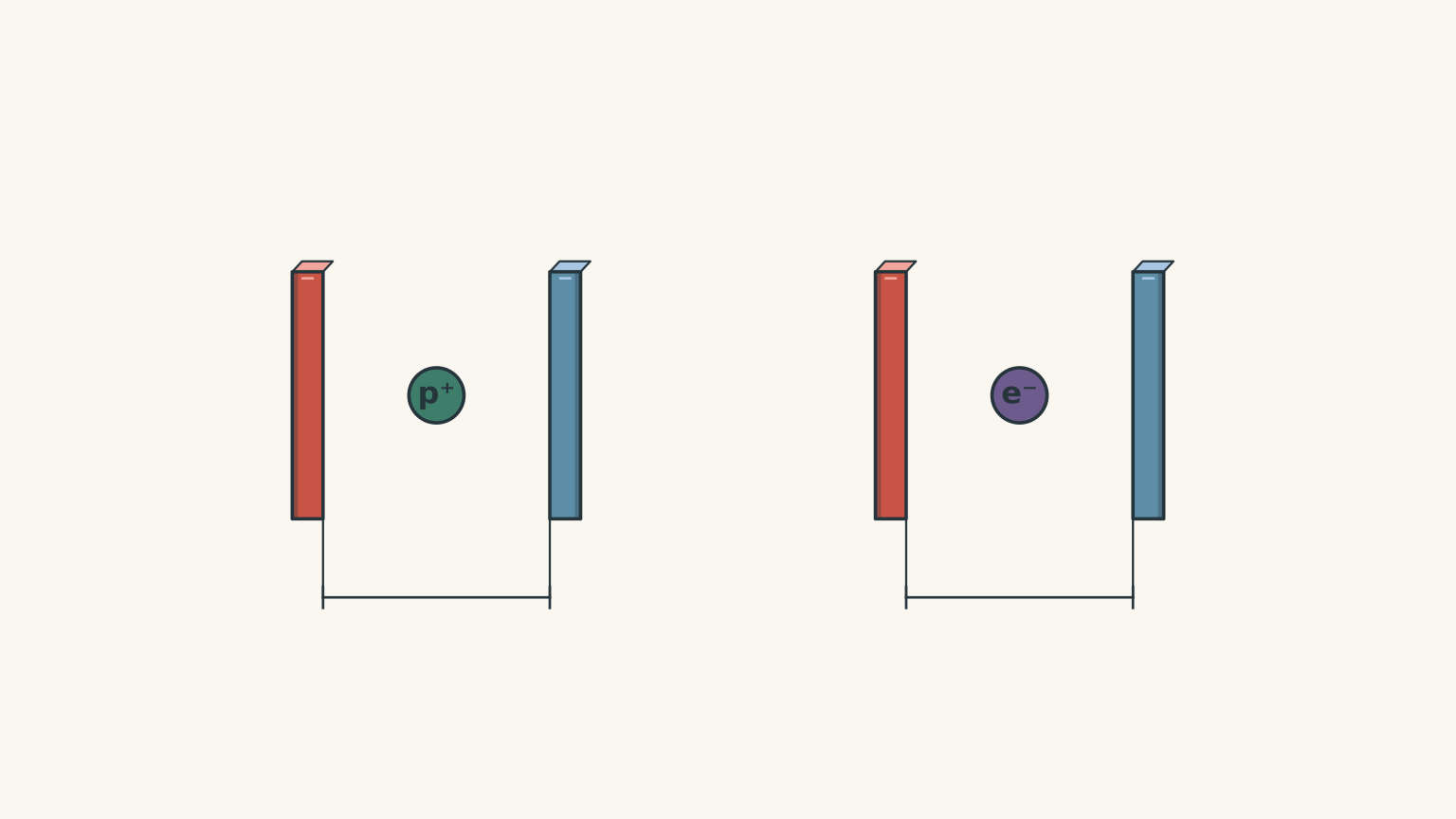
Two identical, separate parallel-plate arrangements each produce a uniform electric field of \(1.8\times10^4\ \mathrm{N\,C^{-1}}\), directed east.
Each arrangement has a plate separation of \(6.0\ \mathrm{cm}\).
A proton is placed at rest halfway between the plates in the first arrangement. An electron is placed at rest halfway between the plates in the second arrangement.
Both particles are released simultaneously. Consider their motion over a time interval of \(2.0\ \mathrm{ns}\).
Assume the field remains uniform over the interval.
(a) Calculate the magnitude of the electric force acting on each particle. State the direction of the force on each particle. (2 marks)
(b) Calculate the magnitude of the acceleration of each particle. Determine the ratio of the electron’s acceleration to the proton’s acceleration. (4 marks)
(c) Calculate the velocity of each particle after \(2.0\ \mathrm{ns}\). Include the direction of each velocity. (2 marks)
(d) Explain why the forces acting on the two particles have equal magnitudes but opposite directions, and why their acceleration magnitudes are different. (2 marks)
03Worked solutions and marking guide
Solution 1
(a) Potential difference and electric field strength
The magnitude of the potential difference is \(600\ \mathrm{V}\), and the electric field strength is \(2.0\times10^4\ \mathrm{V\,m^{-1}}\).
The potential difference is the difference between the potentials of the two plates:
\[ \begin{aligned} |\Delta V| &= |V_B-V_A|\\ &=|-150-450|\\ &=600\ \mathrm{V} \end{aligned} \]
The plate separation is:
\[ d=3.0\ \mathrm{cm}=0.030\ \mathrm{m} \]
For a uniform electric field, the field strength \(E\) is the magnitude of the potential difference divided by the plate separation \(d\):
\[ \begin{aligned} E&=\frac{|\Delta V|}{d}\\ &=\frac{600}{0.030}\\ &=2.0\times10^4\ \mathrm{V\,m^{-1}} \end{aligned} \]
Answer:
\[ \boxed{E=2.0\times10^4\ \mathrm{V\,m^{-1}}} \]
(b) Electric force on the electron
The magnitude of the force is \(3.2\times10^{-15}\ \mathrm{N}\), directed towards plate A.
The electric field points from the positive plate towards the negative plate. Therefore, it points from A towards B.
The electric force \(F\) on a charge is related to its charge \(q\) and the electric field strength \(E\):
\[ F=|q|E \]
Using the elementary charge magnitude:
\[ \begin{aligned} F&=(1.60\times10^{-19})(2.0\times10^4)\\ &=3.2\times10^{-15}\ \mathrm{N} \end{aligned} \]
An electron has a negative charge, so its force acts in the opposite direction to the electric field.
Therefore, the force acts towards plate A.
Answer:
\[ \boxed{F=3.2\times10^{-15}\ \mathrm{N}} \]
Direction: towards plate A.
(c) Uniform fields and edge effects
The electric field is approximately uniform in the central region because the plates are large and parallel, with a relatively small separation.
In this central region:
- Electric field lines are approximately straight.
- Field lines are parallel to each other.
- The spacing between field lines is approximately constant.
These features indicate that both the direction and magnitude of the electric field remain approximately constant.
Near the plate edges, the field becomes non-uniform. This is due to fringing effects.
The electric field lines curve outwards near the edges rather than remaining straight and parallel. Their spacing and direction change, so the field strength and direction are no longer constant.
Marking guide
| Part | Required working or idea | Marks |
|---|---|---|
| (a) | Correct potential difference of 600 V | 1 |
| (a) | Converts plate separation to 0.030 m | 1 |
| (a) | Correct electric field calculation and unit | 1 |
| (b) | Uses \(F=|q|E\) | 1 |
| (b) | Correct force magnitude | 1 |
| (b) | Correct direction, towards A | 1 |
| (c) | Explains why the central field is approximately uniform | 2 |
| (c) | Explains the curvature and variation of the field near the edges | 2 |
| Total | 10 |
Solution 2
(a) Potential difference experienced by the proton
The potential difference is \(-400\ \mathrm{V}\).
Potential difference is calculated as final potential minus initial potential:
\[ \begin{aligned} \Delta V&=V_f-V_i\\ &=V_Q-V_P\\ &=-80-320\\ &=-400\ \mathrm{V} \end{aligned} \]
The negative sign indicates that the proton moves to a region of lower electric potential.
Answer:
\[ \boxed{\Delta V=-400\ \mathrm{V}} \]
(b) Change in electric potential energy
The proton’s electric potential energy decreases by \(6.4\times10^{-17}\ \mathrm{J}\).
The change in electric potential energy \(\Delta U\) is related to the particle’s charge \(q\) and the potential difference:
\[ \Delta U=q\Delta V \]
A proton has a positive charge of \(+1.60\times10^{-19}\ \mathrm{C}\).
Substituting:
\[ \begin{aligned} \Delta U&=(1.60\times10^{-19})(-400)\\ &=-6.4\times10^{-17}\ \mathrm{J} \end{aligned} \]
The negative result means the proton loses electric potential energy.
Answer:
\[ \boxed{\Delta U=-6.4\times10^{-17}\ \mathrm{J}} \]
(c) Work done by the electric field
The electric field does \(6.4\times10^{-17}\ \mathrm{J}\) of positive work on the proton.
The work \(W_{\mathrm{field}}\) done by the electric field is the negative of the change in electric potential energy:
\[ W_{\mathrm{field}}=-\Delta U \]
Therefore:
\[ \begin{aligned} W_{\mathrm{field}}&=-(-6.4\times10^{-17})\\ &=+6.4\times10^{-17}\ \mathrm{J} \end{aligned} \]
The positive sign means the electric field transfers energy to the proton.
Answer:
\[ \boxed{W_{\mathrm{field}}=+6.4\times10^{-17}\ \mathrm{J}} \]
(d) Electron moving from Q to P
The electron’s electric potential energy also decreases by \(6.4\times10^{-17}\ \mathrm{J}\).
First, calculate the potential difference for the electron:
\[ \begin{aligned} \Delta V&=V_P-V_Q\\ &=320-(-80)\\ &=+400\ \mathrm{V} \end{aligned} \]
The electron has a charge of \(-1.60\times10^{-19}\ \mathrm{C}\).
Therefore:
\[ \begin{aligned} \Delta U&=q\Delta V\\ &=(-1.60\times10^{-19})(400)\\ &=-6.4\times10^{-17}\ \mathrm{J} \end{aligned} \]
The work done by the electric field is:
\[ \begin{aligned} W_{\mathrm{field}}&=-\Delta U\\ &=+6.4\times10^{-17}\ \mathrm{J} \end{aligned} \]
The key idea is that electric potential energy depends on both the charge and the electric potential.
For the proton, the charge is positive, so moving to a lower potential decreases its potential energy.
For the electron, the charge is negative, so moving to a higher potential decreases its potential energy.
Both particles move in the direction of their respective electric forces. Consequently, the electric field does positive work on both particles.
Answer:
\[ \boxed{\Delta U=-6.4\times10^{-17}\ \mathrm{J}} \]
\[ \boxed{W_{\mathrm{field}}=+6.4\times10^{-17}\ \mathrm{J}} \]
Marking guide
| Part | Required working or idea | Marks |
|---|---|---|
| (a) | Uses final potential minus initial potential | 1 |
| (a) | Correct signed potential difference | 1 |
| (b) | Uses \(\Delta U=q\Delta V\) | 1 |
| (b) | Correct signed energy change | 1 |
| (c) | Correct relationship between work and energy change | 1 |
| (c) | Correct positive work value | 1 |
| (d) | Correct potential difference for Q to P | 1 |
| (d) | Correct electron potential energy change | 1 |
| (d) | Correct work done by the electric field | 1 |
| (d) | Explains the effect of the negative charge on the energy change | 1 |
| Total | 10 |
Solution 3
(a) Electric field between the plates
The electric field strength is \(1.5\times10^4\ \mathrm{V\,m^{-1}}\), directed towards the left plate.
The magnitude of the potential difference is:
\[ \begin{aligned} |\Delta V|&=|150-(-150)|\\ &=300\ \mathrm{V} \end{aligned} \]
Convert the plate separation into metres:
\[ d=2.0\ \mathrm{cm}=0.020\ \mathrm{m} \]
Calculate the electric field strength:
\[ \begin{aligned} E&=\frac{|\Delta V|}{d}\\ &=\frac{300}{0.020}\\ &=1.5\times10^4\ \mathrm{V\,m^{-1}} \end{aligned} \]
The electric field points from the positive plate to the negative plate.
Since the right plate is positive and the left plate is negative, the field points towards the left.
Answer:
\[ \boxed{E=1.5\times10^4\ \mathrm{V\,m^{-1}}} \]
Direction: towards the left plate.
(b) Electric force on the electron
The force magnitude is \(2.4\times10^{-15}\ \mathrm{N}\), directed towards the right plate.
Using the relationship between electric force and field strength:
\[ F=|q|E \]
\[ \begin{aligned} F&=(1.60\times10^{-19})(1.5\times10^4)\\ &=2.4\times10^{-15}\ \mathrm{N} \end{aligned} \]
The electron is negatively charged, so its force acts opposite to the electric field.
The field points left, so the force on the electron points right, towards the positive plate.
Answer:
\[ \boxed{F=2.4\times10^{-15}\ \mathrm{N}} \]
Direction: towards the right plate.
(c) Electron acceleration
The electron’s acceleration is approximately \(2.6\times10^{15}\ \mathrm{m\,s^{-2}}\), directed towards the right plate.
Newton’s second law relates force \(F\), mass \(m\), and acceleration \(a\):
\[ F=ma \]
Rearranging:
\[ a=\frac{F}{m} \]
Using the electron mass:
\[ \begin{aligned} a&=\frac{2.4\times10^{-15}}{9.11\times10^{-31}}\\ &=2.63\times10^{15}\ \mathrm{m\,s^{-2}} \end{aligned} \]
The acceleration is in the same direction as the net force.
Therefore, it points towards the right plate.
Answer:
\[ \boxed{a=2.6\times10^{15}\ \mathrm{m\,s^{-2}}} \]
Direction: towards the right plate.
(d) Final speed of the electron
The electron reaches the right plate with a speed of approximately \(1.0\times10^7\ \mathrm{m\,s^{-1}}\).
The electron moves from a potential of \(-150\ \mathrm{V}\) to \(+150\ \mathrm{V}\).
Therefore:
\[ \Delta V=+300\ \mathrm{V} \]
Its change in electric potential energy is:
\[ \begin{aligned} \Delta U&=q\Delta V\\ &=(-1.60\times10^{-19})(300)\\ &=-4.80\times10^{-17}\ \mathrm{J} \end{aligned} \]
The electron loses electric potential energy.
Since the electric field does positive work, this lost potential energy becomes kinetic energy.
The electron starts from rest, so its initial kinetic energy is zero.
Therefore:
\[ \Delta K=-\Delta U \]
\[ K_f=4.80\times10^{-17}\ \mathrm{J} \]
Kinetic energy is related to mass \(m\) and speed \(v\) by:
\[ K=\frac{1}{2}mv^2 \]
Rearranging for speed:
\[ v=\sqrt{\frac{2K}{m}} \]
Substituting:
\[ \begin{aligned} v&=\sqrt{\frac{2(4.80\times10^{-17})} {9.11\times10^{-31}}}\\ &=1.03\times10^7\ \mathrm{m\,s^{-1}} \end{aligned} \]
Answer:
\[ \boxed{v=1.0\times10^7\ \mathrm{m\,s^{-1}}} \]
The electron accelerates towards the positive plate, converting electric potential energy into kinetic energy.
Marking guide
| Part | Required working or idea | Marks |
|---|---|---|
| (a) | Correct electric field magnitude | 1 |
| (a) | Correct field direction | 1 |
| (b) | Correct force magnitude | 1 |
| (b) | Correct force direction, opposite to the field | 1 |
| (c) | Uses \(a=F/m_e\) | 1 |
| (c) | Correct acceleration magnitude and direction | 1 |
| (d) | Correct signed change in potential energy or equivalent energy gain | 1 |
| (d) | Correct relationship between electric potential energy and kinetic energy | 1 |
| (d) | Correct substitution into the kinetic energy equation | 1 |
| (d) | Correct final speed with units | 1 |
| Total | 10 |
Solution 4
(a) Electric field between the plates
The electric field strength is \(5.0\times10^3\ \mathrm{V\,m^{-1}}\), directed downwards.
The magnitude of the potential difference is:
\[ \begin{aligned} |\Delta V|&=|100-(-100)|\\ &=200\ \mathrm{V} \end{aligned} \]
The plate separation is:
\[ d=0.040\ \mathrm{m} \]
Using the uniform field equation:
\[ \begin{aligned} E&=\frac{|\Delta V|}{d}\\ &=\frac{200}{0.040}\\ &=5.0\times10^3\ \mathrm{V\,m^{-1}} \end{aligned} \]
The electric field points from the positive plate to the negative plate.
Since the upper plate is positive and the lower plate is negative, the field points downwards.
Answer:
\[ \boxed{E=5.0\times10^3\ \mathrm{V\,m^{-1}}} \]
Direction: vertically downwards.
(b) Time spent between the plates
The electron spends \(5.0\times10^{-9}\ \mathrm{s}\) between the plates.
The horizontal distance travelled is the plate length:
\[ L=0.10\ \mathrm{m} \]
The horizontal velocity \(v_x\) remains constant because the electric force acts vertically, not horizontally.
Time is calculated using:
\[ t=\frac{\text{distance}}{\text{speed}} \]
Therefore:
\[ \begin{aligned} t&=\frac{L}{v_x}\\ &=\frac{0.10}{2.0\times10^7}\\ &=5.0\times10^{-9}\ \mathrm{s} \end{aligned} \]
Answer:
\[ \boxed{t=5.0\times10^{-9}\ \mathrm{s}} \]
(c) Vertical acceleration and displacement
The electron accelerates upwards at \(8.8\times10^{14}\ \mathrm{m\,s^{-2}}\), reaching a vertical displacement of approximately \(0.011\ \mathrm{m}\) upwards.
First, calculate the magnitude of the electric force:
\[ \begin{aligned} F&=|q|E\\ &=(1.60\times10^{-19})(5.0\times10^3)\\ &=8.0\times10^{-16}\ \mathrm{N} \end{aligned} \]
The electric field points downwards, but the electron is negatively charged.
Therefore, the electric force acts upwards.
Using Newton’s second law:
\[ a_y=\frac{F}{m_e} \]
\[ \begin{aligned} a_y&=\frac{8.0\times10^{-16}}{9.11\times10^{-31}}\\ &=8.78\times10^{14}\ \mathrm{m\,s^{-2}} \end{aligned} \]
The vertical acceleration \(a_y\) is constant because the electric field is uniform.
The electron’s initial vertical velocity is zero.
Therefore, its vertical displacement \(y\) can be calculated using:
\[ y=u_yt+\frac{1}{2}a_yt^2 \]
Here, \(u_y=0\), so:
\[ y=\frac{1}{2}a_yt^2 \]
Substituting:
\[ \begin{aligned} y&=\frac{1}{2}(8.78\times10^{14}) (5.0\times10^{-9})^2\\ &=0.01098\ \mathrm{m} \end{aligned} \]
Answer:
\[ \boxed{a_y=8.8\times10^{14}\ \mathrm{m\,s^{-2}}} \]
\[ \boxed{y=0.011\ \mathrm{m}\text{ upwards}} \]
The electron is displaced upwards by approximately \(1.1\ \mathrm{cm}\).
It does not strike the upper plate. The electron starts halfway between the plates, so it has \(2.0\ \mathrm{cm}\) of clearance above its starting position.
(d) Trajectory and exit velocity
The electron follows a parabolic trajectory, curving upwards.
This happens because the horizontal velocity remains constant while the vertical velocity increases due to constant upward acceleration.
To calculate the exit angle, first determine the vertical component of the electron’s velocity.
Using:
\[ v_y=u_y+a_yt \]
Since the initial vertical velocity is zero:
\[ \begin{aligned} v_y&=(8.78\times10^{14})(5.0\times10^{-9})\\ &=4.39\times10^6\ \mathrm{m\,s^{-1}} \end{aligned} \]
The horizontal velocity remains:
\[ v_x=2.0\times10^7\ \mathrm{m\,s^{-1}} \]
The angle \(\theta\) above the horizontal is:
\[ \tan\theta=\frac{v_y}{v_x} \]
Therefore:
\[ \begin{aligned} \theta&=\tan^{-1}\left( \frac{4.39\times10^6}{2.0\times10^7} \right)\\ &=12.4^\circ \end{aligned} \]
Answer:
\[ \boxed{\theta\approx12^\circ} \]
The electron exits travelling approximately \(12^\circ\) above the horizontal.
Marking guide
| Part | Required working or idea | Marks |
|---|---|---|
| (a) | Correct electric field magnitude | 1 |
| (a) | Correct downward field direction | 1 |
| (b) | Correct time calculation and answer | 1 |
| (c) | Correct electric force magnitude and direction | 1 |
| (c) | Correct vertical acceleration | 1 |
| (c) | Uses the vertical displacement equation | 1 |
| (c) | Correct vertical displacement and direction | 1 |
| (d) | Identifies the upward-curving parabolic trajectory | 1 |
| (d) | Correct vertical exit velocity calculation | 1 |
| (d) | Correct exit angle and direction | 1 |
| Total | 10 |
Solution 5
(a) Electric force on each particle
Both particles experience an electric force of magnitude \(2.88\times10^{-15}\ \mathrm{N}\).
However, the force directions are opposite.
The electric field points east, which is to the right in this question.
The electric force magnitude is:
\[ F=|q|E \]
Both particles have the same charge magnitude:
\[ |q|=1.60\times10^{-19}\ \mathrm{C} \]
Therefore:
\[ \begin{aligned} F&=(1.60\times10^{-19})(1.8\times10^4)\\ &=2.88\times10^{-15}\ \mathrm{N} \end{aligned} \]
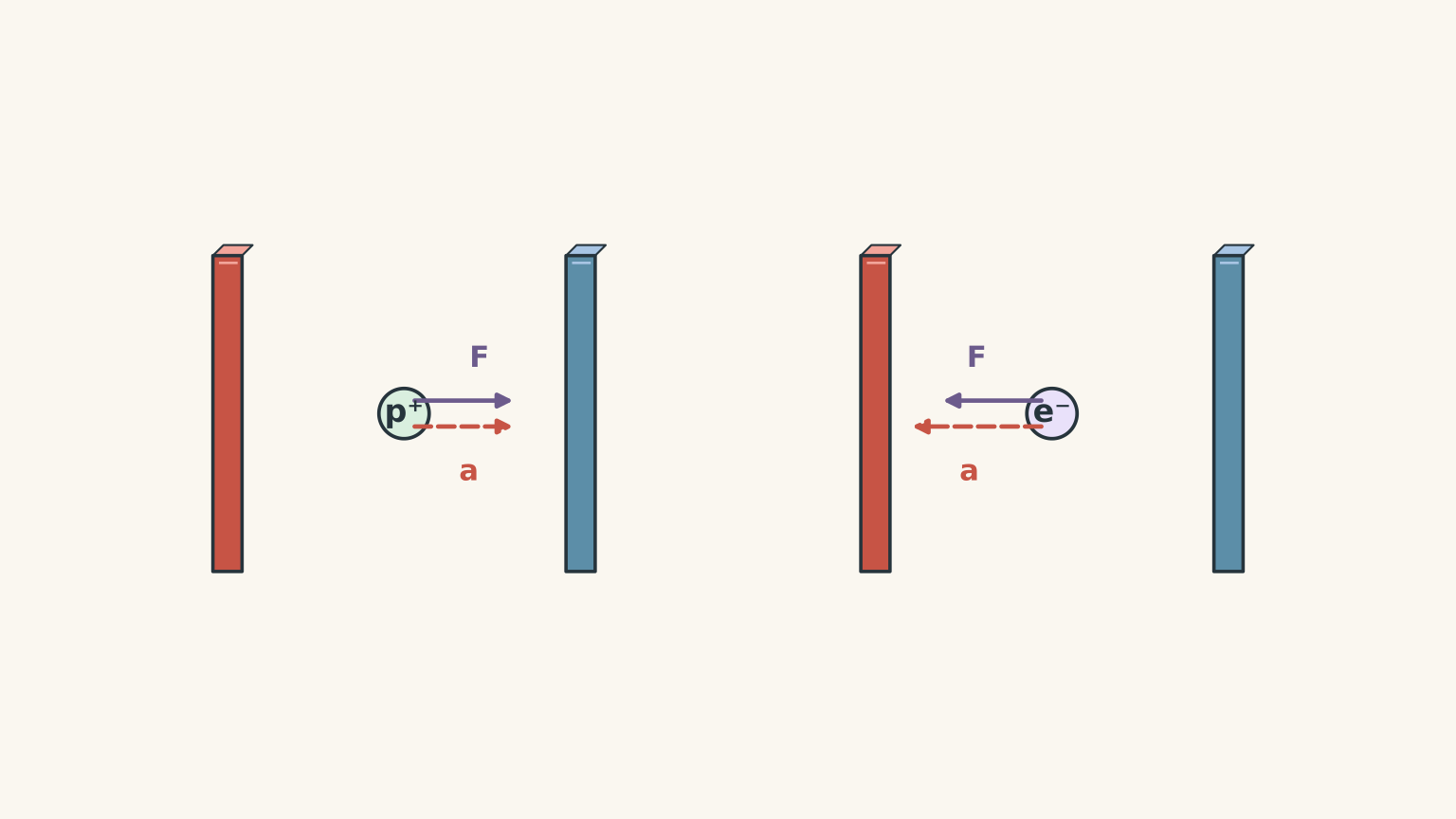
A proton is positively charged, so its force acts in the same direction as the electric field.
An electron is negatively charged, so its force acts in the opposite direction.
Answer:
| Particle | Force magnitude | Force direction |
|---|---|---|
| Proton | \(2.88\times10^{-15}\ \mathrm{N}\) | East |
| Electron | \(2.88\times10^{-15}\ \mathrm{N}\) | West |
(b) Acceleration of each particle
The electron’s acceleration is approximately \(3.2\times10^{15}\ \mathrm{m\,s^{-2}}\), while the proton’s acceleration is approximately \(1.7\times10^{12}\ \mathrm{m\,s^{-2}}\).
Newton’s second law gives:
\[ a=\frac{F}{m} \]
For the electron:
\[ \begin{aligned} a_e&=\frac{2.88\times10^{-15}} {9.11\times10^{-31}}\\ &=3.16\times10^{15}\ \mathrm{m\,s^{-2}} \end{aligned} \]
Its acceleration is directed west, because its force is directed west.
For the proton:
\[ \begin{aligned} a_p&=\frac{2.88\times10^{-15}} {1.67\times10^{-27}}\\ &=1.72\times10^{12}\ \mathrm{m\,s^{-2}} \end{aligned} \]
Its acceleration is directed east.
To compare their acceleration magnitudes, calculate the ratio:
\[ \frac{a_e}{a_p} = \frac{3.16\times10^{15}} {1.72\times10^{12}} \]
\[ \boxed{\frac{a_e}{a_p}\approx1.8\times10^3} \]
The electron accelerates approximately 1,800 times faster than the proton.
Answer:
\[ \boxed{a_e=3.2\times10^{15}\ \mathrm{m\,s^{-2}}} \]
\[ \boxed{a_p=1.7\times10^{12}\ \mathrm{m\,s^{-2}}} \]
The electron’s acceleration magnitude is approximately 1,800 times greater.
(c) Velocity after \(2.0\ \mathrm{ns}\)
The electron reaches a velocity of \(6.3\times10^6\ \mathrm{m\,s^{-1}}\) west, while the proton reaches \(3.4\times10^3\ \mathrm{m\,s^{-1}}\) east.
Both particles start from rest and experience constant acceleration.
The relationship between final velocity \(v\), acceleration \(a\), and time \(t\) is:
\[ v=u+at \]
Since both initial velocities \(u\) are zero:
\[ v=at \]
Convert the time into seconds:
\[ t=2.0\ \mathrm{ns}=2.0\times10^{-9}\ \mathrm{s} \]
For the electron:
\[ \begin{aligned} v_e&=(3.16\times10^{15})(2.0\times10^{-9})\\ &=6.32\times10^6\ \mathrm{m\,s^{-1}} \end{aligned} \]
Its velocity is directed west.
For the proton:
\[ \begin{aligned} v_p&=(1.72\times10^{12})(2.0\times10^{-9})\\ &=3.44\times10^3\ \mathrm{m\,s^{-1}} \end{aligned} \]
Its velocity is directed east.
Answer:
\[ \boxed{v_e=6.3\times10^6\ \mathrm{m\,s^{-1}}\text{ west}} \]
\[ \boxed{v_p=3.4\times10^3\ \mathrm{m\,s^{-1}}\text{ east}} \]
(d) Comparing the particles
The force magnitudes are equal because both particles have the same charge magnitude and experience the same electric field strength.
The force directions are opposite because the proton is positively charged, whereas the electron is negatively charged.
Their acceleration magnitudes differ because acceleration depends on both force and mass:
\[ a=\frac{F}{m} \]
Both particles experience the same force magnitude, but the electron has a much smaller mass.
Consequently, the electron experiences a much greater acceleration.
The acceleration ratio is approximately 1,800, matching the inverse ratio of their masses.
Marking guide
| Part | Required working or idea | Marks |
|---|---|---|
| (a) | Correct force magnitude for both particles | 1 |
| (a) | Correct force directions for proton and electron | 1 |
| (b) | Uses \(a=F/m\) | 1 |
| (b) | Correct electron acceleration | 1 |
| (b) | Correct proton acceleration | 1 |
| (b) | Correct acceleration ratio | 1 |
| (c) | Correct electron velocity and direction | 1 |
| (c) | Correct proton velocity and direction | 1 |
| (d) | Explains equal force magnitudes and opposite directions using charge magnitude and sign | 1 |
| (d) | Explains different accelerations using the particles’ different masses | 1 |
| Total | 10 |
04Final mark summary
| Question | Topic | Marks |
|---|---|---|
| 1 | Electric field strength, force and edge effects | 10 |
| 2 | Electric potential energy and work | 10 |
| 3 | Electron acceleration and energy conversion | 10 |
| 4 | Charged-particle trajectory in a uniform field | 10 |
| 5 | Comparing proton and electron motion | 10 |
| Total | 50 |
Marking notes: Award method marks for correct physical principles and substitutions, even when an earlier arithmetic error affects a later answer. Apply follow-through where the subsequent working is consistent with the student’s earlier result. Accept mathematically equivalent approaches and reasonable rounding.
The paper assesses the supplied electric potential and charged-particle motion scope only. It should be used as a focused revision assessment, rather than as a measure of performance across the entire HSC Physics course.